Leandro Miguel Velasco (Colombian, 1933–), The Transfiguration of the Lord. Mural, Great Upper Church Sacristy, Basilica of the National Shrine of the Immaculate Conception, Washington, DC. Photo: Fr. Lawrence Lew, OP.
And after six days Jesus took with him Peter and James, and John his brother, and led them up a high mountain by themselves. And he was transfigured before them, and his face shone like the sun, and his clothes became white as light. And behold, there appeared to them Moses and Elijah, talking with him. And Peter said to Jesus, “Lord, it is good that we are here. If you wish, I will make three tents here, one for you and one for Moses and one for Elijah.” He was still speaking when, behold, a bright cloud overshadowed them, and a voice from the cloud said, “This is my beloved Son, with whom I am well pleased; listen to him.” When the disciples heard this, they fell on their faces and were terrified. But Jesus came and touched them, saying, “Rise, and have no fear.” And when they lifted up their eyes, they saw no one but Jesus only.
And as they were coming down the mountain, Jesus commanded them, “Tell no one the vision, until the Son of Man is raised from the dead.”
—Matthew 17:1–9
In the artwork above, Moses is shown on the left holding the Ten Commandments and representing the law, and Elijah, on the right, holds a scroll, representing the prophets; Jesus stands in the center, the fulfillment of both. The painted inscription inside the picture is, of course, Peter’s words to Jesus in Matthew 17:4. The carved inscription below, however, comes from an earlier passage in Matthew’s Gospel, 13:16–17, where Jesus says to his disciples, “Blessed are your eyes, for they see, and your ears, for they hear.For truly, I say to you, many prophets and righteous people longed to see what you see, and did not see it, and to hear what you hear, and did not hear it.”
This is one of several paintings by Leandro Miguel Velasco located in the sacristy of the Basilica of the National Shrine of the Immaculate Conception in Washington, DC. (He also designed, in 2006–7, the church’s Incarnation and Redemption dome mosaics, in a much different style.) The sacristy is the room where the priest and attendants vest and prepare before the service, and where they return their vestments and used liturgical vessels afterward. It is not accessible to the general public.
+++
SONG: “Transfiguration Hymn” | Words adapted by Jeffrey Cooper from the Collect of the Feast of the Transfiguration | Music by J.J. Wright | Performed by the J.J. Wright Trio (J.J. Wright on piano, Ike Sturm on bass, and Nate Wood on drums) and vocalists Sharon Harms and Ashley Daneman on Vespers for the Feast of the Transfiguration (2017)
Seeing your glory in the face of your Son,
Hearing his words, and knowing what he has done,
Now we pray that just what we behold
In him we may become.
That, as the prophets spoke in days long before,
We may be heirs through faith with him we adore:
With the Spirit and with you he reigns
Now and forevermore.
Find the full program of J.J. Wright’s Jazz Vespers service for the feast of the Transfiguration, including a lead sheet for this song and others, at http://www.transfigurationvespers.com/program.
This post belongs to the weekly series Artful Devotion. If you can’t view the music player in your email or RSS reader, try opening the post in your browser.
To view all the Revised Common Lectionary scripture readings for Transfiguration Sunday, cycle A, click here.
Published in 1990 by Liturgy Training Publications, A Lent Sourcebook: The Forty Days is an anthology of hymns, poems, prayers, homilies, and reflections gathered from ancient and modern sources on a variety of Lenten themes, interspersed with scripture passages. The thousand-plus entries were compiled and edited by J. Robert Baker, Evelyn Kaehler, and Peter Mazar, with additional compilation help from James P. Barron, OP; Thomas Cademartrie; Elizabeth Hoffman; Gabe Huck; Mary McGann, RSCJ; G. Michael Thompson; and Elizabeth-Anne Vanek. The introduction is by Peter Mazar.
I really love the scope of the selections, which come from church fathers, mystics, novelists, poets, songwriters, activists, theologians, saints and martyrs, the Roman Missal and the Byzantine Rite. There’s Graham Greene, Flannery O’Connor, Elie Wiesel, John Donne, Gerard Manley Hopkins, E. E. Cummings, T. S. Eliot, Rainer Maria Rilke, Ambrose, Bonaventure, Dante, Negro spirituals and Shaker hymns and medieval carols, Jewish and Celtic blessings, Teresa of Avila, Julian of Norwich, Pierre Teilhard de Chardin, Dag Hammarskjöld, Thomas Merton, Dorothy Sayers, Simone Weil, C. S. Lewis, Dietrich Bonhoeffer, Daniel Berrigan, Oscar Romero, Desmond Tutu, Robert Farrar Capon, Walter Brueggemann, and many more.
These are some of the better-known names, but there are also names and texts that were new to me, some coming from obscure, out-of-print books or journal articles, and some of the selections that originated in Greek or Polish being translated afresh for this volume. There are a few African and Latin American voices represented, but most voices come from the West—a limitation that is understandable. Several compilation-style Lent devotionals I’ve used in the past feature only British and American writers, and this goes far beyond that, I’m glad to say. Just be aware that because A Lent Sourcebook is now three decades old, it doesn’t include any of the significant Christian voices that have emerged in more recent years.
Also be aware that this book was published by a Catholic institution, and the make-up of the compilation team was (from what I can tell) entirely Catholic, so that theology and tradition is heavily reflected. As a Protestant, that was not a barrier at all to me enjoying the book. There were a few selections that I take issue with on theological or practical grounds—but I never expect to agree with or to gravitate toward everything I read in an anthology! I appreciated learning more about the Catholic liturgies that surround Lent and some of the sources that inform or respond to them, as well as historical practices that developed in different locales. Eastern Orthodox liturgies are also featured, as are Protestant writings (including, in abundance, hymns!). There were several pleasant surprises for me.
I’ve read a handful of volumes from LTP’s Sourcebook series (which includes other liturgical seasons as well as topics like Baptism, Eucharist, Marriage, and so on), and they’re all great.
Because of the way I’m constituted, I tend to get more out of devotionals that integrate the arts rather than those that start off with a scripture passage followed by a lengthy prose reflection ending with a moral lesson or present-day application. I do appreciate discursive prose very much, but I like how this anthology also incorporates poetry, song, and fiction to stoke the imagination and showcase the beauty and multifacetedness of the gospel. Repentance, renewal, feasting and fasting, temptation, purity, divine love and mercy, prayer, silence, and eternity are among the themes addressed, and the biblical texts span from the Genesis narratives to the Pauline epistles.
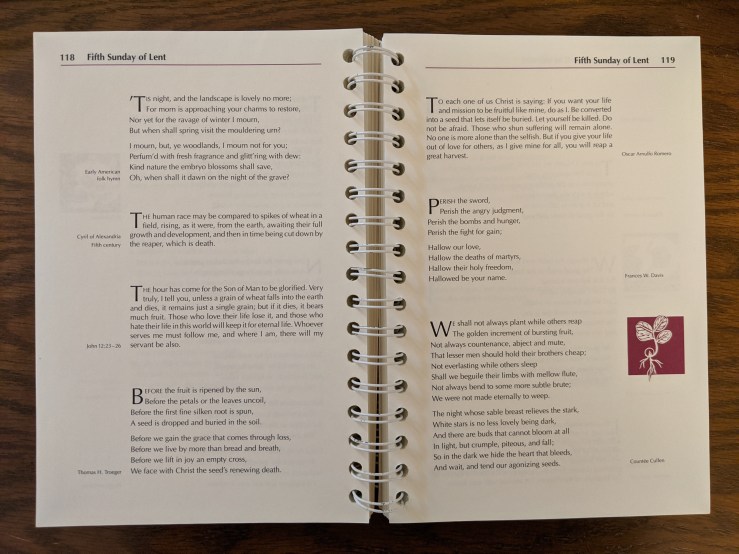
A Lent Sourcebook is available in two different formats: a single, 462-page, perfect-bound volume (ISBN 9780929650364), which appears to be the only option available on the publisher’s website, or two spiral-bound volumes (9780929650203, 9780929650357), which is what came to me through my local library’s interlibrary loan system. The entries are organized by week (Week of Ash Wednesday, First Week of Lent, . . . Sixth Week of Lent), and those “chapters” are broken down further by day (First Sunday of Lent, etc.), extending from Carnival to Holy Thursday. Basic attributions are given in the margins of each page, with fuller citations available in the back of the book. Also, each page spread contains a simple square (woodcut? linocut?) illustration, printed in magenta, by Suzanne M. Novak.
Below is a sampling of passages I encountered here for the first time.
An effigy of the Carnival is, in a great many places, “condemned to death” and executed (the method of execution varies—sometimes it is burnt, sometimes drowned, sometimes beheaded). The “putting to death of Carnival” is often accompanied by general tussles; nuts are thrown at the grotesque creature itself, or everyone pelts everyone else with flowers or vegetables. In other places (around Tübingen, for instance) the figure of the Carnival is condemned, decapitated and buried in a coffin in the cemetery after a mock ceremony. This is called “Carnival’s funeral.”
The other episode which is of the same sort is the driving out or killing of “Death” in various forms. The most widespread custom in Europe is this: Children make a guy from straw and branches and carry it out of the village saying: “We are carrying Death to the water,” or something of the sort; they then throw it into a lake or well, or else burn it. In Austria, all the audience fight round Death’s funeral pyre to get hold of a bit of the effigy. There we see the fertilizing power of Death—a power attaching to all the symbols of vegetation, and to the ashes of the wood burnt during all the various festivals of the regeneration of nature and the beginning of the New Year. As soon as Death has been driven out or killed, Spring is brought in.
Christianity is not reconciliation with death. It is the revelation of death, and it reveals death because it is the revelation of Life. Christ is this Life. And only if Christ is Life is death what Christianity proclaims it to be, namely the enemy to be destroyed and not a “mystery” to be explained. Religion and secularism, by explaining death, give it a “status,” a rationale, make it “normal.” Only Christianity proclaims it to be abnormal and, therefore, truly horrible.
I was entrusted with a sinless and living land,
but I sowed the ground with sin
and reaped with a sickle the ears of laziness;
in thick sheaves I garnered my actions,
but winnowed them not on the threshing-floor of repentance.
I beg of you, my God, the eternal farmer,
with the wind of your loving-kindness
winnow the chaff of my works,
and grant to my soul the harvest of forgiveness;
shut me in your heavenly storehouse, and save me!
—Byzantine Vespers, from The Lenten Triodion, translated by G. Michael Thompson
+++
Alas, dear Christ, the snake is here again.
Alas, it is here: terror has seized me, and fear.
Alas that I ate of the fruit of the tree of knowledge.
Alas that its envy led me to envy too.
I did not become like God; I was cast out of paradise.
Temper, sword, awhile, the heat of your flames
and let me go again about the garden,
entering with Christ, a thief from another tree.
—Gregory of Nazianzus, from Poemata Dogmatica (382 AD), translated from the Latin by Walter Mitchell and published in Early Christian Prayers, ed. Adalbert Hammon, OFM (1961)
(In this prayer the speaker likens himself to the thief who was executed on a “tree” beside Jesus on Calvary. I am “a thief from another tree,” Gregory confesses, having given in to temptation and stolen the fruit that was not mine. He apostrophizes the cherubim’s flaming sword that bars entry to Eden, begging it to cool down so that he might, by the merits of Christ, pass [back] into paradise, as did that penitent thief on Good Friday.)
+++
Even after several years with the reformed liturgy, it still comes as something of a shock to hear Lent described in the first Lenten preface as “this joyful season.” For those of us conditioned to imagine Lent as a grim, unpleasant time, the temptation will be either to shrug it off as poetic license or to associate it with a mother’s attempt to persuade a child to take its medicine.
But there is always C. S. Lewis. In his account of his youth and his journey of faith, Surprised by Joy (1955), Lewis gives us an inveigling definition of joy as “an unsatisfied desire which is itself more desirable than any satisfaction.” Here, perhaps, is something we can latch onto as we confront the notion of Lent as a “joyful season.”
Lent, in this perspective, is a time for eschewing pleasure in order to be surprised by joy, that unsatisfied desire more desirable than any satisfaction. Conversely, it is a time for recognizing the habit we have of seeking satisfactions that dull the deepest longing of the heart; the habit of having to have and not wanting to want. “The very notion of joy,” writes C. S. Lewis, “makes nonsense of our common distinction between having and wanting. There to have is to want and to want is to have.” Lent would then be a time for discovering what it is we really want, the heart’s desire, the restlessness which for Augustine is a symptom of our being made for something we can never possess. Paradoxically, knowing that longing brings joy.
—Mark Searle, “The Spirit of Lent,” in Assembly 8, no. 3 (1981), published by the University of Notre Dame Press
+++
Each day may I remember the sources of the mercies thou hast bestowed on me gently and generously;
Each day may I be fuller in love to thyself.
Each thing I have received, from thee it came,
Each thing for which I hope, from thy love it will come,
Each thing I enjoy, it is of thy bounty,
Each thing I ask comes of thy disposing.
Holy God, loving Father, of the word everlasting,
Grant me to have of thee this living prayer:
Lighten my understanding, kindle my will, begin my doing,
Incite my love, strengthen my weakness, enfold my desire.
[. . .]
And grant thou to me, Father beloved,
From whom each thing that is freely flows,
That no tie over-strict, no tie over-dear
May be between myself and this world below.
“O Healing River” | Words by Fran Minkoff and music by Fred Hellerman, 1964
O healing river, send down your waters,
Send down your waters upon this land.
O healing river, send down your waters,
And wash the blood from off the sand.
This land is parching; this land is burning;
No seed is growing in the barren ground.
O healing river, send down your waters;
O healing river, send your waters down.
Let the seed of freedom awake and flourish;
Let the deep roots nourish; let the tall stalks rise.
O healing river, send down your waters,
O healing river, from out of the skies.
+++
“The Cast” by Sharon Olds (1985)
When the doctor cut off my son’s cast the
high scream of the saw filled the room
and the boy’s lap was covered with fluff like the
chaff of a new thing emerging, the
down in the hen-yard. . . . [Read the rest at poetryfoundation.org]
+++
Enter into the mystery of silence.
Your goal in life is not to hold your tongue but to love, to know yourself and to receive your God. You need to learn how to listen, how to retreat into the depths, how to rise above yourself.
Silence leads you to all this, so seek it lovingly and vigilantly. But beware of false silence: Yours should be neither taciturnity nor glumness, nor should it be systematic or inflexible, or torpid. Authentic silence is the gateway to peace, adoration and love.
Detail from a 14th-century Sienese panel painting, showing two enemies being reconciled by an archangel, embracing each other after having cast aside their weapons. Collection of the Museum of Fine Arts, Boston.
“You have heard that it was said to those of ancient times, ‘You shall not murder’; and ‘whoever murders shall be liable to judgment.’ But I say to you that if you are angry with a brother or sister, you will be liable to judgment; and if you insult a brother or sister, you will be liable to the council; and if you say, ‘You fool,’ you will be liable to the hell of fire. So when you are offering your gift at the altar, if you remember that your brother or sister has something against you, leave your gift there before the altar and go; first be reconciled to your brother or sister, and then come and offer your gift.”
I could listen to Seth Avett [previously] sing all day—and sometimes I do. (Lately I’ve been gorging on his cover of the Tom Waits song “Fish and Bird”!) His light, plaintive, silvery voice moves my soul in a way that producer Rick Rubin embodies in the 2018 HBO documentary May It Last: A Portrait of the Avett Brothers, as in the clip below. (He’s the long-bearded guy swaying around with his eyes closed.) “No Hard Feelings” is the crux of the film, and it made me cry when I first watched it. It’s an aspiration to live without bitterness, without malice, without enemies—an aspiration arrived at by contemplating one’s eventual death.
When my body won’t hold me anymore
And it finally lets me free
Will I be ready?
When my feet won’t walk another mile
And my lips give their last kiss goodbye
Will my hands be steady?
When I lay down my fears
My hopes and my doubts
The rings on my fingers
And the keys to my house
With no hard feelings
When the sun hangs low in the west
And the light in my chest
Won’t be kept held at bay any longer
When the jealousy fades away
And it’s ash and dust for cash and lust
And it’s just hallelujah
And love in thoughts and love in the words
Love in the songs they sing in the church
And no hard feelings
Lord knows they haven’t done
Much good for anyone
Kept me afraid and cold
With so much to have and hold
When my body won’t hold me anymore
And it finally lets me free
Where will I go?
Will the trade winds take me south
Through Georgia grain or tropical rain
Or snow from the heavens?
Will I join with the ocean blue
Or run into the Savior true
And shake hands laughing
And walk through the night
Straight to the light
Holding the love I’ve known in my life
And no hard feelings
Lord knows they haven’t done
Much good for anyone
Kept me afraid and cold
With so much to have and hold
Under the curving sky
I’m finally learning why
It matters for me and you
To say it and mean it too
For life and its loveliness
And all of its ugliness
Good as it’s been to me
I have no enemies
I have no enemies
I have no enemies
I have no enemies
Directed by Judd Apatow and Michael Bonfiglio and filmed over the course of two years, May It Last charts the rise of the North Carolina folk rock band the Avett Brothers (Scott Avett [previously], Seth Avett, Bob Crawford, Joe Kwon) and follows them in the present during the creation of their multi-Grammy-nominated album True Sadness. The nucleus of the film is the brotherhood of Scott and Seth—their growing up in the South, their creative collaborations, and their constant love, respect, and support for one another. Marriage, divorce, parenthood, and illness are also highlighted, as these inform the songs on True Sadness, of which Seth says, “There are moments of undeniable celebration and camaraderie, others of quiet and lonely exhalation.” (This could really describe the Avett Brothers’ whole catalog.)
The documentary is wonderful; you should see it. It’s streaming for free on HBO or can be rented from YouTube, Amazon Prime, or Vudu.
When God gave us this commandment, do you think the idea was that we would form a community in which we constantly antagonize each other, hate each other, abuse each other, wound each other—and then, at the last moment, refrain from murdering each other? Of course not. The spirit of “You shall not murder” is that your bearing toward your neighbors—both in your actions and in your dispositions, your hand and your heart—should never be enmity. Think of it this way: when you’re angry at your brother or sister, when you lash out with hateful words, isn’t that, too, in its own way a kind of violence, a lesser form of “murder”? Isn’t that, too, in its own way a violation of the commandment, an act of ruin against the healthy community the commandment is meant to help you create?
This post belongs to the weekly series Artful Devotion. If you can’t view the music player in your email or RSS reader, try opening the post in your browser.
To view all the Revised Common Lectionary scripture readings for the Sixth Sunday after Epiphany, cycle A, click here.
Godfried Schalcken (Dutch, 1643–1706), A Boy Blowing on a Firebrand to Light a Candle, 1692–98. Oil on canvas, 75 × 63.5 cm. Scottish National Gallery, Edinburgh. Photo: Antonia Reeve.
You are the light of the world. A city set on a hill cannot be hidden. Nor do people light a lamp and put it under a basket, but on a stand, and it gives light to all in the house. In the same way, let your light shine before others, so that they may see your good works and give glory to your Father who is in heaven.
—Matthew 5:14–16
+++
SONG: “This Little Light of Mine,” American folk song, early twentieth century
“This Little Light of Mine” is often attributed, with a date of 1920, to composer Harry Dixon Loes (1895–1965), a white man from the Midwestern United States; sometimes Avis B. Christiansen (1895–1985), a regular collaborator of his, is credited as lyricist. But according to NPR, “researchers at Moody Bible Institute, where Loes taught for 21 years, say they found no evidence he wrote the song or claimed to write it.” Other sources call the song a Negro spiritual, but because it doesn’t appear in any collection of plantation songs from the nineteenth century, that’s difficult to substantiate. It’s possible either the lyrics or melody or both originated in postbellum African American communities, and that Loes acted as an adapter/arranger. Either way, documentation is lacking. For more on the song’s attribution difficulties, see this blog post by Rev. Daniel Harper, who concludes that it’s probably best to cite the song’s author as “Unknown.”
The earliest recording of the song is a version sung by Doris McMurray, a black inmate at Gorree State Farm prison in Huntsville, Texas, which music preservationists John and Ruby Lomax collected during their 1939 Southern States recording trip. Thereafter it became popular on a wider scale in both the black gospel and white folk traditions.
In 1952 it was recorded by the Ward Singers with a bridge—again, whose authorship is unknown:
On Monday, he gave me the gift of love; On Tuesday, peace came from above. On Wednesday, he told me to have more faith; On Thursday, he gave me a little more grace. On Friday, he told me to watch and pray; On Saturday, he told me just what to say. On Sunday, he gave me power divine Just to let my little light shine.
During the 1950s and ’60s, “This Little Light of Mine” became an important civil rights anthem, a special favorite of Fannie Lou Hamer’s. The lyrics were adapted by Zilphia Horton, among others, to suit the context of freedom marches, etc. In 1959 Moe Asch of Folkway Records recorded an impromptu session at a Highlander Center workshop for activists in Tennessee, featuring a trio of high school students from the Montgomery Improvement Association: Mary Ethel Dozier, Minnie Hendrick, and Gladys Burnette Carter. The guitar accompaniment is by Guy Carawan, and the bass voice is Sam Collier of the Nashville Quartet from American Baptist Theological Seminary:
They sing, “Deep down in the South, I’m gonna let it shine . . .” and “We’ve got the light of freedom . . . God gave it to us . . .”
Bettie Mae Fikes, a song leader from the Student Nonviolent Coordinating Committee (SNCC) in Selma, Alabama, markedly inserted the names of oppressors into the verses, such as Selma’s then sheriff: “Tell Jim Clark, I’m gonna let it shine!” Or “Tell the KKK,” or “our president.” Bold lines like these really bring out the defiance aspect of the song.
Although a piece of Americana, “This Little Light of Mine” caught on worldwide. It is part of the repertoire of the Soweto Gospel Choir from South Africa, who sings it in English and Zulu (“M’Lilo Vutha Mathanjeni”), often in medley with “If You Ever Needed the Lord”:
The song is also sometimes sung in medley with Jester Hairston’s “Amen,” as at the wedding of Prince Harry and Meghan Markle on May 19, 2018, where it was performed by the Kingdom Choir. This mashup has been recorded over the years by such soul artists as Sam Cooke (1964), Otis Redding (1966), and Etta James (1982).
In public arenas the song is sometimes decoupled from its Christian-specific context and used to proclaim more generally one’s inherent dignity or one’s uniqueness or potential or agency or the fire in one’s belly. That’s not incompatible with the intent of the passage in Matthew’s Gospel on which the song is based, but it stops a bit short, as the Gospel writer implies that the light is the light of the Christ who lives in us, and says that by letting him shine through—by letting people see the beauty of his gospel, expressed in deeds—we draw others into a state of gratitude and praise to God.
This post belongs to the weekly series Artful Devotion. If you can’t view the music player in your email or RSS reader, try opening the post in your browser.
To view all the Revised Common Lectionary scripture readings for the Fifth Sunday after Epiphany, cycle A, click here.
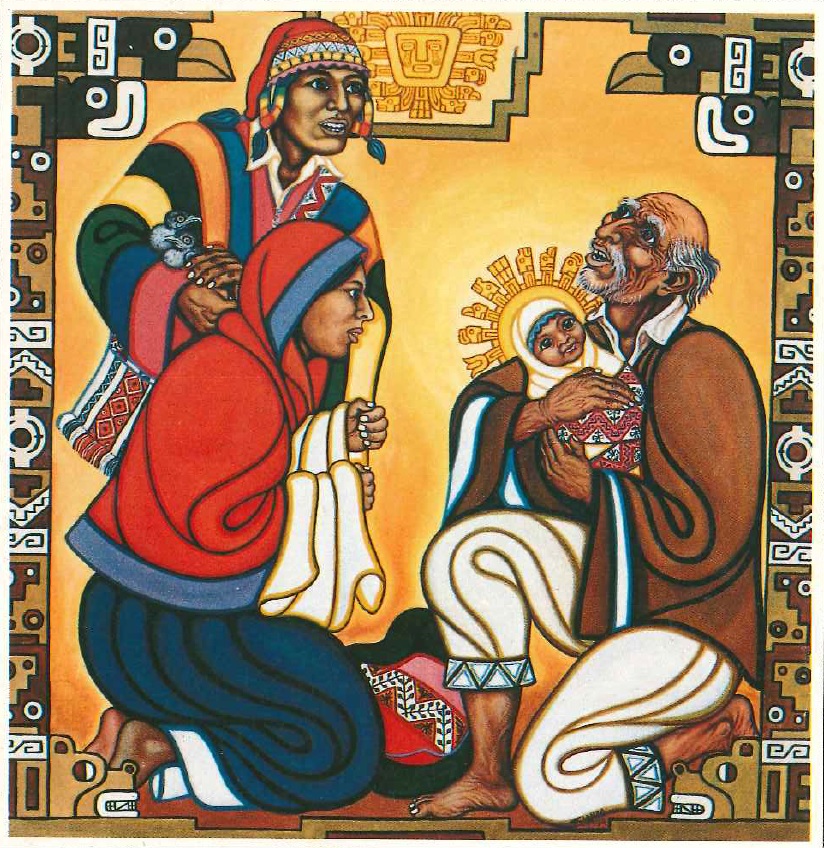
Severino Blanco, Simeon Blessing the Christ Child, 1980s. Chapel of the Casa del Catequista (CADECA), Cochabamba, Bolivia. Image courtesy of Ayopaya Mission.
Now there was a man in Jerusalem, whose name was Simeon, and this man was righteous and devout, waiting for the consolation of Israel, and the Holy Spirit was upon him. And it had been revealed to him by the Holy Spirit that he would not see death before he had seen the Lord’s Christ. And he came in the Spirit into the temple, and when the parents brought in the child Jesus, to do for him according to the custom of the Law, he took him up in his arms and blessed God and said,
“Lord, now you are letting your servant depart in peace,
according to your word;
for my eyes have seen your salvation
that you have prepared in the presence of all peoples,
a light for revelation to the Gentiles,
and for glory to your people Israel.”
Severino Blanco is a Quechuan Christian artist from Cochabamba, Bolivia. In the early 1980s he was commissioned by Father Manfred Rauh (1932–2011), a Jesuit missionary from Germany who spent most of his priestly life in Bolivia, to create a Life of Christ painting cycle for the interior of the chapel of the Casa del Catequista (CADECA), a training center for catechists. To make the gospel story really come alive for the catechists, who are mostly Quechua and Aymara, Blanco chose to set it in an Andean context, with Jesus as an indigenous South American—fully human, fully immersed in history and culture, fully for them. The images are reproduced, with commentary, in the German-language book Von Befreiung und Erlösung: Bilder in CADECA Cochabamba/Bolivien (Of Liberation and Redemption: Pictures in CADECA Cochabamba, Bolivia). A few can also be viewed online here, here, and here. The chapel was consecrated in 1984 and is still in use.
Blanco’s Simeon Blessing the Christ Child is one of the many painted scenes inside the CADECA chapel. Joseph, dressed in poncho and chullo (knitted hat with earflaps), carries two little birds to present as an offering for his son’s dedication. Mary, barefoot, is dressed in a red hooded shawl and a long blue skirt—the colors traditionally associated with Mary in the West—and has just laid down what I’m guessing might be an aguayo, the sling she uses to transport Jesus on her back. (Or perhaps it’s Simeon’s hat, which he removed in reverence?) As for Jesus, he is swaddled in colorful, patterned, homespun wool. When Mary passes the babe to Simeon, he is elated to receive into his arms salvation incarnate. He turns his eyes upward to God the Father, whose presence is suggested by a golden sun-face, whose rays shine forth also in the halo of the Son. The designs on these terminals, and around the border of the painting, are deeply influenced by traditional Andean art.
“A light for revelation to the Gentiles,” salvation prepared for “all peoples”—these phrases from the lectionary jingle in my ears as I meditate on Blanco’s painting.
+++
Here are the Artful Devotions for Candlemas from the previous two church year cycles:
This post belongs to the weekly series Artful Devotion. If you can’t view the music player in your email or RSS reader, try opening the post in your browser.
To view all the Revised Common Lectionary scripture readings for the feast of the Presentation of the Lord, cycle A, click here.
Graffito with a parody of the Crucifixion, scratched in plaster on the wall of the Domus Gelotiana on the Palatine Hill, Rome, ca. 200. Collection of the Museo Palatino, Rome.
For the word of the cross is folly to those who are perishing, but to us who are being saved it is the power of God. For it is written,
“I will destroy the wisdom of the wise,
and the discernment of the discerning I will thwart.”
Where is the one who is wise? Where is the scribe? Where is the debater of this age? Has not God made foolish the wisdom of the world? For since, in the wisdom of God, the world did not know God through wisdom, it pleased God through the folly of what we preach to save those who believe. For Jews demand signs and Greeks seek wisdom, but we preach Christ crucified, a stumbling block to Jews and folly to Gentiles, but to those who are called, both Jews and Greeks, Christ the power of God and the wisdom of God. For the foolishness of God is wiser than men, and the weakness of God is stronger than men.
—1 Corinthians 1:18–25
+++
SONG: “The Old Rugged Cross” | Words and music by George Bennard, 1913 | Performed by Angie Sutherland and Edgar Napier, 2019
In this recording from last year, Angie Sutherland sings “The Old Rugged Cross” with her father on their front porch in West Virginia, a favorite pastime. A few months later, on August 25, he died of cancer.
The classic hymn reflects on the paradox of the cross that Paul teases out in this week’s epistle reading: it’s both ugly and beautiful, both shameful and glorious. George Bennard, the songwriter, describes it as “the emblem of suffering and shame,” “so despised by the world,” “reproach[ful]” (disgraceful, discrediting). And yet for the Christian it “has a wondrous attraction,” “a wondrous beauty,” rough and blood-stained though it is, because the sacrifice of Christ that took place there brings about the world’s salvation. And so we love it, cherish it, cling to it, as the greatest gift and our only hope, though the world may laugh.
+++
The paradoxical nature of the Crucifixion makes it especially challenging for artists to represent visually. How do you show something that is utterly degrading and an apparent defeat but that is actually a cosmic victory, an act of self-giving worthy of praise? Artistic renderings are often accused of being either too sanitized or too gory.
The subject of Christ’s crucifixion is rare in early Christian art, entirely absent from the catacombs and sarcophagi in Rome, and, despite its centrality in preaching and the textual theology of the church fathers, doesn’t become common until the Byzantine period—and even then it is the cross’s victory that is shown, at the expense of its shamefulness. This rejection of Crucifixion images wasn’t an issue of depicting God the Son, as he showed up in other scenes early on—feeding at his mother’s breast, talking to the woman at the well, healing the hemorrhaging woman, raising Lazarus from the dead, enthroned in heaven, and even during other stages of his passion. The rarity of the crucified Christ in art of the first several centuries of the Common Era has puzzled art historians and theologians alike, who can only speculate that the shame associated with crucifixion as a form of execution and the stigma thus attached to worshiping a crucified deity are behind it.
Stone rubbing trace of the Alexamenos graffito, published in “Ancient Rome in the Light of Recent Discoveries” by Rodolfo Lanciani (1898)
For the primary image of this Artful Devotion, I’ve taken a different tack and am featuring an anti-Christian image, a historical artifact from ca. 200 Rome that shows just how shameful crucifixion was. “For the word of the cross is folly to those who are perishing . . . a stumbling block . . .” It’s a graffito that was discovered in 1857 during an excavation of the ruins of a paedagogium, a boarding school for imperial page boys, on the Palatine Hill, within the emperors’ palace complex. (The school had been walled up sometime in the third century to support constructions above it.) Richard Viladesau describes the image in his book The Beauty of the Cross: The Passion of Christ in Theology and the Arts—from the Catacombs to the Eve of the Renaissance:
In an unfrequented corner of the Palatine museum in Rome there is a collection of ancient graffiti. Most visitors give them no more than a glance before passing on to the more attractive statues and artifacts. Roughly etched on slabs of marble, these inscriptions once defaced the walls of the imperial palaces that stood on the spot. Among them is one from the residence of the imperial pages called the graffito of Alexamenos. It consists of a very roughly drawn image and a few words of Greek. In style and appearance it has nothing to distinguish it from the many other similar pieces of graffiti that abound in Roman museums; but for the Christian it has a particular significance. The rough incision shows a crucified man with the head of an ass. Next to him is a smaller figure with an arm extended in his direction. Nearby are the crudely carved words ΑΛΕ ξΑΜΕΝΟϹ ϹΕΒΕΤΕ ϑΕΟΝ, “Alexamenos worships [his] God.” It is the earliest known pictorial representation of the crucifixion of Christ and of his adoration as divine. In a city so full of the triumphant monuments of Christianity, there is something strangely moving in finding this first visual testimony to the Christian faith amidst the fragments of daily life of pagan Rome; and even more so in finding it in this rude sketch, probably drawn by a palace page with cruel schoolboy humor to mock the faith of a fellow slave.
The graffito reminds us of how Christianity must have appeared to the sophisticated ancient pagan world: a strange minority religion from a small backwater of the civilized world: a religion that was centered on a man punished as a criminal with the most humiliating form of execution, and a faith practiced mostly by slaves and people of the lower classes. It reflects the Roman belief that the Jews worshipped a god with the head of an ass—a notion that was apparently also carried over to Christians. It also shows graphically the scandal of the cross to which St. Paul refers. For sophisticated Hellenistic society, the notion of a suffering god was ridiculous: an obviously mythological conception. For the adherents of popular religion, Jewish or gentile, the notion of a savior who was himself defeated by the powers of evil was equally absurd.
How did the cross, the symbol of degradation, an occasion for mockery, become the primary symbol of Christian faith? (19–20)
(That concluding question is precisely what Viladesau explores in the rest of the book, one in a series!)
See also “The Crucifixion of Christ in Art,” a lecture given by the Rt. Revd. Lord Richard Harries at Gresham College on January 12, 2011. (He discusses the Alexamenos graffito briefly, starting at 9:50.)
As a juxtaposition to that anonymous Roman bully’s scrawl, consider the splendidly jeweled, gold repoussé cover of a Carolingian Gospel book from the court school of Charles the Bald, known as the Lindau Gospels. (It came quite a bit later, in the ninth century.) It majors on the “glory” side of Paul’s equation, even though the peripheral figures are shown in mourning.
Front cover of the Lindau Gospels, made in France, ca. 870–80. Gold repoussé, 35 × 27.5 cm. Collection of the Pierpont Morgan Library, New York.
I wonder what part of the story we lose with this beautiful, gleaming, physically strong Christ erect on his cross. And on the converse, with Crucifixion images that focus heavily on suffering, humiliation, showing a Christ who’s beaten, bloody, forsaken, and crying out in agony. Is it possible to convey both aspects of the Crucifixion—the shame and the glory, the pain and transcendence—simultaneously? Can you name any artists who have done so successfully? (I have some thoughts, but I want to hear yours!) Or do we need a plenitude of Crucifixion images to hold one another in check and to help us more fully abide in the multifaceted mystery that is the death of Christ? Or, whether the Crucifixion image is, at face value, repellent or attractive, is that irrelevant—does the Christian viewer simply bring his or her theology to the image, reading into an ugly Crucifixion the beautiful redemption wrought by such a sacrifice, or into a beautiful Crucifixion the ugliness of humanity’s depravity that led to such (implicit) suffering?
This post belongs to the weekly series Artful Devotion. If you can’t view the music player in your email or RSS reader, try opening the post in your browser.
To view all the Revised Common Lectionary scripture readings for the Fourth Sunday after Epiphany, cycle A, click here.
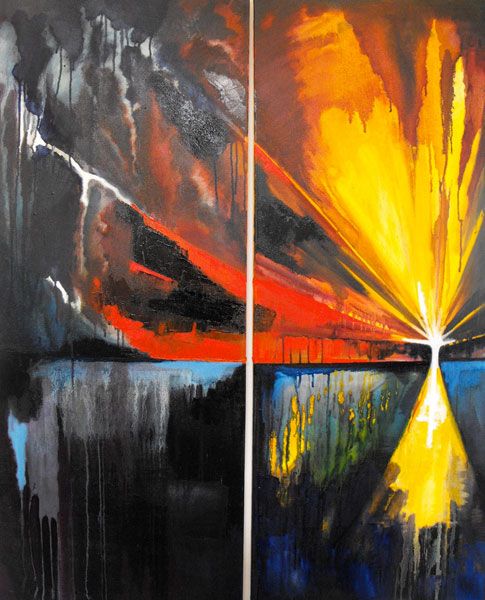
Judith Tutin (Irish, 1979–), Breaking, 2011. Diptych, St. Aidan’s Cathedral, Enniscorthy, County Wexford, Ireland.
But there will be no gloom for her who was in anguish. In the former time he brought into contempt the land of Zebulun and the land of Naphtali, but in the latter time he has made glorious the way of the sea, the land beyond the Jordan, Galilee of the nations.
The people who walked in darkness have seen a great light;
those who dwelt in a land of deep darkness,
on them has light shone.
You have multiplied the nation;
you have increased its joy;
they rejoice before you
as with joy at the harvest,
as they are glad when they divide the spoil.
For the yoke of his burden,
and the staff for his shoulder,
the rod of his oppressor,
you have broken as on the day of Midian.
For every boot of the tramping warrior in battle tumult
and every garment rolled in blood
will be burned as fuel for the fire.
—Isaiah 9:1–5
Now when he heard that John had been arrested, he withdrew into Galilee. And leaving Nazareth he went and lived in Capernaum by the sea, in the territory of Zebulun and Naphtali, so that what was spoken by the prophet Isaiah might be fulfilled:
“The land of Zebulun and the land of Naphtali,
the way of the sea, beyond the Jordan, Galilee of the Gentiles—
the people dwelling in darkness
have seen a great light,
and for those dwelling in the region and shadow of death,
on them a light has dawned.”
From that time Jesus began to preach, saying, “Repent, for the kingdom of heaven is at hand.”
This song was recorded live in 1998 at the Resurrection Youth Convention in Gatlinburg, Tennessee. The MP3 can be downloaded for free, along with sheet music, at http://ncfmusic.com/resource/dawning-light/.
For a previously featured James Ward song, see the Artful Devotion “Death Is Ended.”
+++
The Jewish prophet Isaiah was active during the Assyrian captivity in the second half of the eighth century B.C. The Israelite lands of Zebulun and Naphtali were, along with Gilead in Transjordan, the first to fall to Assyria; the people were deported, and their lands became Assyrian provinces. But these three areas, according to Isaiah 9:1, would also be the first to see the dawning of a glorious new era, where the people step out of darkness and desolation into the fruits of God’s victory, and all military equipment is cast once and for all into an enormous bonfire, for war is over, and oppression is no more.
The future is written as something which has already happened, for it belonged to the prophetic consciousness of men like Isaiah to cast themselves forward in time and then look back on the mighty acts of God, saying to us: ‘Look forward to it, it is certain, he has already done it!’ Because of this confidence, Isaiah can place the light of 9:1ff. in immediate proximity to the darkness of 8:22, not because it will immediately happen but because it is immediately evident to the eye of faith; those walking in the darkness can see the light ahead and are sustained by hope. . . .
Isaiah insists here that hope is a present reality, part of the constitution of the ‘now’. The darkness is true but it is not the whole truth and certainly not the fundamental truth. (98–99)
This post belongs to the weekly series Artful Devotion. If you can’t view the music player in your email or RSS reader, try opening the post in your browser.
To view all the Revised Common Lectionary scripture readings for the Third Sunday after Epiphany, cycle A, click here.
EVERYPSALM: Over the next three years, indie-folk duo Poor Bishop Hooper (whom I blurbed here) will be writing and releasing one biblical psalm setting per week, sequentially from Psalm 1 to Psalm 150. And they are very graciously making all these songs available to download for free! They’ve already released the first three, and I’ve been thoroughly enjoying them. To sign up to receive a weekly download link in your inbox, visit https://www.everypsalm.com/. You may also want to consider giving to the project.
+++
PHOTO SERIES: Un-Daily Bread by Gregg Segal: For his latest project, US-based photographer Gregg Segal has been photographing Venezuelan immigrants with the entirety of their belongings lying around them. According to the United Nations High Commissioner for Refugees (UNHCR), an organization that Segal is collaborating with, the number of people in Venezuela forced to leave their homes due to violence, insecurity, threats, and/or lack of essential services keeps increasing, with more than 4.6 million refugees and migrants from the country living around the world, mostly in South America. In the photograph below, you can see a young mother and her two children surrounded by a few changes of clothes, a doll, a baby bottle, medicine, diapers, arepas, and a Bible. The three traveled over six hundred miles from Maracaibo to Bogotá, hitching rides and catching buses.
Alesia, Arianny, and Lucas, Colombia, 2019. Photo by Gregg Segal, from his Un-Daily Bread series.
Un-Daily Bread it is an offshoot of Segal’s Daily Bread series, in which he photographed images of kids from around the world surrounded by what they eat each day.
+++
LITURGY: Impelled by the various antagonisms that have been on the rise both domestically and abroad, Aaron Niequist has written and compiled a ten-page Liturgy for Peacemakers, which includes a call to worship, two songs, a confession of sin and assurance of pardon, scripture readings, and prayers, including one minute of holy space each to pray for a global enemy, a local enemy, and a personal enemy. The liturgy, which focuses on shaping us to be instruments of God’s peace in the world, is free for you to use in your living rooms and/or churches, and to adapt in any way you wish.
+++
EXHIBITION: Andy Warhol: Revelation, October 20, 2019–February 16, 2020, Andy Warhol Museum, Pittsburgh: Ever since reading Jane Daggett Dillenberger’s illuminating book The Religious Art of Andy Warhol(1998), I’ve been interested to explore more deeply the Byzantine Catholicism of Andy Warhol and how it influenced his art. (I was surprised to learn, for example, that although he had a complicated relationship with Christianity, Warhol regularly attended Mass, wore a cross around his neck, carried a pocket missal and rosary, and prayed daily with his mother in Old Slavonic over the forty years he lived with her.) A pioneer of the pop art movement best known for his silkscreen prints of Marilyn Monroe and Campbell’s soup cans, Warhol also made giant cross paintings as well as screen prints of famous Renaissance religious paintings in full or in detail (by Piero della Francesca, Raphael, and Leonardo da Vinci)—especially The Last Supper, his last and largest series. Jesus is surely a part of American pop culture, so Warhol’s use of such imagery is not all that unusual in light of his larger oeuvre. But is there anything more to this choice of subject?
Andy Warhol (American, 1928–1987), The Last Supper, 1986. Acrylic and silkscreen ink on linen, 78 × 306 in. (198.1 × 777.2 cm). Andy Warhol Museum, Pittsburgh.
Andy Warhol (American, 1928–1987), Cross (Red), 1982. Synthetic polymer paint and silkscreen on canvas, 90 × 70 in. (228.6 × 177.8 cm). Andy Warhol Museum, Pittsburgh.
I’ll be driving to Pittsburgh next weekend, where Warhol grew up, to see an exhibition of his religious works curated by José Carlos Diaz from the Andy Warhol Museum’s permanent collection. I’ll also be attending a lecture at the museum given by Jonathan A. Anderson, titled “Religion in an Age of Mass Media: Andy Warhol’s Catholicism.” (It’s January 25 at 6 p.m. Update: Watch the lecture on YouTube.) In and around Pittsburgh is also where Fred Rogers (of Mister Rogers’ Neighborhood fame) spent most of his life, so I’ll be visiting a few key spots related to him as well!
+++
EXHIBITION: Scott Avett: INVISIBLE, October 12, 2019–February 2, 2020, North Carolina Museum of Art, Raleigh: “Internationally recognized as co-founder of the band The Avett Brothers, Scott Avett has been a working artist, focusing on painting and printmaking, since he earned a BFA in studio art from East Carolina University in 2000. But until now this art-making part of his life has been a secret and a more solitary creative pursuit in comparison to his life as a musician, singer, and songwriter. This solo exhibition features Avett’s large-scale oil paintings. These are psychologically charged and emotionally intense portraits focused on his family and himself—often intimate, vulnerable, and sometimes uncomfortably truthful portrayals. Like his songs, Avett’s paintings speak to universal issues of spirituality and struggle, love and loss, heartache and joy, as well as more personal stories of career, family, and living in the South.”
As an Avett Brothers fan, I made it a point to see this exhibition in December when I was visiting family for Christmas, and actually, it exceeded my expectations. It was endearing to see portraits of Avett’s three children tumbling around, swinging, engaged in deep thought at the dinner table, playacting as monsters, wailing—and he and his wife in the middle of it all, experiencing both the joys and stresses of parenting. My favorite pieces were probably the companion paintings Motherhood and Fatherhood, which show the messiness of those callings.
Scott Avett (American, 1976–): Motherhood (2012); Fatherhood (2013). Oil on canvas, 106 × 65 in. each. Photo: Victoria Emily Jones.
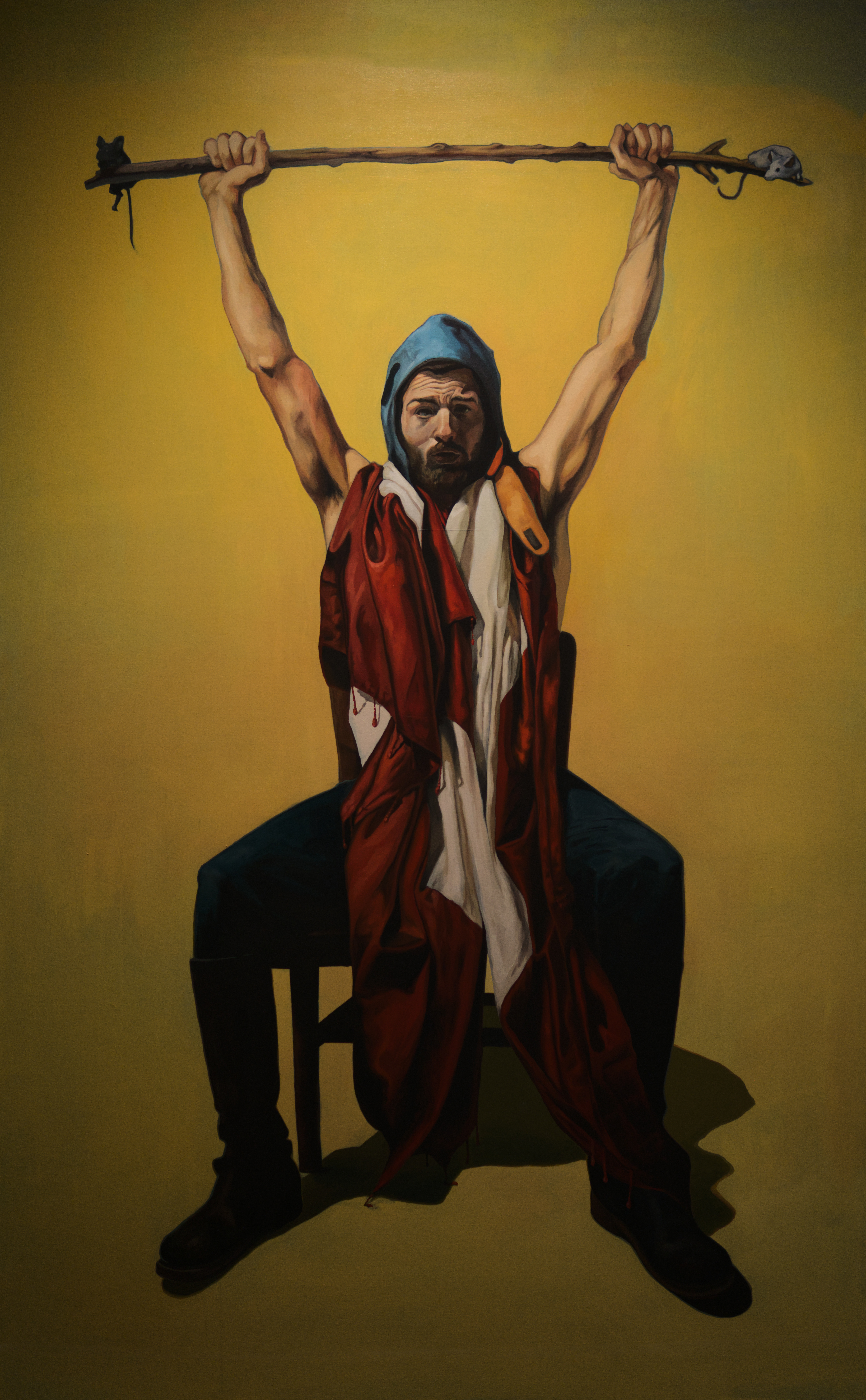
Fatherhood is one of several self-portraits in the show. The one that’s most prominently displayed, right at the entrance, is Black Mouse, White Mouse, which references Leo Tolstoy’s personal essay “A Confession,” about an existential crisis. In it Tolstoy recounts a fable of a man who falls into a well with a dragon at the bottom. On his way down he grabs hold of a branch growing out of the wall, but it’s being nibbled by two mice, and his fall to death is imminent. This scenario is representative of where we all find ourselves: finite beings in an infinite world, dangling over the abyss. There are four possible ways to respond, says Tolstoy: ignorance, epicureanism, suicide, or hanging on to life. He thinks suicide the most logical but says he lacks the nerve to carry it out.
Tolstoy then launches into metaphysical musings, grappling with the question of God’s existence, when suddenly, he has an epiphany that “God is Life,” and that “I live, really live, only when I feel Him and seek Him.” He continues, “I returned to the belief in that Will which produced me and desires something of me. I returned to the belief that the chief and only aim of my life is to be better, i.e. to live in accord with that Will. And I returned . . . to a belief in God . . .”
Scott Avett (American, 1976–), Black Mouse, White Mouse, 2010. Oil on canvas, 106 × 65 in. Photo: Victoria Emily Jones.
Avett’s spirituality isn’t overt in any of the paintings, but it’s been interesting to hear him open up more about that aspect of himself in artist talks and interviews. In an October talk, for example, he said, “I’m a true believer that every single one of us is a beloved son or daughter of God, period. I know that for certain. And because of that, this [pointing to himself] isn’t the only bright shining person in this room. It’s insane how true that is. . . . I’ve just always lived like that—like someone was watching. It was God the whole time; he was right there with me and in me, the whole time. When I was younger it was so much easier to access that. And now growing older, it’s about opening up to access that again.”
SONG: “Offertory” by John Ness Beck, performed by Future:Past: Micah 6:8 has, for me, functioned as what some would call a “life verse”: a guiding principle that I return to again and again to reorient myself to the divine will. I long to be the kind of person the verse describes: one who does justice, loves mercy, and walks humbly with God. Thanks to Paul Neeley at Global Christian Worship, I’ve just been made aware of a beautiful musical setting of this passage, which happens to be one of the Revised Common Lectionary readings for February 2 this year.
“With what shall I come before the LORD,
and bow myself before God on high?
Shall I come before him with burnt offerings,
with calves a year old?
Will the LORD be pleased with thousands of rams,
with ten thousands of rivers of oil?
Shall I give my firstborn for my transgression,
the fruit of my body for the sin of my soul?”
He has told you, O man, what is good;
and what does the LORD require of you but to do justice, and to love kindness, and to walk humbly with your God?
—Micah 6:6–8
The music was composed in the second half of the twentieth century by John Ness Beck and was adapted for TTBB (tenor-tenor-bass-bass) by Craig Courtney—performed here a cappella by Josh Adams, Davis Gibson, Jon Kok, and Matthew Reiskytl of the Christian music and media ministry Future:Past. To purchase sheet music for “Offertory” (available in SATB, SSA, and TTBB voicings, with keyboard and optional string quartet), click here.
I waited patiently for the LORD;
he inclined to me and heard my cry.
He drew me up from the pit of destruction,
out of the miry bog,
and set my feet upon a rock,
making my steps secure.
He put a new song in my mouth,
a song of praise to our God.
Many will see and fear,
and put their trust in the LORD.
—Psalm 40:1–3
+++
SONG: “Oh, He’s Taken My Feet” | Early American folk hymn, performed by Lucy Simpson, with Rock Creek (Bill Destler, Wally Macnow, Tom McHenry), Mary Alice Amidon, Peter Amidon, and Caroline Paton, on Sharon Mountain Harmony: A Golden Ring of Gospel (1982, 2002)
Lucy Picco Simpson (1940–2006) was a prodigious collector of old hymns, amassing four hundred hymnals, mostly from the nineteenth and twentieth centuries, over her lifetime. From their pages she would dig out old gems and help revive them—such as “Oh, He’s Taken My Feet.” After recording the song for Folk-Legacy Records in 1982, it was picked up by folk singers Jean Redpath and Lisa Neustadt in 1986, and thenceforth by others.
I’m not sure precisely where Simpson sourced the song from, but I do know both the text and tune were compiled, along with 249 others, by George Pullen Jackson in the book Spiritual Folk Songs of Early America (New York: J.J. Augustin, 1937), which you can download for free from Project Gutenberg.
Sharon Mountain Harmony, where Simpson’s simple rendition appears, is one of my favorite albums. In his 1983 review for the Washington Post, Richard Harrington wrote,
On “Sharon Mountain Harmony” the inspiration is the particularly rich motherlode of gospel song, both black and white traditions. Rock Creek [the vocal trio comprising Wally Macnow, Tom McHenry, and Bill Destler] shares the album with Lucy Simpson of Brooklyn, and Mary Alice and Peter Amidon of Vermont. Simpson and Rock Creek alternate leads while providing a constant, thick backing of informal and earthy harmonies with heavenly aspirations. The singing is comfortable, unhurried. No matter which voice leads – Simpson’s ethereal and soft soprano, Bill Destler’s gentle tenor or Wally McHenry’s persuasive baritone – it’s the richness of the ensemble, the entrancing vocal weaves, that make this album a quiet gem. Another plus is the choice of material. All 16 songs are deeply rooted in prayer meetings, crusty hymnals and songbooks, revival tents, amen corners, rural radio programs; they come from the land and they’ve been well-used. There’s the clipped bluegrass harmony of “Glory Bound,” the shape-note urgency of “There Are Angels Hovering Round,” the exuberant Baptist release of “Oh, He’s Taken My Feet” and “Trouble So Hard,” the spiritual grace of “Blessed Quietness” and “Time Has Made a Change in Me,” the calming reassurance of “I Will Arise.” These are all wonderful songs, beautifully displayed. They reflect intensely personal convictions and a tremendous respect for the grace of unadorned voices singing from the heart.
Folk artist Sam Amidon, one of the sons of Peter and Mary Alice Amidon (who sing on Sharon Mountain Harmony), learned “Oh, He’s Taken My Feet” from Lucy Simpson, a family friend. Music critic Ryan Foley calls Amidon a “clever re-inventor, overly ambitious re-animator, whiz-bang music folklorist, fusty archivist . . . disassembling and then reconstructing antiquated sacred songs, secular ballads, and folk tunes.”
That’s what he does with this song on his 2013 album Bright Sunny South. “Brimming with unexpected shifts and subtleties,” Amidon’s arrangement of “He’s Taken My Feet” “begin[s] with a spare guitar and voice, [then is] slowly joined by hints of trumpet, understated fretless bass, and other elements until the song, very gradually, grows to a burning climax of dissonant guitars, synths, and explosive drums” (Fred Thomas). The sonic chaos at the end lasts almost a full two minutes and represents “the mire and the clay”—all that pulls us down, gets us stuck.
The melancholic tone that culminates in clashing is not what you’d expect from a psalm of testimony about the rock-solid stability God provides. But when the song is taken in context of the whole biblical psalm on which it is based, which vacillates between praise and lament, it makes perfect sense. Psalm 40 opens by celebrating the deliverance God has wrought in the past, but then it moves into the miry present, where the psalmist is in need of another deliverance:
For evils have encompassed me
beyond number;
my iniquities have overtaken me,
and I cannot see;
they are more than the hairs of my head;
my heart fails me.
Be pleased, O LORD, to deliver me!
O LORD, make haste to help me!
. . .
You are my help and my deliverer;
do not delay, O my God! (vv. 12–13, 17b)
Amidon’s arrangement of “He’s Taken My Feet” captures the believer’s struggle through adverse circumstances to find firm footing once again on the “Rock of Ages.” From within the fray the speaker remembers God’s faithfulness, sings God’s faithfulness, and that weary song creates anticipation for yet another act of divine rescue.
This post belongs to the weekly series Artful Devotion. If you can’t view the music player in your email or RSS reader, try opening the post in your browser.
To view all the Revised Common Lectionary scripture readings for the Second Sunday after Epiphany, cycle A, click here.











 Art & Theology