DOCUMENTARY: Juneteenth: Faith and Freedom, dir. Ya’Ke Smith: Released June 7 by Our Daily Bread Ministries, this film follows Where Ya From? podcast host Rasool Berry to Texas to talk with pastors, historians, activists, artists, and elected officials about the spiritual significance of America’s newest federal holiday, and to visit historic sites associated with it. You can watch the full seventy-five-minute film for free on YouTube. Here’s the trailer:
The interviewees, in order of appearance, are:
Dr. Michael W. Waters, pastor, Abundant Life African Methodist Episcopal Church
SPOTIFY PLAYLISTS by Lara Downes (with commentary!):
>> Songs for Freedom: A Juneteenth Playlist (2021): Award-winning pianist and NPR radio host Lara Downes curated an excellent Spotify playlist for Juneteenth last year—a mix of jazz, classical, and soul. It is full of wonderful surprises, introducing me to the work of several African American composers, new and old, such as Wynton Marsalis’s The Democracy! Suite for jazz ensemble; a symphony by William Grant Still titled “Song of a New Race”; “Adoration” by Florence Price (originally written for organ but arranged here for violin and piano); “Fanfare on Amazing Grace” by Adolphus Hailstork; and “Startin’ Sumthin’” by Jeff Scott, a French hornist who performs “urban classical chamber music.”
There are also several well-known names—Billie Holiday, Mahalia Jackson, Aretha Franklin, Nina Simone, Duke Ellington, John Coltrane, Stevie Wonder—and more recent popular artists like Jon Batiste and Rhiannon Giddens. Batiste’s arrangement of “What a Wonderful World” is gorgeous, and the music video—wow (see below). It features a group of Black nuns having fun around London—picnicking on a park bench, traversing monkey bars, sharing the gospel with passersby, eating cotton candy, riding bumper cars. It captures the tone of the song perfectly.
From Downes’s list I also really like the blues song “I Knew I Could Fly” by Allison Russell and Leyla McCalla, excerpted in the following featurette. It’s from the album Songs of Our Native Daughters, which sheds light on African American women’s stories of struggle, resistance, and hope.
Be sure to read the NPR article that introduces the playlist. Downes calls out nine of the musical selections with blurbs that provide some background, and throughout there is a smattering of historical photographs of Black flourishing in and around Washington, DC, from 1904 onward, taken by the Black-owned Scurlock Studio.
YWCA camp for girls. Highland Beach, Maryland, 1930. This photo is from the Scurlock Studio Collection at the Smithsonian National Museum of American History.
>> Songs to Believe In: A Juneteenth Playlist (2022): As I was formatting this post I realized that Downes just published a brand-new playlist for Juneteenth 2022. I haven’t had time to listen yet, but it looks awesome. “I offer you a collection of music that insists on the promise of freedom, however long in coming,” she writes. “Music that counters the shrieking dissonance of conflict with the radiant warmth of its harmonies, that offers us comfort in our sorrow and sustenance in our struggle. Songs that ground us with the steadiness of their rhythms and embrace us in the lines of their melodies. Music that brings us hope and faith and even joy, urging us to stand and fight another day, reminding us that what we are celebrating on this holiday is our freedom to believe, even in the hardest of times.”
+++
YOUTUBE PLAYLIST: Juneteenth Playlist by Victoria Emily Jones. Nineteen songs of freedom and faith—gospel, pop, funk, R&B, and spirituals. I wanted to choose all live performances or music videos so that there’s a visual element to engage.
One of the songs is “Clap Praise” by Diane White-Clayton, performed by Selah Gospel Choir. It’s a setting of Psalm 47, which opens, “Clap your hands, all you peoples; shout to God with loud songs of joy!”
Dr. Diane White-Clayton is a composer, conductor, pianist, and lecturer in ethnomusicology specializing in Black sacred music. I love the exuberance and all the body percussion in this widely performed piece of hers. I learned about Selah Gospel Choir through Bridge Projects, an art gallery in Los Angeles where they recently performed. The choir was founded in 2007 “as a space for people who want to sing gospel music birthed by the spirit of the Black church and the ancestry of Black community but are either unable to find it in their home place of worship or do not identify with being in a church at all.”
+++
DANCE WORK: Revelations, choreographed by Alvin Ailey: This classic thirty-six-minute work choreographed by the pioneering Alvin Ailey premiered in New York in 1960 and since then has been performed continually around the globe. This particular performance at Lincoln Center premiered online on December 6, 2020, as part of Alvin Ailey American Dance Theater’s virtual season during the pandemic. “Using African American spirituals, song-sermons, gospel songs, and holy blues, Revelations fervently explores the places of deepest grief and holiest joy in the soul.” Ailey said it was born of the “blood memories” of his childhood in rural Texas and his affection for the Baptist church that nurtured him.
All the numbers are great, but my favorite is “Wade in the Water” (part of the “Take Me to the Water” sequence that begins at 9:41). Second favorite: “Fix Me” (5:22).
SONGS: The Holy Spirit Prayer is a traditional Catholic prayer that’s sung at Mass on the feast of Pentecost: “Come, Holy Spirit; fill the hearts of your faithful, and kindle in them the fire of your love. Send forth your Spirit and they shall be created, and you shall renew the face of the earth. O God, who by the light of the Holy Spirit did instruct the hearts of the faithful, grant that by the same Holy Spirit we may be truly wise and ever enjoy his consolations, through Christ our Lord. Amen.” The following two songs are settings of the first part of this prayer.
>> “Kindle in Us Your Love” by Deanna Witkowski: This funky refrain by jazz composer Deanna Witkowski “works well as a gospel acclamation, prayer response, or opening song,” especially for Pentecost. I’m planning to introduce it to my Presbyterian congregation this Sunday. (For church services, Witkowski charges a licensing fee of just $3 per use.) You can purchase the piano score here; it also appears in the Voices Together hymnal. Hear a high school choir perform the piece in the video below, with Witkowski accompanying on keys.
Come, Holy Spirit Kindle in us the fire of your love Come, Holy Spirit Kindle in us your love
>> “Holy Spirit, Come to Us” by Jacques Berthier (Taizé chant):Taizé is an ecumenical Christian monastic community in France comprising more than one hundred Catholic and Protestant brothers from some thirty different countries. They welcome in around a hundred thousand young pilgrims a year, who come for prayer, Bible study, and communal work and worship. The songs of Taizé use simple musical phrases and few words that are repeated. Composed in 1998, “Holy Spirit, Come to Us” is one of 232 songs Jacques Berthier wrote for Taizé. It consists of solo verses sung by a leader over an ostinato refrain sung by the people.
Holy Spirit, come to us Kindle in us the fire of your love Holy Spirit, come to us Holy Spirit, come to us
Jesus said, “It is by your love for one another That everyone will recognize you as my disciples.”
Jesus said, “No one has greater love than this: To lay down one’s life for those one loves.”
We know love by this, That Christ laid down his life for us.
This is love: it is not we who have loved God But God who loved us.
Taizé songs may be sung in public worship settings free of charge, provided their simplicity is preserved (i.e., no elaborate arrangements are permitted); for other uses, see here.
+++
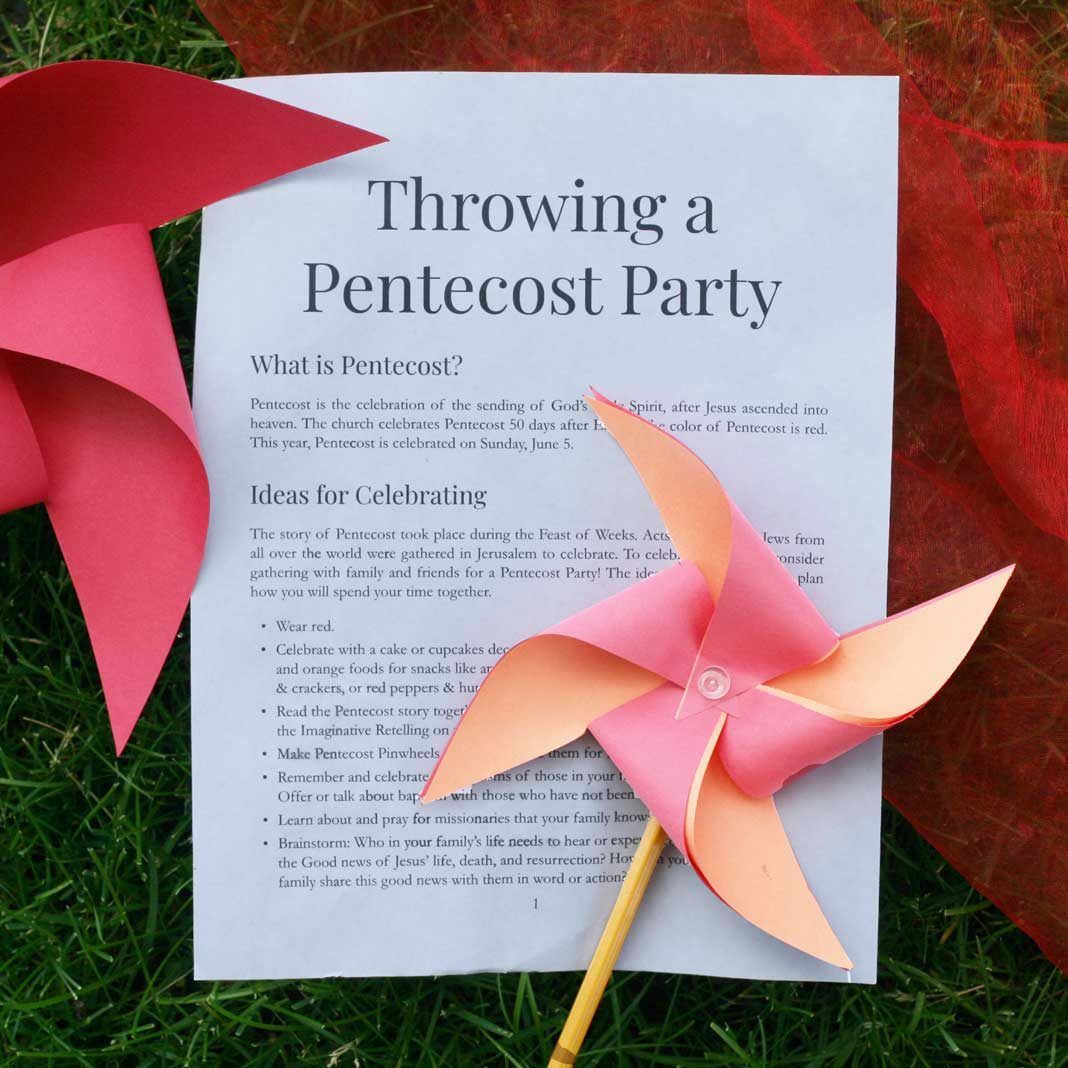
DIGITAL DOWNLOAD: Pentecost Party: Word & Wonder is offering a free twelve-page PDF of resources for celebrating Pentecost with children. Besides a list of party ideas, it includes an imaginative retelling of the Pentecost story from the perspective of a child, a prayer guide, prompts for talking about the Holy Spirit, coloring pages, and a pinwheel craft. On their website you will also find other family-friendly resources for the church year. [HT: Global Christian Worship]
+++
BLOG POST: “Whitsun Week” by Eleanor Parker: “The week following Pentecost is a lost holiday. From the Middle Ages until the early 20th century the period around Whitsun was the principal summer holiday of the year – especially Whit-Monday”—which is June 6 this year. “It was the time for fairs, Morris dancing, games, ale-drinking, school and church processions, weddings, wandering into the countryside, and generally having a good time.” Gooseberries and cheesecakes were broken out for the occasion, and communities engaged in fun activities like cricket, archery, sack races, and donkey derbies.
British medievalist Eleanor Parker compiles several sources that describe the Whitsuntide festivities of medieval western Europe and calls her readers to revive the week’s outdoor merrymaking!
+++
SHORT FILM: Stickmatch: Created in 2020 by London-born animator William Crook, this twenty-second stop-motion animation uses autumn leaves to simulate flames. [HT: Colossal]
DOCUMENTARY SERIES: Taste and See, dir. Andrew Brumme: “Taste and See is a documentary series exploring the spirituality of food with farmers, chefs, bakers, and winemakers engaging with food as a profound gift from God. Their stories serve as a meditation on the beauty, mystery, and wonder to be found in every meal shared at the table.” The Rabbit Room, who is partnering with them for a virtual cinema event (see below), says, “If, in some blessed alternate universe, Robert Farrar Capon had decided to make a documentary with Terrence Malick, guided by the foundational wisdom of Wendell Berry, then they would have made something like the pilot of Taste and See.”
Some of the people you see in the series trailer are Shamu Sadeh, cofounder of Adamah Farm and Fellowship in Connecticut, which integrates organic farming, Jewish learning, sustainable living, and contemplative spiritual practice (Adamah is the focus of the pilot film); The Soul of Wine: Savoring the Goodness of God author Gisela Kreglinger, who grew up on a winery that has been in her family for generations and who leads wine pilgrimages in Burgundy and Franconia (“a spiritual, cultural, and sensory exploration of wine”); Norman Wirzba, a professor at Duke who teaches and publishes at the intersections of theology, philosophy, ecology, and agrarian and environmental studies (see, e.g., his Food and Faith: A Theology of Eating); Kendall Vanderslice, a North Carolina baker, author, and founder of Edible Theology, which offers “curriculum, community, and communications that connect the Communion table to the kitchen table”; and Joel Salatin, who raises livestock on his Polyface Farm in Swoope, Virginia, in the Shenandoah Valley.
You can buy tickets to a virtual screening of the hour-long pilot, which is happening twice daily from June 3 to June 19 and includes exclusive access to a panel discussion with singer-songwriter Andrew Peterson, theologian Norman Wirzba, and director Andrew Brumme. Revenue from ticket sales will fund the production of future films, some of which are already in the works. “The funding raised will determine how far we can go and which stories we can pursue,” Brumme tells me. “We’re hopeful the virtual event will bring together enough of a supportive base of people who want to see this series made.” There’s also an option on the website to donate.
DISCUSSION PANEL: “Art Between the Sacred and the Secular,” June 6, 2022, Akademie der Künste, Berlin: Moderated by the Rev. Professor Ben Quash, this free public event (reserve tickets here) puts in conversation artist Alicja Kwade; Dr. María López-Fanjul y Díez del Corral, senior curator of the Bode Museum and the Gemäldegalerie; and Dr. Neil MacGregor, former director of the British Museum and the National Gallery, London. The questions they’ll address (see below) sound really intriguing!
Alicja Kwade (Polish, 1979–), Causal Emergence (December 2020), 2019. Watch hands on cardboard, framed, 175 × 175 cm.
“The abiding power of Christian motifs, ideas and styles in a host of modern and contemporary works that superficially look un- or anti-Christian indicates that visual art and Christian tradition have not become complete strangers. This invites analysis and understanding.
“How have Christian artworks and artistic traditions found new articulations, caused new departures, or provoked new subversions in the last 100 to 150 years? What forms of engagement between theology and modern and contemporary art do such developments in the relationship between art and Christianity invite and reward?
“How do viewers (Christian and non-Christian) interact with historical Christian art today, and how do modern sensibilities affect our viewing of earlier Christian artworks and artistic traditions?
“Is contemporary art an alternative to religion or can it sometimes be an ally? How do contemporary art and religion each respond to human experiences of the absurd or the tragic? What do contemporary art and the spaces in which we encounter it, tell us about the histories of both Western Christianity and Western secularisation?”
+++
FUNDRAISER: New Ordinary Time Album: The indie folk trio Ordinary Time is one of my favorite musical groups—I heard them in concert at a church here in Baltimore a few years ago!—so I’m really excited to see that they’re working on their sixth full-length album, their first since 2016. It will be produced by the esteemed Isaac Wardell, founder of Bifrost Arts and the Porter’s Gate. Per usual, it will comprise a mix of original and classic sacred songs, including the new “I Will Trust,” demoed in the second video below. Help fund their production costs through this Indiegogo campaign, which ends June 15. A donation of just $25 will get you an early download of the album.
The music video was shot in February at a bar in Daphne, Alabama, with some eighty of Kimbrough’s friends and supporters, and it premiered May 13. It was his way of saying farewell to his Church of the Apostles community in Fairhope, Alabama, where he served as worship leader and artist-in-residence for eight years. He left this spring to take a new job as uptown artist-in-residence at Church of the Incarnation in Dallas.
“From the time I wrote ‘Oh Give Thanks,’ I always pictured it as a bar tune, specifically set in New Orleans,” Kimbrough says. “The image Psalm 107 conjures for me is a group of friends sitting together swapping stories of God’s deliverance and raising their glasses to celebrate his goodness.” He has noted that some people are uneasy about singing the line “We cried like drunken sailors” in church, but he points out that it’s there in the Old Testament psalm! (Recounting how God rescued a group of men from a storm at sea, the psalmist says that as the waves rose, “they reeled and staggered like drunkards / and were at their wits’ end. Then they cried to the Lord in their trouble, / and he brought them out from their distress,” vv. 27–28).
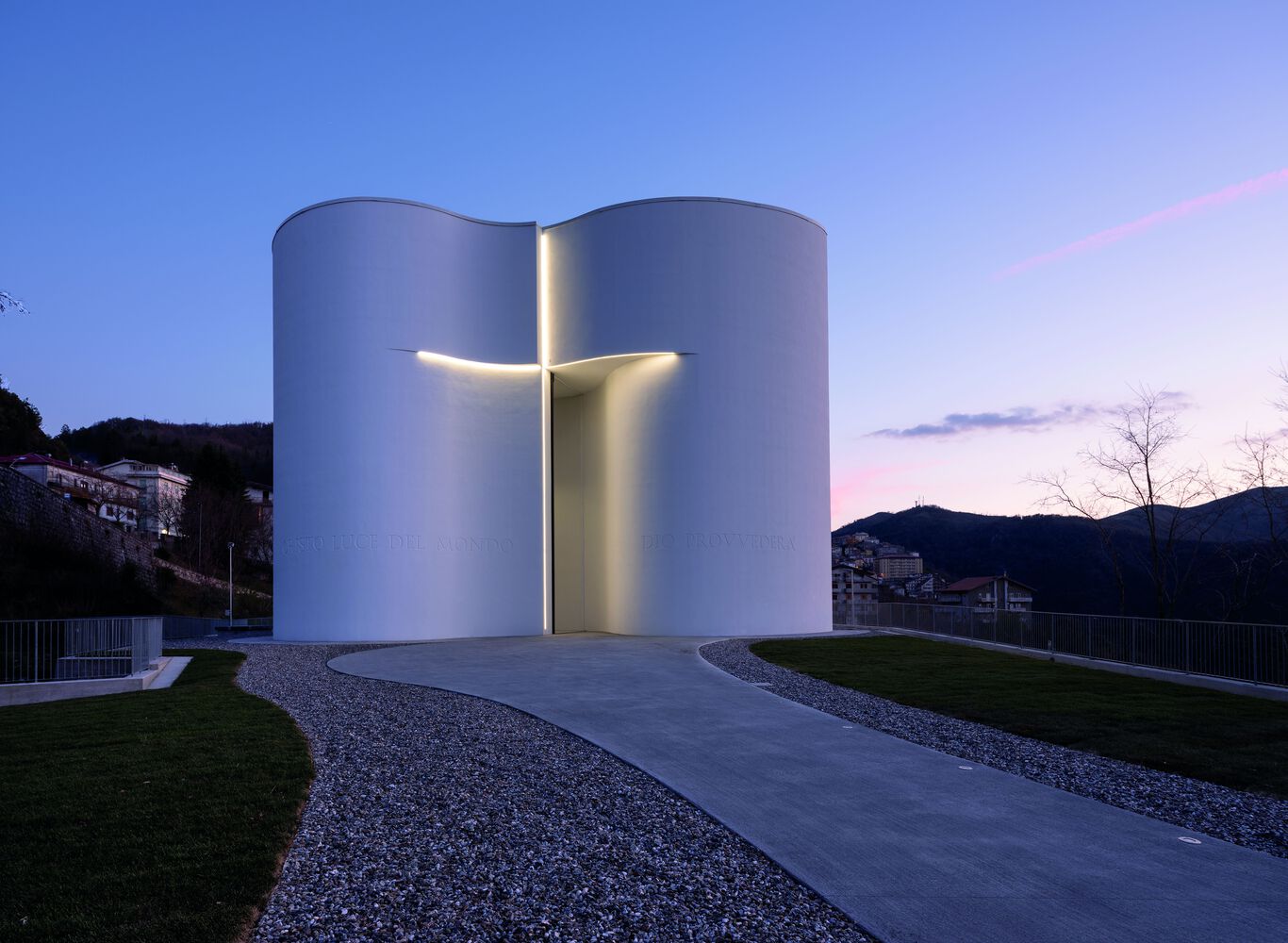
CHURCH ARCHITECTURE: Santa Maria Goretti Church, Mormanno, Italy: In 2013 architect Mario Cucinella won a competition held by Italy’s assembly of Catholic bishops to create the new parish church of Santa Maria Goretti in the hilltop town of Mormanno in Calabria. Because a third of the funds had to be raised locally, the project wasn’t completed until last year. Cucinella says that gave him time to win over its most important constituency: the elderly women who go to Mass every day, and who at first “were suspicious of its modernism.” [HT: My Modern Met]
Cucinella designed an elegantly minimalist concrete building with sinuous surfaces that form the shape of a four-leaf clover, a reinterpretation, Cucinella says, of the shape of Baroque churches. The enclosure has only a few openings. “On its north side, two walls part to create an entrance—while also contributing edges to a cross cut into the curves and lit by LEDs at night. On its south side, a small window is positioned to focus afternoon sunlight on a crucifix on July 6,” Maria Goretti’s birthday.
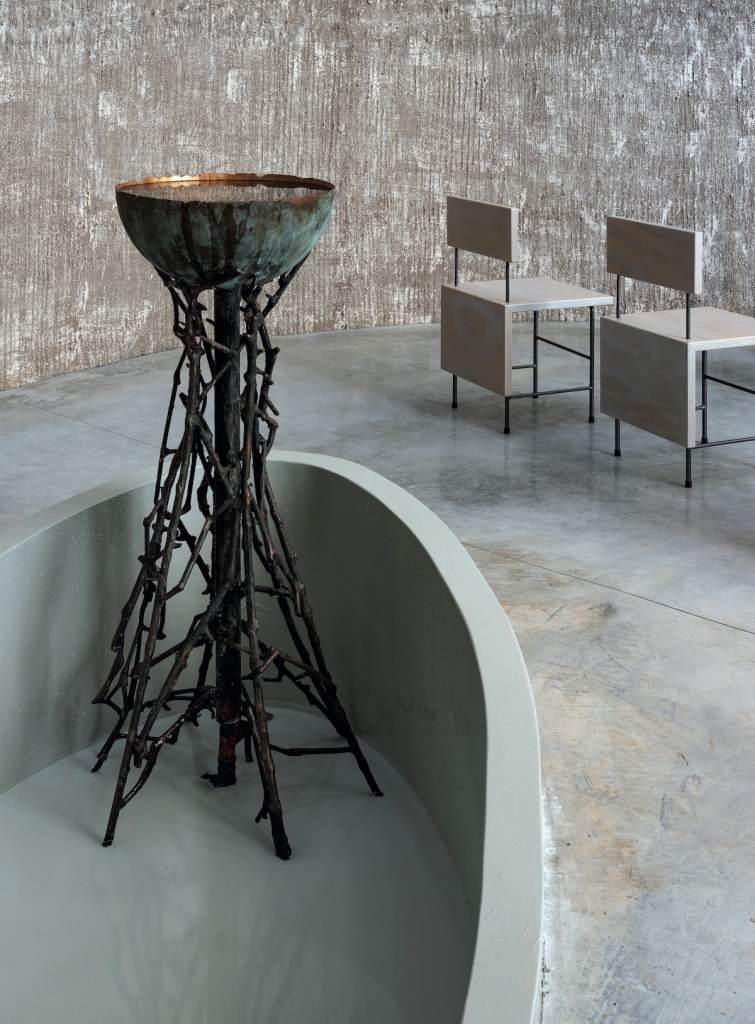
Santa Maria Goretti Church, Mormanno, Italy, designed by Mario Cucinella Architects, completed 2021. Photo: Duccio Malagamba.Photo: Duccio MalagambaBaptismal font by Giuseppe Maraniello. Photo: Duccio Malagamba.
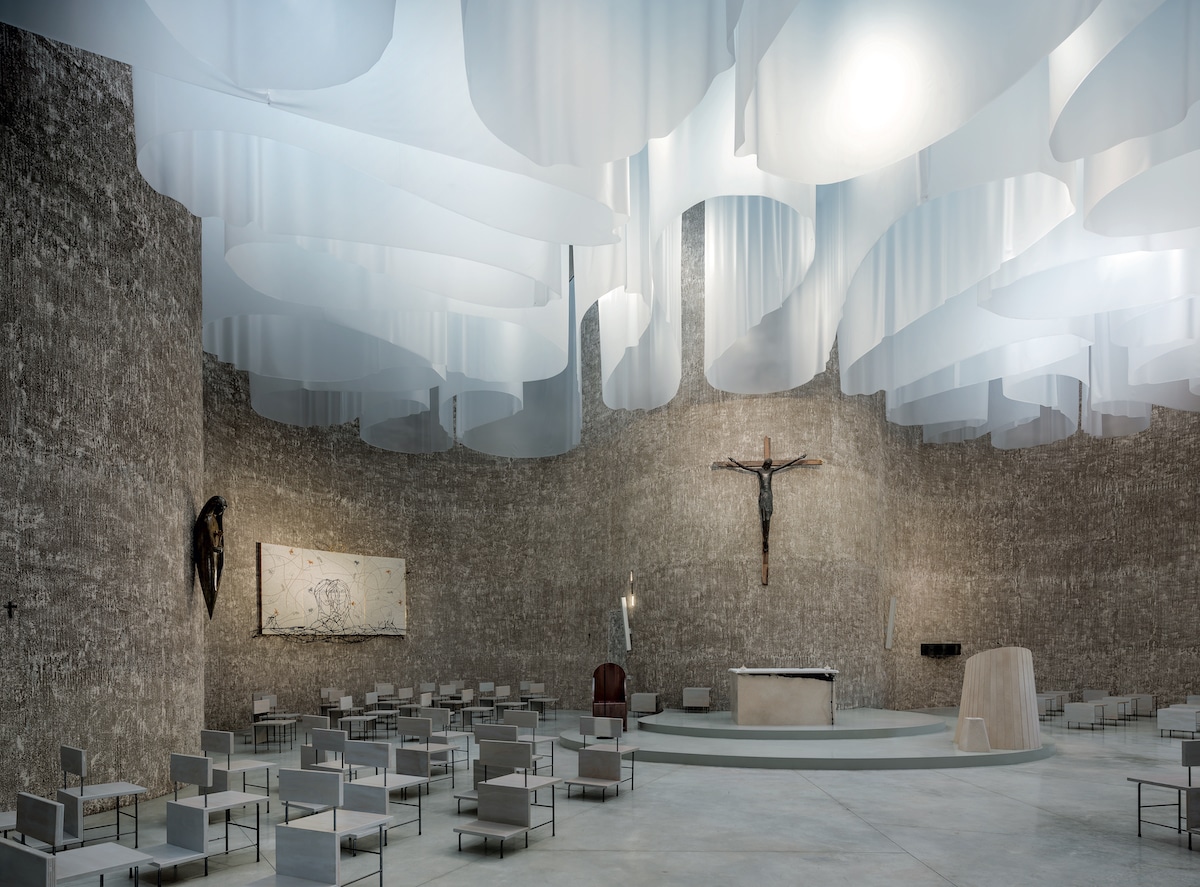
Inside, the walls are hand-finished in plaster mixed with hemp fibers and lime, which give them a mottled, earth-toned look. The most dominant feature of the interior is the twelve-foot-deep scrim that falls from the ceiling in swirls, filtering in sunlight. Artist Giuseppe Maraniello (b. 1945) was commissioned to create the lectern, tabernacle, baptismal font, and figure of the Virgin Mary, while the simple steel and wood seating is by Mario Cucinella Design. Click on any of the three photos above to view more.
The church’s namesake, one of the youngest saints to be canonized, was stabbed to death in 1902 at age eleven while resisting a rape. She is the patron saint of purity, young women, and victims of sexual assault.
11. Summer of Soul (. . . or, When the Revolution Could Not Be Televised), dir. Ahmir “Questlove” Thompson. The Harlem Cultural Festival of summer 1969, consisting of six free concerts spread out over six sequential Sundays, is a touchstone of Black music history and culture. Attracting over 300,000 people and known colloquially as “Black Woodstock” (Woodstock took place the same summer), it featured major pop, R&B, blues, jazz, funk, and gospel artists, including Nina Simone, Gladys Knight & the Pips, Mahalia Jackson, B. B. King, Stevie Wonder, the 5th Dimension, Edwin Hawkins, Mavis Staples, and Sly and the Family Stone. But because the festival got so little media attention, both during and in the fifty-plus years since, few people actually know about it.
Questlove combines archival footage of the incredible live concert performances—drawing from the forty-plus hours shot by festival coproducer Hal Tulchin, most of it never before seen—with interviews he conducted with participating musicians, audience members, and cultural commentators, as well as with other historical footage that gives a broader portrait of the times. Thoughtfully constructed, Summer of Soul highlights several movements taking place at the time within Black communities—civil rights, antiwar, Black pride, Black Power—anchoring them in musical expressions of those ideas. One thing that keeps coming up in the film is the therapeutic aspect of music, especially gospel music; several interviewees mention how music is one way they cope with unrest, trauma, and injustice and express their pain as well as their hope.
The concert took place only one year after the assassination of Martin Luther King Jr., and one of the highlights for me was gospel veteran Mahalia Jackson and a young Mavis Staples singing “Precious Lord, Take My Hand” as a tribute to him. (Seconds before King died, he had requested that song from Ben Branch, who was set to perform that night.) At one point Jackson passes the mic to Staples to let her solo, which could be read symbolically as her passing the gospel music baton to the next generation.
The most revelatory sequence for me was the one where the Staples Singers’ performance of “It’s Been a Change” is interwoven with contemporary interviews about the moon landing. As Apollo 11 touched down on July 20, 1969, and the astronauts’ disembarkment was being broadcast live around the world, thousands of Black people were gathered at a park in Harlem watching the festival concert, just as they had been for the past three Sundays, instead of their television screens. A journalist was there asking attendees why they were missing this important historic event, and the responses overwhelmingly boiled down to: it wasn’t relevant to them; this music was. Several expressed frustration that with the rampant poverty, hunger, and urban decay, the pouring of tax dollars into space exploration was not only a serious misuse of funds but also immoral. These sentiments are best encapsulated in the spoken-word poem “Whitey on the Moon,” written and performed by Gil Scott-Heron the following year.
Streaming on Disney+ and Hulu.
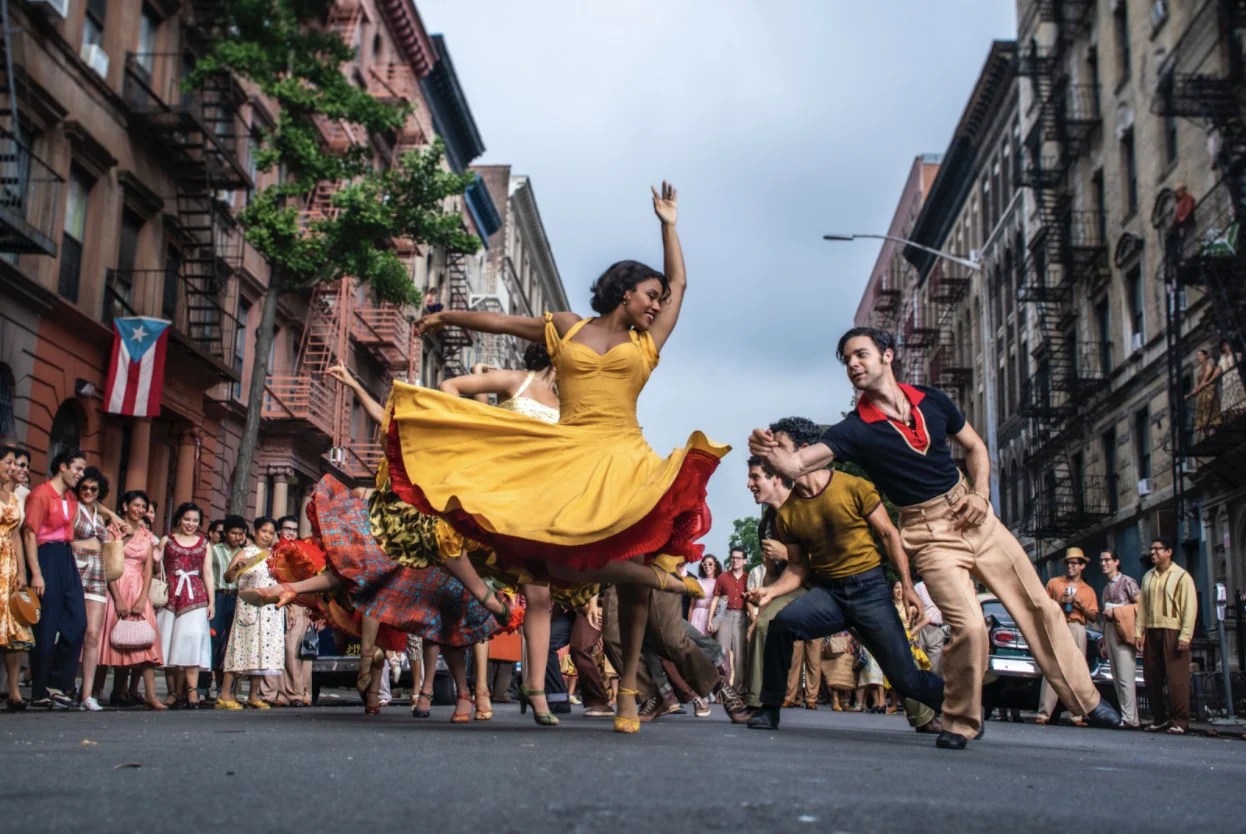
12. West Side Story, dir. Steven Spielberg. I was skeptical of this musical being remade, as the original film adaptation from 1961 is so iconic and well loved. But I must say, I actually prefer this version! The choreography, dancing, and cinematography are phenomenal. Filming dance sequences, especially with large ensembles, is a notorious challenge, and the scene of the school dance in the gym nails it. And rather than being confined to an apartment rooftop, as it was in ’61, the “America” number moves through the streets of Manhattan and is even more colorful and dynamic.
You’re probably already familiar with the storyline, which is inspired by Shakespeare’s Romeo and Juliet: two teenage lovers associated with rival New York street gangs, the Sharks (made up of Puerto Ricans) and the Jets (who are white), fall in love, with disastrous consequences. I’ve always thought the love story to be pretty shallow, and for all the narrative and character fixes/updates Tony Kushner makes to the source material in this screenplay, that doesn’t really change here. Tony (Ansel Elgort) and Maria (Rachel Zegler) are given a little more dimension, but I’m still not totally invested in their romance. And Maria’s quick forgiveness of Tony for what he does to her brother (no spoilers) is just baffling to me.
Still, I appreciate the added backstories given to several of the characters, and even to the turf wars. Spielberg makes it clear that the story is unfolding against the backdrop of the real-life slum-clearance projects in San Juan Hill (Lincoln Square), in which, beginning in 1959, the neighborhood’s majority Black and Hispanic tenants were evicted to make way for the building of Lincoln Center.
Anita (Ariana DeBose) leads the boisterous musical number “America” in Steven Spielberg’s West Side Story. Charismatic and layered, DeBose’s performance is my favorite in the film. (Her character is given more to do in this version.)
Spielberg also corrects an egregious flaw in the 1961 film, which was the casting of white actors in brownface to play Puerto Rican characters. (Even Rita Moreno, who was a Puerto Rican playing a Puerto Rican, was made to wear skin-darkening makeup as Anita in the original.) Spielberg took care to cast Latinx actors of various skin tones. He also has them speaking occasional Spanish in the film, which is not subtitled (he did not want to “other” the language). So there’s more ethnic and cultural authenticity, and the Puerto Rican characters are more rounded. However, I understand the criticism that the story itself, despite Spielberg’s modifications, still stereotypes Puerto Rican males as violent and ignorant, and Puerto Rican women as either virginal (like Maria) or fiery (like Anita).
For an alternative musical depiction of Puerto Ricans in New York City, set in the 2000s, I commend to you In the Heights, which also released last year. It didn’t crack my top 20, and I was not impressed by the female lead, but it’s a really enjoyable watch—and the concept, music, lyrics, and screenplay are actually by Puerto Ricans (Lin-Manuel Miranda and Quiara Alegría Hudes), not by white guys.
Streaming on Disney+ and HBO Max. (But if you can catch it on a big screen, do it!)
13. Together Together, dir. Nikole Beckwith. A type of aspiring parent that I’ve never seen onscreen before, and frankly have never even thought about, is the single man in middle age who, because he has no partner but really wants a child, uses a surrogate. This heartwarming pregnancy dramedy explores the odd relational dynamic between these two people—Matt (Ed Helms), who’s getting ready to be a father, and Anna (Patti Harrison), the young woman, a stranger at first, whom Matt hires to grow his child inside her.
Many Christians have strong opinions about how children should be brought into the world—that is, through the sexual union of a husband and wife. And while that is a beautiful and God-honoring process, not to mention the most practical, there are some for whom marriage never pans out but who still desire to experience the miracle of new life bred from one’s own genes, and the joys of parenthood. What might the bond between an expectant dad and his gestational surrogate look like? They share an incredibly intimate (but nonsexual) connection by virtue of the creative act they’re participating in together, but obviously it’s sticky, because one of the parties will have to cut her attachment to the child after the birth—or will she?
The movie subverts popular rom-com tropes by showing a deep platonic relationship between two nonrelated people of the opposite sex—and I really appreciate that. We’ve been programmed to want to see, and even to expect, these two people to become romantically involved, as that’s the happiest ending we can imagine. Beckwith gives us something different. Watching Matt and Anna’s friendship blossom throughout the film is so beautiful and gratifying, and the ending is perfect.
Streaming on Hulu.
14. The Mitchells vs. The Machines, dir. Michael Rianda and Jeff Rowe: In this animated family flick, the quirky and dysfunctional Mitchell family must band together to save the world from a robot apocalypse. It’s genuinely funny, and I appreciated the foregrounding of the father-daughter relationship, which starts out strained but heals and grows through shared crisis.
Streaming on Netflix.
15. Judas and the Black Messiah, dir. Shaka King. It’s Chicago, 1968. When Bill O’Neal (LaKeith Stanfield) is caught impersonating a federal officer to steal a car, the FBI agrees to drop all charges, plus give him a monthly stipend, if he will infiltrate the Illinois chapter of the Black Panther Party to gather intelligence on Chairman Fred Hampton (Daniel Kaluuya), whose message of Black liberation and community activism toward that goal have made him a perceived national threat.
This American biopic dramatizes Hampton’s rise to power and his assassination by police. A charismatic leader with strong organizational skills, Hampton was building an alliance among gangs and minority groups in Chicago—an antiracist, anticlass Rainbow Coalition. He taught political education classes, launched a project for community supervision of the police (to hold them accountable for brutality), helped set up a free medical clinic and a free breakfast program on the West Side, and more.
After striking his deal with the FBI, O’Neal was able to gain the trust of Party members through deception. He became Hampton’s driver and, later, his security captain. The information he supplied to agents about Hampton’s apartment layout enabled the infamous police raid on December 4, 1969, in which Hampton was gunned down while sleeping next to his pregnant girlfriend (Dominique Fishback), who survived—and who served, alongside Fred Hampton Jr., as a consultant on the film.
Significant as he is, Fred Hampton is not a person I ever learned about in school, so this film was educative for me.
Streaming on HBO Max.
16. Hive, dir. Blerta Basholli. This Albanian-language drama from Kosovo is based on the real-life story of Fahrije Hoti (played by Yllka Gashi). The film opens seven years after Fahrije’s husband went missing in the Krusha massacre in March 1999, during the Kosovo War.
Fahrije is a beekeeper, but she’s struggling to provide for her two children and her disabled father-in-law with local honey sales alone. So she starts her own business making and selling ajvar (a condiment made from roasted red peppers), first at the grocery store in town and later for export to other European countries. For help in this venture she recruits many of the other widows in Krusha, of varying ages, who form a “hive” of support for one another. But because the culture is very patriarchal, the women meet with hostility from the older men in the village who believe it’s dishonorable for women to be entrepreneurs and who see their economic independence as a threat to traditional values.
Grief and empowerment are interwoven in this inspiring story of a woman who dares to imagine a future for herself and her family apart from her husband, whom she painfully acknowledges (though not out loud) may be dead.
It’s now been twenty-three years since the massacre, and people in Krusha are still holding out hope for husbands and sons to return, putting pressure on the government to redouble its search efforts. More than 240 men from the village have been confirmed dead, while sixty-four remain missing.
Streaming on Kanopy.
17. Licorice Pizza, dir. Paul Thomas Anderson. I don’t know what to say about this one, except that it’s wacky and entertaining. An ode to LA’s San Fernando Valley of the 1970s, where writer-director Paul Thomas Anderson grew up, it centers on the “goofily chaste romance” (Alissa Wilkinson’s words) between fifteen-year-old Gary Valentine (Cooper Hoffman) and twenty-five-year-old Alana Kane (Alana Haim). She’s flattered by the attention he gives her and charmed by his precocity and cheeky drive; he, besides simply crushing on her, relishes her cheerleading and practical support for his upstart business ventures, like selling waterbeds and opening a pinball arcade. Although the age difference between Gary and Alana is a bit uncomfortable, the tone is light and the stakes are low. Their chemistry is not an erotic one, but rather one that’s sparked and sustained by their having fun together on ridiculous adventures.
18. The Tragedy of Macbeth, dir. Joel Cohen. “A tale of murder, madness, ambition, and wrathful cunning,” adapted here with stunning visuals that capture the mood of the play just right. Add to that a stellar cast. Kathryn Hunter as the three witches (aka “the weird sisters”) is especially compelling—sent shivers down my spine!
Streaming on Apple TV+.
19. Our Friend, dir. Gabriela Cowperthwaite. A celebration of faithful, embodied friendship, this drama is adapted from the 2015 Esquire article “The Friend: Love Is Not a Big Enough Word” that Matt Teague wrote after his wife Nicole’s death from ovarian cancer at age thirty-six. When Nicole (Dakota Johnson) is diagnosed and starts getting sick, her and Matt’s (Casey Affleck) friend Dane (Jason Segal) leaves his management job and girlfriend in New Orleans and moves into the Teagues’ house in Fairhope, Alabama, to provide care and support for as long as he’s needed—which ends up being fourteen months! He gets their girls ready for school in the mornings, cooks meals, does the laundry, provides mental and emotional support, and helps Nicole accomplish her bucket list. The film is sweet and sad and joyful all at once.
Our Friend has been criticized for not portraying several of the physical horrors of cancer that Matt describes in the article. But I’d say that even though it’s not particularly graphic, the film still presents cancer as ugly and disruptive and painful and exhausting; rightfully, it does not romanticize terminal illness or death. What is a shame, I’ll mention, is that the central role Christian faith plays in the Teagues’ lives, as Matt has been vocal about in interviews and Nicole shared a lot about on her cancer blog and on YouTube, is entirely absent from the film.
Segal is excellent as Dane. And it’s beautiful to see not just Dane’s sacrificial love but also the Teagues’ dedication to and inclusion of Dane throughout their married life, as we see in the many flashbacks that develop their friendship story. Married couples, especially ones with kids, tend to maintain relationships mostly with other married couples, not with singles, which should not be so—so I love that the film highlights this trio of friends in a meaningful way.
Streaming on Amazon Prime.
20. A Hero, dir. Asghar Farhadi. Rahim (Amir Jadidi) is on leave from debtors’ prison when he finds a bag of gold. He seeks to return it to its owner and becomes a local celebrity—until some people start to question his integrity.
I know, I know. My top 20 list of films from 2021 is very late. Several that I wanted to see before compiling the list didn’t come to a theater near me until after the Oscar nominees were announced . . . But better late than never, right?
I’m breaking up the list into two separate posts.
I am counting films as from 2021 if they were released in the US in that year. If the film is available for free through a streaming service to subscribers, I will mention that at the end of the description; most of the others can be rented online for a fee, or you might also try checking your local library for a DVD.
Note: Several of these films are rated R, and for a variety of reasons. If you want to avoid specific types of mature content, I suggest you consult the Parents’ Guide on the IMDB page of whatever movie you’re considering watching.
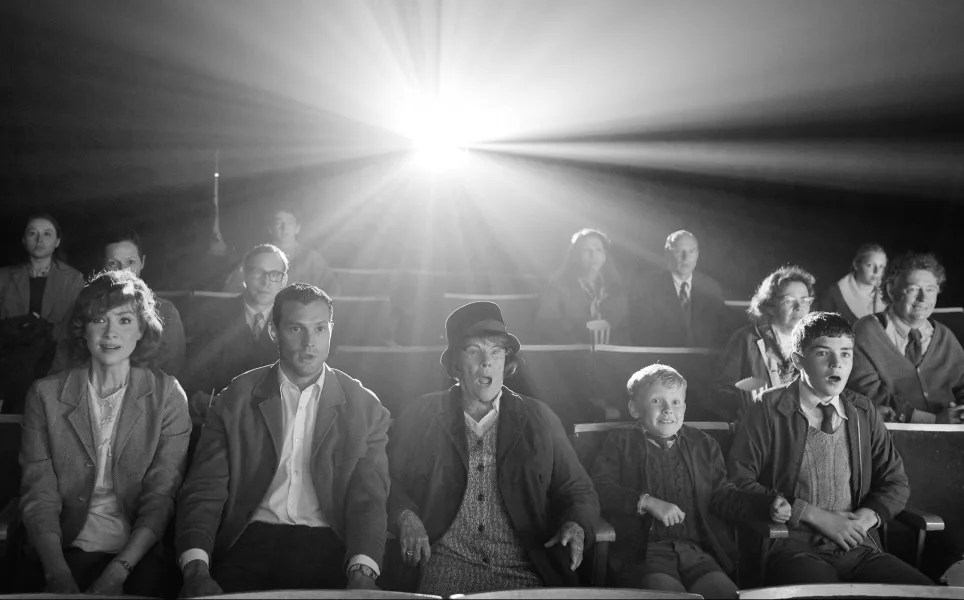
The joy of cinema is one of the themes in Kenneth Branagh’s semiautobiographical film Belfast, as all three generations of Buddy’s family enjoy going to the movies together. In this still, they react to the flying car riding off the cliff in Chitty Chitty Bang Bang.
1. Belfast, dir. Kenneth Branagh. Drawn from writer-director Kenneth Branagh’s own childhood, Belfast takes place in 1969–70 in a working-class neighborhood in the Northern Ireland capital, at the beginning of the thirty-year period of political violence known as the Troubles. This conflict was between (mostly Catholic) nationalists seeking independence from Britain, and (mostly Protestant) loyalists who saw themselves as British and thus sought to preserve Northern Ireland’s union with Britain. The focus of the film, however, is on family, not politics, as all the events of the year are filtered through the perspective of nine-year-old Buddy (Jude Hill). He sees his dad, for example, who refuses to participate in the riots, as a hero in the vein of his favorite western film characters.
Belfast is poignant and nostalgic and not at all the worse for being so. The “Everlasting Love” scene near the end is euphoric—and well earned!—and made me cry. In the wake of a death and amid financial debt, impending displacement from what has been their family’s hometown for generations, and other marital strains, Pa (Jamie Dornan) sings a pop song to Ma (Caitriona Balfe) from a lounge stage and pulls her into a dance, creating a moment of pure celebration, love, and defiant survival. The film’s highlight for me is how it holds together life’s joys and struggles, sorrows and laughter. Branagh, who moved with his parents and brother from Belfast to Reading, England, at age nine to escape the violence, dedicated the film to “those who stayed, those who left, and those who were lost” in Belfast.
2. The Power of the Dog, dir. Jane Campion. An adaptation of a Thomas Savage novel, this film subverts the traditional image of the western cowboy, exploring male virility, vulnerability, and agency. What is required to protect those you love? Is it muscles and bluster and a “gloves off” sort of grit, or a courage rooted someplace else?
Set in Montana in 1925, the film centers on the macho-posturing Phil Burbank (Benedict Cumberbatch), who runs a cattle ranch with his brother George (Jesse Plemons). When George marries the widowed Rose (Kirsten Dunst), she and her impressionable teenage son Peter (Kodi Smit-McPhee) settle at the Burbank estate. Phil is set off by Peter’s “sissiness”—his willowy frame, his slight lisp, his delight in crafting paper flowers for his mother—and he reacts with incessant bullying. He is cruel, mocking, and emotionally abusive not only to Peter but also to Rose, whom he resents for layered reasons.
The ending makes us see one of the characters in a completely different light and therefore prompts us to reread some of the emotional dynamics we have witnessed. The title comes from Psalm 22:20: “Deliver my soul from the sword; my darling from the power of the dog” (KJV).
Streaming on Netflix.
3. The Lost Daughter, dir. Maggie Gyllenhaal. Ambivalence toward motherhood is rarely explored onscreen. We see mother characters overwhelmed and exhausted, even stifled, but the sacrifices they make in those roles are almost always portrayed as ultimately worth it for the profound love and joy they experience as a result of being a mom. Because we’re conditioned, culturally and religiously, to view children as an unmitigated blessing, to express any kind of regret about having children is taboo (we’re only allowed to regret not having children). Women are expected to relish their role as mothers and to find their deepest fulfillment in that role, and if they don’t, they’re branded as “bad” or selfish.
I can already hear the alarm bells going off with my readers right now. “Children are a gift from God! How dare we be anything less than grateful for them! Women are designed to bear and nurture life! What could possibly be more fulfilling than living out that design?” One of the great things about films is that they often help us to enter into other experiences and perspectives, to access the feelings of another and, through that, our own. That doesn’t mean we forsake our beliefs and convictions, but we open ourselves up to a story that could challenge our sometimes overly simplistic thinking. One doesn’t have to reject the Bible to acknowledge that motherhood is messy and that for many women it requires them to confront (or else bury) darker pulls and emotions. Contrary to what we’re often told, motherliness does not come naturally to all women! There’s much more I could say about this, but let’s get to The Lost Daughter:
First-time writer-director Maggie Gyllenhaal, who herself has two daughters, wanted to make a film that explores all the complicated, unresolved emotions surrounding motherhood, which can include terror, anxiety, doubt, annoyance, and despair. An adaptation of Elena Ferrante’s novel of the same title, it follows Leda (Olivia Colman), a middle-age literature professor on holiday in Greece. One day on the beach she encounters a young mother named Nina (Dakota Johnson), who triggers Leda’s memories of her own two daughters, now in their twenties. We see flashbacks to Leda’s life as a struggling twenty-something mom (played by Jessie Buckley). She loves her children but feels plundered by them. And so she does something “aberrant,” as Gyllenhaal put it in an interview, which we find out about halfway through the film.
The film neither punishes nor condones its protagonist’s behavior. To what degree Leda feels guilt, regret, or satisfaction, and about what specifically, is largely left to the viewer to interpret, as she’s a hard one to read. (Colman gives us a very interior performance, which I think is to her and the film’s credit.) She is obviously troubled by past decisions, as her dizzy spells and thievery would suggest. There is also quite a bit of open-ended symbolism at play throughout.
Streaming on Netflix.
4. Drive My Car, dir. Ryûsuke Hamaguchi. The forty-minute prologue of this three-hour film establishes the relationship between theater actor-director Yusuke Kafuku (Hidetoshi Nishijima) and his screenwriter wife, Oto (Reika Kirishima). Within this pocket of time, Oto dies of a cerebral hemorrhage—after Yusuke finds out about her having an affair but before he confronts her about it. Roll opening credits.
Based loosely on a short story by Haruki Murakami, Drive My Car is about grief, intimacy, betrayal, forgiveness, self-knowledge, and communication across barriers. Two years after his wife’s death, Yusuke participates in a residency in Hiroshima, where he has been invited to direct a multilingual stage production of Chekhov’s Uncle Vanya, about a forty-seven-year-old man who is so world-weary that he wants to die. Yusuke’s concept is for the actors to act in their native language—Mandarin, Japanese, Korean, Korean Sign Language—feeding off their dialogue partner’s tones, speech rhythms, body language, and facial expressions, while subtitles are projected on a screen for the play’s audience.
Yusuke’s emotional healing comes through his work on this play (“Chekhov is terrifying because his lines drag the real out of you,” he says) and through the friendship he develops with his assigned driver, Misaki Watari (Toko Miura), a young woman who also carries a private grief. The two help each other come to terms with loss and regret and learn how to live again.
Streaming on HBO Max.
5. Flee, dir. Jonas Poher Rasmussen. This animated documentary chronicles the refugee experience of Amin Nawabi (not his real name), who fled from Afghanistan to Russia with his family in 1992 when he was eleven to escape the Mujahedeen attacks that became more frequent in Kabul after the Soviet withdrawal. He sought asylum in Europe for the next few years as an unaccompanied minor and eventually settled in Denmark, where he attended high school in Copenhagen and became friends with classmate Jonas Poher Rasmussen, now a filmmaker. More than twenty years later, he is telling his story for the first time, and it is Rasmussen he has entrusted it to.
The use of animation, a rare but not unheard-of choice for a documentary, has several advantages. It enables the subject to remain anonymous for his own safety. It allows for the re-creation of scenes from Amin’s childhood that were not, and could not have been, captured on film. And it enhances the expressiveness, tone, and meaning of certain scenes. The animation is supplemented, sparingly, with archival newsreel footage that gives historical veracity to some of Amin’s memories. And an important link to “the real” is forged by the use of Amin’s own voice in the animated interview sessions, conducted over several years, and sometimes in voiceover in the flashbacks. (His younger self is voiced by actors who capture him at two different ages—nine to eleven, and fifteen to eighteen.)
Throughout the film, Amin works to integrate his past and present and to make a home (“someplace safe, somewhere you know you can stay, and you don’t have to move on”) with his fiancé, Kasper, whom he has not yet spoken his traumas to.
Streaming on Hulu.
6. CODA, dir. Sian Heder. Sure, this film follows a predictable narrative arc and hits all the notes you would expect. But it’s so good! Seventeen-year-old Ruby (Emilia Jones) is the only hearing member of her family (CODA = child of deaf adults). Before school each day she works on the family’s fishing boat with her dad (Troy Kotsur) and older brother (Daniel Durant), while her mom (Marlee Matlin) runs the business side of things. But she finds herself increasingly drawn toward singing as a career path, and she starts to consider applying to Berklee College of Music in Boston.
The conflict is a familiar one: follow the plans your parents have laid out for you, or chase your own dreams, your own calling. Ruby needs to find her identity apart from being her family’s interpreter. But how can she honor the talents she’s been gifted with and her family obligations? Ruby’s parents slowly learn to accept and support her ambitions, even though they revolve around an auditory art form that is not accessible to them, and even though it means she’ll have to leave home. A turning point comes when they see her sing a duet at a school concert. In what is the most moving scene in the film, they experience the performance through watching the reactions of others in the audience.
Streaming on Apple TV+.
7. The Killing of Two Lovers, dir. Robert Machoian. A stylish arthouse drama set in rural Utah, this film follows David (Clayne Crawford), who’s desperately trying to keep his family of six together during a separation from his wife, Niki (Sepideh Moafi). He refuses to accept that the marriage is over. Shot in a 4:3 aspect ratio and with lots of long takes, the film is raw, potent, unflinching. And I love where it ends up.
Streaming on Hulu.
8. The Truffle Hunters, dir. Michael Dweck and Gregory Kershaw. This documentary made me smile more than any other film I saw last year. It’s so tender, and so gorgeously shot. And it’s got to be my favorite dog movie!
Truffle hunters are typically a secretive bunch, but the filmmakers got access to several of these elderly men from northern Italy who forage the forests with their trusty dogs, seeking out the edible fungus, a gourmet delicacy, to sell at high-priced auctions or on the black market. There are no interviews, no voiceovers—just a quietly observant camera. Despite the high prices truffles fetch, the hunters live simple lives in their Piedmont villages. And each has his own personality.
There’s a heavy focus on the relationship between the men and their dogs. They share meals with them, take baths with them, sing “Happy Birthday” to them, bring them to church. Aurelio, who is single and has no children, looks for someone to take care of his dog Birba when he dies; his chatter with Birba, and his expressions of love (like baking her a cake for her birthday), is the most endearing part of the film. It was also precious to see Titina, Carlo’s dog, being blessed by a priest—to use her gift of scent to serve others, to bring joy, as her finds will end up being used to make delicious dishes.
9. The Father, dir. Florian Zeller. Because of the COVID-19 extended eligibility period for Oscar submissions last year, this film was technically part of the 2021 Academy Awards, even though it was released in February 2021. Anthony Hopkins, who won Best Actor for this role, plays Anthony, an elderly man with dementia. As he loses his grip on the things and people around him, he becomes easily agitated and resists the care of his daughter Anne (Olivia Colman).
Zeller said he wanted the audience to feel as though, like Anthony, they’re “groping their way through a labyrinth,” so he wove a complex narrative that mixes reality with Anthony’s memories. We are made to feel his confusion, terror, frustration, and disorientation, in part by the use of multiple actors to portray a single character, such that we’re also not sure who’s who and what’s going on. Kudos to editor Yorgos Lamprinos and production designer Peter Francis for their work, as both those skills are key in pulling off this kind of storytelling.
The film is heartbreaking—the biggest downer on my list, for sure, especially with its climactic scene where Anthony breaks down and cries for his mommy. But by inviting us into Anthony’s suffering, The Father develops our empathy for those whose brains stop functioning properly in old age, for whom the world no longer makes any sense—an incredibly fearful thing.
10. C’mon C’mon, dir. Mike Mills. Johnny (Joaquin Phoenix) is a radio journalist who travels the US asking kids big questions about life. When his sister (Gaby Hoffmann) is forced to deal with a mental health crisis her ex-husband is experiencing, Johnny becomes the caretaker of her son (Woody Norman) for an extended period. The uncle-nephew bonding that follows constitutes the core of the film. UnlikeThe Lost Daughter, C’mon C’mon paints a bright and affirmative portrait of parenthood. It acknowledges the challenges of raising children while also celebrating the many small, beautiful moments of connection that are possible between adult and child.
SONG: “Put out into the deep” by David Bednall (2008), performed by The Gesualdo Six (2020): A verbatim setting of Luke 5:1–11 (RSV), the calling of the disciples, which is the Revised Common Lectionary reading for February 6.
+++
ESSAYS:
>> “Ghosts in Los Angeles” by Arthur Aghajanian, Ekstasis: The author of this essay reflects on Andres Serrano’s Nomads (1990), a humanizing series of portrait photographs of men and women experiencing homelessness in New York City. “Serrano titled each photograph with its subject’s first name, suggesting a familiarity with those portrayed while retaining their anonymity. . . . The images mimic the visual style of fashion and advertising, while also referencing historical portraits of the wealthy and powerful. The work restores the visibility along with the dignity of its subjects. . . . His diverse group reflects the vulnerabilities we all share, and the grace that sustains us in adversity.”
Andres Serrano (American, 1950–), Bertha, from the Nomads series, 1990. Cibachrome, 152 × 125 cm.
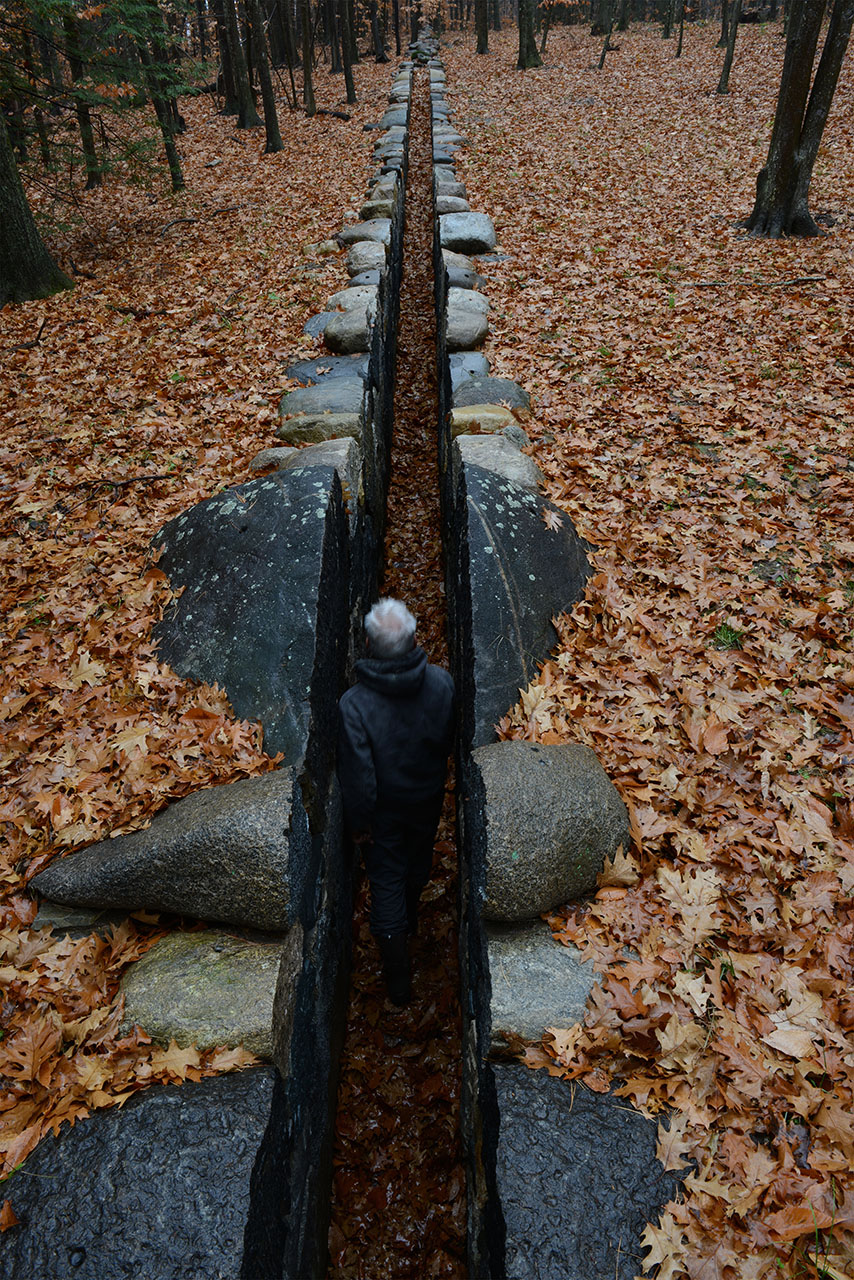
>> “The Cleft in the Rock: A Theology of Negative Spaces” by Daniel Drage, Image: This Image journal essay explores profound negative spaces in scripture—the first Sabbath, exile, the passage opened up by the parting of the Red Sea, empty wombs, tombs, nail wounds, the cleft of a rock, the space between the gold cherubim’s wings above the mercy seat—bringing them into conversation with works by contemporary British sculptors David Nash, Rachel Whiteread, and Andy Goldsworthy. Emptinesses that are full and presence via absence are key ideas.
Andy Goldsworthy (British, 1956–), Passage, 2015. Granite. Private collection, New Hampshire. Copyright of the artist.
+++
ANIMATED SHORT FILMS:
>> Migrants, dir. Hugo Caby, Antoine Dupriez, Aubin Kubiak, Lucas Lermytte, and Zoé Devise: The graduation project of five film students from the Pôle 3D school in France, this short follows a mother polar bear and her cub who are displaced from their Arctic home. When their ice float runs aground a new habitat and they’re forced to learn a new way of life, the native brown bears treat them with hostility. The filmmakers said the project was initially inspired by the story of the Aquarius, a watercraft filled with refugees that grabbed global headlines when it was refused entry at Italian ports in 2018. [HT: Colossal]
>> Tokri (The Basket), dir. Suresh Eriyat: A father-daughter story set in Mumbai, this stop-motion animated short from Studio Eeksaurus is about mistakes and forgiveness, and how meaningful a kind extended hand from a stranger can be . . . or not. [HT: Colossal]
WEBINAR: “Formational Films Round-Up: Movies That Matter,” hosted by Renovaré: Recorded August 24, this is an excellent eighty-minute conversation with film critic and professor Jeffrey Overstreet [previously], minister Catherine Barsotti, and theologian Chris Hall, led by Carolyn Arends [previously]. Each of the three guests identifies and discusses five films that have been spiritually formative to them—and what great selections! (Though there are four I have not yet seen.) Barsotti’s number one is one of my all-time favorites.
Because the movie ratings issue (that is, content like violence, sex, and/or profanity) is almost always raised by Christian audiences, Arends asks, “Are there some films that are bad for you to watch, and if so, why?” The question is wisely addressed from 34:52 to 49:40.
+++
INTERVIEW: “We must become poetry,”Still Life: For the September 13, 2021, edition of his weekly Still Life letter, Michael Wright [previously] interviewed Christian author Paul J. Pastor, having been intrigued by a recent tweet of his, which asks, “Where are the bardic preachers, wild at the eye, speaking not just to mind or heart, but to gut?” Pastor talks about the connection between the seen and the unseen; the relationality of poetry and finding shelter in the words, images, and emotions of another; holistic knowing; the disservice of reducing the Bible’s poetry to moral lessons with tidy applications; the nearness of Walt Whitman’s poetic vision to the Christian vision of sanctification; and more.
“My passion is for Christians to reclaim our way’s remarkable resources for living virtuously, beautifully, and well,” he says. Mine too!
To subscribe to Still Life, distributed for free every Monday over email, click here.
+++
Lecture by David Brinker for the 8th Catholic Arts Biennial, Verostko Center for the Arts at Saint Vincent College, Latrobe, PA, September 12, 2021: I mentioned the call for entries for this exhibition back in June. Of the 396 entries from artists from around the country, MOCRA director and guest juror David Brinker has selected 52. In this talk given the weekend after the exhibition’s opening (which starts at 14:47), he discusses the following three questions, pulling in artworks from the current exhibition and from his twenty-five-plus years as an art curator at a Catholic institution.
What identifies contemporary art as “Catholic”?
What contributions can Catholic art and artists offer to the broader contemporary art world?
What can Catholic art and artists receive from the broader art world?
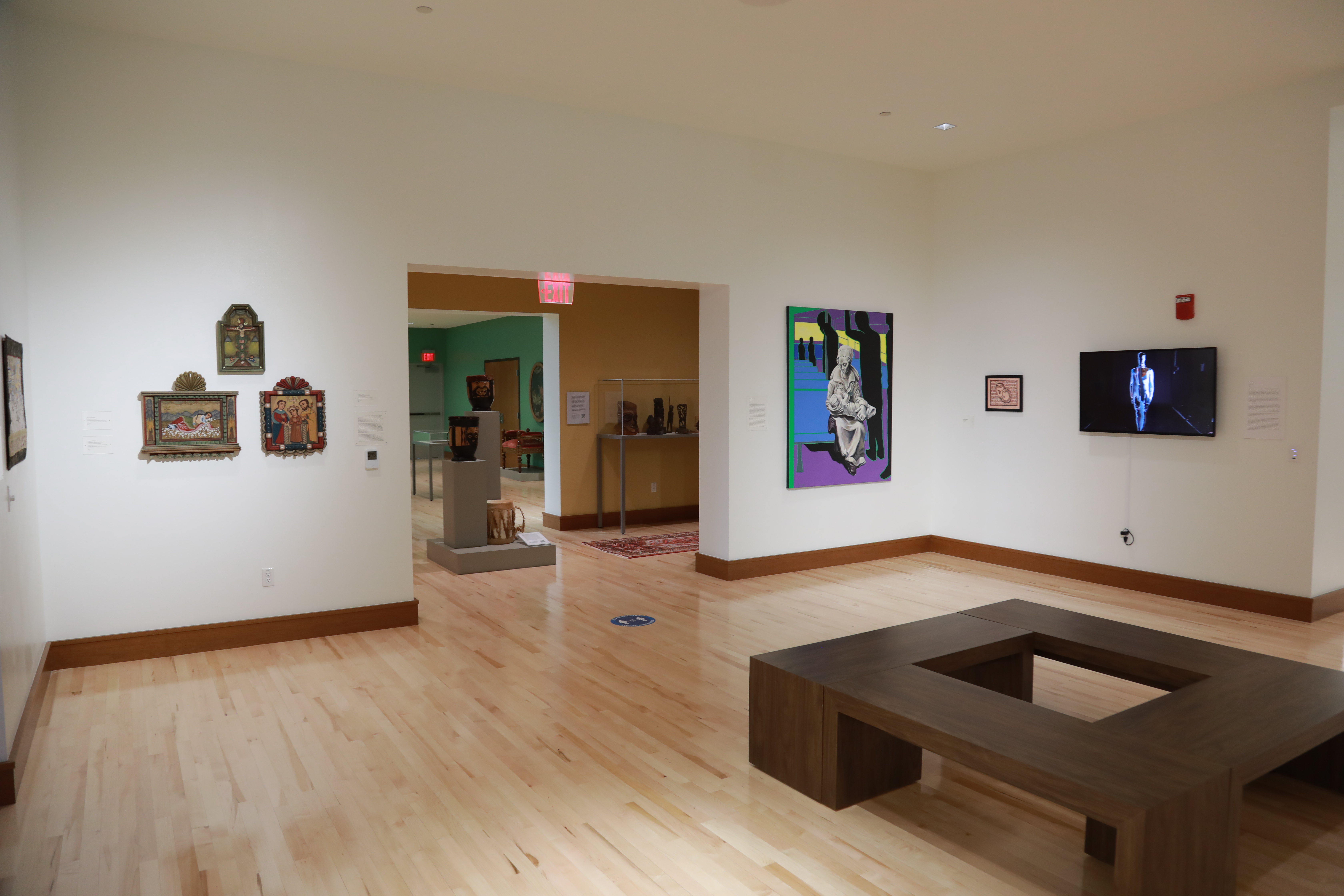
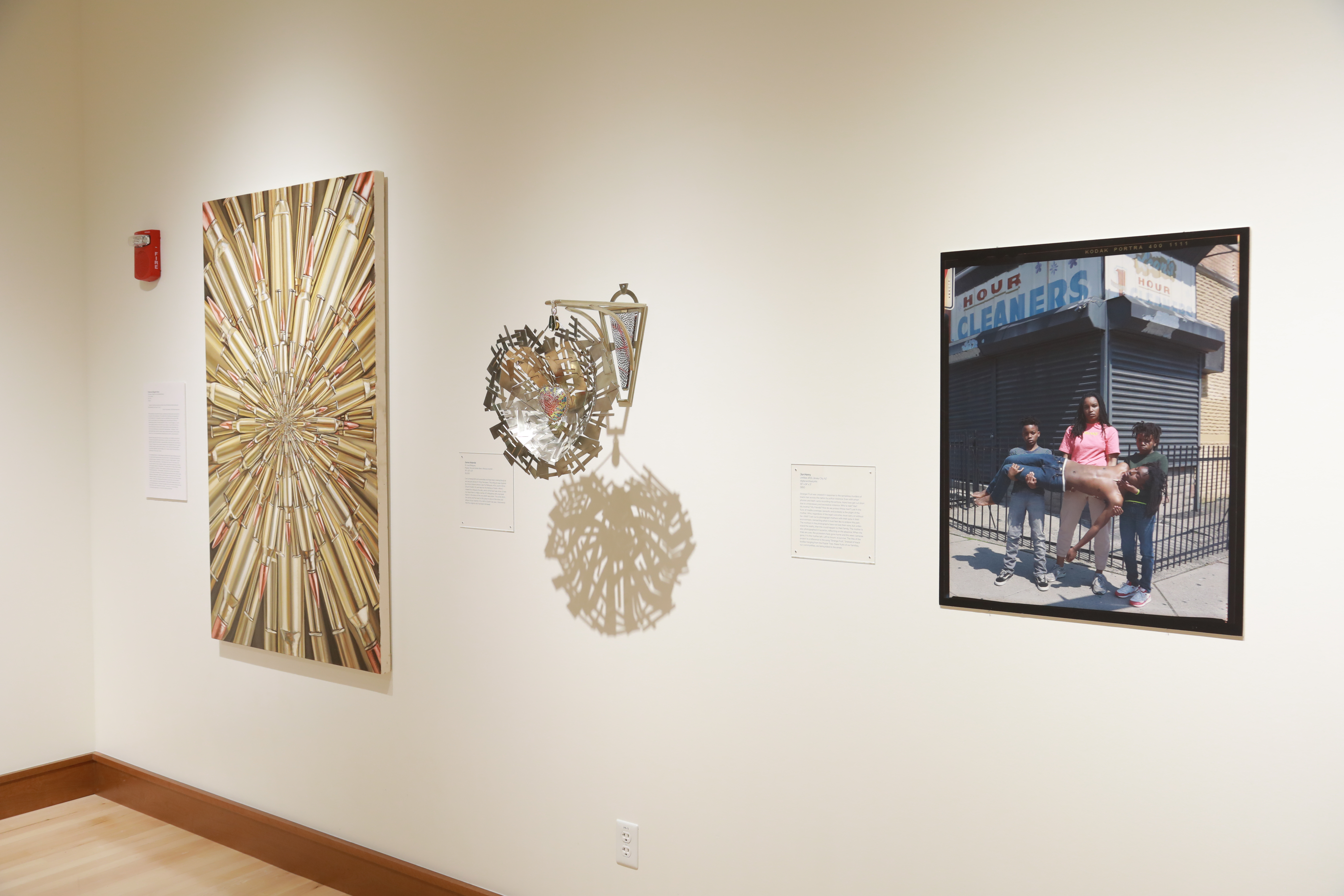
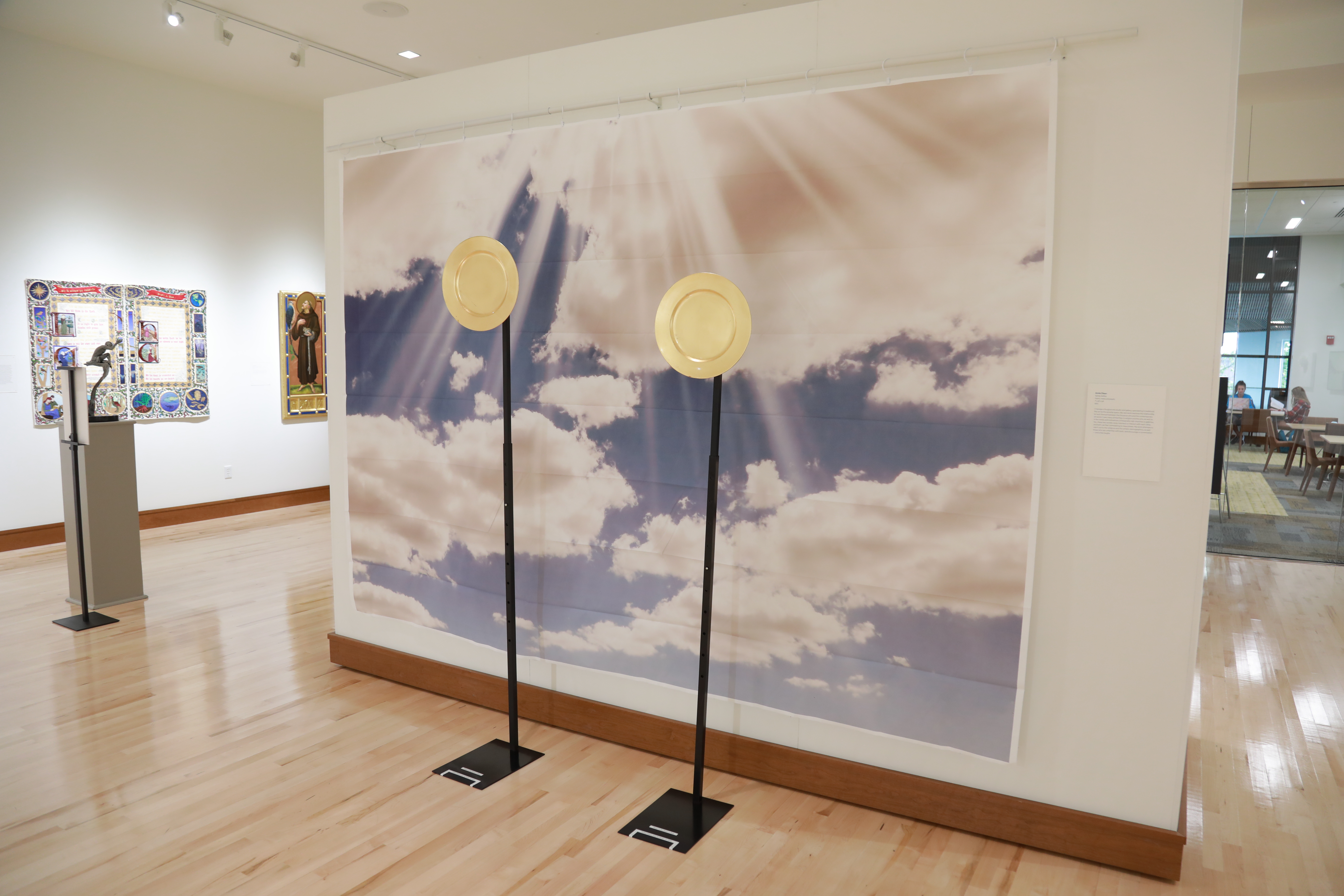
Exhibition view, 8th Catholic Arts Biennial. From left to right are three retablos by Vicente Telles, Maternidad by Piki Mendizabal, Iesu in Utero by Rebecca Spilecki, and The Living Temple by Jesse Klassen.The Heart of Man by Kristen van Diggelen Sloan; St. Laud Reliquary by James Malenda; Untitled, #33, Jersey City, NJ by Jon HenryForeground: Saintly Selfies by Annie Dixon
(The three photos above are provided courtesy of the Verostko Center for the Arts.)
Saint Vincent’s 8th Catholic Arts Biennial exhibition is on view through October 29, 2021; off-campus visitors are asked to make an appointment by emailing verostkocenter@stvincent.edu. While you’re in the area, you might also want to visit the Fred Rogers Center at Saint Vincent College, which houses artifacts from Mister Rogers’ Neighborhood as part of a larger permanent exhibition on his life, work, and influence. (Latrobe was Fred Rogers’s hometown.) And Pittsburgh is just an hour away!
+++
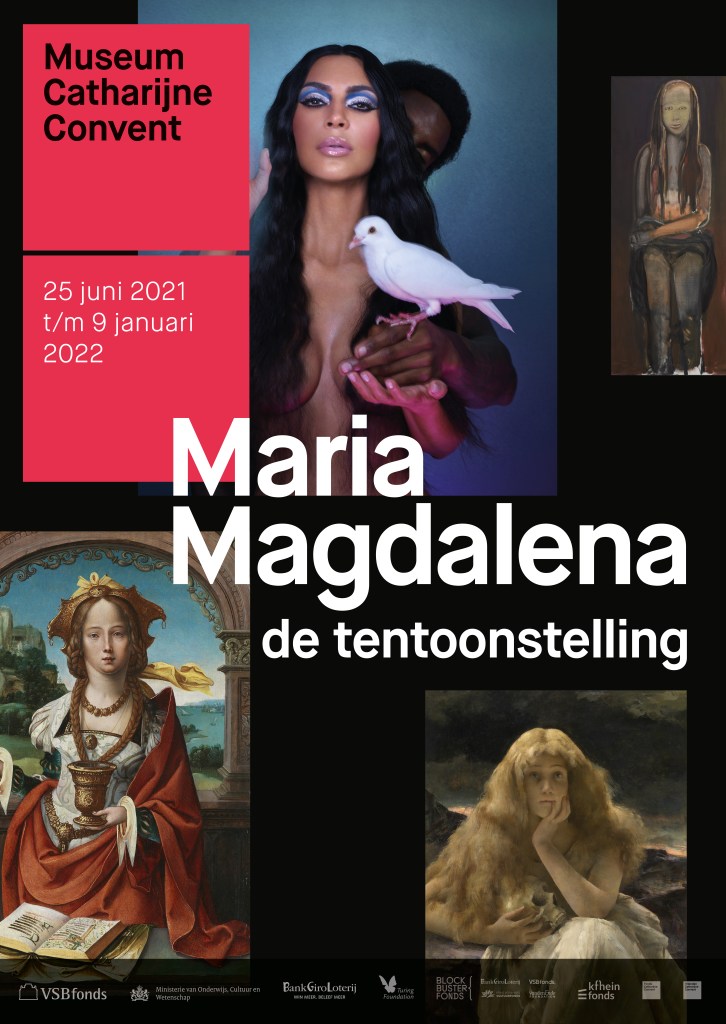
EXHIBITION: Maria Magdalena (Mary Magdalene),Museum Catharijneconvent, Utrecht, Netherlands, June 25, 2021–January 9, 2022: Curated by Lieke Wijnia. “Mary Magdalene is one of the most enigmatic women from the New Testament. Through a trans-historical display of artistic representations from the eleventh century to the present day, this exhibition explores the enduring fascination for this mysterious saint.” The catalog, Mary Magdalene: Chief Witness, Sinner, Feminist, is available in Dutch or English from the publisher Waanders. In addition to the exhibition page on the museum’s website, which hosts select images and a series of videos, resources in Dutch include an audio tour (with images), a podcast episode and accompanying article, and a video preview with commentary by Karin Haanappel.
I’m fascinated by Mary Magdalene, and while I won’t get to see this exhibition, it appears that it does an excellent job of exploring the many facets of her life and identity (including both before meeting Jesus and after his ascension), as told through canonical and apocryphal texts, and her complicated reception history. It addresses her role as the first witness to Jesus’s resurrection; the so-called Gnostic Gospel of Mary, which has Peter saying, “Sister, we know that the Savior loved you more than the rest of the women. Tell us the words of the Savior which you remember—which you know (but) we do not, nor have we heard them”; the legacy of Pope Gregory the Great’s infamous Easter sermon of 591 CE, which, in its (many would say erroneous) conflation of the Magdalen with other New Testament women, identified her as a converted prostitute; the development of legends about her later life in southern France, as an evangelist, a miracle-worker, and a penitent, cave-dwelling ascetic; modern films and literature that cast her as a romantic lover, or even the wife, of Jesus; and Pope Francis’s elevation of her liturgical commemoration from an obligatory memorial to a feast day in 2016, in which she is to be celebrated not as a fallen woman doing penance but as the “apostle to the apostles,” a title of hers dating back to the High Middle Ages.
The poster above features Mary Magdalene Receives the Holy Spirit by American photographer David LaChapelle, Magdalena by contemporary South African artist Marlene Dumas, The Magdalen from a sixteenth-century Flemish workshop, and Mary Magdalene by nineteenth-century Belgian artist Alfred Stevens.
+++
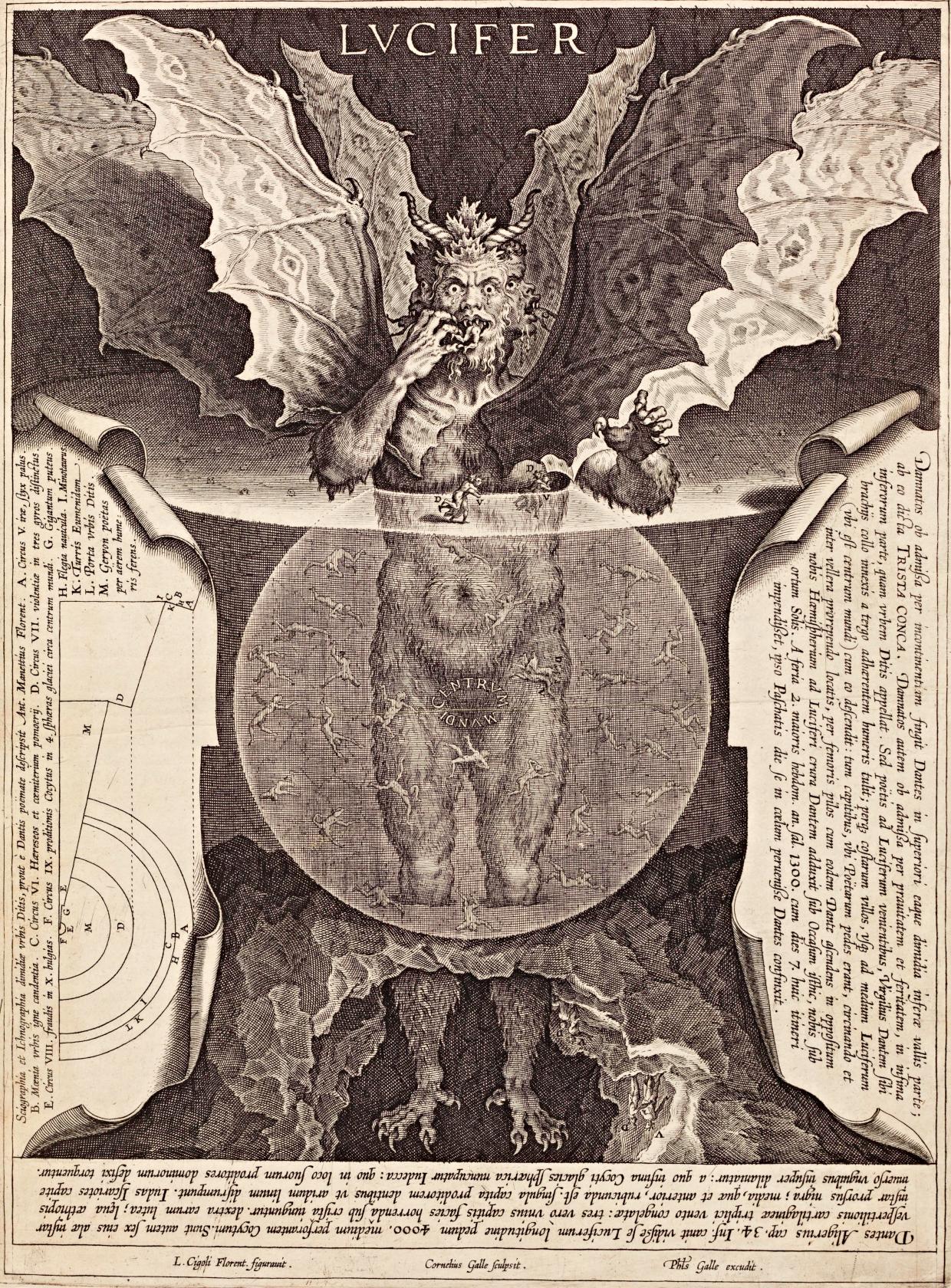
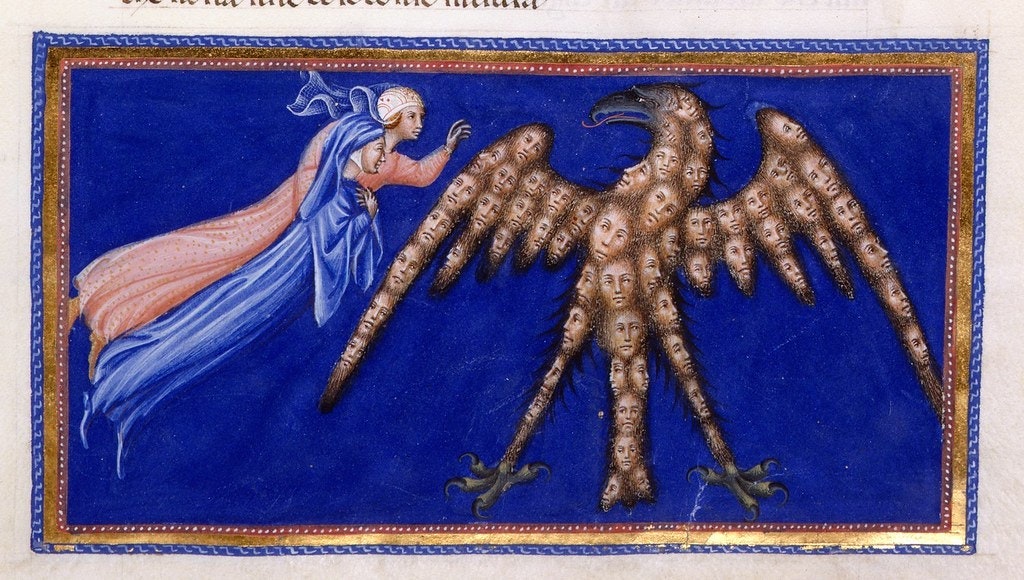
ARTICLE: “700 Years of Dante’s Divine Comedy in Art”: In honor of the seven hundredth anniversary of the Italian poet Dante Alighieri’s death on September 14, the Public Domain Review has collected art directly inspired by his Commedia from over the last seven centuries—on the nine circles of hell, the beatific vision, and much more. Under the tutelage of literature professor Stefano Gidari, I read and studied Dante’s groundbreaking afterlife-adventure trilogy—in Italian!—in 2009 while living in Florence, where it was written, which was such an invaluable experience.
Cornelis Galle I (Flemish, 1576–1650), Lucifer, after Stradanus, ca. 1595. Engraving, 27.5 × 20 cm.Giovanni di Paolo (Italian, ca. 1403–1482), Dante and Beatrice before the Eagle of Justice, ca. 1450. From Yates Thompson 36, fol. 162, British Library, London.
SONGWRITING CONTEST: 2021 Creation Care and Climate Justice Songwriting Contest, sponsored by The Porter’s Gate: “We are working on new worship resources celebrating God’s creation and His call to care for the created world. Over the next year we’ll be writing new songs on this subject and recording them. As part of this project, we are looking for submissions from anyone who would like to write a song or has already written a song on this subject. If you are a songwriter or composer, or if you know a songwriter who would be interested, click on this link for all the details of the contest. Songwriters are invited to submit worship songs related to caring for God’s creation, and we are offering a $500 cash prize to the winner. We’ll also record the winning piece.” No entry fee. Deadline August 30, 2021.
+++
CINEPOEM: “First Grade Activist” – Poem by Nic Sebastian, video by Marie Craven: This 2014 short by Australian filmmaker Marie Craven takes a poem written and read by Nic Sebastian—one of many poems made freely available for “remixing” through the now-defunct Poetry Storehouse—and sets it to moving images and music. About bullying in schools and transforming perceptions, the poem suggests concrete ways to turn a personal attribute that elicits taunts into one that’s praiseworthy, merely by reframing it. It’s an ode to red hair!
Video poetry, sometimes called “cinepoetry,” is a hybrid genre that combines the best of both art forms to make dynamic new works. To explore more, visit Moving Poems, Poetry + Video, filmpoetry.org, and the Film and Video Poetry Society, which is currently accepting submissions for its fourth annual symposium.
+++
NEW SONGS BY IAMSON:
IAMSON is the alias of Orlando Palmer, a Christian singer-songwriter from Richmond, Virginia. Here are two of his recent songs, each of which he invited a friend to perform.
They discuss the role of metaphor in the Bible, the unique powers of different art forms, and the ways our aesthetic choices open up and close down opportunities for formation in worship.
I so appreciate Taylor’s ecumenicism. He’s an Anglican priest in the United States but does not prescribe any one “right” way of using the arts in worship. In all his examples from across Christian traditions and even historical eras, he’s keen on exploring what motivates aesthetic choices and the benefits and drawbacks of any given choice. For instance, he compares the experiences of worshipping in a Gothic cathedral versus in a living room; neither one is inherently better than the other, but each setting will inevitably form worshippers in distinct ways. He also compares two songs centered on the idea of God as rescuer: the Gettys’ “In Christ Alone” and Hillsong’s “Oceans”; both have a similar aim but take very different approaches to reach it, and that’s OK.
Lots of great content here, folks, and a great intro to the themes in Taylor’s book.
NEW PLAYLIST: August 2021 (Art & Theology): This month’s thirty-song roundup opens with a 1936 recording by blues guitarist and singer Blind Roosevelt Graves and goes on to include “Amazing Grace” sung to the tune of HOUSE OF THE RISISNG SUN; “Amaholo,” a song in Luganda performed by a youth choir from Kkindu Village, Uganda (its first line is “God’s blessing can’t be blocked by the devil!”); some Joan Baez and Johnny Cash; “Pretty Home,” a Shaker hymn by Patsy Roberts Williamson, an enslaved African American woman whose freedom was purchased by the Pleasant Hill Shaker community in the early 1800s; Psalm 118:1–4 in Hebrew, set by one of the most popular contemporary singer-songwriters of Jewish religious songs, Debbie Friedman, and sung by a trio of brothers; a gospel song from one of my favorite films of 2019, Peanut Butter Falcon; and “God Yu Takem Laef Blong Mi,” a Melanesian choir rendition of “Take My Life and Let it Be” from Terrence Malick’s The Thin Red Line.
+++
CALL FOR PITCHES: Geez 63 Jubilee: “What would the biblical practice of Jubilee look like today? Geez magazine is looking for submissions that reimagine ideas of debt forgiveness, reparations, trumpets singing, and a whole lot of radical rest. Deadline for pitches: August 12.” [HT: ImageUpdate]
Creative nonfiction essays, investigative articles, “flash nonfiction” (short insights, as few as fifty words), photographs, and poems are among the forms accepted. To get you started, Geez provides a whole host of questions for pondering, as well as specific prompts, such as:
Rewrite Isaiah 61, “The year of the Lord’s favor,” in the context of today’s struggles for justice.
Take a nap. Write a poem about it.
Write a street liturgy for the front steps of Navient, American Educational Services, or other student loan debt collectors.
Explore global social movements that have employed practices of Jubilee, implicitly or explicitly.
Describe the sounds of a great Jubilee party.
If you want to stay apprised of what the quarterly is up to in the future, sign up for their newsletter (there’s an option to receive contributor pitch emails) and/or follow them on Facebook and Twitter.
+++
THE GESUALDO SIX:
The Gesualdo Six is an award-winning British vocal ensemble directed by Owain Park. I’ve really been enjoying all the content on their YouTube channel, which includes original performances of sacred motets, hymns, carols, chansons, and contemporary pieces—like the two below, both written specifically for the group. Be sure to check out their website for information about live concerts!
>> “The Blue Bird” by Andrew Maxfield: The composer writes, “The text [see below]—a beloved poem by Mary Elizabeth Coleridge—evokes ‘blueness’ not just in its title; every image is blue: the lake, the bird’s wings, the sky above and beneath. Far from being monochromatic, though, this poetic meditation reveals a multiplicity within the narrow spectrum we label ‘blue.’ Royal. Navy. Cobalt. Tiffany. Sky. Midnight. All of these flash, but only briefly, as our winged protagonist catches his fleeting reflection in the lake’s glassy surface. Blue, then, is the subject and substance of my musical setting. Harmonically, the piece hovers, as the bird does, in what feels to me like a cool, gentle, blue sound—little variations and reflections on the wings and water here and there, but the piece attempts to remain ‘blue in blue’ (or what Miles Davis might have called ‘Kind of Blue’) and, after not too long, disappears, as the birds shifts, glides, and vanishes. Melodically, this bird nods to another: to William Byrd, one of the great composers of the English Renaissance, whose contrapuntal inventiveness inspires me. And—I couldn’t help myself—my setting alludes to Joni Mitchell’s song ‘Blue,’ but I leave it to you to locate the reference.”
The lake lay blue below the hill. O’er it, as I looked, there flew Across the waters, cold and still, A bird whose wings were palest blue.
The sky above was blue at last, The sky beneath me blue in blue. A moment, ere the bird had passed, It caught his image as he flew.
ONLINE EVENTS: “Origin, an Art House Dallas program, seeks to establish a wholeness and connectedness between spiritual formation, imagination, and the arts with the ultimate intent to establish a sacred perspective on how we individually and collectively live and create. We believe that beauty shown through the arts, culture, and creation holds a powerful ability to form the way we see ourselves, the world, and our interaction with both.”
This summer’s iteration of the program consists of a series of online Thursday night talks by artists or pastors, followed by facilitated discussions. Two of these have already passed, but two are still upcoming: “Embodiment” with Guy Delcambre on August 12, and “Beauty” with Kelly Kruse on August 26. RSVP at Eventbrite.
In addition to the free events, there’s an accompanying anthology of articles, poems, visual art, scripture, and questions for prayerful reflection, which is on sale for $8.
+++
MOVIE OPENING: I’m working my way through all the Best Picture Oscar winners since the award’s inception in 1928 and have come upon 1980’s Ordinary People, Robert Redford’s directorial debut. Based on the novel by Judith Guest, it’s about the fragmentation of an upper middle-class family, the Jarretts, following the death of the eldest son, Buck, in a sailing accident and a subsequent suicide attempt by the other son, Conrad (played by Timothy Hutton).
I was really struck by its opening, which features a sacred choral version of Pachelbel’s Canon in D by Noel Goemanne. Although the film is not a religious one, the choice to open it with a prayer from the lips of Conrad, albeit one assigned by his high school choir teacher, is very fitting, as it voices the character’s longings. Throughout the film Conrad will struggle to find that peace, joy, and love he sings about in class—learning over time to assert with sincerity, in spite of grave tragedy, “Alleluia.”
The full lyrics by Goemanne are below, and you can watch a performance of the full song by the Meridian Community College Chorus and Guitar Ensemble here.
In the silence of our souls O Lord, we contemplate Thy peace Free from all the world’s desires Free of fear and all anxiety
O Lord our God Wisdom, joy, and peace and love divine O Lord our God Glory, praise, and honor be always thine
O dearest Lord, come to us now Have mercy on us, stay with us and protect us all
O Lord our God Wisdom, truth, and love and peace and joy O Lord our King Thy praises we will always sing
The arts don’t just fill our time with uplifting stories and pretty pictures. They don’t just distract us with things to look at; they teach us how to look. They train our vision, down to the level of our souls.
Art can teach us to see the tiny gradations in a field of green—or how to see a suffering world in the context of grace. How to recognize the humanity of a character who seems like an irredeemable villain. How to slow down. How to pay attention not just to the notes but the silences between the notes. How to hear the echo of divine music in human speech. How to look at our own failures and successes with perspective, even laughter. The arts ask us to use the full range of our senses. And they can restore us to our full, God-given humanity.
—Greg Pennoyer, executive director of Image journal [source]




 Art & Theology