ESSAY: “On ‘Laudes Creaturarum’ (‘All Creatures of Our God and King’): A Polyphony” by Kimberly Johnson

Blogger’s note: I’m fascinated by the history of hymns—all the creative hands they pass through (lyricists, translators, composers, harmonizers, arrangers, hymnal editors, church musicians, worship pastors, recording artists, etc.) to become what we use in our churches today. In this essay, poet, translator, and literary critic Kimberly Johnson traces in fragments the history of “All Creatures of Our God and King” [previously], interweaving that history with snippets of the authors’ biographies, musical analysis, personal confession, and observations from the time she spent in and around the hymn’s origin place of Assisi in the Umbria region of Italy.

Copyright credit: The essay “On ‘Laudes Creaturarum’ (‘All Creatures of Our God and King’): A Polyphony” by Kimberly Johnson is from Stars Shall Bend Their Voices: Poets’ Favorite Hymns and Spiritual Songs, edited by Jeffrey L. Johnson (Asheville, NC: Orison Books, 2018). It is reproduced here by permission of the publisher. I’ve added the photos for visual reference.

Laudes Creaturarum

Altissimu onnipotente bon signore
      tue so le laude la gloria e l’ onore e onne benedictione.
Ad te solo altissimo se konfano
      e nullu homo ene dignu te mentovare.
Laudatu si mi signore cum tucte le tue creature
      spetialmente messor lu frate sole
      lu quale iorno et allumini per loi.
E ellu è bellu e radiante cum grande splendore
      de te altissimu porta significatione.
Laudatu si mi signore per sora luna e le stelle
      in celu l’ ai formate et pretiose e belle.
Laudatu si mi signore per frate vento
      e per aere e nubilo e sereno et onne tempu
      per lu quale a le tue creature dai sustentamentu.
Laudatu si mi signore per sor aqua
      la quale è multo utile e humele e pretiosa e casta.
Laudatu si mi signore per per frate focu
      per lu quale n’ allumeni la nocte
      e ellu è bello e iucundo e robusto e forte.
Laudatu si mi signore per sora nostra matre terra
      la quale ne sustenta e governa
      e produce diversi fructi e coloriti fiore e erba.
Laudatu si mi signore per quilli ke perdonano per lo tue amore
      e sostengono infirmitate e tribulation
      beati quelli ke ‘l sosterranno in pace
      ke da te altissimu sirano incoronati.
Laudatu si mi signore per sora nostra morte corporale
      da la quale nullu homo vivente po skappare
      guai a quilli ke morranno in peccata mortale.
      Beati quelli ke troverà ne le tue sanctissime voluntati
      ke la morte secunda no ’l poterà far male.
Laudate e benedicete lu mi signore e rengratiate
      e servite a lui cum grande humilitate. Amen.

Francis of Assisi, c. 1225

Praises of the Creatures

Highest, omnipotent, good our Lord,
      yours are the praises, the glory, the honor, and all blessing.
To you alone, Most High, they are owed,
      and no mortal is worthy to mention you.
Be praised, my Lord, through all your creatures,
      especially through my Lord Brother Sun,
      who brings the day, and you shed light through him.
And he is beautiful and radiant in his grand splendor!
      Of you, Most High, he bears the likeness.
Be praised, my Lord, through Sister Moon and the stars;
      in heaven you formed them, bright and precious and beautiful.
Be praised, my Lord, through Brother Wind
      and through the air, cloudy and serene, and through all weathers
      by which you give your creatures sustenance.
Be praised, my Lord, through Sister Water,
      who is so useful and humble and precious and chaste.
Be praised, my Lord, through Brother Fire,
      through whom you illuminate the night;
      and he is lovely and playful and robust and strong.
Be praised, my Lord, through our Sister Mother Earth,
      who sustains and governs us
      and who brings forth varied fruits with vibrant flowers and herbs.
Be praised, my Lord, through those who give pardon for love of you,
      and bear infirmity and tribulation;
      blessed are those who persevere in peace,
      for they will be, by you Most High, endowed a crown.
Be praised, my Lord, through our sister, Death-of-the-Flesh,
      from whom no living mortal can escape.
      Woe to those who die in mortal sin!
      Blessed whom death finds abiding in your most sacred will,
      for the second death shall do them no harm.
Praise and bless my Lord, and render thanks to Him,
      and serve Him with great humility. Amen.

Translated from the Italian by Kimberly Johnson, 2018

All Creatures of Our God and King

All creatures of our God and King,
lift up your voice and with us sing:
Alleluia, alleluia!
O burning sun with golden beam,
and shining moon with silver gleam,
O praise Him, O praise Him,
Alleluia, alleluia, alleluia!

O rushing wind so wild and strong,
white clouds that sail in heaven along:
Alleluia, alleluia!
New rising dawn in praise rejoice;
you lights of evening find a voice,
O praise Him, O praise Him,
Alleluia, alleluia, alleluia!

Cool flowing water, pure and clear,
make music for your Lord to hear:
Alleluia, alleluia!
Fierce fire, so masterful and bright,
providing us with warmth and light,
O praise Him, O praise Him,
Alleluia, alleluia, alleluia!

Earth ever fertile, day by day,
bring forth your blessings on our way:
Alleluia, alleluia!
All flowers and fruits that in you grow,
let them his glory also show,
O praise Him, O praise Him,
Alleluia, alleluia, alleluia!

All you who are of tender heart,
forgiving others, take your part:
Alleluia, alleluia!
All you who pain and sorrow bear,
praise God and on him cast your care,
O praise Him, O praise Him,
Alleluia, alleluia, alleluia!

And thou most kind and gentle death,
waiting to hush our latest breath:
Alleluia, alleluia!
Thou leadest home the child of God,
and Christ our Lord the way hath trod.
O praise Him, O praise Him,
Alleluia, alleluia, alleluia!

Let all things their Creator bless,
and worship Him in humbleness:
Alleluia, alleluia!
Praise, praise the Father, praise the Son,
and praise the Spirit, Three in One!
O praise Him, O praise Him,
Alleluia, alleluia, alleluia!

Translated from the Italian by William Henry Draper, 1919
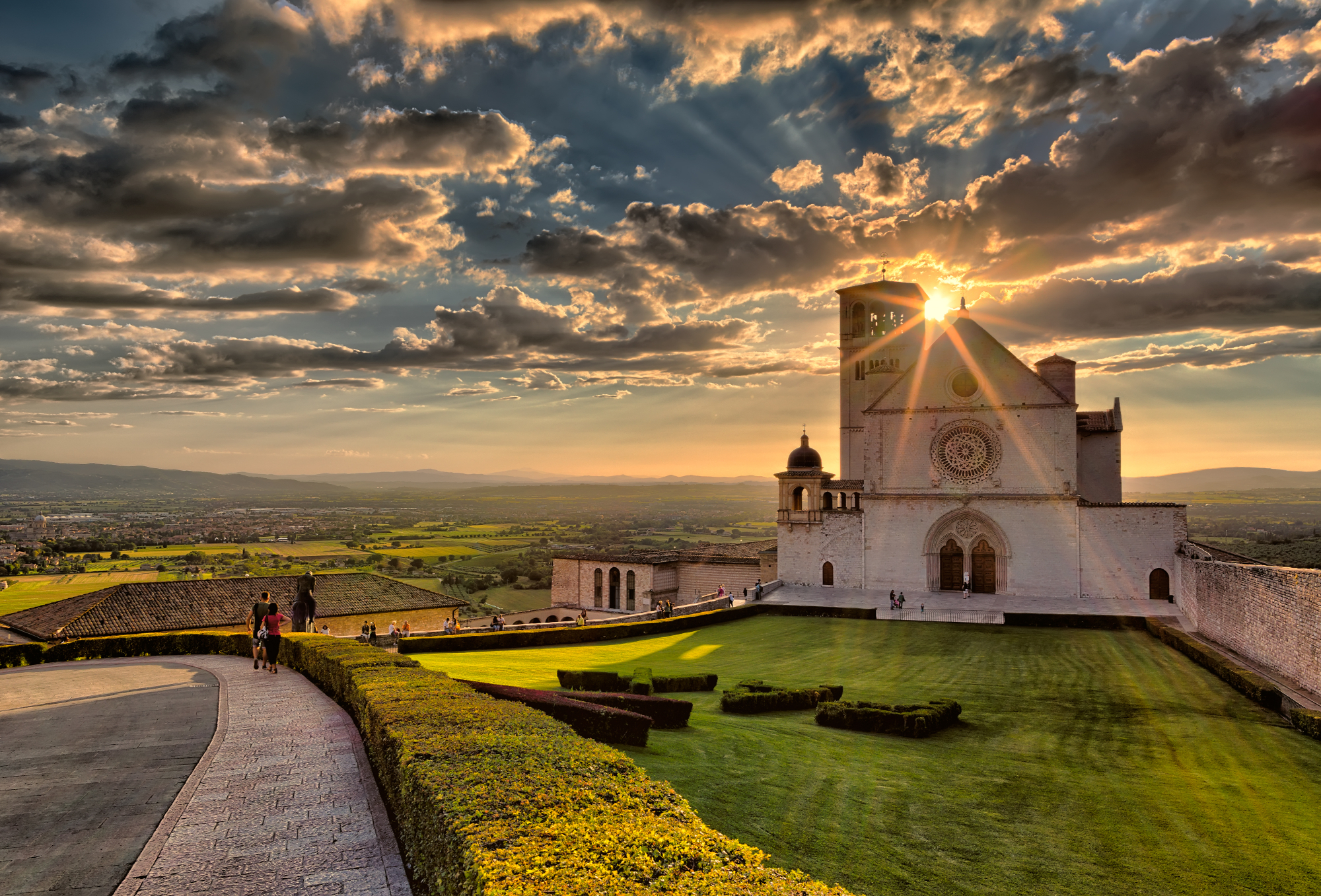
Basilica of St. Francis of Assisi
Basilica of St. Francis of Assisi, Assisi, Italy. Photo: Giorgio Art.

In Assisi, the sky vaults clouded and serene against the foothills.

*

Pietro, known as Francesco, devoted brother of his order, put quill to thirteenth-century parchment and began to praise. His inspiration was Psalm 148, whose Hebrew exhortations spur the sun and moon, the stars and highest heavens, tempests and mountains and wingèd birds to sing their Lord’s splendid name. Barchu and Hallelu.

*

In the trees that ring the great cathedral at Assisi, birds trill an antiphon in the innumerable dialects of their collected species.

*

“Laudatu si mi signore per sora nostra morte corporale,” Francis wrote in his backwater dialect, “da la quale nullu homo vivente po skappare.” Be praised, my Lord, through our sister, Death-of-the-Flesh, from whom no living mortal can escape.

*

William Henry Draper lost his first wife in childbirth. He lost his second wife in her youth. He lost three sons in World War I and a daughter in her childhood.

*

In Francesco’s hymn, the psalm’s call to worship forges familial bonds, each voice enfolded into the household: My Lord Brother Sun. Sister Moon and Sister Water, Brother Fire and Brother Wind.

*

Twice widowed, four times unfathered, William Henry Draper served as rector of the parish church in Leeds, where, in 1919, he translated a centuries-old poem by an Umbrian monk for a Whitsunday children’s concert.

*

On Whitsunday, the Assisi cathedral is afire with cloven tongues, pilgrims murmuring a babel of prayer.

*

Thou rushing wind that art so strong

*

At the wind of the day I walked the fortress wall on Assisi’s hilltop as the houselights came on below. “A mighty fortress is our God,” another word-dazzled monk would write three centuries after Francesco threw open the enclosures of monastic care to the lazar-house, the beggars, the birds.

*

At a piazza dinner in the hilltop town of Perugia, against which the young soldier Pietro called Francesco marched impenitent and won a year in prison for his pains, I overhear a tourist family at the next table. In New Jersey cadence, the mother suggests a next day’s trip to the basilica in Assisi. She sells it: “It’s where St. Francis is from.” Her son whines, “Who’s St. Francis?” The mother pauses. The pavement birds are belled into the evening sky. “He’s this really famous Franciscan monk.”

*

In the basilica, the nave vaults with sky, a gloaming blue clouded with verdant green. Gold stars fan out like finches. Like gilt notes on an ethereal staff.
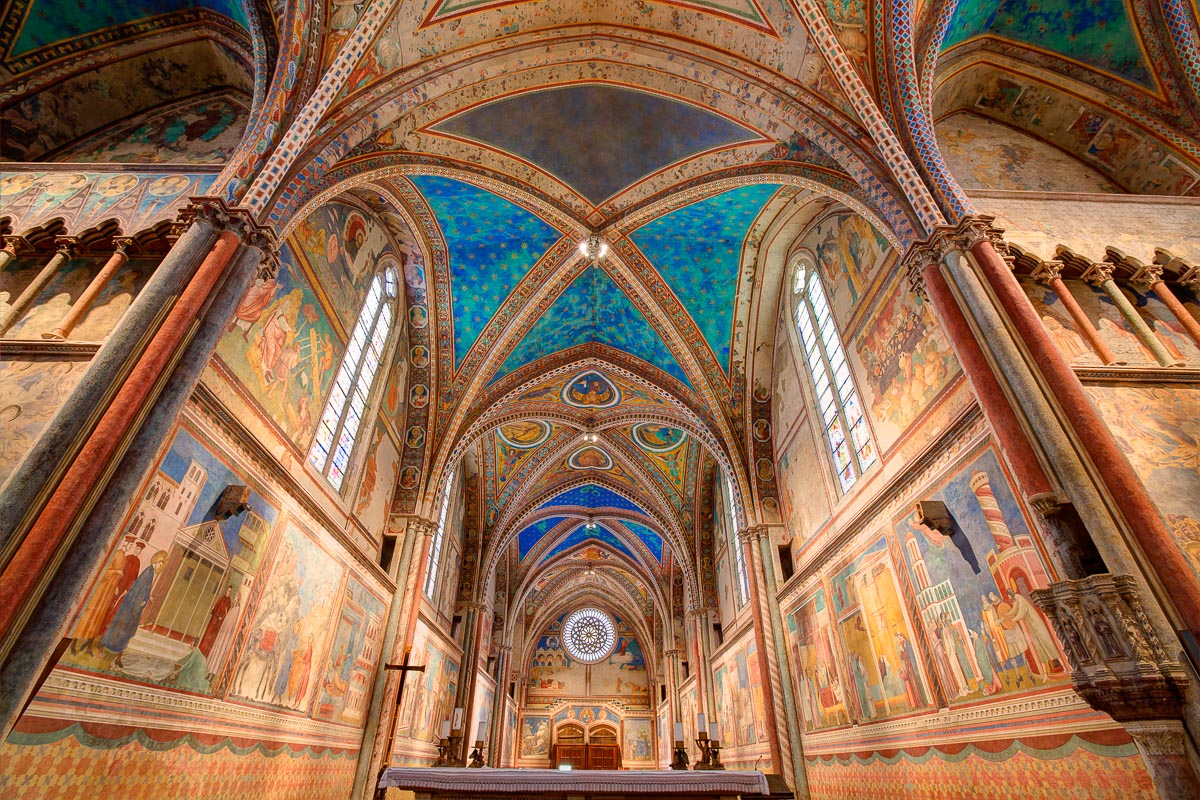
Basilica of St. Francis of Assisi
Basilica of St. Francis of Assisi, Assisi, Italy. Photo: Gustavo Kralj / Gaudium Press Images.

*

Ralph Vaughan Williams, son of a vicar, took up an old German tune, “Lasst uns Erfreuen” (“Let Us Rejoice”), harmonizing his Anglican to that melody’s spare Jesuit. And how hear we every man in our own tongue, wherein we were born?

*

It’s not the repeated alleluia. It’s not the catalogue of earthy beauty. It’s not the open-throated Ptolemaic chime. What undoes me is the single minor chord.

*

Undone. Unfathered. Lazar-house. Lost. Tempest. Prison. Babel. Evening. “Sora nostra morte corporale.”

*

The minor chord: unheard in the tune’s Teutonic plainchants, unheard before Vaughan Williams’s harmonies. It falls at the end of the penultimate line of each verse—in some versions of Draper’s English text, the minored syllable is Him, and in some it is Jah; either way, God takes the fall.

*

Vaughan Williams’s minor chord is the musical cognate of Francesco’s steadfast praise in and through the death of the flesh: a gut punch that refuses to be redeemed by the next line’s joy.

*

Confiteor: The next line’s return to D major requires a resolve that, many days, I don’t have.

*

In the Upper Church in Assisi, the fresco cycle attributed (probably wrongly) to Giotto includes San Francesco d’Assisi predica agli uccelli. There are doves, of course, in the saint’s congregation. There is a woodcock, I think. A robin. They will not fly until his sermon is finished. Until he follows the downpour with worms.
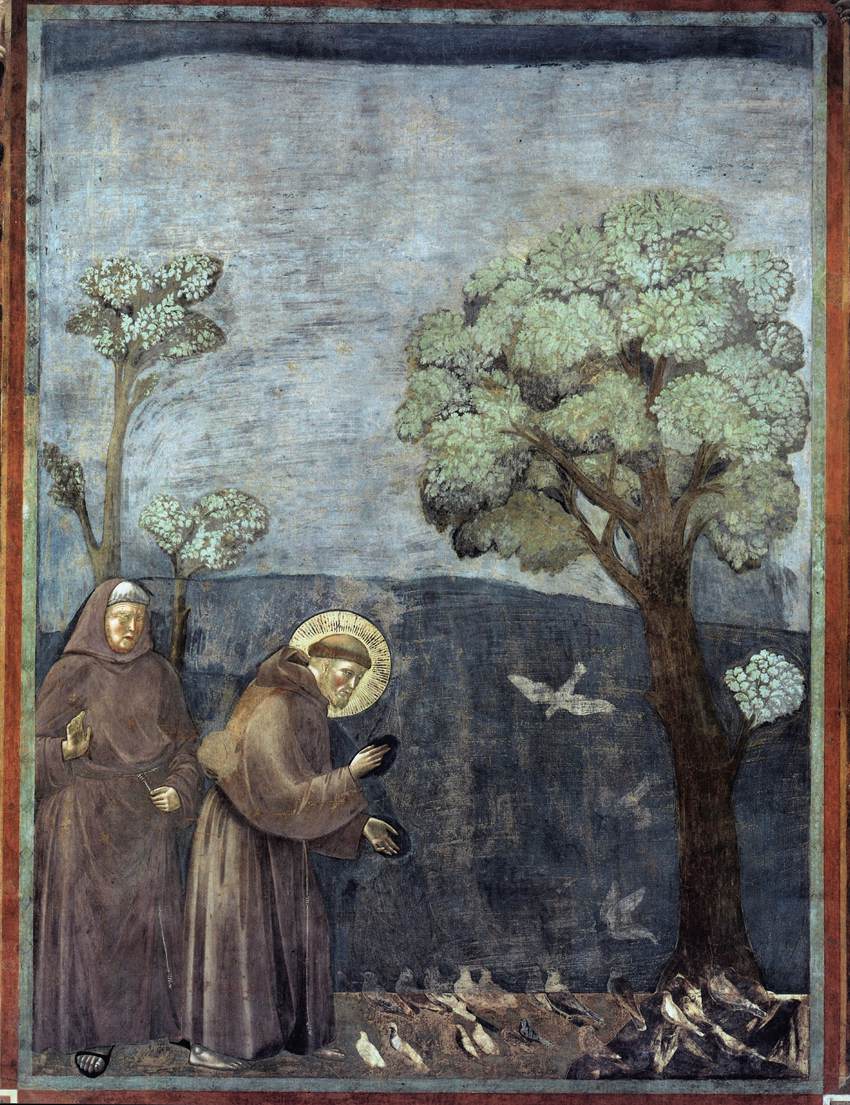
St. Francis Preaching to the Birds
“Sermon to the Birds,” from the Legends of Saint Francis cycle, attributed to Giotto, 1297–1300. Fresco, 270 × 200 cm. Upper Church, Basilica of St. Francis of Assisi, Assisi, Italy.

*

Nearby, another fresco shows Francis struck with stigmata; each wound an asterisk, a caveat. A flurry of wings above his head.
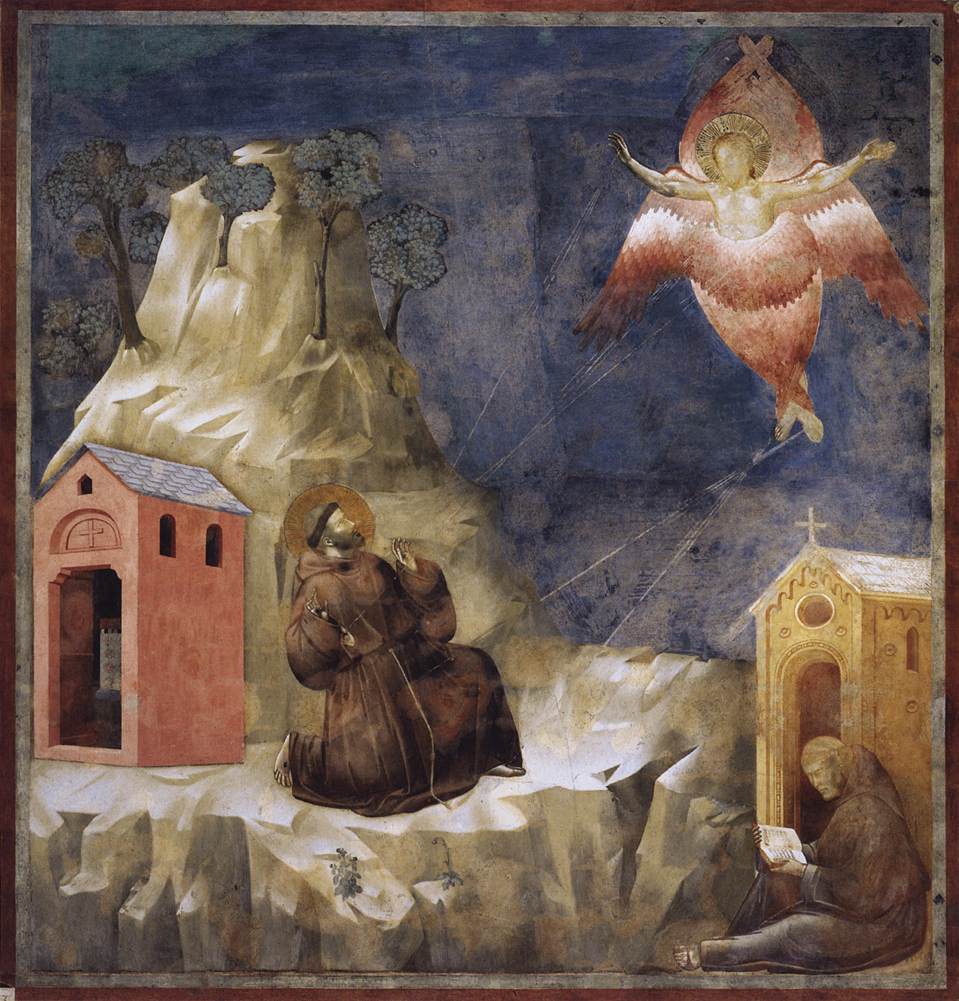
Stigmatization of St. Francis
“The Stigmatization of St. Francis,” from the Legends of Saint Francis cycle, attributed to Giotto, 1297–1300. Fresco, 270 × 230 cm. Upper Church, Basilica of St. Francis of Assisi, Assisi, Italy.

*

You lights of evening

*

At the altar in Assisi, my vespers are belled into the vault, where they flock and cloud.

*

Outside, rain. The birds tangle among the leaves, sustain their refractory antiphon. All with one accord in one place.

*

“perdonano per lo tue amore / infirmitate e tribulatione”

*

Pardon and love, weakness and wrack. Blame and whine, and worms and no escape. O praise Him.

*

A creaturely hymn for us creatures: Pietro called Francesco, faux Giotto, bereft William, Ralph, the variant birds, and myself. Each of us cloven by major and minor, each our own Pentecost.
Roundup: Paradise-themed contemporary art, Rogationtide hymn, Gija Ascension painting, and more

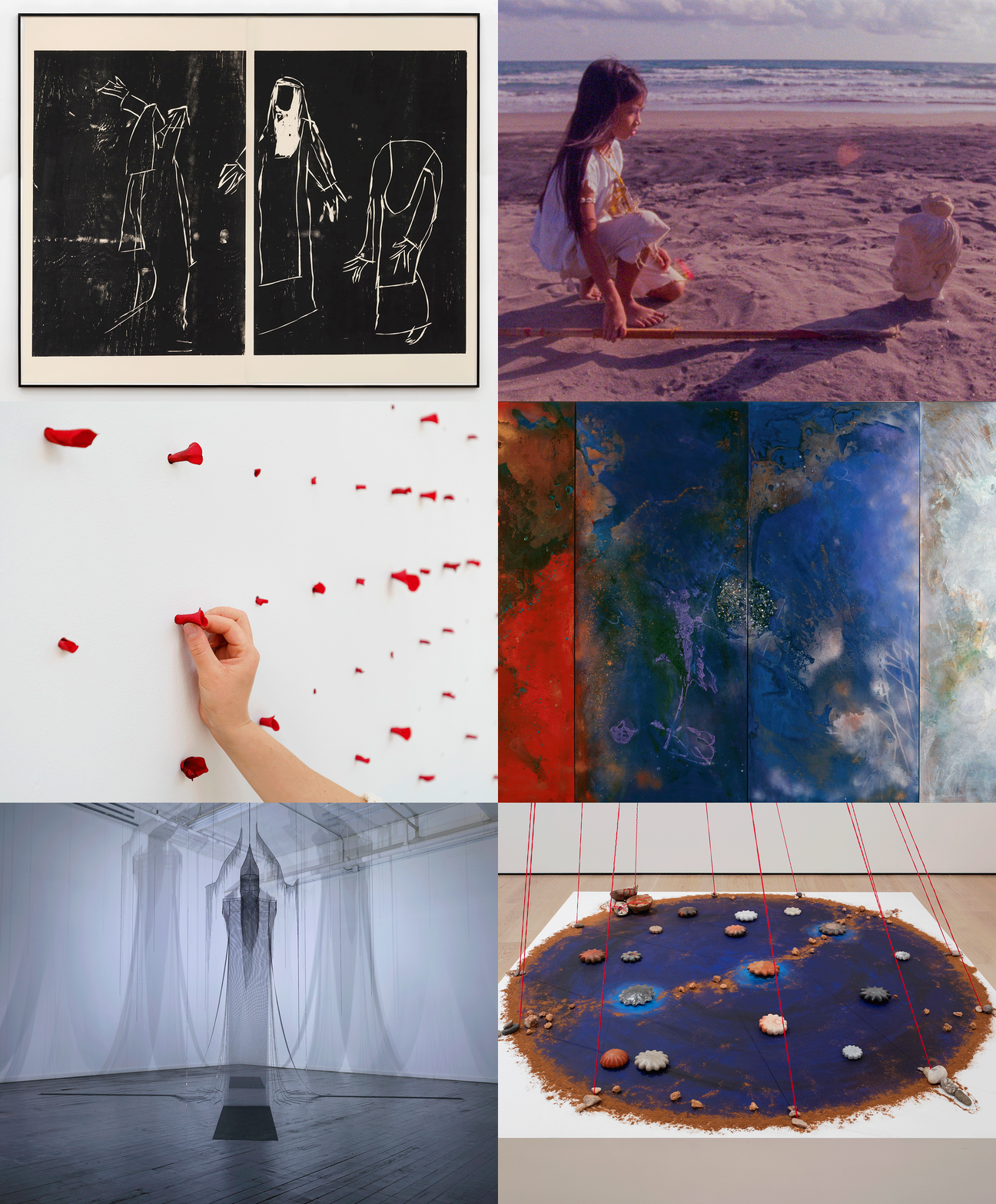
EXHIBITION: Here After, Bridge Projects, Los Angeles, May 7–July 30, 2022: This latest offering from the spirituality-forward art gallery Bridge Projects looks amazing! I appreciate their commitment to featuring religiously and ethnically diverse artists, as well as a range of styles and media.

Here After exhibition
Andrea Büttner, Dancing Nuns, 2007; Tuan Andrew Nguyen, video still from The Boat People, 2020; Belu-Simion Fainaru, Monument for Nothingness, 2012–22; Bonita Helmer, The Four Worlds (Tiferet), 2002–5; Afruz Amighi, Guardian, 2021; Mercedes Dorame, Orion’s Belt—Paahe’ Sheshiiyot—a map for moving between worlds, 2018

The group exhibition features thirty-seven artists who explore the idea of paradise—both how it has been pursued on earth across history, and how it is imagined after life. From Pure Land Buddhism’s chant “Namu Amida Butsu” (“I take refuge in Amida Buddha”) to Christianity’s prayer for the Kingdom to be “on earth as it is in heaven,” the concepts of paradise are as diverse as those who hope for it.

In Here After, works like William Kurelek’s Farm Boy’s Dream of Heaven (1963) envision an eschatological beyond in figurative form, while works by Bonita Helmer and Zarah Hussain do so in more abstract terms. Andrea Büttner and Claire Curneen’s works point to a vulnerable, sensual bodiliness, embedded in the surface of the world where all things come to pass. There is a land beyond the river by Gyun Hur and Tuan Andrew Nguyen’s The Boat People make space for remembrance of those who have passed, while Afruz Amighi, Mercedes Dorame, and Charwei Tsai position the viewer between worlds, feet firmly planted on the ground yet gazing at the glory and wonder of the beyond. In his installation Skywall, David Wallace Haskins plunges into the boundless sky and its immaterial light, letting all the expansive beauty grip the viewer. Kate Ingold intones the rhythmic mantras of what the divine is not with minute stitches, employing almost impossible patience to painstakingly outline absence. Kris Martin lodges small contradictions in the mind, which, in time, grow to be distracting puzzles—the candle in a sealed box, whose existence cannot be proven with the senses. And Tatsuo Miyajima uses digital counters to display the uncountable, unending dimension of existence.

+++

SONGS:

>> “O Jesus, Crowned with All Renown,” performed by Jon and Amanda McGill: The Monday to Wednesday preceding Ascension Day is known as Rogationtide, a short liturgical period (observed by most Anglicans, Episcopalians, Catholics, and others) in which we pray that God blesses the crops so that they yield a good harvest. It falls on May 23–25 this year. The hymn “O Jesus, Crowned with All Renown” is especially associated with the Rogation Days. It was written in 1860 by Edward White Benson, archbishop of Canterbury, and is typically paired with the tune KINGSFOLD.

O Jesus, crowned with all renown,
Since thou the earth hast trod,
Thou reignest, and by thee come down
Henceforth the gifts of God.
Thine is the health and thine the wealth
That in our halls abound,
And thine the beauty and the joy
With which the years are crowned.

Lord, in their change, let frost and heat
And winds and dews be giv’n;
All fostering power, all influence sweet,
Breathe from the bounteous heav’n.
Attemper fair with gentle air
The sunshine and the rain,
That kindly earth with timely birth
May yield her fruits again.

That we may feed the poor aright,
And gathering round thy throne,
Here, in the holy angels’ sight,
Repay thee of thine own:
That we may praise thee all our days,
And with the Father’s name,
And with the Holy Spirit’s gifts,
The Savior’s love proclaim.

Spiritual director and writer Tamara Hill Murphy explains the meaning of Rogationtide:

“Rogation” is derived from the Latin verb rogare, which means “to ask.” In the liturgies of Rogation Days, we ask the Lord to bless the fields, the crops, and the hands of farmers who produce our food. Worship on Rogation Days teaches us that we depend upon God’s favor over his land. We ask him for goodness over not just an abstract idea of our “land” but the very real earth beneath our feet in our backyards, our neighborhoods, and whatever part of the earth our feet hit the ground. As we’ve become a post-industrial society, the prayers for Rogation Days have expanded to include not only prayers for farmers and fishermen, but also for commerce and industry, and for all of us as stewards of creation.

>> “The Twelve: An Anthem for the Feast of Any Apostle,” words by W. H. Auden and music by William Walton: In 1965 the dean of the choir school at Christ Church, Oxford—Dr. Cuthbert Simpson—approached poet W. H. Auden and composer William Walton to write a choral anthem for use on apostolic feast days. “The Twelve” is the result. In this video filmed at Keble College, Oxford, in July 2021, it is performed by the vocal ensembles VOCES8 and Apollo5 (both directed by Barnaby Smith), with Peter Holder on organ. Learn more about the background and structure of the anthem here.

This performance appears on Renewal?, a concept album released February 25 that combines new works by Paul Smith (cofounder of VOCES8) and Donna McKevitt with works by three influential modern composers: William Walton, John Cage, and William Henry Harris. “Multifaceted texts by Lal Ded, Edmund Spenser, W. H. Auden, Lord Byron, Pablo Neruda, Maya Angelou, and Edna St. Vincent Millay offer space to consider our world, past and present, and meditate on a response to build a better future.”

You can read the full text of “The Twelve” in the YouTube video description. It begins,

Without arms or charm of culture,
Persons of no importance
From an unimportant Province,
They did as the Spirit bid,
Went forth into a joyless world
Of swords and rhetoric
To bring it joy.

+++

VISUAL MEDITATIONS:

Ascension Day occurs every year on the Thursday that falls forty days after Easter (see Acts 1:1–3). This year it is May 26. Here are two Ascension-themed visual meditations from ArtWay.eu.

>> On the Reidersche Tafel, by Nigel Halliday: This ivory bas-relief, which was probably originally embedded in a book cover, is the earliest known representation of the Ascension. It shows Jesus striding up a mountain, being pulled up into heaven by the hand of God the Father. (Mark and Luke use the passive voice to describe the Ascension: “he was taken up into heaven.”) He is dressed in a toga and holding a scroll. Learn more from Nigel Halliday at the above link, or visit this Instagram post I made two years ago.

Ascension (Reidersche Tafel)
The Women at Christ’s Tomb and the Ascension, Milan or Rome, ca. 400. Ivory plaque, 18.7 × 11.5 cm. Bayerisches Nationalmuseum (Bavarian National Museum), Munich, Germany.

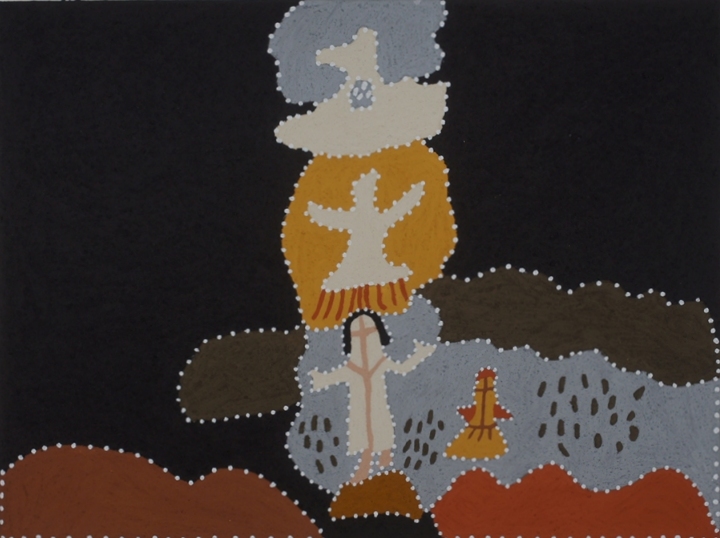
>> On Ngambuny Ascends by Shirley Purdie, by Rod Pattenden: Ngambuny is the Gija name for Jesus. Aboriginal Australian artist Shirley Purdie sets his ascension within the indigenous landscape of the Bungle Bungle Range, using her characteristic style of dotted outlines. “Purdie draws on her cultural tradition to locate the presence of God within the skin of her land,” writes the Rev. Dr. Rod Pattenden. “Her work is literally painted with the earth, as she collects ochres from the land she is responsible for and mixes it with glue to attach to her warm hued canvases.” Pattenden offers a fascinating reading of Purdie’s Ngambuny Ascends, discussing the use of black ocher, God as Creator Spirit alive in the earth, and more.

Purdie, Shirley_Ngambuny Ascends
Shirley Purdie (Gija, 1948–), Ngambuny Ascends, 2013. Natural ocher on canvas, 60 × 80 cm. Private collection. The artist is represented by the Warmun Art Centre in Warmum, WA, Australia.

Roundup: Guite-Bell live event, Sister Corita Kent, and more

FREE LIVE EVENT: “Faith and the Imagination: Poetry, Song, and Inspiration with Steve Bell and Malcolm Guite,” June 4–7, 2022, Greater Seattle area: Join hundreds of Seattle artists and ministry leaders for four days of poetry, vocal performances, and conversation about the gift of the human imagination for the flourishing of our world, hosted by Cambridge’s distinguished poet Malcolm Guite and award-winning Canadian musician Steve Bell.

Sessions are free and open to the public and will not be livestreamed (and the conversations require advance registration):

  • June 4, 7–9pm: Live Concert (Seattle, WA)
  • June 5, 9:45–11am: Worship Service (Normandy Park, WA)
  • June 5, 7–9:30pm: A Conversation on: Faith and the Arts (Seattle, WA)
  • June 6, 6:30–8:30pm: A Conversation on: Faith and Technology (Bellevue, WA)
  • June 7, 7–9pm: A Conversation on: Faith and Work (Seattle, WA)

Guite and Bell have been collaborating for years. Below are two snippets of them performing together. In the first video Guite comedically performs (to rhythmic accompaniment!) a villanelle he wrote in response to something a woman who worked at the venue of one of his poetry talks exasperatedly said to him when his hurried photocopying caused a paper jam. The second video showcases a sonnet by Guite on the baptism of Christ, from his collection Sounding the Seasons: Seventy Sonnets for the Christian Year, and the song that Bell adapted it into, released on Keening for the Dawn.

+++

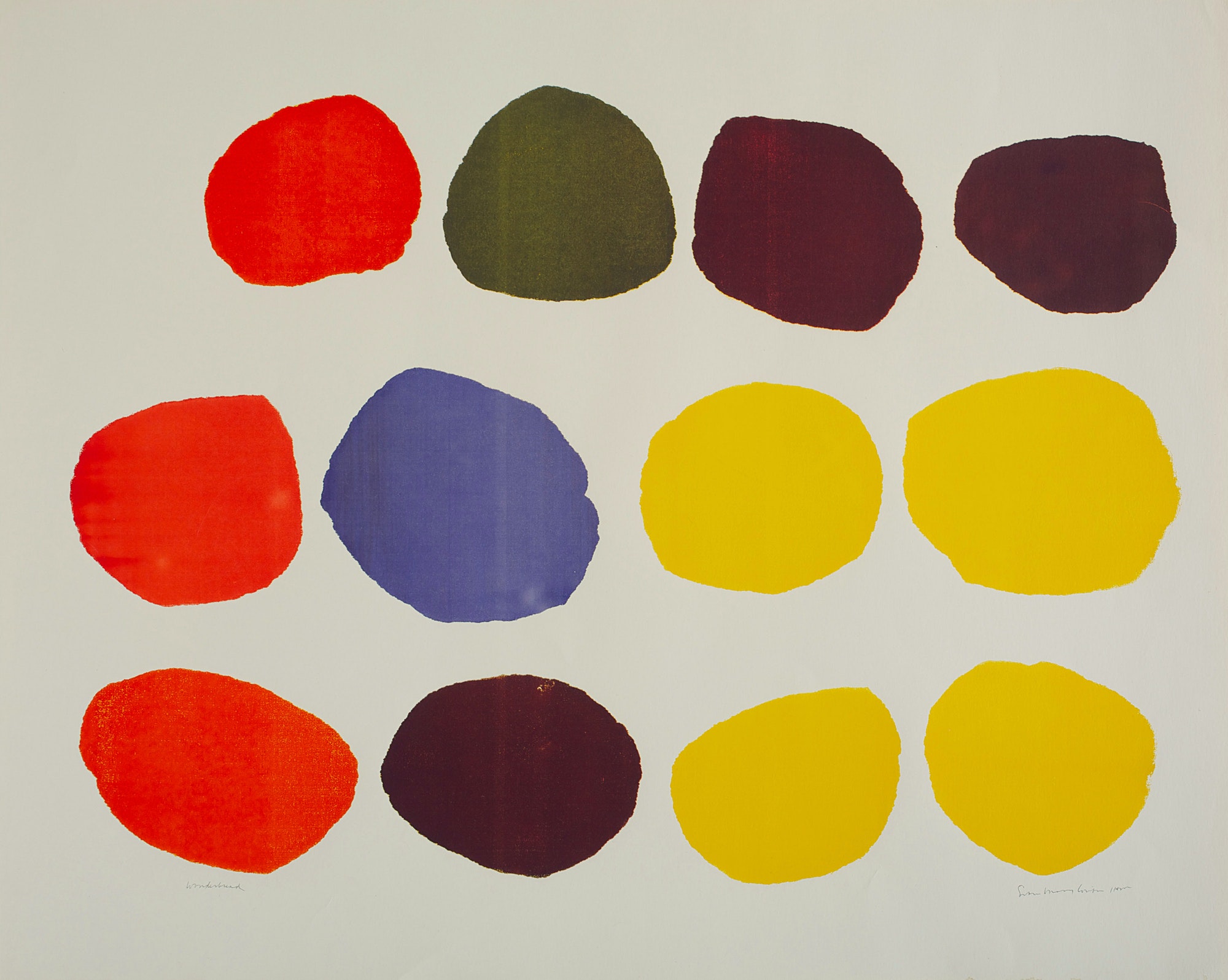
ESSAY: “The Listening Heart: Corita Kent’s Reforming Vision” by Michael Wright: Corita Kent (1918–1986) [previously] was an American pop artist who was also, for over three decades, a nun. Michael Wright writes about how “she became interested not just in depicting scenes from the Bible but answering this: what might happen if a Christian imagination engaged the world around us through the arts? That art might look less like an illustration from a children’s Bible and more like exploring seeing the stuff of life—even a bread bag—as dialogue partners with mysteries of faith.” wonderbread is one of four works he discusses—“a playful meditation on sacred time, wonder, and communion.”

Kent, Corita_wonderbread
Corita Kent (American, 1918–1986), wonderbread, 1962. Serigraph, 25 1/2 × 30 1/2 in.

While I do think even Kent’s biblical artworks push the genre of religious art forward, I appreciate how Wright challenges Christians to give a chance to her works that are less straightforwardly religious, as these are often the most imaginative and profound. And they, too, are “deeply Christian work.” Let’s not think so narrowly about what “Christian art” must look like!

+++

LIVING PRAYER PERIODICAL: Pentecost 2022: One of the organizations I work for is the Daily Prayer Project [previously], which publishes seven ecumenical Christian prayer periodicals a year, structured around the liturgical calendar. I do the curation for the Gallery section, which comprises three art images with written reflections, and the editing. Our latest edition covers June 5 (the feast of Pentecost) through August 6, and it includes prayers from India, Japan, Korea, Algeria, Italy, the Choctow Nation, and more. I’m excited to feature on the cover Corita Kent’s word picture: gift of tongues! As many of her screenprints do, it integrates image and text—in this case Acts 2:1–2a, which sprawls out through the sky and onto a billowing banner, like a sail, over a crowd of people aflame with the fire of the newly descended Spirit of God.

Pentecost LPP 2022

On the website there are options for one-time purchase or group subscription, and for digital only or print and digital.

+++

PRAYER: “The Lord’s Prayer, Extended Dance Mix” by Nadia Bolz-Weber: In March, actor Jennifer Garner asked Lutheran pastor and author Nadia Bolz-Weber if she could offer a prayer and a benediction on her InstaLive. Bolz-Weber vamped on the traditional words of the Lord’s Prayer, the text of which you can read at the boldface link.

Such a beautiful prayer.

One of the things I appreciate about Bolz-Weber’s spiritual teaching is her avoidance of clichés. She gives fresh language to the experiences of faith and life in general and to theology, which often reawakens me to the beauty of God and of Christ’s gospel. Describing why she regularly turns to prayer, she says in the Instagram video:

When I don’t have enough—like if I don’t have enough patience, if I don’t have enough compassion for myself or other people, when I don’t have enough resources—prayer is this way in which I can remind myself that there is enough. That I have a connection to my own divine source. I have a connection to God. And in the heart of God there’s enough forgiveness when I don’t have enough. In the heart of God there’s enough compassion when I don’t have enough. And so for me, it’s about reminding myself of that connection.

+++

SONG: “Dry Bones” by Gregory Porter: From Gregory Porter’s 2021 album Still Rising, this song was inspired by Ezekiel 37. The official music video features dancing skeletons in yellow cowboy boots(!), animated by L’Incroyable Studio. The song’s bridge quotes the African American spiritual “Dem Bones.”

The first verse goes,

I won’t die, won’t bury, won’t sink
’Cause love is the spirit I drink
I’ll be free in the morning light
’Cause your touch is the medicine of life
There’s a dance to this beat, let’s shake
Every move—feel my body awake
There’s a sound—you and me are one
And your hope is the rhythm I drum

Roundup: Psalms and the arts, Ukrainian Easter Choir, and more

BLOG POST: “An open letter to pastors (A non-mom speaks about Mother’s Day)” by Amy Young: There’s disagreement among church leaders on whether Hallmark holidays, such as Mother’s Day, should be recognized during a worship service, and if so, how. Having mothers stand (while women who are not mothers in the conventional sense remain seated) can be very othering and bring up feelings of sadness or shame. It’s also a day when people are thinking about their own mothers, which can evoke a complex range of emotions.

Amy Young believes there is a way to honor mothers in church without alienating others, as well as to acknowledge the breadth of experiences associated with mothering. She has drafted a pastoral address that I find so wise and compassionate. Some women are estranged from their children. Some have experienced miscarriage or abortion. Some have had failed adoptions, or failed IVF treatments. Some placed a child for adoption. Some have been surrogate mothers. Some are foster mothers, or are the primary guardian of a relative’s child. Some are spiritual moms. Some women want to be mothers but have no partner or have had trouble conceiving. Some were abused by their mothers. Some have lost mothers. Some never met their mother. Young puts her arms around all these people who are potentially in the pews on Mother’s Day, making room for the complexity of the day—which does include celebration!

+++

VIDEO: “United with Beauty: The Psalms, the Arts, and the Human Experience” by Mallory Johnson: Mallory Johnson graduated last weekend with a bachelor’s in music and worship (concentration: voice) from Samford University in Birmingham, Alabama. (In the fall she will be starting an MDiv program at Beeson Divinity School.) All the seniors in the Samford School of the Arts are required to complete a capstone project tailored to their individual interests and career goals. As Johnson’s interests center on theology, history, and the arts, she created a twenty-minute video rooted in the Psalms that integrates music, poetry, short excerpts of fiction, visual art, and quotes from van Gogh, Tchaikovsky, Goethe, Luther, and others, resulting in a contemplative multimedia experience.

I resonate so much with Johnson’s approach of bringing together works from different artistic disciplines to interpret one another and to invite the viewer into worship. Her curation is stellar! To cite just one example, the contemporary choral work Stars by Ēriks Ešenvalds plays as we see, among other images, an Aboriginal dot painting of the constellations Orion and Canis and a nighttime landscape by realist painter Józef Chełmoński. Another: John Adams’s double piano composition “Hallelujah Junction” is brought into conversation with Psalm 150 and a painting by Jewish artist Richard Bee of David dancing before the ark.

Józef Chełmoński (Polish, 1849–1914), Starry Night, 1888. Oil on canvas, 22 13/16 × 28 3/4 in. (58 × 73 cm). National Museum in Kraków, Poland.

The video opens with the theme of awe and wonder—expanses of sky and sea and field; the beauty and vastness of God mirrored in the natural world—and then moves to lament—of the prospering of the wicked; of exhaustion, anxiety, and other forms of mental or spiritual anguish and their causes; of personal sin—and finally ends with an assurance of grace and with exultation. Johnson shows how the longings of modern people overlap with those of the biblical psalmists. Here’s her description:

In his famous work titled Confessions, St. Augustine writes this: “Yet to praise you, God, is the desire of every human.” Is this true? What does this look like?

During my time at Samford, I have felt my heart and mind overflow with love for the arts. As a Christian, they have played a devotional role in my life. I find such joy in seeing connections between music, art, and literature that may seem unrelated on the surface. I believe that all humans have a longing for the goodness of God and we find “echoes” of Him everywhere, and most beautifully in artistic expression.

I wanted to show others how I understand the world as a Christian artist. This project is a journey through the Psalms, using art to reinforce the idea that the Psalms capture the full universal human experience. Across time and space, we have all felt the same things and we have all had the same deep longing for “something higher.”

I hope you can allow this project to wash over you. Make time to watch it alone or with someone you love, distraction-free. Turn the lights out, light a candle, watch it on a big screen with the volume up loud. Be cozy under a blanket with a cup of coffee, or grab a journal and write down anything that sticks out to you! It is my earnest desire that you will be moved by the artistic expression of humanity, and that you may realize that God has always been the goodness you most deeply desire.

+++

SONGS:

>> “Broken Healers” by Elise Massa: Singer-songwriter Elise Massa is the assistant director of music and worship arts at Church of the Ascension in Pittsburgh. A meditation on Christ as Wounded Healer, this song from her 2014 album of demos, We Are All Rough Drafts, was inspired by an Eastertide sermon.

Here’s the final stanza (the full lyrics are at the Bandcamp link):

Broken healers are we all
In a living world, decayed
With broken speech we stutter, “Glory”
As broken fingers mend what’s frayed
Holy Spirit, come, anoint us
As you anointed Christ the King
Who wore the crown of the oppressed
Who bears the scars of suffering

>> “Agnus Dei” by Michael W. Smith, performed by the Ukrainian Easter Choir: This is one of the few CCM songs I listened to as a young teen (Third Day’s version from a WOW CD!) that I’m still really fond of. In this video that premiered April 17, an eighty-person choir conducted by Sergiy Yakobchuk was assembled from multiple churches in Ukraine to perform for an Easter service in Lviv organized by the Billy Graham Evangelistic Association. Michael W. Smith’s “Agnus Dei” is one of three songs they sang, in both English and Ukrainian. The name of the soloist is not given. Many of the vocalists in the choir have been displaced from their homes by the current war with Russia. One of them says, “With the war, celebrating the Resurrection means for us now life above death, good above evil.”

+++

PRAYER EXERCISE: “Visio Divina: A 20-Minute Guided Prayer Reflection for the Crisis in Ukraine”: Visio divina, Latin for “divine seeing,” is a spiritual practice of engaging prayerfully with an image, usually an artwork—allowing the visual to invite you into communion with God. On March 17 Vivianne David led a virtual visio divina exercise with Natalya Rusetska’s Crucifixion, hosted by Renovaré. I caught up with the video afterward and found it a very meaningful experience. As the painting is by a Ukrainian artist and represents Christ’s passion, the war in Ukraine is a natural connection point.

I appreciate David’s wise guidance, which includes these reminders:

  • Stay with the image, regardless of whether or not you ​“feel” something happening right away. There is something beautiful about faithfully waiting with that space, having dedicated it to God as a time of prayer.
  • Notice what draws your attention, what invites you into the image—let that become a space for conversation with Christ.
  • Notice what sort of emotions arise as you stay with the image. How does it awaken desire? Let these emotions lead you back to continued dialogue with God.

This kind of quiet, focused looking with an openness to encounter is something I encourage on the blog. Any of David’s three tips above I would also suggest for any art image I post—a corrective to hasty scrolling habits. Stick around for the last four minutes of the video to see dozens and dozens of impressions from participants, which may reveal new aspects of the painting to you.

Roundup: “Jesus Is Alive” (Japanese version), art competition, and more

SONGS:

>> “Jesus Is Alive” by Ron Kenoly, performed in Japanese by Ruah Worship: Ruah Worship is a vocal ensemble made up of four siblings from Japan: (from left to right in video) Joshua Mine, Julia Mine, Erika Grace Izawa (née Mine), and Marian Mine. Here they sing an a cappella arrangement of a Ron Kenoly song, translated into Japanese by Hiromi Yamamoto and Kazuo Sano. Click on the “CC” (closed captioning) button for English subtitles. [HT: Global Christian Worship]

Their harmonies are wonderful! And they have lots of great videos on their YouTube channel, a mix of original songs and songs translated from other languages or written in Japanese. For another Easter-themed song they’ve recorded, see “Because He Lives.”

>> “I Went to the Garden” by Sam Hargreaves: Written in a bluegrass style from Mary Magdalene’s perspective, this song was released this year as part of the Resurrection People resource from the UK organization Engage Worship, where you can find downloadable videos (songs, webinars), sheet music, and church service outlines that include prayers, all-age ideas, readings, poems, sermon outlines, responses, and more. Sam Hargreaves is on lead vocals and acoustic guitar, Timo Scharnowski is on backing vocals and percussion, and David Hyde is on banjo and slide guitar.

Another song from the Resurrection People pack—one that made me laugh!—is “Peter’s Slowcoach Blues.”

+++

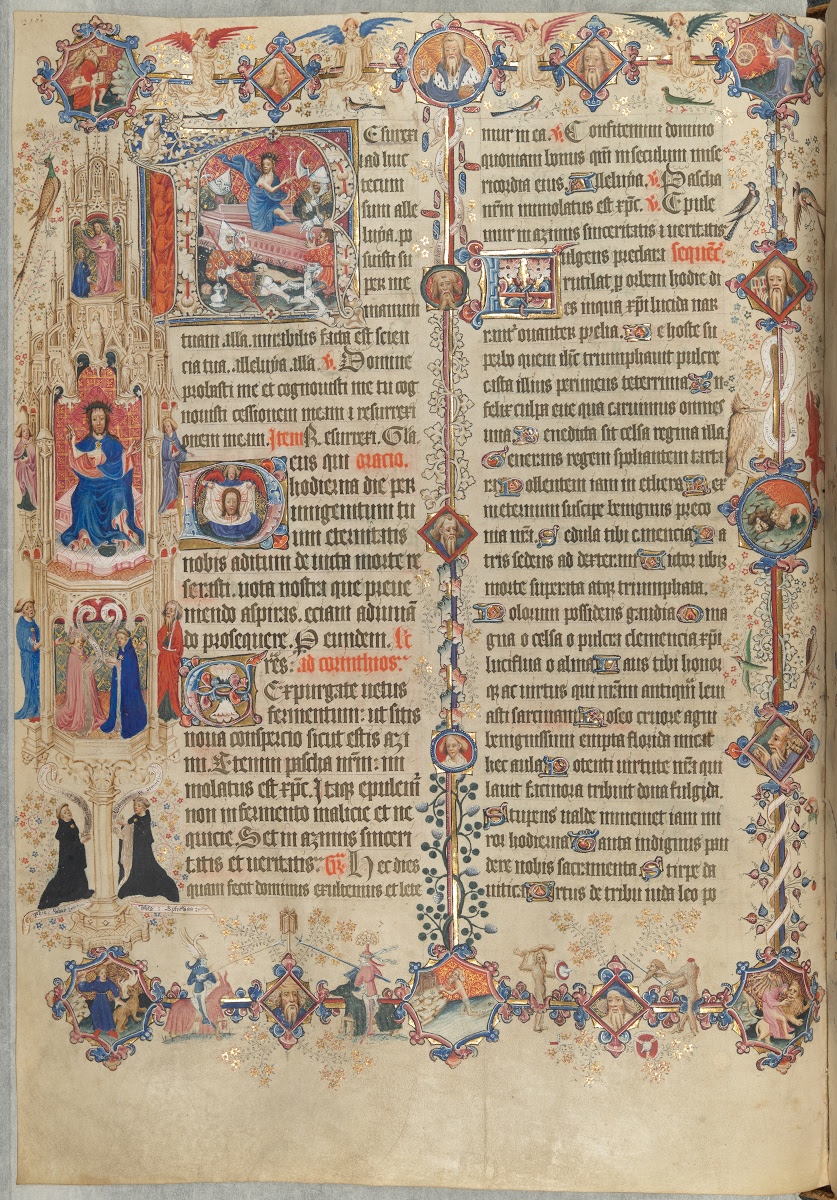
ART COMMENTARY: The Sherborne Missal: On this episode of the BBC Radio 4 program Moving Pictures, host Cathy Fitzgerald talks with art historians Alixe Bovey, Kathleen Doyle, Eleanor Jackson, and Paul Binski and scribe and illuminator Patricia Lovett about a page from the medieval illuminated Sherborne Missal that introduces the Mass for Easter Sunday. Made for the Benedictine abbey of St. Mary’s in Sherborne, Dorset, around 1400, this Christian service book amazingly survived the pillaging of the English Reformation intact.

Sherborne Missal (Easter Mass)
Illuminated folio introducing the Mass for Easter Sunday, from the Sherborne Missal, Dorset, England, ca. 1399–1407. British Library, London, Add Ms 74236, page 216. Click on image to zoom in.

At the top is the historiated initial “R” for Ressurexit, with Christ emerging from his tomb. An elaborate border around the page contains scenes from the Old Testament, portraits of prophets, a bestiary-inspired scene, angels, birds, plants, fantastical knights, and two wodewoses (wild men) engaging in a bizarre confrontation. Such imagination! Learn why a daddy lion breathing on his cubs signified resurrection to the medieval mind, and in what sense Samson and Jonah are “types” of Christ.

“The thing to grasp about medieval art,” Binski says, “is that they don’t have the same categories and boundaries that we do. We have quite defined boundaries around what’s comic and what’s tragic, and what’s serious and what’s lightweight. In the Middle Ages, serious things and playful things accompanied one another; they were all part of the same thing.”

+++

CALL FOR ENTRIES: Chaiya Art Awards 2022/23: Submissions are now open—UK residents only—for this biannual competition on spiritually inflected visual art, this time on the theme of “Awe and Wonder.” In addition to the usual exhibition space for the longlisted finalists at London’s gallery@oxo, Chaiya has secured a second venue, the Bargehouse, which will allow for larger-scale artworks and installations. The top prize is ₤10,000. Deadline: August 31, 2022.

+++

CIVA TRAVELING EXHIBITION: Heads, Faces, and Spiritual Encounter: Drawn from the collection of Edward and Diane Knippers and available for rental, this exhibition comprises forty-some artworks that all focus on the human face. There are works by modern heavyweights like Henri Matisse, Marc Chagall, David Alfaro Siqueiros, Georges Rouault, and Eric Gill, along with a few seventeenth-century portraits, African masks, and works by contemporary artists of faith. I saw the exhibition in Austin, Texas, in November and was really moved. Click on the link to browse the art and to inquire about rental.

Heads, Faces, and Spiritual Encounter

Easter, Day 8

I pray that, according to the riches of his glory, he may grant that you may be strengthened in your inner being with power through his Spirit, and that Christ may dwell in your hearts through faith, as you are being rooted and grounded in love. I pray that you may have the power to comprehend, with all the saints, what is the breadth and length and height and depth, and to know the love of Christ that surpasses knowledge, so that you may be filled with all the fullness of God.

—Ephesians 3:16–19

For once you were darkness, but now in the Lord you are light. Live as children of light—for the fruit of the light is found in all that is good and right and true. Try to find out what is pleasing to the Lord. Take no part in the unfruitful works of darkness . . .

“Sleeper, awake!
    Rise from the dead,
and Christ will shine on you.”

—Ephesians 5:8–11a, 14b

LOOK: Resurrection by Lu Lan

Lu Lan_Resurrection
Lu Lan (Chinese, 1972–), Resurrection, 1996. Tempera on cardboard, 50 × 50 cm.

LISTEN: “Easter Light” | Words by Angier Brock and music by Cecilia McDowall, 2016 | Performed by the Oxford Choir, on Oxford Choral Highlights 2017

In Easter light, the risen Christ is moving among us.
     How brightly the meadowlark sings its song of the season.
          Alleluia.
     How gently the Easter light lifts the face of the lily.
         Christ is risen.
With illumed heart and radiant faces,
     we too sing in that light.
          Christ is risen indeed. Alleluia. Alleluia.

Let Christ be rising now in our lives and in our prayers,
     as we open our hands to both friend and stranger.
Let Christ be rising now in our words and in our work
     as we strive to repair the earth
     and free all its creatures from danger.

Risen Christ of limitless love,
     Risen Christ of compassion and peace,
          Risen Christ of gracious surprising—
You move among us in Easter light.
Be now in us, rising.

I so love Angier Brock’s collaborations with Cecilia McDowall. I featured another of their choral anthems, “Advent Moon,” two Advents ago.

“Easter Light” is quieter and more reflective than most other Easter anthems. It muses on how, as the natural world awakens to the fullness of spring, our hearts are beckoned to come awake also. Christ rose from his grave in first-century Palestine and he rises in his followers, moving us to love, compassion, peace, generosity, and works of repair and liberation. This anthem is a blessing and a prayer—that we would be reanimated, reastonished, by the “risen Christ of gracious surprising”; that we would be Easter people, people of life and light, practicing resurrection.

The text above is as Brock wrote it. She gave McDowall the leeway to rearrange the order of lines, to repeat and layer words, and so on. Brock told me how pleased she is by how McDowall set the alleluias. “I think of them as ‘falling alleluias’ or ‘waterfalls of alleluias,’” she said.

In addition to being a sacred lyricist, Brock is also a poet. I asked her if she approaches differently the task of writing a poem that she knows will be set to music for church contexts versus writing a poem that does not have that objective. Here’s what she said:

For me, the biggest difference between writing a hymn or anthem text, as opposed to a freestanding poem, is that with the hymn or anthem, I know I will quite literally be putting words into other peoples’ mouths. And not just any words—words about faith, about the Holy, the Divine. Theology figures in—not my personal or private theology, but something larger. That adds a layer of—I’m not sure what the word is. Complexity? Responsibility? Gravitas? Something like one of those things, or some combination thereof.

The above recording is of a performance by the collegiate Oxford Choir, but for examples of church choirs singing “Easter Light” for Easter Day worship services, see the following timestamped video links:

+++

This concludes my *daily* posts in this format—but there are still another forty-two days of Easter, and I hope you’re continuing to celebrate! I’ll still be sharing content throughout the remainder of the season, just at a lesser frequency. In the meantime, I hope you’re enjoying the Art & Theology Eastertide Playlist, which includes today’s featured song.

If you would like to leave me a “tip” for the Lent-Easter posts or playlists, you can do so through PayPal. I appreciate your support, which gives me the freedom to step away from paid freelancing projects to devote time here, and to keep all the blog content free and available to everyone instead of moving to a Patreon model. If you don’t have a PayPal account but still wish to contribute to my work (as some of you have indicated to me), you could buy me a book from my Amazon wish list. Books feed my research and shape my spiritual development and can impact what I cover on the blog. Please note that wish list items do not equal endorsements.

I wish you all a very happy Eastertide! Thanks for journeying with me through Lent and Bright Week.

Easter, Day 7

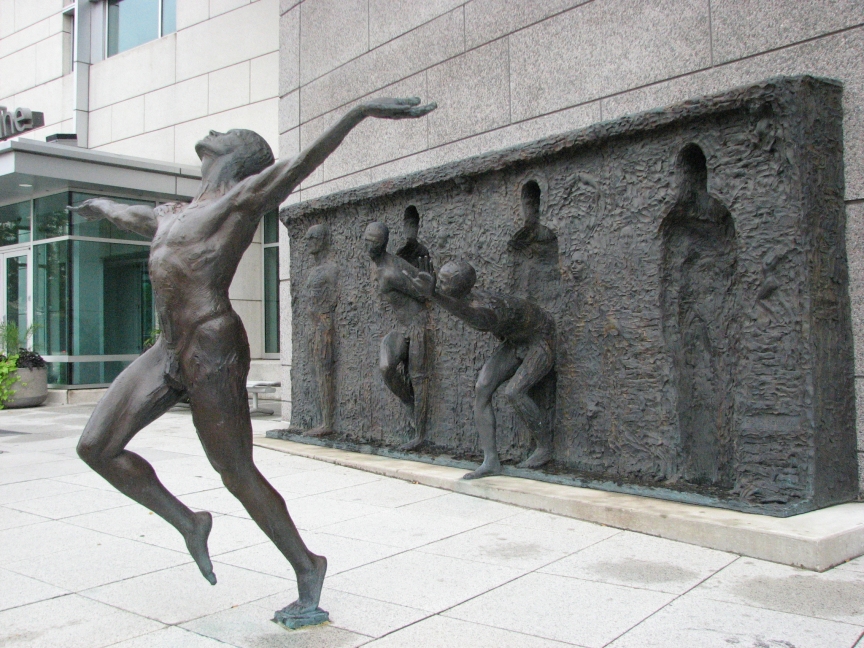
LOOK: Freedom by Zenos Frudakis

Frudakis, Zenos_Freedom
Zenos Frudakis (American, 1951–), Freedom, 2001. Bronze, 8 × 20 ft. 16th and Vine Streets, Philadelphia.

LISTEN: “We Will Rise Again” by Ben Keyes, on Were You There? Are You Here? (2007)

Hallelujah, we will rise again
Angels rolled the stone away
The Lord has raised his Son
Victory is won
He’s gonna call us from the grave

I want to walk in your kingdom
(Give me back my feet!)
I want to walk in your kingdom
(Roll that stone away from me!)
I want to clap my hands in glory
(Give me back my hands!)
I want to clap my hands in glory
(Roll that stone away from me!)

Refrain

I want to walk in your kingdom
(Give me back my feet!)
I want to walk in your kingdom
(Roll that stone away from me!)
I want to stomp my feet in glory
(Give me back my feet!)
I want to stomp my feet in glory
(Roll that stone away from me!)

Refrain

I want to sing in your kingdom
(Give me back my throat!)
I want to sing in your kingdom
(Roll that stone away from me!)
I want to shout in glory
(Give me back my throat!)
I want to shout out in glory
(Roll that stone away from me!)

Refrain ×2

This gospel song by Ben Keyes is sung from the perspective of the faithful departed—those siblings in Christ who have passed on but who are awaiting their bodily resurrection on the last day. Although in this world our bodies decay and we return to dust, one day we will be reconstituted and raised, and we will join with saints from all over the globe in praise of Christ our Savior in the new heavens and the new earth. In Keyes’s song, the deceased anticipate that joyful reuniting of body and soul, and the eternal ingathering of the universal church. They appeal to God to give them back their vocal cords so that they can sing and shout; their feet, so they can move about and dance; their hands, so they can clap and serve.

Ben Keyes is the codirector, with his wife Nickaela Fiore-Keyes, of the Southborough L’Abri branch in Massachusetts. Founded by Edith and Francis Schaeffer, L’Abri (French for “shelter”) is an international network of communities that integrate study and discussion about God and life with practical community work. These “shelters” house both short-term guests and long-term residents. They are not a retreat, a commune, or a seminary, but they incorporate elements of all three.

Keyes grew up at the Southborough L’Abri and from an early age has loved to play music. When he was in high school his family joined an African American church and he became involved in the music ministry, learning how to play gospel piano and bass guitar. He went on to study ethnomusicology at Brown University, exploring the beauties of old-time music, bluegrass, blues, gospel, and traditional Irish music.

From 2005 to 2007 Keyes studied theology and the arts at Regent College in Vancouver, where he earned a master’s degree. He directed a large gospel choir as part of his final thesis project—which you can get a taste of from his excellent album Were You There? Are You Here?, whose finale is “We Will Rise Again.” All the songs are by Keyes, and the choir is made up of grad students from Regent and the University of British Columbia.

At Regent Keyes met Peter La Grand and Jill McFadden, fellow classmates, and the three of them formed Ordinary Time, a folk acoustic trio rooted in the Christian tradition. They sing both original songs and arrangements of old hymns and have five full-length albums to date—with another coming out in 2023! Here they are singing Keyes’s “We Will Rise Again” from their remote locations (Southborough, Vancouver, Baltimore) in 2020, using the Acapella app:  

Update: Ordinary Time recorded a new rendition of this song on their 2024 album You Are My Hiding Place!

+++

On a related note: In 2019 I wrote a set of commentaries on the general resurrection for the Visual Commentary on Scripture, using an ancient sarcophagus, a medieval manuscript illumination, and a modern painting to dialogue with 1 Corinthians 15:35–58. I shared some of the shortlisted images here.

Easter, Day 6

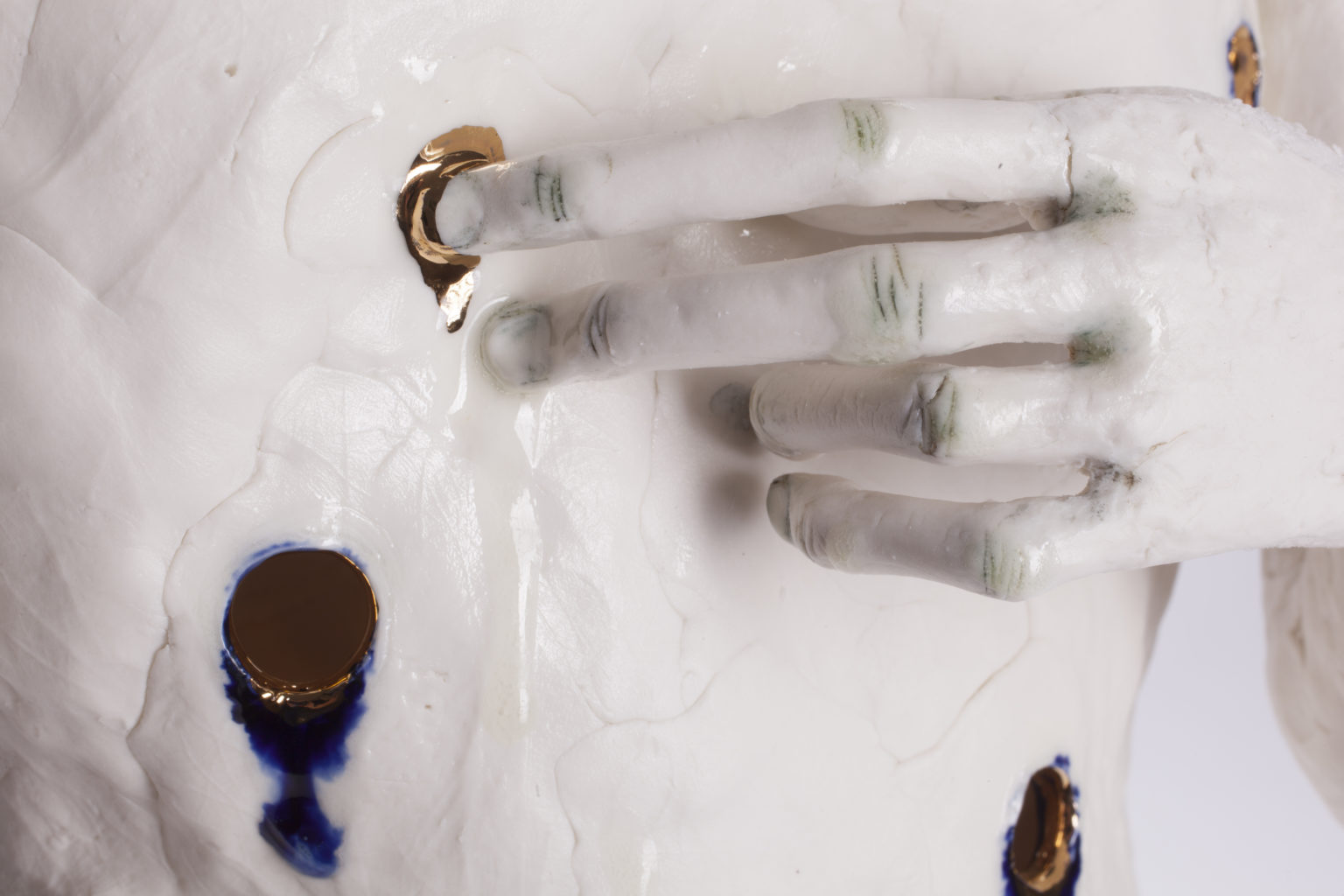
LOOK: Empty Tomb (detail) by Claire Curneen

Curneen, Claire_Empty Tomb (detail)
Claire Curneen (Irish, 1968–), Empty Tomb (detail), 2018. Porcelain, h. 31 inches.

I encountered this striking image on the cover of Image no. 97 (Summer 2018). I’ve not been able to find a photograph of the full piece, but Curneen created a variation on it last year.

In the article “Beauty in Brokenness: The Sculpture of Claire Curneen,” Richard Davey writes that in Curneen’s body of work,

indications of internal states of transformation or transfiguration are not confined to gold. . . . Recently Curneen has begun to use a deep blue to create a similar effect. Like ultramarine, which was reserved for only the most significant parts of medieval paintings, this blue glaze is used only sparingly, painted onto faces, hands, and other areas where it will have the maximum impact. The effect is dramatic, with faces dissolving into an incorporeal void. For unlike gold, which reflects light, this deep blue holds light, absorbing our gaze into its pellucid depths. Curneen exploited this difference in one of her most recent works, Empty Tomb (2018), where blue and gold ooze from a series of gaping wounds, like the unmingled blood and water that flowed from the side of the dead Christ. With the tip of one finger, this elegiac figure gently points out one of these openings, echoing Saint Thomas, who needed to touch Jesus’s wounded side before he could believe. This gesture is the only moment of animation in a work that is otherwise still, but it is not the focus. That is to be found in the wounds themselves, which stand out starkly against the limpid porcelain. These are the empty tomb of the title, apertures exuding blue and gold, dark and light. They draw us in so that we find our attention focused entirely on these small rings. For a moment, as we teeter on this visual precipice, with solidity melting around us and the figure dissolving into the background, time stands still.

LISTEN: “Empty” by The Sowing Season, on The Fox & the Sparrow (2017)

Oh Mary, why have you come?
Come drop your oils and run
You’ll find no one
Find no one

Oh Thomas, can’t you see?
Where bone and sinew meet
You’ll find a hole
Find a whole

Oh Saul, look down at your hands
All red and dripping in the sand
It’s the wrong blood
The wrong blood

Come find the blood of the Son

Jesus meets people where they’re at: Mary Magdalene in her grief (John 20:11–18), Thomas in his doubt (John 20:24–29), Saul in his murderous zealotry (Acts 9:1–19). And he transforms them. After their encounters with the risen Christ, Mary’s tears give way to joy; Thomas’s doubt transposes into belief; and Saul goes from persecutor of Christians to key apostle, with a ministry of preaching the gospel, planting churches, and writing letters of teaching and encouragement that have become sacred scripture.

The song “Empty” by The Sowing Season reflects Christ’s gentle invitation to behold his transfigured wounds and to move, with him, from death into life.

This song is on the Art & Theology Eastertide Playlist.

Easter, Day 5

LOOK: Ballet Skirt or Electric Light by Georgia O’Keeffe

O'Keeffe, Georgia_Ballet Skirt or Electric Light
Georgia O’Keeffe (American, 1887–1986), Ballet Skirt or Electric Light, 1927. Oil on canvas, 36 × 30 in. (91.4 × 76.2 cm). Art Institute of Chicago.

The Art Institute of Chicago, which owns this painting, offers the following description:

In the 1920s Georgia O’Keeffe began creating the paintings of enlarged flowers for which she is most famous, including a series of works devoted to the white rose; this painting is her most abstracted depiction of the subject. O’Keeffe simplified the energy of the blooming rose to its essence, so that it resembles a brilliant light radiating out of flat Cubist planes. She exhibited this painting as White Rose—Abstraction at Alfred Stieglitz’s Intimate Gallery in 1928 and retitled it Ballet Skirt or Electric Light (from the White Rose Motif) when she lent it to the Art Institute of Chicago’s 1943 retrospective of her work.

I was introduced to Ballet Skirt in Imaging the Word: An Arts and Lectionary Resource, volume 3, where it appears in the Easter section. So credit goes to that book’s editors (Susan A. Blain, et al.) for linking the image with Christ’s resurrection. Now I can’t see it any other way! Bright and explosive, the painting has as its focal point an orb of light near the bottom edge, which could be read as the figure of Christ standing in the open mouth of the tomb.

By the way, all three Imaging the Word volumes, which I chanced upon at Ollie’s Bargain Outlet some years ago, are excellent. Structured around the Revised Common Lectionary, years A through C, the books integrate scripture, visual art, poetry, sheet music, liturgies, fiction excerpts, quotes from Bible commentaries and spiritual nonfiction, and more. They are published by United Church Press.

LISTEN: “Aurora lucis rutilat” (Light’s Glittering Morn Bedecks the Sky) | Words attributed to Ambrose, 4th century; translated into English by John Mason Neale, 1851 | Music by Orlande de Lassus, ca. 1592, published posthumously in 1604 | Performed by the Choir of Clare College, Cambridge, dir. Graham Ross, 2016

1. Aurora lucis rutilat, 
caelum laudibus intonat,
mundus exultans iubilat,
gemens infernus ululat,

2. Cum rex ille fortissimus,
mortis confractis viribus,
pede conculcans tartara
solvit catena miseros!

3. Ille, qui clausus lapide
custoditur sub milite,
triumphans pompa nobile
victor surgit de funere.

4. Solutis iam gemitibus
et inferni doloribus,
“Quia surrexit Dominus!”
resplendens clamat angelus.

5. Tristes erant apostoli
de nece sui Domini,
quem poena mortis crudeli
servi damnarant impii.

6. Sermone blando angelus
praedixit mulieribus,
“In Galilaea Dominus
videndus est quantocius”

7. Illae dum pergunt concite
apostolis hoc dicere,
videntes eum vivere
osculant pedes Domini.

8. Quo agnito discipuli
in Galilaeam propere
pergunt videre faciem
desideratam Domini.

9. Claro paschali gaudio
sol mundo nitet radio,
cum Christum iam apostoli
visu cernunt corporeo.

10. Ostensa sibi vulnera
in Christi carne fulgida,
resurrexisse Dominum
voce fatentur publica.

11. Rex Christe clementissime,
tu corda nostra posside,
ut tibi laudes debitas
reddamus omni tempore!

12. Deo patri sit gloria
eiusque soli filio
cum spiritu paraclito
et nunc et in perpetuum.
Light’s glitt’ring morn bedecks the sky,
heav’n thunders forth its victor cry,
the glad earth shouts its triumph high,
and groaning hell makes wild reply.

While he, the King of glorious might,
treads down death’s strength in death’s despite,
and trampling hell by victor’s right,
brings forth his sleeping saints to light.

Fast barred beneath the stone of late
in watch and ward where soldiers wait,
now shining in triumphant state,
he rises Victor from death’s gate.

Hell’s pains are loosed and tears are fled;
captivity is captive led;
the angel, crowned with light, hath said,
“The Lord is risen from the dead.”

The apostles’ hearts were full of pain
for their dear Lord so lately slain:
that Lord his servants’ wicked train
with bitter scorn had dared arraign.

With gentle voice the angel gave
the women tidings at the grave;
“Forthwith your Master shall ye see:
he goes before to Galilee.”

And while with fear and joy they pressed
to tell these tidings to the rest,
their Lord, their living Lord, they meet,
and see his form, and kiss his feet.

The Eleven, when they hear, with speed
to Galilee forthwith proceed:
that there they may behold once more
the Lord’s dear face, as oft before.

In this our bright and Paschal day,
the sun shines out with purer ray,
when Christ, to earthly sight made plain,
the glad apostles see again.

The wounds, the riven wounds he shows
in that his flesh with light that glows,
in loud accord both far and nigh
the Lord’s arising testify.

O Christ, the King who lov’st to bless,
do thou our hearts and souls possess:
to thee our praise, that we may pay
to whom our laud is due for aye.

Orlande de Lassus’s setting of “Aurora lucis rutilat” is a motet for ten voices. Graham Ross describes the piece in the BBC Music Magazine article “The best choral music for Easter”:

A setting of an anonymous 4th century text – the Hymn for Lauds on Easter Sunday – Lassus’s motet begins by tenderly depicting the dawn of Easter morning, but soon leads to a double-choir celebration of the triumph of the resurrection, full of word-painting, jubilation and a brief triple-time passage proclaiming the joy of Easter day (‘in hoc pascali gaudio’). Written late in Lassus’s life, the work is a unique example in the Franco-Flemish composer’s output of Venetian polychoral technique, with harmonic completeness in each choir.

The hymn exists in several different English translations and variations and has been set to music by multiple composers or paired with preexisting hymn tunes. For example, I’ve heard it sung to LASST UNS ERFREUEN, a tune from seventeenth-century Germany that today is most associated with the hymn “All Creatures of Our God and King.” In this case, “alleluias” and other short acclamations are added to the verses.

If you want to use this hymn for congregational singing, I would recommend the following version (with LASST UNS ERFREUEN), which I cobbled together from a few different sources (including the Jubilate Hymns version and the Liturgy Fellowship Facebook group) but which draws heavily on Neale’s translation:

Light’s glittering morning fills the sky,
heav’n thunders forth its victor cry:
Christ is risen! Alleluia!
The glad earth shouts its triumph high
and groaning hell makes wild reply.
Christ is risen! O praise him!
Alleluia, alleluia, alleluia!

For Christ the Lord, the mighty King,
despoils death and draws its sting.
Christ is risen! Alleluia!
He tramples down the pow’rs of night,
brings forth his ransomed saints to light.
Christ is risen! O praise him!
Alleluia, alleluia, alleluia!

His rocky tomb the threefold guard
of watch and stone and seal had barred.
Alleluia, alleluia!
But shining now in glorious state,
he rises Victor from death’s gate.
Christ is risen! O praise him!
Alleluia, alleluia, alleluia!

Hell’s pains are loosed and tears are fled;
captivity is captive led.
Alleluia, alleluia!
“Weep not!” an angel voice has said.
“The Lord is risen from the dead!”
O praise him, O praise him!
Alleluia, alleluia, alleluia!

All praise be thine, O risen Lord,
from death to endless life restored;
Christ is risen! Alleluia!
To Father, Son, and Spirit be
all pow’r and praise eternally!
Christ is risen! O praise him!
Alleluia, alleluia, alleluia!

Easter, Day 4

How did Jesus’s mother, Mary, come to find out that he had risen from the dead? Was she there when it happened, keeping vigil? Was she among the holy women at the tomb to whom the angel made the announcement, or did these women go to Mary to relay the news to her? Maybe an angel came to tell her personally? Or perhaps Jesus himself appeared to her, to tell and show, at the home where she was staying.

The Bible is silent as to Mary’s whereabouts between the time of Entombment and the events of Easter morning. Historically, there have been proponents of each of the above suppositions. But the one that has taken the strongest hold is the last one—that Jesus made direct personal contact with his mom after his resurrection, before appearing to anyone else. He wasn’t at the tomb when Mary Magdalene got there (unless, perhaps, he was lingering somewhere in the shadows). Where did he go in the early morning? Some scholars say he must have gone to console his mother.

The claim that Jesus appeared first to Mother Mary can be found as far back as Ambrose (340–397), who wrote in his De virginitate, “Therefore Mary saw the resurrection of the Lord: she saw it first and believed.”

Around 1300 the anonymous writer known as Pseudo-Bonaventure elaborated on this tradition in his highly influential Meditationes Vitae Christi (Meditations on the Life of Christ), providing a vivid and affecting narrative in which Mary, when the women depart for the tomb on Sunday morning, stays behind and prays for God to restore her son to her alive.  

And with that, she so praying, sweet tears shedding, lo suddenly our Lord Jesus came and appeared to her, and in all white clothes, with a glad and lovely cheer, greeting her in these words: “Hail, holy mother.” And anon she turning said: “Art thou Jesus, my blessed son?” And therewith she kneeling down honored him; and he also kneeling beside her said: “My dear mother, I am. I have risen, and lo, I am with you.” And then both rising up kissed the other; and she with unspeakable joy clasped him, sadly, resting all upon him, and he gladly bare her up and sustained her. [as translated into Middle English by Nicholas Love in The Mirror of the Blessed Life of Jesus Christ, ca. 1400, with modernized spellings]

Pseudo-Bonaventure imagines a private, emotional reunion in a domestic interior. This episode was picked up by Ludolph of Saxony in his Vita Christi and by other writers, and it circulated throughout Europe. It made its way into the visual arts starting in the first half of the fourteenth century. The two most famous examples are the right wing of Rogier van der Weyden’s Miraflores Triptych and a woodcut from Albrecht Dürer’s Small Passion series.

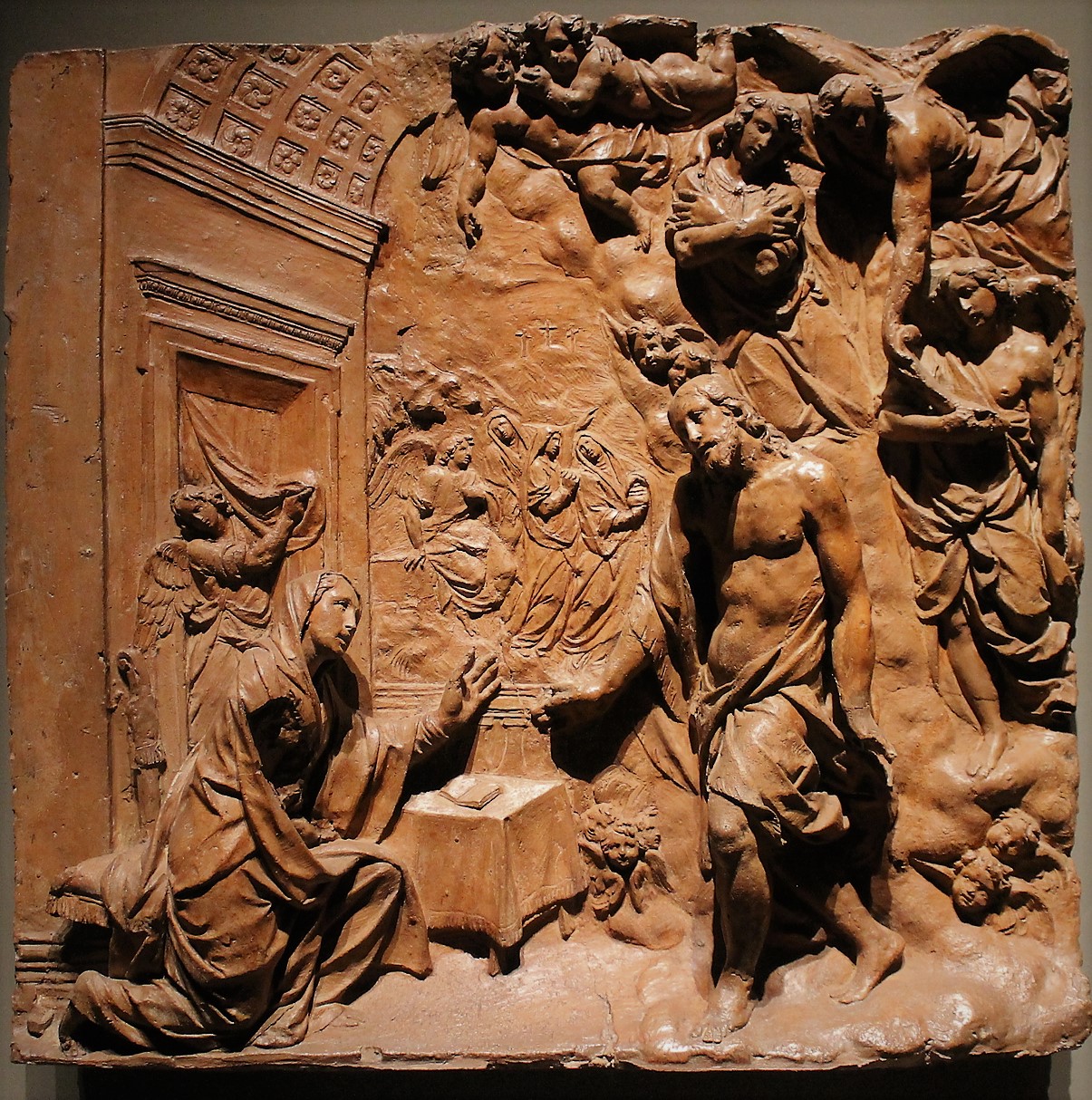
But I want to take a look at this Italian Baroque bas-relief by the minor artist Giovanni Pietro Lasagna.

LOOK: Christ Appearing to His Mother by Giovanni Pietro Lasagna

Lasagna, Giovanni Pietro_Christ Appearing to His Mother
Giovanni Pietro Lasagna (Italian, d. 1658), Christ Appearing to His Mother, first quarter of 17th century. Terracotta.

I found this artwork in the blog article “Iconography of the Resurrection – Christ Appears to His Mother” by Margaret Duffy, which provides a fascinating compilation of images. Duffy cites its location as unknown, and I’ve not been able to find reference to it anywhere else. It was probably made in Milan, where the artist was active. An email inquiry I sent last month to the city’s Museo del Duomo, which has similar terracottas from the same period in its collection, has garnered no reply. It’s possible the work was made as a design for a marble sculpture.

Carved in low relief in the background, an angel sits on the edge of an empty sarcophagus and tells the three women with their ointment jars that Jesus is not here but is risen. Three untenanted crosses are visible in the distance on Mount Calvary, a shadow of Friday’s events.

In the foreground, sculpted in high relief, we see Mary at her prayer desk. She is interrupted by the triumphant entry of her risen son, attended by angels. Their arms reach out to embrace each other as her grief turns to joy.

To reinforce the news of resurrection, an angel who stands behind Mary peeks out from behind a curtained doorway and points to the concurrent scene that’s unfolding in the garden of Jesus’s burial.

I’m not certain of the identity of the figures behind Jesus. But in looking into it, I did find that there’s a legend, likely originating in fourteenth- or fifteenth-century Spain, that when Jesus appeared to his mother after the resurrection, he presented to her the redeemed of the Old Testament, whom he had just freed from Hades.* So it’s possible that the beardless young man at the upper left with his arms crossed over his chest is Adam, and that the figure at the right with one breast bared is Eve. And I think the man at the top right corner who’s touching them both is an angel.

Note the iconographic similarity to scenes of the Annunciation—Gabriel’s announcement to the young Mary that she had been chosen by God to bear his Son. This “emphasizes the parallelism between the heralding of the Incarnation by the Archangel, and Christ’s own announcement, to his mother, of the fulfillment of that Incarnation, that is, the Resurrection.”**

* James D. Breckenridge, “‘Et Prima Vidit’: The Iconography of the Appearance of Christ to His Mother,” Art Bulletin 39, no. 1 (March 1957): 28. This excellent illustrated article traces the literary and visual history of the resurrected Christ appearing to his mother, in its several variations.

** Ibid., 26–27.

LISTEN: “Be Joyful, Mary” (Regina caeli, jubila) | Words: Latin, 17th century, based on the 12th-century “Regina caeli”; anonymous English translation from Psallite, 1901 | Music by Nicholas Andrew Barber, 2020

Be joyful, Mary, heav’nly queen
Gaude, Maria!
Your son who died was living seen
Alleluia!

Laetare, O Maria
O Maria

The son you bore by heaven’s grace
Gaude, Maria!
Did all our guilt and sin efface
Alleluia!

Laetare, O Maria
O Maria

The Lord has risen from the dead
Gaude, Maria!
He rose with might as he had said
Alleluia!

Laetare, O Maria
O Maria

This song has its roots in a medieval liturgical text that is still used as an antiphon (short hymn) in the Roman Catholic Church throughout the Easter season. Gaude means “rejoice”; laetare, “be glad.”

The lyrics could be in the voice of the women who went early to the tomb and are returning with the great news, or it could be that we the faithful are imaginatively addressing Mary across time, inserting ourselves into that story of the first Easter morning.