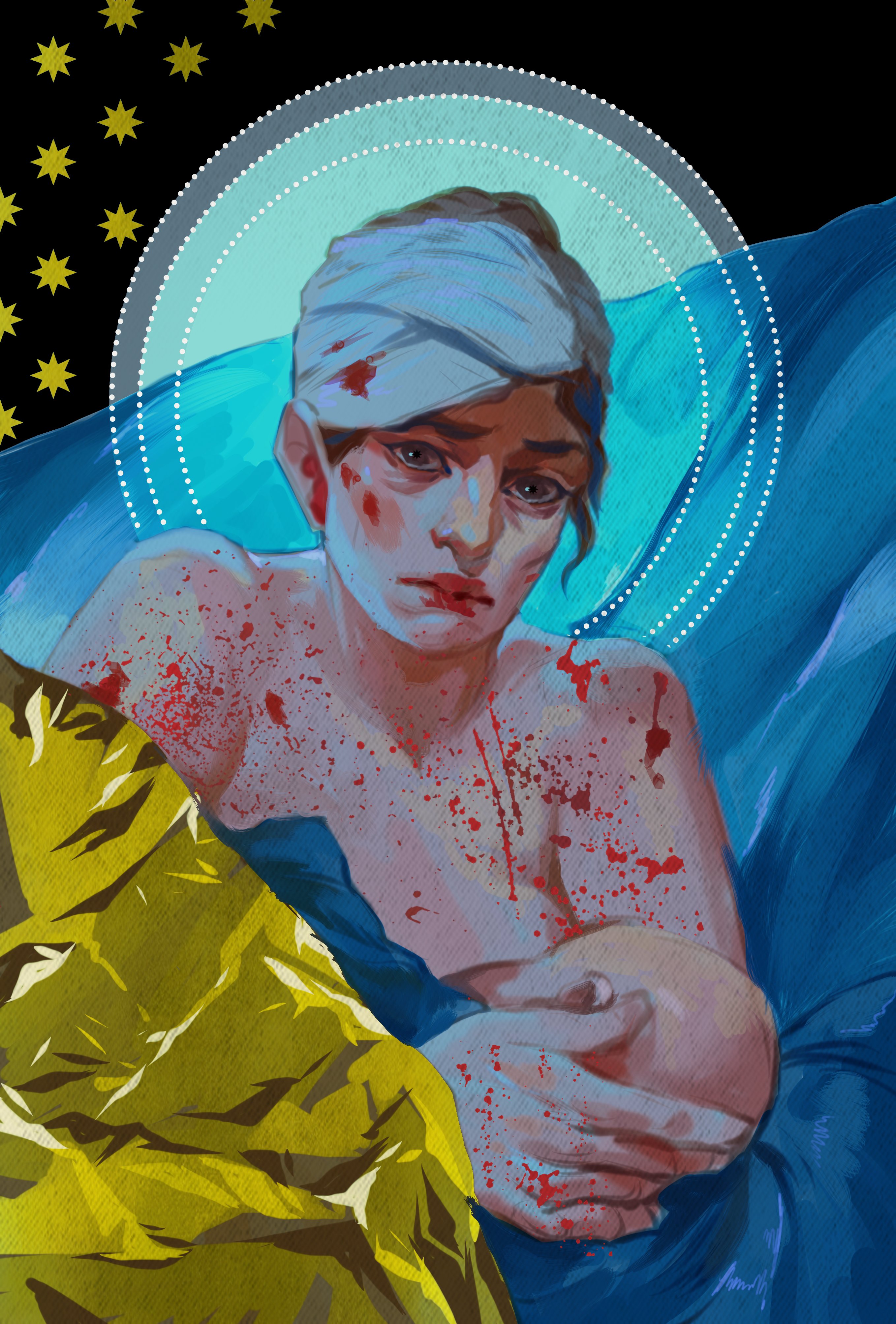
UKRAINIAN MADONNAS: Since Russia invaded Ukraine on February 24 and even still continues to aggress, artists have taken up their art to address the war—several drawing on iconography of the Madonna and Child, particularly the Maria lactans (breastfeeding Mary) type. Two Ukrainian artists were inspired by different news photos of young mothers protecting their infants from the shelling in Kyiv in March—one of whom was photographed in a hospital being treated for wounds she sustained from fallen glass while shielding her daughter with her body, and the other hiding from the blasts in a subway station.
These images show the vulnerability of Christ, who is with us in our suffering, and indict those who cause such suffering.
In his response to the war in Ukraine, Serbian artist Michael Galovic, who lives in Australia, also uses Christian iconography: the Theotokos Kyriotissa (Mother of God enthroned with Christ); Archangel Michael, the patron saint of Kyiv, fighting a dragon (Rev. 12:7–8) in an ethereal rendering of a scene from the Très Riches Heures du Duc de Berry, a fifteenth-century French book of hours; and a hellmouth from the twelfth-century Winchester Psalter. These three medieval images are superimposed on Picasso’s masterwork Guernica, named after the Spanish town bombed by Nazis in 1937 and representative of the horrors of war.
Michael Galovic (Serbian Australian, 1949–), Ukraine Response, 2022. Egg tempera and gold leaf on linen on board, 170 × 80 cm. Collection of the Australian Centre for Christianity and Culture, Canberra, Australia.
Whereas Frirean’s and Solomennykova’s paintings are more intimate, Galovic takes a more cosmic approach, showing wails of lament from abstracted forms intercut with epic battles between good and evil—but at the calm center, Christ is on the throne, holding the scroll of his good word. History is going somewhere. Hate will be damned. Love will triumph.
>> “Galoba (The Prayer),” performed by Trio Mandili: A sung performance of a poem written in 1858 by the Georgian poet and statesman Ilia Chavchavadze (1837–1907). An English translation follows.
Our Father, who art in heaven, With tenderness I stand before thee on my knees. I ask for neither wealth nor glory; I won’t debase my holy prayer with such matters. I desire instead for my soul to be enlightened by heaven, My heart to be radiant with thy love. Even if my enemies pierce me in the heart, I beg thee: “Forgive them, Lord, for they know not what they do!” Even if my enemies pierce me in the heart, I beg thee: “Forgive them, Lord, for they know not what they do!” [source, adapt.]
>> “Peace All Over the World” by Robert Bradley: Written and performed by Detroit musician Robert Bradley, this song originally appeared on the film Playing for Change: A Cinematic Discovery of Street Music (2005). To celebrate their twentieth anniversary, Playing for Change [previously] has remastered it and added new footage from Ukraine.
>> “Du som gick före oss” (You Who Went Before Us) |Words by Olov Hartman, 1968 | Music by Sven-Erik Bäck, 1959 | Performed by VOCES8, 2022: The melody uses all twelve semitones of the octave! I’ve provided a literal English translation of the Swedish below with the help of Google Translate; for a looser but more poetic translation by Fred Kaan, from 1976, see here. Note: The video identifies the song parenthetically as Psalm 74, not because it’s a setting of Psalm 74 from the Bible, but because it is no. 74 in Den svenska Psalmboken, the official hymnal of the Church of Sweden.
Du som gick före oss
längst in i ångesten,
hjälp oss att finna dig,
Herre, i mörkret.

Du som bar all vår skuld
in i förlåtelsen,
du är vårt hjärtas fred,
Jesus, för evigt.

Du som med livets bröd
går genom tid och rum,
giv oss för varje dag,
Kristus, det brödet.

Du som går före oss
ut i en trasig värld,
sänd oss med fred och bröd,
Herre, i världen.
You who went before us
in the depths of anxiety,
help us to find you,
Lord, in the dark.

You who bore all our guilt
into forgiveness,
you are the peace of our hearts,
Jesus, forever.

You who are the living bread
offered abundantly through all the earth,
give us each day,
dear Christ, that bread.

You who go before us
out into a broken world,
send us out likewise, Lord,
with peace and bread.
EXHIBITION: Afro-Atlantic Histories, National Gallery of Art, Washington, DC, April 10–July 17, 2022: There are still two more weeks to catch this excellent exhibition in the US capital, which I saw in June, before it travels to the Los Angeles County Museum of Art (December 11, 2022–April 30, 2023) and the Dallas Museum of Art (dates TBA). “For centuries, artists have told and retold the complex histories of the African Diaspora. Explore this enduring legacy in the exhibition Afro-Atlantic Histories, which takes an in-depth look at the historical experiences and cultural formations of Black and African people since the 17th century. More than 130 powerful works of art, including paintings, sculpture, photographs, and time-based media by artists from Africa, Europe, the Americas, and the Caribbean, bring these narratives to life.”
I wish I had more time to devote to it here before it wraps, as there are so many compelling artworks, but instead let me just share a two-minute video tour, followed by a lecture from April 10, which both provide a good overview:
The exhibition is divided into six sections: Maps and Margins, Enslavements and Emancipations, Everyday Lives, Rites and Rhythms, Portraits, and Resistances and Activisms. Kanitra Fletcher, associate curator of African American and Afro-Diasporic art at the National Gallery of Art, says in her talk,
The word histories in the title indicates the plurality of the narratives represented in the exhibition. They are fictional and nonfictional, mythical and factual. As a framework to coalesce narratives that have been left aside at the margins and forgotten, Afro-Atlantic Histories is open, plural, diverse, and inclusive, refusing the canon of traditional art history. This show resists the idea of a definitive history or a “grand narrative” of the Diaspora and presents diverse accounts of the past that challenge long-established hierarchies and forges new questions and connections that show how complex and intertwined are all of our histories.
Here’s an artwork that isn’t included in either of the above videos and that was new to me:
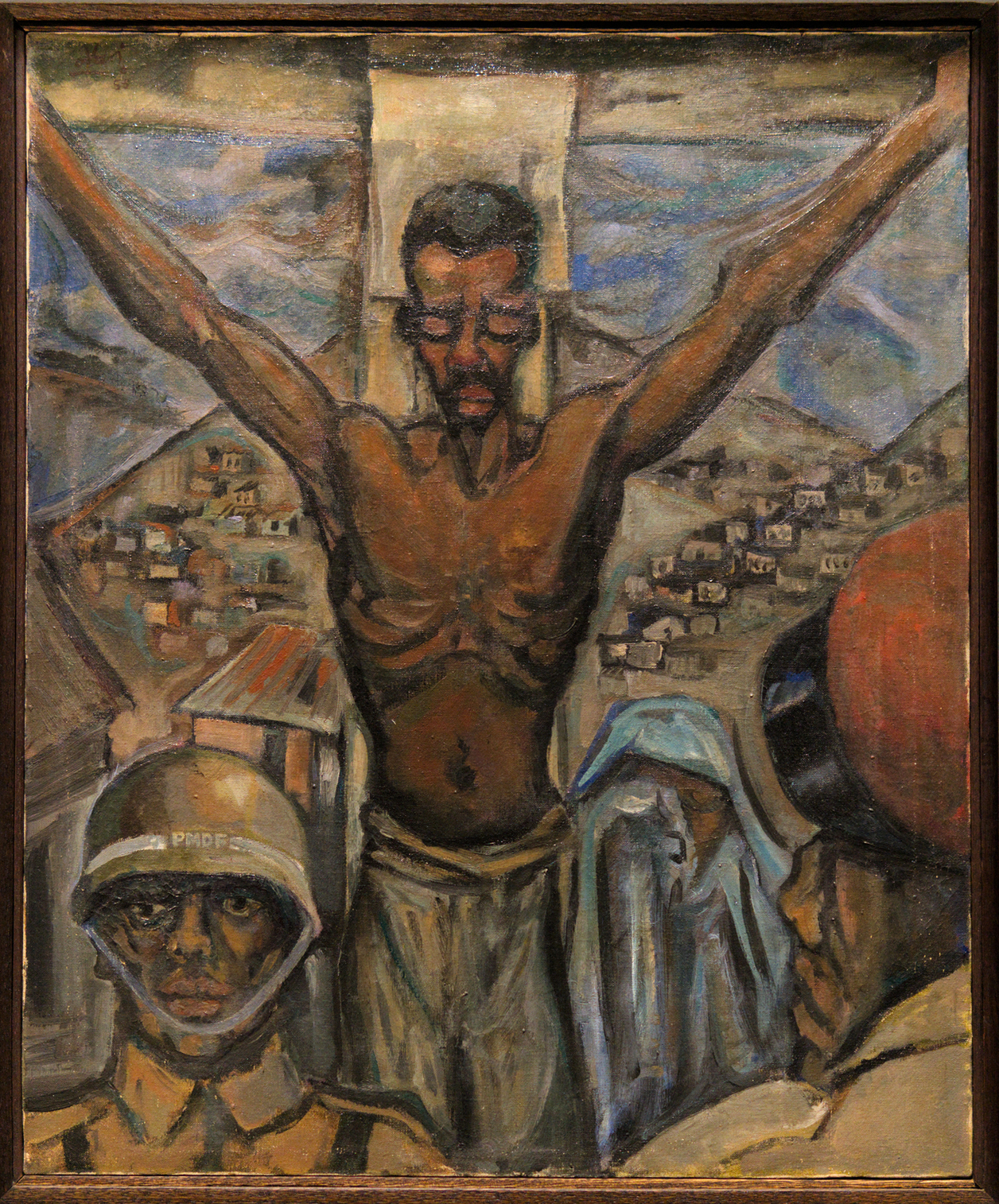
Octávio Araújo (Brazilian, 1926–2015), Cristo favelado (Slum Christ), 1950. Oil on canvas, 64 × 53 cm. Collection of the Instituto de Pesquisas e Estudos Afro-Brasileiros (IPEAFRO), Rio de Janeiro. Photo: Victoria Emily Jones, at Afro-Atlantic Histories at the National Gallery of Art, Washington, DC, June 2022.
Artist Octávio Araújo entered this painting in the Black Christ contest held in 1955 by the Teatro Experimental do Negro (Black Experimental Theater) in Rio de Janeiro (I mentioned this contest previously in relation to another submission, a painting by Djanira da Motta e Silva). It shows Christ crucified in a Brazilian favela, his Roman tormentors replaced with military police officers, perpetrators of state-sanctioned violence against the nation’s Black people.
+++
ONLINE COURSE: “Theology and the Arts,” with Jason Goroncy, Rod Pattenden, and guest artists, September 19, 20, 21, 26, 27, 28 and October 21, 2022: Whitley College, a teaching college of the University of Divinity outside Melbourne, is offering a seven-day intensive online course on theology and the arts this fall (description below), taught by the coeditors of the new book Imagination in an Age of Crisis: Soundings from the Arts and Theology. Registration is open to anyone, but participants will need to be available to engage live online from 9:30 a.m. to 3:00 p.m. (Melbourne time) on each of the scheduled days, for lectures, discussions, and other online activities, such as “meet the artist,” gallery visits, interviews, and student presentations. The cost to audit the course is AUD $500 (~ USD $343). There’s also an option to receive academic credit. Professor Goroncy writes,
When, in 1741, George Frideric Handel completed writing the Hallelujah Chorus for his oratorio Messiah, he reportedly told his servant: ‘I did think I did see all Heaven before me, and the great God Himself [sic] seated on His throne, with His Company of Angels’. More recently, the Australian musician Nick Cave described how the gods are closely associated with the flight of the imagination. Both musicians had a sense, each in their own way, of how closely related are the arts and theological work.
Theology and art are often considered separate expressions of human activity, but are they? How might they relate? What influence do they have on one another, and how might such inform our understanding of faith, of the human condition, of the creature’s vocation, and maybe even of God?
The registration deadline is July 15—but if there are still open spots available, it’s possible you could get in after that date. Email Dorothy Morgan at registrar@whitley.edu.au for an application form and more information.
+++
SYMPOSIUM: “Humanity Redeemed: The Theological Vision of Georges Rouault,” September 23–24, 2022, Gordon Conwell Theological Seminary, Charlotte, NC: I’m considering attending! The early-bird rate, good through July 23, is $80 for the general public and includes a Friday dinner and Saturday lunch. “Georges Rouault (1871–1958) was unique among French modernist artists due to his Christian commitment and its influence on his work. The theological vision unveiled through his art is honest and complex, one that reflects the changing climate and tumultuous events of the early twentieth century. In doing so, Rouault showed the possibility of salvation and hope within the inexplicable suffering and mundane realities of human life. His close friend Jacques Maritain identified this as ‘the art of humanity redeemed.’
“This symposium will gather teachers, pastors, artists, ministry leaders, and others to reflect on the theological vision of Georges Rouault and his ongoing impact. Prominent scholars and practitioners with expertise in theology, art history, philosophy, therapy, and community leadership will be offering papers and leading the discussion. One of the speakers, Philippe Rouault, is the great grandson of Georges Rouault and will be providing a personal introduction to his life, work, and family. In addition, several artists will present new work inspired by Rouault, which will both enrich our experience together and show the ongoing generativity of Rouault’s vision and style.”
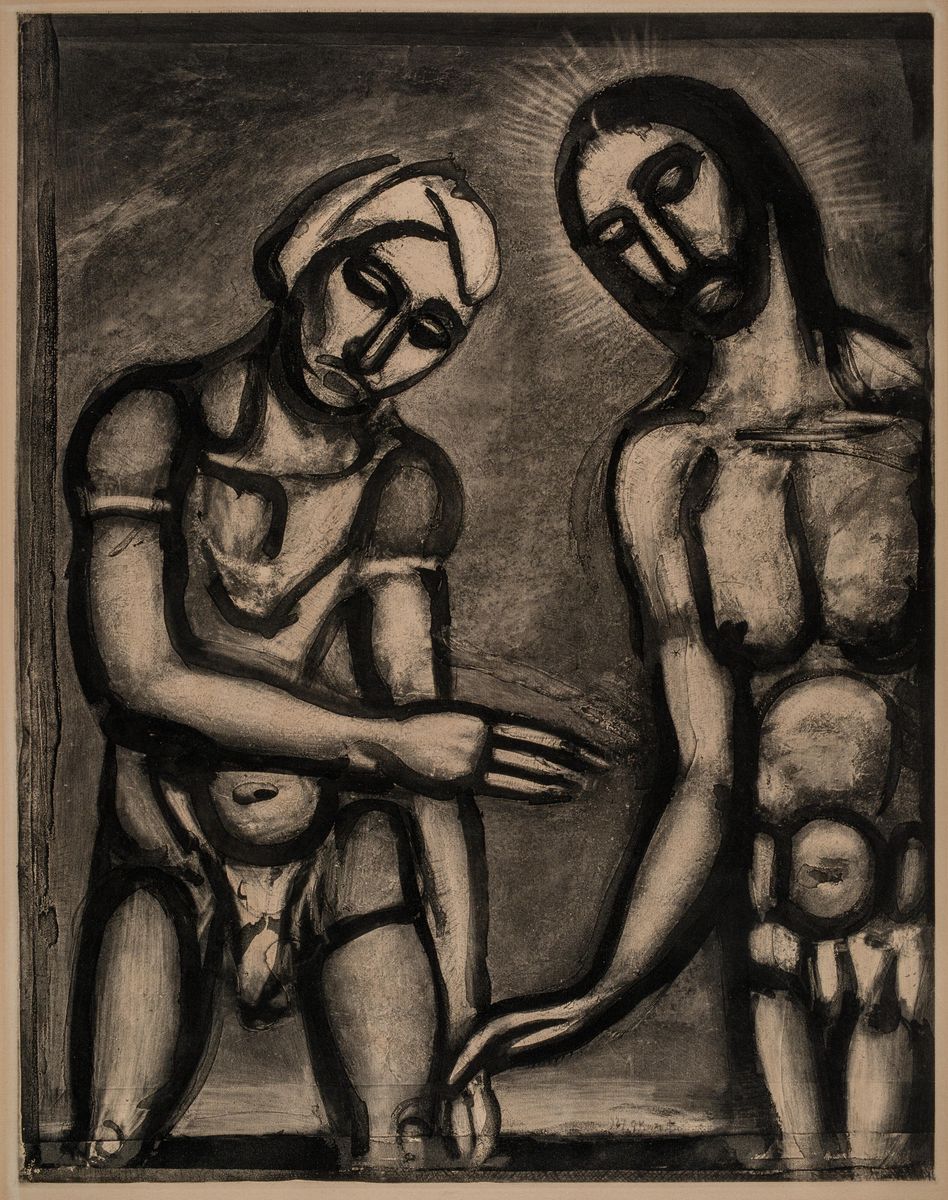
Georges Rouault (French, 1871–1958), Seigneur, c’est vous, je vous reconnais [Lord, it is you, I know you], plate 32 from the Miserere et Guerre series, 1948. Aquatint, roulette, drypoint over heliogravure on paper, 57.4 × 44.9 cm (plate). Art Gallery of South Australia, Adelaide.
+++
SPOTIFY PLAYLIST: July 2022 by Victoria Emily Jones: Includes a thirteenth-century antiphon for the Holy Spirit by Hildegard of Bingen (“Love abounds in all . . .”); a Luganda praise song for children’s choir; an excerpt from an Orthodox Vespers service in the Yup’ik language from Kodiak, Alaska; a gospel-style setting of Psalm 23; and more. Below are live recordings on YouTube of a few songs from the list: a cover by Amir Darzi and Lital Regev of “Long, Long, Long” from the Beatles’ White Album, which songwriter George Harrison said addresses God; “Love Like There’s No Tomorrow” by gospel-blues husband-wife duo The War and Treaty; and “Here in the Vineyard of My Lord,” a Primitive Baptist hymn compiled in The Good Old Songs (1913) and performed by Americana/folk music duo Anna & Elizabeth.
DOCUMENTARY: Juneteenth: Faith and Freedom, dir. Ya’Ke Smith: Released June 7 by Our Daily Bread Ministries, this film follows Where Ya From? podcast host Rasool Berry to Texas to talk with pastors, historians, activists, artists, and elected officials about the spiritual significance of America’s newest federal holiday, and to visit historic sites associated with it. You can watch the full seventy-five-minute film for free on YouTube. Here’s the trailer:
The interviewees, in order of appearance, are:
Dr. Michael W. Waters, pastor, Abundant Life African Methodist Episcopal Church
SPOTIFY PLAYLISTS by Lara Downes (with commentary!):
>> Songs for Freedom: A Juneteenth Playlist (2021): Award-winning pianist and NPR radio host Lara Downes curated an excellent Spotify playlist for Juneteenth last year—a mix of jazz, classical, and soul. It is full of wonderful surprises, introducing me to the work of several African American composers, new and old, such as Wynton Marsalis’s The Democracy! Suite for jazz ensemble; a symphony by William Grant Still titled “Song of a New Race”; “Adoration” by Florence Price (originally written for organ but arranged here for violin and piano); “Fanfare on Amazing Grace” by Adolphus Hailstork; and “Startin’ Sumthin’” by Jeff Scott, a French hornist who performs “urban classical chamber music.”
There are also several well-known names—Billie Holiday, Mahalia Jackson, Aretha Franklin, Nina Simone, Duke Ellington, John Coltrane, Stevie Wonder—and more recent popular artists like Jon Batiste and Rhiannon Giddens. Batiste’s arrangement of “What a Wonderful World” is gorgeous, and the music video—wow (see below). It features a group of Black nuns having fun around London—picnicking on a park bench, traversing monkey bars, sharing the gospel with passersby, eating cotton candy, riding bumper cars. It captures the tone of the song perfectly.
From Downes’s list I also really like the blues song “I Knew I Could Fly” by Allison Russell and Leyla McCalla, excerpted in the following featurette. It’s from the album Songs of Our Native Daughters, which sheds light on African American women’s stories of struggle, resistance, and hope.
Be sure to read the NPR article that introduces the playlist. Downes calls out nine of the musical selections with blurbs that provide some background, and throughout there is a smattering of historical photographs of Black flourishing in and around Washington, DC, from 1904 onward, taken by the Black-owned Scurlock Studio.
YWCA camp for girls. Highland Beach, Maryland, 1930. This photo is from the Scurlock Studio Collection at the Smithsonian National Museum of American History.
>> Songs to Believe In: A Juneteenth Playlist (2022): As I was formatting this post I realized that Downes just published a brand-new playlist for Juneteenth 2022. I haven’t had time to listen yet, but it looks awesome. “I offer you a collection of music that insists on the promise of freedom, however long in coming,” she writes. “Music that counters the shrieking dissonance of conflict with the radiant warmth of its harmonies, that offers us comfort in our sorrow and sustenance in our struggle. Songs that ground us with the steadiness of their rhythms and embrace us in the lines of their melodies. Music that brings us hope and faith and even joy, urging us to stand and fight another day, reminding us that what we are celebrating on this holiday is our freedom to believe, even in the hardest of times.”
+++
YOUTUBE PLAYLIST: Juneteenth Playlist by Victoria Emily Jones. Nineteen songs of freedom and faith—gospel, pop, funk, R&B, and spirituals. I wanted to choose all live performances or music videos so that there’s a visual element to engage.
One of the songs is “Clap Praise” by Diane White-Clayton, performed by Selah Gospel Choir. It’s a setting of Psalm 47, which opens, “Clap your hands, all you peoples; shout to God with loud songs of joy!”
Dr. Diane White-Clayton is a composer, conductor, pianist, and lecturer in ethnomusicology specializing in Black sacred music. I love the exuberance and all the body percussion in this widely performed piece of hers. I learned about Selah Gospel Choir through Bridge Projects, an art gallery in Los Angeles where they recently performed. The choir was founded in 2007 “as a space for people who want to sing gospel music birthed by the spirit of the Black church and the ancestry of Black community but are either unable to find it in their home place of worship or do not identify with being in a church at all.”
+++
DANCE WORK: Revelations, choreographed by Alvin Ailey: This classic thirty-six-minute work choreographed by the pioneering Alvin Ailey premiered in New York in 1960 and since then has been performed continually around the globe. This particular performance at Lincoln Center premiered online on December 6, 2020, as part of Alvin Ailey American Dance Theater’s virtual season during the pandemic. “Using African American spirituals, song-sermons, gospel songs, and holy blues, Revelations fervently explores the places of deepest grief and holiest joy in the soul.” Ailey said it was born of the “blood memories” of his childhood in rural Texas and his affection for the Baptist church that nurtured him.
All the numbers are great, but my favorite is “Wade in the Water” (part of the “Take Me to the Water” sequence that begins at 9:41). Second favorite: “Fix Me” (5:22).
EXHIBITION: Paula Rego: Secrets of Faith, Victoria Miro Venice, April 23–June 18, 2022: Portuguese-born British artist Paula Rego died last Wednesday, June 8, after a seven-decade career, and in the midst of four solo exhibitions of her work—including this one at Victoria Miro’s gallery in Venice, which explores her small but significant body of religious art. [HT: Jonathan Evens]
In 2002 Jorge Sampaio, then president of Portugal, commissioned Paula Rego to create eight pastel drawings based on episodes from the life of the Virgin Mary, to be installed permanently in the chapel of the presidential palace (Palácio de Belém) in Lisbon. Titled Nossa Senhora (Our Lady), the cycle comprises Annunciation; Nativity; Adoration; Purification at the Temple; Flight into Egypt; Lamentation; Pietà; and Assumption. Rego had such fun with the commission that she produced additional works on the subject, which she decided to keep for herself. It is these, along with her watercolor studies, that are currently on display in Venice. (The original eight pastels are not allowed to leave the chapel for which they were made.)
Paula Rego (Portuguese British, 1935–2022), The Flight to Egypt, 2002. Watercolor and ink on paper, 8 1/4 × 11 3/4 in. (21 × 29 cm).Paula Rego (Portuguese British, 1935–2022), Descent from the Cross, 2002. Pastel on paper mounted on aluminum, 29 1/2 × 28 3/8 in. (75 × 72 cm).
I learned about Rego’s Marian cycle a few years ago and became enthralled by it, though I’ve never seen it in person, and most of these supplemental works are new to me. It’s unique, in part because of Mary’s corporeality. In a 2003 interview with Richard Zimler, Rego said, “If there is anything new about these representations of the Virgin, it is the fact that they were done by a woman, which is very rare. . . . It always used to be men who painted the life of the Virgin, and now it is a woman. It offers a different point of view, because we identify more easily with her.”
While the president praised the cycle and Rego insisted that “these pictures were created with admiration and respect,” an open letter to Sampaio referred to it as an “outrage done to the vast majority of the Portuguese people,” an “outrage against their religious beliefs and an offence to the Virgin Mary.” In brief: “blasphemous and scandalous.” I can see why Rego’s larger oeuvre, with its often menacing and/or transgressive imagery (not least of which is her Abortion Series), would scandalize conservative viewers, but I am a bit confused by the outrage at Nossa Senhora, which to me seems very honoring. The objectors, it sounds like, are those who prefer Mary to be more ethereal and sedate; they don’t want to see her, for example, slouching or wincing or expressing astonishment, or awkwardly struggling to hold the weight of her son’s corpse. There will always be those who resist any kind of updating of religious art. If the scenes are restaged in an unfamiliar way or rendered in an unfamiliar style or introduce a new element or the figures don’t look like how we have always pictured them, then some will oppose them outright—which is a shame, because such art often invites us more deeply into the story, helping us to see it afresh.
PODCAST EPISODE: “Past Hymns for the Present Moment,”Tokens, May 26, 2022: “Hymns are often sentimentalized in the American church, cast aside as merely retired songs with dated language, bearing no real appeal or relevance. But of course it may be that our old hymnals have some crucial things to say to us in our current cultural moment. This is the challenge I [Lee C. Camp] posed to Odessa Settles, Phil Madeira, and Leslie Jordan: find and perform some old hymns which might be both indicting and encouraging to the modern church, and to the world at large. Beautiful conversation and moving performances, taped at Nashville’s Sound Emporium.”
+++
POETRY UNBOUND EPISODES:
In each episode of this podcast from On Being Studio, host Pádraig Ó Tuama unpacks a contemporary poem in fifteen minutes. Here are two from season 5 (which just came to an end) that I particularly liked.
>> “Looking for The Gulf Motel” by Richard Blanco: “What happens when we remember?” Ó Tuama asks. “Why do we remember? Is it sweet or sad? Is it both? If you particularly associate warm memories, romantic memories, nostalgic memories with a place, and then that place is changed, does that mean that all those memories are gone?” In this poem from a collection of the same title (which I checked out from my local library at Ó Tuama’s recommendation, and it’s excellent!), Cuban American poet Richard Blanco, at age thirty-eight, reminisces about a family beach vacation from his childhood. Read the poem here.
If I were writing this poem, it would be called “Looking for The Blockade Runner,” as that’s the name of the Wrightsville Beach hotel in North Carolina that my family and I used to stay at for four days or so each summer. My little brother and I should still be running around on the waterfront lawn as our parents watch us from inside the giant window of the dining room, finishing up their breakfast. My dad should still be riding in a wave on a boogie board, teaching me technique. My mom should still be lounging at the pool in her black one-piece with sunglasses and a Vanity Fair, I feeling so grown up beside her sipping my virgin piña colada. My brother should still be exhilarated by the live hermit crabs at Wings, and I by the dried starfish and sand dollars. We should all still be walking back from the Oceanic, our bellies filled with she-crab soup and hush puppies and catch-of-the-day, down the shore at dusk.
>> “The change room” by Andy Jackson: A poet who’s interested in difference and embodiment, here Andy Jackson, who has severe spinal curvature due to Marfan syndrome, “is looking at the attention that he gets in his body and is refocusing it, extending it wider, looking at the deeper question of, what does it mean for any of us to be in a body, and how do we in bodies relate to others in bodies?” Read the poem here, from the collection Human Looking.
+++
CORITO VIDEOS: A corito (literally “short song”) is a type of Latino Christian worship song. Coritos have “fairly simple tunes, often with repetitive words, that the people sing by heart,” writes Justo L. González in ¡Alabádle!: Hispanic Christian Worship. “Most of them are anonymous, and pass by word of mouth from one congregation to another. For that reason, the tune or the words of a particular corito may vary significantly from one place to another. They are often sung to the accompaniment of clapping hands, tambourines, and other instruments.” To learn more about this genre, see the Calvin Institute of Christian Worship interview with Rosa Cándida Ramírez and Analisse Reyes and the entry in the Encyclopedia of Christianity in the Global South, vol. 2.
>> Joseph Espinozasings a corito medley consisting of “Cuando el pueblo del Señor” (When the People of the Lord), “No puede estar triste” (The Heart That Worships Christ Cannot Be Sad), “Ven, ven, Espiritu divino” (Come, Come, Holy Spirit), “Cantaré al Señor por siempre” (I Will Sing to the Lord Forever), and “El Poderoso de Israel” (The Mighty One of Israel). Aaron Barbosa is on keyboard, Fabian Chavez is on percussion, and Yosmel Montejo is on bass.
Federico Apecena provides the following translation. (The slashes indicate the number of times that line or passage is sung.)
//The heart that worships Jesus cannot be sad The heart that worships God cannot be sad//
//That’s why I sing, I sing hallelujah The heart that worships God cannot be sad//
//There’s victory, there’s victory, there’s victory in the blood of Jesus// The enemy will not be able to defeat our souls //Because there is victory, because there is victory, because there is victory in the blood of Jesus//
//That’s why I sing, I sing hallelujah The heart that worships God cannot be sad//
///Those that wait, that wait in Jesus/// //Like eagles, like eagles, their wings will open//
They will walk and will not get tired, they will run and will not stop //New life they will have, new life they will have, those that wait, that wait in Jesus//
//That’s why I sing, I sing hallelujah The heart that worships God cannot be sad//
PRAYER COMPILATION: “Prayers for a Violent World” by W. David O. Taylor: “How exactly do we pray in the aftermath of violence? What words should we put on our lips? What can the whole people of God say ‘amen’ to and what might only one of us be able to say amen to in good conscience? These questions are, of course, far from easy to answer, but over the past couple of years I have attempted to give language to such matters and I have included here a number of those prayers, in the hope that they might prove useful, and perhaps comforting, to people who face the terrors and traumas of violent activities on a regular basis.” Included are prayers After a Mass Shooting, Against Bloodthirstiness, For Loving a Hurting Neighbor, For Enemies, For Bitter Lament, For Peace in a Time of War, For Those Who Weary of Doing Justice, and more.
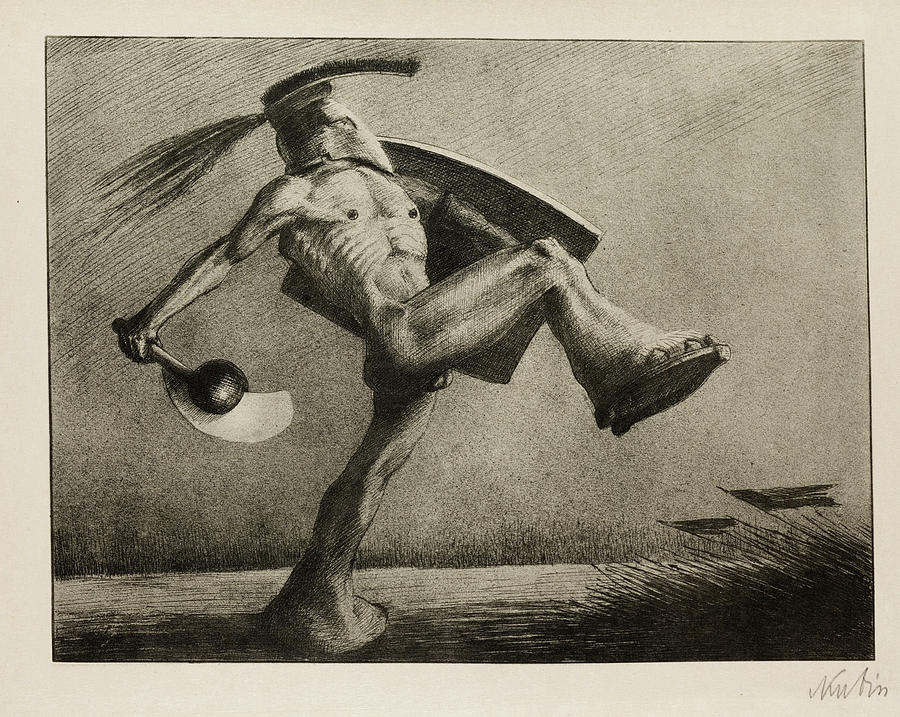
Alfred Kubin (Austrian, 1877–1959), War, 1903
Here’s Taylor’s Prayer of Allegiance to the Prince of Peace:
O Lord, you who deserve all our loyalties, we pledge allegiance this day to the Lamb of God and to the upside-down Kingdom for which he stands, one holy nation under God, the Servant King and the Prince of Peace, with liberty and justice for all without remainder. We pray this in the name of the Holy Trinity. Amen.
+++
NEW ALBUMS:
>> Sorrow’s Got a Hold on Me by Paul Zach: On May 20, singer-songwriter Paul Zachwrote on his Instagram, “My new album of thirteen sad church songs is out today! Many of these songs were written right after one of my weekly EMDR therapy sessions, as I have been working through the sorrow, trauma, and grief of the past few years. I’m learning to bring all of myself to God in prayer and songwriting, which includes my sorrow and anger. I’ve always heard that God shows up in a unique way in times of grief but that has not been my experience. These songs are an invitation for the ‘man of sorrows’ to join me in my grief.”
Zach often writes collaboratively (including as part of the Porter’s Gate! see below), and the cowriters on some of the songs here are Kate Bluett, Latifah Alattas (Page CXVI), Nick Chambers, Orlando Palmer (IAMSON), Jessica Fox, Alex Johnson, and Philip Zach. There are also a few guest vocalists.
>> Climate Vigil Songs by the Porter’s Gate:The Porter’s Gate is a collective of fifty-plus songwriters, musicians, scholars, pastors, and music industry professionals from a variety of Christian worship traditions and cultural backgrounds, making music for churches. This sixth album of theirs, made in partnership with the #ClimateVigil movement, is themed around environmental justice and creation care. Below are videos for “Brother Son (Giving Glory!)” and “Jubilee.”
Besides “Brother Sun,” my favorite tracks are “Satisfied,” a prayer that we would stop seeking to build our wealth (a motive that drives a lot of environmental injustices) and instead be grateful for God’s provision; “The Kingdom Is Coming,” a marchlike call-and-response song that rallies us to pray, wait, and work for an end to creation’s groaning; and “Water to Wine,” which wonders at the miraculous process of planting and growing grapes for harvest. There’s also “All Creatures Lament,” a minor-key arrangement of “All Creatures of Our God and King” with new lyrics that enjoin the animals to mourn habitat loss, air pollution, and other results of humans’ power abuses and irresponsible stewardship.
To learn more about the album, listen to this great interview with Porter’s Gate cofounder and producer Isaac Wardell; it’s from the RESOUNDworship Songwriting Podcast, hosted by Joel Payne. Wardell discusses the vision for Climate Vigil Songs, and especially the difficulty, with thematic albums, of avoiding the pitfalls of being too heavy-handed with the messaging on the one hand, and on the other, being so vague that people don’t see the connection. There’s also a need for tonal balance, and for songs that fill different functions.
We wanted to write for this album at least three different kinds of songs. One kind is essentially songs of lament—songs lamenting the state of creation because of human sin and the brokenness of the world. Secondly, we wanted to write hopeful, you might even call them eschatological, songs—songs that are joyful, that are about this is the world that God has made, this is God’s creative work, this is how God calls us into his creative work. . . . And lastly, we wanted to write mobilization songs—songs that have some kind of an ethical component of calling people to action in some way. . . . We want to make sure the record is not too much of a downer, like all lament songs; we want to make sure that it’s not too much of a happy-clappy “Isn’t creation beautiful!”; and we also don’t want to let it just delve into being a 100 percent political action record. . . . We want to balance those things.
Wardell also talks about the group’s collaborative songwriting approach (including all the theological and editorial work that’s put in), Te Fiti’s stolen (and later, restored) heart in Disney’s Moana, personified nature in the Psalms, creation as an experiencer of the fall and redemption, the role of provocation in church, and biblical imagery he wishes they could have included on the album but had to leave out for length.
+++
POEM + CHORAL SETTING: “when god decided to invent” by E. E. Cummings: “Here’s a brief powerhouse of a poem from E. E. Cummings, two stanzas that draw a sharp distinction between God’s inventive, joyful creativity on the one hand, and our too-frequent turn toward violence on the other. As the mass shootings in Buffalo, Uvalde, and elsewhere continue to reverberate, Cummings’ poem helps us feel and think about what’s at stake – and what the way forward looks like.”
SALT Project reproduces the poem, provides brief commentary, and links to a musical setting by Joshua Shank—a composition for SATB, soprano saxophone, and finger cymbals that premiered in 2005. Shank says the arc of his piece is creation-destruction-recreation. “This final chord is the creator taking control of the creation again.”
+++
RADIO EPISODE: “Belief in Poetry: John Donne”: John Donne (1572–1631) is one of my favorite poets, and looking back on the blog, I can’t believe I’ve not yet featured any of his poems! (I’ll have to rectify that . . .) In this BBC Radio 4 segment from March 13, poet and theologian Pádraig Ó Tuama considers Donne’s complex faith life through his poetry. He speaks with Julie Sanders, professor of English literature and drama at Newcastle University; Mark Oakley, writer and dean of St. John’s College, Cambridge; and Michael Symmons Roberts, poet and professor of poetry at Manchester Metropolitan University. Sir Simon Russell Beale reads the four featured Donne poems: “Death, be not proud” and “Batter my heart, three-person’d God” from his Holy Sonnets series, “Hymn to God, My God, in My Sickness,” and “A Hymn to God the Father.”
Here are two of the quotes that stood out to me:
“It’s easy to think of John Donne’s life falling neatly into two parts: the worldly man, and the spiritual seeker; the lover of women, and the lover of God; Catholic, then Protestant; before Anne, and after Anne; love poet, and religious poet. But life is rarely that clear. And rather, it’s the tension between these dynamics of him that gives birth to so much of his work.”—Pádraig Ó Tuama
“There’s an assumption that a poet working in this territory is sure of their ground and knows what they’re writing about. I don’t think that’s ever true, because why would you write the poems, if that were true? You’d just bathe in your certainty! The whole act of sitting down to write a poem is not to dress up something you already know in a way that makes it an enticing package for other people to be convinced by—and if you attempted that, it’s going to fall like the deadest thing on the page. Making a poem is an exploratory process. You don’t know where it’s going to end when you start it.”—Michael Symmons Roberts
SONGS: The Holy Spirit Prayer is a traditional Catholic prayer that’s sung at Mass on the feast of Pentecost: “Come, Holy Spirit; fill the hearts of your faithful, and kindle in them the fire of your love. Send forth your Spirit and they shall be created, and you shall renew the face of the earth. O God, who by the light of the Holy Spirit did instruct the hearts of the faithful, grant that by the same Holy Spirit we may be truly wise and ever enjoy his consolations, through Christ our Lord. Amen.” The following two songs are settings of the first part of this prayer.
>> “Kindle in Us Your Love” by Deanna Witkowski: This funky refrain by jazz composer Deanna Witkowski “works well as a gospel acclamation, prayer response, or opening song,” especially for Pentecost. I’m planning to introduce it to my Presbyterian congregation this Sunday. (For church services, Witkowski charges a licensing fee of just $3 per use.) You can purchase the piano score here; it also appears in the Voices Together hymnal. Hear a high school choir perform the piece in the video below, with Witkowski accompanying on keys.
Come, Holy Spirit Kindle in us the fire of your love Come, Holy Spirit Kindle in us your love
>> “Holy Spirit, Come to Us” by Jacques Berthier (Taizé chant):Taizé is an ecumenical Christian monastic community in France comprising more than one hundred Catholic and Protestant brothers from some thirty different countries. They welcome in around a hundred thousand young pilgrims a year, who come for prayer, Bible study, and communal work and worship. The songs of Taizé use simple musical phrases and few words that are repeated. Composed in 1998, “Holy Spirit, Come to Us” is one of 232 songs Jacques Berthier wrote for Taizé. It consists of solo verses sung by a leader over an ostinato refrain sung by the people.
Holy Spirit, come to us Kindle in us the fire of your love Holy Spirit, come to us Holy Spirit, come to us
Jesus said, “It is by your love for one another That everyone will recognize you as my disciples.”
Jesus said, “No one has greater love than this: To lay down one’s life for those one loves.”
We know love by this, That Christ laid down his life for us.
This is love: it is not we who have loved God But God who loved us.
Taizé songs may be sung in public worship settings free of charge, provided their simplicity is preserved (i.e., no elaborate arrangements are permitted); for other uses, see here.
+++
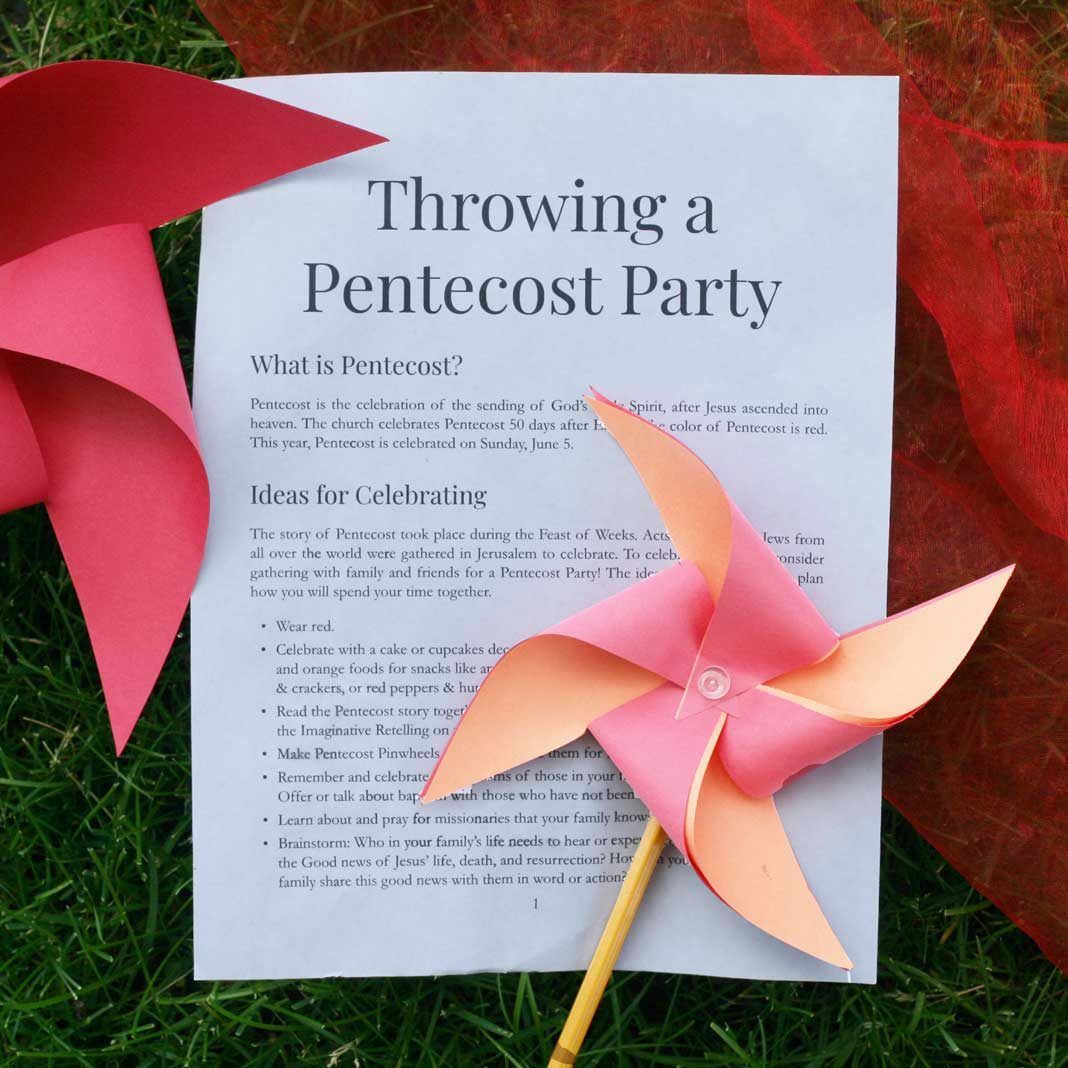
DIGITAL DOWNLOAD: Pentecost Party: Word & Wonder is offering a free twelve-page PDF of resources for celebrating Pentecost with children. Besides a list of party ideas, it includes an imaginative retelling of the Pentecost story from the perspective of a child, a prayer guide, prompts for talking about the Holy Spirit, coloring pages, and a pinwheel craft. On their website you will also find other family-friendly resources for the church year. [HT: Global Christian Worship]
+++
BLOG POST: “Whitsun Week” by Eleanor Parker: “The week following Pentecost is a lost holiday. From the Middle Ages until the early 20th century the period around Whitsun was the principal summer holiday of the year – especially Whit-Monday”—which is June 6 this year. “It was the time for fairs, Morris dancing, games, ale-drinking, school and church processions, weddings, wandering into the countryside, and generally having a good time.” Gooseberries and cheesecakes were broken out for the occasion, and communities engaged in fun activities like cricket, archery, sack races, and donkey derbies.
British medievalist Eleanor Parker compiles several sources that describe the Whitsuntide festivities of medieval western Europe and calls her readers to revive the week’s outdoor merrymaking!
+++
SHORT FILM: Stickmatch: Created in 2020 by London-born animator William Crook, this twenty-second stop-motion animation uses autumn leaves to simulate flames. [HT: Colossal]
DOCUMENTARY SERIES: Taste and See, dir. Andrew Brumme: “Taste and See is a documentary series exploring the spirituality of food with farmers, chefs, bakers, and winemakers engaging with food as a profound gift from God. Their stories serve as a meditation on the beauty, mystery, and wonder to be found in every meal shared at the table.” The Rabbit Room, who is partnering with them for a virtual cinema event (see below), says, “If, in some blessed alternate universe, Robert Farrar Capon had decided to make a documentary with Terrence Malick, guided by the foundational wisdom of Wendell Berry, then they would have made something like the pilot of Taste and See.”
Some of the people you see in the series trailer are Shamu Sadeh, cofounder of Adamah Farm and Fellowship in Connecticut, which integrates organic farming, Jewish learning, sustainable living, and contemplative spiritual practice (Adamah is the focus of the pilot film); The Soul of Wine: Savoring the Goodness of God author Gisela Kreglinger, who grew up on a winery that has been in her family for generations and who leads wine pilgrimages in Burgundy and Franconia (“a spiritual, cultural, and sensory exploration of wine”); Norman Wirzba, a professor at Duke who teaches and publishes at the intersections of theology, philosophy, ecology, and agrarian and environmental studies (see, e.g., his Food and Faith: A Theology of Eating); Kendall Vanderslice, a North Carolina baker, author, and founder of Edible Theology, which offers “curriculum, community, and communications that connect the Communion table to the kitchen table”; and Joel Salatin, who raises livestock on his Polyface Farm in Swoope, Virginia, in the Shenandoah Valley.
You can buy tickets to a virtual screening of the hour-long pilot, which is happening twice daily from June 3 to June 19 and includes exclusive access to a panel discussion with singer-songwriter Andrew Peterson, theologian Norman Wirzba, and director Andrew Brumme. Revenue from ticket sales will fund the production of future films, some of which are already in the works. “The funding raised will determine how far we can go and which stories we can pursue,” Brumme tells me. “We’re hopeful the virtual event will bring together enough of a supportive base of people who want to see this series made.” There’s also an option on the website to donate.
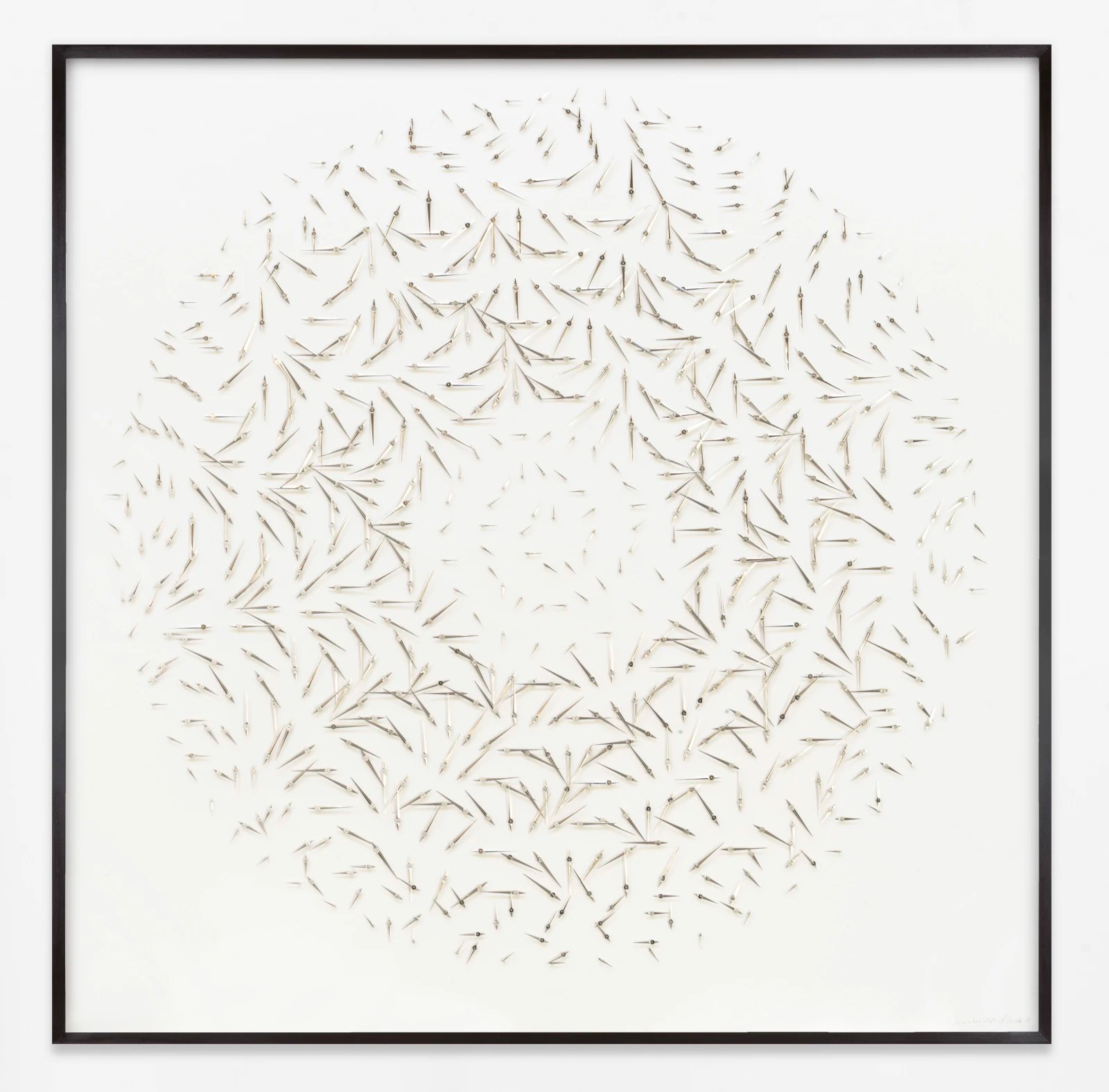
DISCUSSION PANEL: “Art Between the Sacred and the Secular,” June 6, 2022, Akademie der Künste, Berlin: Moderated by the Rev. Professor Ben Quash, this free public event (reserve tickets here) puts in conversation artist Alicja Kwade; Dr. María López-Fanjul y Díez del Corral, senior curator of the Bode Museum and the Gemäldegalerie; and Dr. Neil MacGregor, former director of the British Museum and the National Gallery, London. The questions they’ll address (see below) sound really intriguing!
Alicja Kwade (Polish, 1979–), Causal Emergence (December 2020), 2019. Watch hands on cardboard, framed, 175 × 175 cm.
“The abiding power of Christian motifs, ideas and styles in a host of modern and contemporary works that superficially look un- or anti-Christian indicates that visual art and Christian tradition have not become complete strangers. This invites analysis and understanding.
“How have Christian artworks and artistic traditions found new articulations, caused new departures, or provoked new subversions in the last 100 to 150 years? What forms of engagement between theology and modern and contemporary art do such developments in the relationship between art and Christianity invite and reward?
“How do viewers (Christian and non-Christian) interact with historical Christian art today, and how do modern sensibilities affect our viewing of earlier Christian artworks and artistic traditions?
“Is contemporary art an alternative to religion or can it sometimes be an ally? How do contemporary art and religion each respond to human experiences of the absurd or the tragic? What do contemporary art and the spaces in which we encounter it, tell us about the histories of both Western Christianity and Western secularisation?”
+++
FUNDRAISER: New Ordinary Time Album: The indie folk trio Ordinary Time is one of my favorite musical groups—I heard them in concert at a church here in Baltimore a few years ago!—so I’m really excited to see that they’re working on their sixth full-length album, their first since 2016. It will be produced by the esteemed Isaac Wardell, founder of Bifrost Arts and the Porter’s Gate. Per usual, it will comprise a mix of original and classic sacred songs, including the new “I Will Trust,” demoed in the second video below. Help fund their production costs through this Indiegogo campaign, which ends June 15. A donation of just $25 will get you an early download of the album.
The music video was shot in February at a bar in Daphne, Alabama, with some eighty of Kimbrough’s friends and supporters, and it premiered May 13. It was his way of saying farewell to his Church of the Apostles community in Fairhope, Alabama, where he served as worship leader and artist-in-residence for eight years. He left this spring to take a new job as uptown artist-in-residence at Church of the Incarnation in Dallas.
“From the time I wrote ‘Oh Give Thanks,’ I always pictured it as a bar tune, specifically set in New Orleans,” Kimbrough says. “The image Psalm 107 conjures for me is a group of friends sitting together swapping stories of God’s deliverance and raising their glasses to celebrate his goodness.” He has noted that some people are uneasy about singing the line “We cried like drunken sailors” in church, but he points out that it’s there in the Old Testament psalm! (Recounting how God rescued a group of men from a storm at sea, the psalmist says that as the waves rose, “they reeled and staggered like drunkards / and were at their wits’ end. Then they cried to the Lord in their trouble, / and he brought them out from their distress,” vv. 27–28).
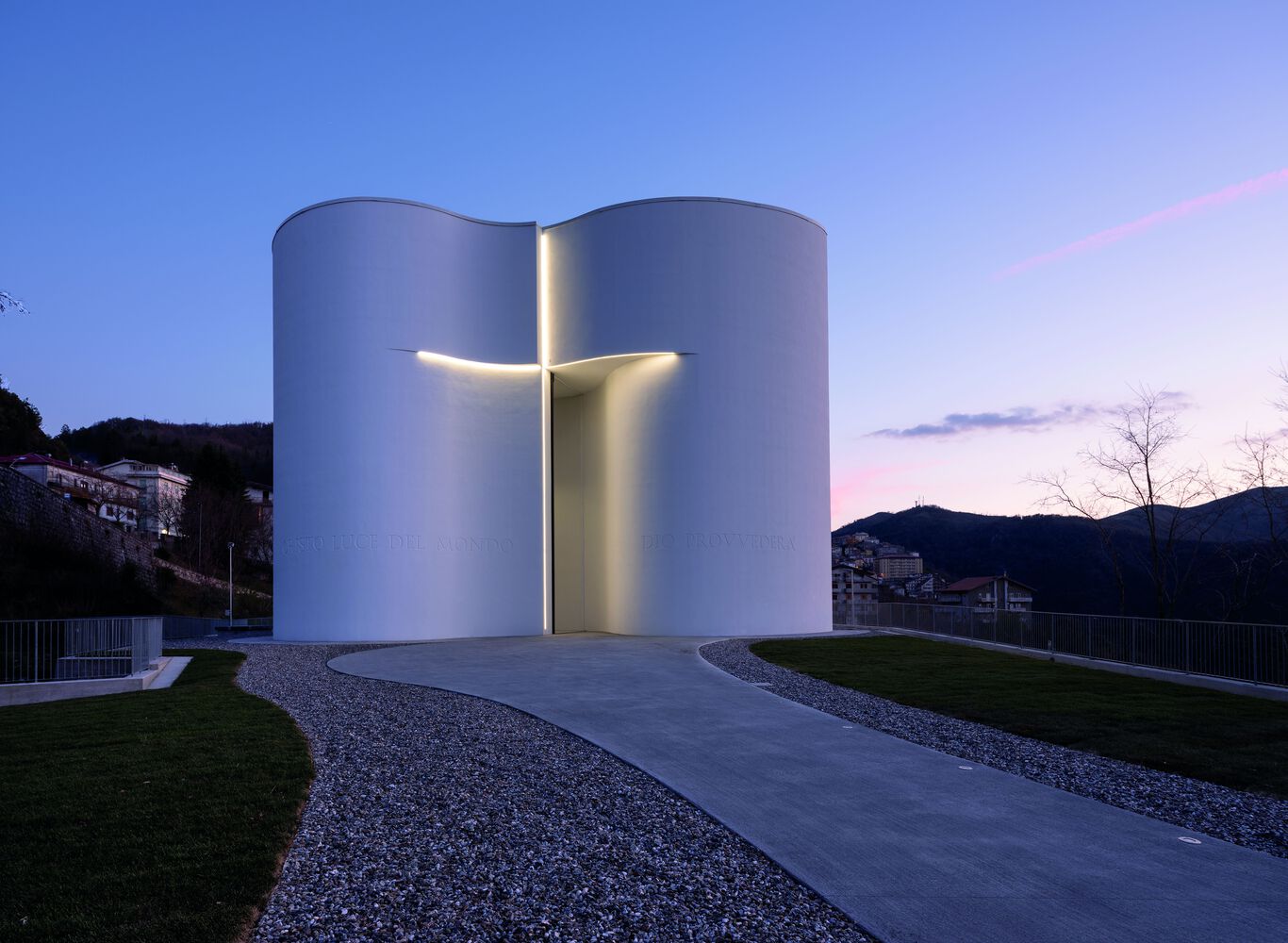
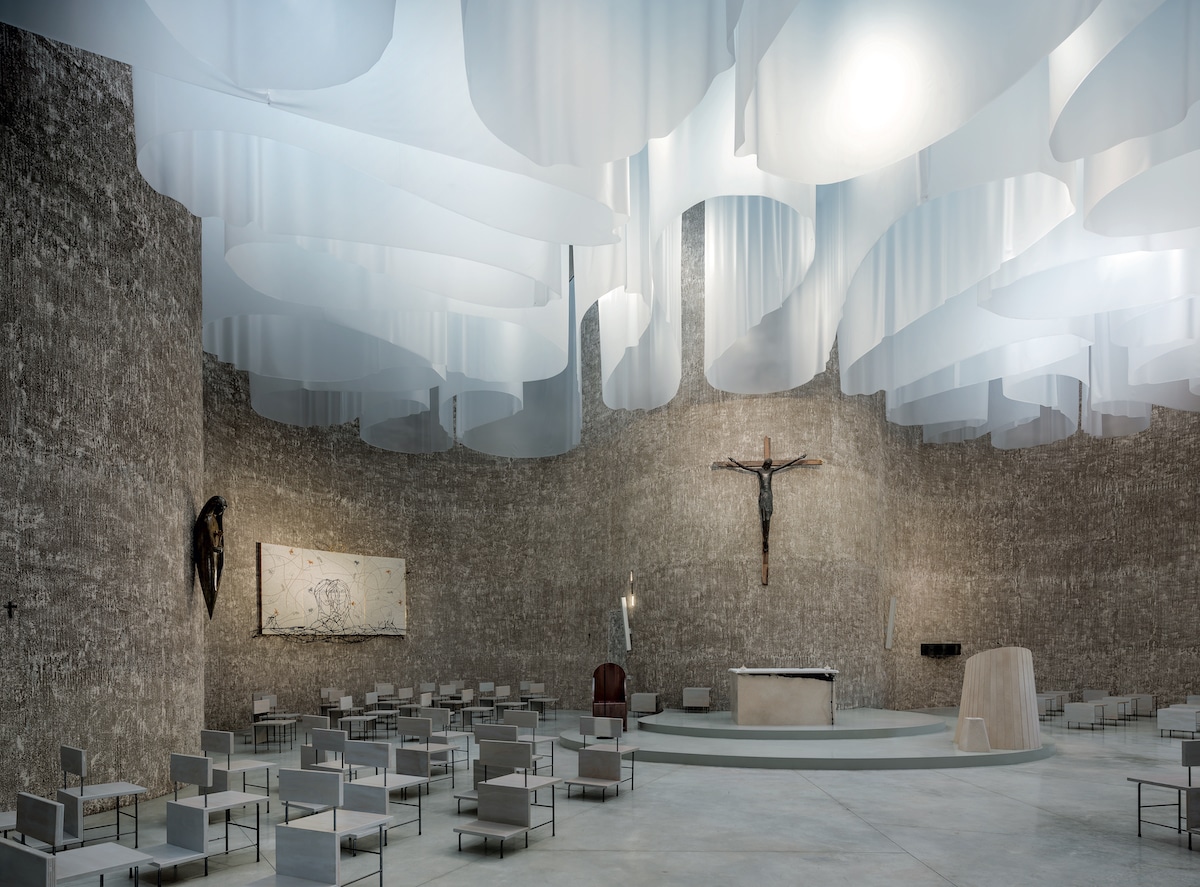
CHURCH ARCHITECTURE: Santa Maria Goretti Church, Mormanno, Italy: In 2013 architect Mario Cucinella won a competition held by Italy’s assembly of Catholic bishops to create the new parish church of Santa Maria Goretti in the hilltop town of Mormanno in Calabria. Because a third of the funds had to be raised locally, the project wasn’t completed until last year. Cucinella says that gave him time to win over its most important constituency: the elderly women who go to Mass every day, and who at first “were suspicious of its modernism.” [HT: My Modern Met]
Cucinella designed an elegantly minimalist concrete building with sinuous surfaces that form the shape of a four-leaf clover, a reinterpretation, Cucinella says, of the shape of Baroque churches. The enclosure has only a few openings. “On its north side, two walls part to create an entrance—while also contributing edges to a cross cut into the curves and lit by LEDs at night. On its south side, a small window is positioned to focus afternoon sunlight on a crucifix on July 6,” Maria Goretti’s birthday.
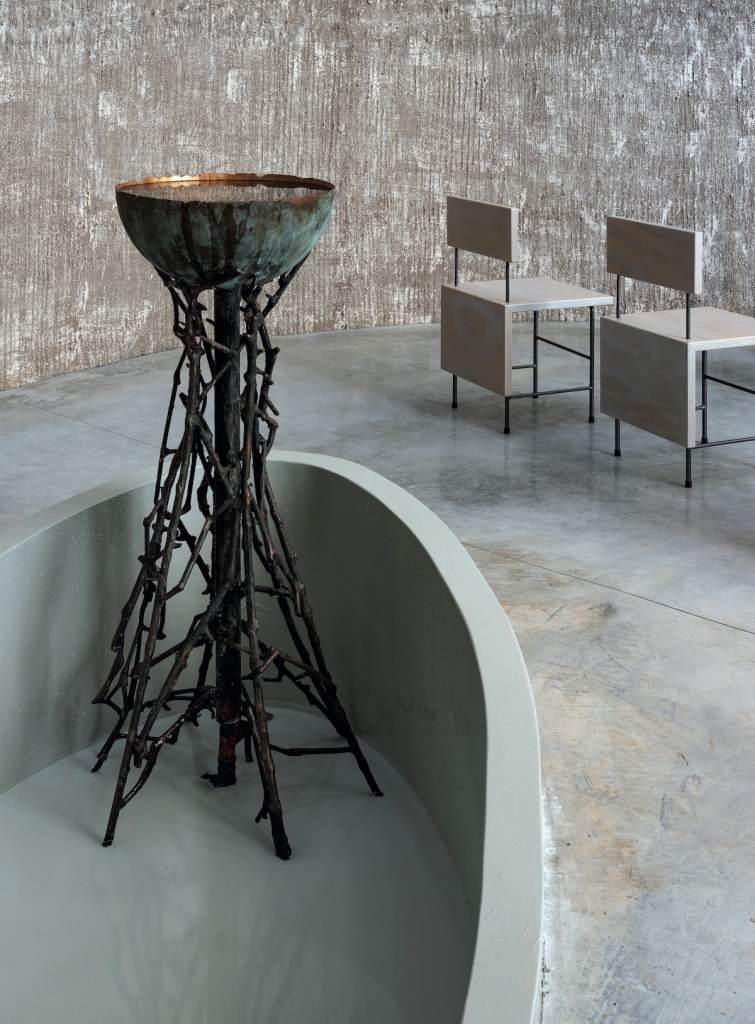
Santa Maria Goretti Church, Mormanno, Italy, designed by Mario Cucinella Architects, completed 2021. Photo: Duccio Malagamba.Photo: Duccio MalagambaBaptismal font by Giuseppe Maraniello. Photo: Duccio Malagamba.
Inside, the walls are hand-finished in plaster mixed with hemp fibers and lime, which give them a mottled, earth-toned look. The most dominant feature of the interior is the twelve-foot-deep scrim that falls from the ceiling in swirls, filtering in sunlight. Artist Giuseppe Maraniello (b. 1945) was commissioned to create the lectern, tabernacle, baptismal font, and figure of the Virgin Mary, while the simple steel and wood seating is by Mario Cucinella Design. Click on any of the three photos above to view more.
The church’s namesake, one of the youngest saints to be canonized, was stabbed to death in 1902 at age eleven while resisting a rape. She is the patron saint of purity, young women, and victims of sexual assault.
Blogger’s note: I’m fascinated by the history of hymns—all the creative hands they pass through (lyricists, translators, composers, harmonizers, arrangers, hymnal editors, church musicians, worship pastors, recording artists, etc.) to become what we use in our churches today. In this essay, poet, translator, and literary critic Kimberly Johnson traces in fragments the history of “All Creatures of Our God and King” [previously], interweaving that history with snippets of the authors’ biographies, musical analysis, personal confession, and observations from the time she spent in and around the hymn’s origin place of Assisi in the Umbria region of Italy.
Copyright credit: The essay “On ‘Laudes Creaturarum’ (‘All Creatures of Our God and King’): A Polyphony” by Kimberly Johnson is from Stars Shall Bend Their Voices: Poets’ Favorite Hymns and Spiritual Songs, edited by Jeffrey L. Johnson (Asheville, NC: Orison Books, 2018). It is reproduced here by permission of the publisher. I’ve added the photos for visual reference.
Laudes Creaturarum
Altissimu onnipotente bon signore tue so le laude la gloria e l’ onore e onne benedictione. Ad te solo altissimo se konfano e nullu homo ene dignu te mentovare. Laudatu si mi signore cum tucte le tue creature spetialmente messor lu frate sole lu quale iorno et allumini per loi. E ellu è bellu e radiante cum grande splendore de te altissimu porta significatione. Laudatu si mi signore per sora luna e le stelle in celu l’ ai formate et pretiose e belle. Laudatu si mi signore per frate vento e per aere e nubilo e sereno et onne tempu per lu quale a le tue creature dai sustentamentu. Laudatu si mi signore per sor aqua la quale è multo utile e humele e pretiosa e casta. Laudatu si mi signore per per frate focu per lu quale n’ allumeni la nocte e ellu è bello e iucundo e robusto e forte. Laudatu si mi signore per sora nostra matre terra la quale ne sustenta e governa e produce diversi fructi e coloriti fiore e erba. Laudatu si mi signore per quilli ke perdonano per lo tue amore e sostengono infirmitate e tribulation beati quelli ke ‘l sosterranno in pace ke da te altissimu sirano incoronati. Laudatu si mi signore per sora nostra morte corporale da la quale nullu homo vivente po skappare guai a quilli ke morranno in peccata mortale. Beati quelli ke troverà ne le tue sanctissime voluntati ke la morte secunda no ’l poterà far male. Laudate e benedicete lu mi signore e rengratiate e servite a lui cum grande humilitate. Amen.
Francis of Assisi, c. 1225
Praises of the Creatures
Highest, omnipotent, good our Lord, yours are the praises, the glory, the honor, and all blessing. To you alone, Most High, they are owed, and no mortal is worthy to mention you. Be praised, my Lord, through all your creatures, especially through my Lord Brother Sun, who brings the day, and you shed light through him. And he is beautiful and radiant in his grand splendor! Of you, Most High, he bears the likeness. Be praised, my Lord, through Sister Moon and the stars; in heaven you formed them, bright and precious and beautiful. Be praised, my Lord, through Brother Wind and through the air, cloudy and serene, and through all weathers by which you give your creatures sustenance. Be praised, my Lord, through Sister Water, who is so useful and humble and precious and chaste. Be praised, my Lord, through Brother Fire, through whom you illuminate the night; and he is lovely and playful and robust and strong. Be praised, my Lord, through our Sister Mother Earth, who sustains and governs us and who brings forth varied fruits with vibrant flowers and herbs. Be praised, my Lord, through those who give pardon for love of you, and bear infirmity and tribulation; blessed are those who persevere in peace, for they will be, by you Most High, endowed a crown. Be praised, my Lord, through our sister, Death-of-the-Flesh, from whom no living mortal can escape. Woe to those who die in mortal sin! Blessed whom death finds abiding in your most sacred will, for the second death shall do them no harm. Praise and bless my Lord, and render thanks to Him, and serve Him with great humility. Amen.
Translated from the Italian by Kimberly Johnson, 2018
All Creatures of Our God and King
All creatures of our God and King, lift up your voice and with us sing: Alleluia, alleluia! O burning sun with golden beam, and shining moon with silver gleam, O praise Him, O praise Him, Alleluia, alleluia, alleluia!
O rushing wind so wild and strong, white clouds that sail in heaven along: Alleluia, alleluia! New rising dawn in praise rejoice; you lights of evening find a voice, O praise Him, O praise Him, Alleluia, alleluia, alleluia!
Cool flowing water, pure and clear, make music for your Lord to hear: Alleluia, alleluia! Fierce fire, so masterful and bright, providing us with warmth and light, O praise Him, O praise Him, Alleluia, alleluia, alleluia!
Earth ever fertile, day by day, bring forth your blessings on our way: Alleluia, alleluia! All flowers and fruits that in you grow, let them his glory also show, O praise Him, O praise Him, Alleluia, alleluia, alleluia!
All you who are of tender heart, forgiving others, take your part: Alleluia, alleluia! All you who pain and sorrow bear, praise God and on him cast your care, O praise Him, O praise Him, Alleluia, alleluia, alleluia!
And thou most kind and gentle death, waiting to hush our latest breath: Alleluia, alleluia! Thou leadest home the child of God, and Christ our Lord the way hath trod. O praise Him, O praise Him, Alleluia, alleluia, alleluia!
Let all things their Creator bless, and worship Him in humbleness: Alleluia, alleluia! Praise, praise the Father, praise the Son, and praise the Spirit, Three in One! O praise Him, O praise Him, Alleluia, alleluia, alleluia!
Translated from the Italian by William Henry Draper, 1919
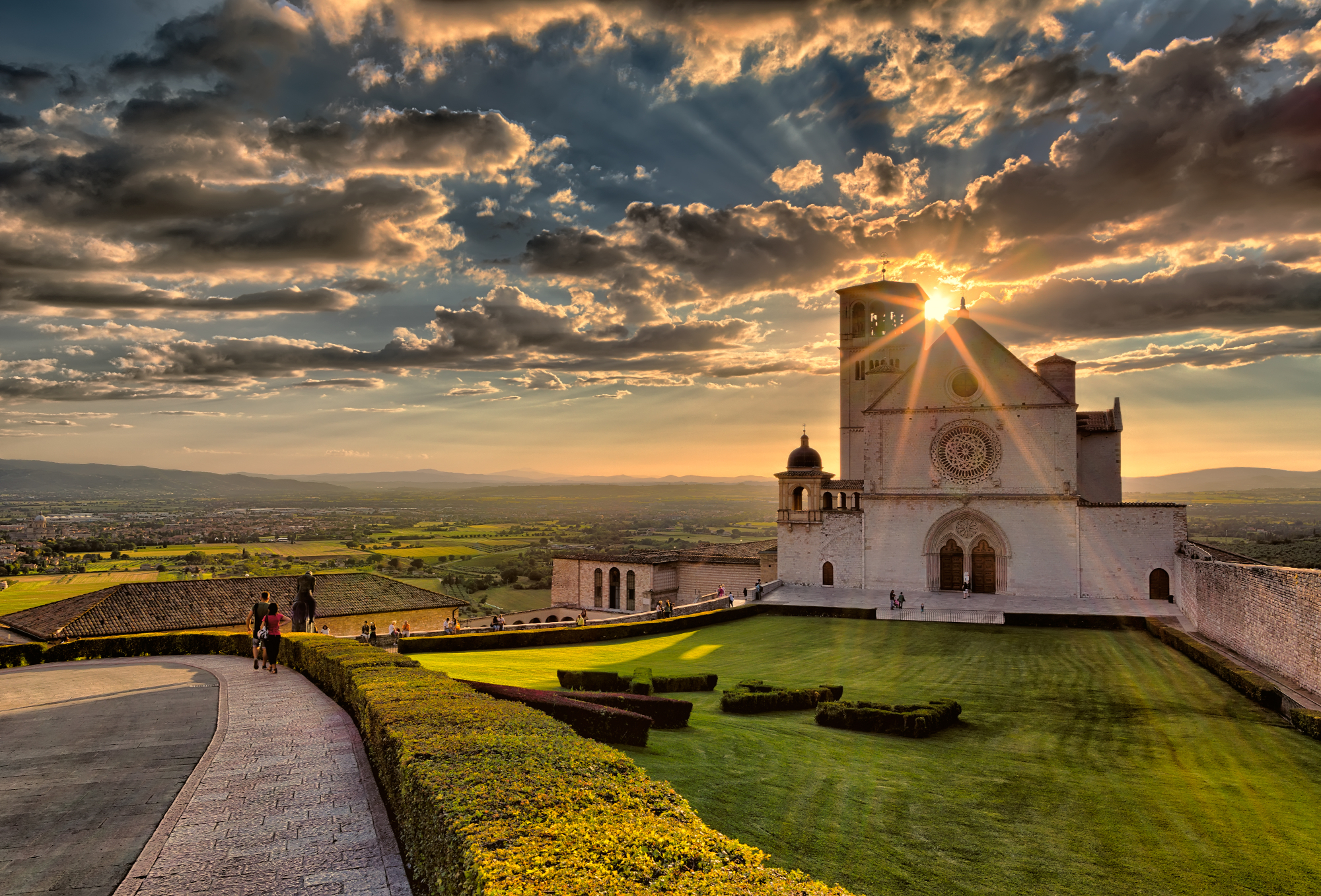
Basilica of St. Francis of Assisi, Assisi, Italy. Photo: Giorgio Art.
In Assisi, the sky vaults clouded and serene against the foothills.
*
Pietro, known as Francesco, devoted brother of his order, put quill to thirteenth-century parchment and began to praise. His inspiration was Psalm 148, whose Hebrew exhortations spur the sun and moon, the stars and highest heavens, tempests and mountains and wingèd birds to sing their Lord’s splendid name. Barchu and Hallelu.
*
In the trees that ring the great cathedral at Assisi, birds trill an antiphon in the innumerable dialects of their collected species.
*
“Laudatu si mi signore per sora nostra morte corporale,” Francis wrote in his backwater dialect, “da la quale nullu homo vivente po skappare.” Be praised, my Lord, through our sister, Death-of-the-Flesh, from whom no living mortal can escape.
*
William Henry Draper lost his first wife in childbirth. He lost his second wife in her youth. He lost three sons in World War I and a daughter in her childhood.
*
In Francesco’s hymn, the psalm’s call to worship forges familial bonds, each voice enfolded into the household: My Lord Brother Sun. Sister Moon and Sister Water, Brother Fire and Brother Wind.
*
Twice widowed, four times unfathered, William Henry Draper served as rector of the parish church in Leeds, where, in 1919, he translated a centuries-old poem by an Umbrian monk for a Whitsunday children’s concert.
*
On Whitsunday, the Assisi cathedral is afire with cloven tongues, pilgrims murmuring a babel of prayer.
*
Thou rushing wind that art so strong
*
At the wind of the day I walked the fortress wall on Assisi’s hilltop as the houselights came on below. “A mighty fortress is our God,” another word-dazzled monk would write three centuries after Francesco threw open the enclosures of monastic care to the lazar-house, the beggars, the birds.
*
At a piazza dinner in the hilltop town of Perugia, against which the young soldier Pietro called Francesco marched impenitent and won a year in prison for his pains, I overhear a tourist family at the next table. In New Jersey cadence, the mother suggests a next day’s trip to the basilica in Assisi. She sells it: “It’s where St. Francis is from.” Her son whines, “Who’s St. Francis?” The mother pauses. The pavement birds are belled into the evening sky. “He’s this really famous Franciscan monk.”
*
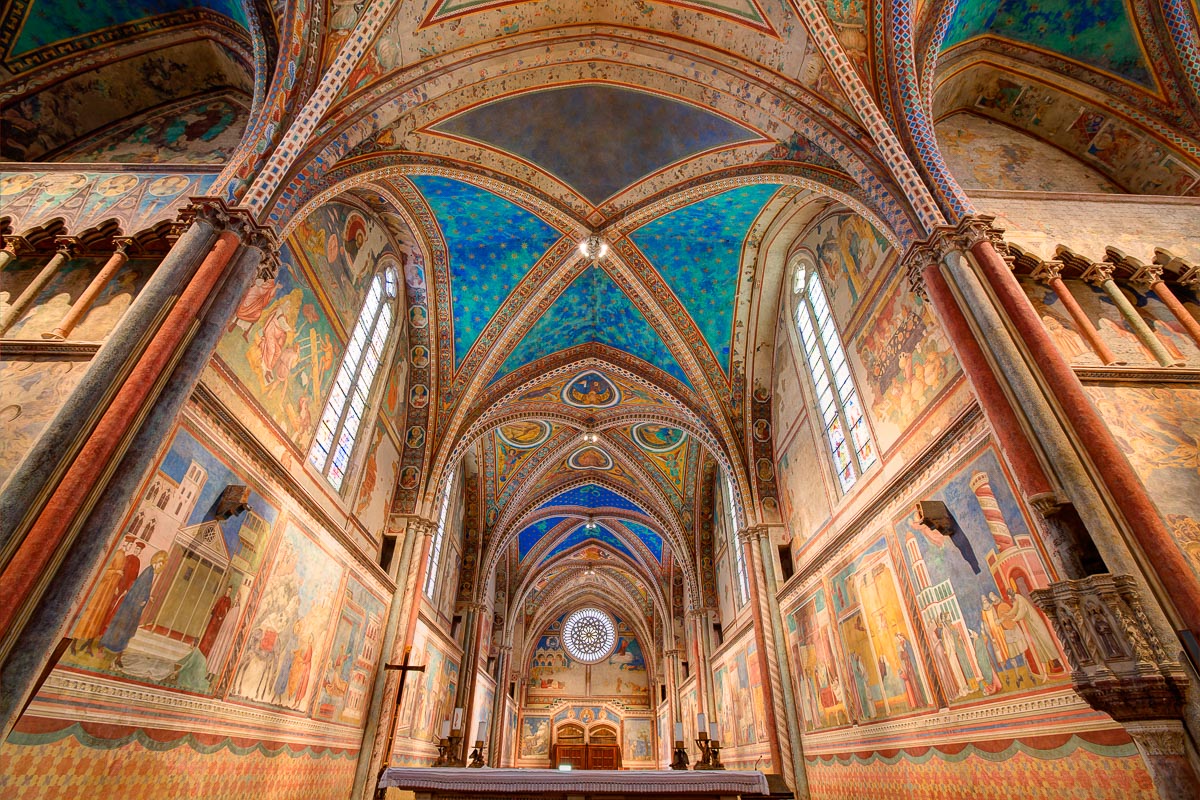
In the basilica, the nave vaults with sky, a gloaming blue clouded with verdant green. Gold stars fan out like finches. Like gilt notes on an ethereal staff.
Basilica of St. Francis of Assisi, Assisi, Italy. Photo: Gustavo Kralj / Gaudium Press Images.
*
Ralph Vaughan Williams, son of a vicar, took up an old German tune, “Lasst uns Erfreuen” (“Let Us Rejoice”), harmonizing his Anglican to that melody’s spare Jesuit. And how hear we every man in our own tongue, wherein we were born?
*
It’s not the repeated alleluia. It’s not the catalogue of earthy beauty. It’s not the open-throated Ptolemaic chime. What undoes me is the single minor chord.
The minor chord: unheard in the tune’s Teutonic plainchants, unheard before Vaughan Williams’s harmonies. It falls at the end of the penultimate line of each verse—in some versions of Draper’s English text, the minored syllable is Him, and in some it is Jah; either way, God takes the fall.
*
Vaughan Williams’s minor chord is the musical cognate of Francesco’s steadfast praise in and through the death of the flesh: a gut punch that refuses to be redeemed by the next line’s joy.
*
Confiteor: The next line’s return to D major requires a resolve that, many days, I don’t have.
*
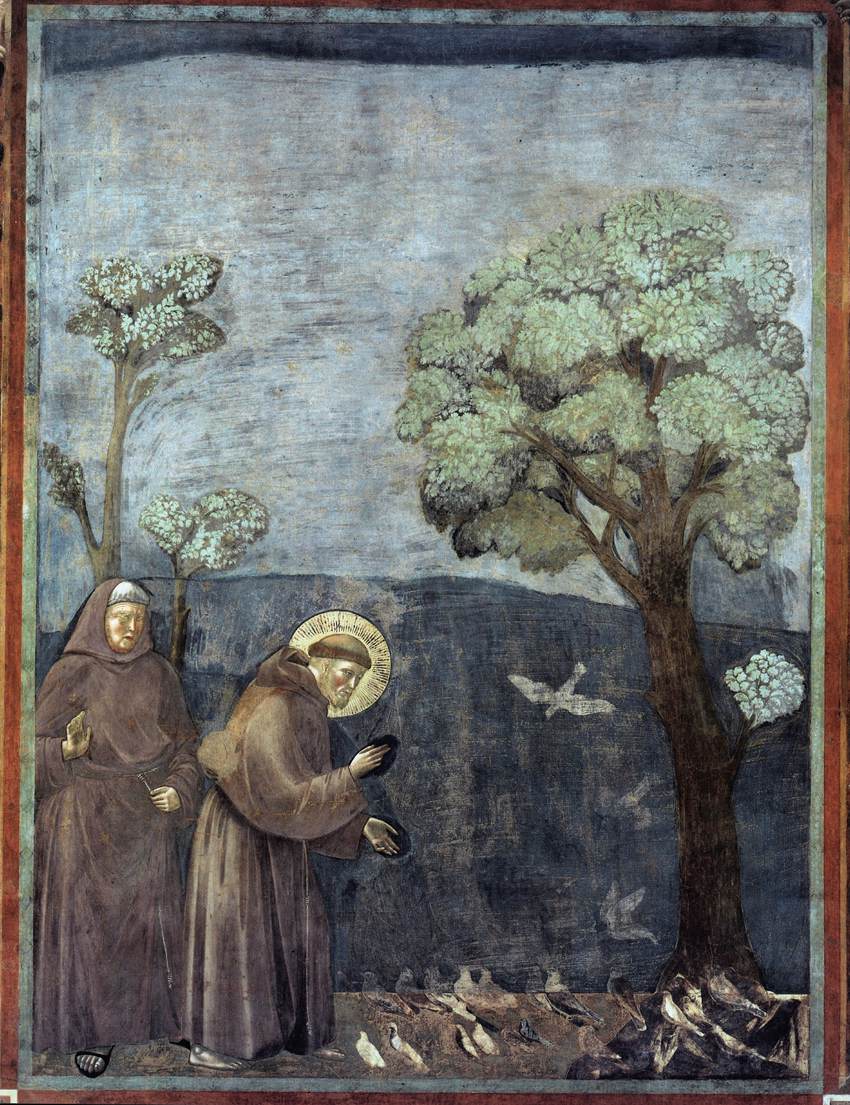
In the Upper Church in Assisi, the fresco cycle attributed (probably wrongly) to Giotto includes San Francesco d’Assisi predica agli uccelli. There are doves, of course, in the saint’s congregation. There is a woodcock, I think. A robin. They will not fly until his sermon is finished. Until he follows the downpour with worms.
“Sermon to the Birds,” from the Legends of Saint Francis cycle, attributed to Giotto, 1297–1300. Fresco, 270 × 200 cm. Upper Church, Basilica of St. Francis of Assisi, Assisi, Italy.
*
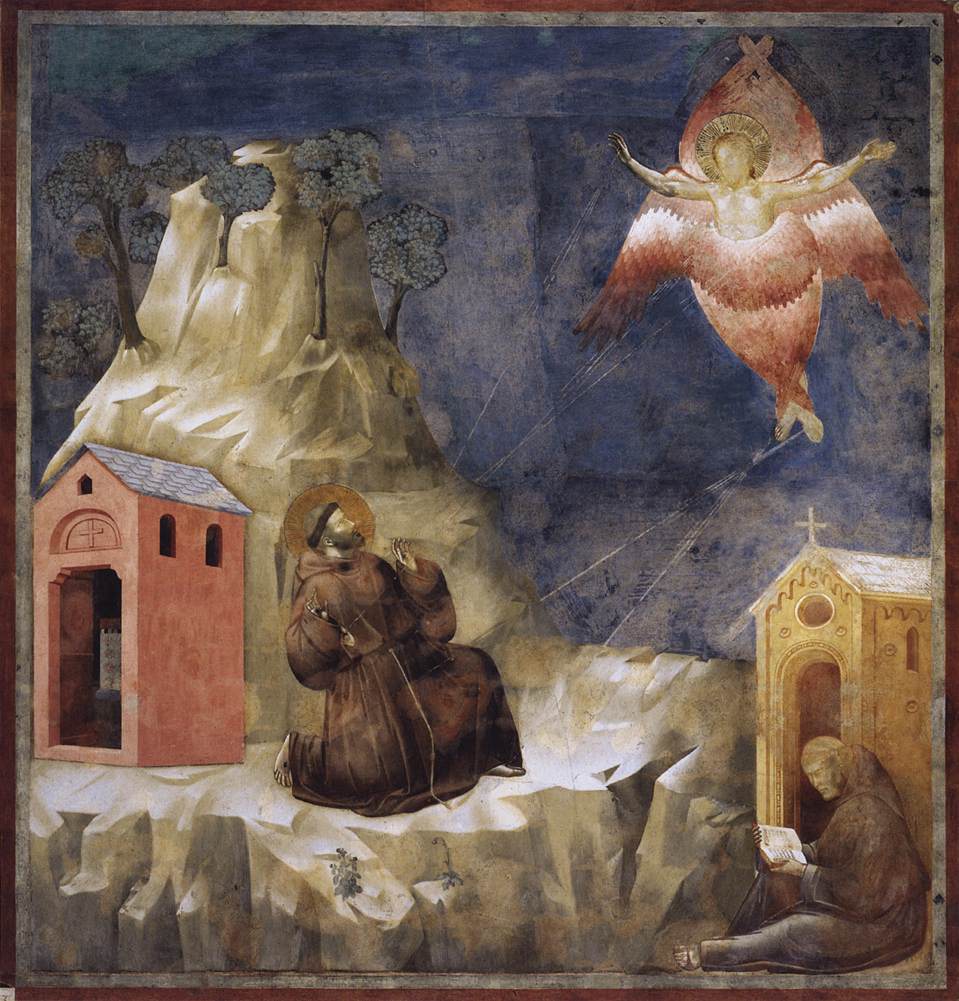
Nearby, another fresco shows Francis struck with stigmata; each wound an asterisk, a caveat. A flurry of wings above his head.
“The Stigmatization of St. Francis,” from the Legends of Saint Francis cycle, attributed to Giotto, 1297–1300. Fresco, 270 × 230 cm. Upper Church, Basilica of St. Francis of Assisi, Assisi, Italy.
*
You lights of evening
*
At the altar in Assisi, my vespers are belled into the vault, where they flock and cloud.
*
Outside, rain. The birds tangle among the leaves, sustain their refractory antiphon. All with one accord in one place.
*
“perdonano per lo tue amore / infirmitate e tribulatione”
*
Pardon and love, weakness and wrack. Blame and whine, and worms and no escape. O praise Him.
*
A creaturely hymn for us creatures: Pietro called Francesco, faux Giotto, bereft William, Ralph, the variant birds, and myself. Each of us cloven by major and minor, each our own Pentecost.
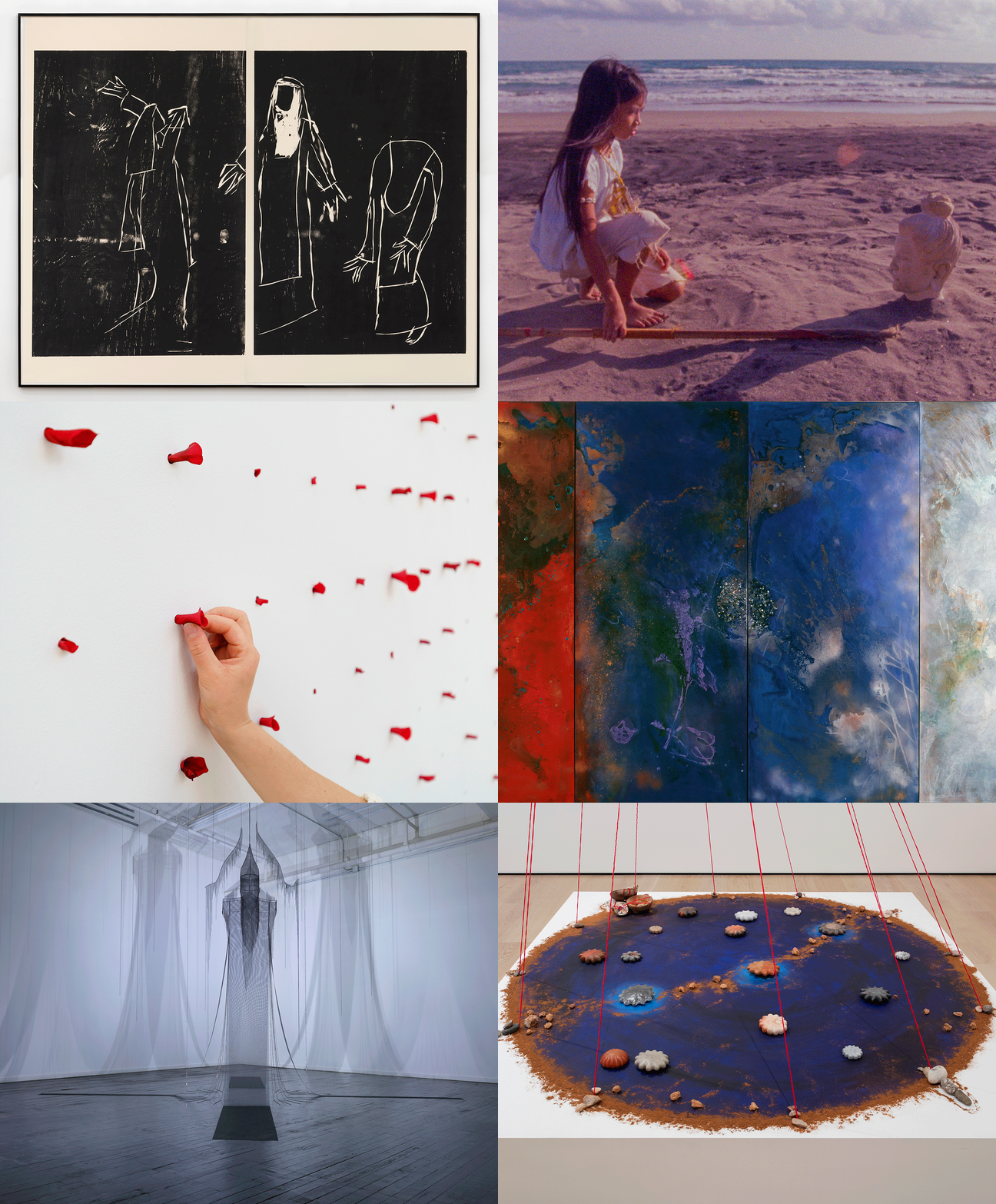
EXHIBITION: Here After, Bridge Projects, Los Angeles, May 7–July 30, 2022: This latest offering from the spirituality-forward art gallery Bridge Projects looks amazing! I appreciate their commitment to featuring religiously and ethnically diverse artists, as well as a range of styles and media.
Andrea Büttner, Dancing Nuns, 2007; Tuan Andrew Nguyen, video still from The Boat People, 2020; Belu-Simion Fainaru, Monument for Nothingness, 2012–22; Bonita Helmer, The Four Worlds (Tiferet), 2002–5; Afruz Amighi, Guardian, 2021; Mercedes Dorame, Orion’s Belt—Paahe’ Sheshiiyot—a map for moving between worlds, 2018
The group exhibition features thirty-seven artists who explore the idea of paradise—both how it has been pursued on earth across history, and how it is imagined after life. From Pure Land Buddhism’s chant “Namu Amida Butsu” (“I take refuge in Amida Buddha”) to Christianity’s prayer for the Kingdom to be “on earth as it is in heaven,” the concepts of paradise are as diverse as those who hope for it.
In Here After, works like William Kurelek’s Farm Boy’s Dream of Heaven (1963) envision an eschatological beyond in figurative form, while works by Bonita Helmer and Zarah Hussain do so in more abstract terms. Andrea Büttner and Claire Curneen’s works point to a vulnerable, sensual bodiliness, embedded in the surface of the world where all things come to pass. There is a land beyond the river by Gyun Hur and Tuan Andrew Nguyen’s The Boat People make space for remembrance of those who have passed, while Afruz Amighi, Mercedes Dorame, and Charwei Tsai position the viewer between worlds, feet firmly planted on the ground yet gazing at the glory and wonder of the beyond. In his installation Skywall, David Wallace Haskins plunges into the boundless sky and its immaterial light, letting all the expansive beauty grip the viewer. Kate Ingold intones the rhythmic mantras of what the divine is not with minute stitches, employing almost impossible patience to painstakingly outline absence. Kris Martin lodges small contradictions in the mind, which, in time, grow to be distracting puzzles—the candle in a sealed box, whose existence cannot be proven with the senses. And Tatsuo Miyajima uses digital counters to display the uncountable, unending dimension of existence.
+++
SONGS:
>> “O Jesus, Crowned with All Renown,” performed by Jon and Amanda McGill: The Monday to Wednesday preceding Ascension Day is known as Rogationtide, a short liturgical period (observed by most Anglicans, Episcopalians, Catholics, and others) in which we pray that God blesses the crops so that they yield a good harvest. It falls on May 23–25 this year. The hymn “O Jesus, Crowned with All Renown” is especially associated with the Rogation Days. It was written in 1860 by Edward White Benson, archbishop of Canterbury, and is typically paired with the tune KINGSFOLD.
O Jesus, crowned with all renown, Since thou the earth hast trod, Thou reignest, and by thee come down Henceforth the gifts of God. Thine is the health and thine the wealth That in our halls abound, And thine the beauty and the joy With which the years are crowned.
Lord, in their change, let frost and heat And winds and dews be giv’n; All fostering power, all influence sweet, Breathe from the bounteous heav’n. Attemper fair with gentle air The sunshine and the rain, That kindly earth with timely birth May yield her fruits again.
That we may feed the poor aright, And gathering round thy throne, Here, in the holy angels’ sight, Repay thee of thine own: That we may praise thee all our days, And with the Father’s name, And with the Holy Spirit’s gifts, The Savior’s love proclaim.
“Rogation” is derived from the Latin verb rogare, which means “to ask.” In the liturgies of Rogation Days, we ask the Lord to bless the fields, the crops, and the hands of farmers who produce our food. Worship on Rogation Days teaches us that we depend upon God’s favor over his land. We ask him for goodness over not just an abstract idea of our “land” but the very real earth beneath our feet in our backyards, our neighborhoods, and whatever part of the earth our feet hit the ground. As we’ve become a post-industrial society, the prayers for Rogation Days have expanded to include not only prayers for farmers and fishermen, but also for commerce and industry, and for all of us as stewards of creation.
>> “The Twelve: An Anthem for the Feast of Any Apostle,” words by W. H. Auden and music by William Walton: In 1965 the dean of the choir school at Christ Church, Oxford—Dr. Cuthbert Simpson—approached poet W. H. Auden and composer William Walton to write a choral anthem for use on apostolic feast days. “The Twelve” is the result. In this video filmed at Keble College, Oxford, in July 2021, it is performed by the vocal ensembles VOCES8 and Apollo5 (both directed by Barnaby Smith), with Peter Holder on organ. Learn more about the background and structure of the anthem here.
This performance appears on Renewal?, a concept album released February 25 that combines new works by Paul Smith (cofounder of VOCES8) and Donna McKevitt with works by three influential modern composers: William Walton, John Cage, and William Henry Harris. “Multifaceted texts by Lal Ded, Edmund Spenser, W. H. Auden, Lord Byron, Pablo Neruda, Maya Angelou, and Edna St. Vincent Millay offer space to consider our world, past and present, and meditate on a response to build a better future.”
You can read the full text of “The Twelve” in the YouTube video description. It begins,
Without arms or charm of culture, Persons of no importance From an unimportant Province, They did as the Spirit bid, Went forth into a joyless world Of swords and rhetoric To bring it joy.
+++
VISUAL MEDITATIONS:
Ascension Day occurs every year on the Thursday that falls forty days after Easter (see Acts 1:1–3). This year it is May 26. Here are two Ascension-themed visual meditations from ArtWay.eu.
>> On the Reidersche Tafel, by Nigel Halliday: This ivory bas-relief, which was probably originally embedded in a book cover, is the earliest known representation of the Ascension. It shows Jesus striding up a mountain, being pulled up into heaven by the hand of God the Father. (Mark and Luke use the passive voice to describe the Ascension: “he was taken up into heaven.”) He is dressed in a toga and holding a scroll. Learn more from Nigel Halliday at the above link, or visit this Instagram post I made two years ago.
The Women at Christ’s Tomb and the Ascension, Milan or Rome, ca. 400. Ivory plaque, 18.7 × 11.5 cm. Bayerisches Nationalmuseum (Bavarian National Museum), Munich, Germany.
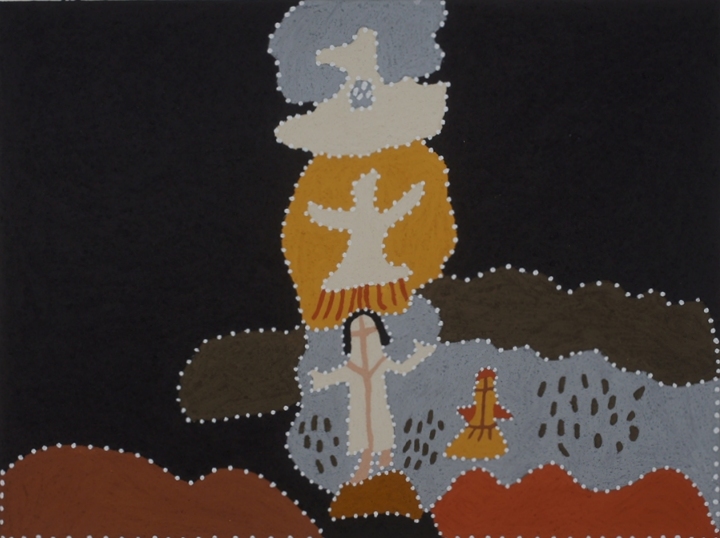
>> On Ngambuny Ascends by Shirley Purdie, by Rod Pattenden: Ngambuny is the Gija name for Jesus. Aboriginal Australian artist Shirley Purdie sets his ascension within the indigenous landscape of the Bungle Bungle Range, using her characteristic style of dotted outlines. “Purdie draws on her cultural tradition to locate the presence of God within the skin of her land,” writes the Rev. Dr. Rod Pattenden. “Her work is literally painted with the earth, as she collects ochres from the land she is responsible for and mixes it with glue to attach to her warm hued canvases.” Pattenden offers a fascinating reading of Purdie’s Ngambuny Ascends, discussing the use of black ocher, God as Creator Spirit alive in the earth, and more.
Shirley Purdie (Gija, 1948–), Ngambuny Ascends, 2013. Natural ocher on canvas, 60 × 80 cm. Private collection. The artist is represented by the Warmun Art Centre in Warmum, WA, Australia.
Sessions are free and open to the public and will not be livestreamed (and the conversations require advance registration):
June 4, 7–9pm: Live Concert (Seattle, WA)
June 5, 9:45–11am: Worship Service (Normandy Park, WA)
June 5, 7–9:30pm: A Conversation on: Faith and the Arts (Seattle, WA)
June 6, 6:30–8:30pm: A Conversation on: Faith and Technology (Bellevue, WA)
June 7, 7–9pm: A Conversation on: Faith and Work (Seattle, WA)
Guite and Bell have been collaborating for years. Below are two snippets of them performing together. In the first video Guite comedically performs (to rhythmic accompaniment!) a villanelle he wrote in response to something a woman who worked at the venue of one of his poetry talks exasperatedly said to him when his hurried photocopying caused a paper jam. The second video showcases a sonnet by Guite on the baptism of Christ, from his collection Sounding theSeasons: Seventy Sonnets for the Christian Year, and the song that Bell adapted it into, released on Keening for the Dawn.
+++
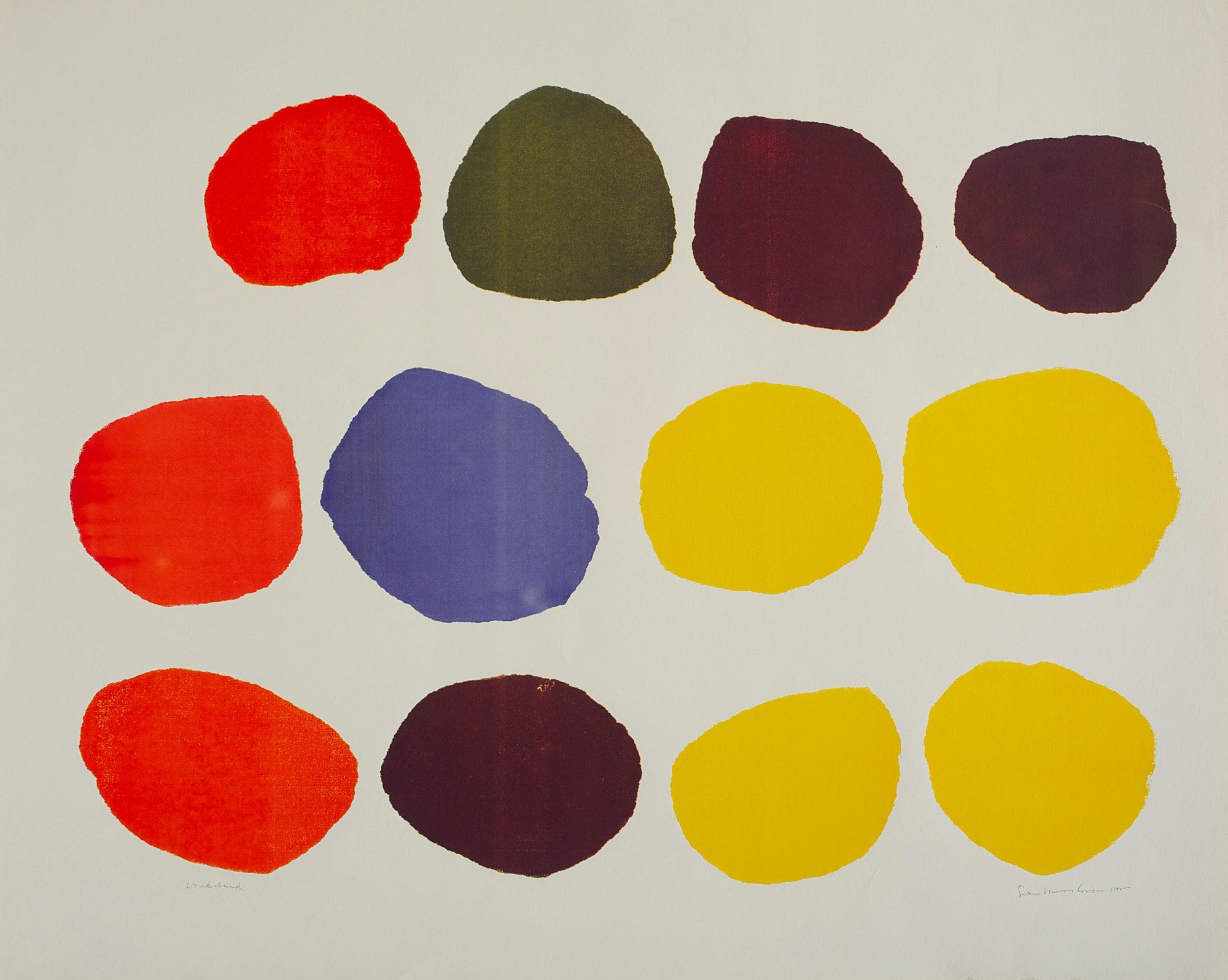
ESSAY: “The Listening Heart: Corita Kent’s Reforming Vision” by Michael Wright:Corita Kent (1918–1986) [previously] was an American pop artist who was also, for over three decades, a nun. Michael Wright writes about how “she became interested not just in depicting scenes from the Bible but answering this: what might happen if a Christian imagination engaged the world around us through the arts? That art might look less like an illustration from a children’s Bible and more like exploring seeing the stuff of life—even a bread bag—as dialogue partners with mysteries of faith.” wonderbread is one of four works he discusses—“a playful meditation on sacred time, wonder, and communion.”
Corita Kent (American, 1918–1986), wonderbread, 1962. Serigraph, 25 1/2 × 30 1/2 in.
While I do think even Kent’s biblical artworks push the genre of religious art forward, I appreciate how Wright challenges Christians to give a chance to her works that are less straightforwardly religious, as these are often the most imaginative and profound. And they, too, are “deeply Christian work.” Let’s not think so narrowly about what “Christian art” must look like!
+++
LIVING PRAYER PERIODICAL: Pentecost 2022: One of the organizations I work for is the Daily Prayer Project [previously], which publishes seven ecumenical Christian prayer periodicals a year, structured around the liturgical calendar. I do the curation for the Gallery section, which comprises three art images with written reflections, and the editing. Our latest edition covers June 5 (the feast of Pentecost) through August 6, and it includes prayers from India, Japan, Korea, Algeria, Italy, the Choctow Nation, and more. I’m excited to feature on the cover Corita Kent’s word picture: gift of tongues! As many of her screenprints do, it integrates image and text—in this case Acts 2:1–2a, which sprawls out through the sky and onto a billowing banner, like a sail, over a crowd of people aflame with the fire of the newly descended Spirit of God.
On the website there are options for one-time purchase or group subscription, and for digital only or print and digital.
+++
PRAYER: “The Lord’s Prayer, Extended Dance Mix” by Nadia Bolz-Weber: In March, actor Jennifer Garner asked Lutheran pastor and author Nadia Bolz-Weber if she could offer a prayer and a benediction on her InstaLive. Bolz-Weber vamped on the traditional words of the Lord’s Prayer, the text of which you can read at the boldface link.
One of the things I appreciate about Bolz-Weber’s spiritual teaching is her avoidance of clichés. She gives fresh language to the experiences of faith and life in general and to theology, which often reawakens me to the beauty of God and of Christ’s gospel. Describing why she regularly turns to prayer, she says in the Instagram video:
When I don’t have enough—like if I don’t have enough patience, if I don’t have enough compassion for myself or other people, when I don’t have enough resources—prayer is this way in which I can remind myself that there is enough. That I have a connection to my own divine source. I have a connection to God. And in the heart of God there’s enough forgiveness when I don’t have enough. In the heart of God there’s enough compassion when I don’t have enough. And so for me, it’s about reminding myself of that connection.
+++
SONG: “Dry Bones” by Gregory Porter: From Gregory Porter’s 2021 album Still Rising, this song was inspired by Ezekiel 37. The official music video features dancing skeletons in yellow cowboy boots(!), animated by L’Incroyable Studio. The song’s bridge quotes the African American spiritual “Dem Bones.”
The first verse goes,
I won’t die, won’t bury, won’t sink ’Cause love is the spirit I drink I’ll be free in the morning light ’Cause your touch is the medicine of life There’s a dance to this beat, let’s shake Every move—feel my body awake There’s a sound—you and me are one And your hope is the rhythm I drum