PLAYLIST: I can’t keep up with all the quality Christian (or, for artists who eschew that label, spiritually inflected?) music recordings that are out there—recent releases as well as back catalogs dating as far back as the thirties. There really is a breadth, and I sometimes get frustrated when I hear people claim otherwise. (Yes, there’s a lot of really crummy Christian music too . . . but that doesn’t mean the entire genre should be dismissed!) During this season of Ordinary Time I’m going to endeavor to release a monthly Spotify playlist consisting of a random assortment of thirty psalms, hymns, and spiritual songs, each by a different artist. Here’s June’s:
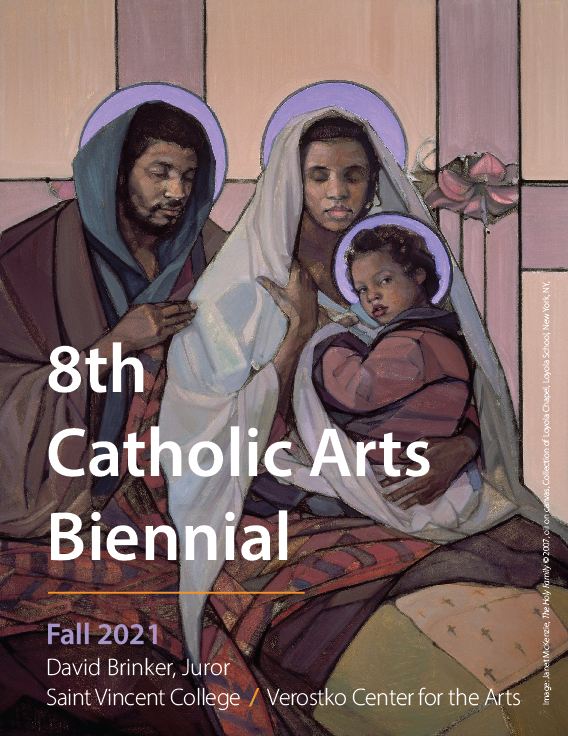
CALL TO ARTISTS:8th Catholic Arts Biennial: Saint Vincent College in Latrobe, Pennsylvania, has issued a call for submissions for its eighth biannual juried exhibition of Christian-themed art. “This Biennial encourages submissions that expand representations of Christ, the Virgin Mary, biblical narratives, and the lives of the saints beyond Eurocentric presentations. Artwork made by women and persons of color is strongly encouraged. In addition to depictions of traditional Christian subjects, artists are urged to submit works that address social concerns from perspectives of faith pertinent to the contemporary moment. Works investigating the diversity of the human experience enlivened by Gospel values are also desired.”
Artists can be of any religious or denominational affiliation and can submit up to three works by the deadline of June 25. In addition to being exhibited September 6–October 29, 2021, at the Verostko Center for the Arts, the finalists will also be eligible for a top prize of $1,000, plus other cash prizes. The juror this year is David Brinker, director of the Museum of Contemporary Religious Art at Saint Louis University. (The painting on the promotional poster is The Holy Family by Janet McKenzie, a previous winner.)
+++
SONGS:
>> “Prarthana Kelkaname” (Hear Our Prayer): Jijo Hebron, a Christian worship leader from Kerala, India, and his wife Niveda Jijo released this YouTube recording on Sunday, in which they sing to God in the Malayalam language. The song’s English meaning is below. [HT: Global Christian Worship]
Hear our prayer and supplication, oh Lord It is the promise in your Son’s name: Whatever we ask, it will be granted. There is no one to take care of my worries apart from you Who stands as my father and mother
>> “Morning Prayer” by Langhorne Slim: From the album Strawberry Mansion, released this January.
+++
ANIMATED SHORT: If Anything Happens I Love You: “In the aftermath of tragedy, two grieving parents journey through an emotional void as they mourn the loss of a child.” Written and directed by Will McCormack and Michael Govier and animated by Youngran Nho and team, this thirteen-minute film won Best Animated Short at the 2021 Oscars. It’s amazing how much I feel for these characters after such a short time of getting to know them. Streaming on Netflix.
+++
ARTICLE: “Art and Interfaith Conversation” by Andrew Smith: Birmingham, England, is a religiously diverse city, home not only to Christians but also to Muslims, Sikhs, Hindus, Buddhists, Jews, and others. The Church of England recognizes this rich presence and has on staff a director of interfaith relations for the bishop of Birmingham, Canon Dr. Andrew Smith. Smith is interested in how art and artifacts can be used to develop conversations between people of different faiths and to create new conversations, and here he discusses a Birmingham Conversations project he led along that vein: multifaith group tours at the Birmingham Museum and Art Gallery and St. Philip’s Cathedral. These he embarked on with a posture primarily of learning, not teaching. [HT: Still Life]
Smith served as a consultant for the museum’s faith gallery, which highlights religious objects from various traditions. He discusses the importance of honoring the integrity of each object’s spiritual significance, and some of the difficulties of creating a space that’s welcoming to people of all faiths when certain faiths regard certain imagery as problematic or even forbid it. He also shares some of the responses of non-Christian participants to specific works of Christian art, in both the museum and the cathedral. Some from the latter are recorded in the following video:
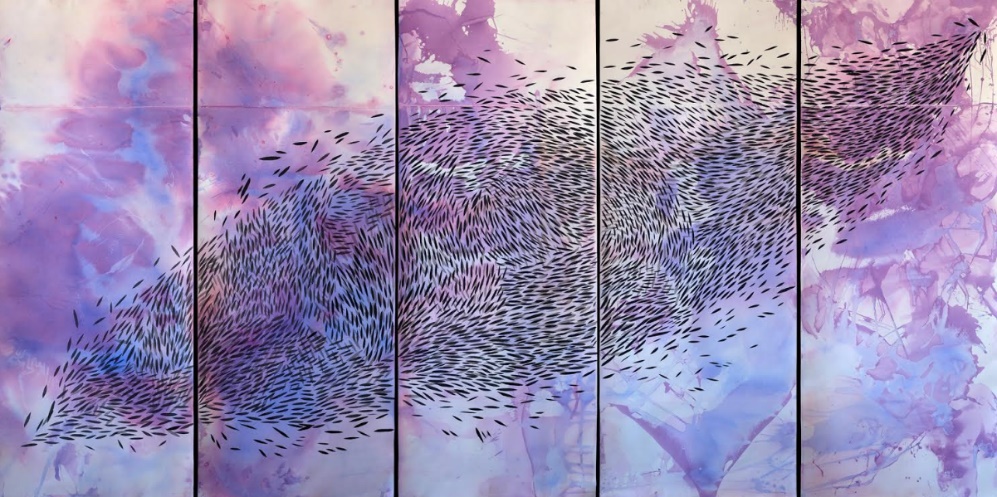
The Birmingham Conversations also commissioned two local artists, Jake Lever and Mandy Ross, to produce work informed by their visits over a yearlong period to different places of worship around Birmingham.
Jake Lever (British, 1963–), Dance, 2016. Ink and gouache on paper.
This call-and-response song is from the December 31, 2015, morning session of the Urbana student missions conference in St. Louis, Missouri. It’s performed by the University of Hawaii’s Hui Poly student group, a ministry of InterVarsity Hawai‘i geared toward Pasifika Christians, along with some new conference friends. The song (and ministry) leader is Moanike’ala Nanod-Sitch, who establishes the rhythm on the djembe and issues the calls. She is the pastor of Ka ‘Ohana o ke Aloha church in Kaneohe and is of Native Hawaiian, Chinese, Japanese, and Ukrainian descent.
The first half of the song is in English (lyrics below), but starting at 3:51, the singers launch into seven different Polynesian or Native American languages: Yup’ik, ‘Ōlelo Hawai‘i (Hawaiian), Fijian, Tongan, Samoan, Hawaiian Pidgin, and Lakota. Subtitles are included in the video. There’s also dancing!
Holy Spirit, come (Holy Spirit, come) Won’t you rain down (Rain down) Rain down (Rain down)
Come like fiyah, come like flames Come like thundah, come like rain Won’t you rain down (Rain down) Rain down (Rain down)
Fill us up, fill our cup Fill us up, fill our cup Won’t you rain down (Rain down) Rain down (Rain down)
We want more, we want more We want more, we want more Won’t you rain down (Rain down) Rain down (Rain down)
Till we overflow Till we overflow Won’t you rain down (Rain down) Rain down (Rain down)
The Son of righteousness will rise With healing in his wings We will be free And dance before our king Let your kingdom come And let your will be done Here on earth as it is In heaven (In heaven) In heaven (In heaven)
We will walk in your love As we advance your kingdom Bringing your word To every nation Let your kingdom come And let your will be done Here on earth as it is In heaven (In heaven) In heaven (In heaven)
To view other video content from Urbana 15, including songs and sermons, see https://2100.intervarsity.org/resource-keyword/urbana-15. Urbana has been held triennially since 1946, and its worship always demonstrates a commitment to global multiculturalism.
EXHIBITION: “God is . . . ,” May 14–23,gallery@oxo, London: The winning entry from the second Chaiya Art Awards competition, along with forty-nine shortlisted others, are being exhibited in London’s South Bank starting tomorrow. The exhibition also has a virtual option, which I received an advance preview of, along with the catalog. Read my review at ArtWay.eu. There is a diverse range of responses to the theme of “God is . . . ,” in a range of media!
+++
VIRTUAL CONCERT: “I Should Be Glad”: On May 2 the Choral Society of Durham and the Duke University Chorale put on a virtual concert, performing songs of lament and hope. They sing of “hours that go on broken wings” and “the unchanging ache of things”; of “this long, hard climb, carr[ying] ancestral sorrow”; of violence and murder; of God’s seeming absence; of feeling like a “moanin’ dove.” But they also sing invitations to be glad, to lay down one’s burden, to see beauty, to soar. Click here for a copy of the program, which contains credits, texts, and translations. I really enjoyed the selection of pieces—most were new to me—and the execution (technical and artistic) is excellent. An hour very well spent. Note that in lieu of a ticket charge, a $10 donation is recommended.
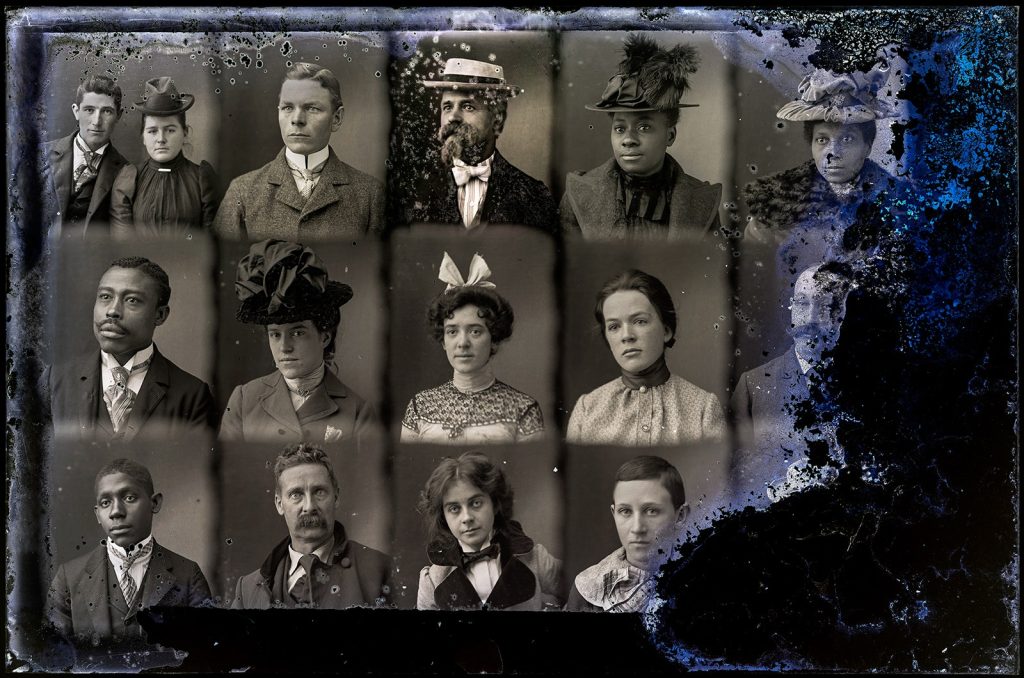
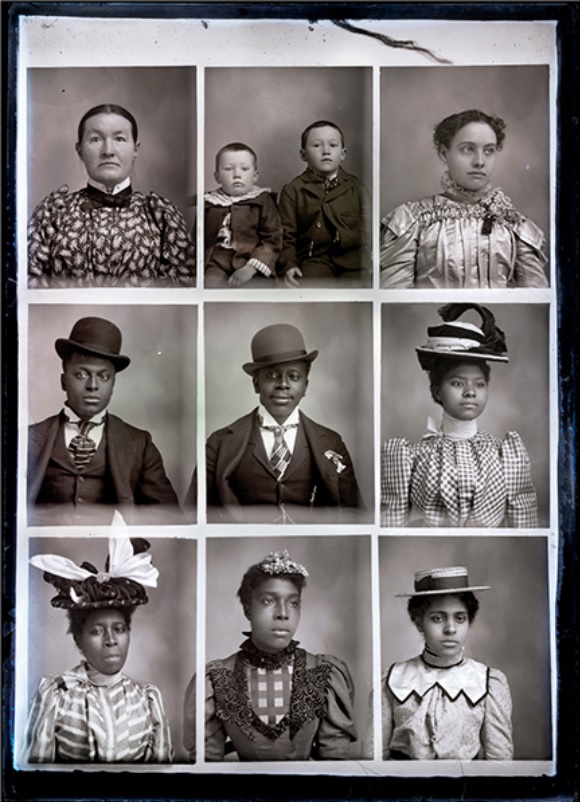
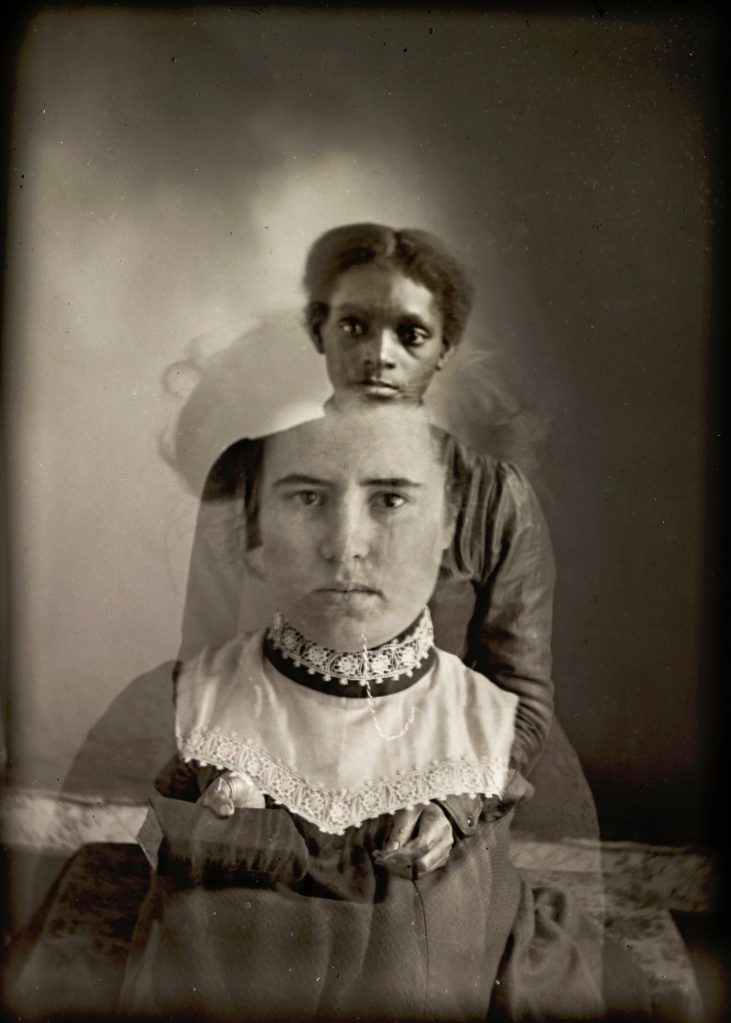
Among the songs are contemporary choral settings of traditional prayers, a civil rights hymn, and the world premiere of the five-movement Where We Find Ourselves by Michael Bussewitz-Quarm (she/her), inspired by the photographs of Hugh Magnum. Magnum, who was white, ran an integrated portrait studio in the Jim Crow South from 1897 until his death in 1922, photographing white and Black clients with equal dignity. The glass plate negatives and contact prints languished in his family’s moldering tobacco barn in Durham, North Carolina, until the 1970s, when they were discovered prior to the property’s slated demolition. They were transferred (many of them damaged) to the Duke University archives, where they again lay mostly dormant until being recently dug out by photographer-writers Margaret Sartor and Alex Harris, who compiled and presented them as an exhibition and accompanying book. Bussewitz-Quarm’s composition is a moving meditation on these timeworn photographs, and the lyrics by Shantel Sellers are pure poetry.
Photographs by Hugh Magnum, courtesy of the David M. Rubenstein Rare Book & Manuscript Library at Duke University, Durham, NCIn some of the negatives the panels have fused, causing the subjects to extend past their frames and thus giving the illusion that they were sitting together.“The portraits are often accidentally double-exposed,” writes Sarah Blackwood for the New Yorker, “and many of the double exposures overlay images of white and black sitters, who suddenly seem to sit alongside or even atop one another. Such ghostly interactions produce from two Mangum portraits an entirely new image altogether, one in which the pride and pleasure of self-presentation is shadowed by the racial realities of the time.”
Set list:
“I Should Be Glad” by Susan LaBarr (composer) and Sara Teasdale (lyricist)
“Sometimes I Feel,” traditional African American spiritual, arr. Alice Parker and Robert Shaw
“Where We Find Ourselves” by Michael Bussewitz-Quarm (composer) and Shantel Sellers (lyricist)
“Hymn to Freedom” by Oscar Peterson (composer) (arr. Paul W. Read) and Harriette Hamilton (lyrics)
+++
POEM COMMENTARY: “The Night” by Henry Vaughan, commentary by Dr. Grace Hamman (blog post | podcast episode): I’ve featured poems by Henry Vaughan several times on this blog but not the one that just might be his most famous: “The Night,” about the Pharisee Nicodemus’s midnight rendezvous with Jesus (see John 3). It contains the beautiful and much-lauded line “There is in God, some say, / A deep but dazzling darkness . . .” Medieval literature scholar Grace Hamman [previously], podcaster and blogger at Old Books with Grace, reads and unpacks the poem, first giving some historical and biographical context. Vaughan was an Anglican Welshman living during the English Civil War when the Puritans were in power, which means he was cut off from the forms of worship through which he was used to encountering Christ. This, Hamman says, influenced his writing of the poem and of the larger collection, Silex Scintillians, it’s a part of.
She has made the commentary available in both written and audio form.
+++
EDITORIALS by JAMES K.A. SMITH:
When I see a James K.A. Smith [previously] byline, I know what follows is going to be good. He’s a fantastic thinker, writer, and speaker—and he’s the editor in chief of my favorite arts journal, Image. Below is a link to the opening editorial he wrote for each of the last two issues. (The whole journal is full of rich content. Subscribe!)
>> “Healing the Imagination: Art Lessons from James Baldwin,”Image no. 107 (Winter 2020): Here Smith engages with James Baldwin’s 1964 essay “The Uses of the Blues,” in which Baldwin discusses how we “project onto the Negro face, because it is so visible, all of our guilts and aggressions and desires”; white America invents stories and images of Black Americans that reflect our disfigured imaginations. “The imagination is a form of habit, a learned, bodily disposition to the world. . . . It’s the imagination—well- or malformed—that determines what I see before I look,” Smith writes.
He connects Baldwin’s essay to Jesus’s parable of the good Samaritan, showing how the priest and the Levite had different habits of perception than the protagonist. “To see the person before me as an enemy or animal”—or, I would add, a burden—“is a failure of imagination; to see a neighbor instead is a feat of the imagination. Our society is grappling with a soul-sickness that is ultimately an infection of our imagination.” We reflexively imagine others as threats, competitors, adversaries.
The arts can play a huge role in reshaping our imaginations, in retraining us to see people rightly. “I dream of a third Great Awakening,” he says, “in which our imaginations would be reborn, a sanctification of sight baptized by stories and images such that even our first glance is holy. The tents for this revival would be galleries and cinemas; we’ll sing from poems and novels; the altar call will invite us to attend plays and contemplate sculpture.” He’s not saying art should replace church or religion but that art is a powerful agent of spiritual and perceptual formation; “the arts pluck the strings of our imagination uniquely.”
In their March 3 episode, “Healing the Imagination, with James K.A. Smith,”The Weight podcast had Smith on to expound on some of the points in the editorial, to unpack this musing: “Could it be that the arts are more likely to move the needle on our collective perception of one another?” He discusses definitions of “culture” and “art,” both creational goods (God has deputized human beings to unfurl the tacit possibilities he has folded into creation!); the influence of Augustine and Kuyper on his thought; the “transcending, opening, decentering” potential of artistic encounters; his experience of becoming an American citizen; and why he believes national healing will come not primarily through politics but through the arts. He mentions a few commendable recent examples of churches’ hospitality toward artists, citing Pope John Paul II’s 1999 Letter to Artists, written “to all who are passionately dedicated to the search for new ‘epiphanies’ of beauty so that through their creative work as artists they may offer these as gifts to the world,” and Redeemer Church of Knoxville, who converted the unused rooms of their building into artist studios for the larger community to use.
“Christian communities, if they actually really care about healing the soul of a nation, could do no better than to invest in the arts,” Smith says. “Not so we can go make Thomas Kinkade paintings or Kirk Cameron movies or whatever, but so that we have artists who are actually speaking to our neighbors in ways that meet them as human.”
>> “How to Visit a Museum: Disciplines of Availability,”Image no. 108 (Spring 2021): “Aesthetic experiences I didn’t go looking for that burrow their way most deeply into my psyche . . . are only possible if I am cultivating a way of life that puts me in front of artworks that don’t conform to my preferences. That might mean signing up for the disciplines of an aesthetic way of life in which I am puzzled or frustrated or decentered by the feeling of ‘not getting it.’ It means approaching paintings and poems without expecting immediate returns. In my experience, the way of surprise lies in listening to a community of friends bear witness to what has captivated them and letting my puzzlement be an impetus to explore new territory. When Shane McCrae gushes about a poet who has felt inaccessible to me, I assume I have something to learn. And so I taste and see. A life hungry for aesthetic surprise does not settle for daily doses of predictably poignant comfort; instead, I need to expose my palate to strange, maybe even unsavory tastes as a way of making myself available for the sublime. While we can’t manufacture the surprise, we can learn to make ourselves available.” Read more at the link.
Reminds me of a creative prompt given last November by Corey Frey of The Well Collaborative in Frederick, Maryland: “Find a challenging poem or work of art or piece of music that doesn’t trigger your appreciative mechanism quite so easily. Sit with it. Let it confuse you. Allow its toe to creep in the crack of the door of your respect (re-spect: look a second time).”
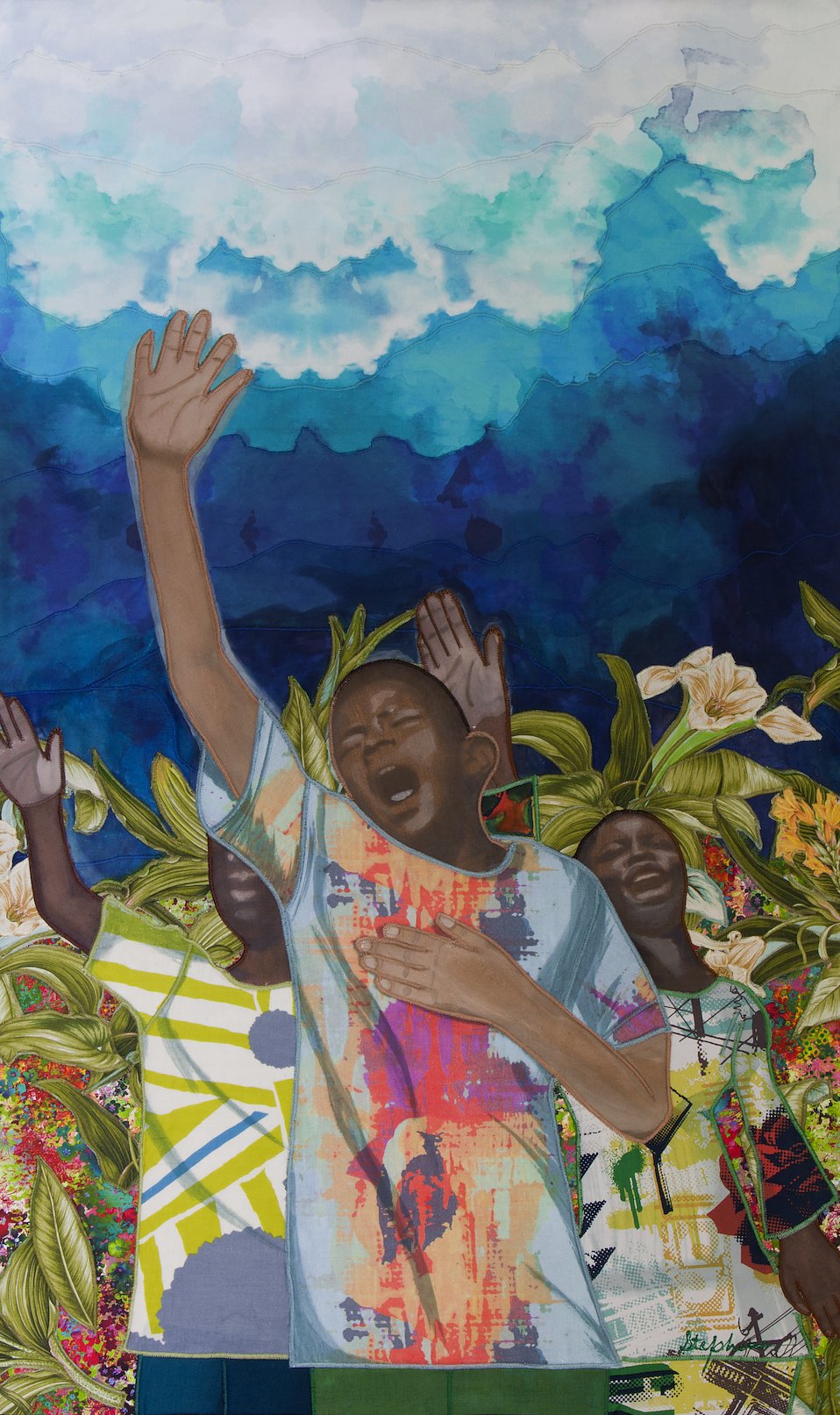
EXHIBITION: Otherwise/Revival, Bridge Projects, Los Angeles, April 9–June 26, 2021: Curated by Jasmine McNeal and Cara Megan Lewis, this group exhibition visualizes the impact of the historic Black church—specifically the Black Pentecostal movement—on contemporary artists. Included are several artists I’ve featured on the blog before—Lava Thomas [here], Kehinde Wiley [here], Clementine Hunter [here], Letitia and Sedrick Huckaby [here]—plus twenty-six others.
Phyllis Stephens (American, 1955–), High and Lifted Up, 2020. Cotton fabric, 57 × 33 in. Private collection. Courtesy of the artist and Richard Beavers Gallery, New York.Kenturah Davis (American, 1984–), Namesake I, 2014. Incense ink on rice paper, applied with rubber stamp letters, 39 × 36 in. Courtesy of the artist and the Petrucci Family Foundation, New Jersey.
I regret that I won’t be able to see the exhibition in person, but there’s a wealth of relevant content available on the gallery’s website, including photos, artist bios and statements, and commentaries. I haven’t fully delved in yet, but some of the artist names are new to me, and I look forward to jumping over to their websites to learn more. There’s also a series of free events that have been scheduled. The premiere of the virtual music performance yes! lord by Ashton T. Crawley and a symposium on the Azusa Street Revival have already passed (both are archived online for on-demand viewing), but here are some upcoming opportunities you can reserve a spot for:
May 1: “Jazz and the Gospel” with Daniel E. Walker, Ashon T. Crawley, Dario Robleto, Norman Teague, Lava Thomas, and Folayemi (Fo) Wilson
ARTICLE: “5 Films About the Beauty of Resurrection” by Brett McCracken: “Resurrection’ tropes are so familiar in certain genres that they can numb us to the jarring beauty and bracing surprise of resurrection. But other films capture the magic and shock of resurrection by situating it within more mundane realities and contexts. Here are five of my favorite examples of this kind—movies that capture resurrection in all of its miraculous, unsettling, hope-giving glory.” One of his selections is Happy as Lazzaro, which I saw last year and enjoyed:
+++
NEW ALBUMS:
>> Hymns I by Lovkn: Steven Lufkin is a singer-songwriter from Phoenix, Arizona, recording under the name Lovkn. His latest EP, a collection of eight acoustic hymn covers, was released April 2. (Also, he’s currently raising funds to record an album of original songs, to be released later this year: kickstarter.com/projects/lovkn/new-album-2021.)
>> Prayers for the Time of Trial by Joel Clarkson: Released April 7, this EP comprises five original SATB choral compositions by Joel Clarkson, which he recorded with his sister Joy Clarkson. My favorite is the first, “Lighten Our Darkness,” a setting of the Book of Common Prayer’s Collect for Aid Against Perils: “Lighten our darkness, we beseech thee, O Lord; and by thy great mercy defend us from all perils and dangers of this night; for the love of thy only Son, our Savior, Jesus Christ. Amen.”
The other four are “Sub Tuum Praesidium” (Beneath Thy Protection), a third-century hymn to the Virgin Mary as Theotokos; “Hail King,” a poem by Joel’s other sister, Sarah Clarkson, that marvels at how rocky cliffs and sea waves and herring gulls sing God’s praises in their own way; “Ubi Caritas,” an ancient hymn centered on the theme of Christian charity; and the simple benediction “May the peace of the Lord be with you now and always.”
ORTHODOX CHANT: Russian Kontakion of the Departed: At Prince Philip’s funeral service at St. George’s Chapel at Windsor Castle on April 17, a choir of four sang, among other pieces, the Russian Kontakion of the Departed, translated into English by William John Birkbeck and arranged by Sir Walter Parratt. “The Russian Kontakion of the Departed is an ancient Kiev chant with its origins in the Russian Orthodox liturgy. This moving chant expresses the sorrow of grief but reminds us of the Christian hope of everlasting life; in the face of sadness, we sing Hallelujahs.” [HT: Global Christian Worship]
Give rest, O Christ, to thy servant with thy saints: where sorrow and pain are no more; neither sighing but life everlasting. Thou only art immortal, the creator and maker of man: and we are mortal formed from the dust of the earth, and unto earth shall we return: for so thou didst ordain, when thou created me saying: Dust thou art und unto dust shalt thou return. All we go down to the dust; and weeping o’er the grave we make our song: Alleluia, alleluia, alleluia.
+++
VISUAL LITURGY: “After Ezekiel” by Madeleine Jubilee Saito: Remember those flip books you probably encountered as a kid—the ones with a series of images that gradually change from one page to the next, giving the illusion of animation when viewed in quick succession? Well, this is a digital version of that. In 2019 cartoonist and illustrator Madeleine Jubilee Saito created an image sequence intended to be swiftly clicked through as part of the Easter Vigil at a church in Boston. It was inspired by the story of Ezekiel in the valley of dry bones (Ezek. 37). Very compelling!
As the church continues in this fifty-day season of Eastertide to celebrate the resurrection of Christ, here are some songs I’ve come across for the occasion and really enjoyed. A few are brand-new, while others are new performances.
Good Shepherd New York, a church in Manhattan, has a phenomenal team of in-house musicians and collaborators from coast to coast. They provide music for weekly digital worship services as well as release recordings under the name Good Shepherd Collective. Check out their Easter service from April 4! The songs are listed below.
MEDLEY: “Christ the Lord Is Risen Today” by Charles Wesley / “Celebrate Jesus” by Gary Oliver (1:35)
The GSC has posted “Here Comes the Sun” as a standalone video on Instagram. It features Brennan Smiley on lead vocals and acoustic guitar; Liz Vice on harmonizing vocals; Charles Jones on Hammond organ; John Arndt on piano; Jesse Chandler on flute, clarinet, and saxophone; Joseph M on electric guitar; Tyler Chester on bass guitar; and McKenzie Smith on drums. The art and stop-motion animation are by Boston-based artist Soyoung L Kim.
Last year the Fundación la Caixa in Barcelona launched project #YoCanto Aleluya, soliciting professional and amateur singers alike throughout Spain and Portugal to be part of a “virtual choir,” a phenomenon that has exploded since the pandemic has made live musical concerts a health risk. Participants were asked to submit a video of themselves singing Handel’s famous “Hallelujah” chorus. Igor Cortadellas of Igor Studio then developed a concept for digitally merging all 352 submissions by projecting them on the interior architecture of Barcelona’s Basilica of Santa Maria del Mar (or overlaying them in postproduction?), and he directed a small team to execute this vision. What a feat! The final video was released a few months ago at Christmastime.
“Hallelujah” concludes part 2 of 3 of the oratorio, which covers Christ’s passion and death, resurrection, ascension, and the first spreading of the gospel. The words of the chorus are taken from Revelation 19:6, 11:15, and 19:16. For another blog post featuring an excerpt from Handel’s Messiah, see the Artful Devotion “Worthy Is the Lamb.”
“Keep the Feast (Pascha Nostrum)” by Ryan Flanigan: For this new song, Ryan Flanigan of Liturgical Folk adapted the words of the Pascha Nostrum (“Our Passover”), a traditional Christian hymn for Eastertide that, after the Reformation, was preserved in English in the Book of Common Prayer. It is based on 1 Corinthians 5:7–8, Romans 6:9–11, and 1 Corinthians 15:20–22. Flanigan wrote a fun new melody for it, which he demos here.
+++
“Zinda Yeshua (Jesus Is Alive)” by Blesson Varghese and James Bovas: This Hindi-language Easter song is from Grace Ahmedabad, an Assemblies of God church in the Indian state of Gujarat. James Bovas sings lead, with Priscilla Mozhumannil on supporting vocals. See the YouTube description for a full list of credits. [HT: Global Christian Worship]
+++
“Judah’s Lion” | Words by Fulbert of Chartres, ca. 975–1028, and Rick Barnes, 2016 | Music by Rick Barnes, 2016 | Performed by Covenant Presbyterian Virtual Choir and Orchestra, Birmingham, Alabama, 2021
Organized by Mount Tabor Ecumenical Centre for Art and Spirituality:
>> April 10, 11 a.m.–12:30 p.m. EDT: “The Victory of Life (Easter in Renaissance Art)”: “The most important event of New Testament belief, Christ’s Resurrection, is not described in the Scriptures. That has not prevented artists however from imagining it. As we celebrate Eastertide, we invite you to join Monsignor Timothy Verdon as he reflects on a number of works focused on this theme.”
>> April 15, 11:30 a.m.–1 p.m. EDT: “In the Shadow of Your Wings: Musical Bible Study on the Psalms”:Deus Ex Musica presents this interactive event in which participants watch prerecorded live performances of three brand-new vocal settings of Psalm 57, each set to music by a composer representing a different Christian tradition. After viewing the performances, participants will engage in moderated small-group discussions. No musical expertise is required.
Deus Ex Musica is an ecumenical organization of musicians, educators, pastors, and scholars that promotes the use of sacred music as a resource for learning and spiritual growth.
>> April 26, 3–4 p.m. EDT: “Art and the Liturgical Year: Bringing the Church Calendar to Life”: Organized in partnership with the CEEP Network. “This workshop explores ways of engaging artists with churches/congregations using the church calendar. What might inspire artists in engaging with the patterns that underpin the life of many churches, and how might engaging with artists open up understandings of faith in new ways for congregations? Examples of the kind of projects we will explore include initiatives using the visual arts in dialogue with scripture or exhibitions/installations in particular seasons such as Advent or Lent. Fundamentally, though, this workshop seeks explore a range of ideas and approaches and to hear about the benefits both for artists and congregations.”
Panelists:
Janet Broderick, Beverly Hills, California: Rector, All Saints Beverly Hills
Paul-Gordon Chandler, Casper, Wyoming: Bishop, Diocese of Wyoming; and Founding President of CARAVAN Arts (moderator)
Catriona Laing, Brussels: Chaplain, St. Martha & St. Mary’s Anglican Church Leuven; Associate Chaplain, Holy Trinity Brussels
Ben Quash, London: Professor, Christianity and the Arts & Director, Center for Arts and the Sacred, King’s College London; Director, Visual Commentary on Scripture Project
Aaron Rosen, Washington, DC: Professor, Religion and Visual Culture; Director, Henry Luce III Center for the Arts and Religion, Wesley Theological Seminary; Cofounder, Stations of the Cross Public Art Project
>> June 4, 11, 18, 25, 11:30 a.m.–1 p.m. EDT: “Jesus Is Just Alright: What Pop Songs About Jesus Can Teach Christians Today”: Led by composer, musician, and educator Delvyn Case of Deus Ex Musica. “For over fifty years, pop musicians in all genres have explored the meaning and significance of Jesus in their music. The result is a rich collection of songs that consider important spiritual questions like faith, doubt, and prayer in unique and often provocative ways. Through a combination of listening and discussion, this four-part series invites participants to explore a different spiritual topic each week. Join us to listen to great music that asks tough questions about our faith and our lives as Christians.”
>> April 21, 1–2 p.m. EDT: “Exhibiting Faith in the Museum and Beyond”: World-leading experts Ittai Weinryb, Neil MacGregor, and Jennifer Sliwka will discuss the joys and difficulties of introducing to the general public art that builds on a faith tradition. “They will discuss what has become a major concern for teachers, lecturers and museum curators in many countries. How do you encourage a largely secular audience to step inside a work of art, in such a way that its religious meaning is felt and understood, and the artistic experience can become immersive? . . . Among the topics to be explored are:
The opening up of museums and galleries to enhanced audiences during the pandemic.
How certain objects are altered by their move from a sacred space into a museum, yet how they also ‘live on’ beyond the museum plinth or computer screen.
The need to understand secular inhibitions and the loss of interest in Christianity and to find ways in which works of art can readdress this situation.”
>> April 29, 2–3:30 p.m. EDT: “Coventry Cathedral: Icon and Inspiration”: “Join Alexandra Epps [an Accredited Lecturer for The Arts Society and Guide and Lecturer at Tate Modern, Tate Britain and the Guildhall Art Gallery] for the extraordinary story of the rebuilding of Coventry Cathedral as a symbol of peace and reconciliation and its inspiring commitment to the modern. Experience the artistic journey that is the Cathedral discovering the work of many of the world-class artists associated with its many treasures including Jacob Epstein, Elisabeth Frink, John Piper, Graham Sutherland and more.”
>> May 5, 5–6 p.m. EDT: “The Art of Criticism: The People’s Madonna”: “Filmmaker Lucia Senesi grew up in Arezzo, Italy, within walking distance of several Old Master Madonnas. But it wasn’t until she was older—and viewing films by Andrei Tarkovsky and Valerio Zurlini, who were both captivated by the Madonna del Parto in Monterchi—that she saw these paintings with fresh eyes. Her essay in the spring issue of Image describes the fascinating history of a Madonna commissioned by peasants, executed by a Renaissance master, condemned by popes, and preserved through wars and social upheaval. She’ll talk with culture editor Nick Ripatrazone about film, the populism of sacred art, and the scandal of a woman pregnant with God.”
>> May 26, 5–6 p.m. EDT: “The Art of Imagery: You Are What You Contemplate”: “Artist Scott Erickson wanted to design a series of Stations of the Cross that people in his Portland neighborhood could encounter without the barrier of having to enter a church building—and he wanted to make them accessible to all. The result is a series of downloadable, printable images that have appeared all over the globe. His most recent book is Honest Advent: Awakening to the Wonder of God-with-Us Then, Here, and Now. He’ll speak with Image editor in chief James K.A. Smith about church, art, and ‘spiritual formation through image contemplation.’”
Now after the Sabbath, toward the dawn of the first day of the week, Mary Magdalene and the other Mary went to see the tomb. And behold, there was a great earthquake, for an angel of the Lord descended from heaven and came and rolled back the stone and sat on it. His appearance was like lightning, and his clothing white as snow. And for fear of him the guards trembled and became like dead men. But the angel said to the women, “Do not be afraid, for I know that you seek Jesus who was crucified. He is not here, for he has risen, as he said. Come, see the place where he lay. Then go quickly and tell his disciples that he has risen from the dead, and behold, he is going before you to Galilee; there you will see him. See, I have told you.” So they departed quickly from the tomb with fear and great joy, and ran to tell his disciples.
—Matthew 28:1–8
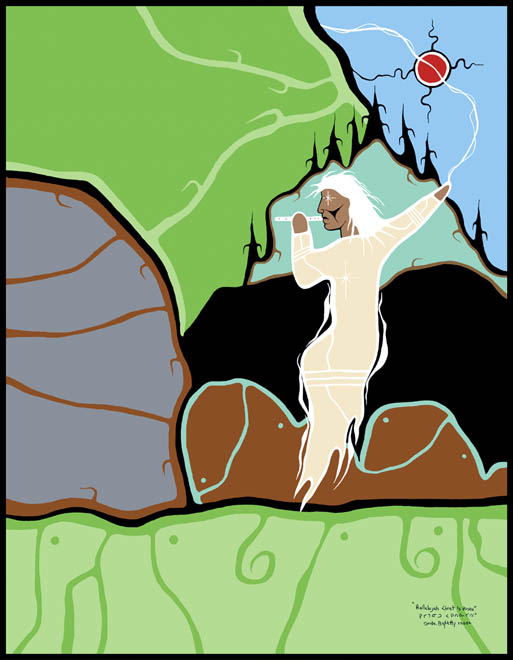
LOOK: Ovide Bighetty (Cree, 1969–2014), Hallelujah, Christ Has Risen, 2002. Acrylic on canvas. From the Kisemanito Pakitinasuwin (The Creator’s Sacrifice) cycle, commissioned by the Indian Metis Christian Fellowship.
Ovide Joseph Bighetty was a Cree (Missinippi-Ethiniwak) self-taught artist originally from Pukatawagan First Nation on the Missinippi River in northwestern Manitoba. He was influenced by the Woodland art style of Norval Morrisseau.
In 2002 the Indian Metis Christian Fellowship (now called the Indigenous Christian Fellowship, or ICF) commissioned Bighetty to create a series of paintings on Christ’s death and resurrection. According to their website, “among North American indigenous peoples, there is the story that, before Europeans arrived on Turtle Island, elders had visions about white people coming from the east with a story from the Creator.” One elder even had a vision of “the Creator’s sacrifice” that corresponds to elements of the biblical passion narratives and Easter story.
Bighetty fulfilled the commission in consultation with Pukatawagan elders, making sure he was properly honoring his people’s heritage.
Hallelujah, Christ Has Risen is the sixteenth painting in a sequence of seventeen. The ICF website offers the following description based on Matthew 28:2–4: “Early on the third day, there was a violent earthquake. A spirit sent by the Creator came down from heaven, rolled the stone away and sat on it. His appearance was like lightning and his clothes white as snow. The warriors were so afraid that they trembled and became like dead men.” It looks to me like the angel is playing a flute with one hand, and with the other he gestures toward the sky, indicating Jesus’s impending ascension.
LISTEN: “Christ the Lord Is Risen Today” | Words by Charles Wesley, 1739 | Music from the Lyra Davidica, 1708 | Arranged and performed by pianist Craig Curry on A Jazz-Inspired Easter, 2012
Christ the Lord is ris’n today, Alleluia! Sons of men and angels say,* Alleluia! Raise your joys and triumphs high, Alleluia! Sing, ye heav’ns, and earth reply, Alleluia!
Love’s redeeming work is done, Alleluia! Fought the fight, the battle won, Alleluia! Death in vain forbids him rise, Alleluia! Christ hath opened paradise, Alleluia!
Lives again our glorious King, Alleluia! Where, O death, is now thy sting? Alleluia! Once he died our souls to save, Alleluia! Where’s thy victory, O grave? Alleluia!
Soar we now where Christ has led, Alleluia! Foll’wing our exalted Head, Alleluia! Made like him, like him we rise, Alleluia! Ours the cross, the grave, the skies, Alleluia!
Hail the Lord of earth and heav’n, Alleluia! Praise to thee by both be giv’n, Alleluia! Thee we greet triumphant now, Alleluia! Hail the Resurrection, thou, Alleluia!
King of glory, soul of bliss, Alleluia! Everlasting life is this, Alleluia! Thee to know, thy pow’r to prove, Alleluia! Thus to sing, and thus to love, Alleluia!
* Alternatively, “Earth and heav’n in chorus say,” as in the United Methodist Hymnal.
This is, for me and many others, the Easter hymn par excellence. (Charles Wesley was a brillianthymn writer.) I never tire of it year after year. It’s glorious.
Happy Easter, friends. Christ is risen!
Be sure to stick around for the next fifty days as I continue to celebrate Easter here at Art & Theology.
All four canonical Gospel accounts of the retrieval of Jesus’s body from the cross and its entombment are very matter-of-fact. There is no mention of grieving. The focus is on the roles of Joseph of Arimathea and Nicodemus, though Matthew and Mark mention two Marys being present (Matt. 27:61; Mark 15:47), and Luke refers generically to “the women who had come with him from Galilee” (Luke 23:55). Mark and Luke also mention the women preparing and, after the Sabbath, returning with burial spices (Mark 16:1; Luke 23:56–24:1).
Leave it to the artists, poets, and composers to inject some emotion into these undeniably wrenching moments! Of carrying the corpse of a loved one, cleaning it, dressing it, and saying goodbye as it’s put into the earth. There is an enormous number of paintings, sculptures, music, and literary texts composed over the centuries to aid Christians in meditating on the dead Christ and vicariously lamenting with those present, especially the Virgin Mary.
After Mary and the others laid Jesus to rest on Friday, their mourning continued, I’m sure, into Saturday. They were utterly bereft.
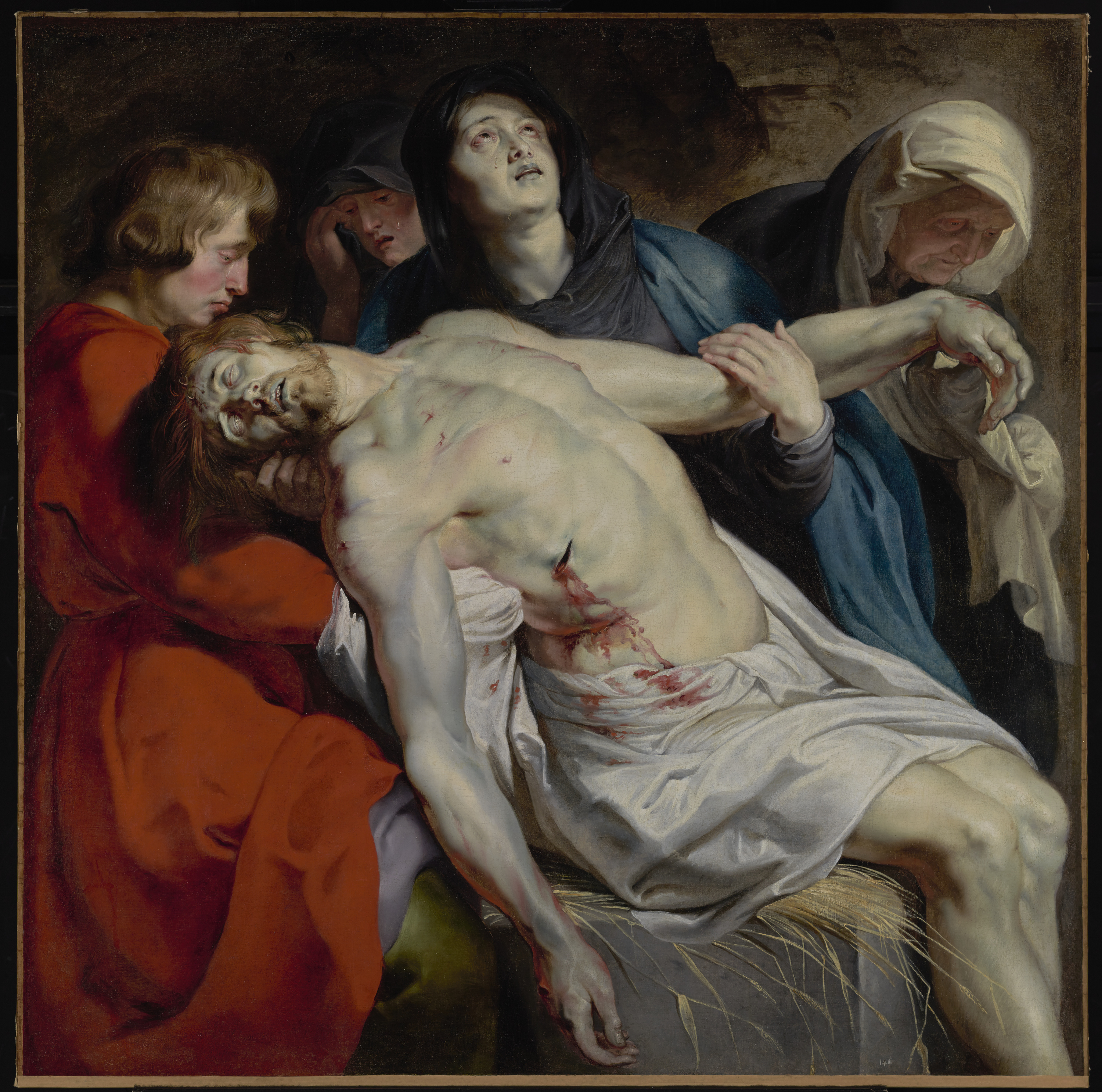
LOOK:Peter Paul Rubens (Flemish, 1577–1640), The Entombment, ca. 1612. Oil on canvas, 51 5/8 × 51 1/4 in. (131.1 × 130.2 cm). J. Paul Getty Museum, Los Angeles.
The Flemish Baroque artist Peter Paul Rubens painted scenes of the lamentation of Christ many times. I saw this one in person at the Getty a few years ago, and it really drew me in. It shows Saint John and the Virgin Mary supporting Jesus’s body as they lay him down onto a stone slab. Mary Magdalene weeps from behind, and another, older Mary, the mother of James the Younger and Joseph (Matt. 27:56; Mark 15:40), gingerly lifts his wounded hand, fixing her sorrow there.
Rubens does not shy away from the ugliness of death, showing Jesus’s eyes rolled back in his head, his lips blue, and blood caked in his hair and dried up around the gaping laceration in his side. His whole body is pale with death, his skin green-tinged, in contrast to John’s ruddy complexion; his mother wears the same deathly pallor. Her eyes are red and puffy, and she looks up to the heavens as if to question why, or to petition God for strength.
The wheat that Jesus lies on alludes to the straw he was bedded in as a newborn and to the bread of the Eucharist on the altar. Christ’s body is given as a holy offering for the sins of the world.
Áine Minogue is an award-winning Irish harpist, singer, arranger, and composer, now living in the Boston area. She plays and sings a mix of traditional tunes and original songs, most with Gaelic lyrics. “Song of Keening” wasn’t written explicitly for Holy Week, but it is a funeral lament that uses non-word utterances to express grief. Minogue writes,
In old Ireland, the practice of keening provided a physical and emotional release for those who grieved. Sometimes, keening was a direct emotional response to loss, practiced by both men and women, though particularly by women who had lost young children—a common occurrence in the past, when child mortality rates were significantly higher.
However, often a professional keener was hired by a family as a way of honoring the dead. These professional mourners were always women, and their keening was more stylized, taking the form of an improvisation based on particular structures and handed-down phrases. Though practiced in diverse cultures from Ireland to Greece, keening was generally frowned upon by church authorities, and treated with disdain by those who embraced the trappings of modernity. The practice now has virtually died out.
This piece is improvised in the old style, using old structures and vocables.
Professional mourners (moirologists) were used in ancient Israel too, at least by those wealthy enough to afford them. There’s no indication that any were present at the death of Jesus. In art history the chief mourners at Jesus’s crucifixion and burial are his mother, Mary; John, to whose care Mary was entrusted; Mary Magdalene; and Jesus’s other female followers.
Now from the sixth hour there was darkness over all the land until the ninth hour. And about the ninth hour Jesus cried out with a loud voice, saying, “Eli, Eli, lema sabachthani?” that is, “My God, my God, why have you forsaken me?” And some of the bystanders, hearing it, said, “This man is calling Elijah.” And one of them at once ran and took a sponge, filled it with sour wine, and put it on a reed and gave it to him to drink. But the others said, “Wait, let us see whether Elijah will come to save him.” And Jesus cried out again with a loud voice and yielded up his spirit.
—Matthew 27:45–50 (emphasis added; cf. Mark 15:33–37)
According to the ESV Study Bible, “Jesus’s call to God in Aramaic (’Eli, ’Eli) sounds similar to the Hebrew name for Elijah (’Eliyahu), which the bystanders misunderstand as a summons to the prophet.” A minority opinion among scholars is that, instead, the bystanders deliberately twist Jesus’s words to further mock him. It was a common expectation of Jews during Jesus’s time that Elijah would return as a precursor to the great day of the Lord (see Mal. 4:5).
What Jesus was in fact citing was Psalm 22, a lament of David, which opens with this searing cry of dereliction: “My God, my God, why have you forsaken me?” A series of raw and wrenching poetic descriptions of suffering and pleas for deliverance, the psalm is nevertheless punctuated with reflections on God’s holiness, faithfulness, and care. Verse 22 (“I will tell of your name . . .”) marks a clear turn in which the speaker moves into a hope that is triumphant.
My God, my God, why have you forsaken me? Why are you so far from saving me, from the words of my groaning? O my God, I cry by day, but you do not answer, and by night, but I find no rest.
Yet you are holy, enthroned on the praises of Israel. In you our fathers trusted; they trusted, and you delivered them. To you they cried and were rescued; in you they trusted and were not put to shame.
But I am a worm and not a man, scorned by mankind and despised by the people. All who see me mock me; they make mouths at me; they wag their heads; “He trusts in the LORD; let him deliver him; let him rescue him, for he delights in him!”
Yet you are he who took me from the womb; you made me trust you at my mother’s breasts. On you was I cast from my birth, and from my mother’s womb you have been my God. Be not far from me, for trouble is near, and there is none to help.
Many bulls encompass me; strong bulls of Bashan surround me; they open wide their mouths at me, like a ravening and roaring lion.
I am poured out like water, and all my bones are out of joint; my heart is like wax; it is melted within my breast; my strength is dried up like a potsherd, and my tongue sticks to my jaws; you lay me in the dust of death.
For dogs encompass me; a company of evildoers encircles me; they have pierced my hands and feet— I can count all my bones— they stare and gloat over me; they divide my garments among them, and for my clothing they cast lots.
But you, O LORD, do not be far off! O you my help, come quickly to my aid! Deliver my soul from the sword, my precious life from the power of the dog! Save me from the mouth of the lion! You have rescued me from the horns of the wild oxen!
I will tell of your name to my brothers; in the midst of the congregation I will praise you: You who fear the LORD, praise him! All you offspring of Jacob, glorify him, and stand in awe of him, all you offspring of Israel! For he has not despised or abhorred the affliction of the afflicted, and he has not hidden his face from him, but has heard, when he cried to him.
From you comes my praise in the great congregation; my vows I will perform before those who fear him. The afflicted shall eat and be satisfied; those who seek him shall praise the LORD! May your hearts live forever!
All the ends of the earth shall remember and turn to the LORD, and all the families of the nations shall worship before you. For kingship belongs to the LORD, and he rules over the nations.
All the prosperous of the earth eat and worship; before him shall bow all who go down to the dust, even the one who could not keep himself alive. Posterity shall serve him; it shall be told of the Lord to the coming generation; they shall come and proclaim his righteousness to a people yet unborn, that he has done it.
—Psalm 22
Ever since the early church, Christians have interpreted this psalm messianically, as there are many clear parallels to Christ’s passion, which the Gospel writers were well aware of.
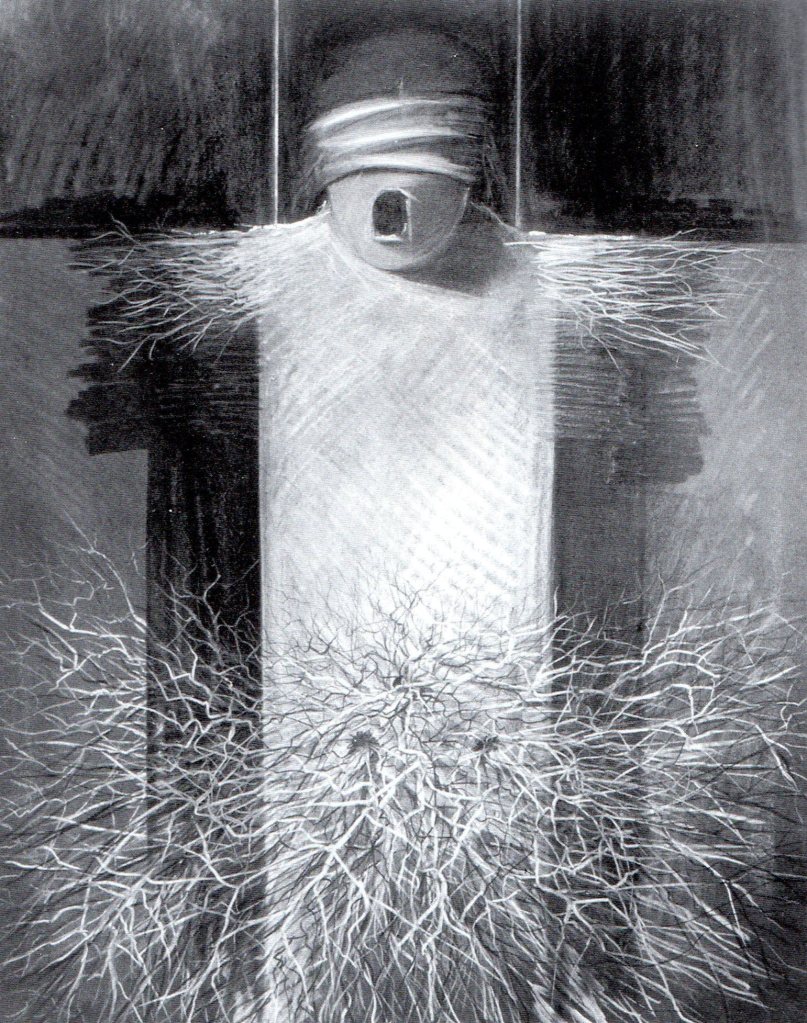
LOOK: Enrico Pinardi (American, 1934–2021), Crucifixion with Thorns, 2002. Oil on canvas.
I corresponded with the artist of this painting a few years ago after having found a black-and-white photo of it in the book The Crucifixion in American Art by Robert Henkes (2003). He granted me permission to reproduce the image on my blog, said he didn’t have a color photo. (“The image is kinda black, white, and blue,” he clarified.) I haven’t gotten around to posting it until now. I wish I had thought to ask about its location; I’m assuming it’s in a private collection somewhere, probably in the United States. After searching for Pinardi online the other week to see what he’s been up to, I found that he died January 30 due to complications from COVID-19.
Crucifixion with Thorns captures something of the horror of Christ’s felt abandonment on the cross. In the throes of death, he opens his mouth in a primal wail—the “loud voice” Matthew and Mark speak of, the “God, why?” He is becoming frayed, unraveled. A thicket of thorns tears through his body—or perhaps that is the cross-post (Pinardi’s expressionistic style deliberately makes it difficult to distinguish between the two). He is pierced.
He is also blindfolded. Luke 22:64 says that Jesus’s captors blindfolded him prior to his appearance before the Sanhedrin, striking him and asking him mockingly to identify, if he’s the Son of God, who it was who struck him. Though his eyes were not covered while he hung on the cross, the artist’s choice to cover them here amplifies the sense of his being in the dark, cut off, and also serves to identify him with other victims of political torture.
The following text was written by committee (with the input of nine Presbyterian denominations) and first published in Pittsburgh in The Psalter: With Responsive Readings (1912), paired with an older tune by Lowell Mason. It covers two-thirds of Psalm 22, omitting the last nine verses—or rather, if you want to look at it this way, compacting them into four lines, as they contain a lot of repetition. I’ve noted in a separate column which verses of the biblical psalm each line of the song corresponds to.
My God, my God, I cry to Thee;
O why hast Thou forsaken Me?
Afar from Me, Thou dost not heed,
Though day and night for help I plead.

But Thou art holy in Thy ways,
Enthroned upon Thy people’s praise;
Our fathers put their trust in Thee,
Believed, and Thou didst set them free.

They cried and, trusting in Thy Name,
Were saved, and were not put to shame;
But in the dust My honor lies,
While all reproach and all despise.

My words a cause for scorn they make,
The lip they curl, the head they shake,
And, mocking, bid Me trust the Lord
Till He salvation shall afford.

My trust on Thee I learned to rest
When I was on My mother’s breast;
From birth Thou art My God alone,
Thy care My life has ever known.

O let Thy strength and presence cheer,
For trouble and distress are near;
Be Thou not far away from Me,
I have no source of help but Thee.

Unnumbered foes would do Me wrong;
They press about Me, fierce and strong;
Like beasts of prey their rage they vent;
My courage fails, My strength is spent.

Down unto death Thou leadest Me,
Consumed by thirst and agony;
With cruel hate and anger fierce
My helpless hands and feet they pierce.

While on My wasted form they stare,
The garments torn from Me they share,
My shame and sorrow heeding not,
And for My robe they cast the lot.

O Lord, afar no longer stay;
O Thou My helper, haste, I pray;
From death and evil set Me free;
I live, for Thou didst answer Me.

I live and will declare Thy fame
Where brethren gather in Thy Name;
Where all Thy faithful people meet,
I will Thy worthy praise repeat.
v. 1

v. 2


v. 3

v. 4


v. 5

v. 6


v. 7

v. 8


v. 9

v. 10


v. 11


v. 12

v. 13
v. 14

v. 15

v. 16


v. 17
v. 18


v. 19

vv. 20–21a
v. 21b

v. 22
One hundred years later, the Rev. Vito Aiuto wrote a new melody for this metrical translation, his only modifications to the text being to substitute out the archaic pronouns (e.g., Thee, Thou) and verb forms (e.g., hast, dost), unless needed to retain the rhyme scheme or meter. He and his wife, Monique, perform the song on their second full-length album along with a team of other musicians, listed here. Sufjan Stevens is among those in the seven-person choir that wails and sings echoes in the first half.
The song opens with a metallic screeching sound, harsh and grating. There are tensions and dissonances in the music, but at verse 5 (around 4:07) a tonal shift happens, as groping in the dark gives way to greater clarity and confidence. The pain is still there, but, like the psalm on which it’s based, it stretches toward hope.
A graduate of Princeton Theological Seminary, Aiuto is one of the founders of Resurrection Brooklyn, a church network of five Presbyterian (EPC) congregations serving the borough. He has been the lead pastor of Resurrection Williamsburg since it began in May 2005. I had the pleasure of hearing him preach in person at CIVA’s 2019 conference.
I’ve featured retuned hymns by The Welcome Wagon twice before on the blog; see Artful Devotion posts “Hail to the Lord’s Anointed” (for the Baptism of the Lord) and “The Strife Is Over” (for Easter).
Then the soldiers of the governor took Jesus into the governor’s headquarters, and they gathered the whole battalion before him. And they stripped him . . .
And when they had crucified him, they divided his garments among them by casting lots.
—Matthew 27:27–28, 35
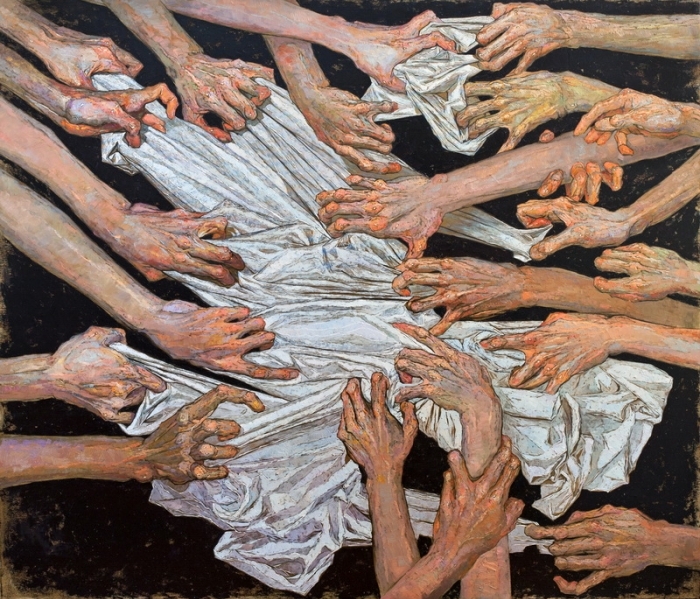
LOOK: Denis Sarazhin (Ukrainian, 1982–), Pantomime 6, 2015. Oil on canvas, 130 × 150 cm.
LISTEN: “They have stripped me of my garments,” Byzantine hymn in plagal second tone, chanted by Vassilis Hadjinicolaou [HT: Global Christian Worship]
This doxastikon (a type of hymn) is sung during the Orthros (Matins) of Great and Holy Friday, which is prayed on the night of Holy Thursday. Note that because they follow the Julian calendar rather than the Gregorian, Orthodox Christians celebrate Good Friday on April 30 this year (and Easter on May 2).
If you’re wondering where the (for me, uncomfortably) violent image in the last line comes from, it’s from Psalm 2:9 (cf. Rev. 19:15). Its insertion into the episode of Christ’s being mocked seems to me an odd choice, seeing as the whole passion narrative is about God the Son absorbing violence rather than enacting it, and we know from his issuance of forgiveness from the cross that he did not have a vengeful attitude toward his tormenters. I speak from outside the Orthodox tradition, though.
Otherwise I find this hymn very moving. Its first line is what inspired the image I chose—of numerous hands clawing at cloth. Nakedness is one of the many indignities Jesus faced on Good Friday; he was stripped, dressed parodically in purple, reclothed with his personal garments, and then stripped again before being crucified. As he hung dying, exposed to the public, the Roman soldiers gambled for his clothing, souvenirs from the high-profile execution. Again, the soldiers’ bestiality is reflected in Sarazhin’s painting.




 Art & Theology