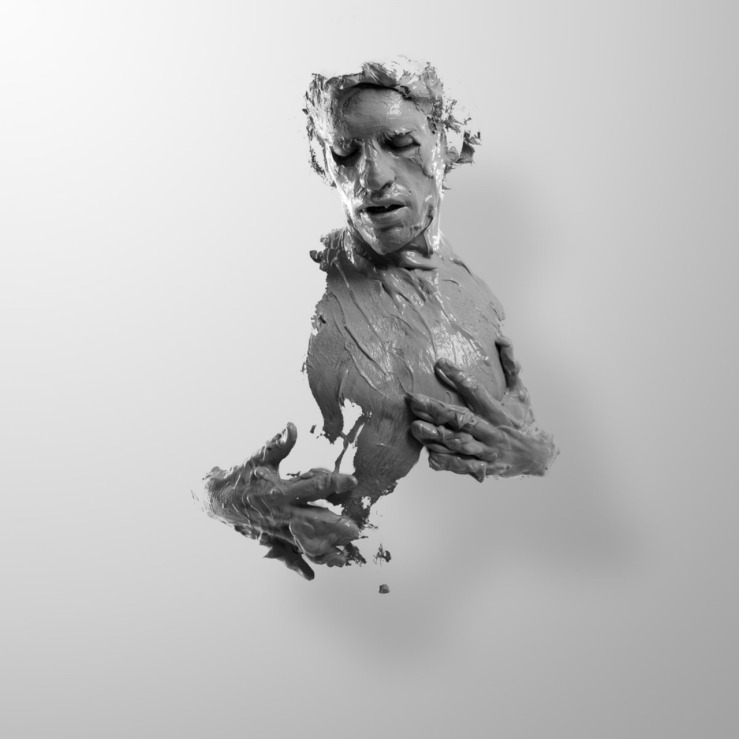
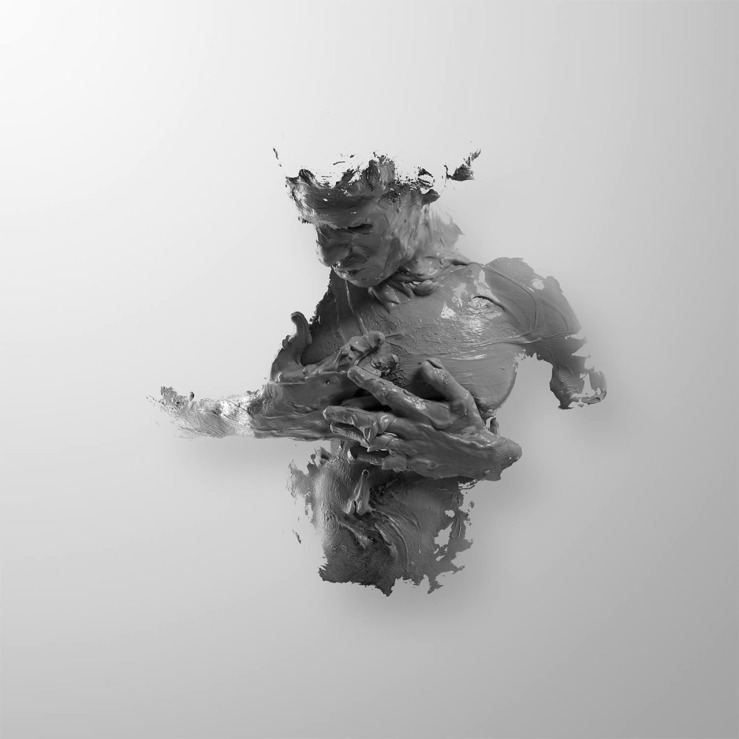
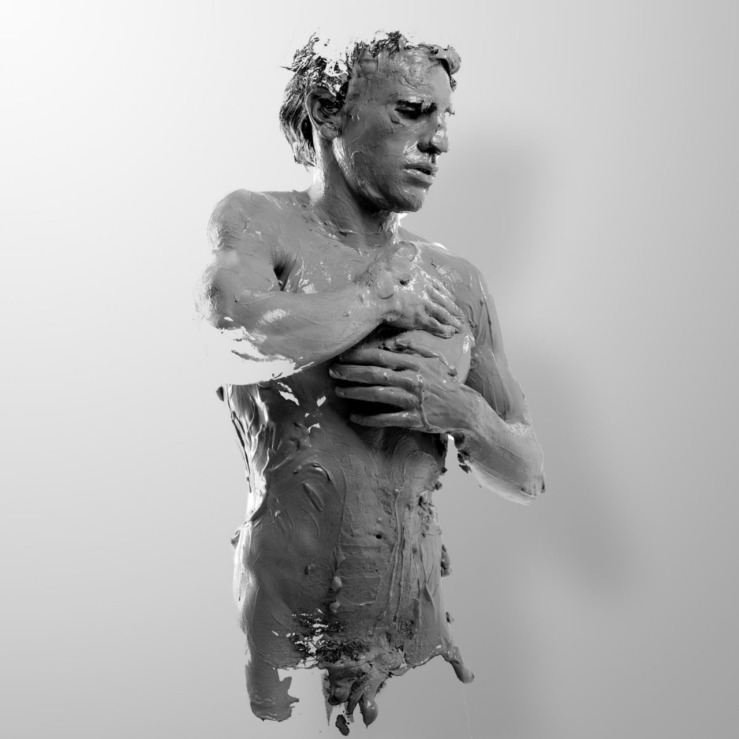
Alejandro Maestre Gasteazi (Spanish, 1979–), Untitled, 2010. Printed ink on cotton paper, 40 × 40 cm. Edition of 20.Alejandro Maestre Gasteazi (Spanish, 1979–), Untitled, 2010. Printed ink on cotton paper, 40 × 40 cm. Edition of 20.Alejandro Maestre Gasteazi (Spanish, 1979–), Untitled, 2010. Printed ink on cotton paper, 40 × 40 cm. Edition of 20.
The word that came to Jeremiah from the Lord: “Arise, and go down to the potter’s house, and there I will let you hear my words.” So I went down to the potter’s house, and there he was working at his wheel. And the vessel he was making of clay was spoiled in the potter’s hand, and he reworked it into another vessel, as it seemed good to the potter to do.
Then the word of the Lord came to me: “O house of Israel, can I not do with you as this potter has done? declares the Lord. Behold, like the clay in the potter’s hand, so are you in my hand, O house of Israel.”
—Jeremiah 18:1–6
+++
SONG: “Have Thine Own Way, Lord” | Words by Adelaide A. Pollard, 1906 | Music by George C. Stebbins, 1907 | Performed by Johnny Cash, 1973, and released on Bootleg, Vol. I: Personal File, 2006
Update, July 25, 2021: Orlando Palmer, aka IAMSON, has just posted an Instagram video of himself singing the first verse of “Have Thine Own Way, Lord.” So beautiful:
It is not you who shapes God, it is God who shapes you.
If then you are the work of God, await the hand of the artist
Who does all things in due season.
Offer God your heart, soft and tractable,
And keep the form in which the artist has fashioned you.
Let your clay be moist,
Lest you grow hard and lose the imprint of God’s fingers.
The three photographs above by Alejandro Maestre Gasteazi are from a cycle of twenty portraits of the artist’s friend Julián Cánovas-Yañez, which show his mud-lathered form gradually taking shape—an effect achieved, in part, in digital postprocessing. Credit goes to Philip Chircop for first pairing these photographs with this quote by the second-century Greek bishop Irenaeus.
This post belongs to the weekly series Artful Devotion. If you can’t view the music player in your email or RSS reader, try opening the post in your browser.
To view all the Revised Common Lectionary scripture readings for Proper 18, cycle C, click here.
After nudges from several readers, I’ve decided to join Instagram! Follow me @art_and_theology. I’m still trying to settle on how I’d like to use the platform, but in the meantime, I’ve been sharing photos I’ve taken on visits to art museums and spaces that house sacred art. (And in case you don’t already know, Art & Theology is also on Facebook and Twitter.)
+++
DANCE: “Sign of the Times,” choreographed by Travis Wall: Premiering August 19, 2019, on Fox’s So You Think You Can Dance (season 16, episode 11), this contemporary dance piece is choreographer Travis Wall’s response to the gun violence epidemic in America. It’s a communal lament through movement, really—an expression of fear, sadness, pain, anger, frustration, and defiance. It is performed by this season’s “top ten”: Benjamin Castro, Gino Cosculluela, Eddie Hoyt, Madison Jordan, Anna Linstruth, Bailey Muñoz, Sophie Pittman, Mariah Russell, Ezra Sosa, and Stephanie Sosa.
+++
FEATURED POET: Marjorie Maddox: The latest installment of Abbey of the Arts’ Featured Poet series is, as usual, wonderful! I’ve read some of Maddox’s poems in magazines and anthologies but haven’t yet gotten my hands on one of her collections. This feature has incentivized me to request a copy of Transplant, Transport, Transubstantiation through my local library.
“The work of poetry,” Maddox writes, is “empathy and epiphany. The process of writing and reading allows us to better understand this world and the next. Poetry connects the local and universal, the mundane and the miraculous. It gives us those ears to hear and eyes to see that we might, then, head back into the turning world sustained, nourished, and willing to learn more. And will this not lead us to the Sacred? Yes, I say. Yes.”
+++
ESSAY: “Acts of Attention: On Poetry and Spirituality” by Robert Cording: I really enjoyed this essay from Image journal about the importance of attending to the world. “Attention is simply a loving look at what is,” writes Cording, a poet and birdwatcher. He discusses seeing not as a physiological act but as perceiving the fullness that exists in each moment. “Seeing is impossible without love or reverence,” he says. Along the way he engages with Marie Howe, Aristotle, Emerson and Thoreau, Tolstoy, Ruskin, Heidegger, Hopkins, Czesław Miłosz, and Marilynne Robinson. He also walks us through three poems: Robert Frost’s “Two Tramps in Mud Time,” Wallace Stevens’s “Man on the Dump,” and Seamus Heaney’s “The Pitchfork.” So much goodness here!
If you enjoyed this essay as much as I did, be sure to also check out “Cloud Shapes and Oak Trees,” also by Cording, from 2017.
+++
EXHIBITION: Abraham: Out of One, Many, curated by Rev. Paul-Gordon Chandler of Caravan: Caravan is an international nonprofit that uses the arts to build sustainable peace around the world. “Our peacebuilding work is based on the belief that the arts can serve as one of the most effective mediums to enhance understanding, bring about respect, enable sharing, and facilitate friendship between diverse peoples, cultures and faiths.”
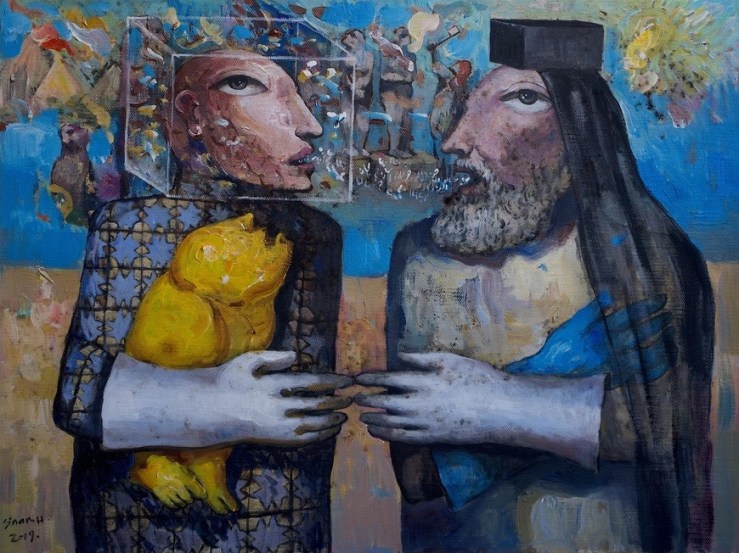
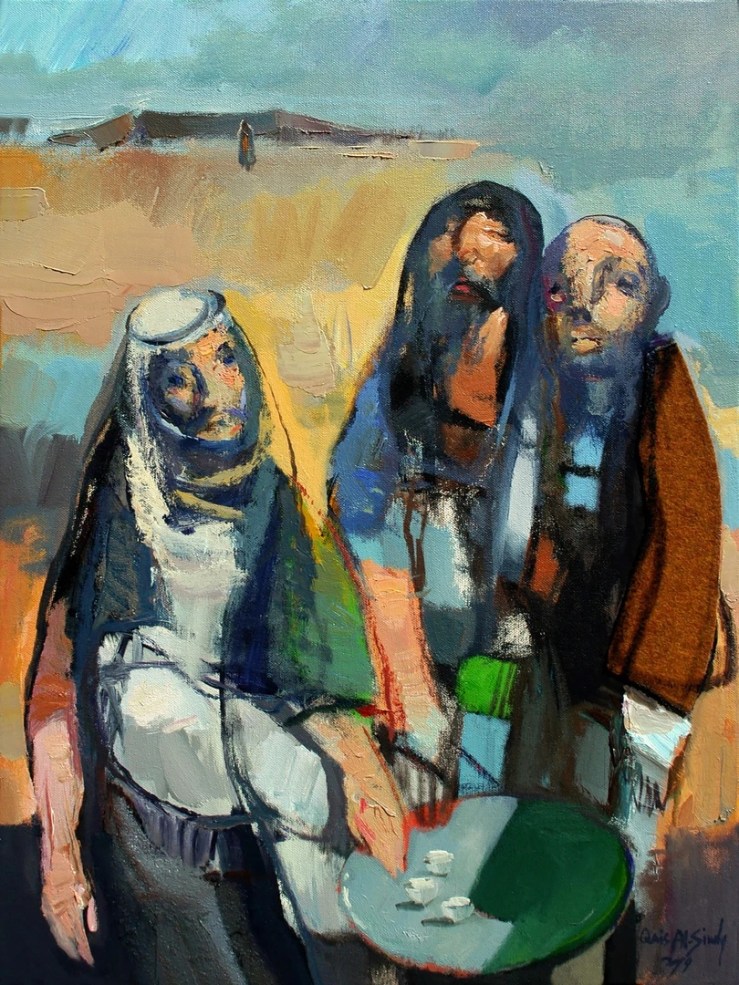
Caravan’s current exhibition is built around Abraham, a key ancestral figure shared by the world’s three major monotheistic religions: Judaism, Christianity, and Islam. Caravan commissioned three Middle Eastern artists, one from each of these faith traditions, to each create five paintings on these subjects: Living as a Pilgrim, Welcoming the Stranger, Sacrificial Love, The Compassionate, and A Friend of God. The exhibition of resulting works opened May 3 at St. Paul’s Within the Walls in Rome. From there it has traveled to Paris and Edinburgh and, starting September 8, will be in the States, touring through 2021 with stops in Boston, Atlanta, Houston, Washington, DC, Chicago, and more (see schedule). There’s an excellent digital catalog available, which contains full-color reproductions and descriptions of all fifteen paintings.
Sinan Hussein (Iraqi, 1977–), Living as a Pilgrim, 2019. Mixed media on canvas, 45 × 60 cm. Part of the “Abraham: Out of One, Many” exhibition organized by Caravan.Qais Al Sindy (Iraqi, 1967–), Welcoming the Stranger, 2019. Oil and collage on canvas, 60 × 45 cm. Part of the “Abraham: Out of One, Many” exhibition organized by Caravan.
+++
MUSICAL: In the Green by Grace McLean:Lincoln Center Theater’s LCT3 produces shows by new playwrights, directors, and designers, and for this summer, they commissioned a musical about the twelfth-century German mystic Hildegard of Bingen. (It finished its run on August 4, so I’m late in publicizing it—sorry!) A Benedictine nun and later abbess, Hildegard was also a composer, poet, dramatist, theologian, botanist, and healer—a true polymath. In the Green focuses on her relationship with her mentor, Jutta, just six years her senior.
Here’s Grace McLean, the show’s lyricist, composer, playwright, and player of Jutta, performing “Eve” (which uses looping technology!), followed by a short conversation between her and one of the other cast members. [HT: Still Life]
While looking online and on Spotify for the best available recording of this classic, I decided on the a cappella rendition by Zero8, a Stockholm-based male choir. But my favorite solo rendition is, ironically, from this year’s Chilling Adventures of Sabrina: Season One (Original Television Soundtrack). Though I don’t endorse the show, Jaz Sinclair’s vocal performance in episode 8 is gorgeous. (Her character sings the hymn during a funeral scene.) I also came across a retuned version by Sara Groves from her 2013 album The Collection, which is quite lovely, though I remain attached to the original tune.
+++
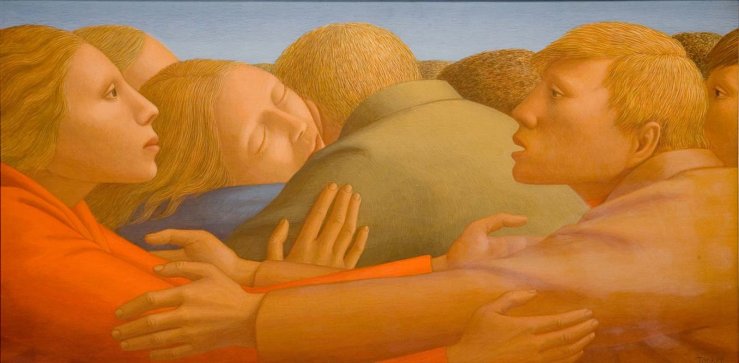
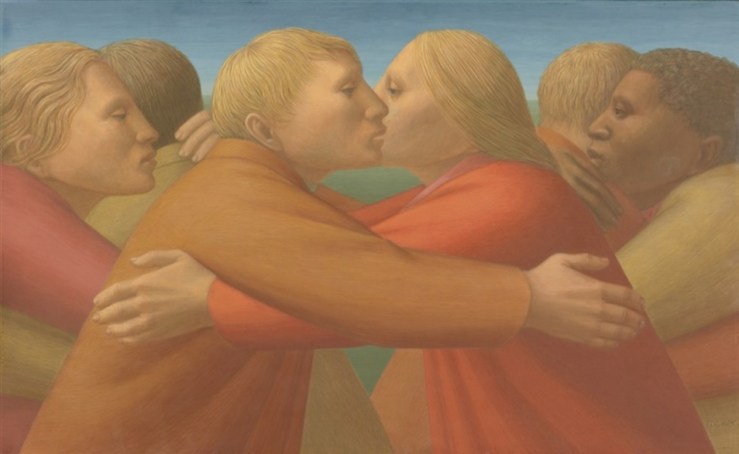
The “embrace of peace” in the title of the above George Tooker painting refers to a liturgical element in many Christian worship services in which congregants bless one another in the name of Christ. Depending on the church culture, this can be done with a handshake, a hug, or in some cultures, a kiss. The ritual is commonly referred to as the “passing of the peace” and, more than a mere greeting, is a significant gesture of reconciliation, unity, and love. Here’s a variation by Tooker on the same theme:
George Tooker (American, 1920–2011), An Embrace of Peace, 1986. Egg tempera on gesso panel, 16 × 26 in.
This post belongs to the weekly series Artful Devotion. If you can’t view the music player in your email or RSS reader, try opening the post in your browser.
To view all the Revised Common Lectionary scripture readings for Proper 17, cycle C, click here.
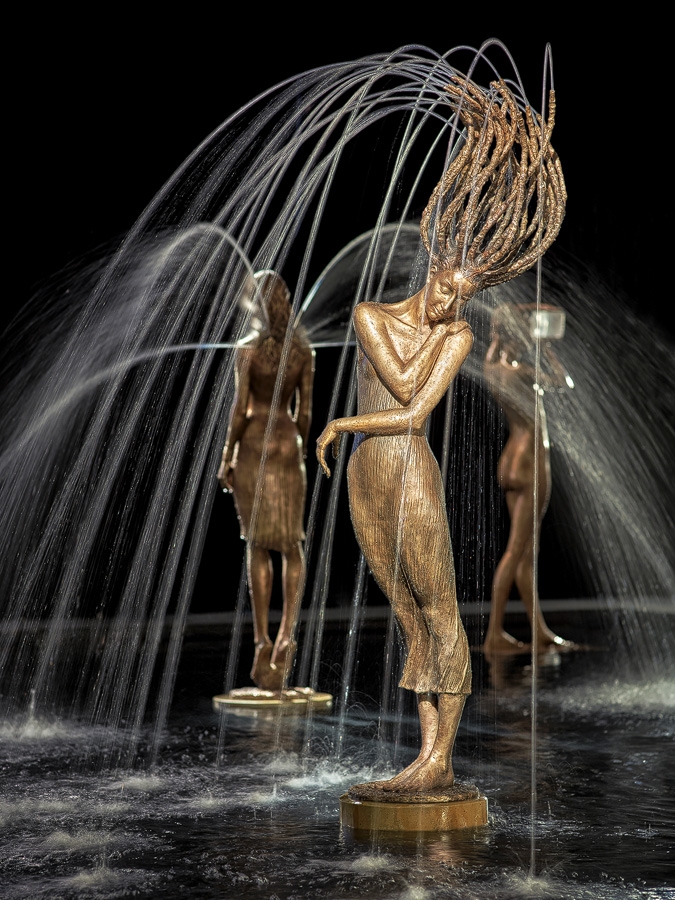
Małgorzata Chodakowska (Polish, 1965–), Primavera III, 2014. Bronze fountain, 220 cm tall. (In the background are Angel and Woman with Ice.)
The LORD will guide you continually,
and satisfy your needs in parched places,
and make your bones strong;
and you shall be like a watered garden,
like a spring of water,
whose waters do not fail.
—Isaiah 58:11 NRSV
+++
SONG: “I’ve Got Peace Like a River” | Negro spiritual | Performed by Wally Macnow, with Lucy Simpson, Peter Amidon, Mary Alice Amidon, Bill Destler, Tom McHenry, and Caroline Paton, on Sharon Mountain Harmony: A Golden Ring of Gospel (1982)
I love Wally Macnow’s ebullient rendition of this Negro spiritual for Folk Legacy Records. It’s a different tune than I’m accustomed to; for the more widely recognized melody, check out, for example, Lynda Randle.
The phrase “peace like a river” appears in Isaiah 48:18 and 66:12, and between those verses is another one, above, in which Isaiah relays God’s promise to water our souls in times of drought and, what’s more, to make us into springs whose water can’t help but bubble up to the surface and spill over.
+++
Małgorzata Chodakowska is a Polish artist who has lived in Germany since 1991. She is renowned for her “water sculptures,” (usually nude) figures carved in oak wood and then cast in bronze and designed for water. Chodakowska creates unique paths for the water, specific to each sculpture—it might fan out from the waist like a tutu, for example, expand from the back like angels’ wings, or shoot every which way around an orb, suggesting the movement of celestial bodies. Browse her work at http://www.skulptur-chodakowska.de/en/fountains/, or view a sampling in the video below.
This post belongs to the weekly series Artful Devotion. If you can’t view the music player in your email or RSS reader, try opening the post in your browser.
To view all the Revised Common Lectionary scripture readings for Proper 16, cycle C, click here.
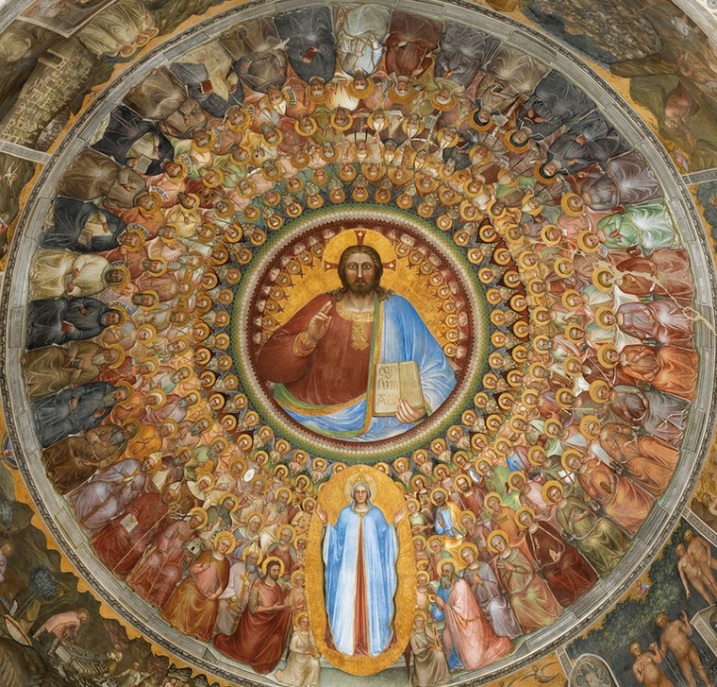
Giusto de’ Menabuoi (Italian, ca. 1320–1391), Paradise, ca. 1378. Dome fresco, Padua Baptistery, Italy.
Therefore, since we are surrounded by so great a cloud of witnesses, let us also lay aside every weight and the sin that clings so closely, and let us run with perseverance the race that is set before us, looking to Jesus the pioneer and perfecter of our faith, who for the sake of the joy that was set before him endured the cross, disregarding its shame, and has taken his seat at the right hand of the throne of God.
A cloud of witnesses around us,
a thousand echoes from the past,
proclaim the One who freed and found us,
and leads us on, from first to last.
For such a gift, let all uplift
a thousand alleluias.
A carnival of faiths and cultures
parading through our settled praise,
with jangled rhythms, songs and dances,
expresses Love’s expansive ways.
Christ is our song. To God belong
a thousand alleluias.
A crowd, that clamors pain and anger,
prevents us from nostalgic pride;
the cries of poverty and hunger
recall us to our Savior’s side.
There we entrust, to God most just,
a thousand alleluias.
A throng of future shapes and shadows,
a world that may, or may not be,
names us the servants and the stewards
of all the Spirit longs to see.
In awe we bend, and onward send
a thousand alleluias.
A rainbow-host of milling children,
God’s varied image, from all lands,
awakes again our founding vision,
that onward, urgently expands.
Give all, give more. Let love outpour
a thousand alleluias.
+++
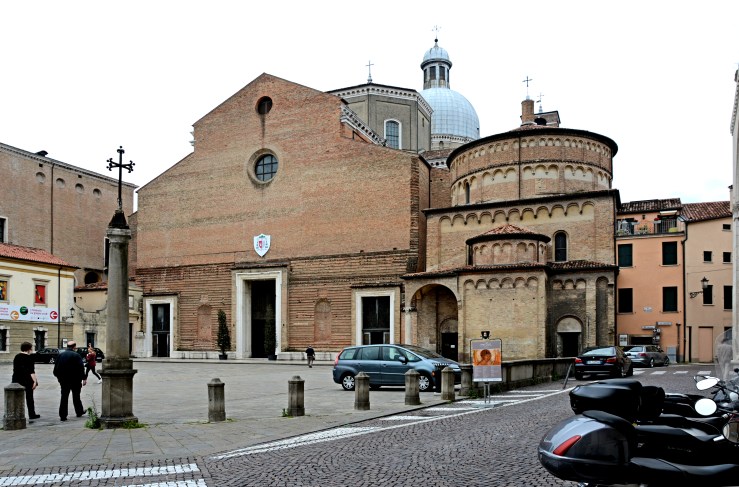
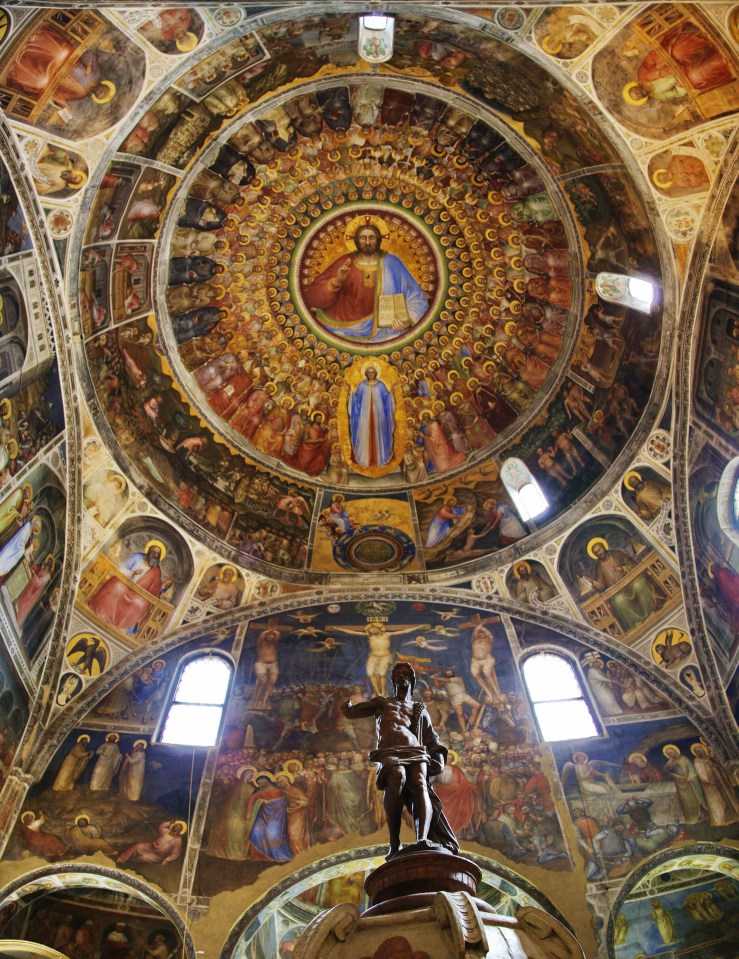
Padua Cathedral (left) and Baptistery (right). Photo: Peter Owen.Padua Baptistery, interior panorama. Photo: Nikola Sarnavka.
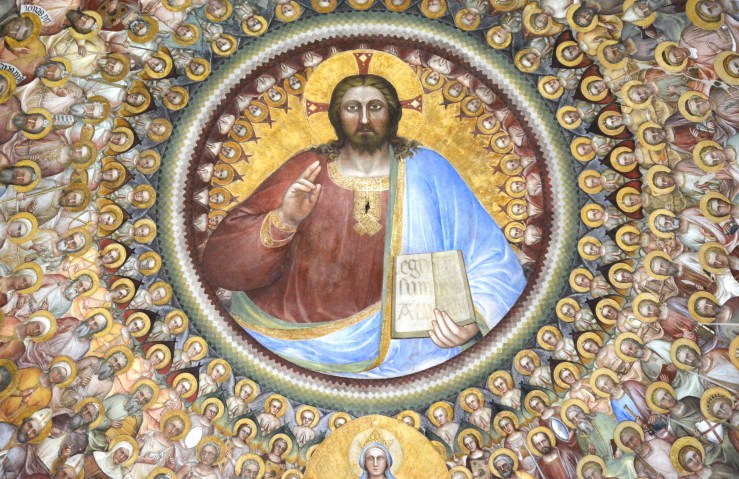
In de’ Menabuoi’s stunning fresco, we glimpse a rendering of the glory of Christ’s church. We see a myriad of saints surrounding Jesus in a circle, which itself, suggests fullness and unending eternity. This grand scene was painted on the ceiling of a baptistery, a chapel set aside for the purpose of uniting new believers to the Lord and His church. So when the newly illumined ones came up out of the waters of baptism, they would see a representation of what and who they were just joined to: Jesus Christ as the Lord of Hosts, arrayed in the midst of His mother and the various ranks of saints, an image of God’s kingdom.
The image of Christ in the center of the cupola is of the type known as Christ Pantocrator, meaning “Christ Almighty” or “Ruler of All.” The book he holds open reads, EGO SUM Α ω (“I am Alpha and Omega”).
This post belongs to the weekly series Artful Devotion. If you can’t view the music player in your email or RSS reader, try opening the post in your browser.
To view all the Revised Common Lectionary scripture readings for Proper 15, cycle C, click here.
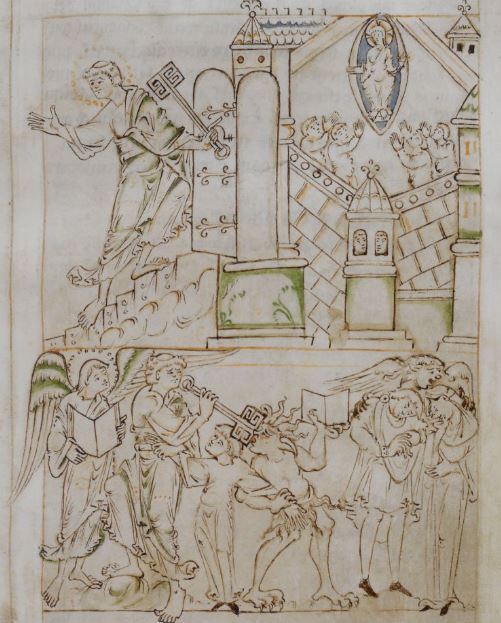
Ink drawing with color wash from the Liber Vitae of New Minster and Hyde, England, ca. 1031. Stowe MS 944, fol. 7r, British Library, London.
Fear not, little flock, for it is your Father’s good pleasure to give you the kingdom.
—Luke 12:32
+++
SONG: “Keys to the Kingdom” | Traditional gospel blues song, performed by Abigail Washburn (lead vocals), Kai Welch (trumpet, backing vocals), and friends (I can’t find the names of the upright bassist and percussionist—anyone know?)
I’ve got the keys to the kingdom, the world can’t do me no harm
Go Gabriel, get the trumpet, move on down to the sea
Don’t you sound that trumpet, ’til you hear from me
I’ve got the keys to the kingdom, the world can’t do me no harm
Take ol’ John on the island, place him in a kettle of oil
Then the angels came from heaven down, told him that the oil wouldn’t boil
I’ve got the keys to the kingdom, the world can’t do me no harm
Take ol’ Paul and Silas, place ’em in jail below
Then the angels came from heaven down and unlocked that prison-house door
I’ve got the keys to the kingdom, the world can’t do me no harm
When I get in trouble, I know I done no crime
Wake up central in Glory, and Jesus come to the phone
I’ve got the keys to the kingdom, the world can’t do me no harm
I got the keys to the kingdom, the world can’t do me no harm
Abigail Washburn is a Grammy Award–winning clawhammer banjo player and singer and one of my favorite musical artists. Here she sings a traditional song from the American South, which, as is typical of such songs, exists in many variations. Her version, she says, is based on a performance by Lillie Cogswell Knox, recorded a cappella on a porch in Murrells Inlet, South Carolina, in the 1930s. You can listen to this historic recording on Deep River of Song: South Carolina—Got the Keys to the Kingdom, from the Alan Lomax Collection.
Washburn has performed “Keys to the Kingdom” at many concerts, each performance unique. You can find a handful of these on YouTube; I particularly like the smoky jazz version she did at the Berkeley Café in Raleigh, North Carolina, in January 2011, embedded above. She also recorded the song on the 2006 EP The Sparrow Quartet, the album title a reference to the cross-cultural folk music group consisting of herself, husband Béla Fleck (banjo), Ben Sollee (cello), and Casey Driessen (fiddle). The album version has a banjo accompaniment (by Fleck) and an overall brighter tone.
While Matthew 16:19, Jesus’s metaphoric handing over of the keys to Peter and the church, is the more direct inspiration for the refrain, I love reading the gentle saying of Jesus from Luke 12:32 in relation to this song.
+++
The drawing above is a detail from one of the pages of the eleventh-century Liber Vitae (“Book of Life”) from New Minster in Winchester, a medieval Benedictine monastery that moved to Hyde after the Norman Conquest. The book contains a list of names of the members of the community and its associates and benefactors, living and dead, along with pictures, grants, historical accounts, material for church services, prayers, and other devotional material.
This drawing is part of a spread toward the beginning of the manuscript that shows St. Peter unlocking the gates of heaven as he welcomes in a queue of the saved from the facing page. Inside the celestial city, Christ is adored. The page’s middle band shows Peter fighting a devil for a man’s soul. The man’s victory is secure, as his name is recorded in the Book of Life, which the angel flashes open, over against the devil’s faulty document. Amusingly, to cinch the victory, Peter delivers a mighty whack to the devil’s head with his oversize key!
We’ve got the keys to the kingdom—we’re heirs with full access, granted us by our loving Father. The world can’t do us no harm.
This post belongs to the weekly series Artful Devotion. If you can’t view the music player in your email or RSS reader, try opening the post in your browser.
To view all the Revised Common Lectionary scripture readings for Proper 14, cycle C, click here.
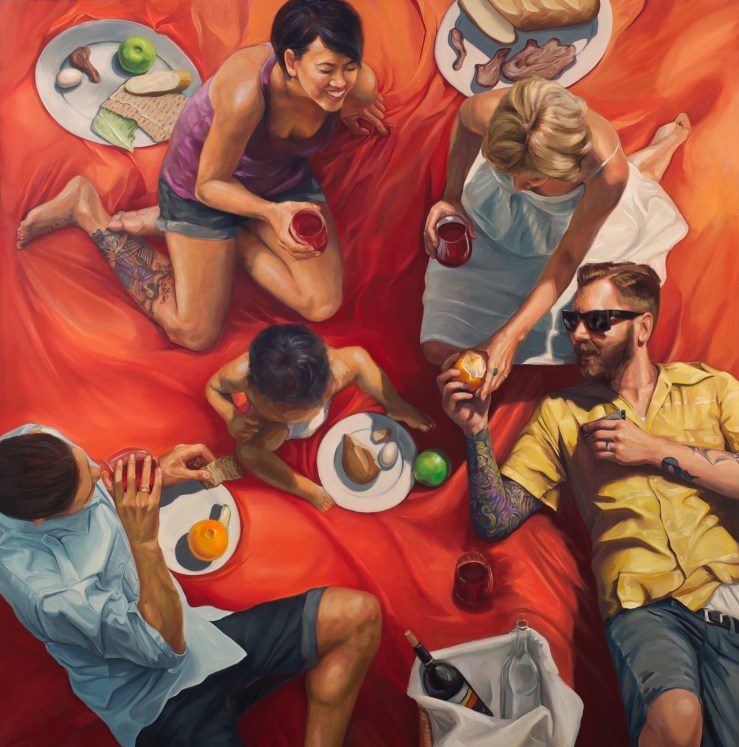
Kirsten Van Mourick, Eucharist, 2014. Oil on canvas, 72 × 72 in.
Oh give thanks to the Lord, for he is good,
for his steadfast love endures forever!
Let the redeemed of the Lord say so,
whom he has redeemed from trouble . . .
For he satisfies the longing soul,
and the hungry soul he fills with good things.
Some sat in darkness and in the shadow of death,
prisoners in affliction and in irons,
. . .
they fell down, with none to help.
Then they cried to the Lord in their trouble,
and he delivered them from their distress.
He brought them out of darkness and the shadow of death,
and burst their bonds apart.
Let them thank the Lord for his steadfast love,
for his wondrous works to the children of man!
. . .
And let them offer sacrifices of thanksgiving,
and tell of his deeds in songs of joy!
For a video tutorial by the songwriter on how to play “Oh Give Thanks” on the guitar, click here.
This post belongs to the weekly series Artful Devotion. If you can’t view the music player in your email or RSS reader, try opening the post in your browser.
To view all the Revised Common Lectionary scripture readings for Proper 13, cycle C, click here.
Li Kai Tong, Atonement, ca. 1997. Ink wash painting.
And when you were dead in trespasses and the uncircumcision of your flesh, God made you alive together with him, when he forgave us all our trespasses, erasing the record that stood against us with its legal demands. He set this aside, nailing it to the cross.
—Colossians 2:13–14 NRSV
+++
SONG: “There Is a Fountain” | Words by William Cowper, 1772 | Music by Noah James, on Hymns (2013)
I love Noah James’s retuned performance of this classic hymn with mandolin and kick drum.
+++
This painting isn’t technically accomplished, but conceptually, as an illustration of a theological truth, it’s clever. Using the medium of ink wash painting, Hong Kong artist Li Kai Tong depicts the Chinese character for sin being washed away by Christ’s blood. I found this image in the June 1997 issue of Image: Christ and Art in Asia, the newsletter of the Asian Christian Art Association, published quarterly from 1979 to 2011. The entire archive has been digitized and is a treasure trove.
This post belongs to the weekly series Artful Devotion. If you can’t view the music player in your email or RSS reader, try opening the post in your browser.
To view all the Revised Common Lectionary scripture readings for Proper 12, cycle C, click here.
Image journal subscriptions are 50% off through the summertime—only $24 for four full-color issues! This is the magazine I most look forward to receiving in the mail. So much great poetry, art, essays, and more.
+++
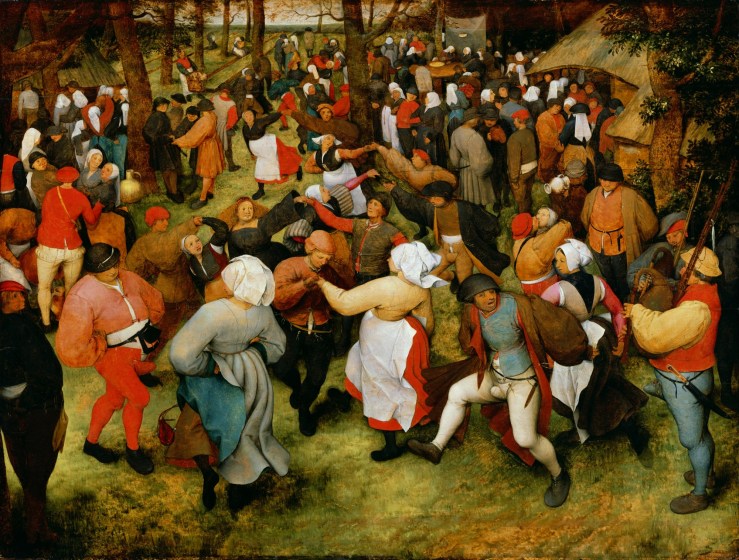
NEW POEM: “They Too Go Round” by Paul Mariani: This poem from the current issue of Image journal (no. 101) brings together Pieter Bruegel the Elder’s Wedding Dance with Fra Angelico’s Last Judgment at San Marco, gesturing toward a vision in which the terrestrial is taken up into the celestial. Bruegel’s Dutch peasant dancers “pound” and “rollick” with beer foam on their faces and general bawdiness; the saints from the Fra Angelico painting, by contrast, step lithely and with reverence in their round dance on the very grasses of paradise. Disparate though they are in tone, Mariani connects these two images, playing with the idea of circling. Just as the wedding guests dance round and round, so too does time; so too the spheres. And at the center of this cosmic round dance is praise: humanity linked hand in hand with the angels, not closed in on themselves but opening up into the glory of God.
Pieter Bruegel the Elder (ca. 1525–1569), The Wedding Dance, ca. 1566. Oil on panel, 119.3 × 157.4 cm. Detroit Institute of Arts, Michigan, USA.Fra Angelico (ca. 1395–1455), The Last Judgment (detail), ca. 1431. Tempera on wood, 105 × 210 cm. Museum of San Marco, Florence, Italy.
The last stanza quotes an excerpt from a famous medieval Catholic prayer: “Sinning daily, and not repenting, the fear of death disturbs me, for there is no redemption in Hell. Have mercy on me, O God, and save me.” The speaker’s anxiety has been building up as he reflects on the empty pleasures to which he has been so long devoted and the imminence of death. This anxiety, however, is swept away in one turn as he catches a glimpse of God’s abundant salvation and its final consummation—a “sea-changing moment, now and forever.” Christ, the fulfillment of all desire, sits on his throne at the center of this turning world, beckoning us into the dance of the redeemed.
(FYI, Paul Mariani will be one of the plenary speakers at the Catholic Imagination Conference at Loyola in September. Registration is still open!)
+++
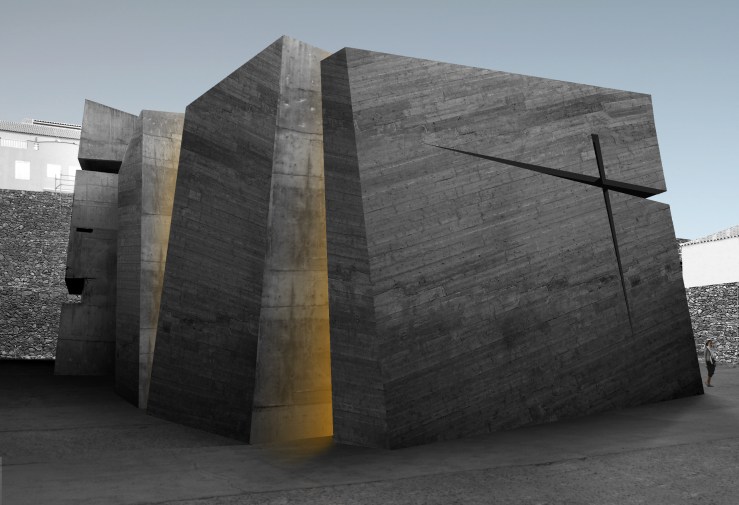
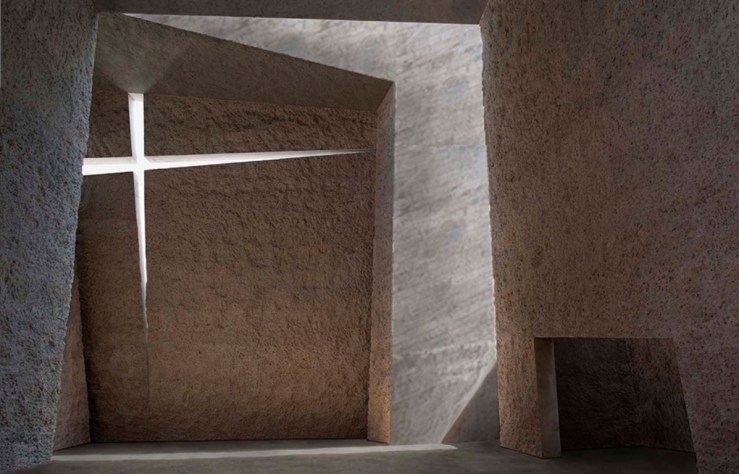
CHURCH ARCHITECTURE: Known for his work in concrete, Spanish architect Fernando Menis designed the new Holy Redeemer Church in Tenerife, Spain, consecrated May 12. I’m digging the minimalism. Learn more and view more photos on the architect’s website. [HT: ArtWay]
Holy Redeemer Church, Tenerife, Spain. Designed by Fernando Menis, completed 2019.Interior: Holy Redeemer Church, Tenerife, Spain. Designed by Fernando Menis, completed 2019.
+++
CHORAL ARRANGEMENT: “Dios es Nuestro Amparo” (God Is Our Refuge), arr. Alfredo Colman: I love this traditional setting of Psalm 46 in Spanish, recently arranged by Alfredo Colman and performed by the Coro del Seminario Internacional Teológico Bautista (Choir of the International Baptist Theological Seminary) in Buenos Aires, Argentina. [HT: Global Christian Worship]
I was curious about the history of the song, so I wrote to Colman; he said he first encountered it in Paraguay, where he grew up, but doesn’t know its country of origin. The song, he told me, has been well known in Latin America since the 1970s. While this particular arrangement of Colman’s has not yet been published, you can find a simpler arrangement for congregational singing in the bilingual hymnal Santo, Santo, Santo: Cantos para el pueblo de Dios / Holy, Holy, Holy: Songs for the People of God, released just this month. Edited by the Calvin Institute of Christian Worship (CICW) in partnership with GIA Publications, it contains over 700 songs in Spanish and English.
For a vision and resources for singing together in Spanish and English, see this recorded CICW workshop, led by Colman and five others, and also the article “Expand Your Church’s Bilingual Music Repertoire.” Introducing bilingual music to a church congregation is “like introducing a new vegetable to toddlers,” says María Eugenia Cornou, the CICW program manager for international and intercultural learning. “Some kids love it, but usually it takes time. It’s a new flavor.”
+++
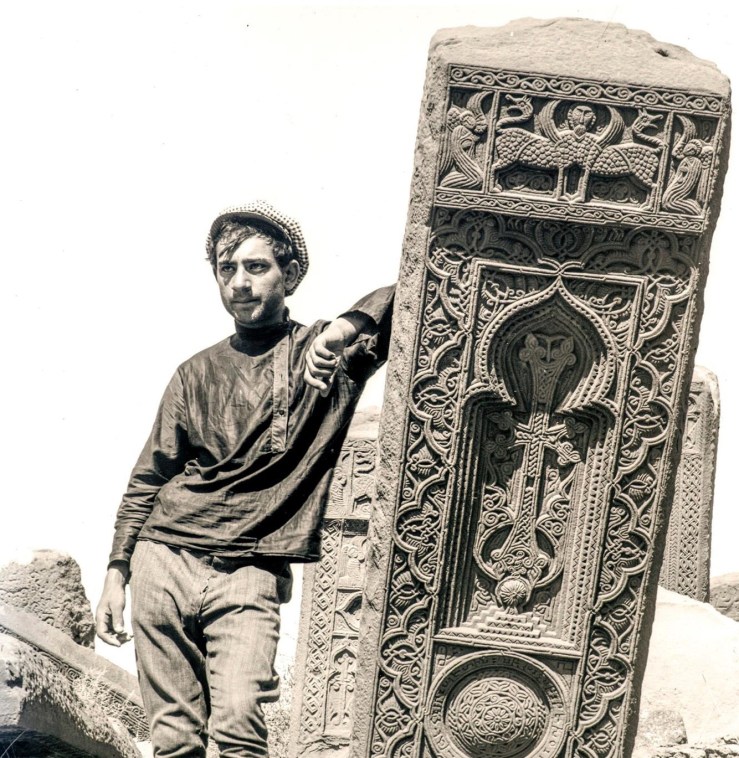
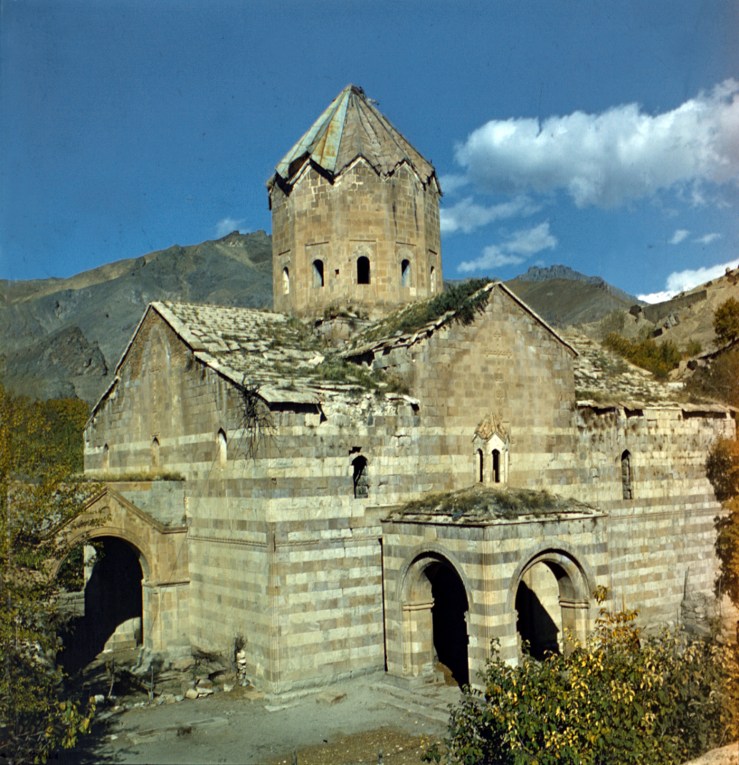
CULTURAL DESTRUCTION: “A Regime Conceals Its Erasure of Indigenous Armenian Culture” by Simon Maghakyan and Sarah Pickman: An investigative report published in February exposed Azerbaijan’s destruction of thousands of medieval Christian Armenian artworks and objects at the necropolis of Djulfa in Nakhichevan. The cemetery at Djulfa contained the world’s largest collection of khachkars, ornately carved memorial steles with crosses, characteristic of Armenian Christianity; 2,920 were documented clandestinely by native Argam Ayvazyan from 1964 to 1987, half of the 5,840 he documented in Nakhichevan as a whole. But, other than the dozen that were removed from the region during or before the Soviet era into church or museum collections, all these were demolished by Azerbaijani soldiers in 1997, 2002, and 2005–6, expunging the region’s last remaining traces of Christianity. (This was in addition to the demolition of 89 Armenian churches and 22,000 tombstones in Nakhichevan.)
“Unlike the self-publicized cultural destruction of ISIS, independent Azerbaijan’s covert campaign to re-engineer Nakhichevan’s historical landscape between 1997 and 2006 is little known outside the region. . . . While some Azerbaijanis have embraced their government’s vandalism as either righteous revenge or a national security measure against potential Armenian territorial claims, other Azerbaijanis . . . have mourned the destruction.”
Here is a short video posted in December 2005 by Nshan Topouzian, the leader of north Iran’s Armenian church, who was tipped off to the destructive activity taking place at the Djulfa cemetery by an Iranian border patrol. (Djulfa is located at the border of Azerbaijan and Iran.)
Hyperallergic pointed out the “cruel irony” and “insult” of Azerbaijan hosting UNESCO’s World Heritage Committee session earlier this month. UNESCO not only avoided a public condemnation of the destruction of Armenian Christian artifacts and churches in Nakhichevan but also praised Azerbaijan (one of its biggest donors) as a “land of tolerance.”
+++
ARTICLE: “6 Works of Classical Music Every Christian Should Know” by Jeremy Begbie: Theologian and pianist Jeremy Begbie is a superstar in the field of theology and the arts. Most of his books, published for academic audiences, are pretty dense, but this article that he wrote for The Gospel Coalition is wonderfully accessible. It opens, “Why bother with classical music? On the face of it, it seems like a serious indulgence to give time and attention to something so trivial as music—classical or otherwise. Yet the fact remains that no human society, however impoverished, has yet managed to do without music in some form. The impulse to sing, to blow air through wooden tubes, and to draw hair across strings seems ineradicable. What’s more, it’s long been recognized that people pour their deepest longings and passions into music-making. Music can be a remarkable index of the profoundest impulses and stirrings of a culture—impulses and stirrings that are often theologically charged.”
He then recommends six works of classical music to spend time with, highlighting the best recordings and musical guides available. From the “bubbling, joyful abundance” of a Mozart piano concerto (“a fresh iteration of creation’s hallelujah”) to the “aching beauty” of Rachmaninov, there’s variety here. Find out what Begbie considers to be “the greatest Christian musical achievement of the early modern era,” and which symphony contains, from its penultimate to final movement, one of the best transitions in Western music.
Begbie is the founder Duke Initiatives in Theology and the Arts, and the program is throwing a big symposium in September to celebrate its ten-year anniversary. I’ll be there! Join me? If you can’t swing the registration cost but live in the Triangle area of North Carolina, consider coming out on Saturday night to “Making All Things New: The Sound of New Creation,” a concert featuring a range of music, “from Bach to Bernstein, Rachmaninov to Latino, medieval to jazz, concert music to film music,” as well as a reflection by N. T. Wright. I attended a similar Begbie-led concert at Duke two years ago, and it was phenomenal.
+++
FILM: Ida (2013), dir. Pavel Pawlikowski: This Oscar Award–winning film about identity and faith is a great watch, especially for its stunning cinematography by Lukasz Zal and Ryszard Lenczewski. Shot in high-contrast black-and-white in the classic 4:3 format, it is almost entirely made up of static frames, exquisitely composed. I really just can’t get over the visuals. Watch the trailer and film clip below, and you’ll get a sense of what I mean. The movie is available on Kanopy, an on-demand streaming service provided for free by many public libraries.
Pietro di Puccio da Orvieto (Italian, active 14th century), “Universe Supported by God with the Signs of the Planets,” 1389–91. Fresco, north gallery, Camposanto Monumentale, Pisa, Italy.
He is the image of the invisible God, the firstborn of all creation. For by him all things were created, in heaven and on earth, visible and invisible, whether thrones or dominions or rulers or authorities—all things were created through him and for him. And he is before all things, and in him all things hold together. And he is the head of the body, the church. He is the beginning, the firstborn from the dead, that in everything he might be preeminent. For in him all the fullness of God was pleased to dwell, and through him to reconcile to himself all things, whether on earth or in heaven, making peace by the blood of his cross.
—Colossians 1:15–20
+++
SONG: “Namasté Saté” by Aradhna, on Namasté Saté (2011)
Namasté saté sarvalok-ashrayaya Namasté chité vishwarup-atmakaya Namo adwait tatwaya muktipradaya Namo brahmane vyapiné shashwataya
Ultimate Reality, we greet You
In you the whole Universe is held together
Your life fills every nucleus that has ever been created
You dwell in our flesh and bones
Your Great Liberation is to bring us into loving oneness with you
So full, that we can no longer feel any separation between us
We greet you, O Supreme One, all-pervading, and eternal
Founded in 2000 by Chris Hale and Pete Hicks, Aradhna (Hindi for adoration) is a band that writes and performs Christ-centered bhajans, Indian devotional songs. (Bhajans, says Hale, have been welcomed by Indian Christians for centuries; every Indian hymnal has a section devoted to the genre.) Both men are American but have roots in South Asia—Hicks was born in India, and Hale was raised in Nepal, where his parents served as medical missionaries. He developed fluency in Hindi and Nepali and, while attending boarding school in India, began training in sitar. After graduating from Berklee College of Music in the US, he returned to Lucknow, India, for further training in sitar and voice. He now lives in Toronto’s Little India with his wife, Miranda Stone, with whom he leads a monthly gathering of Christ-followers called Yeshu Satsang Toronto.
Many of the lyrics of Aradhna’s songs are derived from the writings of Yeshu bhaktas, Hindu devotees of Jesus.
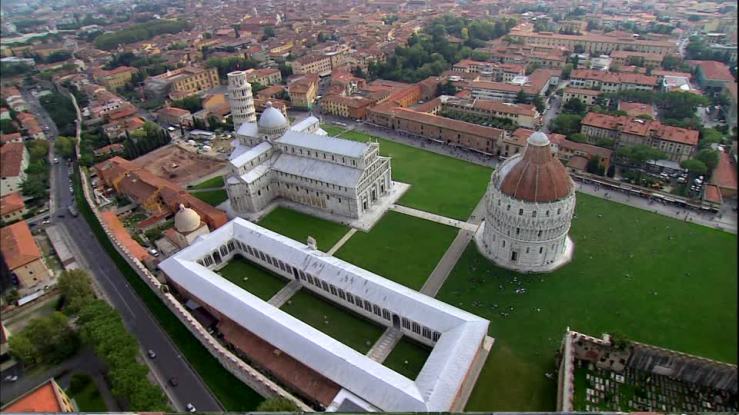
The Campo Santo, or Camposanto Monumentale (“monumental cemetery”), is an oblong Gothic cloister that, alongside Pisa’s cathedral, baptistry, and leaning tower, forms one of the finest architectural complexes in the world.
Aerial view of the Piazza dei Miracoli (Square of Miracles) in Pisa. The Campo Santo is the rectangular edifice with the open courtyard at the bottom.
Completed in 1464, it is filled with funerary monuments, many of which reuse ancient Roman sarcophagi, as well as a classical art collection. In addition, its long walls are covered with frescoes painted during the transitional period between the Middle Ages and the Renaissance. These were badly damaged during World War II, but some have been restored.
The fresco that shows Christ holding the universe, sometimes referred to by the title Theological Cosmography, was painted by a minor artist named Pietro di Puccio. In the second volume of his History of Mediaeval Christianity and Sacred Art in Italy, published in 1872 (well before the Allied bombing), Charles Isidore Hemans writes that the fresco
mystically sets forth the origin of the universe and its dependence upon the Almighty Creator. A colossal figure of Deity, with the aspect proper to the Second Person, supports an immense disk containing numerous concentric circles, with figures, emblems, inscriptions: first in order, the nine Angelic Hierarchies; next, the three Heavens—the first (empyreal) without sign or symbol, the second (crystalline) with the signs of the Zodiac, the third (the firmament) with the starry host; internal to these, a succession of other circles enclosing at the centre a miniature view of the three known continents. At the angles below are the two illustrious Doctors, severally representatives of the theological mind of ages, S. Augustine and S. Thomas Aquinas.
This geocentric model of the universe, with several earthly and (further out) heavenly spheres circling around a motionless earth, was conceived by Ptolemy, who based it on Aristotle. It was the dominant model during the classical, medieval, and Renaissance eras and can be found in the work of other visual artists.
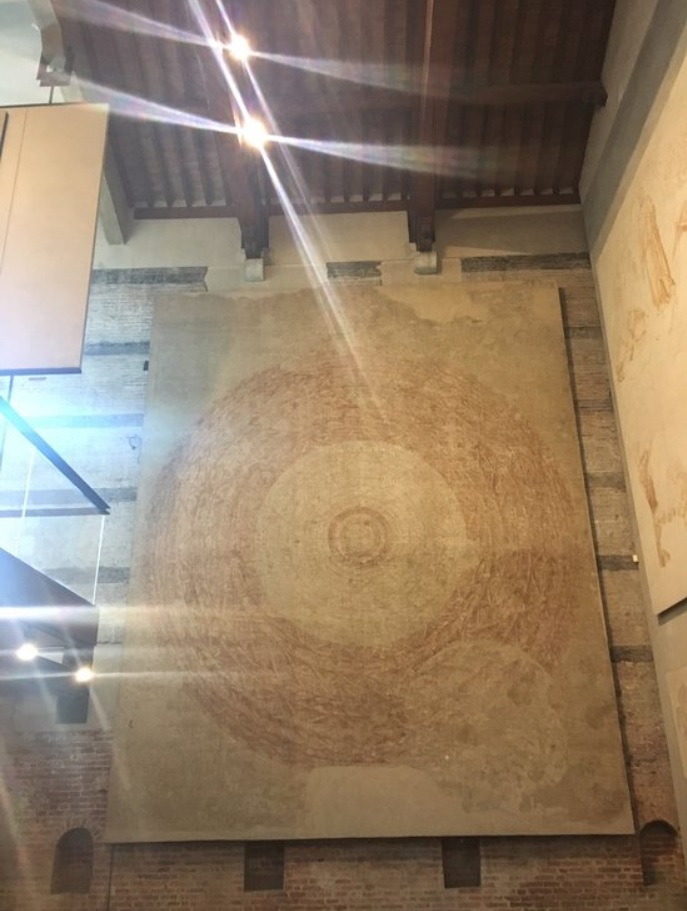
During an extensive restoration process, this and other frescoes were detached from the walls and placed on panels. This led to the discovery of sinopie, or preparatory drawings, underneath, which were also detached and are now kept on display in the Museo delle Sinopie, of special interest to art historians.
Sinopia (red underdrawing in plaster) of the Theological Cosmography fresco from the Campo Santo, relocated to the Sinopia Museum, also in the cathedral square.
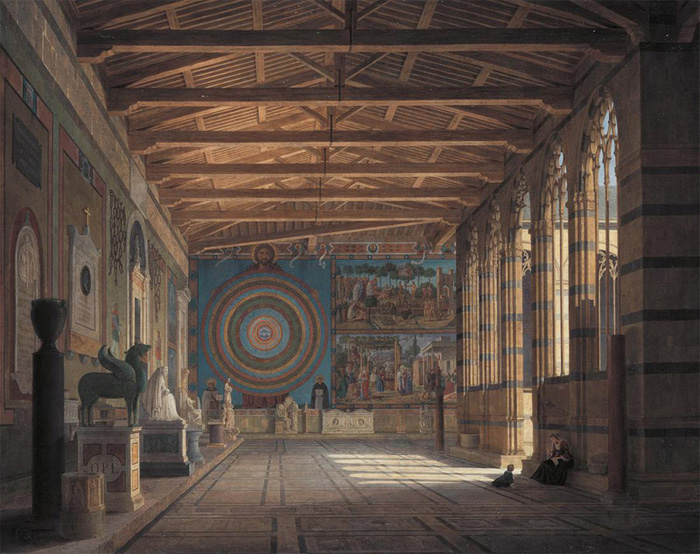
Puccio’s Theological Cosmography has since been returned to its original location in the north gallery of the Campo Santo—at the end of the left hallway in the panoramic shot below. The neoclassicist architect and painter Leon van Kleunze, on a visit to Italy in the mid-nineteenth century, painted a view of the Campo Santo’s north gallery in all its prewar glory.
Leo von Klenze (German, 1784–1864), The Camposanto in Pisa, 1858. Oil on canvas, 38 1/10 × 57 4/5 in. (97 × 147 cm). Neue Pinakothek, Munich.
This post belongs to the weekly series Artful Devotion. If you can’t view the music player in your email or RSS reader, try opening the post in your browser.
To view all the Revised Common Lectionary scripture readings for Proper 11, cycle C, click here.




.jpg)


 Art & Theology