The Promise Rests on Grace (Artful Devotion)

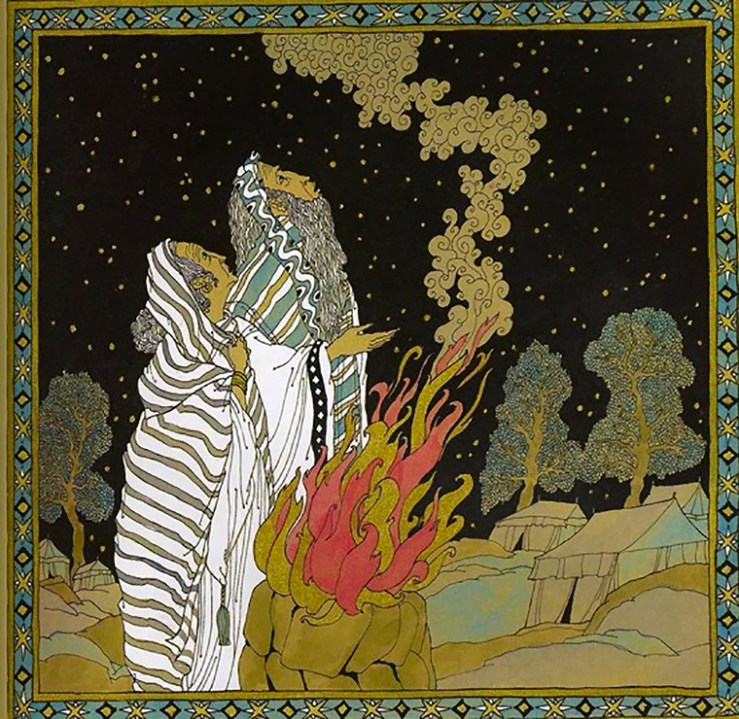
The Promise by Renata Fucikova
Renáta Fucíková (Czech, 1964–), The Promise, 1996. Illustration from the book Stories from the Old Testament, published in France and the Czech Republic.

For the promise to Abraham and his offspring that he would be heir of the world did not come through the law but through the righteousness of faith. For if it is the adherents of the law who are to be the heirs, faith is null and the promise is void. For the law brings wrath, but where there is no law there is no transgression.

That is why it depends on faith, in order that the promise may rest on grace and be guaranteed to all his offspring—not only to the adherent of the law but also to the one who shares the faith of Abraham, who is the father of us all, as it is written, “I have made you the father of many nations”—in the presence of the God in whom he believed, who gives life to the dead and calls into existence the things that do not exist. In hope he believed against hope, that he should become the father of many nations, as he had been told, “So shall your offspring be.” He did not weaken in faith when he considered his own body, which was as good as dead (since he was about a hundred years old), or when he considered the barrenness of Sarah’s womb. No unbelief made him waver concerning the promise of God, but he grew strong in his faith as he gave glory to God, fully convinced that God was able to do what he had promised. That is why his faith was “counted to him as righteousness.” But the words “it was counted to him” were not written for his sake alone, but for ours also. It will be counted to us who believe in him who raised from the dead Jesus our Lord, who was delivered up for our trespasses and raised for our justification.

—Romans 4:13–25 (cf. Genesis 17:1–7, 15–16)

+++

SONG: “The Story of Abraham” by Psallos, on Romans (2015)


This is one of twenty-three songs by Cody Curtis that comprise a complete musical setting of the book of Romans. See my review of the concept album here.


This post belongs to the weekly series Artful Devotion. If you can’t view the music player in your email or RSS reader, try opening the post in your browser.

To view all the Revised Common Lectionary scripture readings for the Second Sunday of Lent, cycle B, click here.

Joyful Lent (Artful Devotion)

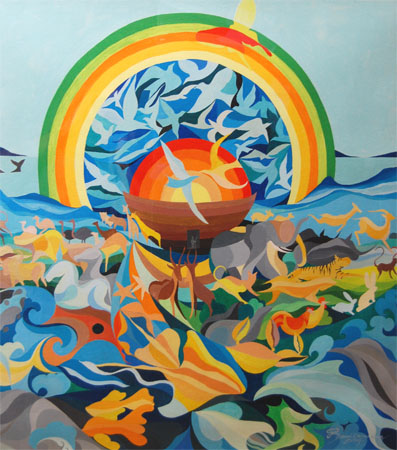
Genesis 9:13 by Sawai Chinnawong
Sawai Chinnawong (Thai, 1959–), Genesis 9:13, 2004. Acrylic on canvas, 27 × 27 in.

Then God said to Noah and to his sons with him, “Behold, I establish my covenant with you and your offspring after you, and with every living creature that is with you, the birds, the livestock, and every beast of the earth with you, as many as came out of the ark; it is for every beast of the earth. I establish my covenant with you, that never again shall all flesh be cut off by the waters of the flood, and never again shall there be a flood to destroy the earth.”

And God said, “This is the sign of the covenant that I make between me and you and every living creature that is with you, for all future generations: I have set my bow in the cloud, and it shall be a sign of the covenant between me and the earth. When I bring clouds over the earth and the bow is seen in the clouds, I will remember my covenant that is between me and you and every living creature of all flesh. And the waters shall never again become a flood to destroy all flesh. When the bow is in the clouds, I will see it and remember the everlasting covenant between God and every living creature of all flesh that is on the earth.”

God said to Noah, “This is the sign of the covenant that I have established between me and all flesh that is on the earth.”

—Genesis 9:8–17

+++

MUSIC: Keyboard Sonata in C Major (K. 159, L. 104) by Domenico Scarlatti | Arranged for banjo by Béla Fleck and for mandolin by Edgar Meyer | Performed by Béla Fleck and Chris Thile on Perpetual Motion (2001)

+++

This art and music may seem inappropriately light and bright for the first Sunday of Lent, a season that’s stereotypically thought of as gloomy and self-deprecating. But the Old Testament reading the Revised Commentary Lectionary assigns to this day is God’s covenant with Noah after the Flood, a passage filled with great hope.

Contrary to popular misconceptions, Lent does not mean forty days of beating yourself up. It literally means “springtime,” and it’s a time of renewal in preparation for Easter. Self-examination is a major component, yes, but so is grabbing hold of the divine promise—of God’s wondrous love and mercy.

In my church’s liturgy (and this is common across denominations), the confession of sin is always followed by words of assurance—a verse of scripture, spoken by the pastor, that reminds us of the pardon we receive through Christ. We are not left in the darkness of our failures; we are brought into the light, and given power to live as children of the light. Repentance is a joyous thing! That’s why the Constitution on the Sacred Liturgy, a Second Vatican Council document, refers to Lent as the “joyful season.” It’s joyful because God’s mercy is amazing.

After forty days on a dark boat, and then some, Noah, his family, and a whole bunch of animals come out to a renewed earth, and to a promise painted across the sky in bright colors that never again will all God’s creation be destroyed. Similarly, during Lent we choose to enter a period of darkness, taking stock of our sin. It may be a rocking journey, but it’s ultimately a period of regeneration, and when we arrive at Easter we receive, as confirmation of the new life that’s possible, the resurrected Christ. He’s there for us all along—we need not wait till Lent’s over to enter his forgiveness and to rise with him. But we also don’t want to skip over the necessary steps of first acknowledging the depth of our sin, and confessing it with a contrite heart.

+++

Excerpt from “The Agreement” by Henry Vaughan, from Silex Scintillans:

But while Time runs, and after it
Eternity, which never ends,
Quite through them both, still infinite,
Thy covenant by Christ extends;
No sins of frailty, nor of youth,
Can foil His merits, and Thy truth.

And this I hourly find, for Thou
Dost still renew, and purge and heal:
Thy care and love, which jointly flow,
New cordials, new cathartics deal.
But were I once cast off by Thee,
I know—my God!—this would not be.

+++

Tomorrow is Ash Wednesday, and I have a poem planned for publication here at Art & Theology. But I also wrote a short visual meditation for the Anglican Church in North America, which you can find at the bottom of their Lent website, https://giftoflent.org/. It’s on Ted Prescott’s mixed-media artwork All My Sins, which incorporates paper ash, the residue left over from the artist’s burning of a list of his personal sins.

All My Sins by Ted Prescott
Theodore Prescott (American, 1944–), All My Sins, 1996. Cherry, lead, hand-blown glass, paper ash, and silicon, 36.5 × 24.5 × 5 in.

This post belongs to the weekly series Artful Devotion. If you can’t view the music player in your email or RSS reader, try opening the post in your browser.

To view all the Revised Common Lectionary scripture readings for the First Sunday of Lent, cycle B, click here.

Light of Knowledge, Glory (Artful Devotion)

Golden Edges by Michael Cook
Michael Cook (British, 1966–), Golden Edges. Acrylic on handmade paper, 58 × 56 cm. For sale (click on image to contact artist).

Second Corinthians 4:3–6, two translations:

And even if our gospel is veiled, it is veiled to those who are perishing. In their case the god of this world has blinded the minds of the unbelievers, to keep them from seeing the light of the gospel of the glory of Christ, who is the image of God. For what we proclaim is not ourselves, but Jesus Christ as Lord, with ourselves as your servants for Jesus’ sake. For God, who said, “Let light shine out of darkness,” has shone in our hearts to give the light of the knowledge of the glory of God in the face of Jesus Christ. (ESV)

If our Message is obscure to anyone, it’s not because we’re holding back in any way. No, it’s because these other people are looking or going the wrong way and refuse to give it serious attention. All they have eyes for is the fashionable god of darkness. They think he can give them what they want, and that they won’t have to bother believing a Truth they can’t see. They’re stone-blind to the dayspring of brightness of the Message that shines with Christ, who gives us the best picture of God we’ll ever get. (The Message)

+++

SONG: “I Saw the Light” by Hank Williams | Performed by the Lower Lights, on The Lower Lights: A Hymn Revival, Volume 2 (2012)


This post belongs to the weekly series Artful Devotion. If you can’t view the music player in your email or RSS reader, try opening the post in your browser.

To view all the Revised Common Lectionary scripture readings for the Sixth Sunday of Epiphany (Transfiguration Sunday), cycle B, click here.

MUSIC VIDEO: “River” by Leon Bridges

A song of confession and cleansing, “River” is from the Grammy-nominated debut album Coming Home (2015) by retro-style soul singer Leon Bridges. The music video, set during the 2015 Baltimore race riots and filmed on location less than a year later, brings together three separate redemption narratives that culminate in a neighborhood baptism via rain and water hose.

The story lines are very allusive, giving a wide berth to viewer interpretations, but here’s what I see. Three different families: a father who has perpetrated some act of violence, fleeing the site of the crime to be with his infant son; a grieving mother and her preteen boy, who lost a family member to violence; and an overworked single mother struggling to make ends meet, whose daughter longs for a better life for them both. Outside these story lines are Bridges and Brittni Jessie, who meet in a motel room after a long car ride to lift up this plea on behalf of the hurting. Into all these situations, they trust, God will bring forgiveness, healing, and hope.

At the end of the video, Bridges too enters the shower of divine grace, lifting his head high in wonder, then bowing it in humility.

Been traveling these wide roads for so long
My heart’s been far from you
Ten thousand miles gone
Oh, I wanna come near and give you
Every part of me
But there’s blood on my hands
And my lips are unclean
In my darkness I remember
Mama’s words reoccur to me:
“Surrender to the good Lord
And he’ll wipe your slate clean”

Take me to your river
I wanna go
. . .

“The river in my song is a metaphor for being born again,” Bridges told Uncut. He elaborates on his Facebook page:

A river has historically been used in gospel music as symbolism for change and redemption. My goal was to write a song about my personal spiritual experience. It was written during a time of real depression in my life, and I recall sitting in my garage trying to write a song which reflected this struggle. I felt stuck working multiple jobs to support myself and my mother. I had little hope and couldn’t see a road out of my reality. The only thing I could cling to in the midst of all that was my faith in God and my only path towards baptism was by way of the river.

When thinking about how to best visually represent this universal battle, I reflected on the depiction of black communities in our media and particular experiences within my own life. This video showcases the unique struggle many black men and women face across this country. However, unlike the captured images which tend to represent only part of the story, I wanted to showcase that through all the injustice, there’s real hope in the world.

I want this video to be a message of light. I believe it has the power to change and heal those that are hurting.

The speaker of the song acknowledges the personal guilt that separates him from God: “I wanna come near . . . but there’s blood on my hands” and, referencing Isaiah 6:5, “my lips are unclean.” But he also acknowledges the One who alone has the power to wash away sin, and to him he surrenders.

The actor with blood on his shirt in the video is Genard “Shadow” Barr (I recognized him from the recent HBO documentary Baltimore Rising) with his real-life son, Jaylin. He’s a former gang member, now community activist, whom Baltimore Police commissioner (at the time) Kevin Davis reached out to after the riots to better understand the needs and frustrations of the black community. “I got a bullet hole in my head, Chief, and that will not happen to my children,” Barr said in one of their meetings. “I will die doing this”—that is, advocating for the betterment of the city, which, as another on the film said, is underserved and overpoliced.

When asked how cops can help diffuse tensions and build the trust of the people, Barr and others suggested as a starting point a flag football game—cops versus the residents of Penn North and Sandtown-Winchester. Billed as the “Unity Bowl,” the game took place on November 29, 2015, the eve of the first trial for Freddie Gray’s death, and helped both sides get to know each other in a different light.

Besides facilitating conversations between police and Baltimore’s black community, Barr also works as a peer advocate and referral specialist for Penn North Recovery Center, which provides intensive outpatient treatment for substance abuse.

I’m not sure whether the other actors in “River” have personal connections to Baltimore—do you know?

(Related posts: “‘Stephen Towns: A Migration’ exhibit”; “From my private collection: ‘Wailing Wall: Song for Quin’ by Steve Prince”)

This music video has received over 17.5 million views on YouTube and lots of mainstream playtime—a rare feat for new gospel songs. “River” is essentially an invitation: Are you ready to be washed? Then come to the river. Experience the new birth offered through Jesus Christ.

For a live performance of “River,” see this excerpt from Saturday Night Live’s December 4, 2015, episode:

For another original gospel song from the same album, check out “Shine.” And consider catching Bridges somewhere on his world tour this year.

Coming Home album cover

Click on the album cover to preview and purchase. [Note: This is an Amazon affiliate link, meaning that a percentage of purchases made through it will go to support this blog.]

Pass Me Not (Artful Devotion)

The Good Samaritan by Marko Rupnik
Fr. Marko Ivan Rupnik (Slovenian, 1954–), The Good Samaritan (detail), 2010. Mosaic. Church of Saint Eusebius (Chiesa parrocchiale di Sant’Eusebio), Cinisello Balsamo, Milan.

“He heals the brokenhearted, and binds up their wounds.” (Psalm 147:3)

+++

SONG: “Pass Me Not” | Words by Fanny J. Crosby, 1868 | Music by William H. Doane, 1870 | Performed by Joe and Nichole Kurtz on The Harp Family Hymnbook, Vol. II, 2017


This post belongs to the weekly series Artful Devotion. If you can’t view the music player in your email or RSS reader, try opening the post in your browser.

To view all the Revised Common Lectionary scripture readings for the Fifth Sunday of Epiphany, cycle B, click here.

Now I’ve Seen It All (Artful Devotion)

Simeon in the Temple by Rembrandt
Rembrandt van Rijn (Dutch, 1606–1669), Simeon in the Temple, 1669. Oil on canvas, 98.5 × 79.5 cm. Nationalmuseum, Stockholm, Sweden.

Candlemas, celebrated every year on February 2, commemorates the presentation of Jesus at the temple forty days after his birth, according to Jewish custom (Luke 2:22–40). While there, the Holy Family encountered Simeon, an elderly man, “righteous and devout,” who was “waiting for the consolation of Israel.” Though weak and tired with age, he was told by the Holy Spirit that he would not die before laying eyes on the messiah of his people, and he banked on that promise. When the Spirit led him to the temple that day, he beheld the baby Jesus and knew instantly that this was the One he had been waiting for—and not only him, but the whole world. He took the child in his arms and sang this canticle, known in church tradition as the “Nunc dimittis” (“Now you dismiss . . .”):

Lord, now you are letting your servant depart in peace,
according to your word;
for my eyes have seen your salvation
that you have prepared in the presence of all peoples,
a light for revelation to the Gentiles,
and for glory to your people Israel. (vv. 28–32)

+++

SONG: “Until My Dying Day Has Come” by Carl-Eric Tangen, from Incarnation Hymns (2008)


+++

Probably Rembrandt’s last painting, Simeon in the Temple was found unfinished on an easel in his studio when he died. It depicts this enlightening moment from Luke 2, in which Simeon recognizes the Christ and exults—quietly, gratefully—in his salvation. The woman in the shadows, thought to be a later addition by another’s hand, is probably the prophetess Anna, though some suppose her to be Mary.


This post belongs to the weekly series Artful Devotion. If you can’t view the music player in your email or RSS reader, try opening the post in your browser.

To view all the Revised Common Lectionary scripture readings for the feast of the Presentation of the Lord, cycle B, click here.

Torn-Down Kingdom (Artful Devotion)

Christ Exorcising the Evil Spirit by James Ensor
James Ensor (Belgian, 1860–1949), Christ Exorcising the Evil Spirit, 1921. Color lithograph from the portfolio Scènes de la vie du Christ (Scenes from the Life of Christ).

And immediately there was in their synagogue a man with an unclean spirit. And he cried out, “What have you to do with us, Jesus of Nazareth? Have you come to destroy us? I know who you are—the Holy One of God.” But Jesus rebuked him, saying, “Be silent, and come out of him!” And the unclean spirit, convulsing him and crying out with a loud voice, came out of him. And they were all amazed, so that they questioned among themselves, saying, “What is this? A new teaching with authority! He commands even the unclean spirits, and they obey him.” And at once his fame spread everywhere throughout all the surrounding region of Galilee.

—Mark 1:23–28

+++

SONG: “Satan, Your Kingdom Must Come Down” | Traditional, performed by Willie Nelson on Country Music (2010)

This spiritual was first recorded and released by Blind Joe Taggart in 1931. An alternative version, “Satan, We’re Gonna Tear Your Kingdom Down,” is #485 in the African American Heritage Hymnal.

+++

Haste to me, Lord, when this fool-heart of mine
Begins to gnaw itself with selfish craving;
Or, like a foul thing scarcely worth the saving,
Swoln up with wrath, desireth vengeance fine.
Haste, Lord, to help, when reason favours wrong;
Haste when thy soul, the high-born thing divine,
Is torn by passion’s raving, maniac throng.

Fair freshness of the God-breathed spirit air,
Pass through my soul, and make it strong to love;
Wither with gracious cold what demons dare
Shoot from my hell into my world above;
Let them drop down, like leaves the sun doth sear,
And flutter far into the inane and bare,
Leaving my middle-earth calm, wise, and clear.

—George MacDonald, from A Book of Strife in the Form of the Diary of an Old Soul (1880)


This post belongs to the weekly series Artful Devotion. If you can’t view the music player in your email or RSS reader, try opening the post in your browser.

To view all the Revised Common Lectionary scripture readings for the Fourth Sunday after Epiphany, cycle B, click here.

Let Jesus Lead You (Artful Devotion)

Promised Land by Maximino Cerezo Barredo
Mural by Maximino Cerezo Barredo (Spanish, 1932–)

“Follow me.” (Mark 1:17)

+++

SONG: “He’s a Mighty Good Leader” (Let Jesus Lead You) | Traditional, performed by Skip James, 1931

“Let Jesus Lead You” was recorded by numerous gospel quartets and bluesmen in the late 1920s and 1930s, the most influential rendition being Nehemiah “Skip” James’s, a pioneering slide guitarist and sometime preacher from Mississippi. Other versions I like, from later, include the Detroiters (1951), Marion Williams & the Stars of Faith (1962), the Morning Star Gospel Singers (1963), and Josh Harmony (2011).

+++

“There” by Robert B. Shaw

There where the lion dines on straw
and walks at ease with dogs and men,
and a boy’s idling fingers draw
the unfanged adder out of his den;
. . . . . . . . . . . . . . . . . . . . . . . . . . . . . . . . .
there is our home. Then lead us there.

(Read the full poem at poetryfoundation.org.)


This post belongs to the weekly series Artful Devotion. If you can’t view the music player in your email or RSS reader, try opening the post in your browser.

To view all the Revised Common Lectionary scripture readings for the Third Sunday after Epiphany, cycle B, click here.

Listening (Artful Devotion)

I'm Listening by Ginger Slonaker
Ginger Slonaker (American), I’m Listening, 2009. Mixed media on paper, 7 × 6 in.

. . . if he calls you, you shall say, “Speak, LORD, for your servant is listening.” . . . (1 Samuel 3:9)

+++

SONG: “Reverently, Quietly” | Words and music by Clara W. McMaster, 1959 | Arranged for solo piano and performed by Paul Cardall, on Primary Worship, 2005

+++

Lord, teach me to listen. The times are noisy and my ears are weary with the thousand raucous sounds which continuously assault them. Give me the spirit of the boy Samuel when he said to Thee, “Speak, for thy servant heareth.” Let me hear Thee speaking in my heart. Let me get used to the sound of Thy voice, that its tones may be familiar when the sounds of earth die away and the only sound will be the music of Thy speaking voice. Amen.

—A. W. Tozer, from The Pursuit of God


This post belongs to the weekly series Artful Devotion. If you can’t view the music player in your email or RSS reader, try opening the post in your browser.

To view all the Revised Common Lectionary scripture readings for the Second Sunday after Epiphany, cycle B, click here.

“And nations shall come to your light . . .” (Artful Devotion)

Adoration of the Christ Child (India, 17th c)
Adoration of the Christ Child, Mughal India, ca. 1630. Opaque watercolor and gold on paper, 15.6 × 11 cm. Freer Gallery of Art, Smithsonian Institution, Washington, DC.

This Saturday, January 6, marks Epiphany, a Christian feast celebrating the manifestation of God incarnate to the peoples of the world, encapsulated in the visit of the Magi to the newborn Christ. In the first lectionary reading I’ve excerpted, Isaiah speaks to Israel, rejoicing that God will one day cause his light of revelation to shine upon them, drawing the nations—a prophecy fulfilled at Christmas; in the second, Paul writes to the church at Ephesus about the glorious expansion of God’s family made possible through Christ, and the unity experienced therein across barriers of race, culture, geography, and so on:

And nations shall come to your light,
and kings to the brightness of your rising. . . .

Then you shall see and be radiant;
your heart shall thrill and exult,
because the abundance of the sea shall be turned to you,
the wealth of nations shall come to you. . . .
They shall bring gold and frankincense,
and shall bring good news, the praises of the LORD.

—Isaiah 60:3, 5–6

The mystery of Christ . . . was not made known to the sons of men in other generations as it has now been revealed. . . . This mystery is that the Gentiles are fellow heirs, members of the same body, and partakers of the promise in Christ Jesus through the gospel.

—Ephesians 3:4–5

+++

SONG: “Miladuka” (“Thy Nativity”) | Arabic Christmas hymn arranged by David Düsing | Performed by the Robert DeCormier Singers & Ensemble, feat. Sandra Arida, on Children Go Where I Send Thee: A Christmas Celebration Around the World (1996)

“Miladuka” is a Christmas troparion, or liturgical hymn, from the Byzantine church. Its English translation, from the CD liner notes, is as follows:

Thy Nativity, O Christ our God,
Hath given rise to the light of knowledge in the world.
For they that worshipped the stars did learn therefrom to worship thee,
O son of justice,
And to know from the east of the highest
Thou didst come.
O Lord, glory to thee.


This post belongs to the weekly series Artful Devotion. If you can’t view the music player in your email or RSS reader, try opening the post in your browser.

To view all the Revised Common Lectionary scripture readings for Epiphany, cycle B, click here.