Stations of the Cross at the SAAM

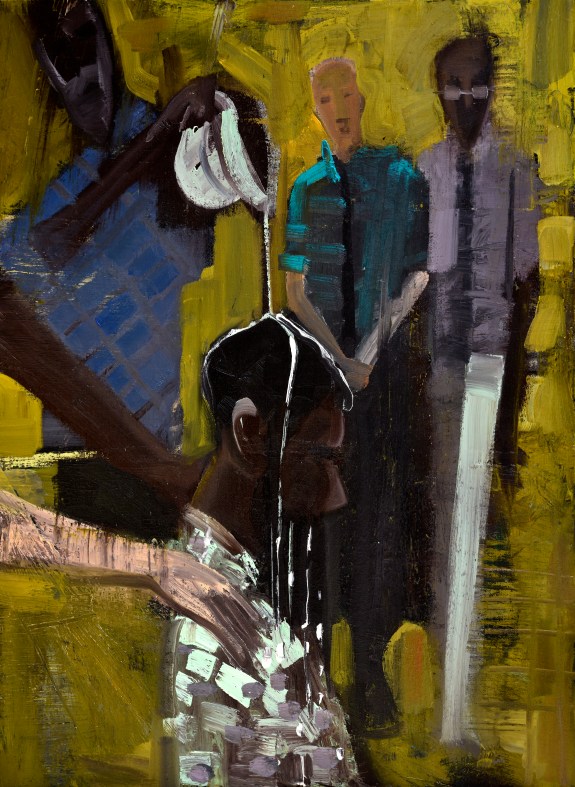
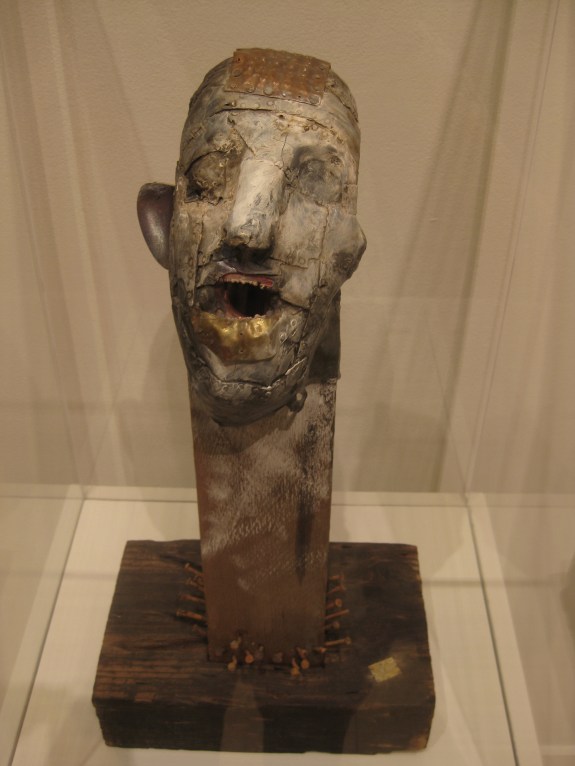
Welcome to the Stations of the Cross audio tour at the Smithsonian American Art Museum (SAAM), developed by Victoria Emily Jones at ArtandTheology.org.

SAAM Stations of the Cross 2018

Originating in the thirteenth century, the Stations of the Cross is a Christian devotional practice whereby participants immerse themselves in the story of Jesus Christ’s final sufferings by metaphorically journeying with him from his trial to his entombment. The road between is known as the Via Dolorosa (“Way of Sorrows”) or Via Crucis (“Way of the Cross”).

In this eighteen-stop tour we will walk this road with Jesus, recognizing along the way the many other paths of sorrow that were traveled in America’s history and that are still being traveled today. Migrant workers, soldiers, prisoners, victims of racial discrimination and violence, the poor and the homeless, the grieving, and the mentally ill are among the many people we will meet through these paintings, sculptures, and mixed-media works that bear witness to human suffering.

The American novelist and social critic James Baldwin said of Beauford Delaney, one of the artists on our tour, “The reality of his seeing caused me to begin to see.” That is my hope: that as we encounter these visual narratives of suffering from our nation’s past and present, we will begin to see. This tour obviously doesn’t cover all the oppressed groups in the US, but this is a starting point for further conversation, discovery, intercessory prayer, confession, and action.

My other hope is that we will be led to a deeper engagement with the biblical narrative—with Jesus’s way of sorrows and why he walked it, what it achieved.

Jesus began his public ministry by reading these words from an Isaiah scroll at his local synagogue at Nazareth:

The Spirit of the Lord is upon me,
because he has anointed me
to proclaim good news to the poor.
He has sent me to proclaim liberty to the captives
and recovering of sight to the blind,
to set at liberty those who are oppressed,
to proclaim the year of the Lord’s favor.

Then, as Luke 4:20–21 tells us, “he rolled up the scroll and gave it back to the attendant and sat down. And the eyes of all in the synagogue were fixed on him. And he began to say to them, ‘Today this Scripture has been fulfilled in your hearing.’” This was a very bold move: here, he is claiming to be the messianic servant of the Lord prophesied about in Isaiah 61, who would bring spiritual and, ultimately, material salvation to the world. But the cost of this salvation, the Hebrew prophet tells us, is suffering; the messianic servant must suffer and die. “He was pierced for our transgressions; he was crushed for our iniquities; upon him was the chastisement that brought us peace, and with his wounds we are healed” (Isaiah 53:5).

Below you will find eighteen audio tracks of art commentary available for free streaming or download, as well as transcripts and artwork locations. If you are taking this tour virtually, you can click on any of the featured images to jump to that object’s museum page, where you can zoom in on details.

As you walk this Way of Sorrows, beholding the sufferings both of Christ and of those he came to redeem, may these artists’ seeing help you to see.   Continue reading “Stations of the Cross at the SAAM”

Lent devotionals with arts component

Next Wednesday, February 14, is the first day of Lent—a season of focused prayer and simple living. During this time I will continue publishing weekly “Artful Devotion” posts based on scripture readings from the Revised Common Lectionary, plus I have a few other posts planned. I’m especially excited about what I’ll be publishing this Sunday—the fruits of many months of labor; I hope you’ll check back!

If you are looking for daily devotional content during Lent that incorporates the arts, check out some of these resources. See also last year’s list: https://artandtheology.org/2017/03/07/art-resources-for-lent/.

“The Lent Project V” by Biola University: From Ash Wednesday through the first week of Easter, Biola University’s Center for Christianity, Culture, and the Arts will be publishing daily “aesthetic meditations” on Christ’s life, death, and resurrection. The scripture texts, art images, music, and poetry are curated by a CCCA team, and staff are invited to contribute written reflections that respond to them. “The mood of Lent can be beautifully captured through the arts, which are often cathartic expressions of longing, suffering, loneliness, love, death and rebirth,” says university president Barry H. Corey. “Art is a great chronicler both of the drama of human history and the aches of the human heart.” Here are some artworks Biola has featured in previous years; click on each to experience the full devotion:

The Bread by Michael Borremans
Michaël Borremans (Belgian, 1963–), The Bread, 2012. Oil on canvas, 29 × 23 cm.
Lamb of God by Arcabas
Arcabas (French, 1926–), Lamb of God. Stained glass, Notre-Dame des Neiges Church, Alpe d’Huez, France.
Deposition and Christ Falling on the Way to Calvary (Palestinian Museum)
The Deposition & Christ Falling on the Way to Calvary, 2014. Collage, from “The Presence of the Holy See” project at the Palestinian Museum. Photographs by Alexandra Boulat (French, 1962–2007); paintings by Raphael.
Jesus on the Shore by Maja Lisa Engelhardt
Maja Lisa Engelhardt (Danish, 1956–), Jesus on the Shore. Altarpiece, Turup Church, Assens, Denmark.

Lenten Readings 2018 by Kevin Greene: For the seventh year in a row, Kevin Greene, a teaching elder at West End Presbyterian Church in Richmond, Virginia, is publishing short daily devotions, each one containing an art image and a piece of music. (Last year I learned of lots of new artists through him!) For the prayer component he has used various resources in the past—the Revised Common Lectionary, sermons on the cross of Christ across the centuries, Wesley’s Scripture Hymns, and excerpts from the early church fathers—but this year he will be using collects (pronounced COL-lects) from the Book of Common Prayer. Unfamiliar with the term? Click here to read how a collect works.   Continue reading “Lent devotionals with arts component”

Light of Knowledge, Glory (Artful Devotion)

Golden Edges by Michael Cook
Michael Cook (British, 1966–), Golden Edges. Acrylic on handmade paper, 58 × 56 cm. For sale (click on image to contact artist).

Second Corinthians 4:3–6, two translations:

And even if our gospel is veiled, it is veiled to those who are perishing. In their case the god of this world has blinded the minds of the unbelievers, to keep them from seeing the light of the gospel of the glory of Christ, who is the image of God. For what we proclaim is not ourselves, but Jesus Christ as Lord, with ourselves as your servants for Jesus’ sake. For God, who said, “Let light shine out of darkness,” has shone in our hearts to give the light of the knowledge of the glory of God in the face of Jesus Christ. (ESV)

If our Message is obscure to anyone, it’s not because we’re holding back in any way. No, it’s because these other people are looking or going the wrong way and refuse to give it serious attention. All they have eyes for is the fashionable god of darkness. They think he can give them what they want, and that they won’t have to bother believing a Truth they can’t see. They’re stone-blind to the dayspring of brightness of the Message that shines with Christ, who gives us the best picture of God we’ll ever get. (The Message)

+++

SONG: “I Saw the Light” by Hank Williams | Performed by the Lower Lights, on The Lower Lights: A Hymn Revival, Volume 2 (2012)


This post belongs to the weekly series Artful Devotion. If you can’t view the music player in your email or RSS reader, try opening the post in your browser.

To view all the Revised Common Lectionary scripture readings for the Sixth Sunday of Epiphany (Transfiguration Sunday), cycle B, click here.

MUSIC VIDEO: “River” by Leon Bridges

A song of confession and cleansing, “River” is from the Grammy-nominated debut album Coming Home (2015) by retro-style soul singer Leon Bridges. The music video, set during the 2015 Baltimore race riots and filmed on location less than a year later, brings together three separate redemption narratives that culminate in a neighborhood baptism via rain and water hose.

The story lines are very allusive, giving a wide berth to viewer interpretations, but here’s what I see. Three different families: a father who has perpetrated some act of violence, fleeing the site of the crime to be with his infant son; a grieving mother and her preteen boy, who lost a family member to violence; and an overworked single mother struggling to make ends meet, whose daughter longs for a better life for them both. Outside these story lines are Bridges and Brittni Jessie, who meet in a motel room after a long car ride to lift up this plea on behalf of the hurting. Into all these situations, they trust, God will bring forgiveness, healing, and hope.

At the end of the video, Bridges too enters the shower of divine grace, lifting his head high in wonder, then bowing it in humility.

Been traveling these wide roads for so long
My heart’s been far from you
Ten thousand miles gone
Oh, I wanna come near and give you
Every part of me
But there’s blood on my hands
And my lips are unclean
In my darkness I remember
Mama’s words reoccur to me:
“Surrender to the good Lord
And he’ll wipe your slate clean”

Take me to your river
I wanna go
. . .

“The river in my song is a metaphor for being born again,” Bridges told Uncut. He elaborates on his Facebook page:

A river has historically been used in gospel music as symbolism for change and redemption. My goal was to write a song about my personal spiritual experience. It was written during a time of real depression in my life, and I recall sitting in my garage trying to write a song which reflected this struggle. I felt stuck working multiple jobs to support myself and my mother. I had little hope and couldn’t see a road out of my reality. The only thing I could cling to in the midst of all that was my faith in God and my only path towards baptism was by way of the river.

When thinking about how to best visually represent this universal battle, I reflected on the depiction of black communities in our media and particular experiences within my own life. This video showcases the unique struggle many black men and women face across this country. However, unlike the captured images which tend to represent only part of the story, I wanted to showcase that through all the injustice, there’s real hope in the world.

I want this video to be a message of light. I believe it has the power to change and heal those that are hurting.

The speaker of the song acknowledges the personal guilt that separates him from God: “I wanna come near . . . but there’s blood on my hands” and, referencing Isaiah 6:5, “my lips are unclean.” But he also acknowledges the One who alone has the power to wash away sin, and to him he surrenders.

The actor with blood on his shirt in the video is Genard “Shadow” Barr (I recognized him from the recent HBO documentary Baltimore Rising) with his real-life son, Jaylin. He’s a former gang member, now community activist, whom Baltimore Police commissioner (at the time) Kevin Davis reached out to after the riots to better understand the needs and frustrations of the black community. “I got a bullet hole in my head, Chief, and that will not happen to my children,” Barr said in one of their meetings. “I will die doing this”—that is, advocating for the betterment of the city, which, as another on the film said, is underserved and overpoliced.

When asked how cops can help diffuse tensions and build the trust of the people, Barr and others suggested as a starting point a flag football game—cops versus the residents of Penn North and Sandtown-Winchester. Billed as the “Unity Bowl,” the game took place on November 29, 2015, the eve of the first trial for Freddie Gray’s death, and helped both sides get to know each other in a different light.

Besides facilitating conversations between police and Baltimore’s black community, Barr also works as a peer advocate and referral specialist for Penn North Recovery Center, which provides intensive outpatient treatment for substance abuse.

I’m not sure whether the other actors in “River” have personal connections to Baltimore—do you know?

(Related posts: “‘Stephen Towns: A Migration’ exhibit”; “From my private collection: ‘Wailing Wall: Song for Quin’ by Steve Prince”)

This music video has received over 17.5 million views on YouTube and lots of mainstream playtime—a rare feat for new gospel songs. “River” is essentially an invitation: Are you ready to be washed? Then come to the river. Experience the new birth offered through Jesus Christ.

For a live performance of “River,” see this excerpt from Saturday Night Live’s December 4, 2015, episode:

For another original gospel song from the same album, check out “Shine.” And consider catching Bridges somewhere on his world tour this year.

Coming Home album cover

Click on the album cover to preview and purchase. [Note: This is an Amazon affiliate link, meaning that a percentage of purchases made through it will go to support this blog.]

Pass Me Not (Artful Devotion)

The Good Samaritan by Marko Rupnik
Fr. Marko Ivan Rupnik (Slovenian, 1954–), The Good Samaritan (detail), 2010. Mosaic. Church of Saint Eusebius (Chiesa parrocchiale di Sant’Eusebio), Cinisello Balsamo, Milan.

“He heals the brokenhearted, and binds up their wounds.” (Psalm 147:3)

+++

SONG: “Pass Me Not” | Words by Fanny J. Crosby, 1868 | Music by William H. Doane, 1870 | Performed by Joe and Nichole Kurtz on The Harp Family Hymnbook, Vol. II, 2017


This post belongs to the weekly series Artful Devotion. If you can’t view the music player in your email or RSS reader, try opening the post in your browser.

To view all the Revised Common Lectionary scripture readings for the Fifth Sunday of Epiphany, cycle B, click here.

Now I’ve Seen It All (Artful Devotion)

Simeon in the Temple by Rembrandt
Rembrandt van Rijn (Dutch, 1606–1669), Simeon in the Temple, 1669. Oil on canvas, 98.5 × 79.5 cm. Nationalmuseum, Stockholm, Sweden.

Candlemas, celebrated every year on February 2, commemorates the presentation of Jesus at the temple forty days after his birth, according to Jewish custom (Luke 2:22–40). While there, the Holy Family encountered Simeon, an elderly man, “righteous and devout,” who was “waiting for the consolation of Israel.” Though weak and tired with age, he was told by the Holy Spirit that he would not die before laying eyes on the messiah of his people, and he banked on that promise. When the Spirit led him to the temple that day, he beheld the baby Jesus and knew instantly that this was the One he had been waiting for—and not only him, but the whole world. He took the child in his arms and sang this canticle, known in church tradition as the “Nunc dimittis” (“Now you dismiss . . .”):

Lord, now you are letting your servant depart in peace,
according to your word;
for my eyes have seen your salvation
that you have prepared in the presence of all peoples,
a light for revelation to the Gentiles,
and for glory to your people Israel. (vv. 28–32)

+++

SONG: “Until My Dying Day Has Come” by Carl-Eric Tangen, from Incarnation Hymns (2008)


+++

Probably Rembrandt’s last painting, Simeon in the Temple was found unfinished on an easel in his studio when he died. It depicts this enlightening moment from Luke 2, in which Simeon recognizes the Christ and exults—quietly, gratefully—in his salvation. The woman in the shadows, thought to be a later addition by another’s hand, is probably the prophetess Anna, though some suppose her to be Mary.


This post belongs to the weekly series Artful Devotion. If you can’t view the music player in your email or RSS reader, try opening the post in your browser.

To view all the Revised Common Lectionary scripture readings for the feast of the Presentation of the Lord, cycle B, click here.

Roundup: RIP Edwin Hawkins; why Christians should read poetry (and who to read); new Reconciliation Window; global song in white churches

Grammy-winning gospel pioneer Edwin Hawkins dies at 74: African American gospel musician, pianist, choir master, composer, and arranger Edwin Hawkins passed away on January 15. He’s best known for his 1967 R&B arrangement of the eighteenth-century hymn “Oh Happy Day,” which became an unexpected international hit and Grammy winner and is now a gospel standard. [HT: Global Christian Worship]

“Oh Happy Day” was one of eight arrangements Hawkins put together for his Northern California State Youth Choir, made up of forty-six singers ages 17 to 25, to record, planning to sell the album to finance a trip to a church youth conference in Washington, DC. They recorded the songs live at Hawkins’s church, the Ephesian Church of God in Christ in Berkeley, California, on a primitive two-track recorder. After hearing the self-published record, Buddah Records signed the group, helping to launch “Oh Happy Day” to the top of the pop charts in the US, UK, France, Germany, and the Netherlands and bringing attention to lead vocalist Dorothy Combs Morrison, 22. At the time, denomination officials did not approve of Christian singers crossing over into secular markets, and they refused to let Hawkins use the name of the choir on the Buddah reissue—hence the “Edwin Hawkins Singers” were born.

Check out the Christianity Today article “How ‘Oh Happy Day’ Gave Gospel a New Beat,” and this clip of the show-stopping performance of the song in the movie Sister Act 2, featuring a young Ryan Toby.

+++

“Ten poets every pastor should know” by Kolby Kerr (+ Part 2): “Preachers need poetry if for no other reason than to be reminded of the palpable weight of language,” writes Kolby Kerr for LeaderWorks, whose vision is “to provide the tools, training, and support to strengthen the church and its leaders to fulfill their God-given mission.” I love this ten-poet “mixtape” Kerr has put together as an entry point for those who have told him they want to “get into poetry.” An ordained minister with a BA in English and an MFA in creative writing, he offers a wise disclaimer: “I point you toward these poets so that you would read them, not strip mine their work for a quick sermon illustration. Before any of this shows up in your preaching, heed Thomas Cranmer: read, mark, learn, and inwardly digest.” [HT: David Taylor]

I recently wrote about one of Kerr’s recommendations, Richard Wilbur, here.

+++

“The Splash of Words: Believing in Poetry” by Mark Oakley: “Poetry is what we reach for when we are falling in love, when we are grieving and when we search the great mysteries. It’s easy to think the language of faith is in creeds, sermons and certainties, but Mark Oakley says that it is poetry that is the person of faith’s native language. In this talk he will invite us on an adventure into poetry’s power to startle, challenge and reframe our vision: like throwing a pebble into water, the words of a poem cause a splash whose ripples can, if we let them, transform the way we see the world, ourselves, and God.”

I mentioned Mark Oakley in a previous roundup. This lecture, given at St. Paul’s Cathedral in London in November 2016, is based on Oakley’s latest book The Splash of Words, which he says he wrote as a way of celebrating the truth that God is in this world. The first half of the video comprises his talk; the second half, Q&A. I was so enthralled by what he had to say that I immediately bought a copy of the book. It contains a twenty-two-page introduction on the value of poetry, but its bulk consists of twenty-nine poems, carefully selected, with commentary. Love it!

+++

New stained-glass window by Thomas Denny: My friend Paul Neeley tipped me off to this new Reconciliation Window by contemporary stained-glass artist Tom Denny, whose distinctive style, characterized by blazing color, is achieved by acid etching and silver staining. Installed at St. John’s Church in Tralee, County Kerry, Ireland, in October 2017, the window depicts, in its central light, the Return of the Prodigal Son. The right panel shows Jesus reading from the book of Isaiah, and the left panel shows John the Baptist, the church’s patron saint. Throughout are names and vignettes from Traelee’s history and landscape. Bloggers Finola Finlay and Robert Harris have just visited St. John’s and have taken many beautiful detail shots of the window; have a look! For more on Denny, see the recently published book Glory, Azure and Gold: The Stained-Glass Windows of Thomas Denny or the article “Walking Man: The Art of Thomas Denny” from issue 86 of Image journal.

Reconciliation Window by Thomas Denny
Thomas Denny (British, 1956–), Reconciliation Window, 2017. Stained glass, 5 × 3 m. St. John’s Church, Tralee, County Kerry, Ireland.

+++

“Appropriation or Activism? Reflections on ‘Global Song’” by Marissa Glynias Moore: This article was posted this week in the Multicultural Worship Leaders Network Facebook group I’m a part of, addressing a question I’ve pondered a lot. A doctoral candidate in ethnomusicology at Yale University, Moore is wrapping up her dissertation on the use of “global songs” in the worship services of white, North American mainline Protestant congregations. She recounts her initial skepticism:

Within my first weeks at Battell [the University Church in Yale], I began to notice a shift in congregational repertoire compared to that of my college church. We rarely sang the hymns that had become dear to me; instead, we were more likely to be singing an Alleluia from Peru or a South African anti-apartheid “freedom song.” While I was curious about this unfamiliar genre of congregational music, the practice itself made me decidedly uncomfortable as I looked around the space: why were we, a bunch of predominantly white American college and graduate students, singing world music? Did we have the right to sing this music? Hadn’t my training as an ethnomusicologist prepared me to vehemently critique such a practice as a manifestation of appropriation?

But as her research developed she has been led to see that singing global song can actually be a gesture of hospitality and solidarity. (Update, 9/4/18: Listen to Moore on episode 24 of Sarah Bereza’s Music and the Church podcast, “Global Song and the Universal Church.”)

Torn-Down Kingdom (Artful Devotion)

Christ Exorcising the Evil Spirit by James Ensor
James Ensor (Belgian, 1860–1949), Christ Exorcising the Evil Spirit, 1921. Color lithograph from the portfolio Scènes de la vie du Christ (Scenes from the Life of Christ).

And immediately there was in their synagogue a man with an unclean spirit. And he cried out, “What have you to do with us, Jesus of Nazareth? Have you come to destroy us? I know who you are—the Holy One of God.” But Jesus rebuked him, saying, “Be silent, and come out of him!” And the unclean spirit, convulsing him and crying out with a loud voice, came out of him. And they were all amazed, so that they questioned among themselves, saying, “What is this? A new teaching with authority! He commands even the unclean spirits, and they obey him.” And at once his fame spread everywhere throughout all the surrounding region of Galilee.

—Mark 1:23–28

+++

SONG: “Satan, Your Kingdom Must Come Down” | Traditional, performed by Willie Nelson on Country Music (2010)

This spiritual was first recorded and released by Blind Joe Taggart in 1931. An alternative version, “Satan, We’re Gonna Tear Your Kingdom Down,” is #485 in the African American Heritage Hymnal.

+++

Haste to me, Lord, when this fool-heart of mine
Begins to gnaw itself with selfish craving;
Or, like a foul thing scarcely worth the saving,
Swoln up with wrath, desireth vengeance fine.
Haste, Lord, to help, when reason favours wrong;
Haste when thy soul, the high-born thing divine,
Is torn by passion’s raving, maniac throng.

Fair freshness of the God-breathed spirit air,
Pass through my soul, and make it strong to love;
Wither with gracious cold what demons dare
Shoot from my hell into my world above;
Let them drop down, like leaves the sun doth sear,
And flutter far into the inane and bare,
Leaving my middle-earth calm, wise, and clear.

—George MacDonald, from A Book of Strife in the Form of the Diary of an Old Soul (1880)


This post belongs to the weekly series Artful Devotion. If you can’t view the music player in your email or RSS reader, try opening the post in your browser.

To view all the Revised Common Lectionary scripture readings for the Fourth Sunday after Epiphany, cycle B, click here.

Birth and death in Lavinia Fontana’s Holy Family painting

Renaissance artists often employed foreshadowing as a theological device in their paintings of Christ’s infancy to remind viewers that Jesus came not just to live a perfect life but to die an atoning death on behalf of sinners. Over all the joy and celebration of the Nativity looms the dark cloud of Crucifixion.

Holy Family with Saints Margaret and Francis by Lavinia Fontana (1552–1614)—one of the first professional female artists to achieve international fame—is one such work that’s embedded with signs of future death: a sarcophagus-like crib resting on an altar-like slab; Mary’s elevation of the body of Christ in a manner that recalls the priest’s raising of the host during the Eucharist; Francis’s cradling of a crucifix in his left elbow pit; and a curtain opening into darkness.

A year earlier, Fontana’s firstborn child died, so her bereavement may have partially inspired the painting.

Holy Family with Saints by Lavinia Fontana
Lavinia Fontana (Italian, 1552–1614), Holy Family with Saints Margaret and Francis, 1578. Oil on canvas, 127 × 104.1 cm (50 × 41 in.). Davis Museum, Wellesley College, Wellesley, Massachusetts.

[ZOOM IN]

The following commentary by Margaret A. Samu is taken from the 2001 exhibition catalog Divine Mirrors: The Virgin Mary in the Visual Arts (pp. 197–98):

In her Holy Family with Saints, Lavinia Fontana presents the Madonna in an intimate domestic scene. Mary tenderly places the infant Christ in a cradle as Joseph stands behind her; opposite them, Saints Margaret and Francis bow their heads in worship. At first glance, the painting appears to celebrate both Christ’s divine birth and the human joy of motherhood, yet its iconographical elements speak also of Christ’s death.

Fontana is widely considered to be the first professional woman artist, as she received numerous commissions for portraits and large-scale religious paintings and actually supported her family by her work. She painted the Holy Family just as her career was beginning to flourish. As an assertion of her arrival as an artist, the painting prominently bears her signature and the date: LAVINIA FONTANA DE ZAPPIS FACIEBAT MDLXXVIII. This signature not only allows us to date the painting with ease but also reveals something of the confidence of this artist, who signs her work like a master so early in her career. Unknown to Italian scholars before the 1990s, this painting has gained prominence in two recent exhibitions.

Like other artists of her period, Fontana responds to the artistic decrees of the Counter-Reformation by turning away from the excesses of the Mannerist style in which she had been trained. Instead, she uses linear perspective and foreshortening to create a realistic sense of spatial recession that clearly defines the setting. In addition, she gives her figures the modest dress and pious decorum that are appropriate to the painting’s religious subject matter. By creating a balanced, nearly symmetrical composition with strong upward diagonals, she emphasizes the centrality of Christ to the devotional image. The linking of her figures by gazes and graceful gestures shows that, like other Bolognese artists, she was influenced by the work of the High Renaissance artist Correggio. In order to succeed as a woman artist in a male-dominated art world, Fontana had to adhere scrupulously to the newly defined doctrines of the Church that arose out of the 1545–1562 Ecumenical Council of Trent.

The artistic verisimilitude of the painting would have made its iconography all the easier for contemporary viewers to read. Saint Margaret is recognizable by her attribute, the dragon that accompanies her. According to legend, she became the patron saint of women in childbirth after using her cross to deliver herself unharmed from the belly of the dragon that had swallowed her as a test of her Christian faith; she then asked women to call upon her for the safe delivery of their children. Bathed in a beatific light, Mary and Saint Margaret are fully absorbed in the present moment, worshipping and caring for the child who raises his plump hand in a babyish sign of blessing. Standing in shadowy gloom, the male saints appear unaware of the scene of maternal bliss before them. Somberly contemplating the crucifix, they are occupied not with the present, the infant Christ, but with his coming death on the cross. To emphasize the point, Saint Francis reveals the stigmata on his hands, miraculous signs of his communion with Christ’s suffering.

Yet the light and dark areas of the painting do not create an absolute division between present and future concerns. Saint Francis is also associated with Christ’s birth: credited with creating the first Nativity scene in an Italian grotto in the thirteenth century, he cradles the tiny crucifix in his arm like a mother holding a child. Mary, on the other hand, does not cradle the child near her but places him in a sarcophagus-like crib on a sacrificial altar table. She lifts his body like a priest raising the Host—the transubstantiated body of Christ—in the celebration of the Holy Eucharist.

Fontana’s inextricable merging of these signs of the birth, death, and resurrection of Christ may reflect her contemplation of the recent birth and subsequent death of her own first-born child in the year before she painted the Holy Family. As she depicts this theme of great personal significance, Fontana also establishes a connection between the divine and earthly planes: a holy subject takes on the real, everyday quality of a domestic scene, while an everyday scene of motherhood is lifted to a sacred level.

Let Jesus Lead You (Artful Devotion)

Promised Land by Maximino Cerezo Barredo
Mural by Maximino Cerezo Barredo (Spanish, 1932–)

“Follow me.” (Mark 1:17)

+++

SONG: “He’s a Mighty Good Leader” (Let Jesus Lead You) | Traditional, performed by Skip James, 1931

“Let Jesus Lead You” was recorded by numerous gospel quartets and bluesmen in the late 1920s and 1930s, the most influential rendition being Nehemiah “Skip” James’s, a pioneering slide guitarist and sometime preacher from Mississippi. Other versions I like, from later, include the Detroiters (1951), Marion Williams & the Stars of Faith (1962), the Morning Star Gospel Singers (1963), and Josh Harmony (2011).

+++

“There” by Robert B. Shaw

There where the lion dines on straw
and walks at ease with dogs and men,
and a boy’s idling fingers draw
the unfanged adder out of his den;
. . . . . . . . . . . . . . . . . . . . . . . . . . . . . . . . .
there is our home. Then lead us there.

(Read the full poem at poetryfoundation.org.)


This post belongs to the weekly series Artful Devotion. If you can’t view the music player in your email or RSS reader, try opening the post in your browser.

To view all the Revised Common Lectionary scripture readings for the Third Sunday after Epiphany, cycle B, click here.