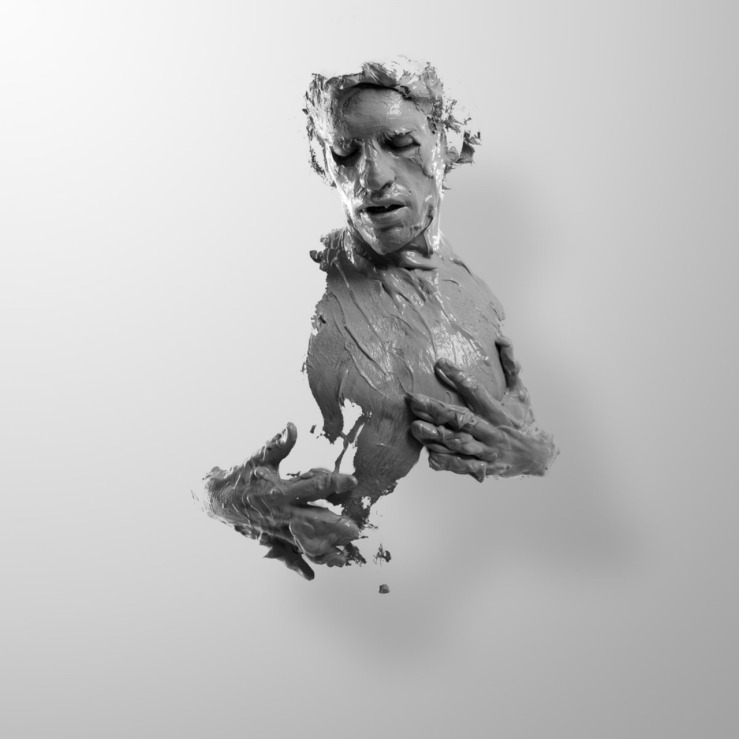
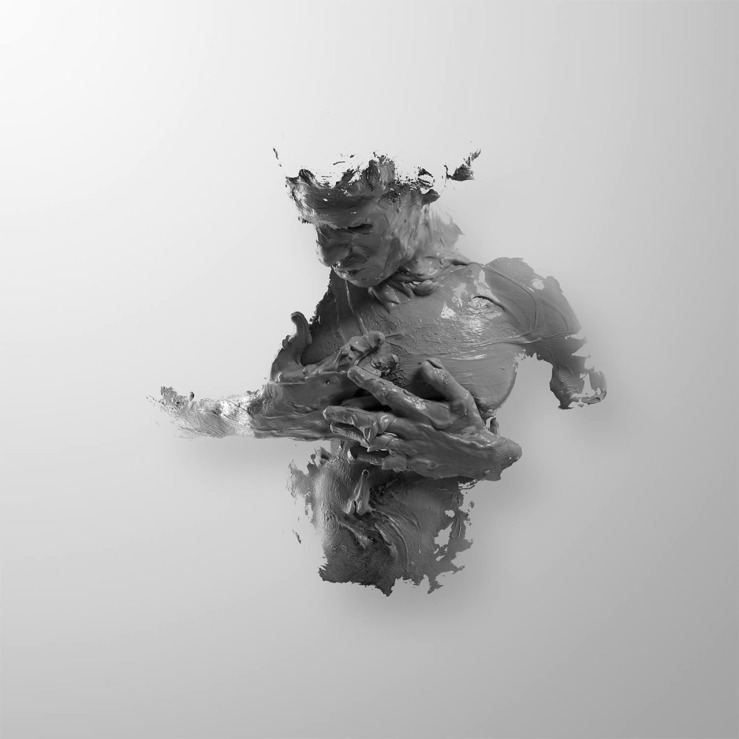
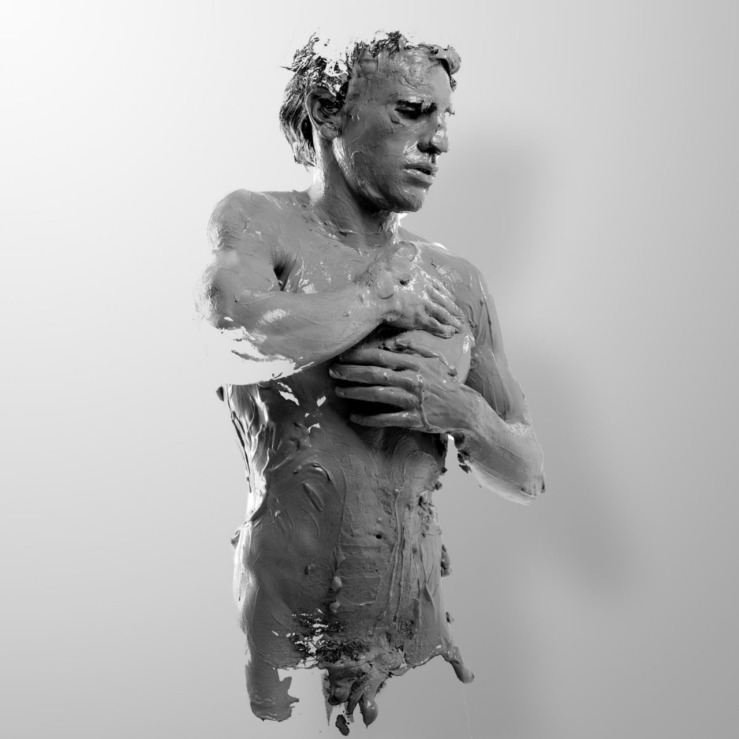
Alejandro Maestre Gasteazi (Spanish, 1979–), Untitled, 2010. Printed ink on cotton paper, 40 × 40 cm. Edition of 20.Alejandro Maestre Gasteazi (Spanish, 1979–), Untitled, 2010. Printed ink on cotton paper, 40 × 40 cm. Edition of 20.Alejandro Maestre Gasteazi (Spanish, 1979–), Untitled, 2010. Printed ink on cotton paper, 40 × 40 cm. Edition of 20.
The word that came to Jeremiah from the Lord: “Arise, and go down to the potter’s house, and there I will let you hear my words.” So I went down to the potter’s house, and there he was working at his wheel. And the vessel he was making of clay was spoiled in the potter’s hand, and he reworked it into another vessel, as it seemed good to the potter to do.
Then the word of the Lord came to me: “O house of Israel, can I not do with you as this potter has done? declares the Lord. Behold, like the clay in the potter’s hand, so are you in my hand, O house of Israel.”
—Jeremiah 18:1–6
+++
SONG: “Have Thine Own Way, Lord” | Words by Adelaide A. Pollard, 1906 | Music by George C. Stebbins, 1907 | Performed by Johnny Cash, 1973, and released on Bootleg, Vol. I: Personal File, 2006
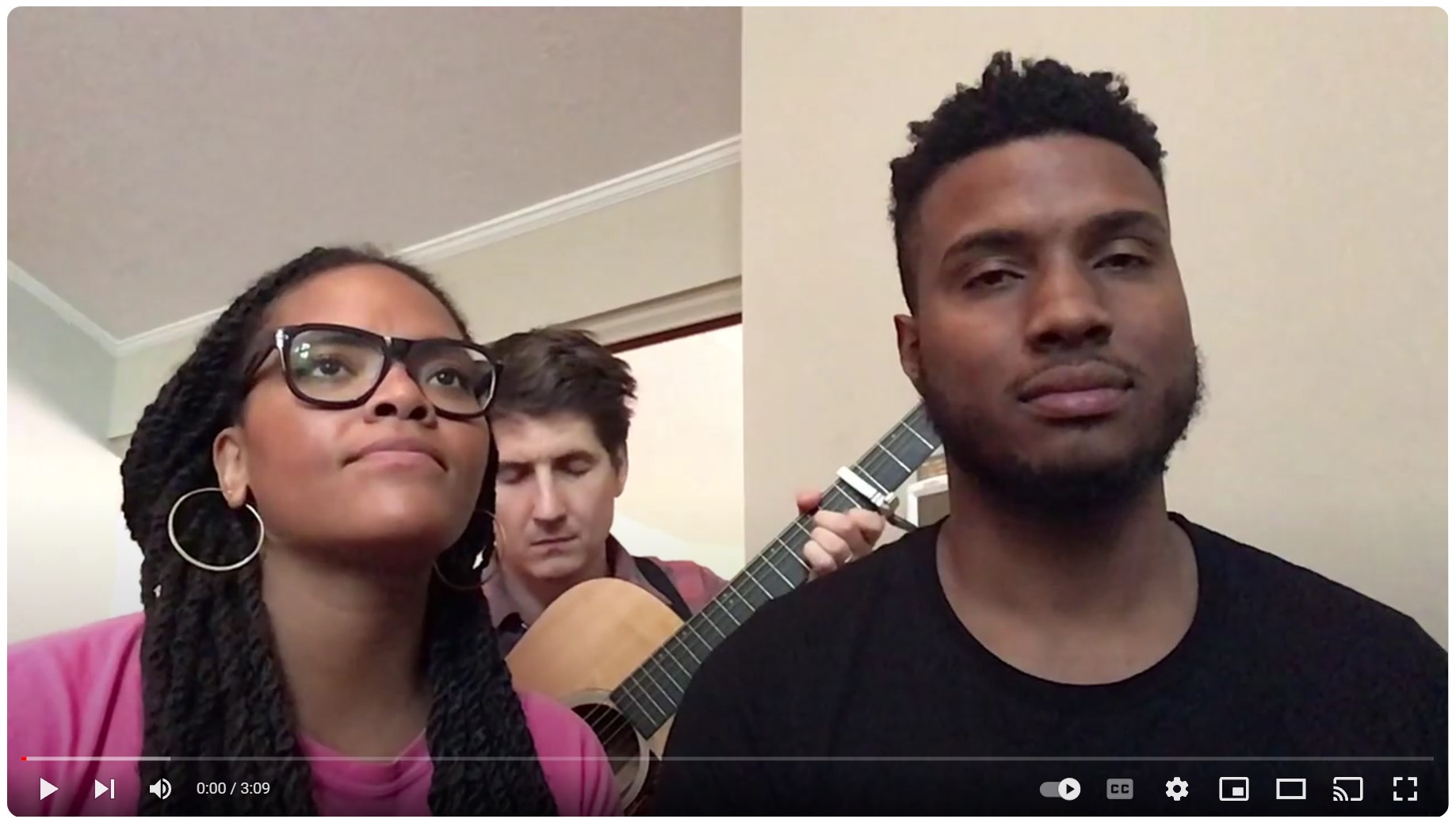
Update, July 25, 2021: Orlando Palmer, aka IAMSON, has just posted an Instagram video of himself singing the first verse of “Have Thine Own Way, Lord.” So beautiful:
It is not you who shapes God, it is God who shapes you.
If then you are the work of God, await the hand of the artist
Who does all things in due season.
Offer God your heart, soft and tractable,
And keep the form in which the artist has fashioned you.
Let your clay be moist,
Lest you grow hard and lose the imprint of God’s fingers.
The three photographs above by Alejandro Maestre Gasteazi are from a cycle of twenty portraits of the artist’s friend Julián Cánovas-Yañez, which show his mud-lathered form gradually taking shape—an effect achieved, in part, in digital postprocessing. Credit goes to Philip Chircop for first pairing these photographs with this quote by the second-century Greek bishop Irenaeus.
This post belongs to the weekly series Artful Devotion. If you can’t view the music player in your email or RSS reader, try opening the post in your browser.
To view all the Revised Common Lectionary scripture readings for Proper 18, cycle C, click here.
After nudges from several readers, I’ve decided to join Instagram! Follow me @art_and_theology. I’m still trying to settle on how I’d like to use the platform, but in the meantime, I’ve been sharing photos I’ve taken on visits to art museums and spaces that house sacred art. (And in case you don’t already know, Art & Theology is also on Facebook and Twitter.)
+++
DANCE: “Sign of the Times,” choreographed by Travis Wall: Premiering August 19, 2019, on Fox’s So You Think You Can Dance (season 16, episode 11), this contemporary dance piece is choreographer Travis Wall’s response to the gun violence epidemic in America. It’s a communal lament through movement, really—an expression of fear, sadness, pain, anger, frustration, and defiance. It is performed by this season’s “top ten”: Benjamin Castro, Gino Cosculluela, Eddie Hoyt, Madison Jordan, Anna Linstruth, Bailey Muñoz, Sophie Pittman, Mariah Russell, Ezra Sosa, and Stephanie Sosa.
+++
FEATURED POET: Marjorie Maddox: The latest installment of Abbey of the Arts’ Featured Poet series is, as usual, wonderful! I’ve read some of Maddox’s poems in magazines and anthologies but haven’t yet gotten my hands on one of her collections. This feature has incentivized me to request a copy of Transplant, Transport, Transubstantiation through my local library.
“The work of poetry,” Maddox writes, is “empathy and epiphany. The process of writing and reading allows us to better understand this world and the next. Poetry connects the local and universal, the mundane and the miraculous. It gives us those ears to hear and eyes to see that we might, then, head back into the turning world sustained, nourished, and willing to learn more. And will this not lead us to the Sacred? Yes, I say. Yes.”
+++
ESSAY: “Acts of Attention: On Poetry and Spirituality” by Robert Cording: I really enjoyed this essay from Image journal about the importance of attending to the world. “Attention is simply a loving look at what is,” writes Cording, a poet and birdwatcher. He discusses seeing not as a physiological act but as perceiving the fullness that exists in each moment. “Seeing is impossible without love or reverence,” he says. Along the way he engages with Marie Howe, Aristotle, Emerson and Thoreau, Tolstoy, Ruskin, Heidegger, Hopkins, Czesław Miłosz, and Marilynne Robinson. He also walks us through three poems: Robert Frost’s “Two Tramps in Mud Time,” Wallace Stevens’s “Man on the Dump,” and Seamus Heaney’s “The Pitchfork.” So much goodness here!
If you enjoyed this essay as much as I did, be sure to also check out “Cloud Shapes and Oak Trees,” also by Cording, from 2017.
+++
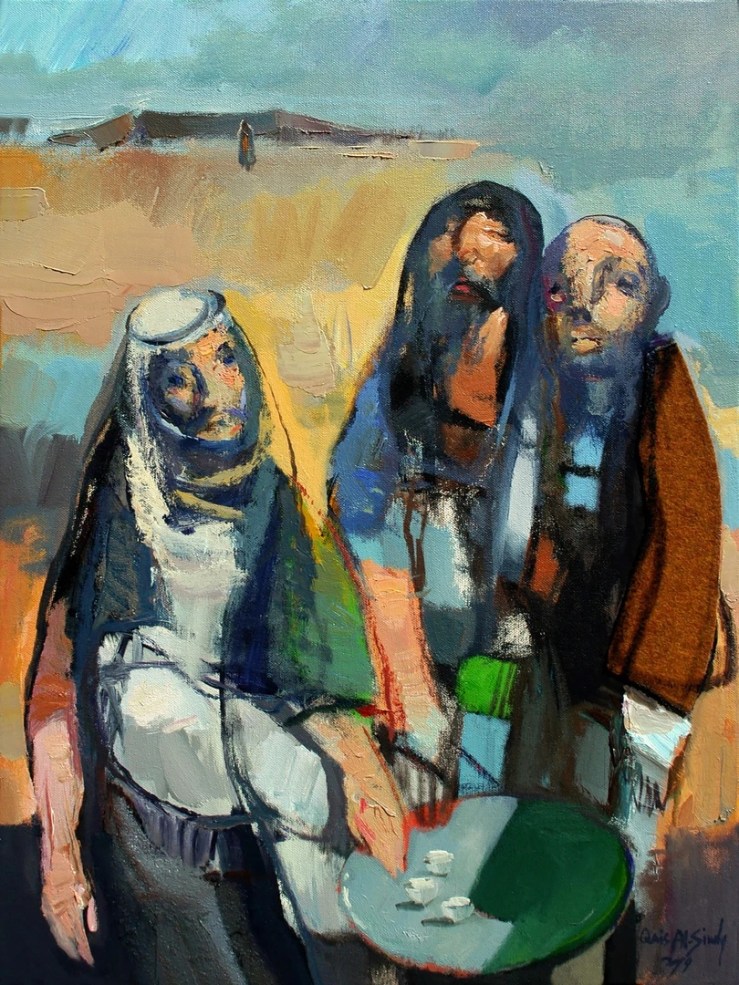
EXHIBITION: Abraham: Out of One, Many, curated by Rev. Paul-Gordon Chandler of Caravan: Caravan is an international nonprofit that uses the arts to build sustainable peace around the world. “Our peacebuilding work is based on the belief that the arts can serve as one of the most effective mediums to enhance understanding, bring about respect, enable sharing, and facilitate friendship between diverse peoples, cultures and faiths.”
Caravan’s current exhibition is built around Abraham, a key ancestral figure shared by the world’s three major monotheistic religions: Judaism, Christianity, and Islam. Caravan commissioned three Middle Eastern artists, one from each of these faith traditions, to each create five paintings on these subjects: Living as a Pilgrim, Welcoming the Stranger, Sacrificial Love, The Compassionate, and A Friend of God. The exhibition of resulting works opened May 3 at St. Paul’s Within the Walls in Rome. From there it has traveled to Paris and Edinburgh and, starting September 8, will be in the States, touring through 2021 with stops in Boston, Atlanta, Houston, Washington, DC, Chicago, and more (see schedule). There’s an excellent digital catalog available, which contains full-color reproductions and descriptions of all fifteen paintings.
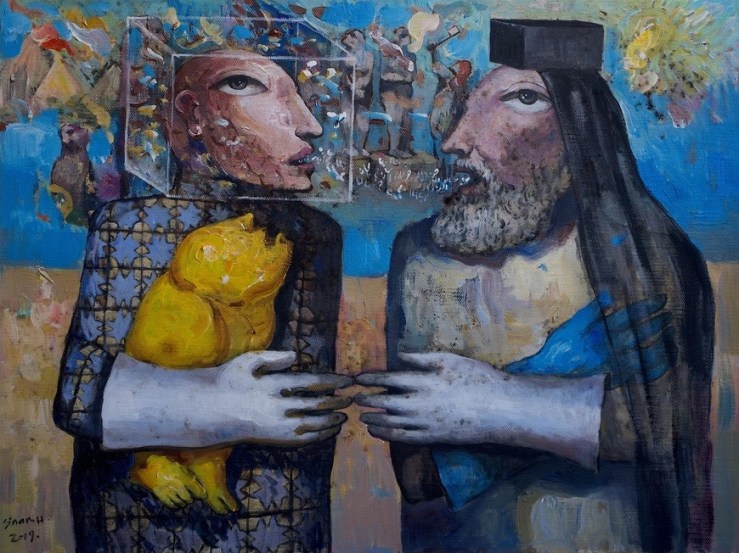
Sinan Hussein (Iraqi, 1977–), Living as a Pilgrim, 2019. Mixed media on canvas, 45 × 60 cm. Part of the “Abraham: Out of One, Many” exhibition organized by Caravan.Qais Al Sindy (Iraqi, 1967–), Welcoming the Stranger, 2019. Oil and collage on canvas, 60 × 45 cm. Part of the “Abraham: Out of One, Many” exhibition organized by Caravan.
+++
MUSICAL: In the Green by Grace McLean:Lincoln Center Theater’s LCT3 produces shows by new playwrights, directors, and designers, and for this summer, they commissioned a musical about the twelfth-century German visionary Hildegard of Bingen. (It finished its run on August 4, so I’m late in publicizing it—sorry!) A Benedictine nun and later abbess, Hildegard was also a composer, poet, dramatist, theologian, botanist, and healer—a true polymath. In the Green focuses on her relationship with her mentor, Jutta, just six years her senior.
Here’s Grace McLean, the show’s lyricist, composer, playwright, and player of Jutta, performing “Eve” (which uses looping technology!), followed by a short conversation between her and one of the other cast members. [HT: Still Life]
While looking online and on Spotify for the best available recording of this classic, I decided on the a cappella rendition by Zero8, a Stockholm-based male choir. But my favorite solo rendition is, ironically, from this year’s Chilling Adventures of Sabrina: Season One (Original Television Soundtrack). Though I don’t endorse the show, Jaz Sinclair’s vocal performance in episode 8 is gorgeous. (Her character sings the hymn during a funeral scene.) I also came across a retuned version by Sara Groves from her 2013 album The Collection, which is quite lovely, though I remain attached to the original tune.
+++
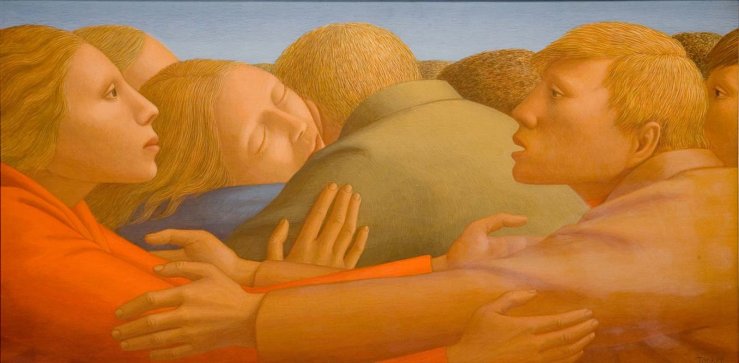
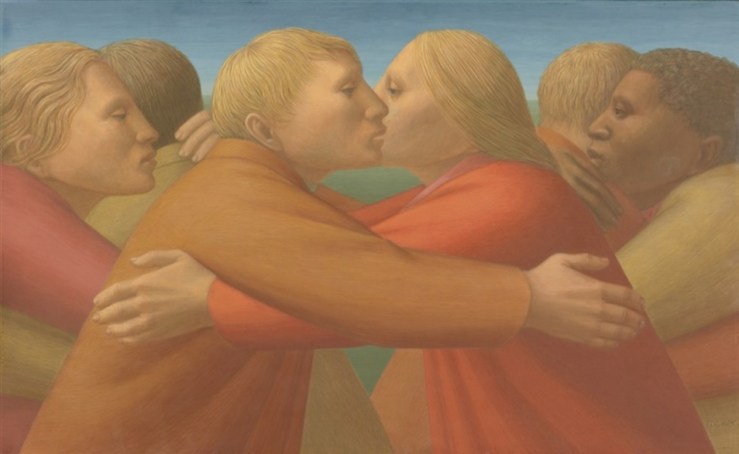
The “embrace of peace” in the title of the above George Tooker painting refers to a liturgical element in many Christian worship services in which congregants bless one another in the name of Christ. Depending on the church culture, this can be done with a handshake, a hug, or in some cultures, a kiss. The ritual is commonly referred to as the “passing of the peace” and, more than a mere greeting, is a significant gesture of reconciliation, unity, and love. Here’s a variation by Tooker on the same theme:
George Tooker (American, 1920–2011), An Embrace of Peace, 1986. Egg tempera on gesso panel, 16 × 26 in.
This post belongs to the weekly series Artful Devotion. If you can’t view the music player in your email or RSS reader, try opening the post in your browser.
To view all the Revised Common Lectionary scripture readings for Proper 17, cycle C, click here.
Here I’d like to share some of the art that was created at and/or on display at the conference. This is just a small snippet.
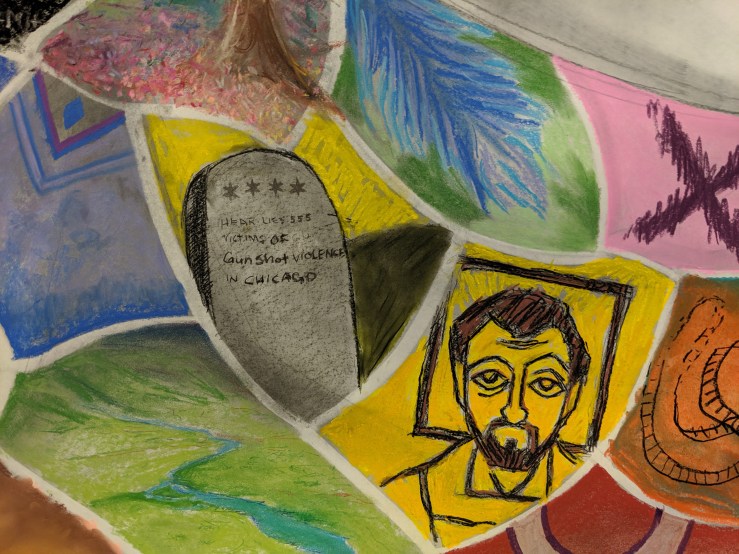
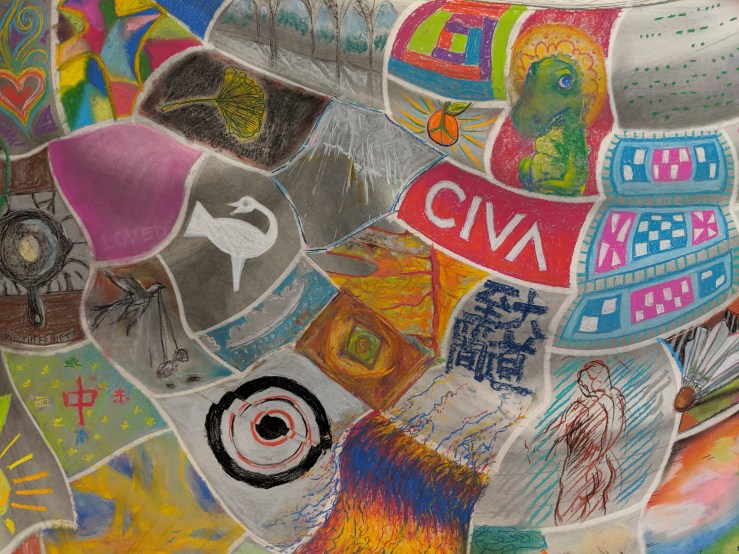
When I first crossed his path Thursday evening, printmaker and draftsman Steve Prince had unfurled a large sheet of paper across the wall of the George K. Brushaber Commons and was drawing in charcoal and graphite. A label taped up beside it gave the title: Prayer Works.
After Prince established the framework of three women quilting, he invited passersby to choose a quilt patch and fill it in with a pastel design of their own. (Though it was very much a low-pressure, “come one, come all” invitation, my self-consciousness, and my not being an artist, prevented me from making my mark. Something I need to get over . . .) It was fun to watch the work evolve over the weekend.
When I left on Sunday, this is what it looked like:
Steve A. Prince and friends, Prayer Works, 2019. A collaborative drawing completed at the 2019 CIVA conference at Bethel University, St. Paul, Minnesota.
Though he has an independent studio practice, Prince is especially passionate about facilitating community art projects—for example, Urban Stations of the Cross (2016), a collaboration between himself and participating members of Sojourn Community Church in Louisville, Kentucky, resulting in fourteen linocuts installed along the walls of the sanctuary. Or the Urban Garden project that capped off Prince’s residency at SUNY Geneseo this January and February. He’s also done a lot of work with grade schools and is great with working with people of all ages.
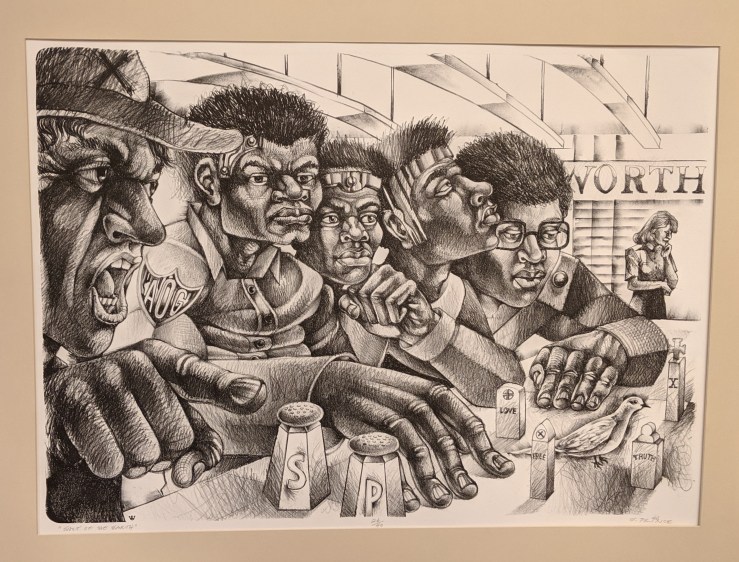
Prince had a work up for auction at the CIVA conference: a 2017 lithograph titled Salt of the Earth, based on a seminal moment in US civil rights history. On February 1, 1960, four African American college students sat down at a lunch counter at F. W. Woolworth’s in Greensboro, North Carolina. When they were refused service and told to leave, they remained in their seats—an act of nonviolent resistance that ignited a youth-led movement of sit-ins all across the South, challenging racial inequality.
Steve A. Prince (American, 1968–), Salt of the Earth, 2017. Lithograph, edition of 40, 27 × 37 in.
Blessed are the peacemakers, for they shall be called sons of God.
Blessed are those who are persecuted for righteousness’ sake, for theirs is the kingdom of heaven.
Blessed are you when others revile you and persecute you and utter all kinds of evil against you falsely on my account. Rejoice and be glad, for your reward is great in heaven, for so they persecuted the prophets who were before you.
You are the salt of the earth, but if salt has lost its taste, how shall its saltiness be restored? It is no longer good for anything except to be thrown out and trampled under people’s feet.
—Matthew 5:9–13
In Prince’s lithograph, protesters Ezell Blair Jr., David Richmond, Franklin McCain, and Joseph McNeil are portrayed as peaceful warriors, wearing badges that read “AOG”—Agent of God, as I once heard Prince explain. (This acronym is found in several of his works.) As they are reviled and persecuted, they remain steadfast and do not retaliate, representing the Christ who likewise was persecuted for righteousness’ sake.
Christ’s Spirit, symbolized by a dove, is resting on the counter. Around him are what look to be mini-tombstones, bearing inscriptions like “Love,” “Free,” “Truth.” These are all values associated with the Spirit (Rom 5:5 and 2 Tim 1:7; 2 Cor 3:17; Jn 15: 26) and also ones for which African American activists fought and died. You’ll notice that the cross-topped “tombstone” bears a chi (X) for Christ.
Social justice is a key theme in Prince’s oeuvre, including the large linocut of his that I bought at a CIVA auction several years ago.
+++
Another artwork at the CIVA conference that invited participation was Tim Lowly’s Without Moving (after Guy Chase). A multiyear project begun in 2009, it’s a portrait of the artist’s daughter Temma, who was born with severe disabilities, surrounded by a field of hundreds of thousands of tiny black dots. These dots, applied meticulously with a paintbrush by Lowly and other participants over the years, signify the contemplative presence of others surrounding Temma, enfolding her. One woman I talked to said her favorite part of the conference was having the honor to participate in this important work; she said it felt very intimate and connective, and like a form of prayer. Learn more and see more photos at the CIVA blog and the artist’s website. After the conference, Lowly declared the painting complete.
Tim Lowly (American, 1958–), Without Moving (after Guy Chase), 2009–19. Acrylic on panel, 75 × 120 in. [click here for a stunning detail shot!]Because I had a few hours to kill before my Sunday evening flight, I spent the afternoon at the Minneapolis Institute of Art—and discovered that the museum has a Lowly painting in its collection! Titled At 25, it, too, was collaborative. The gallery label reads, “At 25 is a collaborative work commemorating Tim Lowly’s daughter Temma’s 25th birthday. She has been the subject of his work since birth, and he has explored his relationship to her as father and caregiver as Temma was born with severe physical disabilities. Lowly considers Temma a creative collaborator in his work and invited friends to contribute to this icon to her life.” (Those friends include Makoto Fujimura, Tim Hawkinson, Bruce Herman, Catherine Prescott, and others.)
Tim Lowly (American, 1958–), At 25 (front), 2010. Acrylic, gold leaf, foil, gold pigment and glitter on wood, 29 1/2 × 23 1/2 × 2 1/4 in. (74.93 × 59.69 × 5.72 cm) (without base). Minneapolis Institute of Art, Minneapolis, Minnesota.
Lowly writes, “The piece is composed of 25 sections, each of which is painted by one or two artists from around the world. For the ‘portrait’ side of the image I provided the participants with a section of a photograph corresponding to the piece they were given. I also gave them black-and-white matte acrylic (the paint I usually use) and asked them to render the photograph as stylistically neutrally as possible. For an artist to set aside their ‘style’ is a significant gesture, and as such I am very grateful for how willingly and sincerely the participants took on this part of the project. For the back side of the work the directive was much more open: ‘make it gold.’ As anticipated, the result of the back was very eclectic and (friendship) quilt-like.”
I didn’t get a photo of the reverse side, but you can view it here.
+++
Above I mentioned an auction. There were many fine lots. I bid on Sandra Bowden’s Law and Gospel collograph but didn’t win.
Sandra Bowden (American, 1943–), Law and Gospel. Collograph mixed media, 18 × 27 in.
The artist’s description reads, “With one additional horizontal cut, the tablets of the Law become four quadrants, suggesting a cross. Jesus said he came to fulfill the Law. When we have finished an item on our list of things to be done, we put a line through it, marking it done. This is what I was thinking as I took the Law, marked it done, with a horizontal line, only to see a cross appear.” Bowden created the textured surfaces by layering gold leafing on the Hebrew text collagraph print, then adding colored iridescent Cray-Pas to the raised areas.
Wayne Roosa’s Tract also caught my eye—an eraser print that quotes Giotto’s Lamentation over the Dead Christ. It belongs to his “Ideas of Order” series of rubber stamp images, which, as he says, “use iconic elements from newspapers and art history, combined and recombined, to suggest symbolic/narrative meaning for our culture’s various structures of order. Here, the microphone, surrogate for figures in power, privilege, or influence, rises out of a trap door abyss, while three angels (from Giotto’s Arena Chapel) grieve over the state of ‘truth’ and discourse.”
Wayne Roosa, Tract, 2009. Eraser print, 11 × 8 1/2 in.
+++
While I was at Bethel, there was a CIVA-sponsored exhibition in the Olson Gallery, The Beautiful, which ran from April 23 to June 16. (This was in addition to a juried show and a walk-in show put together specially for the conference.)
Here are a few notable artworks from The Beautiful:
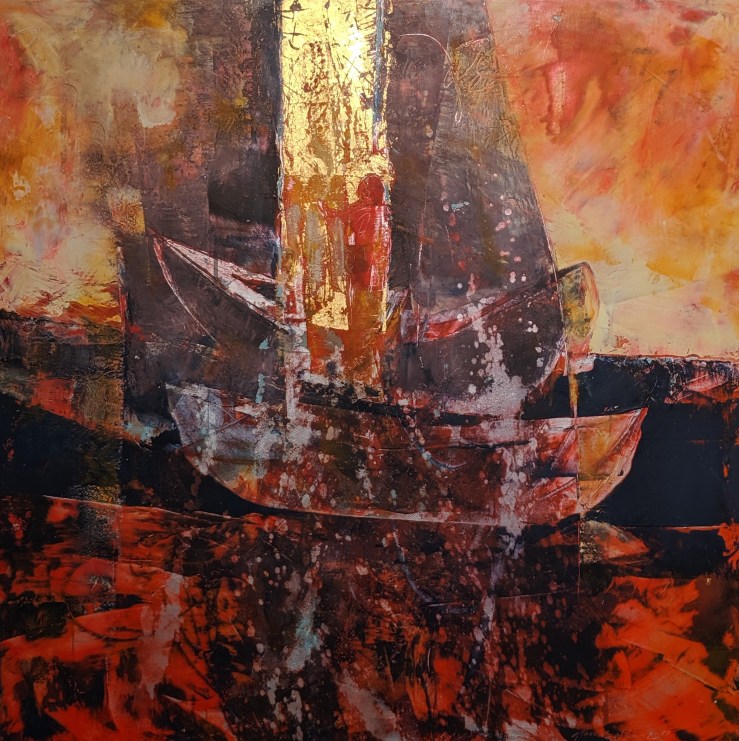
Lauren Tilden (American, 1981–), Wind on Her Face, 2017. Oil on panel, 18 × 24 in.Grace Carol Bomer (American, 1948–), Red Sea Crossing, 2018. Oil, wax, and gold leaf on canvas, 30 × 30 in.Jennie Kimbrough, Untitled 14 (Daniel 3:7–30), 2016. Acrylic and thread on paper, 8 × 5 in.
I learned about Jennie Kimbrough’s “And the Word Was God” series, in which she uses pages from a 1920s German Bible, purchased at a flea market, not only as inspiration but also as her substrate, painting and stitching atop them as a devotional response to the text. Untitled 14 (Daniel 3:7–30) shows the three youths in the fiery furnace, with a fourth figure mysteriously present among them.
Screen cap from artist Jennie Kimbrough’s website, showing a sampling of works from her “And the Word Was God” series
I also spent time at the video installation Belgium / Minnesota (for Henry) by Michelle Westmark Wingard. Shot over a four-hour period and then time-lapsed, it shows the movement of sunlight through a window and across the wall as the day progresses. The decal on the window is the horizon line she extracted from a photograph of a Belgian field, where her grandfather’s plane crashed during World War II; placed over the existing horizon line, it creates an interesting interplay. The artist said she intends the video as “a study of contrasts: light/dark, real/imagined, manicured landscape/wild natural landscape, static/ever-changing” and “a visual dialog about landscape, longing, and the passing of time.”
I love how this piece takes something as ordinary as sunlight and invites us to really notice it, to receive it as something more than a mere commonplace—as a wonder, or even a grace.
Artists are great at noticing beauty that others of us would simply pass by. The day I arrived at the conference, I was walking with my roommate to the dorms when suddenly she stopped in the road with wide eyes and open mouth. I assumed she was reacting to the herd of goats in the near distance, fenced off behind a small chapel—an unexpected and amusing feature of a college campus. (They were brought in last year, I later learned, to help manage an invasive plant species, buckthorn.) But it turns out she was responding to the way the sun’s rays were falling through a tree. “Isn’t this beautiful?” she kept saying, approaching for a closer look and pausing to take it in. She snapped multiple pictures from different angles so that she could paint it later. And here I was, only noticing the goats! Until this new artist friend of mine redirected my attention to something more subtle but equally as delightful.
+++
The Are We There Yet CIVA conference this summer was so rewarding, and these three blog posts, built as they are around works of art, don’t encapsulate the full experience. But they provide a taste of what you might expect to encounter were you to attend a biennial conference in the future.
I’d encourage you to listen to the fifteen-minute interviews conducted at the conference by Libby John of the podcast Art & Faith Conversations. She talks not only to artists but to an arts administrator and an art book publisher, all CIVA members:
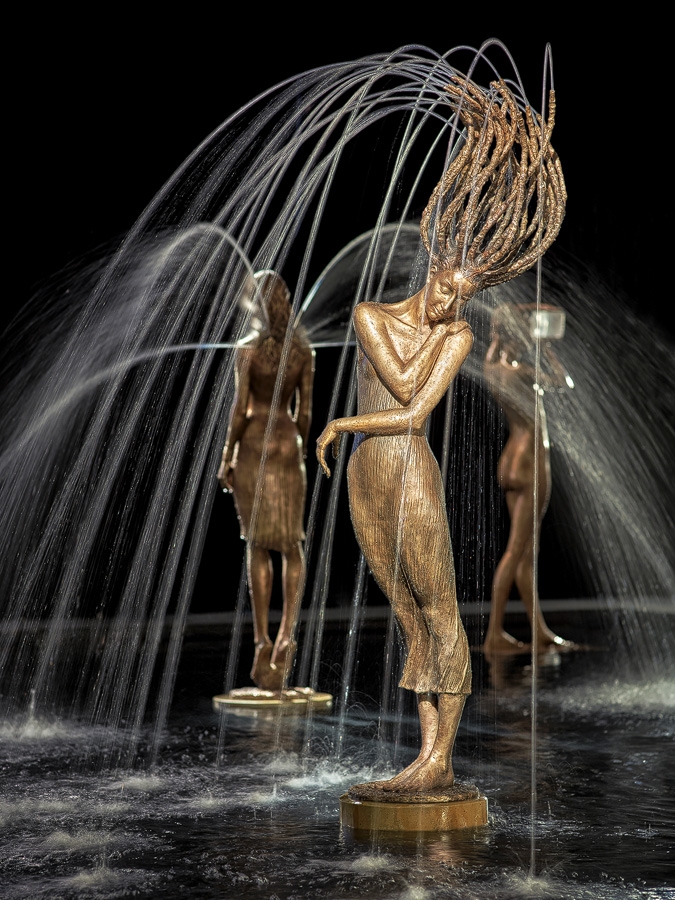
Małgorzata Chodakowska (Polish, 1965–), Primavera III, 2014. Bronze fountain, 220 cm tall. (In the background are Angel and Woman with Ice.)
The LORD will guide you continually,
and satisfy your needs in parched places,
and make your bones strong;
and you shall be like a watered garden,
like a spring of water,
whose waters do not fail.
—Isaiah 58:11 NRSV
+++
SONG: “I’ve Got Peace Like a River” | Negro spiritual | Performed by Wally Macnow, with Lucy Simpson, Peter Amidon, Mary Alice Amidon, Bill Destler, Tom McHenry, and Caroline Paton, on Sharon Mountain Harmony: A Golden Ring of Gospel (1982)
I love Wally Macnow’s ebullient rendition of this Negro spiritual for Folk Legacy Records. It’s a different tune than I’m accustomed to; for the more widely recognized melody, check out, for example, Lynda Randle.
The phrase “peace like a river” appears in Isaiah 48:18 and 66:12, and between those verses is another one, above, in which Isaiah relays God’s promise to water our souls in times of drought and, what’s more, to make us into springs whose water can’t help but bubble up to the surface and spill over.
+++
Małgorzata Chodakowska is a Polish artist who has lived in Germany since 1991. She is renowned for her “water sculptures,” (usually nude) figures carved in oak wood and then cast in bronze and designed for water. Chodakowska creates unique paths for the water, specific to each sculpture—it might fan out from the waist like a tutu, for example, expand from the back like angels’ wings, or shoot every which way around an orb, suggesting the movement of celestial bodies. Browse her work at http://www.skulptur-chodakowska.de/en/fountains/, or view a sampling in the video below.
This post belongs to the weekly series Artful Devotion. If you can’t view the music player in your email or RSS reader, try opening the post in your browser.
To view all the Revised Common Lectionary scripture readings for Proper 16, cycle C, click here.
In a recent conversation, poet and novelist Joy Kogawa said, “We need to see each other’s eyes, and see each other through each other’s eyes.” Art, from all disciplines, can help us do that. Art can awaken our social conscience and breed empathy and understanding. It can serve as a vehicle for lament, a practice of voicing suffering before God. It can also widen our imaginations—that is, in part, our ability to think up creative solutions to problems both big and small. Here are just a few recent justice-oriented art projects that inspire me.
+++
CLASSIC SONG REVISED: Earlier this month Liz Vice, Paul Zach, and Orlando Palmer took Woody Guthrie’s folk classic “This Land Is Your Land” and, gathering at Trinity Church in Charlottesville, Virginia, revised the lyrics and tone to project lament over some of America’s more troubling legacies. The lyrical turn happens in the fourth line: where we would expect “To the New York islands,” we get “To the Texas border,” turning our mind from the country’s beauty to its broken systems that prevent us from sharing abundance with our southern neighbors fleeing violence. The song continues to plot a path through various places of historical and present-day suffering in the US, the three stanzas compactly addressing immigration; slavery, the “New Jim Crow,” and police brutality against black people; and the forcible expulsion of Native Americans from their ancestral territories, as well as massacres and other forms of colonialist violence.
This land is your land
This land is my land
From California
To the Texas border
Through the Juarez mountains
With the migrant caravans
This land was made for you and me
This land is your land
This land is my land
From the piers of Charleston
To the fields of cotton
From the crowded prisons
To the streets of Ferguson
This land was made for you and me
This land is your land
This land is my land
From the Jamestown landing
To Lakota Badlands
From the Trail of Tears to
The reservations
This land was made for you and me
Most people don’t know it, but Guthrie actually wrote “This Land Is Your Land” as a protest against the vast income inequalities in the US. Two of its original verses, the radical ones, were nixed when it came time to record (it was the McCarthy era, after all); these referenced breadlines and tall walls with “No Trespassing” signs. In its original form, the song celebrated America as a place of natural abundance—forests and streams and wheat fields under “endless skyways”—while lamenting the scarcity that many Americans experience. The refrain, therefore, was more loaded. Learn more about the song’s history at https://www.npr.org/2000/07/03/1076186/this-land-is-your-land.
+++
An interactive art installation by Rael San Fratello on July 27, 2019, fostered cross-border interactions between residents of Sunland Park, New Mexico, and Colonia Anapra, Mexico.
SEESAWS AT THE BORDER: On July 27, Oakland-based creative duo Ronald Rael and Virginia San Fratello installed three bright pink teeter-totters through the slats of a section of the US-Mexico border wall that separates the neighboring communities of Sunland Park, New Mexico and Colonia Anapra, Mexico. Citizens on both sides were invited to ride this playground essential with a cross-border partner—a whimsical way to engage the other. As the creators said, it enabled people to literally feel the weight of humanity on the other side, using the wall as a fulcrum. The installation lasted forty minutes before it was dismantled (without incident).
I love this idea of play as protest—teeter-tottering as an act of creative defiance. What was enacted July 27 at the wall was a theater of the absurd, something that Rael, an architect, is especially drawn to in his practice. He actually conceived of Teeter-Totter Wall ten years ago, publishing a conceptual drawing in the book Borderwall as Architecture (University of California Press, 2009), along with other outlandish design possibilities for turning the wall into something that brings together rather than divides—these include its use as a massive xylophone played with weapons of mass percussion, a bookshelf feature inside a binational library, and more. Through these humorous proposals, Rael “reimagin[es] design as both an undermining and reparative measure,” as Dr. Marilyn Gates put it.
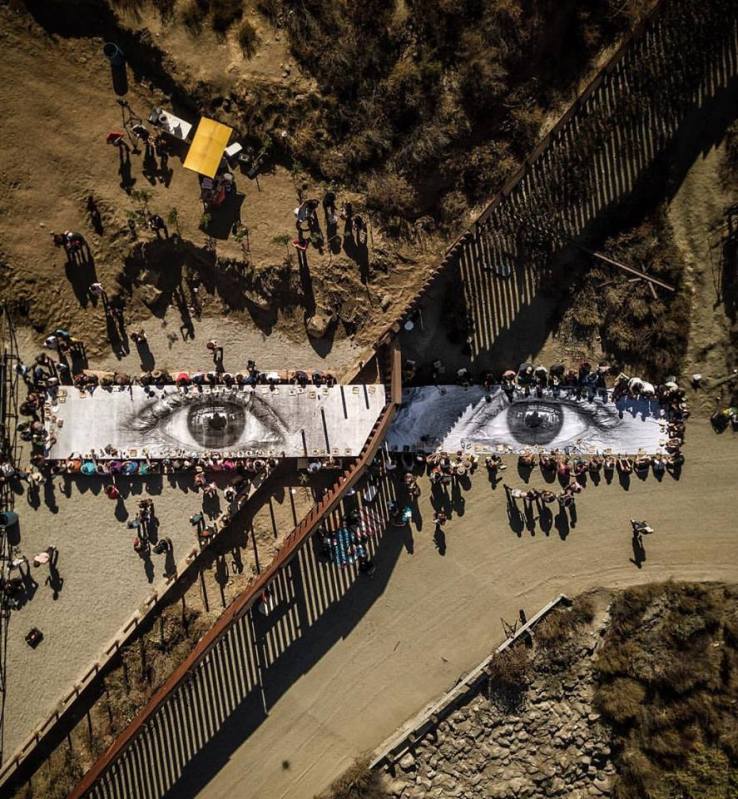
In his 2018 TED Talk, Rael discusses how the wall, meant to separate, has actually served to unite people in some instances. He mentions, for example, games of Wall y Ball, a variation on volleyball that was established at the wall in 1979, and binational yoga classes. I’ve heard of the Eucharist being celebrated jointly through the slats, and picnics hosted—such as the one organized in Tecate by the French artist JR on October 8, 2017: families passed plates of food between the bars, and musicians on both sides played the same songs.
A picnic at the US-Mexico border on October 8, 2017, organized by the elusive street artist JR
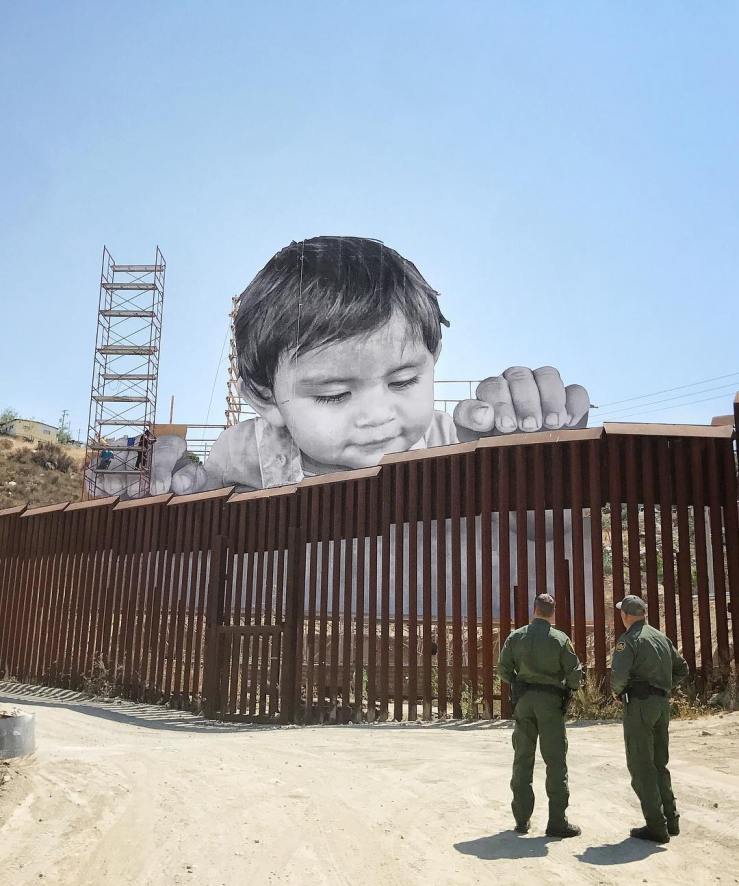
This picnic was the capstone of a month-long installation by JR featuring a monumental photograph of a Mexican toddler named Kikito, peering over the border wall into California from Tecate. (The photograph was held up with scaffolding.)
In early September 2017, street artist JR created a massive art installation on the Mexican side of the US border wall in Tecate showing a child, Kikito, peering over.
Shared play, shared food, shared music, shared sacrament—these are such breathtakingly beautiful countermeasures to separatism. The world needs more imaginative acts like these.
+++
POEM: Timothy E.G. Bartel has just published a new poem, “Status Check,” over at Curator. It’s only five lines, seven questions. A must-read. It’s not about immigration policy per se (it’s open-ended), but it took me back to another poem by Bartel that I featured back in 2017 as part of a blog post entitled “One sonnet vs. shouted prose: Lady Liberty, Emma Lazarus, and Trump.” Bartel has since published a freely downloadable chapbook (a compilation of Sapphic stanzas he wrote this year during National Poetry Month) and a traditionally published collection with Kelsay Books, Aflame but Unconsumed, which I just ordered and am excited about.
+++
VIRTUAL REALITY INSTALLATION: This was in DC last year and I missed it! A VR experience directed by the multi-Academy-Award-winning Alejandro G. Iñárritu, known for the films Birdman, The Revenant, Biutiful, and Babel, and shot by (also multiple-award-winning) cinematographer Emmanuel Lubezki. “Carne y Arenais a six-and-a-half-minute solo experience that employs state-of-the-art technology to create a multi-narrative space with human characters. . . . Based on true accounts from Central American and Mexican refugees, [it] blurs and binds together the superficial lines between subject and bystander, allowing individuals to walk in a vast space and live a fragment of a refugee’s personal journey.”
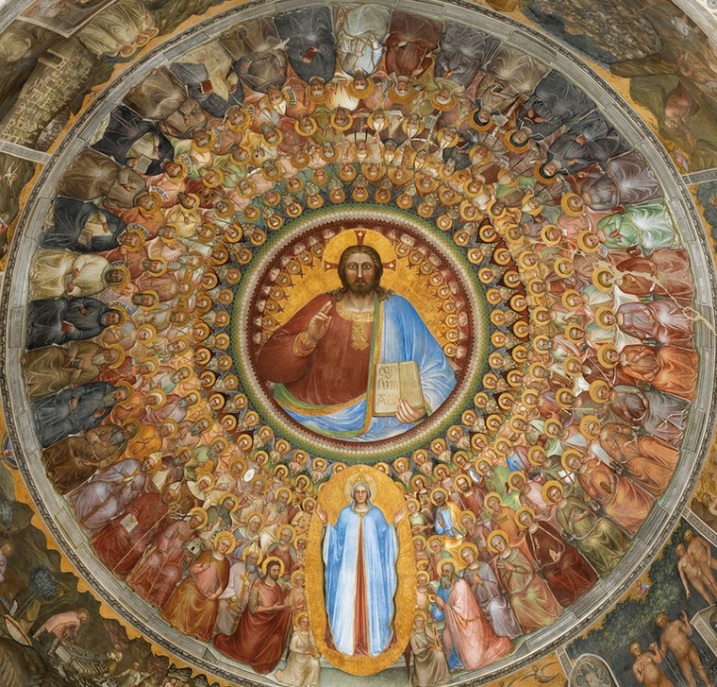
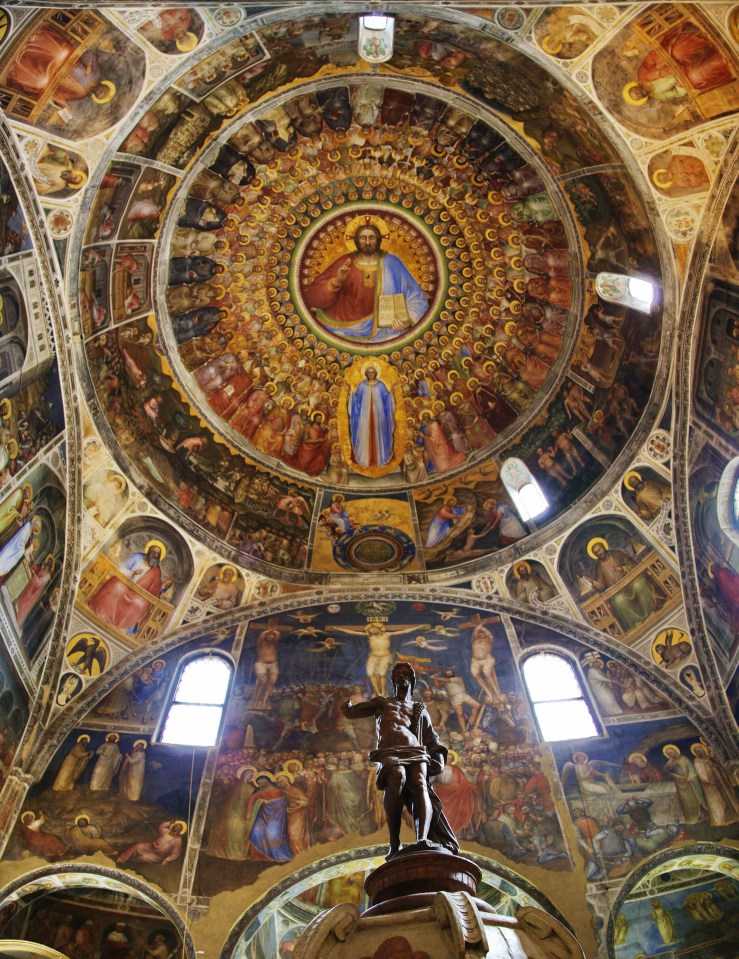
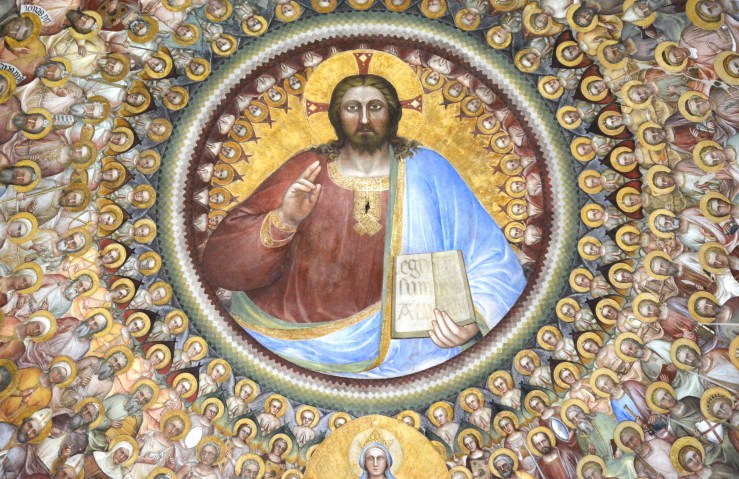
Giusto de’ Menabuoi (Italian, ca. 1320–1391), Paradise, ca. 1378. Dome fresco, Padua Baptistery, Italy.
Therefore, since we are surrounded by so great a cloud of witnesses, let us also lay aside every weight and the sin that clings so closely, and let us run with perseverance the race that is set before us, looking to Jesus the pioneer and perfecter of our faith, who for the sake of the joy that was set before him endured the cross, disregarding its shame, and has taken his seat at the right hand of the throne of God.
A cloud of witnesses around us,
a thousand echoes from the past,
proclaim the One who freed and found us,
and leads us on, from first to last.
For such a gift, let all uplift
a thousand alleluias.
A carnival of faiths and cultures
parading through our settled praise,
with jangled rhythms, songs and dances,
expresses Love’s expansive ways.
Christ is our song. To God belong
a thousand alleluias.
A crowd, that clamors pain and anger,
prevents us from nostalgic pride;
the cries of poverty and hunger
recall us to our Savior’s side.
There we entrust, to God most just,
a thousand alleluias.
A throng of future shapes and shadows,
a world that may, or may not be,
names us the servants and the stewards
of all the Spirit longs to see.
In awe we bend, and onward send
a thousand alleluias.
A rainbow-host of milling children,
God’s varied image, from all lands,
awakes again our founding vision,
that onward, urgently expands.
Give all, give more. Let love outpour
a thousand alleluias.
+++
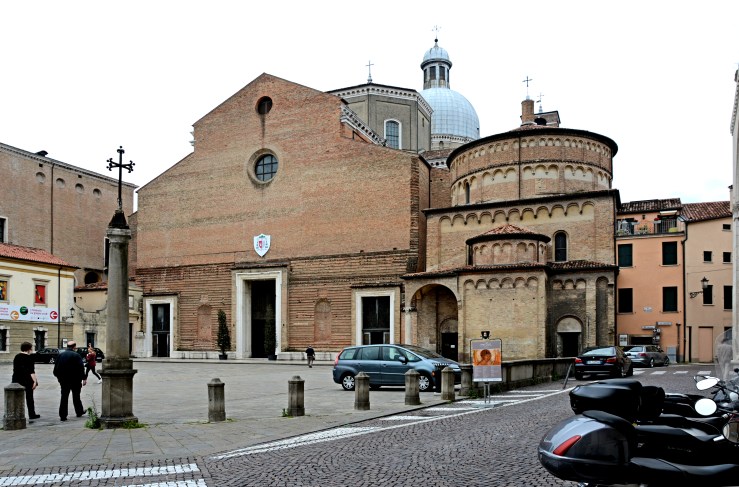
Padua Cathedral (left) and Baptistery (right). Photo: Peter Owen.Padua Baptistery, interior panorama. Photo: Nikola Sarnavka.
In de’ Menabuoi’s stunning fresco, we glimpse a rendering of the glory of Christ’s church. We see a myriad of saints surrounding Jesus in a circle, which itself, suggests fullness and unending eternity. This grand scene was painted on the ceiling of a baptistery, a chapel set aside for the purpose of uniting new believers to the Lord and His church. So when the newly illumined ones came up out of the waters of baptism, they would see a representation of what and who they were just joined to: Jesus Christ as the Lord of Hosts, arrayed in the midst of His mother and the various ranks of saints, an image of God’s kingdom.
The image of Christ in the center of the cupola is of the type known as Christ Pantocrator, meaning “Christ Almighty” or “Ruler of All.” The book he holds open reads, EGO SUM Α ω (“I am Alpha and Omega”).
This post belongs to the weekly series Artful Devotion. If you can’t view the music player in your email or RSS reader, try opening the post in your browser.
To view all the Revised Common Lectionary scripture readings for Proper 15, cycle C, click here.
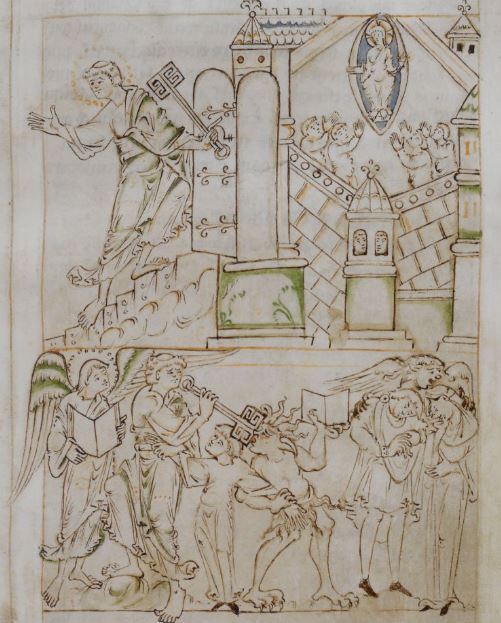
Ink drawing with color wash from the Liber Vitae of New Minster and Hyde, England, ca. 1031. Stowe MS 944, fol. 7r, British Library, London.
Fear not, little flock, for it is your Father’s good pleasure to give you the kingdom.
—Luke 12:32
+++
SONG: “Keys to the Kingdom” | Traditional gospel blues song, performed by Abigail Washburn (lead vocals), Kai Welch (trumpet, backing vocals), and friends (I can’t find the names of the upright bassist and percussionist—anyone know?)
I’ve got the keys to the kingdom, the world can’t do me no harm
Go Gabriel, get the trumpet, move on down to the sea
Don’t you sound that trumpet, ’til you hear from me
I’ve got the keys to the kingdom, the world can’t do me no harm
Take ol’ John on the island, place him in a kettle of oil
Then the angels came from heaven down, told him that the oil wouldn’t boil
I’ve got the keys to the kingdom, the world can’t do me no harm
Take ol’ Paul and Silas, place ’em in jail below
Then the angels came from heaven down and unlocked that prison-house door
I’ve got the keys to the kingdom, the world can’t do me no harm
When I get in trouble, I know I done no crime
Wake up central in Glory, and Jesus come to the phone
I’ve got the keys to the kingdom, the world can’t do me no harm
I got the keys to the kingdom, the world can’t do me no harm
Abigail Washburn is a Grammy Award–winning clawhammer banjo player and singer and one of my favorite musical artists. Here she sings a traditional song from the American South, which, as is typical of such songs, exists in many variations. Her version, she says, is based on a performance by Lillie Cogswell Knox, recorded a cappella on a porch in Murrells Inlet, South Carolina, in the 1930s. You can listen to this historic recording on Deep River of Song: South Carolina—Got the Keys to the Kingdom, from the Alan Lomax Collection.
Washburn has performed “Keys to the Kingdom” at many concerts, each performance unique. You can find a handful of these on YouTube; I particularly like the smoky jazz version she did at the Berkeley Café in Raleigh, North Carolina, in January 2011, embedded above. She also recorded the song on the 2006 EP The Sparrow Quartet, the album title a reference to the cross-cultural folk music group consisting of herself, husband Béla Fleck (banjo), Ben Sollee (cello), and Casey Driessen (fiddle). The album version has a banjo accompaniment (by Fleck) and an overall brighter tone.
While Matthew 16:19, Jesus’s metaphoric handing over of the keys to Peter and the church, is the more direct inspiration for the refrain, I love reading the gentle saying of Jesus from Luke 12:32 in relation to this song.
+++
The drawing above is a detail from one of the pages of the eleventh-century Liber Vitae (“Book of Life”) from New Minster in Winchester, a medieval Benedictine monastery that moved to Hyde after the Norman Conquest. The book contains a list of names of the members of the community and its associates and benefactors, living and dead, along with pictures, grants, historical accounts, material for church services, prayers, and other devotional material.
This drawing is part of a spread toward the beginning of the manuscript that shows St. Peter unlocking the gates of heaven as he welcomes in a queue of the saved from the facing page. Inside the celestial city, Christ is adored. The page’s middle band shows Peter fighting a devil for a man’s soul. The man’s victory is secure, as his name is recorded in the Book of Life, which the angel flashes open, over against the devil’s faulty document. Amusingly, to cinch the victory, Peter delivers a mighty whack to the devil’s head with his oversize key!
We’ve got the keys to the kingdom—we’re heirs with full access, granted us by our loving Father. The world can’t do us no harm.
This post belongs to the weekly series Artful Devotion. If you can’t view the music player in your email or RSS reader, try opening the post in your browser.
To view all the Revised Common Lectionary scripture readings for Proper 14, cycle C, click here.
This is part two of a three-part series based on some of my art encounters at the Christians in the Visual Arts conference held June 13–16, 2019, at Bethel University. This post covers a handful of notable artworks I was introduced to through slides; part three will cover art I experienced in person through the conference’s exhibitions and auction. Read part one, about the Sacred Spaces tour of Minneapolis, here.
In his introductory remarks to the 2019 CIVA conference, Chris Larson cited Lauren Bon’s Artists Need to Create on the Same Scale That Society Has the Capacity to Destroy, the eponymous work of the Brooklyn Rail–curated exhibition running through November 24 at the church of Santa Maria delle Penitenti in Venice, a collateral event of the Venice Biennale. It’s a great rallying quote, one that I hadn’t heard before but that I can really get behind.
Lauren Bon (American, 1962–), Artists Need to Create on the Same Scale That Society Has the Capacity to Destroy, 2006. Neon, edition 1 of 12. Photo: Joshua White, courtesy of the Metabolic Studio, Los Angeles.
The theme of the conference was “Are We There Yet,” a deliberately broad question which I took as referring to the conversation between serious art and serious faith, which CIVA has been heavily engaged in over its forty-year history. We talked about where “there” is and unpacked other aspects of the conference title, but I’m sidestepping those discussions to focus on the visual.
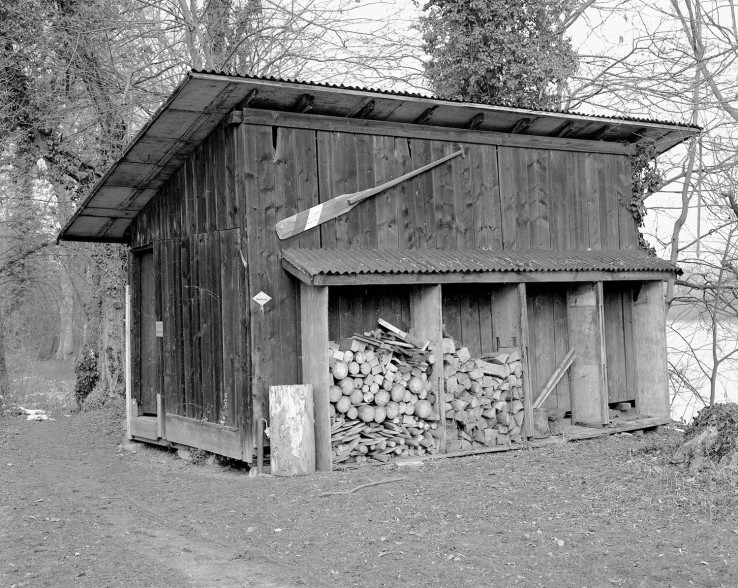
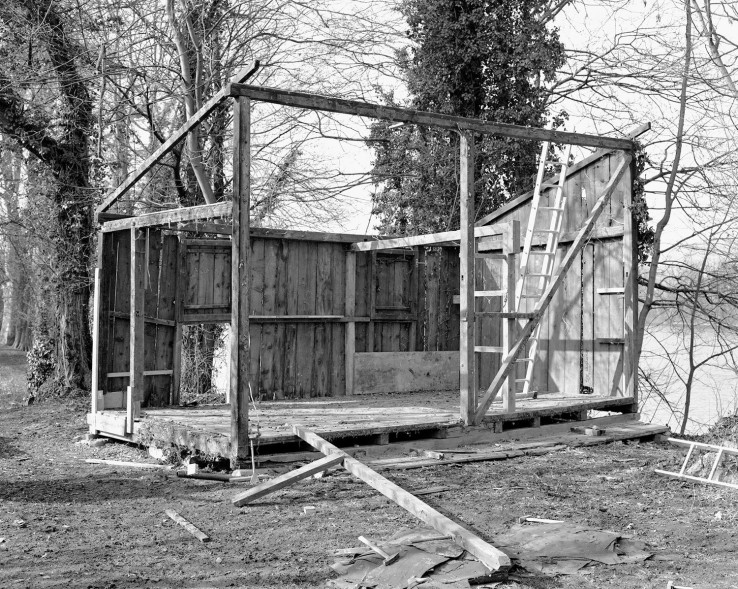
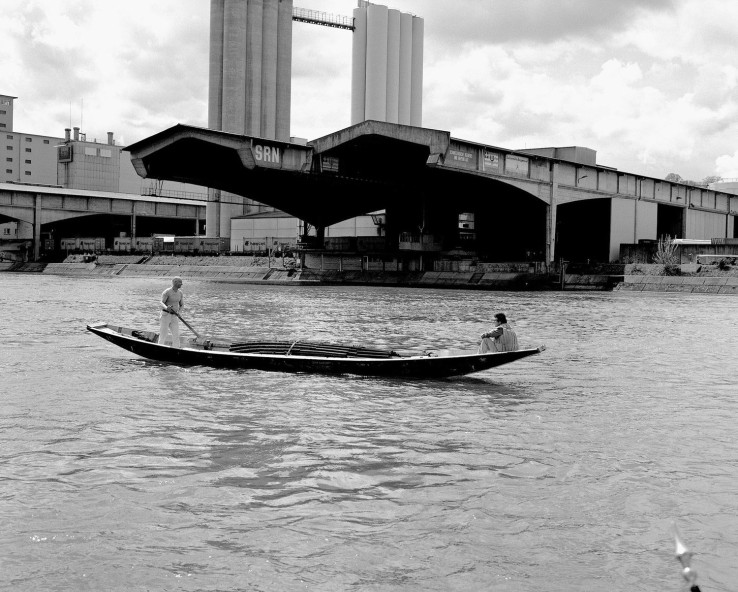
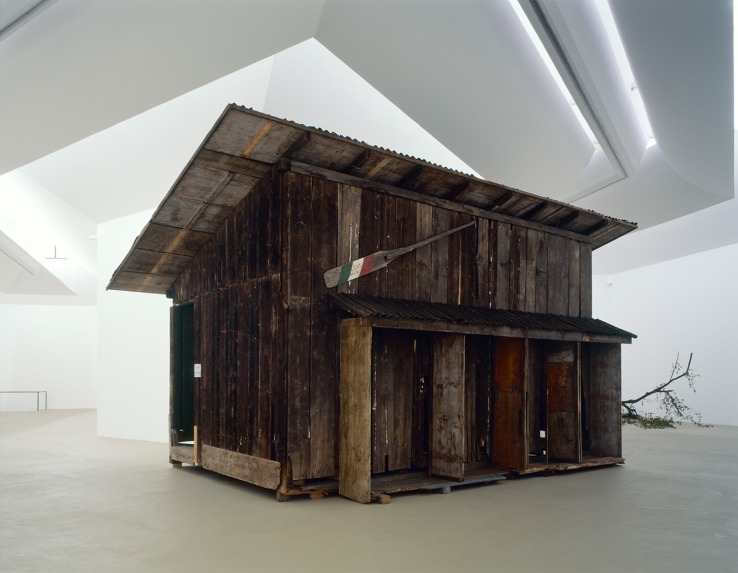
Wayne Roosa oriented our gathering by introducing us to two conceptual art projects by Simon Starling that offer opposing archetypes of the journey. The first, more aspirational one is Shedboatshed(Mobile Architecture No. 2), which involved the movement of a wooden shed from one Swiss riverside location to another. “This journey of 8 km downstream from Schweizerhalle to the centre of Basel was undertaken through the temporary mutation of the shed into a boat. This boat, a copy of a traditional Weidling, was made only with wood from the shed and was subsequently used as a transport system for the remaining parts of the structure. The shed already included an oar of the type used on Weidlings nailed to its facade as decoration. In its new location, the Museum für Gegenwartskunst, the boat was then dismantled and once again re-configured into its original form, but for a few scars left over from its life as a boat, it stands just as it once did several kilometres up-stream” [source].
Simon Starling (British, 1967–), Shedboatshed (Mobile Architecture No. 2 (production still), 2005. Wooden shed, 390 × 600 × 340 cm.
Simon Starling (British, 1967–), Shedboatshed (Mobile Architecture No. 2), 2005. Wooden shed, 390 × 600 × 340 cm. Installation at Museum für Gegenwartskunst, Basel, Switzerland.
“What I’m doing in a gallery situation,” says the artist, “is presenting a journey that I’ve been on, a process I’ve undertaken, and I’m asking for people to look at that in reverse. The circularity of many of the projects is a device to tell a story and it means that if you’re making a work about process, if you start and end in the same place, then somehow the journey becomes the important thing.” I think of lines from T. S. Eliot’s “Little Gidding”: “What we call the beginning is often the end / And to make an end is to make a beginning. / The end is where we start from”—and further down, “And the end of all our exploring / Will be to arrive where we started / And know the place for the first time.”
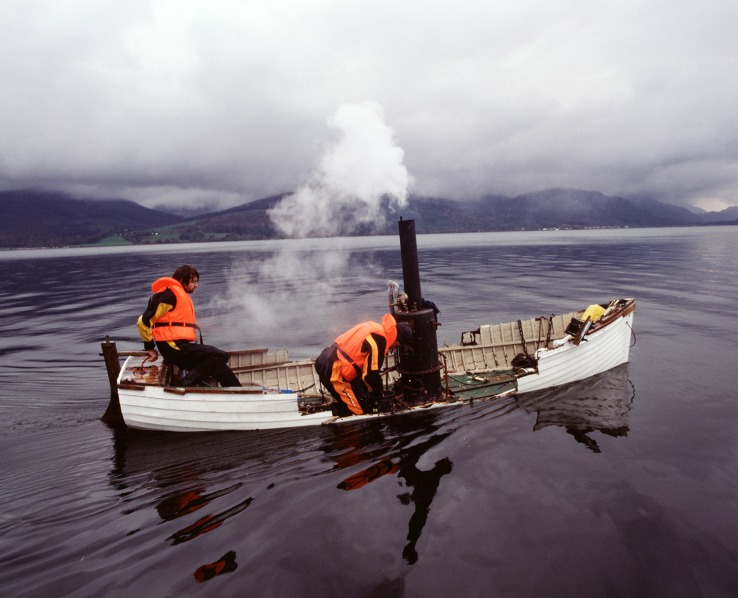
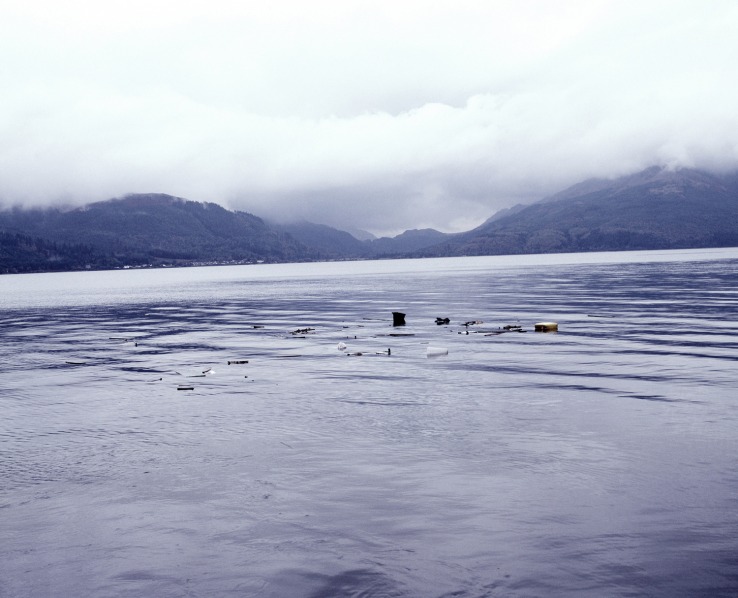
The second Starling work we considered was Autoxylopyrocycloboros, “a four-hour entropic voyage made across Loch Long [in Scotland] on a small wooden steamboat fuelled by wood cut piece-by-piece from its own hull.” This theatre of destruction ends with the boat’s debris floating—or sinking, as it were—in the water, Starling and his crewmate bobbing in their life vests somewhere out of frame. (The journey is presented in gallery settings as a series of thirty-eight color transparencies.) The title is an extrapolation of “ouroboros,” the mythical serpent who eats his own tail.
Simon Starling (British, 1967–), Autoxylopyrocycloboros, 2006. 38 color transparencies, 6 × 7 cm each.
Roosa suggested that as we navigate the waters, we can either self-destruct, eating ourselves alive, or we can deconstruct and then reconstruct. As an organization, we ought to be committed to the latter—taking apart the structure we started with and putting it back together.
+++
Over two and a half days of conference, there were several artists’ panels that brought to the fore some truly exciting work. I especially enjoyed hearing artists Sedrick and Letitia Huckaby, a married couple, discuss their different artistic media, styles, content choices, and creative processes, and the way their work interacts with the other’s. Both explore themes of family, faith, and African American heritage.
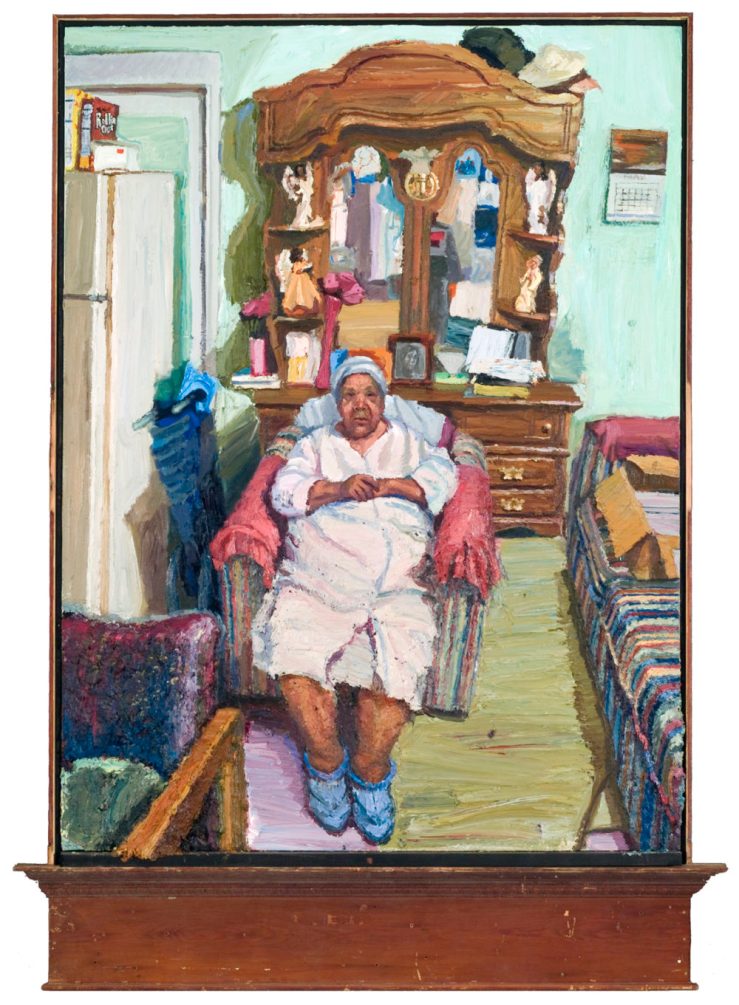
Sedrick Huckaby is a painter, draftsman, printmaker, and sculptor known for his portraits. His earliest body of work is a series of impasto paintings of his maternal grandmother, Hallie Beatrice Welcome Carpenter (“Big Momma”), inside her old wood-framed house in Fort Worth, Texas. These are so tender—they show her resting, drinking coffee, reading her Bible, getting ready for church, talking with family. After Big Momma died, he continued making in absentia portraits of her by depicting accessories she wore or household spaces that bear her imprint—The Shoes She Wore, The Altar Dresser. Sedrick is now renovating Big Momma’s house to serve as a creative project space for the neighborhood.
Sedrick Huckaby (American, 1975–), Sitting in Her Room, 2008. Oil on canvas in rustic wood framework, 48 × 36 in.
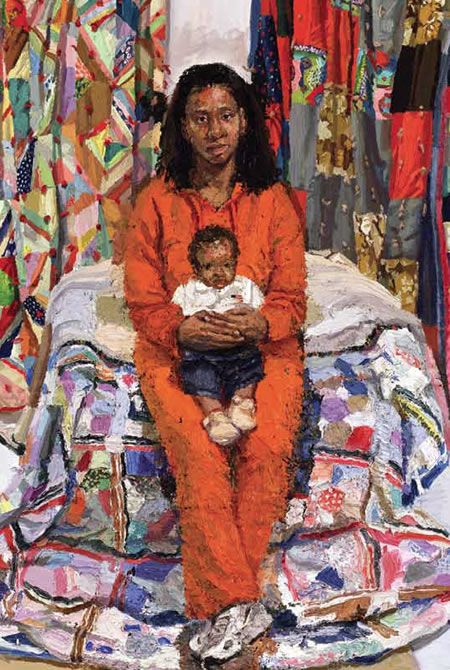
Family has long been the primary subject of Sedrick’s art. I love the 2006 portrait he painted of his wife seated at the foot of their bed and holding their firstborn son, Rising Sun. Mother and child are surrounded by family quilts, made by aunts and grandmothers. The opening between the two wall-hanging quilts forms a square halo around Letitia’s head.
Sedrick Huckaby (American, 1975–), Letitia and Rising Sun, 2006. Oil on canvas, 54 × 36 in.Sedrick Huckaby (American, 1975–), About Family, 2016. Charcoal and chalk on wood, 13 × 23 7/8 in.
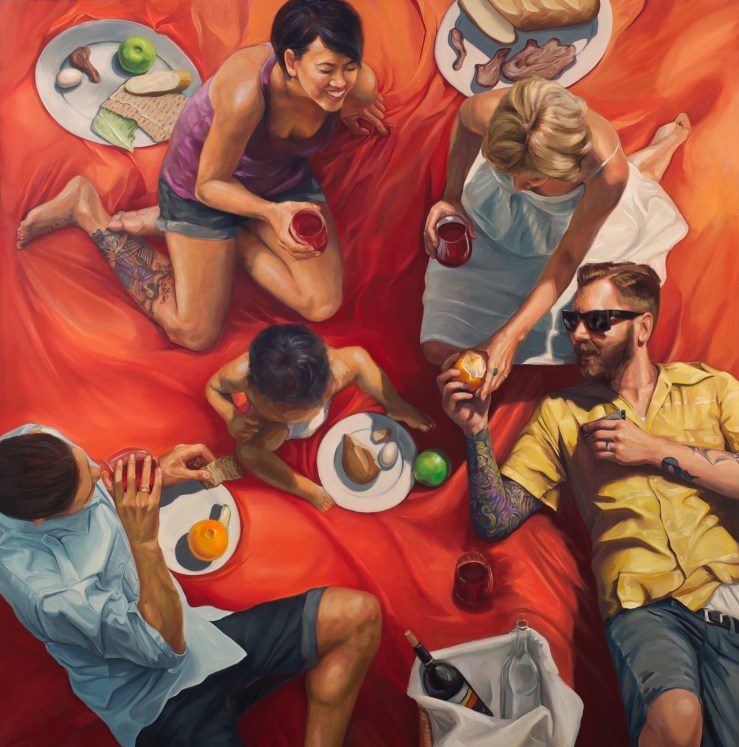
Kirsten Van Mourick, Eucharist, 2014. Oil on canvas, 72 × 72 in.
Oh give thanks to the Lord, for he is good,
for his steadfast love endures forever!
Let the redeemed of the Lord say so,
whom he has redeemed from trouble . . .
For he satisfies the longing soul,
and the hungry soul he fills with good things.
Some sat in darkness and in the shadow of death,
prisoners in affliction and in irons,
. . .
they fell down, with none to help.
Then they cried to the Lord in their trouble,
and he delivered them from their distress.
He brought them out of darkness and the shadow of death,
and burst their bonds apart.
Let them thank the Lord for his steadfast love,
for his wondrous works to the children of man!
. . .
And let them offer sacrifices of thanksgiving,
and tell of his deeds in songs of joy!
For a video tutorial by the songwriter on how to play “Oh Give Thanks” on the guitar, click here.
This post belongs to the weekly series Artful Devotion. If you can’t view the music player in your email or RSS reader, try opening the post in your browser.
To view all the Revised Common Lectionary scripture readings for Proper 13, cycle C, click here.