In those days John the Baptist appeared in the wilderness of Judea, proclaiming, “Repent, for the kingdom of heaven has come near.” This is the one of whom the prophet Isaiah spoke when he said,
“The voice of one crying out in the wilderness: ‘Prepare the way of the Lord; make his paths straight.’”
—Matthew 3:1–3
LOOK: Painted staircases by Xomatok
Painted staircase by Xomatok (b. 1985), Lima, Peru, 2021. All photos by Jeremy Flores.
Artist Xomatok translates the vibrant, geometric motifs of handwoven Andean blankets, or llicllas, into large-scale works that mark the pathways through the hilly Alisos de Amauta neighborhood in Lima, Peru. Painted during the course of two months as part of the Municipality of Lima’s Pinta Lima Bicentenario, the 13 interventions were a collaborative undertaking by the artist and local residents, who transformed the public staircases that wind through the district into multi-level canvases. The resulting patterns are kaleidoscopic and highlight a spectrum of bright colors and symmetries often associated with the traditional textiles.
The following video clip is the opening sequence of the 1973 film adaptation of the stage musical Godspell, which stars David Haskell as John the Baptist:
So. much. joy!
The ram’s horn issues its call. Ballet dancer, student, struggling actress, waitress, cab driver, businessman, businesswoman, parking attendant—they all leave their jobs, casting off their workplace trappings to accept John’s invitation to new and abundant life. They meet him at The Angel of the Waters, a sculpted fountain in New York City’s Central Park. They throw themselves into the fountain like children, receiving their baptism, their initiation into the upside-down kingdom of God.
But John notices Jesus standing at a distance, stripped down and ready for his own baptism. John’s lighthearted visage turns heavy for a moment in recognition that Jesus’s baptism is into suffering and death.
I wrote about Godspell two years ago when I featured one of its songs, “Turn Back, O Man,” to go along with a lectionary reading from Ezekiel. The musical is wacky, with the ragtag disciples forming a comic troupe to act out Jesus’s parables and teachings from the Gospel of Matthew. Some Christians find it all too silly and irreverent. Others, like me, see it as capturing an important element of the Good News, which is joy. This is what Godspell’s creator, John-Michael Tebelak, wanted to get across.
Perhaps the festive tone of the opening number seems disjunctive with what we know of John from the Gospels—a desert ascetic who preached about vipers and axes and fire and winnowing forks, warning his hearers of the wrath to come. Point taken.
However, while his message is a sobering one, repentance need not be a dour affair. We must take honest stock of our sins, yes, laying them out in confession before God, but scripture assures us many times over of God’s pardon, and that’s something to rejoice in! There is a joy to repentance and to following the way of Christ. Turning off the death-road, onto the road of life. As we unload the burdens that have accrued on our backs, we are freed to walk upright once again.
“Repent, for the kingdom of heaven is at hand!” John cries out on the riverbank.
I’d encourage you to read that not as a threat but as an invitation. The kingdom of heaven is marked by grace and possibility. It’s a pearl, it’s a seed, it’s a feast. When we embrace the gospel, our cities become a playground where we enact the values of Christ, childlike as they are, preparing the world to receive her coming King.
Marco Cazzulini (British, 1962–), Ps:24//7 (working title: Choral Cathedral), 2017. Digital artwork, 40 × 40 cm.
Based on a text that’s traditionally read during Advent and on Palm Sunday, this digital artwork by Marco Cazzulini is part of a larger series on the Psalms, which he has compiled in a limited-edition book. Cazzulini writes,
‘Lift up your heads, O you gates; and be lifted up, you age-abiding doors, that the King of glory may come in’ (AMPC). The language of the Psalms is deeply rooted in time and place, experience and tradition. It is likely to be so here. Nevertheless, these words are not hidebound to their history. This verse gives wings to the imagination and can be transposed onto other things.
This triumphal and celebratory cry ‘Lift up your heads, O you gates’ seems to herald the entry of Christ into the vaunted place of His dominion. That which is closed, opens, and that which is worn, patinated by age, is commanded to lift up its head and acknowledge the arrival of the King of Glory. He who stands, and waits, at the doors of our own closed hearts, worn out by bad experience, shut through unbelief, locked by fear, ruined by sin, is the same King of Glory. He comes, knocks, but never forces entry, and on His ‘coming in’ we are lifted up by His own virtuous majesty. His entry transforms and illumines. Jesus comes in divine eminence and meek humanity. He wears His crown with humility and His presence welcomed is like opening a door to a fresh scented breeze.
Great lofty cathedral interiors soaring into the void inform this artwork. Caught in the half light, their ceilings dissolve into a penumbral space as if no roof or limit existed. Their naves running into infinity, their transepts stretching into the unknown.
Bearing equal creative weight is the image of a path running through a grove of tall trees with light filtering through the canopy, camouflaging shapes and creating deep shadows.
For more on Psalm 24 as a whole, used in ancient times as an entrance liturgy for processions into the Jerusalem temple, see this commentary by Old Testament scholar Rolf Jacobson. “The poem,” Jacobson writes, “describes the contrasting natures of the God who enters into human space and those humans who are able to meet the advent of this God. Psalm 24 is about the advent of human beings into the presence of God, and the mutual advent of the King of glory into the presence of ‘those who seek the face of God.’”
Think of this world as a temple or your heart as a temple—that dark doorway of Cazzulini’s image the entrance—and meditate on Christ’s coming into it. Do you need to fling open the gates to let him in?
LISTEN: “Lift Up Your Heads” (original title: “Machet die Tore Weit”) | Text: Psalm 24:7–9 | Music by Andreas Hammerschmidt, 17th century, arr. Robert Field | Performed by Oasis Chorale, dir. Wendell Nisly, on Favorites, 2017
Lift up your heads, ye gates! O eternal doors, Lift up high! And the king of great glory shall come in. Who is this king of great glory? He is the Lord, strong and mighty in battle. Sing Hosanna in the highest!
The German Baroque composer Andreas Hammerschmidt (1612–1675) served as organist and choir director at the Protestant Johanniskirche (Church of St. John) in Zittau from 1639 until his death. He wrote the Advent motet “Machet die Tore Weit” for his community there, setting Martin Luther’s German translation of Psalm 24:7–9. Oasis Chorale sings the piece in English. To hear the original German, click here.
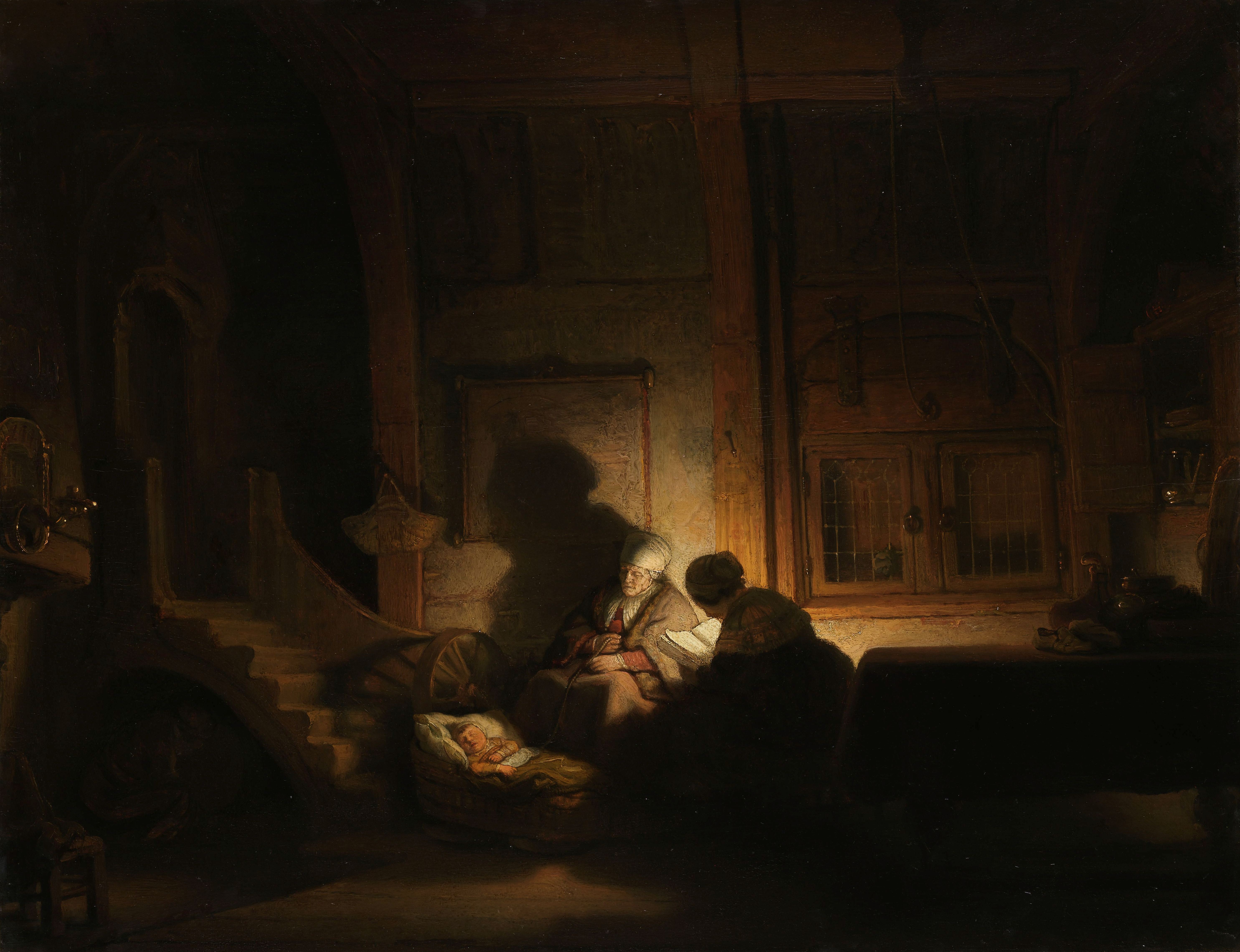
Workshop of Rembrandt van Rijn, Holy Family at Night, ca. 1642–48. Oil on panel, 66.5 × 78 cm. Rijksmuseum, Amsterdam.
During the Dutch Golden Age, the master artist Rembrandt van Rijn (1606–1669) ran a flourishing workshop in Amsterdam, overseeing the production of students’ paintings that continued the deep chiaroscuro and distinctive application of paint seen in his own work.
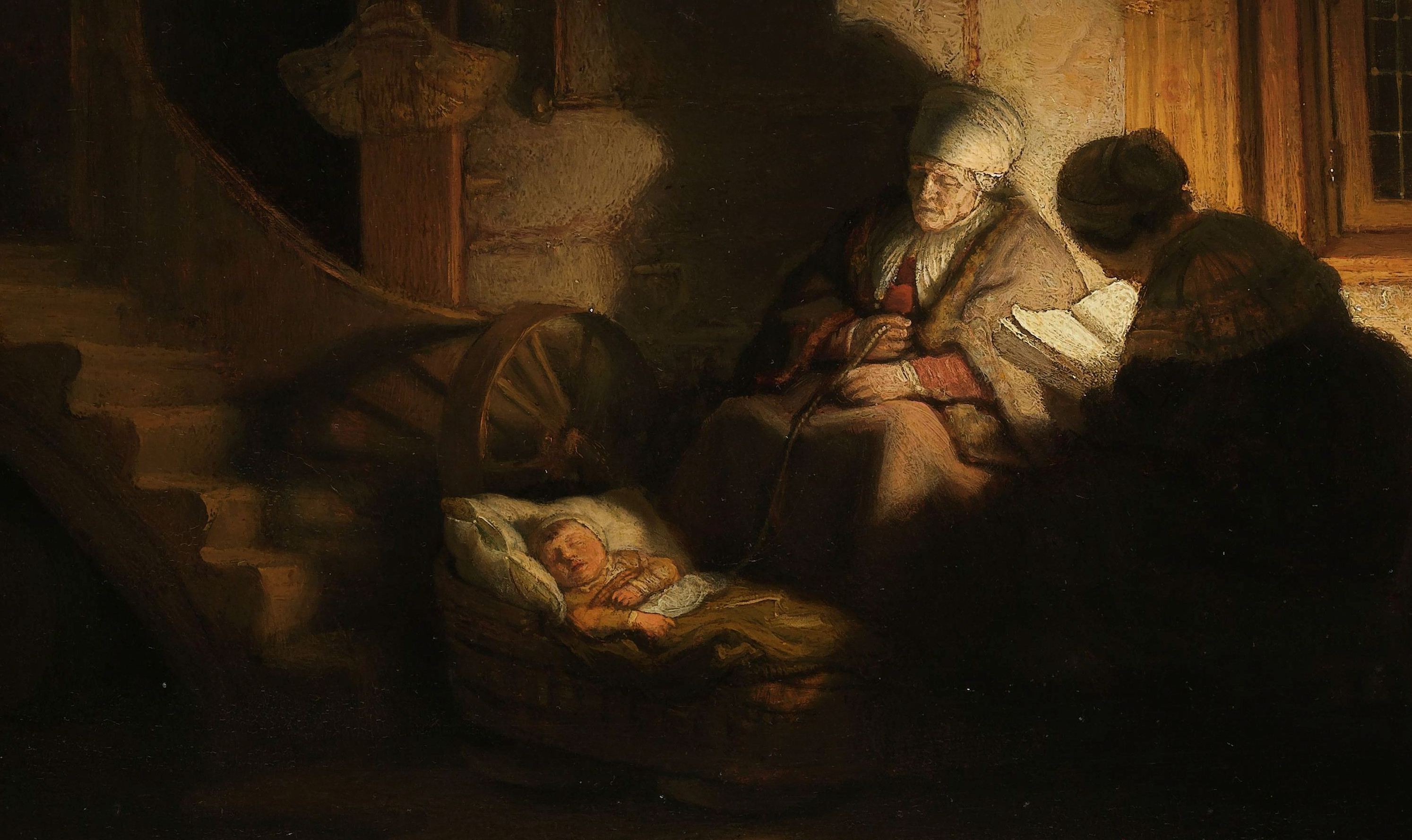
This painting from his workshop shows the Holy Family in a sparsely lit domestic interior at night. The Christ child lies asleep in a wicker cradle at the foot of a half staircase, his grandma Anne likewise nodding off as she rocks him gently with the cradle rope. Relieved by the quiet, Jesus’s mom, Mary, catches up on some reading, and Joseph taps liquid from a barrel on the left under the stairs (he’s very difficult to make out through the shadows).
This lived-in room is full of everyday objects from seventeenth-century Holland. Over the hearth on the left a copper candlestick holder is affixed to the wall. Behind Anne is a map, and beside her a spinning wheel, and a wicker basket hangs from the nail of a curved wooden beam. On the table to the right are a pair of old shoes, a flask attached to a leather belt, and a mortar and pestle, and a Jan Steen jug and other kitchenware are stored in the cupboard above. The shutters are drawn closed over the window. How utterly ordinary!
Although scholarly opinion since 1900 has identified the figures as biblical ones (the title is not the artist’s, as artists did not title their paintings at the time), for much of the painting’s history viewers interpreted it as simply a genre scene—that is, a scene showing regular people going about their daily lives. It lacks the “distinction, nobility, and loftiness” owed to biblical subject matter, it was believed, especially the Holy Family. There are no angels, no haloes. The only hint of sacredness is the pouring of light from a mysterious unknown source.
But the ordinariness of the scene depicted is precisely what makes it so glorious. Jesus was born into a working-class family. For most of his life he labored as a carpenter, adopting Joseph’s trade. He wasn’t surrounded by lavish things. His upbringing looked much like that of all the other Jewish boys in Nazareth. That he was God incarnate would be revealed in time, to those who had eyes to see. But in the meantime, he cooed and pooed and cried and slept and fed and spit up like any other baby! And his mom was exhausted like any other mom, forced to sneak in some time for herself (including private devotional time, as she’s probably reading her Bible here) wherever she could, between childcare, chores, and other obligations.
That God chose to come to us as an ordinary human being born to an ordinary family (albeit conceived in an extraordinary way!) surprised everyone. The song that follows extends the surprise of the Incarnation into God’s other interventions in our lives, on a more personal scale. Just as he defied expectations in his first coming, so he often continues to surprise us in the ways he comes to us now—that is, not according to our own prescriptions, but down his “own secret stair,” when and where we’re least expecting it.
LISTEN: “That Holy Thing” | Words by George MacDonald, 1877 | Music by Katy Wehr, on In Others’ Words, 2008
They all were looking for a king, To slay their foes, and lift them high: Thou cam’st a little baby thing That made a woman cry.
O Son of Man, to right my lot Naught but thy presence can avail; Yet on the road thy wheels are not, Nor on the sea thy sail.
My how or when thou wilt not heed, But come down thine own secret stair, That thou mayst answer all my need, Yea, every bygone prayer.
This song is a setting of a poem written by George MacDonald (1824–1905) in December 1877 and sent by letter to a handful of friends.* When it was first published in 1893 in the two-volume Poetical Works of George MacDonald, it was with this revised final stanza:
My fancied ways why shouldst thou heed? Thou com’st down thine own secret stair; Com’st down to answer all my need, Yea, every bygone prayer!
The poem appears in the highly influential Oxford Book of English Verse (1900), compiled and edited by Arthur Quiller-Couch, but in its original form.
“That holy thing” is a translation of the Greek word hagios, which appears in Gabriel’s speech to Mary in Luke 1:35: “that holy thing which shall be born of thee shall be called the Son of God.” Educator Missy Andrews unpacks the poem:
In “That Holy Thing,” MacDonald meditates on man’s expectations and God’s will. In the first line of the poem, the poet remembers the first-century Jews who suffered under Roman occupation, waiting for the Messiah who would restore the throne of David to Israel. He acknowledges their plight and their expectation, contrasting it with what they in fact received. The baby Christ represented both a gracious answer to their need, and an immediate disappointment. He satisfied the deepest intentions of their prayer and Yahweh’s ancient prophecies, but frustrated their earthy expectations for geographic kingdoms and vindication. Not only that, but the baby King “made a woman cry.” This references not only the immediate suffering and travail of the Christ Child’s mother, Mary, but ultimately the suffering that would rend her heart when He himself was lifted high upon the cross in answer to their desperate prayer for triumph over their foes.
The poet notes that his own travails and petitions, his own desperate need of God’s intervening help, is denied in its immediacy as well. For, although the Son of Man’s own presence alone can help to “right the lot” of the poet, his coming is not visible by road or sea. In this way, MacDonald acknowledges that his own expectations, like those of his spiritual forebears, eclipse his ability to see the Lord’s coming in his own circumstances. He acknowledges the differences between God’s ways and man’s, in faith acknowledging that the Lord answers man in his own ways and times, keeping secret His approach, but stealthily accomplishing man’s every need, answering his every prayer through the mystery of incarnation. This incarnate Child, the Son of Man, replete with humanity and no stranger to suffering, suggests a remedy for all who wait and suffer.
Andrews is a founding director of CenterForLit, whose goal is “to bring readers face to face with the world’s best books so they can know themselves more fully as God’s creatures.” The center has a special emphasis on equipping parents to teach the classics to their kids.
The commentary above is excerpted, with Andrews’s permission, from the first post of twenty-five published in Advent 2015 for the CenterForLit’s “Literary Advent” blog series (which is excellent!). Andrews provides interpretations of poems by John Donne, Madeleine L’Engle, Gerard Manley Hopkins, T. S. Eliot, W. H. Auden, and more, combining literary analysis and theological reflection. You can enjoy Andrews’s series in print form with the book Wild Bells: A Literary Advent.
Kathryn Wehr, PhD, is a singer-songwriter whose most recent album, which leans folk rock in style, is And All the Marys: Women Encountering Christ in the Gospels (2018).
Besides being a musical artist, Wehr is also a scholar whose interests include theology and the arts, spiritual formation, and church history. Her specialization is the religious drama of Dorothy L. Sayers, and as such, she is the editor of the forthcoming book The Man Born to be King, Wade Annotated Edition(IVP Academic, 2023). In addition, she is the managing editor of Logos: A Journal of Catholic Thought and Culture at the Center for Catholic Studies at the University of St. Thomas in Saint Paul, Minnesota.
* Thank you to the Special Collections & University Archives at Taylor University, through whose British Author Collections I discovered this earlier composition date for the poem, as well as an authoritative version of stanza 3 from MacDonald’s own hand. They provided me with a scan of one of MacDonald’s handwritten copies of “That Holy Thing” (Ref. ID 482), which contains the headnote “Written for my friends—Christmas, 1877.”
Antony Gormley (British, 1950–), Blind Light, 2007. Fluorescent light, water, ultrasonic humidifiers, toughened low-iron glass, aluminum, 320 × 978.5 × 856.5 cm. Temporary installation at the Hayward Gallery, London. Photo: Stephen White.
Sir Antony GormleyOBERA is a leading contemporary sculptor and installation artist whose work focuses on the human figure. His Blind Light installation from 2007 consists of a large semitransparent glass chamber lit by fluorescent light and filled with a dense cloud of mist. “Upon entering the room-within-a-room, the visitor is disoriented by the visceral experience of the fully saturated air, in which visibility is limited to less than two feet.”
One visitor took a two-minute video of the experience:
Architecture is supposed to be the location of security and certainty about where you are. It is supposed to protect you from the weather, from darkness, from uncertainty. Blind Light undermines all of that. You enter this interior space that is the equivalent of being on top of a mountain or at the bottom of the sea. It is very important for me that inside it you find the outside.
Sometimes the human experience feels like a groping through fog. It’s hard to see the bigger picture. The not-seeing can be frustrating. There is a doorway leading out into the clear, into full vision—but our passage through isn’t granted us until the general resurrection. Meanwhile, “we walk by faith” (2 Cor. 5:7), stumbling alongside one another through mists of unknowing, but with God’s word and Spirit as guides, giving us glimpses of clarity and confidence to step forward. “For now we see through a glass, darkly; but then face to face,” the apostle Paul writes in anticipation of the day of the Lord. “Now I know in part; but then shall I know even as also I am known” (1 Cor. 13:12).
I’m quiet in cloudy waiting Assured of little but weaknesses Of faith and seeing And I’m wanting only to be filled In this day
And I know you’re coming soon But would you show me where you are right now In cloudy waiting
I’m craving the clouds of your returning Assured of little but a strength Beyond faith and seeing But I’m wanting only to be filled I’m wanting only to be stilled In this day
I know you’re coming soon But would you show me where you are right now In cloudy waiting
I’m hopeful for the fruits of faithfulness But they are slow in their growing And I’m quick to accuse When heavy silence comes
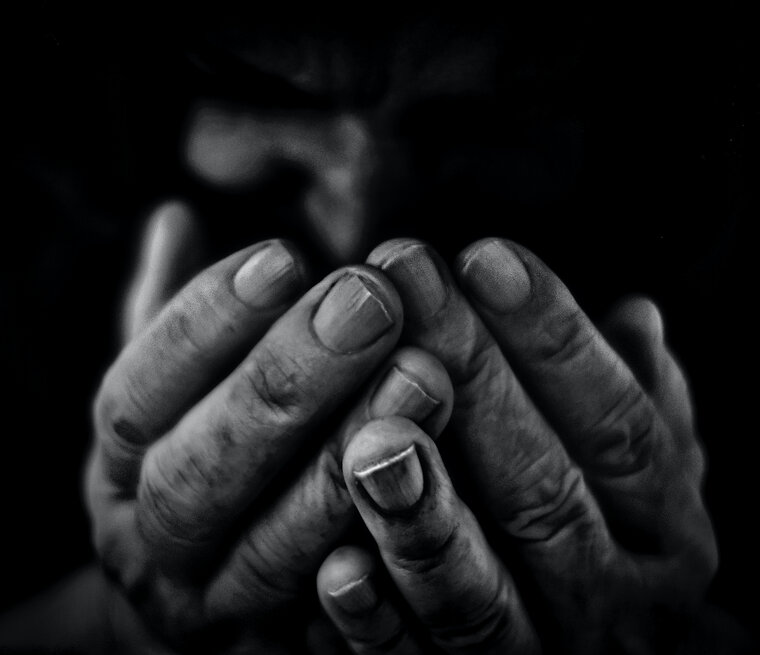
Anila Hussain, God Heals, metallic black and white print on Fujifilm paper with frame, 50 × 50 cm
A finalist for the 2021 Chaiya Art Awards, this black-and-white photograph shows a person at prayer, her hands cupped, anticipating in faith the receipt of what she’s asked for but open to whatever God gives. The woman pictured is photographer Anila Hussain’s eighty-something-year-old mother, who has suffered for years from chronic pain and prays multiple times a day for relief. Hussain is her primary caregiver.
With the woman’s face in the shadows and her rough, overlapping hands illuminated, closely cropped, and in the foreground, God Heals emphasizes a posture of humble and heartfelt entreaty.
Born in Germany and raised in Ecuador, siblings Nikolai, Lucía, Marie-Elisée, and Mirjana Gerstner form the sacred vocal quartet Harpa Dei. Here they sing a traditional chant invoking Christ’s return in ten languages, shifting voice parts and harmonies to beautiful effect. The lyrics are in the video and also below.
Māranā thā is Aramaic (the language of Jesus) for “Come, O Lord.” Christians have prayed this prayer since the apostolic era, looking toward the cosmic healing and restoration that Christ’s second coming will usher in.
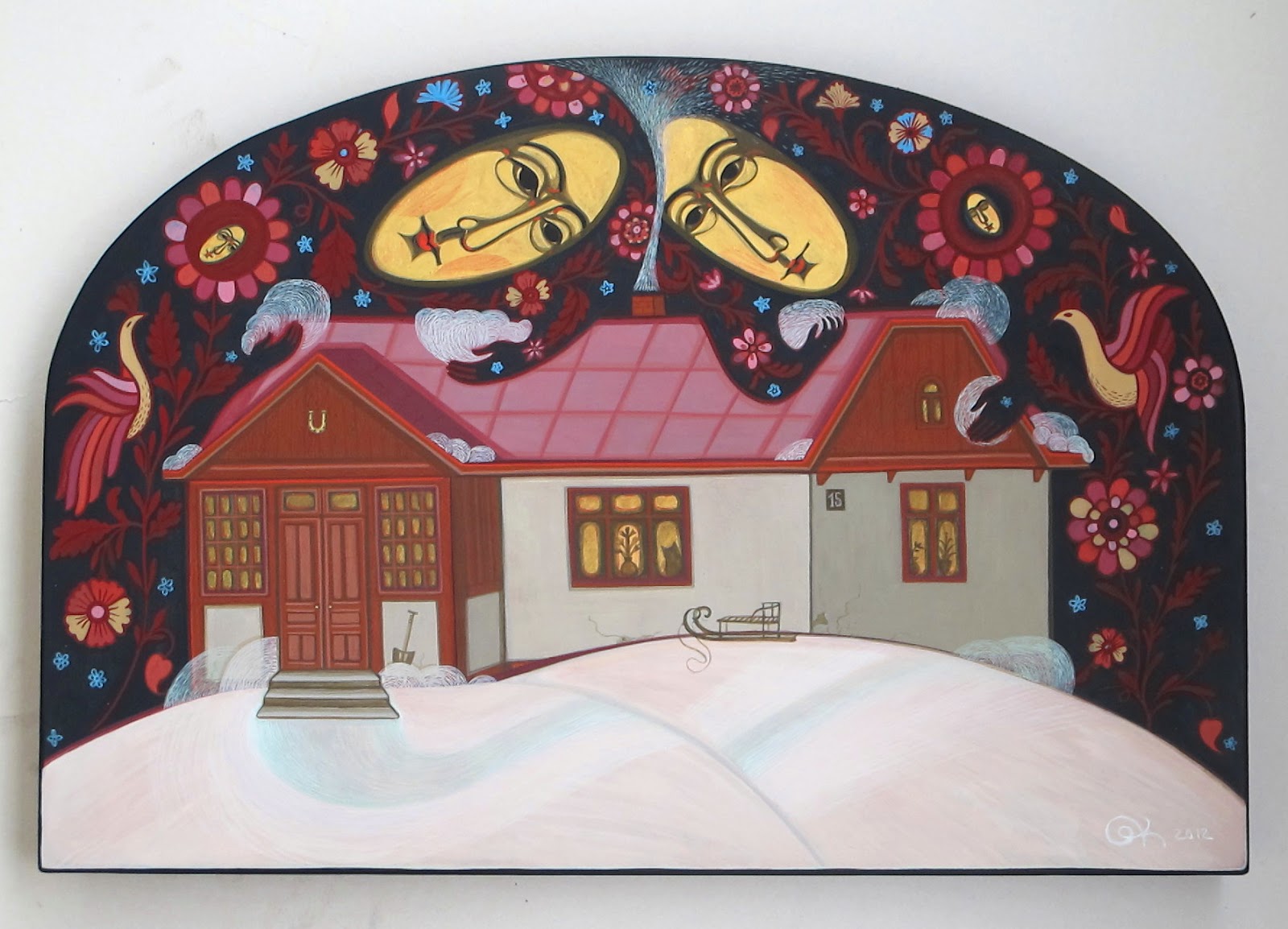
Olya Kravchenko (Ukrainian, 1985–), Home, 2012. Egg tempera on gessoed board, 29 × 39.9 cm.
This painting shows a cottage on a snowy hillside at night. Inside, a fire is lit in the hearth, casting a warm glow and sending smoke rising up the chimney. There’s a cat in the window and a sled on the lawn.
On all sides, the sky is populated by a mystical swirl of birds and flowery tendrils and angelic beings. Two of those angels, represented by large golden heads, hold wisps of snow in their hands and embrace the house, offering a protective presence.
Sadly, this cozy winter idyll is elusive for many this year, not least those in Ukraine, where this painting comes from. Many Ukrainians have had to flee their homes to evade the encroaching Russian troops. Others are dealing with the trauma of having lost family members in the war, or the fear of having loved ones on the front line.
LISTEN: “Jul, Jul, Strålande Jul” (Christmas, Christmas, Glorious Christmas) | Words by Edvard Evers, 1921 | Music by Gustaf Nordqvist, 1921 | Performed by Zero8 on A Zero8 Christmas, 2011 (YouTube: 2016)
Jul, jul, strålande jul, glans över vita skogar, himmelens kronor med gnistrande ljus, glimmande bågar i alla Guds hus, psalm som är sjungen från tid till tid, eviga längtan till ljus och frid! Jul, jul, strålande jul, glans över vita skogar!
Kom, kom, signade jul! Sänk dina vita vingar, över stridernas blod och larm, över all suckan ur människobarm, över de släkten som gå till ro, över de ungas dagande bo! Kom, kom, signade jul, sänk dina vita vingar!
Christmas, Christmas, glorious Christmas: shine over white forests, heavenly crowns with sparkling lights, glimmering arcs in the houses of God, hymns that are sung throughout the ages, eternal longing for light and peace! Christmas, Christmas, glorious Christmas, shine over white forests!
Come, come, blessed Christmas: lower your white wings, over the battlefield’s blood and cry, over the sighs from the bosoms of men, over the loved ones who’ve gone to their rest, over the daybreak of newborn life! Come, come, blessed Christmas: lower your white wings!
“Jul, Jul, Strålande Jul” is one of the most widely sung Swedish Christmas songs. It personifies Christmas as a luminous winged being, asks it to descend over our wooded neighborhoods and over our songs and our longings, dispensing blessing; to extinguish our wars and raging and spread its comforts over our anxieties and losses; and to cradle the new lives that have been born this year, reminders of innocence and signs of hope for a future.
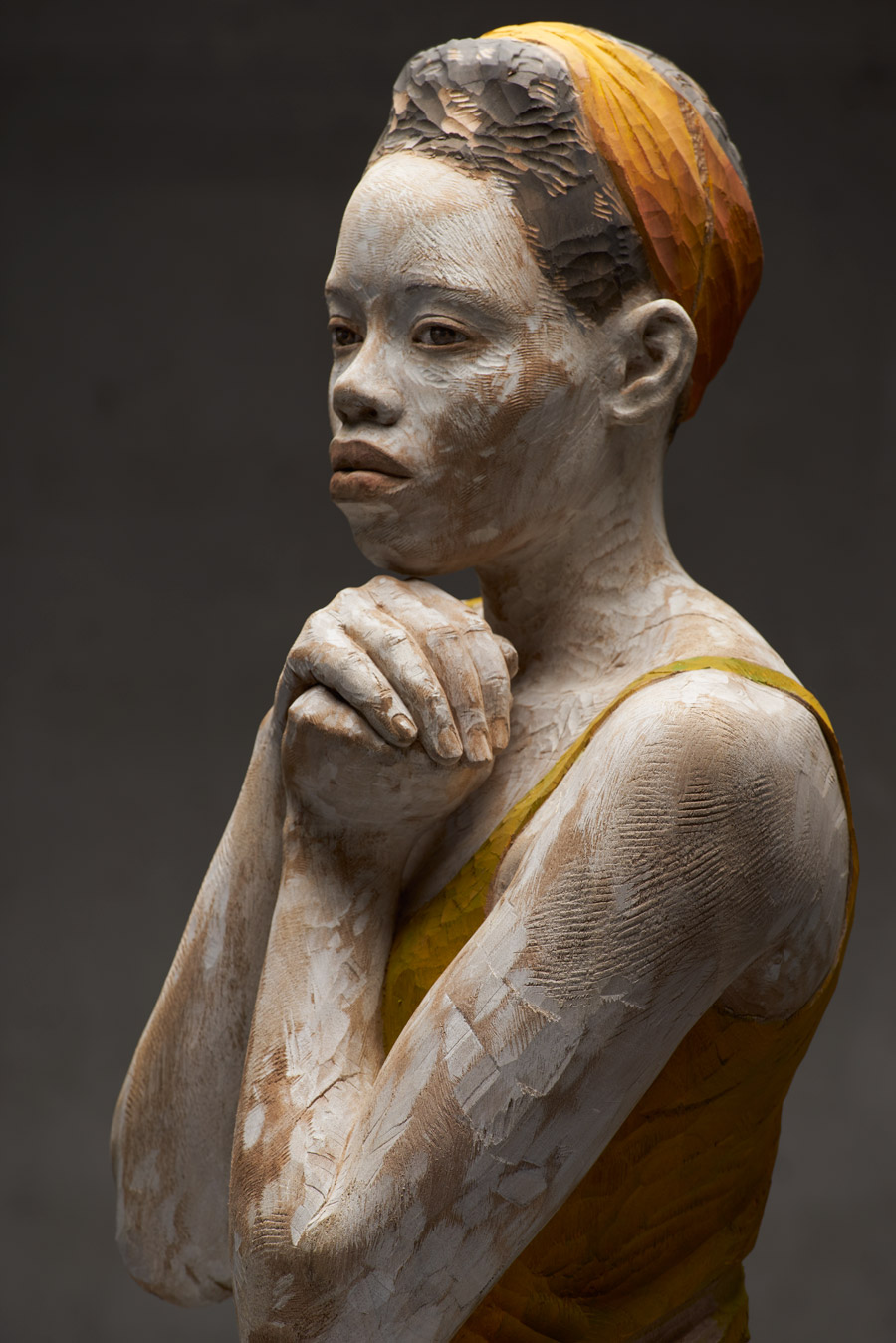
Bruno Walpoth (Italian, 1959–), Lontane speranza (Distant Hope), 2015. Nut wood, 80 × 41 × 32 cm.
LISTEN:“Come Light” by Gregory Thompson, on Lamentations by Bifrost Arts (2016)
Kindle the flint, the tinder Liven the hearth, the stone Shelter the dying lantern light Gladden the shadowed home Into this wilderness of shadows Come, Light original
Answer our famine yearning Nourish our blighted fields Raise all our fallen storehouses Leaven the bitter yield Into this emptiness, this hunger Come, Bread all-bountiful
Out of the blowing starlessness Over the frozen sea Into our barren midnight Up from the fruitless trees O come
Loosen the cloaks of journeymen Mend all the broken roads Wake us from fitful forest sleep Lighten the lonely load Into this pilgrimage, this journey Come, Home perpetual
Dr. Gregory Thompson is a minister, civil rights scholar, author, and producer whose work focuses on race and equity in the United States. He was the senior pastor of Trinity Presbyterian Church in Charlottesville, Virginia, when the music collectives Bifrost Arts and later the Porter’s Gate were founded by Trinity worship arts director Isaac Wardell, and Thompson’s leadership was deeply influential in that work. His contributions to those two music projects extend even to the writing or cowriting of some of the songs that made it onto the albums: “The Zacchaeus Song” (Justice Songs), “O Jerusalem” (Lament Songs), and of course “Come Light” (Lamentations). The latter two he sings on the recordings.
“Come Light” is poetry as prayer. Come, Light of Light, into our shadowy wilderness. Come, all-bountiful Bread; feed our hunger. Come lighten our loads and make straight our paths as we journey Home into your very heart. Such beautiful words, full of yearning, enhanced by the plaintive tune that carries them.
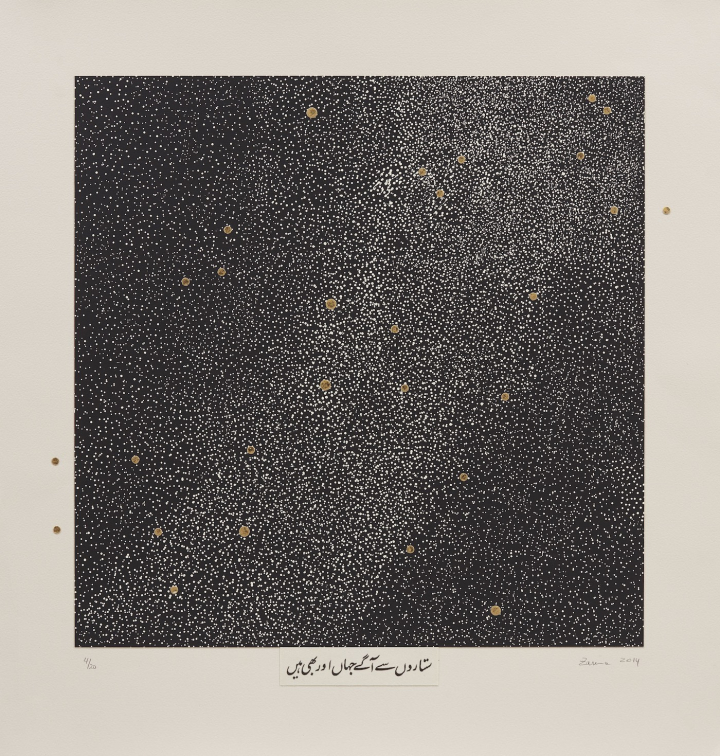
Zarina (Indian American, 1937–2020), Beyond the Stars, 2014. Woodcut printed on BFK light paper collaged with gold leaf and Urdu text, mounted on Somerset Antique paper, 24 × 23 in. Photo: Farzad Owrang.
Printmaker Zarina Hashmi, who preferred to identify herself professionally by her first name only, was born and raised in the small university town of Aligarh, India, and was displaced to Karachi, Pakistan, after the partition of India in 1947. She had a cosmopolitan education, studying woodblock printing in Bangkok and Tokyo and intaglio in Paris. At the beginning of her career she moved to New York, living and working there for forty years before finally moving to London in 2018 to be near family. She passed away two years later.
In Beyond the Stars Zarina shows, through the medium of woodcut, the glory of a night sky. Innumerable stars dot the black ink, as do a smattering of small 22-karat gold orbs that could be read as angels or as the divine presence made visible.
LISTEN: “All Shall Be Well” by Jill McFadden, on Good News by Ordinary Time (2016)
He called him into the night, said Abram, count the stars so bright Through you true peace will come To every tribe and tongue Though no one knows my Name Blessing is coming all the same
And all shall be well
Now many years went by Of withered hopes, unanswered cries Till one night a virgin heard A cry that broke the silence of God That star above them bright Had shone for Abram that night This child so weak, so small Brings peace and rest to all
And all shall be well (2×)
The years unending seem Here in this in between “Peace on earth, God’s will for men” Seems like it came and went The wars, they linger on The darkness overcomes We need not stars but sun Break in, O Coming One Sometimes we cannot tell That You will make all well
But all shall be well All shall be well
Jill McFadden is one-third of the sacred folk band Ordinary Time. She wrote the song “All Shall Be Well” for a Lessons and Carols service, to correspond with the Genesis 22 reading (cf. Gen. 15), where God tells Abraham, “I will indeed bless you, and I will make your offspring as numerous as the stars of heaven and as the sand that is on the seashore . . . and by your offspring shall all the nations of the earth gain blessing for themselves” (vv. 17–18).
This covenant extended down through the ages, reaching fruition many generations later in the person of Jesus of Nazareth, the Promised One from of old and on high, born to make all things well. As the song’s lyrics put it: “many years went by of withered hopes, unanswered cries, till one night a virgin heard a cry that broke the silence of God.” That is, the cry of Mary’s newborn son, whom the angel Gabriel called the “Son of the Most High” and said would establish a kingdom that has no end (Luke 1:32–33).
The Star of Bethlehem, the song says, was one of the millions present when God first promised to bless the world through Abraham’s seed, and now it burns particularly bright over the spot where that blessing is enfleshed in a brand-new and earthshaking way—for the babe in the manger is God incarnate.
But has all really been made well by God’s coming in Christ? There’s still violence and sin and pain and relational fracture. Where’s the peace?
The third stanza of “All Shall Be Well” entreats Christ’s second coming. It laments how peace and light seem elusive here on earth and asks God to make good on his ancient promise. Show us the blessing! Show us the new day, that universal redemption. We’ve received foretastes, but we want to sink our teeth into the whole magnificent meal.
The refrain is a reassurance rooted in God’s steadfast love and faithfulness: “All shall be well.” No matter how far-off that total wholeness feels for you, know that it’s written in the stars, so to speak. The God who created everything good will make it good again as he promised. Until then, we continue to hope and pray, work and wait.
If you would like a harmonized lead sheet, chord chart, and/or string parts for this song, email info@ordinarytimemusic.com, and Jill will make them freely available to you.
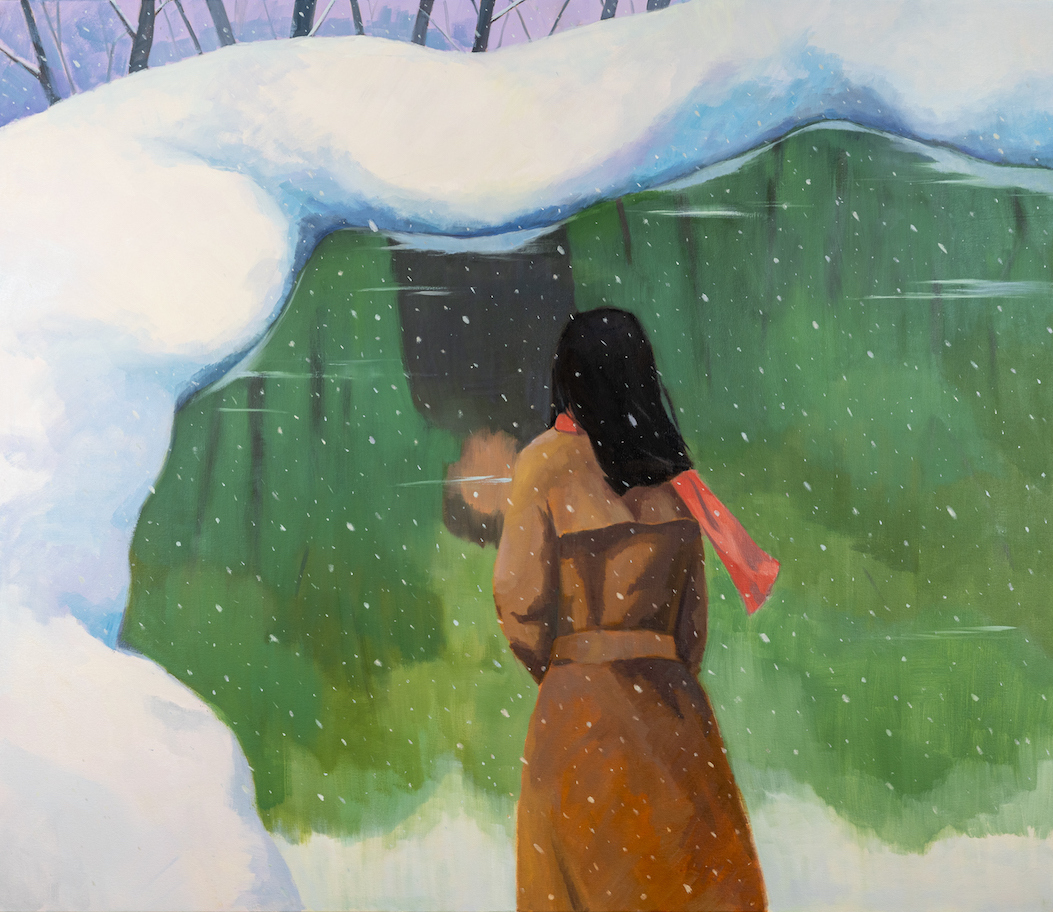
Yuri Yuan (Chinese American, 1996–), Norwegian Wood, 2020. Oil on canvas, 63 × 73 in.
This painting by New York–based artist Yuri Yuan shows a woman in a belted brown trench coat, her back to us, standing at the edge of a frozen pond. A small gust of snowy wind whips her hair and scarf. Though her face isn’t visible, she appears to be deep in thought.
Reflected on the pond’s surface is a man dressed in black. We don’t see his physical form, and his features are indistinguishable in the mirroring ice. Who is he? Does he wish to speak to the woman? Does he come with news, or an invitation, perhaps? Or simply to wait with her in silence?
There’s a mystic quality to the image that’s heightened by the incongruity between the environment and its reflection. In the upper left, the trees are barren and dusted with the white of winter, and indeed the woman is dressed for the cold. And yet in the trees’ reflection in the pond, they are in full foliage, leafy green, as if it were summer.
It’s as if two worlds are converging here in this wood. Or the woman foresees, with the eyes of her spirit, a lushness that has not yet come to pass.
Notice how the snowbanks piled up along the water’s edge could almost double as clouds, particularly in the bottom left, where the white mass meets the sky’s reflection. The heavens and the earth becoming one.
I chose this image to kick off the Advent season (which begins tomorrow) because it captures the sense of longing that the church leans into most especially during these four weeks, but also the sense of promise, the possibility, that’s just as characteristic of the season. In the eschatological reality that Israel’s prophets foresaw, the barren becomes verdant and the dead come to life. “The wilderness and the dry land shall be glad; the desert shall rejoice and blossom” (Isa. 35:1).
Strangely, Norwegian Wood is a painting of both absence and presence, distance and nearness.
If you like, imagine Yuan’s mystery man as God coming close—which is what the Incarnation is: God coming closer than close!
What invitation might God have for you this Advent? What heartache from the past year, or even further back, do you need to bear to the Healer? What hopes do you need to speak out loud?
We wait, we hope We yearn, prepare For who or how or what or where? Maybe the changing of the tide Maybe the turning of someone’s eye Maybe the falling of the snow Only heaven knows What happens when God comes close
We wait, we hope We yearn, prepare For who or how or what or where? Maybe the healing of a heart Maybe reunion of a drift apart Maybe a child’s coming home Only heaven knows What happens when God comes close
We wait, we hope We yearn, prepare For who or how or what or where? Maybe the song, a place to belong Maybe some faith, just a touch of grace Maybe love, it’s rarely what we think of Only heaven knows What happens when God comes close
This is the first post in a daily series that will extend to January 6. You are welcome to subscribe via email or RSS, but posts are optimized for viewing on a web browser. (And note that Gmail sends WordPress posts to your Social tab, unless you create a filter to tell it otherwise.) Links will be shared on Facebook and Twitter.




 Art & Theology