Advent, Day 10: Coming on the Clouds

As I watched in the night visions,

I saw one like a son of man
    coming with the clouds of heaven.
And he came to the Ancient One
    and was presented before him.

—Daniel 7:13

“Immediately after the suffering of those days

the sun will be darkened,
    and the moon will not give its light;
the stars will fall from heaven,
    and the powers of heaven will be shaken.

“Then the sign of the Son of Man will appear in heaven, and then all the tribes of the earth will mourn, and they will see ‘the Son of Man coming on the clouds of heaven’ with power and great glory. And he will send out his angels with a loud trumpet call, and they will gather his elect from the four winds, from one end of heaven to the other.”

—Matthew 24:29–31

“. . . you will see the Son of Man
    seated at the right hand of Power
    and coming on the clouds of heaven.”

—Matthew 26:64

Look! He is coming with the clouds;
    every eye will see him,
even those who pierced him,
    and all the tribes of the earth will wail on account of him.

So it is to be. Amen.

—Revelation 1:7 (cf. Zech. 12:10)

(Related post: https://artandtheology.org/2023/12/12/advent-day-10-lo-he-comes/)

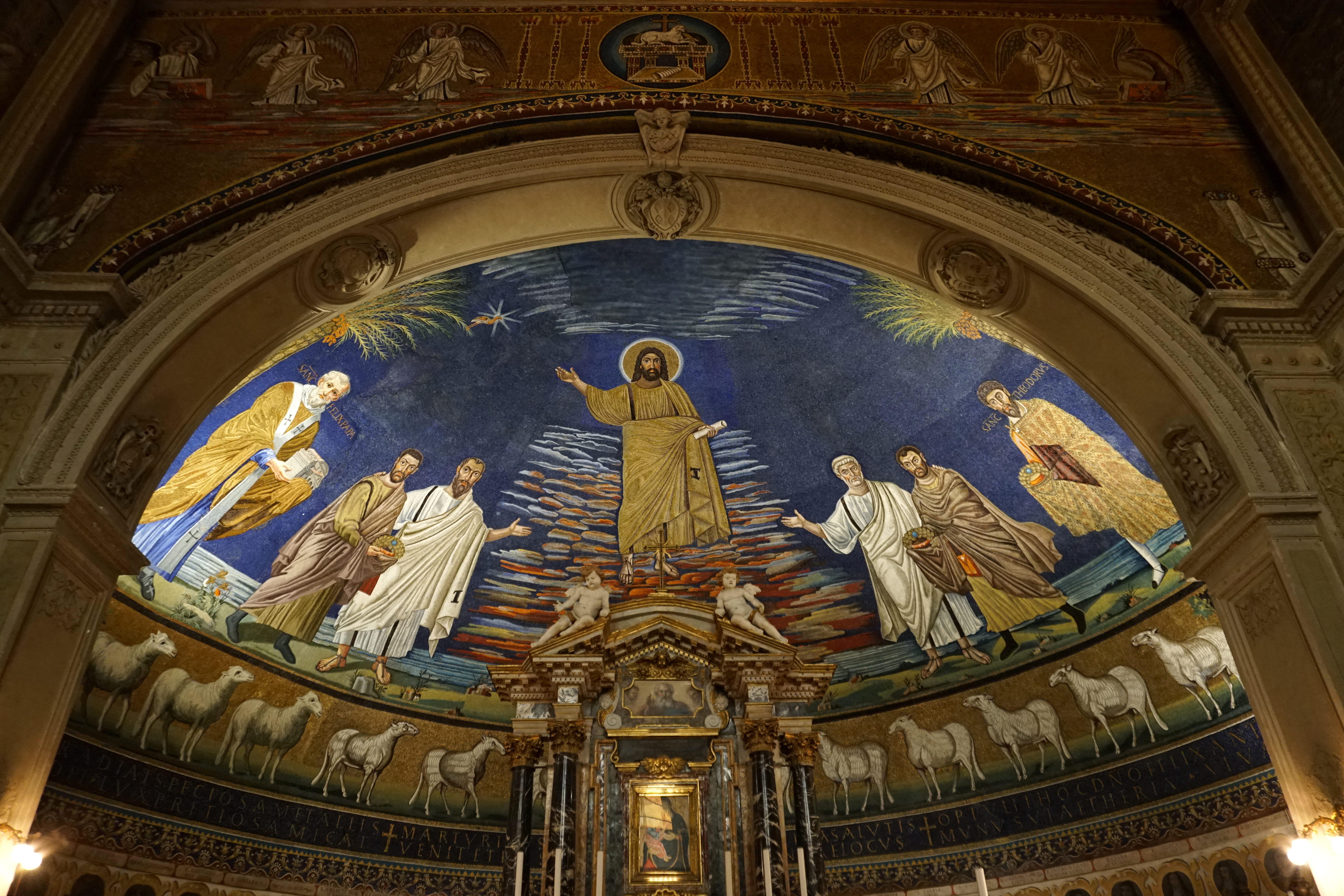
LOOK: Apse mosaic, Basilica of Saints Cosmas and Damian, Rome
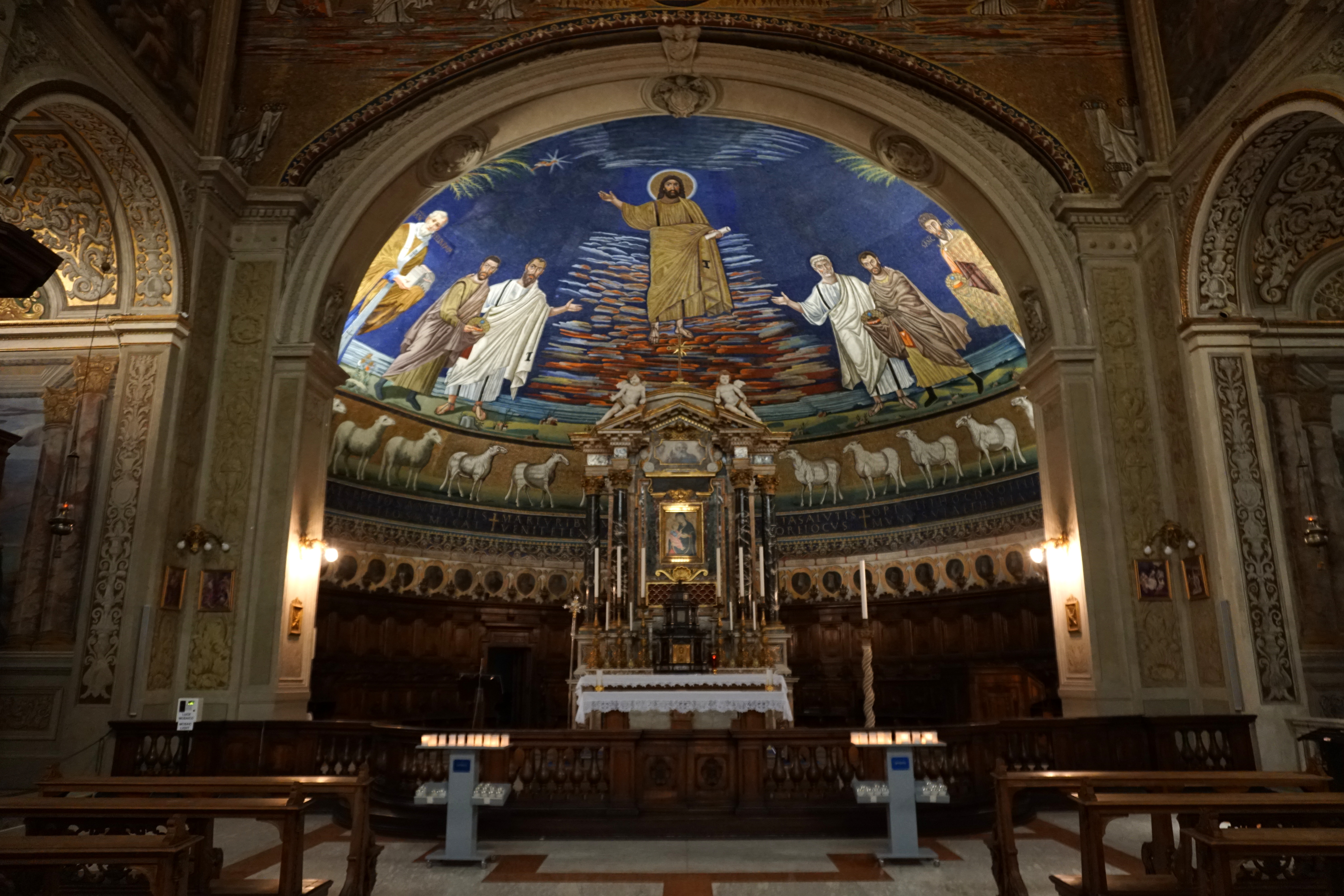
Second Coming of Christ
The Second Coming of Christ, ca. 526–30. Mosaic, Basilica of Santi Cosma e Damiano (Saints Cosmas and Damian), Rome. All photos by Victoria Emily Jones.

Second Coming of Christ

This Roman-Byzantine mosaic decorates the apse (large semicircular recess at the east end of a church) of a basilica in Rome dedicated to the Christian martyr-saints Cosmas and Damian, twin brothers from third-century Arabia. Cosmas and Damian (Cosma and Damiano in Italian) were physicians who, out of love for Christ and humanity, treated their patients free of charge. They were killed in the Diocletian persecution, one of the Roman Empire’s attempts to squelch Christianity.

Situated behind the altar—and partially obscured by a hideous Baroque altarpiece with putti that was added in the seventeenth century—the mosaic depicts the parousia, the second coming of Christ. Christ is bearded and notably dark-skinned, and he wears a golden toga edged with purple. In his left hand he holds a rolled-up scroll, and his right hand he raises to indicate a phoenix in a palm tree—a mythological bird that rose from its own ashes, a potent symbol of resurrection that was adopted by the early Christians.

Descending from the heavens on dramatically colored clouds, Christ is portrayed as a triumphant ruler worthy of worship.
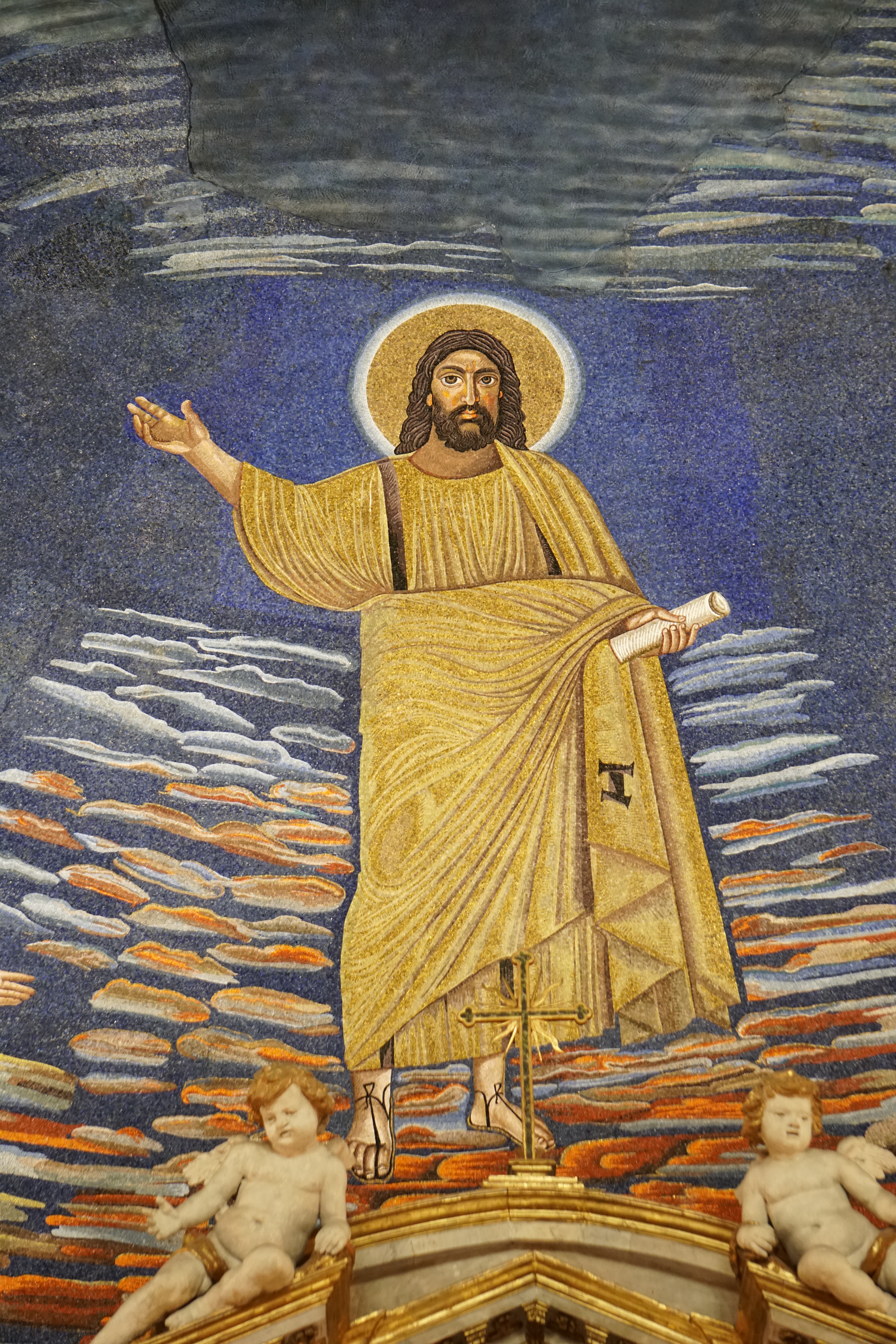
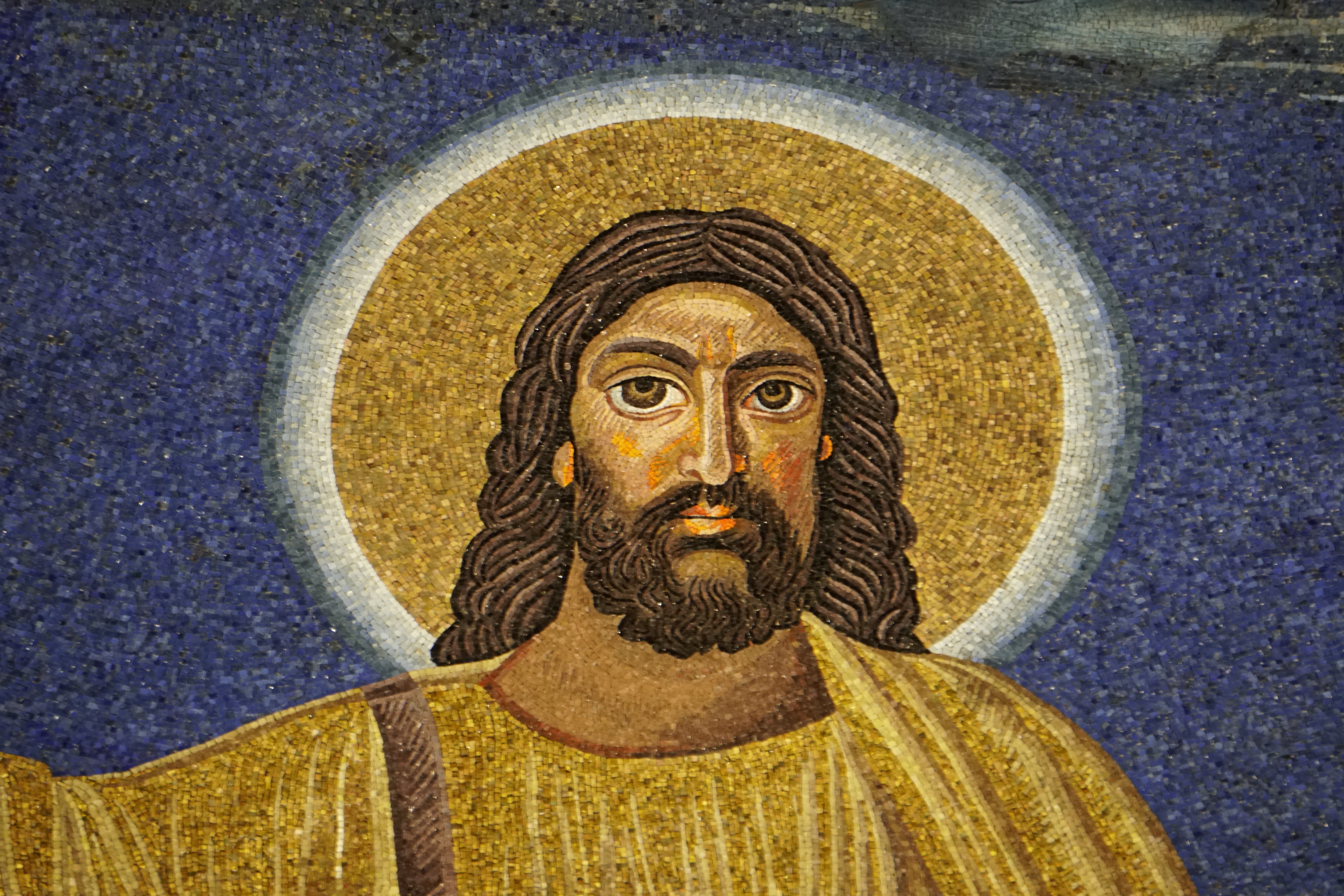
Second Coming of Christ (detail)
Christ mosaic

He is flanked by Peter and Paul, who present Cosmas and Damian. The figures on the extreme left and right are Pope Felix IV (r. 526–30), who paid to convert a pagan temple into the present church and to have it decorated with mosaics, and Theodore, another martyr under Diocletian. Cosmas, Damian, and Theodore lay down the crowns of their martyrdom before Christ, and Felix does the same with a model of the church he built.

The inscription at the base of the mosaic tells us that “Felix has offered this gift worthy of the lord bishop so that he may live in the highest vault of the airy heavens.” (If you balk at that, I do too; that you can buy your way to heaven, that you can earn favor with God or remit your punishment for sin through expensive gifts, is a false belief that still persists today in some corners of popular culture and even the church. I’m grateful for wealthy donors to the church throughout history, whose funds have enabled, among other things, the creation of beautiful art—but I must reckon with the fact that sometimes their motives were misguided and self-serving.)

Below the primary scene is a band of twelve sheep, which represent the apostles, or the Christian flock more generally. They process toward the Agnus Dei (Lamb of God), who stands on a rock from which flow the four rivers of paradise.
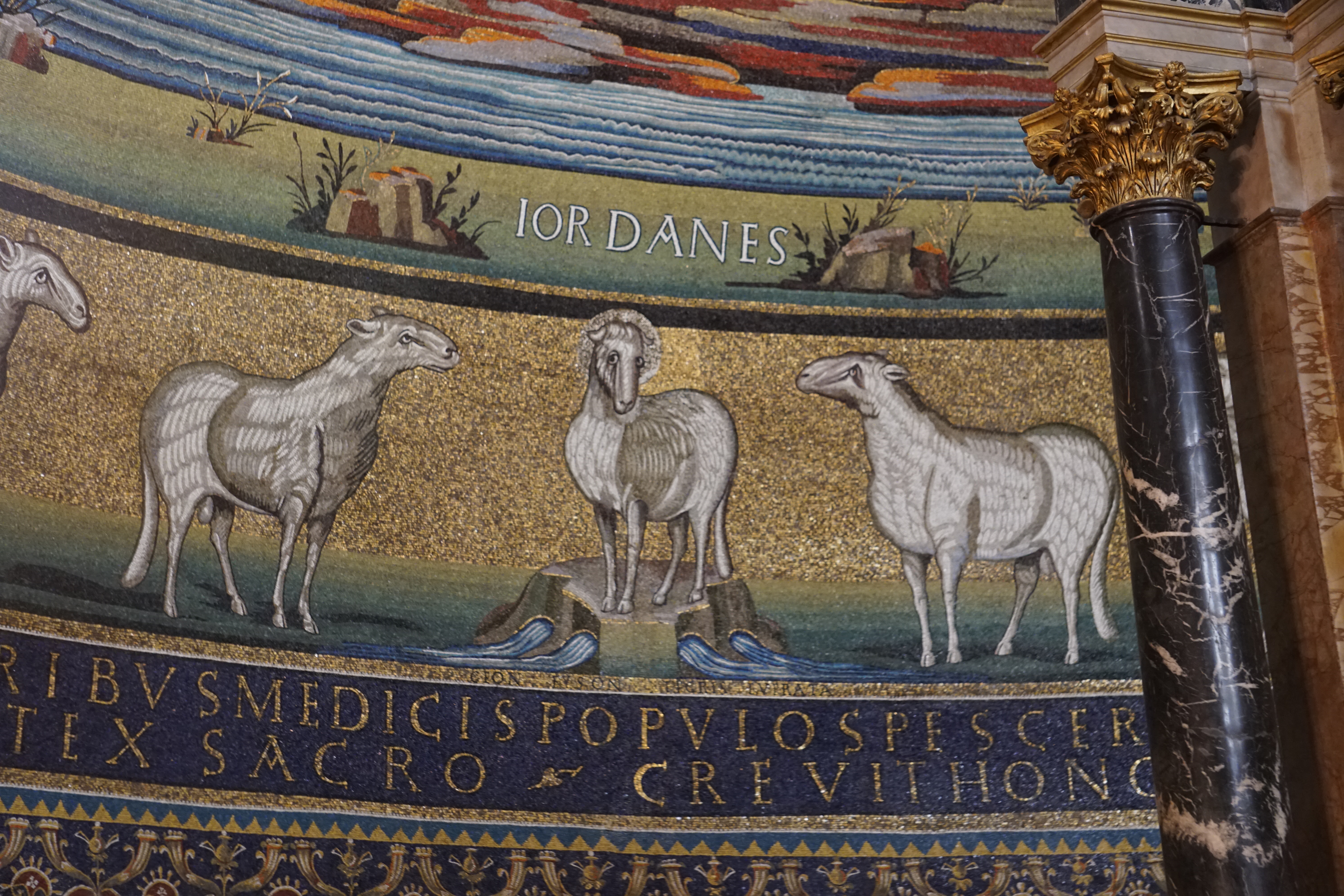
Agnus Dei mosaic

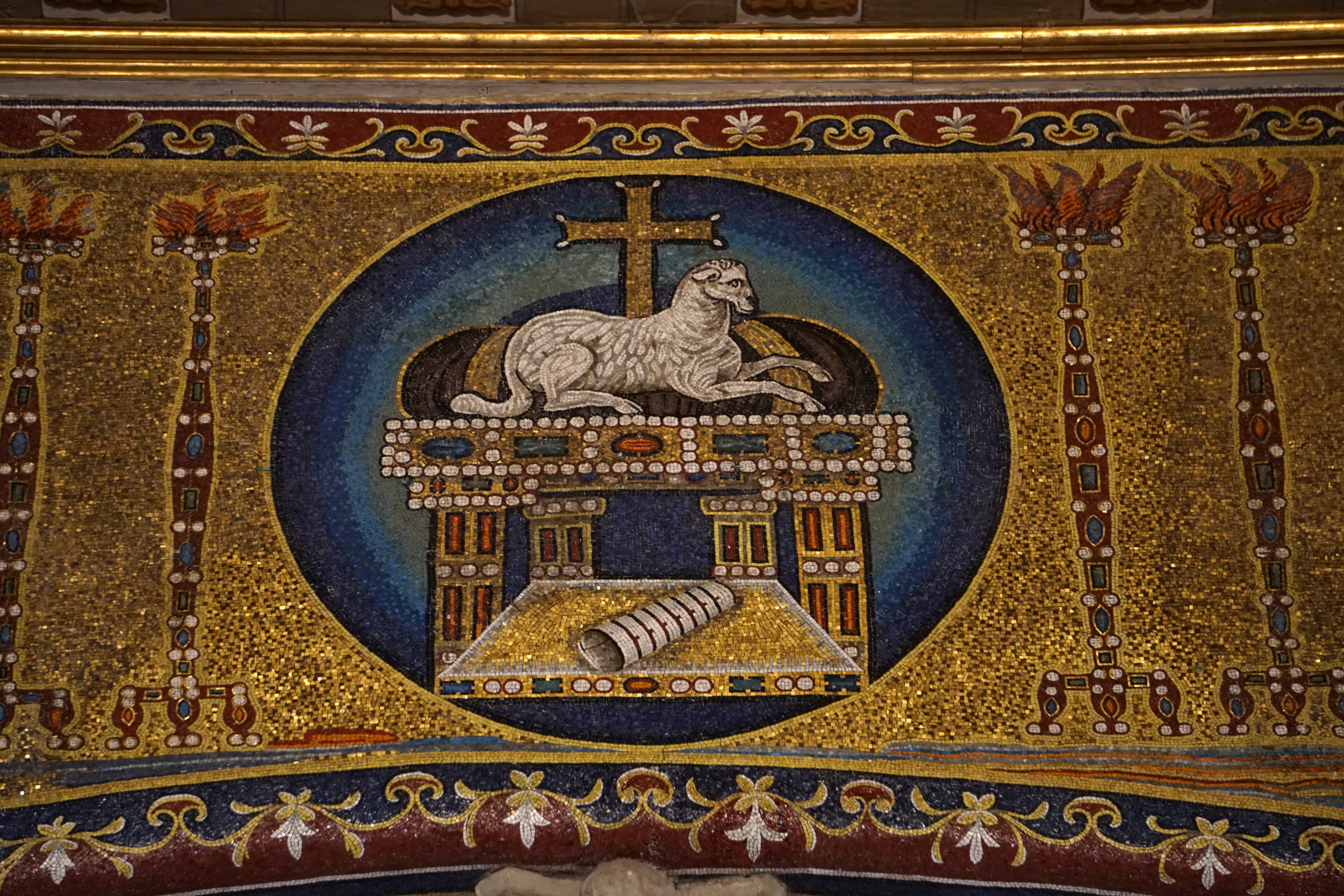
Based on further imagery from the book of Revelation, the arch that frames the apse depicts the Lamb seated upon the throne, a scroll with seven seals laid before him. He is flanked by seven lampstands, angels, and (not pictured) symbols of the Four Evangelists.
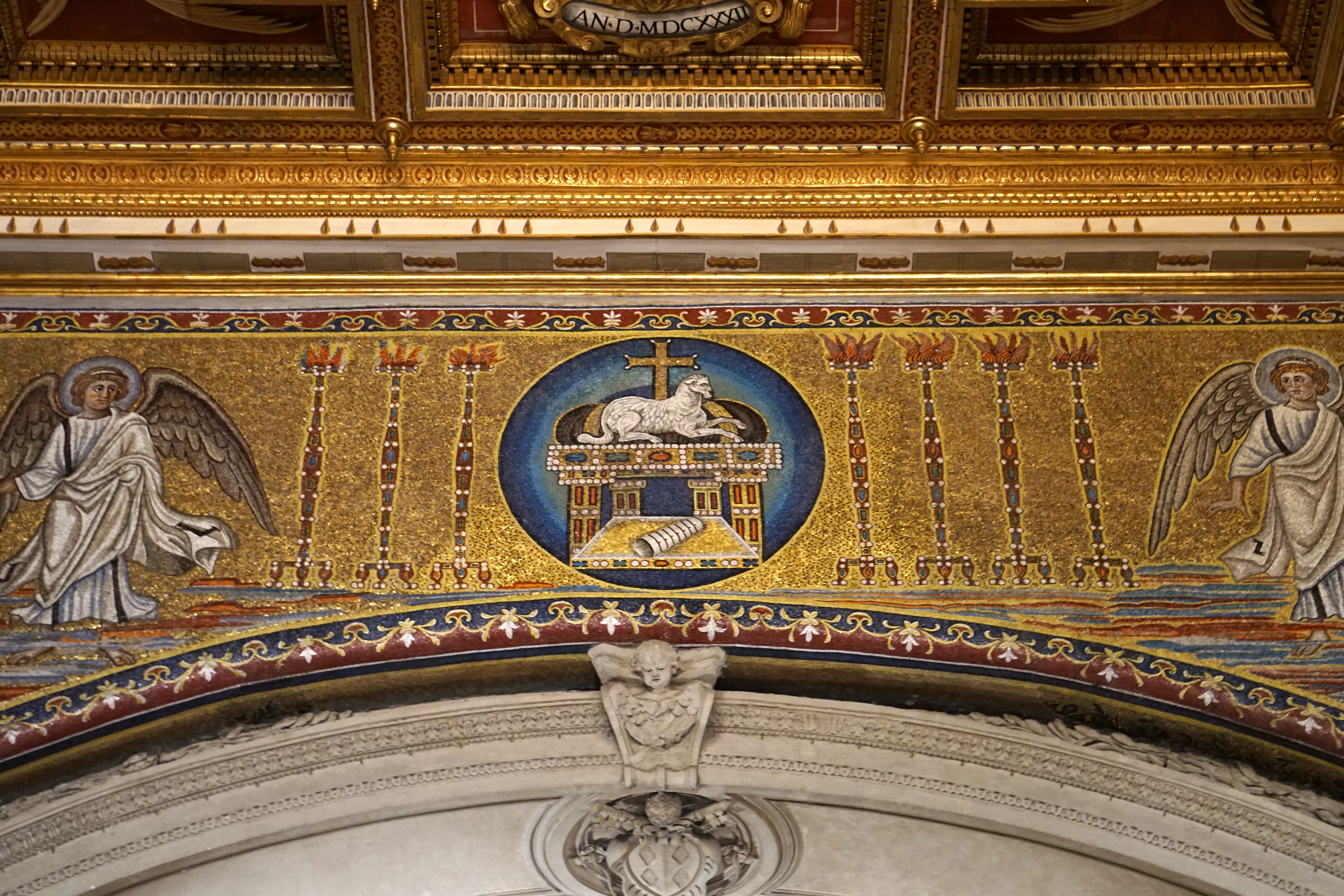
Lamb on the throne
Lamb on the throne (detail)

LISTEN: “God Is Coming on the Clouds” by Brother John Sellers, on Baptist Shouts! and Gospel Songs (1959)

Refrain:
God is coming on the clouds
Yes, he said
God is coming on the clouds
Yes, he said
May be morning, noon, or night
Better get all your business right
God is coming on the clouds
Yes, he said

When the clouds turn dark as night
And there ain’t no light in sight
When the world begins to tremble
Won’t that be an awful night
You better get in a hurry
My Lord is coming soon
Oh, he’s coming on the clouds
Yes, he said [Refrain]

Oh Lord, please give me power
Stay with me every hour
I just been waiting here praying
For your Holy Ghost power
God, you been my friend
I know you freed me from sin
Yeah, you coming on the clouds
Yes, he said [Refrain]
“The Vigil of Joseph” by Elsa Barker (poem)

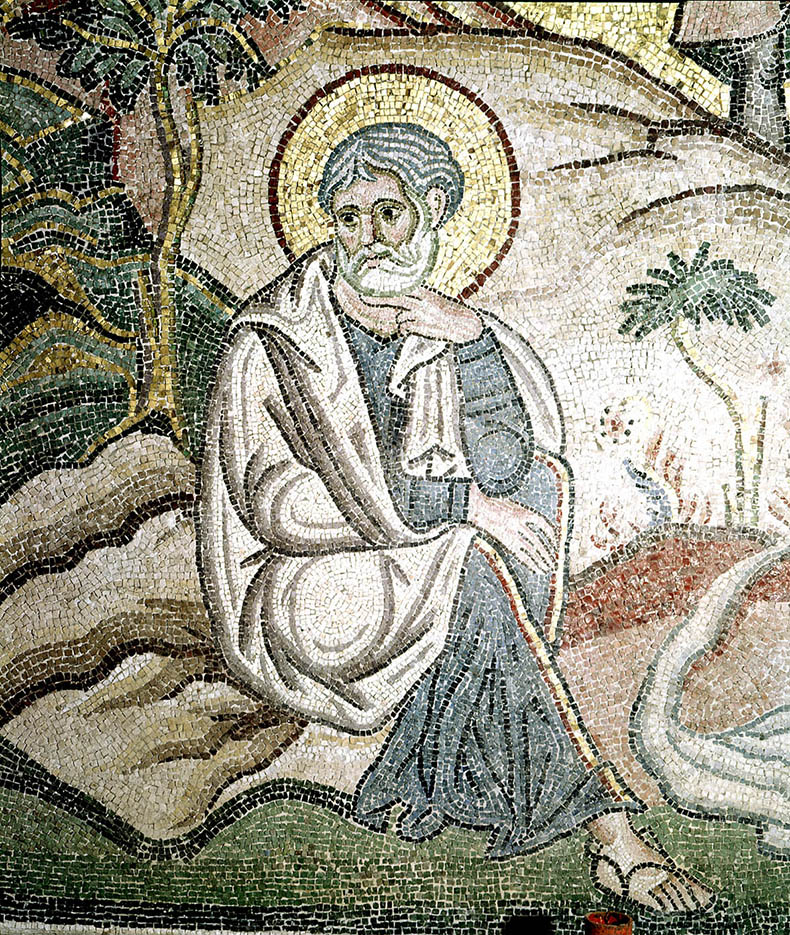
Saint Joseph at the Nativity
Saint Joseph at the Nativity, ca. 1100, mosaic detail from Daphni Monastery, Haidari (outside Athens), Greece [ view full scene ]

After the Wise Men went, and the strange star
Had faded out, Joseph the father sat
Watching the sleeping Mother and the Babe,
And thinking stern, sweet thoughts the long night through.

“Ah, what am I, that God has chosen me
To bear this blessed burden, to endure
Daily the presence of this loveliness,
To guide this Glory that shall guide the world?

“Brawny these arms to win Him bread, and broad
This bosom to sustain Her. But my heart
Quivers in lonely pain before that Beauty
It loves—and serves—and cannot understand!”

from The Frozen Grail and Other Poems by Elsa Barker (Duffield & Company, 1910)

Elsa Barker (1869–1954) was a novelist, short story writer, and poet from New England. She lived for extended periods in London and Paris and was a member of the Theosophical Society.

Jesus as the Pearl of Great Price

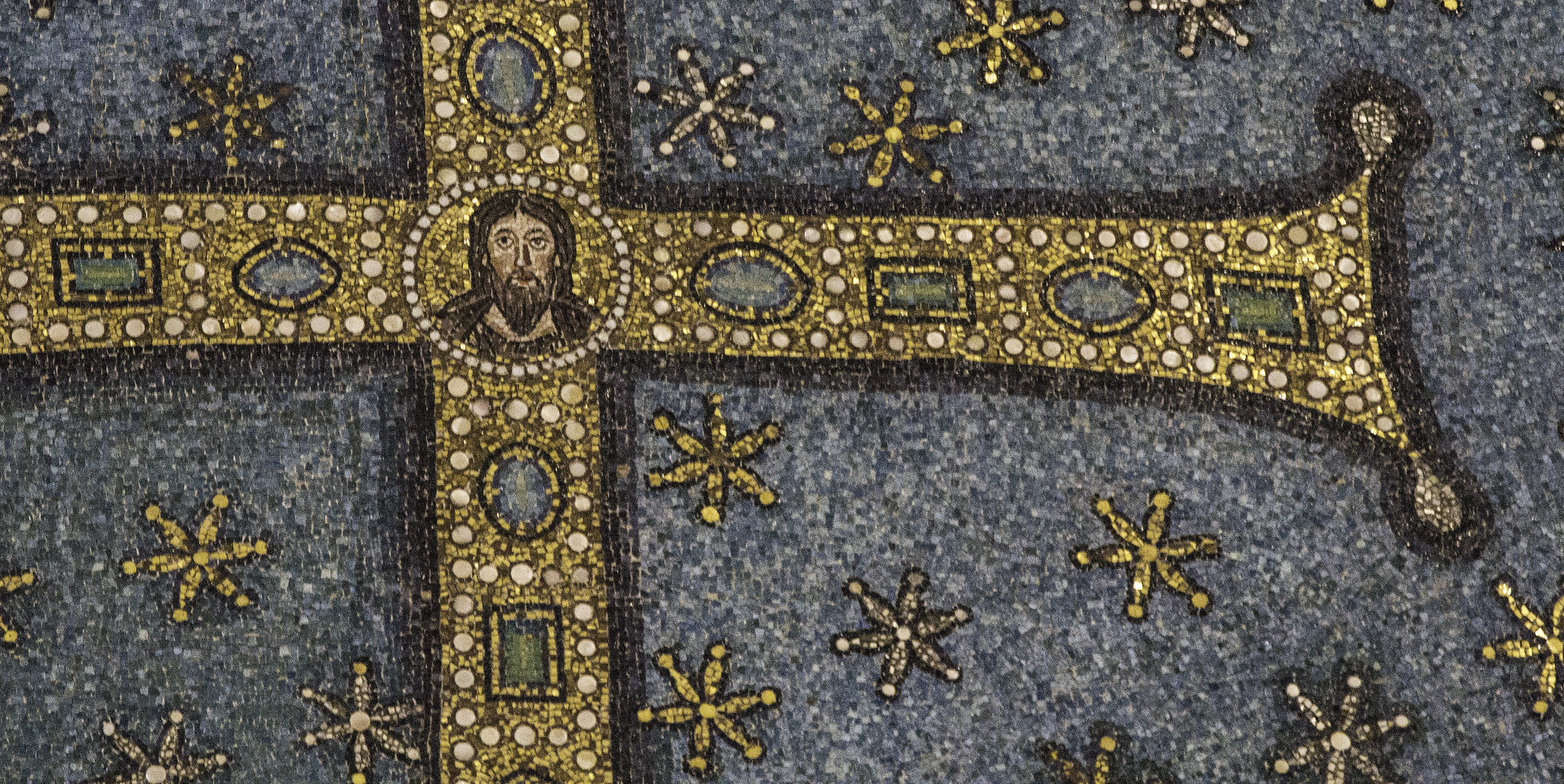
Face of Christ (Ravenna)
Detail of the 6th-century apse mosaic in the Basilica of Sant’Apollinare in Classe, Ravenna, Italy. Photo: Fr. Lawrence Lew, OP.

The kingdom of heaven is like a merchant in search of fine pearls; on finding one pearl of great value, he went and sold all that he had and bought it.

—Matthew 13:45–46

Jag nu den pärlan funnit har,
Som är min själs begär.
Du frågar: Vad? Hör då mitt svar:
Min Frälsare det är!
I have found the pearl of great price,
Which is the desire of my soul.
You ask, “What?” Here is my answer:
“It is my Savior!”

Trans. William Jewson

This is the first stanza of the Swedish hymn “Jag nu den pärlan funnit har” (I Have Found the Pearl of Great Price) (1849), set to a melody from Orsa, Sweden. The hymn is a translation of an English hymn written in 1683 by John Mason. Sung by soprano Margfareta Jonth, it’s the title track of the album Jag nu den pärlan funnit har…: Religious Folk-songs from Dalecarlia, released on vinyl in 1977 and on CD in 1994. The liner notes mention how it’s “much sung by the Baptists” in Sweden.

Whenever hymns are translated from their original languages, modifications to the text are often made to accommodate the meter and end rhyme in the new language. That’s why I’ve provided William Jewson’s literal translation of the Swedish—taken from the liner notes.

Isn’t this song just lovely? I’ve paired it with a Late Antique mosaic from a basilica in northern Italy, showing Jesus’s head at the center of a golden, bejeweled cross. He’s framed by (tesserae-rendered) pearls, suggesting that he is the “pearl of great price” from Matthew 13. This detail is part of a larger Transfiguration scene of sorts (see below).

The parable of the pearl of great price comes from a longer teaching of Jesus’s that compares the kingdom of heaven to a field sown with wheat, a mustard seed, yeast, a buried treasure, and a fisher’s net—images of growth, expansion, value, or ingathering.

To say the kingdom of heaven is like a fine pearl for which a merchant sells all he has is not to suggest that we can buy our way into God’s kingdom; it simply emphasizes the supreme value and desirability of that kingdom. It’s worth everything. We have to go all in—heart, mind, and soul. Sometimes that does mean relinquishing material goods and assets. Wealth can be an impediment to following Jesus if it’s where we place our ultimate love, loyalty, identity, or trust.

Jesus is a gem who wants to be found and cherished. May we be like the merchant, searching and finding, and rejoicing in finding, and willing to give up all to gain Christ.

Apse of Sant'Apollinare in Classe (Ravenna)
Apse of Sant’Apollinare in Classe, Ravenna, Italy. Photo: Berthold Werner.

Lent, Day 14

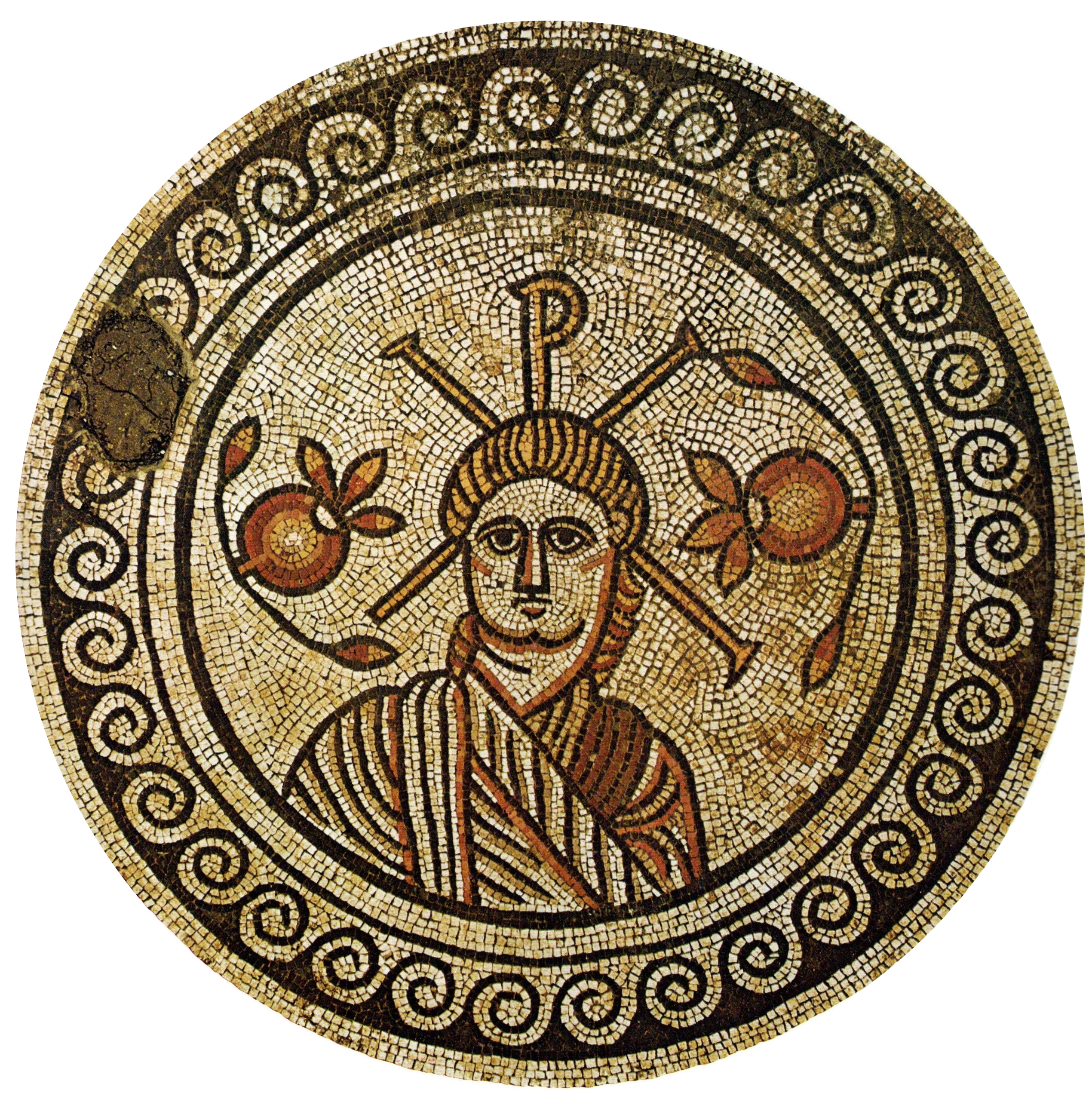
LOOK: Christ with Pomegranates (ancient Christian mosaic)

Christ with Pomegranates
Mosaic from Hinton St. Mary, Dorset, England, early 4th century, preserved at the British Museum, London.

One of the earliest surviving portraits of Christ is in the central roundel of a stone mosaic pavement excavated in the English village of Hinton St. Mary in Dorset, from what was either a Roman villa or a church. It’s part of a larger program of images that covered the floor, which you can see and read about in this Instagram post of mine, and on the British Museum website.

Clean-shaven and wearing a pallium, Christ is crowned with his personal monogram, the chi-rho—the first two letters of the Greek title ΧΡΙΣΤΟΣ, Christos. He is flanked by pomegranates, a symbol of life, fertility, and abundance. In Jewish tradition the pomegranate symbolizes righteousness because it is said to have 613 seeds, corresponding to the 613 mitzvot (commandments) in the Torah. The fruit was woven onto the hems of the robes of the Jewish high priests (Exod. 28:33–34) and is customarily eaten on Rosh Hashanah.

To these symbolic associations, I would add another: sweetness!

[Related post: “So Sweet (Artful Devotion)”]

LISTEN: “Iesu, dulcis memoria” | Words attributed to Bernard of Clairvaux, 12th century (but see notes on authorship) | Music: Medieval chant, harmonized | Performed by Tenth Avenue North, feat. Audrey Assad, on Cathedrals, 2014

On this track Assad sings the first and last stanzas of the traditional five—which are themselves extracted from a poem that was originally forty-two stanzas! The ending sounds abrupt because on the album it moves seamlessly into the next track, “Cathedrals.” For the full song (same tune but without the harmonies), see Angels and Saints at Ephesus by the Benedictines of Mary, Queen of Apostles.

Latin: 

Jesu, dulcis memoria
dans vera cordis gaudia:
sed super mel et omnia
ejus dulcis praesentia.

Nil canitur suavius,
nil auditur jucundius,
nil cogitatur dulcius,
quam Jesus Dei Filius.

Jesu, spes paenitentibus,
quam pius es petentibus!
quam bonus te quaerentibus!
sed quid invenientibus?

Nec lingua valet dicere,
nec littera exprimere:
expertus potest credere,
quid sit Jesum diligere.

Sis, Jesu, nostrum gaudium,
qui es futurus praemium:
sit nostra in te gloria,
per cuncta semper saecula.
Amen.
Literal (nonmetrical) English translation:

Jesus, sweet remembrance,
Granting the heart its true joys,
But above honey and all things
Is His sweet presence.

Nothing more pleasing can be sung,
Nothing gladder can be heard,
Nothing sweeter can be thought
Than Jesus, Son of God.

Jesus, hope of the penitent,
How merciful you are to those who ask,
How good to those who seek;
But O, what you are to those who find!

Tongue has no power to describe
Nor writings to express,
But only belief can know by experience
What it is to love Jesus.

Be our joy, O Jesus,
Who will be the prize we win.
May all our glory be in you, always
And through all ages.
Amen.

Trans. Mick Swithinbank and Jamie Reid Baxter

Does this sound vaguely familiar? Edward Caswall translated it into metrical English in 1849 as “Jesus, the Very Thought of Thee,” a staple of modern American hymnals:

Jesus, the very thought of Thee
With sweetness fills the breast!
Yet sweeter far Thy face to see
And in Thy Presence rest.

No voice can sing, no heart can frame,
Nor can the memory find,
A sweeter sound than Jesus’ Name,
The Savior of mankind.

O hope of every contrite heart!
O joy of all the meek!
To those who fall, how kind Thou art!
How good to those who seek!

But what to those who find? Ah! this
Nor tongue nor pen can show
The love of Jesus, what it is,
None but His loved ones know.

Jesus! our only hope be Thou,
As Thou our prize shalt be;
In Thee be all our glory now,
And through eternity.
Amen.

I commend to you the recording on A Hymn Revival, Volume 3 by The Lower Lights. The tune, from 1866, is by John B. Dykes.

Advent, Day 22

He shall feed his flock like a shepherd: he shall gather the lambs with his arm, and carry them in his bosom, and shall gently lead those that are with young.

—Isaiah 40:11 (KJV) (cf. Micah 5:2–5a, today’s lectionary reading)

“Come unto me, all ye that labour and are heavy laden, and I will give you rest. Take my yoke upon you, and learn of me; for I am meek and lowly in heart: and ye shall find rest unto your souls. For my yoke is easy, and my burden is light.”

—Matthew 11:28–30 (KJV)

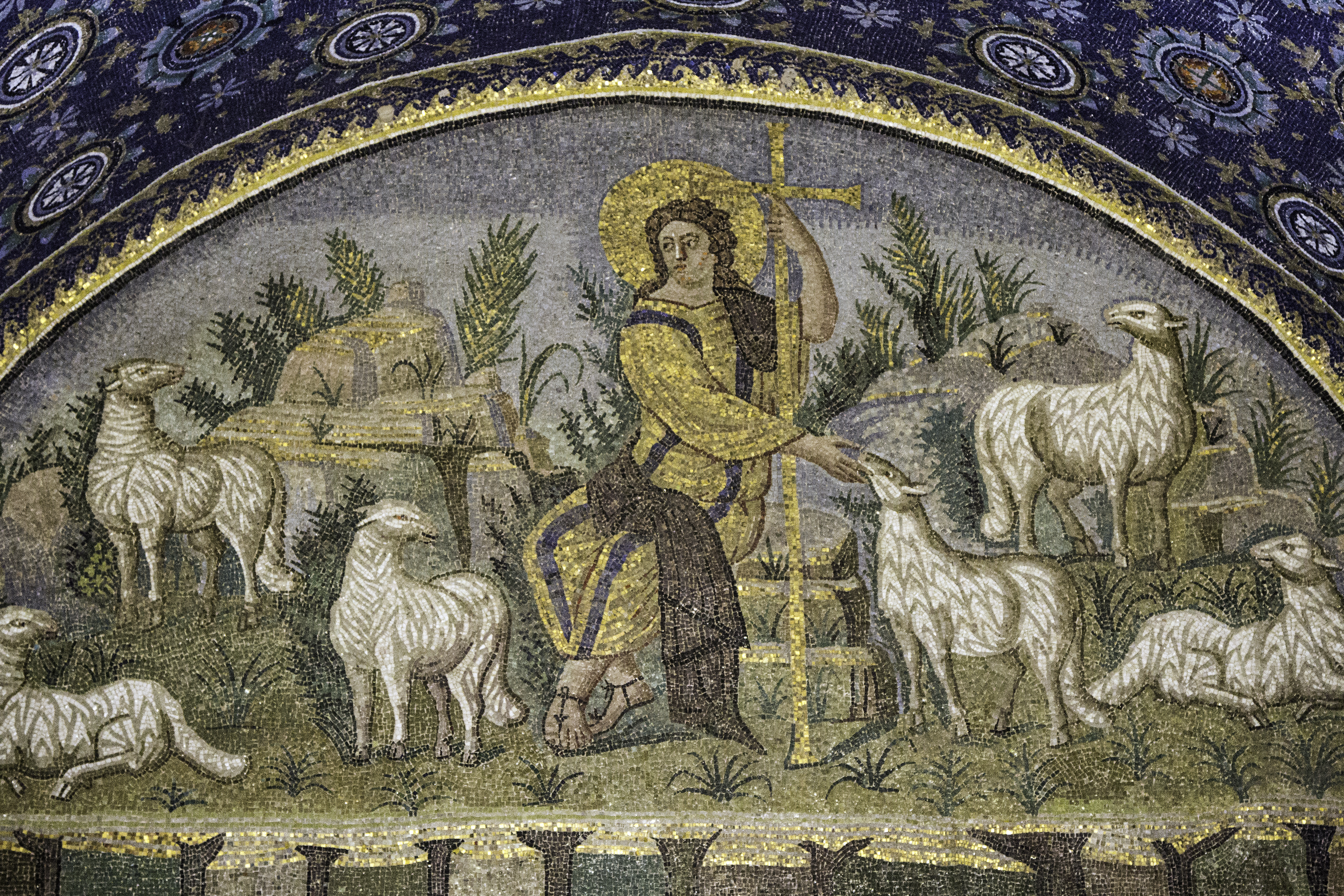
LOOK: Good Shepherd mosaic, Ravenna

Good Shepherd (Ravenna)
Christ the Good Shepherd, 5th century. Mosaic from the tomb of Galla Placidia, Ravenna, Italy. Photo: Fr. Lawrence Lew, OP.

[Related post: “Love, My Shepherd” (Artful Devotion)]

LISTEN: “He Shall Feed His Flock” | Text: Isaiah 40:11; Matthew 11:28–30 (KJV) | Music by Georg Frederic Handel, 1742 | Arranged and sung by Tara Ward on Adventus by Church of the Beloved, 2010

He shall feed his flock
Like a shepherd
And he shall gather
The lambs with his arm
With his arm

He shall feed his flock
Like a shepherd
And he shall gather
The lambs with his arm
With his arm

And carry them in his bosom
And gently lead those
That are with young
And gently lead those
That are with young

Come unto him
All ye that labor
Come unto him
Ye that are heavy laden
And he will give you rest

Come unto him
All ye that labor
Come unto him
Ye that are heavy laden
And he will give you rest

Take his yoke upon you
And learn of him
For he is meek
And lowly of heart
And ye shall find rest
Unto your souls

Take his yoke upon you
And learn of him
For he is meek
And lowly of heart
And ye shall find rest
Unto your souls

Born out of a group of friends’ reading of Life of the Beloved by Henri Nouwen, the Church of the Beloved in Edmonds, Washington, was active from 2006 to 2019. It had a vibrant music ministry, led by Tara Ward, that put out four albums, including Adventus. One of the tracks on Adventus is Ward’s slow, ambient, synth-driven arrangement of “He Shall Feed His Flock,” an air from Handel’s Messiah. Charles Jennens, the librettist (lyricist) of the oratorio, combined passages from Isaiah and Matthew to evoke a sense of the deep soul-rest and care that Christ proffers. Church of the Beloved’s rendition so beautifully captures the weariness we often feel, whether we’re on a spiritual path or not, and is a gentle reminder that Christ is always calling us back into his bosom.

Take Your Shoes Off (Artful Devotion)

God Calling Moses (San Vitale)
Detail of 6th-century mosaic from the sanctuary of San Vitale, Ravenna. Photo: Fr. Lawrence Lew, OP.

Now Moses was keeping the flock of his father-in-law, Jethro, the priest of Midian, and he led his flock to the west side of the wilderness and came to Horeb, the mountain of God. And the angel of the LORD appeared to him in a flame of fire out of the midst of a bush. He looked, and behold, the bush was burning, yet it was not consumed. And Moses said, “I will turn aside to see this great sight, why the bush is not burned.” When the LORD saw that he turned aside to see, God called to him out of the bush, “Moses, Moses!” And he said, “Here I am.” Then he said, “Do not come near; take your sandals off your feet, for the place on which you are standing is holy ground.” And he said, “I am the God of your father, the God of Abraham, the God of Isaac, and the God of Jacob.” And Moses hid his face, for he was afraid to look at God.

Then the LORD said, “I have surely seen the affliction of my people who are in Egypt and have heard their cry because of their taskmasters. I know their sufferings, and I have come down to deliver them out of the hand of the Egyptians and to bring them up out of that land to a good and broad land, a land flowing with milk and honey, to the place of the Canaanites, the Hittites, the Amorites, the Perizzites, the Hivites, and the Jebusites. And now, behold, the cry of the people of Israel has come to me, and I have also seen the oppression with which the Egyptians oppress them. Come, I will send you to Pharaoh that you may bring my people, the children of Israel, out of Egypt.” But Moses said to God, “Who am I that I should go to Pharaoh and bring the children of Israel out of Egypt?” He said, “But I will be with you, and this shall be the sign for you, that I have sent you: when you have brought the people out of Egypt, you shall serve God on this mountain.”

Then Moses said to God, “If I come to the people of Israel and say to them, ‘The God of your fathers has sent me to you,’ and they ask me, ‘What is his name?’ what shall I say to them?” God said to Moses, “I am who I am.” And he said, “Say this to the people of Israel: ‘I am has sent me to you.’” God also said to Moses, “Say this to the people of Israel: ‘The LORD, the God of your fathers, the God of Abraham, the God of Isaac, and the God of Jacob, has sent me to you.’ This is my name forever, and thus I am to be remembered throughout all generations.”

—Exodus 3:1–15

+++

SONG: “Take Your Shoes Off, Moses” by J. D. Jarvis, 1967 | Performed by Courtney Patton, 2014

Written by Kentuckian John Dill Jarvis, “Take Your Shoes Off, Moses” was popularized by Ralph Stanley and the Clinch Mountain Boys in the early seventies (with Keith Whitley singing lead). This performance is by country music artist Courtney Patton from Texas, recorded as part of Modern Trade’s Southern Gospel Revival project.

The first verse and chorus are taken from Sunday’s lectionary reading in Exodus 3, which narrates God’s first direct contact with Moses.

The second verse is based on a later episode in Exodus, where the desert-wandering Israelites are refreshed by water from a rock:

And the LORD said to Moses, “Pass on before the people, taking with you some of the elders of Israel, and take in your hand the staff with which you struck the Nile, and go. Behold, I will stand before you there on the rock at Horeb, and you shall strike the rock, and water shall come out of it, and the people will drink.” And Moses did so, in the sight of the elders of Israel. (Exodus 17:5–6)

The third and final verse references an instruction given just before the parting of the Red Sea:

And Moses said to the people, “Fear not, stand firm, and see the salvation of the LORD, which he will work for you today.” (Exodus 14:13)

+++

San Vitale (c) Paul Dykes
Photo: Paul Dykes

One of the most impressive programs of early Christian mosaic is inside the Basilica of San Vitale [previously] in Ravenna, Italy. The Moses scene is found on the right side of the choir, in the left spandrel: Moses tends his father-in-law’s sheep, then removes his shoes in response to God’s call from the burning bush—which in this artist’s conception is pockets of flame that burn all over Horeb! The prophet Isaiah stands opposite Moses on the right spandrel. Between the two, in the lunette, are Abel and Melchizedek, both understood as types of Christ, offering sacrifices to God. Flanking the mullioned window above them are two of the four evangelists with their symbols: Matthew (with [winged] man) and Mark (with lion).


This post belongs to the weekly series Artful Devotion. If you can’t view the music player in your email or RSS reader, try opening the post in your browser.

To view all the Revised Common Lectionary scripture readings for Proper 17, cycle A, click here.

Hail to the Lord’s Anointed (Artful Devotion)

Arian Baptistery mosaic
The Baptism of Christ, early 6th century. Ceiling mosaic, Arian Baptistery, Ravenna, Italy. Photo: Jim Forest.

Behold my servant, whom I uphold,
my chosen, in whom my soul delights;
I have put my Spirit upon him;
he will bring forth justice to the nations.
He will not cry aloud or lift up his voice,
or make it heard in the street;
a bruised reed he will not break,
and a faintly burning wick he will not quench;
he will faithfully bring forth justice.
He will not grow faint or be discouraged
till he has established justice in the earth;
and the coastlands wait for his law.

Thus says God, the LORD,
who created the heavens and stretched them out,
who spread out the earth and what comes from it,
who gives breath to the people on it
and spirit to those who walk in it:
“I am the LORD; I have called you in righteousness;
I will take you by the hand and keep you;
I will give you as a covenant for the people,
a light for the nations,
to open the eyes that are blind,
to bring out the prisoners from the dungeon,
from the prison those who sit in darkness.
I am the LORD; that is my name;
my glory I give to no other,
nor my praise to carved idols.
Behold, the former things have come to pass,
and new things I now declare;
before they spring forth
I tell you of them.”

—Isaiah 42:1–9

Then Jesus came from Galilee to the Jordan to John, to be baptized by him. John would have prevented him, saying, “I need to be baptized by you, and do you come to me?” But Jesus answered him, “Let it be so now, for thus it is fitting for us to fulfill all righteousness.” Then he consented. And when Jesus was baptized, immediately he went up from the water, and behold, the heavens were opened to him, and he saw the Spirit of God descending like a dove and coming to rest on him; and behold, a voice from heaven said, “This is my beloved Son, with whom I am well pleased.”

—Matthew 3:13–17

You yourselves know what happened throughout all Judea, beginning from Galilee after the baptism that John proclaimed: how God anointed Jesus of Nazareth with the Holy Spirit and with power. He went about doing good and healing all who were oppressed by the devil, for God was with him. . . .

He is the one appointed by God to be judge of the living and the dead. To him all the prophets bear witness that everyone who believes in him receives forgiveness of sins through his name.

—Acts 10:37–38, 42–43

+++

SONG: “Hail to the Lord’s Anointed” | Words by James Montgomery, 1821 | Music by the Rev. Vito Aiuto, on Welcome to the Welcome Wagon, 2008 [previously]

https://open.spotify.com/track/6g28yW9SilEHfMZ7WoLfYc?si=YlCyMYclTpmgT6kNHWABXQ

Hail to the Lord’s Anointed,
great David’s greater Son!
Hail in the time appointed,
his reign on earth begun!
He comes to break oppression,
to set the captive free;
to take away transgression,
and rule in equity.

He comes with succor speedy
to those who suffer wrong;
to help the poor and needy,
and bid the weak be strong;
to give them songs for sighing,
their darkness turn to light,
whose souls, condemned and dying,
are precious in his sight.

He shall come down like showers
upon the fruitful earth;
love, joy, and hope, like flowers,
spring in his path to birth.
Before him on the mountains
shall peace, the herald, go,
and righteousness, in fountains,
from hill to valley flow.

To him shall prayer unceasing
and daily vows ascend;
his kingdom still increasing,
a kingdom without end.
The tide of time shall never
his covenant remove;
his name shall stand forever;
that name to us is love.

+++

Arian Baptistery
Arian Baptistery, Ravenna. Photo: Georges Jansoone.

Baptism of Christ, Arian Baptistery
Photo: Peter Milošević

Baptism of Christ, Arian Baptistery
Photo: Fr. Lawrence Lew, OP

Baptism of Christ (detail)
Photo: Jim Forest

The dome of the great sixth-century Arian Baptistery in Ravenna, Italy, shows, in glimmering mosaic, a young, beardless, fully nude Christ standing waist-deep in the waters of the Jordan as John the Baptist, dressed in leopard skin, anoints him—the archetypal event for the liturgy that used to be performed below. And actually, the anointing water in this representation comes from the beak of a dove, God the Holy Spirit.

The old man on the left is a personification of the Jordan River, whose attributes are derived from that of the Hellenistic river gods. He holds a reed in his hand and leans against a spilled jar, from whose mouth flows the river water, while from his head there sprouts a pair of red crab claws. He is clothed in the same moss that covers the rock John stands on.

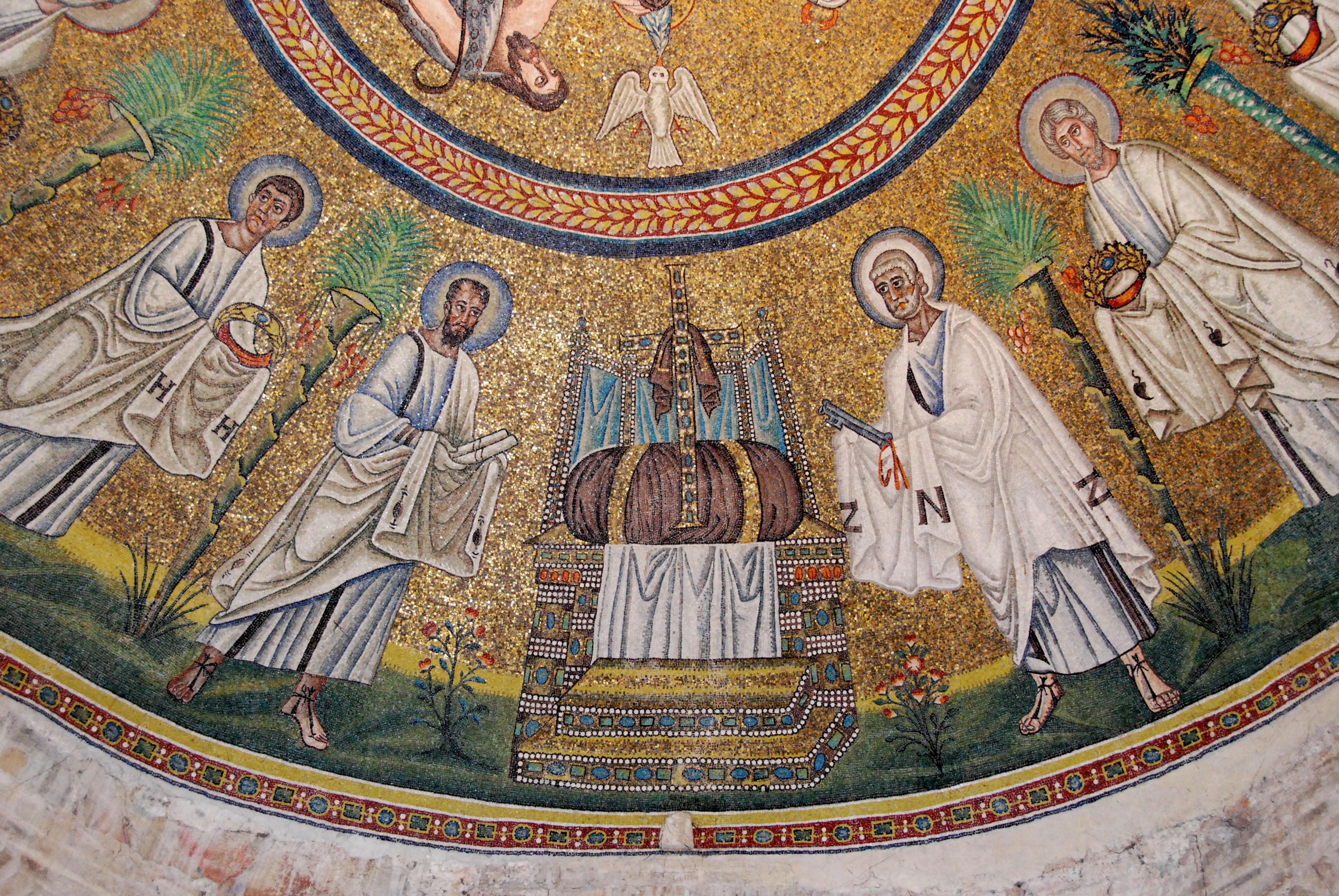
Around this central scene, which is framed by a laurel wreath, is a procession of the twelve apostles, led by Peter (the gray-haired man with the key) and Paul (the dark-haired man with the scrolls). The apostles carry jeweled crowns in their veiled hands—a sign of humility—as they make their way to the empty throne of Christ’s promised return, the hetoimasia, prepared with a plush purple cushion and jeweled cross.

Hetoimasia mosaic (Ravenna)
Photo: Jim Forest

The iconography here is very similar to that of the ceiling mosaic in the even older (Orthodox) Baptistery of Neon, also in Ravenna.

I’ve featured baptistery dome art two other times on the blog: a painting of Paradise from the Padua Baptistery and a Last Judgment mosaic from the Florence Baptistery. Also related are the compilation of contemporary icons of the Baptism of Christ that I published two years ago (the ones by Jerzy Nowosielski and Ivanka Demchuk are favorites of mine) and last year’s Artful Devotion for this calendar day, featuring a Baptism of Christ from the Hitda Codex and a virtuosic piano piece.


This post belongs to the weekly series Artful Devotion. If you can’t view the music player in your email or RSS reader, try opening the post in your browser.

To view all the Revised Common Lectionary scripture readings for the feast of the Baptism of the Lord, cycle A, click here.