Roundup: Nativity assemblage workshop, Arcabas interview, South African worship song, and more

A reader expressed confusion about the bracketed, hyperlinked “previouslys” that occasionally appear after some names in my blog posts. That’s my shorthand for “Click here to see the blog posts where I’ve previously featured this person.” My archive goes back ten years, so while I never repeat content, it’s inevitable that I’ll occasionally highlight an artist or scholar whose work I’ve highlighted before. The one-word link enables me to instantly connect you to a place to explore more of that artist on this site, which lacks an advanced search mechanism (there’s only a basic search bar—in the sidebar of any post if you’re using a desktop, or at the bottom if you’re on your mobile—as well as a tagging system).

+++

SPOTIFY PLAYLIST: November 2026 (Art & Theology)

+++

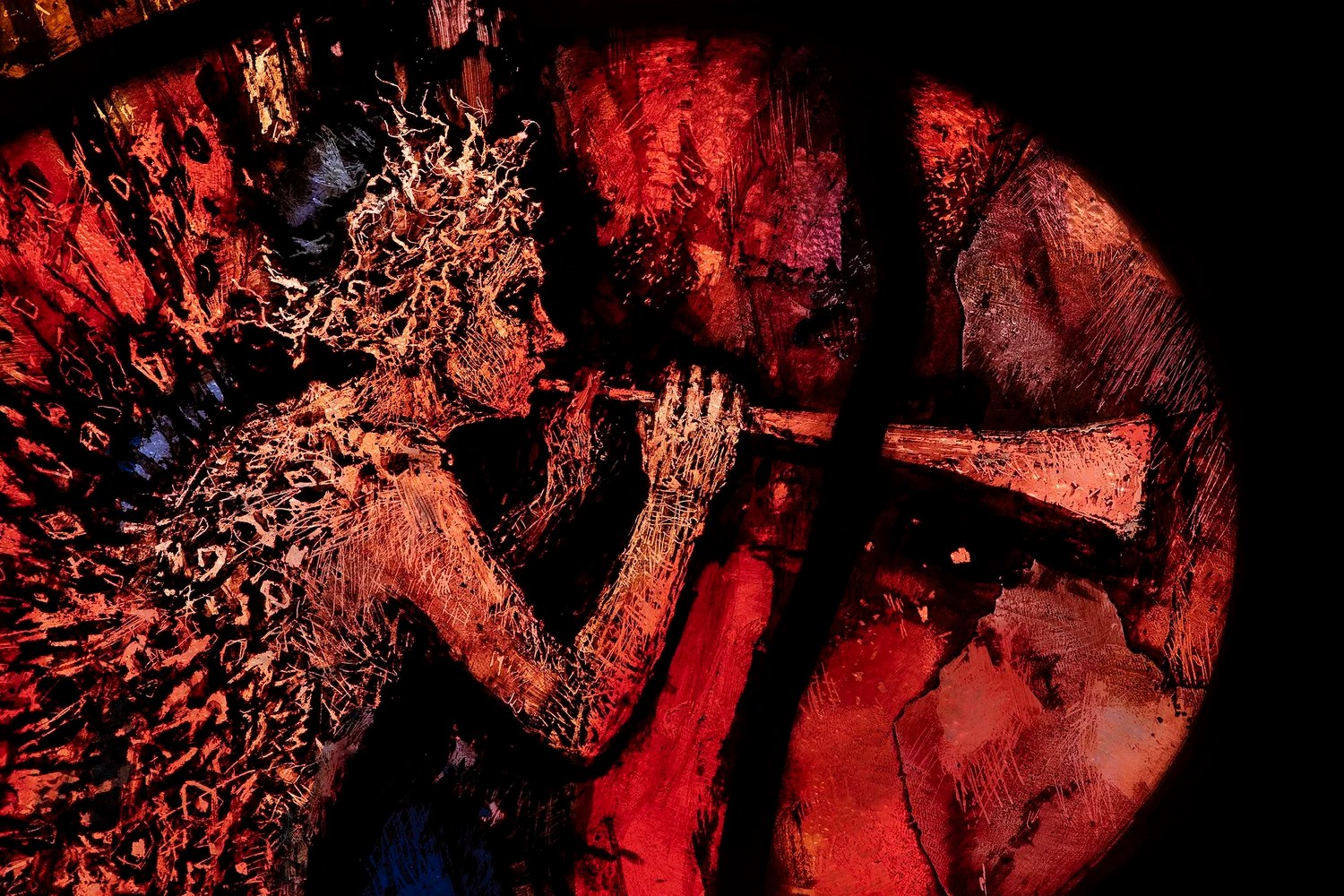
The organization Art and Christianity (A+C) is offering a new Christmas card pack featuring an angel detail of the award-winning East Window at St. John’s Tisbury, Wiltshire, by stained glass artist Thomas Denny [previously], installed last year. The theme of the full window, whose central scene is the Transfiguration, is “seeing”—seeing the glory of God, and the epiphanies in ordinary and extraordinary moments in life. View more photos of the window, and read the artist’s statement, here.
Denny, Thomas_Angel
Thomas Denny (British, 1956–), East Window (detail), St John’s Tisbury, Wiltshire, England, 2025. Photo: James O. Davies.

+++

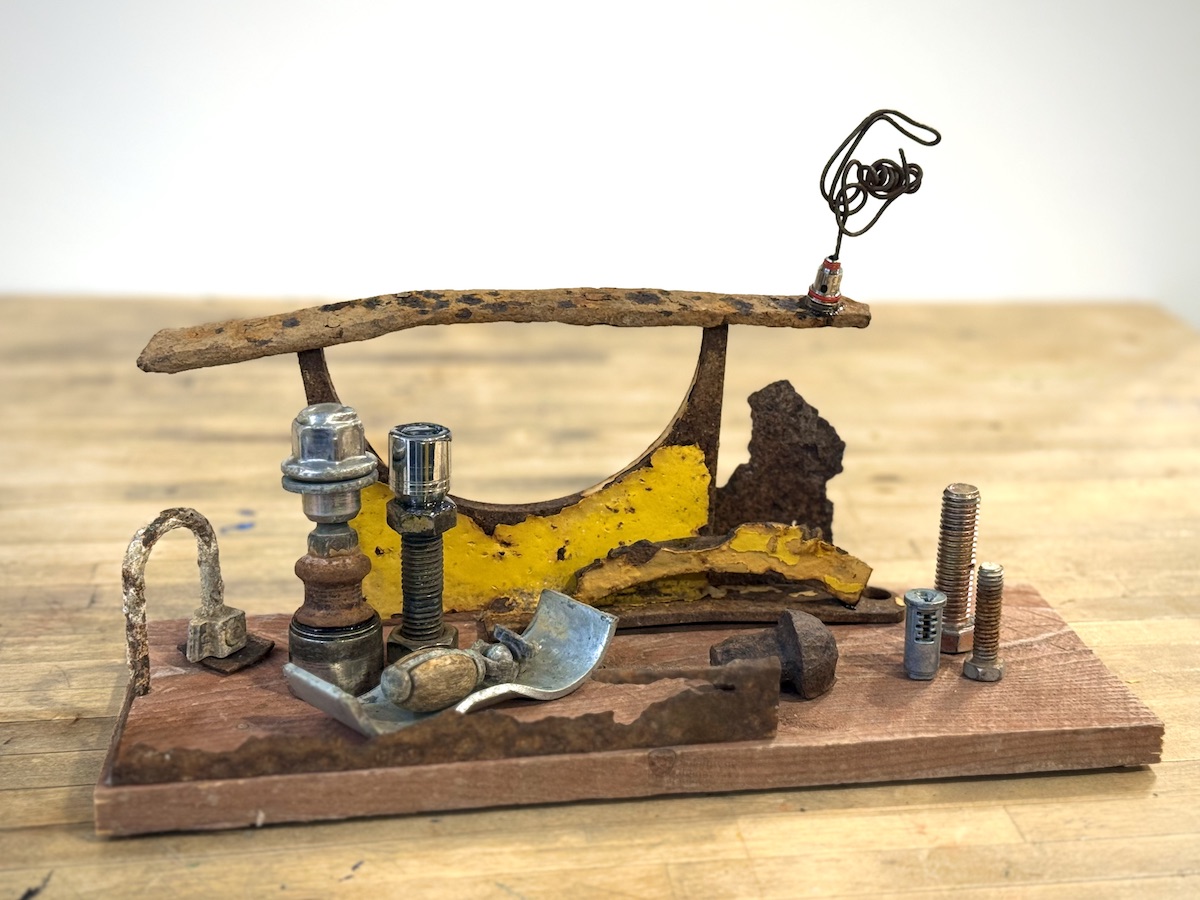
HANDS-ON WORKSHOP: “Embodying Advent: Making Unique Nativities” with Steven Homestead, November 19, 2026, Curate by Space in the Gap, Kaleidoscope center, Mission Viejo, CA: My friend Steven Homestead [previously] is an artist, composer, writer, curator, and arts leader from Orange County, California, who regularly brings people together around art—whether through cofounding the Network of Christians in Visual Arts (NCVA), creating community-based installations, contributing to Biola University’s annual arts devotionals, or organizing arts festivals and other events.
Nativity by Leilani Smith

In two weeks, he’s leading an in-person workshop in which participants will create nativities using the art of assemblage. “Creating manger scenes using assemblage is fitting,” he writes, “because through the Incarnation, Jesus stepped directly into the coarse, tangible, and often fragmented reality of our material world. As we gather found pieces and use them to create nativities—whether with broken bits, discarded items, or meaningful mementos—we participate in a physical parable of Advent. We are reminded that God takes the messy, everyday stuff of creation and weaves it into something holy, revealing glory right in the midst of our human experience.”

+++

INTERVIEW: “Arcabas,” conducted by Misjonarze Saletyni: The last time I featured the artist Arcabas, a reader alerted me to this thirty-minute interview of his that the Missionaries of La Salette recorded in his studio in 2016, two years before his death. It’s in French, but professionally translated closed captioning is available in English.
Arcabas_Pilgrims of Emmaus
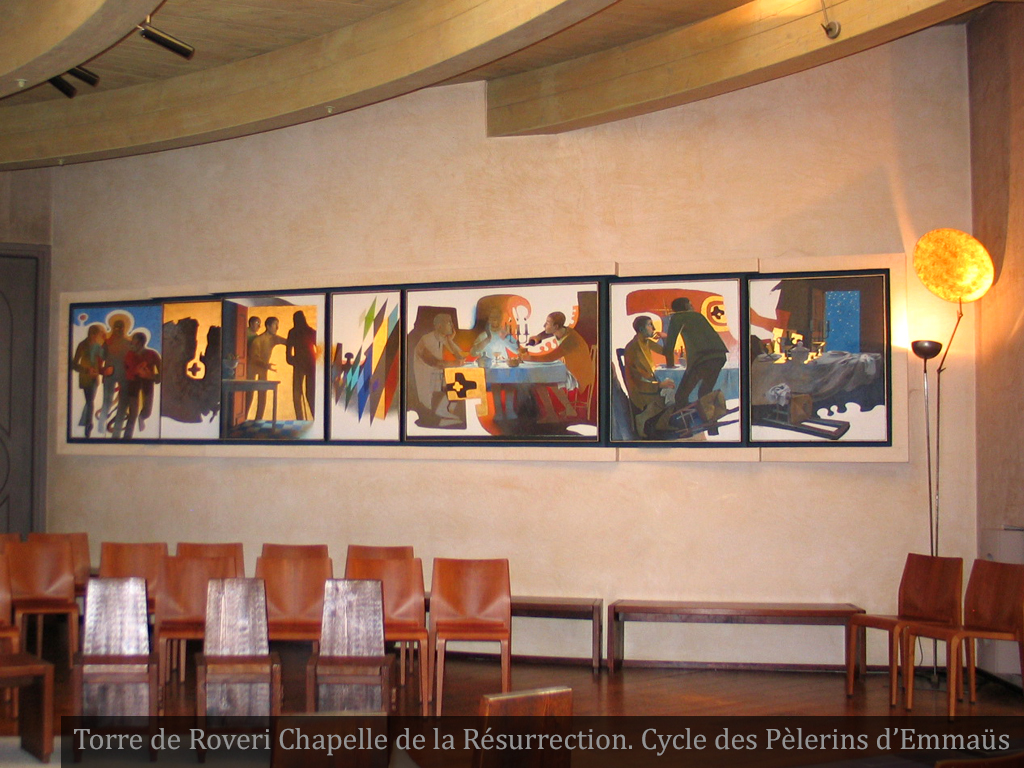
Arcabas (French, 1926–2018), Pèlerins d’Emmaüs (Pilgrims of Emmaus), 1994. Oil and gold leaf on canvas, overall 110 × 560 cm. Chiesa della Resurrezione (Church of the Resurrection), Torre de’ Roveri, Bergamo, Italy. Left to right: Along the Road, Opening the Scriptures, The Welcome, Preparations, The Meal, The Disappearance, The Return.

Arcabas_Prodigal Son (in situ)
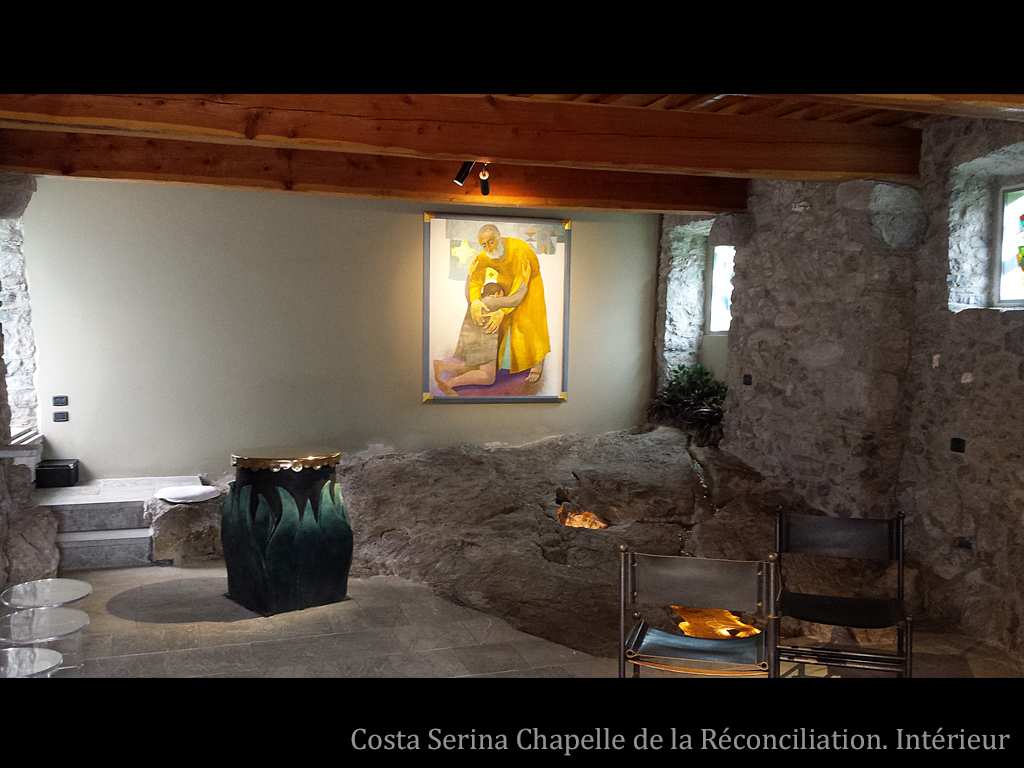
Designed by architect Renzo Pedrini, the Cappella della Riconciliazione (Chapel of Reconciliation) in Costa Serina, Bergamo, Italy, was converted from an old stable. Arcabas made the door, the altar, six stained glass windows, and two oil paintings: a Madonna and Child and, the room’s centerpiece, The Prodigal Son. [view more photos]

Arcabas discusses how his understanding of faith has evolved, why he doesn’t consider himself a “sacred” artist, the extraordinary poetry of the Gospels, the importance of “living the symbols,” and the role of humor in art. He also discusses specific artworks, including:

  • his Pilgrims of Emmaus polyptych at the Church of the Resurrection in Torre de’ Roveri, Bergamo, Italy (see additional commentary here and here);
  • The Prodigal Son in the Chapel of Reconciliation in Costa Serina, Bergamo, Italy;
  • his work for the Sanctuary of Our Lady of La Salette in Isère, France—namely, the Christ Pantocrator in the apse, the Wedding at Cana polyptych, Mary’s Swoon at the Foot of the Cross, The Virgin of La Salette, and his two stained glass windows in the sanctuary’s Chapel of the Encounter;
  • Église Saint-Hugues-de-Chartreuse, France, a forty-year project;
  • and the painting that’s behind him during the interview, showing a donkey, mounted by a monkey(!), warming the infant Christ with his breath. (He playfully tells us the donkey greedily wanted a portrait of just him, not the ox.)
  • (The other painting behind him, which is not directly addressed in the video, is the last Annunciation he ever made.)

+++

SONGS:

Three songs about relinquishing anxiety and resting in God’s loving care.

>> “Come Bring Your Burdens to God”: Originally written in Xhosa during the apartheid era in South Africa, “Woza Nomthwalo Wakho” (Come Bring Your Burdens to God) was popularized in the West by Rev. Dr. John L. Bell of the Iona Community in Scotland [previously]. It’s one of many global Christian songs he collected and had recorded by the Wild Goose Collective, which is where I first heard it. In this video, the Heatwole family, American Anabaptists living in Coyhaique, Chile, sing it at their church, Hermanos del Nuevo Pacto en Cristo (Brethren of the New Covenant in Christ).

>> “On God’s Shoulders” by Paul Zach: This is a fragment of a song written by Paul Zach [previously] and friends in preparation for the 2023 Porter’s Gate album Message Songs, inspired by Eugene Peterson’s best-selling colloquial translation of the Bible. But it apparently ended up on the cutting-room floor. It’s based on Psalm 55:22 (MSG): “Pile your troubles on God’s shoulders—he’ll carry your load, he’ll help you out. He’ll never let good people topple into ruin.”

>> “Sparrow” by Candace Coker: Another song that I don’t think has ever been released on an album. Trinidad-born singer-songwriter Candace Coker [previously] wrote it in 2017, inspired by one of Jesus’s teachings in the Sermon on the Mount about God’s providence (Matt. 10:29–31; Luke 12:6–7).

Lent, Day 21 (Feast of the Annunciation)

LOOK: The Annunciation by Steven Homestead

Homestead, Steven_The Annunciation
Steven Homestead (American, 1982–), The Annunciation, 2020. Digital collage.

Artist, composer, writer, curator, and speaker Steven Homestead of Orange County, California, created this collage by overlaying and manipulating three photographs from the license-free image-sharing website Unsplash. It depicts the moment when the angel Gabriel came to Mary of Nazareth to tell her that she had been chosen to bear God’s Son. Though Mary was initially taken aback by this announcement, she ultimately gave her full assent, leaning into the future God had for her. Through her fiat, her yes, God worked the salvation of the world.

Gabriel and Mary are represented here by two Brazilian models whose raised arms—his right, her left—form near symmetrical arcs. It’s as if he’s calling and she’s responding. She’s bending to God’s will, but not with the sort of demure posture so often assigned to her in art history; instead, her stance is one of freedom and power and becoming.

The curve of Gabriel’s hand matches the curve of the stained glass leading, which encircles his head and frames a representation of the Holy Spirit as dove, flying forth from a sunburst.

The setting is outdoors in a wooded area. Mary is dressed in white, like a bride. As she surrenders to the Divine, she becomes filled with light, the sun’s rays converging on her womb. A mystical veil falls around the two figures, suggesting sanctity and mystery. Her body has become the temple of the Lord.

March 25—exactly nine months before Christmas—is when the church celebrates the miraculous conception of Christ in Mary’s womb, the first stage of the Incarnation. It’s an event that fills me with awe and wonder—as it has thousands of artists over the centuries. I’m building a Pinterest board of Annunciation art that I find compelling, which you may be interested to browse: https://www.pinterest.com/art_and_theology/annunciation/. Homestead’s piece is my latest addition.

LISTEN: “Lord, Prepare Me to Be a Sanctuary” by Randy Lynn Scruggs and John W. Thompson, 1982 | Arranged and performed by the West Angeles COGIC Mass Choir and Congregation on No Limit, 2007

Lord, prepare me
To be a sanctuary
Pure and holy
Tried and true
And with thanksgiving
I’ll be a living
Sanctuary
For you

And whatever you tell me, my answer will be yes
Yes (yes)
Yes (yes to your will, Lord)
Yes (yes to your way)
Yes (Lord, I’ll go where you want me to go)
Yes (yes)
Yes, yes (yes)
Yes (whatever you tell me to do, Lord)
Yes
Yes (my will is your will for me, Lord)
Yes (come on, let’s take it higher, say yeah)

Lord, prepare me
To be a sanctuary
Pure and holy
Tried and true
And with thanksgiving
I’ll be a living
Sanctuary
For you

Hallelujah, hey!
Now I want the Lord to mold me
I want him to make me, I want him to shape me
I want him to direct me, I want him to purge me
I want him to wash me
Whatever he wants me to be
I’ll be just that, so I tell him:

Lord, mold me (mold me)
What you want me to be (what you want me to be)
Oh mold me (mold me)
What you want me to be (what you want me to be)
Oh and say mold me (mold me)
Say what you want me to be (what you want me to be)
Oh mold me (yes, what you want me to be) (mold me)
What you want me to be (what you want me to be)

Mold and we’ll say yes (yes)
Yes to your will say (yes to your will)
Say yeah, yeah (yeah)
Yes to your way, Lord (yes to your way)
Say yes everyday (yes everyday)
Yes to your way (yes to your way)
Say yes, I’ll obey (yes, I’ll obey)
Say yes to your way (yes to your way)

Lord, mold me
What you want me to be
Say what you want me to do
Where you want me to go
Say where you want me to go
When you want me to go
Say how you want me to go
What you want me to do

And you will say yeah (yeah)
Say yeah, yeah, yeah, yeah, yeah, yeah, yeah, yeah (yeah)
Say yes to your way (yes to your way)
Ooh ooh ooh yeah, yeah, yeah, yeah (yeah)
Say yes to your will (yes to your will)
Say, say yeah, yeah, yeah, yeah (yeah)
Say:

Lord, prepare me
To be a sanctuary
Pure and holy
Tried and true
And with thanksgiving
I’ll be a living
Sanctuary
For you

Hallelujah
Lord, I say yes
Lord, I say yes
Lord, I say yes
To your will and to your way
Not my time, but yours

If there’s one word I most associate with the Annunciation, it’s “yes.”

This song doesn’t directly reference the Annunciation, but it does capture the attitude of surrender to God that Mary modeled for us. “Lord, I say yes to your will and to your way.” We can assume that throughout her girlhood she cultivated a devotion that made her open and receptive to God’s call when it came. She was ready to offer herself as God’s sanctuary, a house for his incarnate presence. She literally became pregnant with God!

In a spiritual sense, we too are called to bear Christ within us (Rom. 8:10; 2 Cor. 4:6–7; 13:5; Gal. 1:15–16; 2:20). To be temples of his Spirit (1 Cor. 6:19–20). And to answer yes when God invites us into some new adventure.