Roundup: Nativity assemblage workshop, Arcabas interview, South African worship song, and more

A reader expressed confusion about the bracketed, hyperlinked “previouslys” that occasionally appear after some names in my blog posts. That’s my shorthand for “Click here to see the blog posts where I’ve previously featured this person.” My archive goes back ten years, so while I never repeat content, it’s inevitable that I’ll occasionally highlight an artist or scholar whose work I’ve highlighted before. The one-word link enables me to instantly connect you to a place to explore more of that artist on this site, which lacks an advanced search mechanism (there’s only a basic search bar—in the sidebar of any post if you’re using a desktop, or at the bottom if you’re on your mobile—as well as a tagging system).

+++

SPOTIFY PLAYLIST: November 2026 (Art & Theology)

+++

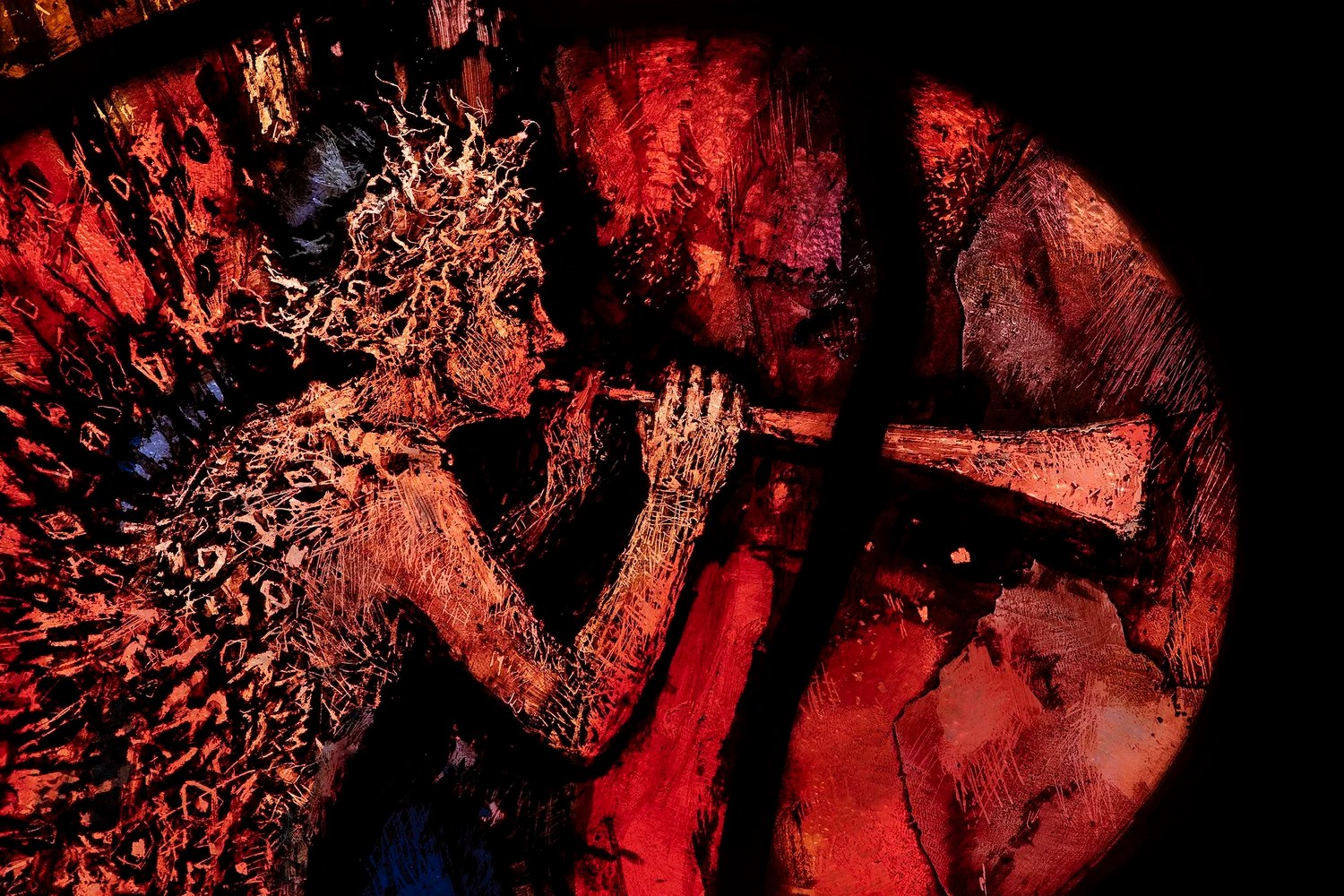
The organization Art and Christianity (A+C) is offering a new Christmas card pack featuring an angel detail of the award-winning East Window at St. John’s Tisbury, Wiltshire, by stained glass artist Thomas Denny [previously], installed last year. The theme of the full window, whose central scene is the Transfiguration, is “seeing”—seeing the glory of God, and the epiphanies in ordinary and extraordinary moments in life. View more photos of the window, and read the artist’s statement, here.
Denny, Thomas_Angel
Thomas Denny (British, 1956–), East Window (detail), St John’s Tisbury, Wiltshire, England, 2025. Photo: James O. Davies.

+++

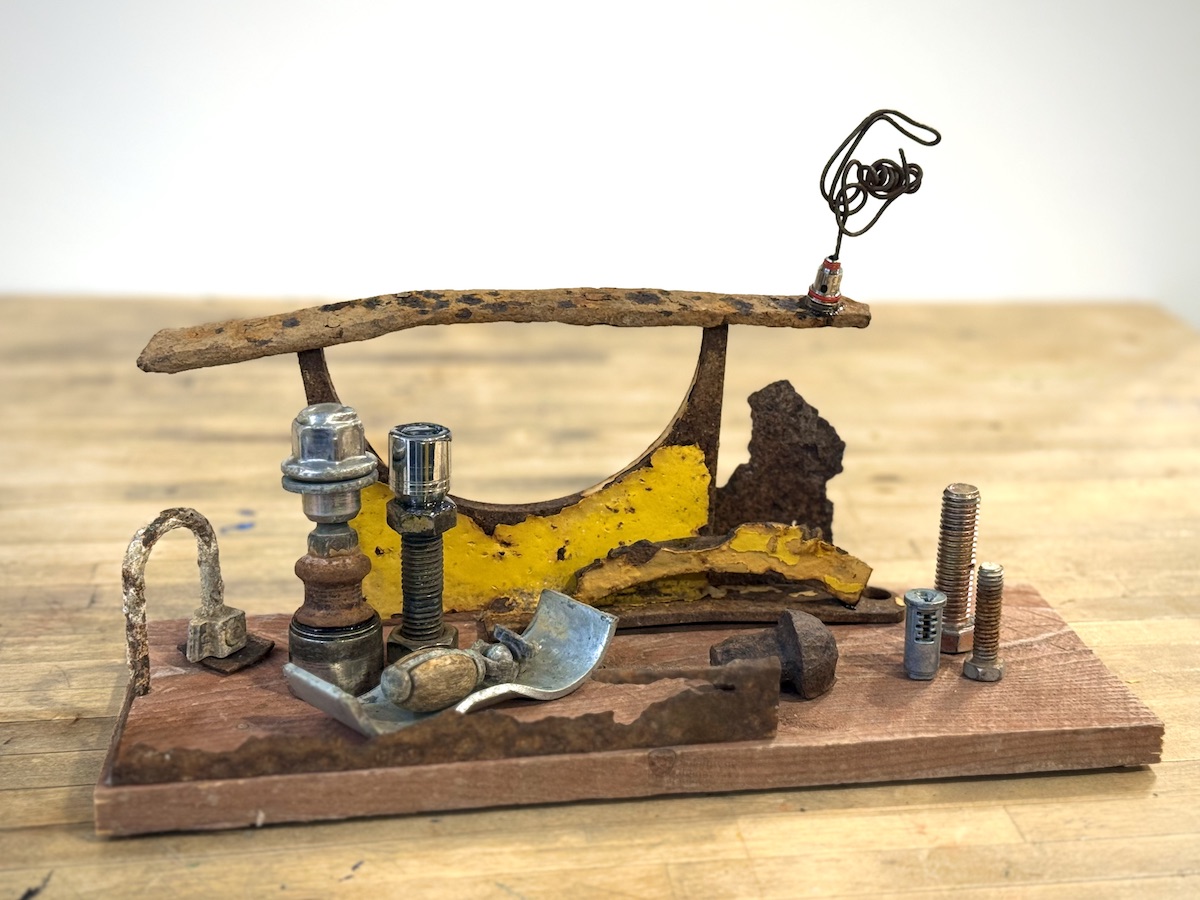
HANDS-ON WORKSHOP: “Embodying Advent: Making Unique Nativities” with Steven Homestead, November 19, 2026, Curate by Space in the Gap, Kaleidoscope center, Mission Viejo, CA: My friend Steven Homestead [previously] is an artist, composer, writer, curator, and arts leader from Orange County, California, who regularly brings people together around art—whether through cofounding the Network of Christians in Visual Arts (NCVA), creating community-based installations, contributing to Biola University’s annual arts devotionals, or organizing arts festivals and other events.
Nativity by Leilani Smith

In two weeks, he’s leading an in-person workshop in which participants will create nativities using the art of assemblage. “Creating manger scenes using assemblage is fitting,” he writes, “because through the Incarnation, Jesus stepped directly into the coarse, tangible, and often fragmented reality of our material world. As we gather found pieces and use them to create nativities—whether with broken bits, discarded items, or meaningful mementos—we participate in a physical parable of Advent. We are reminded that God takes the messy, everyday stuff of creation and weaves it into something holy, revealing glory right in the midst of our human experience.”

+++

INTERVIEW: “Arcabas,” conducted by Misjonarze Saletyni: The last time I featured the artist Arcabas, a reader alerted me to this thirty-minute interview of his that the Missionaries of La Salette recorded in his studio in 2016, two years before his death. It’s in French, but professionally translated closed captioning is available in English.
Arcabas_Pilgrims of Emmaus
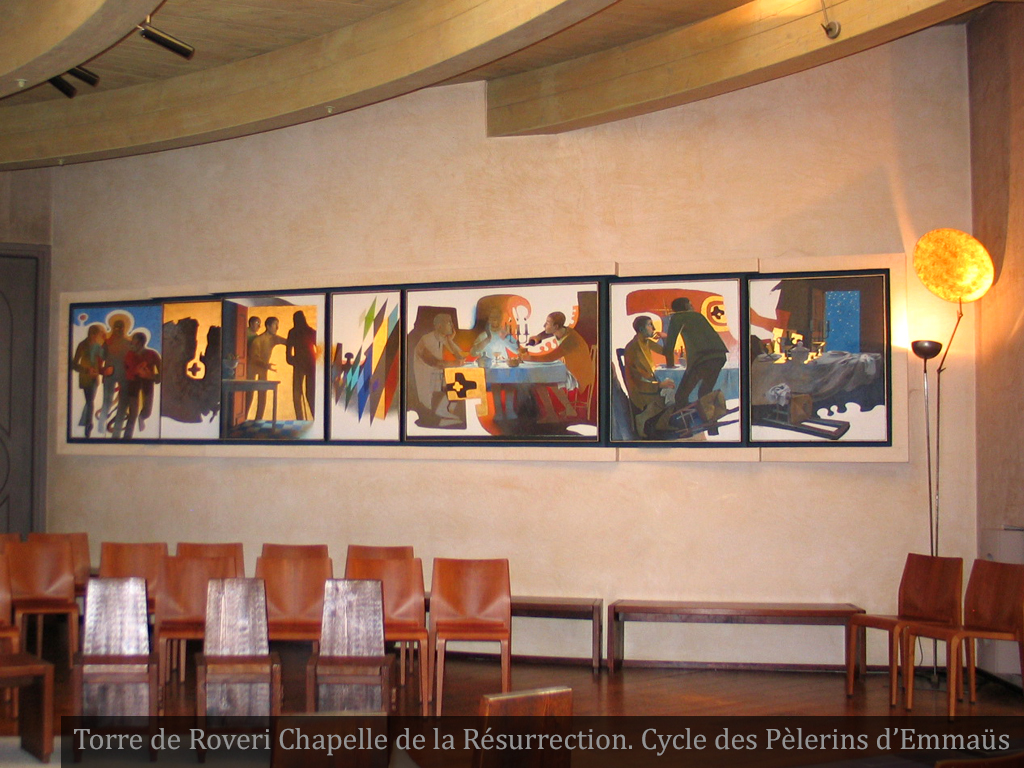
Arcabas (French, 1926–2018), Pèlerins d’Emmaüs (Pilgrims of Emmaus), 1994. Oil and gold leaf on canvas, overall 110 × 560 cm. Chiesa della Resurrezione (Church of the Resurrection), Torre de’ Roveri, Bergamo, Italy. Left to right: Along the Road, Opening the Scriptures, The Welcome, Preparations, The Meal, The Disappearance, The Return.

Arcabas_Prodigal Son (in situ)
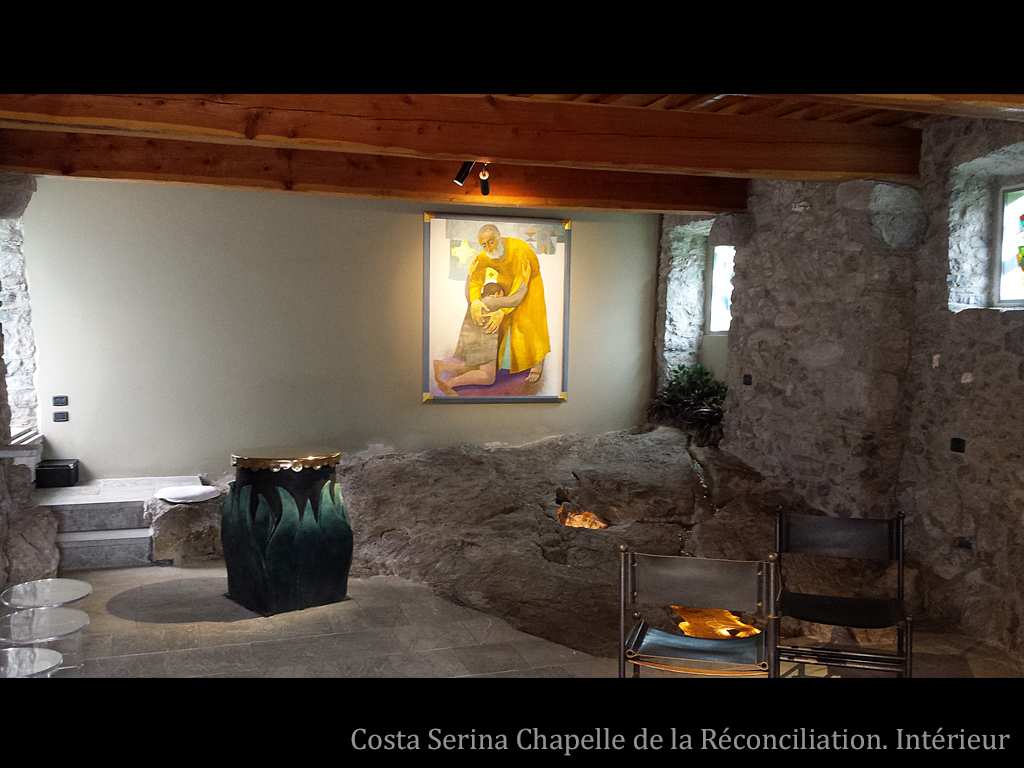
Designed by architect Renzo Pedrini, the Cappella della Riconciliazione (Chapel of Reconciliation) in Costa Serina, Bergamo, Italy, was converted from an old stable. Arcabas made the door, the altar, six stained glass windows, and two oil paintings: a Madonna and Child and, the room’s centerpiece, The Prodigal Son. [view more photos]

Arcabas discusses how his understanding of faith has evolved, why he doesn’t consider himself a “sacred” artist, the extraordinary poetry of the Gospels, the importance of “living the symbols,” and the role of humor in art. He also discusses specific artworks, including:

  • his Pilgrims of Emmaus polyptych at the Church of the Resurrection in Torre de’ Roveri, Bergamo, Italy (see additional commentary here and here);
  • The Prodigal Son in the Chapel of Reconciliation in Costa Serina, Bergamo, Italy;
  • his work for the Sanctuary of Our Lady of La Salette in Isère, France—namely, the Christ Pantocrator in the apse, the Wedding at Cana polyptych, Mary’s Swoon at the Foot of the Cross, The Virgin of La Salette, and his two stained glass windows in the sanctuary’s Chapel of the Encounter;
  • Église Saint-Hugues-de-Chartreuse, France, a forty-year project;
  • and the painting that’s behind him during the interview, showing a donkey, mounted by a monkey(!), warming the infant Christ with his breath. (He playfully tells us the donkey greedily wanted a portrait of just him, not the ox.)
  • (The other painting behind him, which is not directly addressed in the video, is the last Annunciation he ever made.)

+++

SONGS:

Three songs about relinquishing anxiety and resting in God’s loving care.

>> “Come Bring Your Burdens to God”: Originally written in Xhosa during the apartheid era in South Africa, “Woza Nomthwalo Wakho” (Come Bring Your Burdens to God) was popularized in the West by Rev. Dr. John L. Bell of the Iona Community in Scotland [previously]. It’s one of many global Christian songs he collected and had recorded by the Wild Goose Collective, which is where I first heard it. In this video, the Heatwole family, American Anabaptists living in Coyhaique, Chile, sing it at their church, Hermanos del Nuevo Pacto en Cristo (Brethren of the New Covenant in Christ).

>> “On God’s Shoulders” by Paul Zach: This is a fragment of a song written by Paul Zach [previously] and friends in preparation for the 2023 Porter’s Gate album Message Songs, inspired by Eugene Peterson’s best-selling colloquial translation of the Bible. But it apparently ended up on the cutting-room floor. It’s based on Psalm 55:22 (MSG): “Pile your troubles on God’s shoulders—he’ll carry your load, he’ll help you out. He’ll never let good people topple into ruin.”

>> “Sparrow” by Candace Coker: Another song that I don’t think has ever been released on an album. Trinidad-born singer-songwriter Candace Coker [previously] wrote it in 2017, inspired by one of Jesus’s teachings in the Sermon on the Mount about God’s providence (Matt. 10:29–31; Luke 12:6–7).

Roundup: RIP Edwin Hawkins; why Christians should read poetry (and who to read); new Reconciliation Window; global song in white churches

Grammy-winning gospel pioneer Edwin Hawkins dies at 74: African American gospel musician, pianist, choir master, composer, and arranger Edwin Hawkins passed away on January 15. He’s best known for his 1967 R&B arrangement of the eighteenth-century hymn “Oh Happy Day,” which became an unexpected international hit and Grammy winner and is now a gospel standard. [HT: Global Christian Worship]

“Oh Happy Day” was one of eight arrangements Hawkins put together for his Northern California State Youth Choir, made up of forty-six singers ages 17 to 25, to record, planning to sell the album to finance a trip to a church youth conference in Washington, DC. They recorded the songs live at Hawkins’s church, the Ephesian Church of God in Christ in Berkeley, California, on a primitive two-track recorder. After hearing the self-published record, Buddah Records signed the group, helping to launch “Oh Happy Day” to the top of the pop charts in the US, UK, France, Germany, and the Netherlands and bringing attention to lead vocalist Dorothy Combs Morrison, 22. At the time, denomination officials did not approve of Christian singers crossing over into secular markets, and they refused to let Hawkins use the name of the choir on the Buddah reissue—hence the “Edwin Hawkins Singers” were born.

Check out the Christianity Today article “How ‘Oh Happy Day’ Gave Gospel a New Beat,” and this clip of the show-stopping performance of the song in the movie Sister Act 2, featuring a young Ryan Toby.

+++

“Ten poets every pastor should know” by Kolby Kerr (+ Part 2): “Preachers need poetry if for no other reason than to be reminded of the palpable weight of language,” writes Kolby Kerr for LeaderWorks, whose vision is “to provide the tools, training, and support to strengthen the church and its leaders to fulfill their God-given mission.” I love this ten-poet “mixtape” Kerr has put together as an entry point for those who have told him they want to “get into poetry.” An ordained minister with a BA in English and an MFA in creative writing, he offers a wise disclaimer: “I point you toward these poets so that you would read them, not strip mine their work for a quick sermon illustration. Before any of this shows up in your preaching, heed Thomas Cranmer: read, mark, learn, and inwardly digest.” [HT: David Taylor]

I recently wrote about one of Kerr’s recommendations, Richard Wilbur, here.

+++

“The Splash of Words: Believing in Poetry” by Mark Oakley: “Poetry is what we reach for when we are falling in love, when we are grieving and when we search the great mysteries. It’s easy to think the language of faith is in creeds, sermons and certainties, but Mark Oakley says that it is poetry that is the person of faith’s native language. In this talk he will invite us on an adventure into poetry’s power to startle, challenge and reframe our vision: like throwing a pebble into water, the words of a poem cause a splash whose ripples can, if we let them, transform the way we see the world, ourselves, and God.”

I mentioned Mark Oakley in a previous roundup. This lecture, given at St. Paul’s Cathedral in London in November 2016, is based on Oakley’s latest book The Splash of Words, which he says he wrote as a way of celebrating the truth that God is in this world. The first half of the video comprises his talk; the second half, Q&A. I was so enthralled by what he had to say that I immediately bought a copy of the book. It contains a twenty-two-page introduction on the value of poetry, but its bulk consists of twenty-nine poems, carefully selected, with commentary. Love it!

+++

New stained-glass window by Thomas Denny: My friend Paul Neeley tipped me off to this new Reconciliation Window by contemporary stained-glass artist Tom Denny, whose distinctive style, characterized by blazing color, is achieved by acid etching and silver staining. Installed at St. John’s Church in Tralee, County Kerry, Ireland, in October 2017, the window depicts, in its central light, the Return of the Prodigal Son. The right panel shows Jesus reading from the book of Isaiah, and the left panel shows John the Baptist, the church’s patron saint. Throughout are names and vignettes from Traelee’s history and landscape. Bloggers Finola Finlay and Robert Harris have just visited St. John’s and have taken many beautiful detail shots of the window; have a look! For more on Denny, see the recently published book Glory, Azure and Gold: The Stained-Glass Windows of Thomas Denny or the article “Walking Man: The Art of Thomas Denny” from issue 86 of Image journal.

Reconciliation Window by Thomas Denny
Thomas Denny (British, 1956–), Reconciliation Window, 2017. Stained glass, 5 × 3 m. St. John’s Church, Tralee, County Kerry, Ireland.

+++

“Appropriation or Activism? Reflections on ‘Global Song’” by Marissa Glynias Moore: This article was posted this week in the Multicultural Worship Leaders Network Facebook group I’m a part of, addressing a question I’ve pondered a lot. A doctoral candidate in ethnomusicology at Yale University, Moore is wrapping up her dissertation on the use of “global songs” in the worship services of white, North American mainline Protestant congregations. She recounts her initial skepticism:

Within my first weeks at Battell [the University Church in Yale], I began to notice a shift in congregational repertoire compared to that of my college church. We rarely sang the hymns that had become dear to me; instead, we were more likely to be singing an Alleluia from Peru or a South African anti-apartheid “freedom song.” While I was curious about this unfamiliar genre of congregational music, the practice itself made me decidedly uncomfortable as I looked around the space: why were we, a bunch of predominantly white American college and graduate students, singing world music? Did we have the right to sing this music? Hadn’t my training as an ethnomusicologist prepared me to vehemently critique such a practice as a manifestation of appropriation?

But as her research developed she has been led to see that singing global song can actually be a gesture of hospitality and solidarity. (Update, 9/4/18: Listen to Moore on episode 24 of Sarah Bereza’s Music and the Church podcast, “Global Song and the Universal Church.”)