A theological reading of Rodríguez Calero’s acrollages

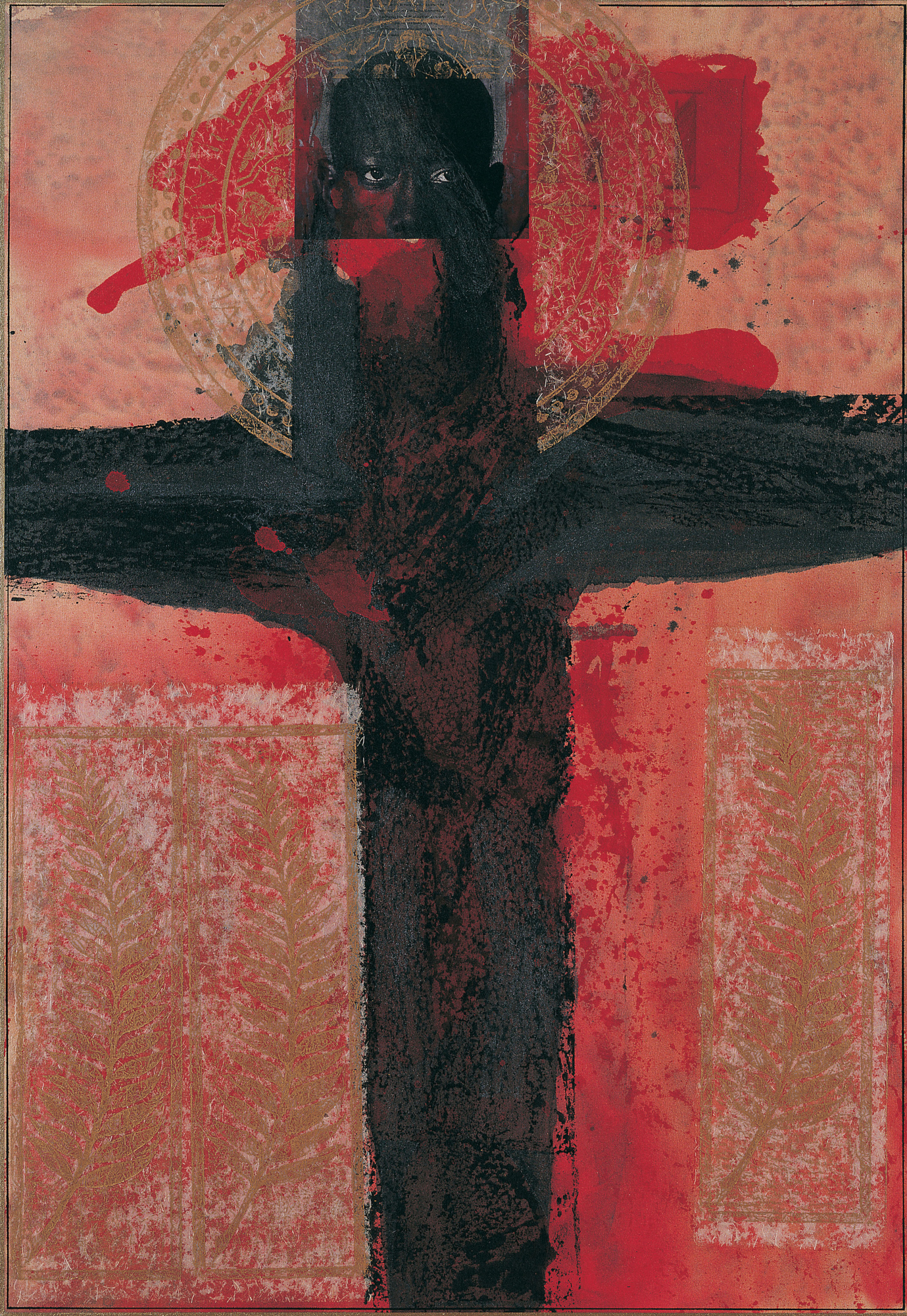
Last month when I was driving home to Maryland from Connecticut, I decided to stop for an hour or two at the Newark Museum of Art in New Jersey. I wanted to see a monumental Nativity painting in their collection by Joseph Stella. It didn’t end up being on display, but I did find many other compelling works. Chief among them was the acrollage painting Christ of the Christians by Nuyorican (New York Puerto Rican) artist Rodríguez Calero, a variation on the Crucifixion that portrays the violence of the cross in the abstract.
Rodriguez Calero_Christ of the Christians
Rodríguez Calero (Puerto Rican, 1959–), Christ of the Christians, 1995. Acrollage on canvas, 52 × 36 in. Newark Museum of Art, Newark, New Jersey. All photos (except the two details that follow) courtesy of the artist.

Made with acrylic paint, rice paper, imaged paper, colored glazes, and gold leaf, the work is heavily layered. Its focal point is the direct gaze of a young Black man, his head framed by a shaded gray box and haloed in gold. His face is cut off just above the mouth. The Word is muted.

This figure fragment is at the top terminal of a rough-edged cruciform that is rendered in a harsh tar-black embedded with deep splotches of red. Body merges with cross—blood, wood, and flesh.

The whole background is covered in pinks and reds. The color pools and splatters and permeates, representing the pouring out of life.

Standing upright alongside the cross are three stenciled palm branches, alluding to Christ’s entry into Jerusalem just five days earlier. Palm branches were a symbol of triumph in ancient Judaism, hence their being waved to greet the Christ, the “Anointed One,” at the city gate. (Jesus’s followers anticipated a political victory over Rome, little knowing that God had other plans.) In Christian iconography palm branches are associated with martyrdom; in portraits and heavenscapes they are held by saints who met an early end because of their spiritual convictions, just like their Lord.

Their presence in this scene can be read on the one hand as an indictment of human fickleness (lauding Jesus as savior one day, crucifying him the next) and on the other as an assertion of triumph through the unlikely means of death on a cross.

The work can also be read through the lens of Black suffering and liberation. The late Christian theologian James Cone writes about such themes in The Cross and the Lynching Tree, a landmark book published in 2013, anticipating the Black Lives Matter movement. Cone explains how powerful a symbol the cross has historically been to Black American communities who face racial terror, violence, and oppression. They see in the Crucifixion, in addition to its spiritual implications, a demonstration of God’s solidarity with the oppressed, and hope on the other side. “I’m with you in your suffering,” says the God who hangs on a tree at the behest of a mob, “and death will not have the final word.”

Cone describes the thousands of lynchings of Black men, women, and children in the US as “recrucifixions”—the killing of sons and daughters of God. Two decades earlier, Jamaican American artist Renee Cox made the same connection in her photographic collage It Shall Be Named, just one in a line of artistic works to do so, going as far back as the Harlem Renaissance. Calero’s Christ of the Christians contributes to this tradition.

The gaze of the Christ in her piece is arresting. It confronts. It asserts the sacred humanity of its wearer, despite attempts to blot it out.

Christ of the Christians (detail)

However, the artist tells me that for her, Christ of the Christians is about sacrifice, not violence, racial or otherwise. The man in the painting is the “people’s Messiah,” she says, “the anointed Savior to humankind who was sent to save all from the pain, darkness, and injustices that we see on a regular basis.” The cross is “willful humility, the culmination of prophecy, and the fulfillment of promises,” and the crown is heavenly reward. The trinity of branches represents hope.

One of the features that most struck me about this piece is its raised and varied textures, a hallmark all across the artist’s larger body of work. Calero coined the term “acrollage” to describe her mixed-media technique in which she uses an acrylic emulsifier to transfer collaged images (from found elements or her own photographs) onto painted canvas, adding further embellishments with gold leaf, stenciled patterns, and rice paper. This technique of layering materials, producing veils, suggests a theme of hiddenness and revelation.

Rodríguez Calero, or RoCa for short, was born in Arecibo, Puerto Rico, in 1959 and moved to Brooklyn when she was a year old. She returned to Puerto Rico after high school to study at the Escuela de Artes Plásticas at the Instituto de Cultura Puertorriqueña, under master artist Lorenzo Homar, who specialized in printmaking. Then she returned to New York for additional training in painting and collage under artist Leo Manso. She currently resides in New York and New Jersey.

Calero’s work merges Catholic iconography and hip-hop culture, drawing her personal community into the visual lexicon of the sacred. Raised Catholic, she was influenced from an early age by religious imagery at church and school. She brings this influence to bear in her artistic work while also integrating and reflecting the multiracial, multiethnic, urban environment she grew up in. “My inspiration really comes from just being in the neighborhood . . . the people walking the streets,” she says.

Alejandro Anreus, art historian and curator of the major 2015 exhibition Rodríguez Calero: Urban Martyrs and Latter-Day Santos at El Museo del Barrio in New York, describes the Nuyorican art aesthetic that was just getting off the ground while Calero studied at the Art Students League of New York from 1976 to 1982:

Starting before 1970—crystalizing possibly with the foundation of the Taller Boricua in New York City—and emerging and developing throughout the 1970s and into the 1980s, a specific aesthetic that can be defined as Nuyorican came into being. The aesthetic of New York Puerto Rican art was a diverse fusion of abstract expressionism and geometric abstraction, surrealism and social realism, as well as assemblage and constructions incorporating cultural and ethnic icons. The ethnic and cultural icons reflected several thematic preoccupations, which included Taino and Afro-Hispano imagery, depictions of barrio life, a popular, even populist Catholicism, and the belief that everyone, particularly the poor and marginalized of the neighborhoods, has dignity and inner worth regardless of social status. [exhibition catalog, p. 23]

The Christian doctrine of the imago Dei—that all human beings bear God’s image—is a central theme in Calero’s work. In His Image even adopts this theological language from the book of Genesis in its title, reminding us that God created each and every person with intrinsic and objective value, a reflection of his own divine self.

Rodriguez Calero_In His Image
Rodríguez Calero (Puerto Rican, 1959–), In His Image, 1994. Acrollage on canvas, 36 × 24 in.

The piece shows a Black man dressed in a coat and beanie looking pensive and forlorn, his eyes downcast. Rectilinear pieces of teal-blue handmade paper form a cross behind him, and the outline of a manhole cover labeled “PUBLIC SERVICE” is superimposed over his face, doubling as a halo. In Christian art the halo signifies the light of Christ shining around and through a person, and Calero often adopts that device to underscore the sacred humanity of her subjects.

But the cross-hatching of this round form across the man’s face gives the impression of prison bars. Is he headed to prison, or is that destination merely what others, those with shallow or skewed vision, see when they look at him? Maybe he feels imprisoned by his circumstances. Or perhaps he is experiencing some kind of mental captivity. Whatever the nature of the confinement, those bars need to be broken. God wants every human being to be free and flourishing.

Rodriguez Calero_El Hijo de Dios
Rodríguez Calero (Puerto Rican, 1959–), El Hijo de Dios, 1995. Acrollage on canvas, 36 × 24 in.

The youth in El Hijo de Dios also shines forth God’s image. He looks straight out at the viewer from under his red Karl Kani sweatshirt hood, with a softness and a self-awareness that evoke empathy. A gilded pattern of crosses in diamonds cuts across the middle third of the acrollage, and a dot-rimmed semicircle, a halo fragment, seems to embrace the boy. The delicacy of this intervention over the thick, heavy folds of the cotton sportswear creates an intriguing mix.

To the boy’s right is a collaged face of a male in profile that looks like it could have been taken out of a Picasso painting. He could be an extension of the primary figure, his face set on a path. Or he could be someone who is at cross-purposes with him, as they are oriented at a ninety-degree angle from each other.

Translated “The Son of God,” the title of this acrollage could refer to Jesus Christ, who bears this title in a special sense, as the only begotten of God the Father. The man does seem to embody the vulnerability and determination that characterize Christ in his passion. Alternatively, it could refer to a child of God more generally, as the Spanish hijo is not necessarily male-specific. The particular and the universal are both at play here. We are all God’s children (Acts 17:28–29), equally and eternally beloved.
Rodriguez Calero_Cruz de Loisaida
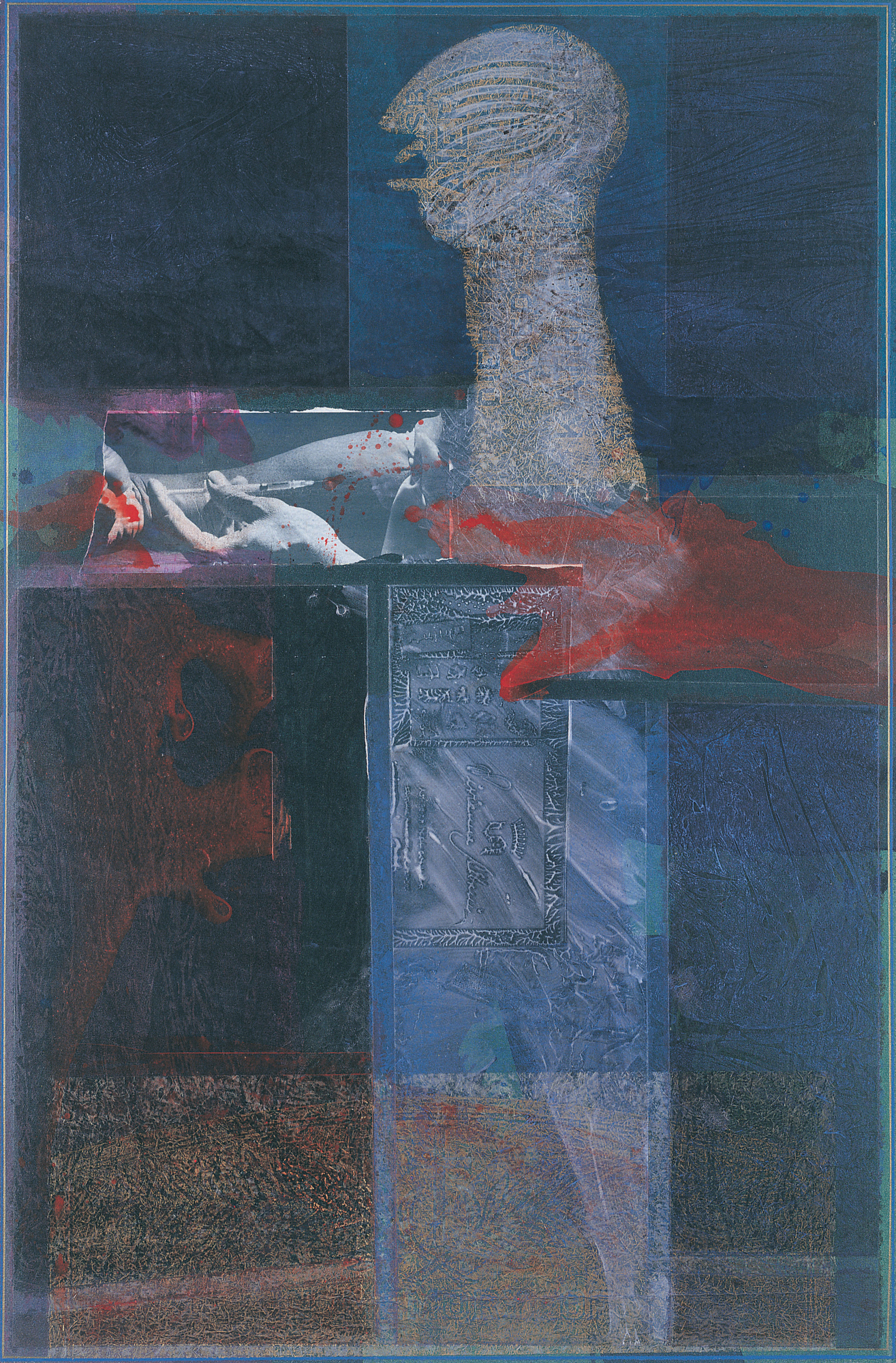
Rodríguez Calero (Puerto Rican, 1959–), Cruz de Loisaida, 1994. Acrollage on canvas, 64 × 42 in.

God’s love reaches especially into places of darkness, even though we don’t always feel it. In Cruz de Loisaida, our eyes are drawn to a monochrome found image of a hand injecting heroin into an arm. This fragment forms part of an abstracted cross, that archetypal symbol of deep suffering. The title, which translates to “Cross of Loisaida,” references a Lower East Side neighborhood with a strong Puerto Rican heritage. The piece laments the pain and anguish of drug addiction and, the artist says, the burdens forced on the Puerto Rican community by the government (“we are the sacrificial lambs”). Red pigment spills forth from the arm, evoking blood.

Rodriguez Calero_Crowned with Thorns
Rodríguez Calero (Puerto Rican, 1959–), Crowned with Thorns, 1999. Acrollage on canvas, 36 × 24 in.

Another acrollage that alludes to Christ’s passion is Crowned with Thorns, which is dominated by a large orange halo filled with linear and organic designs and cut out narrowly to reveal the face of a Black man. This headpiece is not obviously a crown of suffering; instead, it seems to convey an unironic air of royalty. It contains palm branches and irradiating gold lines that branch out like the veins of a leaf. And it smolders like fire. Could this be I AM speaking from the burning bush? The lush floral patterns, the Voice abloom?

By virtue of its historical associations, the title connects the man to Christ. With his hands he touches his Sacred Heart.
Rodriguez Calero_The Chosen
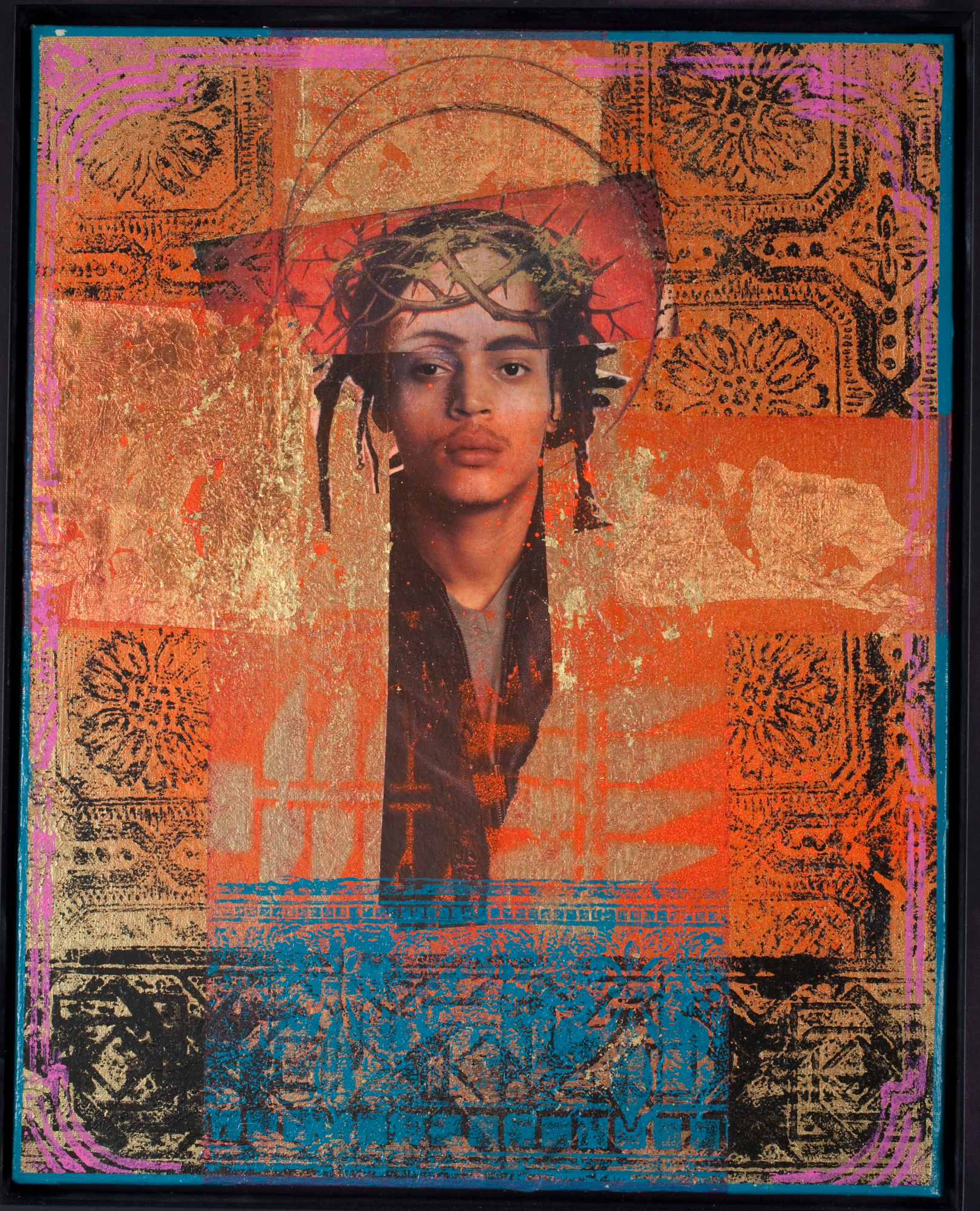
Rodríguez Calero (Puerto Rican, 1959–), The Chosen, 2000. Acrollage on canvas, 20 × 16 in.

One piece that appropriates unmistakable imagery of Christ is The Chosen: it contains a fragment of a Dutch Renaissance painting in the National Gallery of Christ crowned with thorns. Calero has cropped a detail of the gnarly crown piercing (a Caucasian) Christ’s forehead and collaged it with the face of a Latino man and the locs of a third (presumably a Black man). Her multiracial Jesus is nimbed twice over and emerges as if from a behind gold curtain, his brown eyes holding our gaze. He is surrounded by black-ink prints of flowers and crosses and flanked, as in Christ of the Christians, by golden palm branches. Droplets of red paint are splattered about his face and torso, one resting prominently on his upper right cheek like a tear.

Like Jesus, the Virgin Mary, his mother, is a major religious figure in Puerto Rican culture, and Calero references her in several of her artworks. Ángel y Maria depicts the moment of Annunciation, when the angel Gabriel comes to Mary to tell her that she has been chosen to bear God’s Son (Luke 1:26–38).

Rodriguez Calero_Angel y Maria
Rodríguez Calero (Puerto Rican, 1959–), Ángel y María, 2000. Acrollage on canvas, 52 × 36 in.

It’s a stunning image, bringing new life to a subject that has been painted hundreds of thousands of times over the course of history, starting with the ancient Roman catacombs. In Calero’s take, Mary is portrayed as a beautiful young woman of African descent who sits in profile, contemplating the gravity of what has just been asked of her. She holds a bouquet of flowers to her chest—perhaps she was in the midst of picking or arranging them when Gabriel arrived.

Gabriel stands in formality, cognizant of the weight of his message, patiently awaiting a response. His body is rendered in a wash of colors that blend into one another, producing an ethereal look.

Mary’s lips are parted, speaking her yes.

“The theme is love,” Calero told me. “The flowers are a representation of the blessing already inside.”

In the gospel story, this supernatural encounter results in a miraculous pregnancy, pictured in Calero’s La Madonna Negra (The Black Madonna). The image is of the Madonna del Parto (Our Lady of Parturition) type—that is, the pregnant Mary. We don’t often see Mary’s bare belly in all its pregnant glory, but here we are given a glimpse and reminded of the bodiliness of the Incarnation. We can even see the linea nigra extending across her bellybutton!

Rodriguez Calero_La Madonna Negra
Rodríguez Calero (Puerto Rican, 1959–), La Madonna Negra, 2007. Acrollage on canvas, 54 × 24 in.

Calero’s Afro-Latina Madonna has two sets of arms. With one, she cradles her third-trimester baby bump and clenches the veil near her face, and the other she extends outward in a gesture of giving, offering the fruit of her womb for the life of the world (notice the printed impression of a fetus in her upper left hand). I love how these multiple gestures capture the conflicting instincts she must have felt—on the one hand, to keep the child to herself, to protect him from harm, and on the other, knowing her ministry is to support his, to share him with everyone. I see both Mary’s fear and her surrender in this image; her very human “What if I’m not ready for this?” and her “Welcome; come, receive.”

Rodriguez Calero_Virgen Maria
Rodríguez Calero (Puerto Rican, 1959–), Virgen María, 2000. Acrollage on canvas, 52 × 34 in. Collection of María Domínguéz-Morales and Juan M. Morales.

There’s also a hybridity in Virgen María, which shows a woman whose face is an amalgam of “every woman,” says the artist. Strong and confident, this Mary takes up space. Streaks of red paint cut across her torso like cords—but she spreads her arms, breaking what binds her. The bottom half of the canvas consists of blues and reds, Mary’s traditional colors, while the top half is gold, signifying the light of God.

“Mary, for me, has always been pictured as passive, and dressed in blue,” Calero told me. “Think about God in heaven, searching the world for the perfect woman to bear his Son. Now, in that state of mind, I thought Mary was chosen for her beauty, strength, compassion, intellect, and sexiness, and must represent all women, hence my Virgen María.”

Just as Calero often composites people of different races and ethnicities, she also occasionally mixes genders, as in Divine Prophet.

Rodriguez Calero_Divine Prophet
Rodríguez Calero (Puerto Rican, 1959–), Divine Prophet, 2012. Acrollage on canvas, 54 × 36 in.

This prophet’s face is made up of three collaged elements. A male with long hair and closely cropped facial hair forms the base, but the two eyes, underlined in blue shadow, are clearly a woman’s. And a mystical third eye is patched onto the forehead.

In Eastern spirituality, the third eye, also called the inner eye, provides perception beyond ordinary sight. The prophet, for example, sees visions of a reality that is presently invisible but that will one day be made manifest. The third eye symbolizes a state of enlightenment.

The prophet in this piece could be Jesus, or an Old Testament seer, or a prophet from another faith tradition. If the former, it’s interesting to consider how male and female are both contained in the Godhead, per Genesis 1:27. Although the second person of the Trinity incarnated as a male, there’s a long tradition of ascribing feminine attributes to Christ, from Clement to Ephrem to Anselm to Marguerite d’Oingt to Julian of Norwich. Christ is our Mother, they say, who labors to bring us to birth and feeds us at his breast. Moreover, the biblical book of Proverbs personifies Wisdom as a woman, and that woman is associated with Christ.

Centuries of European religious art and its mass-produced derivatives have harnessed the popular imagination to a narrow view of what the sacred looks like. Because of this conditioning through images, most people all over the world, not just in the West, conceive of Jesus, Mary, and the saints—those due honor—as white. Calero challenges that conception, not erasing whites but broadening the tent of sacred imagery to encompass people of color as well.

Most of her “saints” are not historical. They’re ordinary folks from New York’s barrios, or from other US cities—and from today. With their strong frontal poses, direct gazes, and haloes, they reflect the dignified, divine image–bearing status of those whom traditional Christian iconography has tended to exclude.

“Her saints—santos—are latter day and among us, her martyrs are our contemporaries,” says Alejandro Anreus. “They all live and struggle in an urban world filled with tension, even violence, as well as humor, yet open to epiphanies, where miracles can happen.” And, he continues, “her representations of Jesus Christ become all of us, as if reflecting the variety of humanity redeemed by Christ.”

(Regarding Anreus’s crucial last point: I articulated some of my thoughts on the matter a few years ago in this Instagram post.)

Black and brown bodies are beautiful and good, bearing the imprint of God their Creator. Rodríguez Calero helps us see and celebrate that. Bringing her cultural heritage to the fore, she cuts and combines, mixes and matches, contemplates, plays, and intuits, constructing affirming figure-based images of flesh and spirit that, while borrowing Christian visual tropes, are not tethered to Christianity but rather can live and move beyond an orthodox framework.

To learn more about Calero’s art training, her oeuvre, and collage as an art form, see the catalog for her retrospective (written in English and Spanish). You can also visit her website, www.rodriguezcalero.com.

Roundup: Ukrainian Madonnas and songs of peace

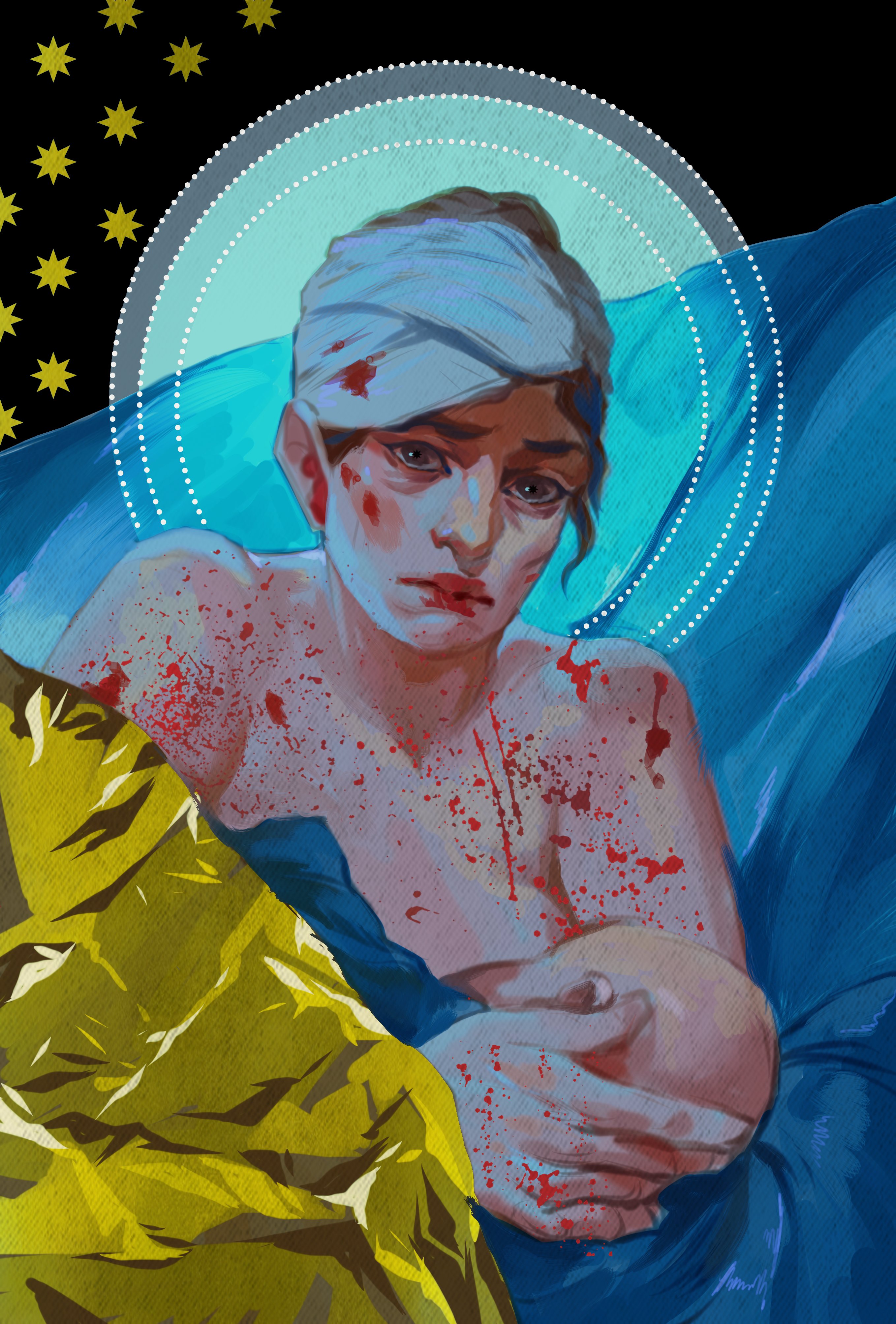
UKRAINIAN MADONNAS: Since Russia invaded Ukraine on February 24 and even still continues to aggress, artists have taken up their art to address the war—several drawing on iconography of the Madonna and Child, particularly the Maria lactans (breastfeeding Mary) type. Two Ukrainian artists were inspired by different news photos of young mothers protecting their infants from the shelling in Kyiv in March—one of whom was photographed in a hospital being treated for wounds she sustained from fallen glass while shielding her daughter with her body, and the other hiding from the blasts in a subway station.

Kyivan Madonna
Maryna Solomennykova, Kyivan Madonna, 2022, digital painting [purchase] [see news photo]

Frirean, Anta_Madonna
Anta Frirean, Ukrainian Madonna, 2022 [see news photo]

These images show the vulnerability of Christ, who is with us in our suffering, and indict those who cause such suffering.

In his response to the war in Ukraine, Serbian artist Michael Galovic, who lives in Australia, also uses Christian iconography: the Theotokos Kyriotissa (Mother of God enthroned with Christ); Archangel Michael, the patron saint of Kyiv, fighting a dragon (Rev. 12:7–8) in an ethereal rendering of a scene from the Très Riches Heures du Duc de Berry, a fifteenth-century French book of hours; and a hellmouth from the twelfth-century Winchester Psalter. These three medieval images are superimposed on Picasso’s masterwork Guernica, named after the Spanish town bombed by Nazis in 1937 and representative of the horrors of war.

Ukraine Response by Michael Galovic
Michael Galovic (Serbian Australian, 1949–), Ukraine Response, 2022. Egg tempera and gold leaf on linen on board, 170 × 80 cm. Collection of the Australian Centre for Christianity and Culture, Canberra, Australia.

Whereas Frirean’s and Solomennykova’s paintings are more intimate, Galovic takes a more cosmic approach, showing wails of lament from abstracted forms intercut with epic battles between good and evil—but at the calm center, Christ is on the throne, holding the scroll of his good word. History is going somewhere. Hate will be damned. Love will triumph.

Thanks to Art/s and Theology Australia for introducing me to the Galovic painting.

+++

SONGS:

>> “Galoba (The Prayer),” performed by Trio Mandili: A sung performance of a poem written in 1858 by the Georgian poet and statesman Ilia Chavchavadze (1837–1907). An English translation follows.

Our Father, who art in heaven,
With tenderness I stand before thee on my knees.
I ask for neither wealth nor glory;
I won’t debase my holy prayer with such matters.
I desire instead for my soul to be enlightened by heaven,
My heart to be radiant with thy love.
Even if my enemies pierce me in the heart,
I beg thee: “Forgive them, Lord, for they know not what they do!”
Even if my enemies pierce me in the heart,
I beg thee: “Forgive them, Lord, for they know not what they do!” [source, adapt.]

>> “Peace All Over the World” by Robert Bradley: Written and performed by Detroit musician Robert Bradley, this song originally appeared on the film Playing for Change: A Cinematic Discovery of Street Music (2005). To celebrate their twentieth anniversary, Playing for Change [previously] has remastered it and added new footage from Ukraine.

>> “Du som gick före oss” (You Who Went Before Us) | Words by Olov Hartman, 1968 | Music by Sven-Erik Bäck, 1959 | Performed by VOCES8, 2022: The melody uses all twelve semitones of the octave! I’ve provided a literal English translation of the Swedish below with the help of Google Translate; for a looser but more poetic translation by Fred Kaan, from 1976, see here. Note: The video identifies the song parenthetically as Psalm 74, not because it’s a setting of Psalm 74 from the Bible, but because it is no. 74 in Den svenska Psalmboken, the official hymnal of the Church of Sweden.

Du som gick före oss
längst in i ångesten,
hjälp oss att finna dig,
Herre, i mörkret.

Du som bar all vår skuld
in i förlåtelsen,
du är vårt hjärtas fred,
Jesus, för evigt.

Du som med livets bröd
går genom tid och rum,
giv oss för varje dag,
Kristus, det brödet.

Du som går före oss
ut i en trasig värld,
sänd oss med fred och bröd,
Herre, i världen.
You who went before us
in the depths of anxiety,
help us to find you,
Lord, in the dark.

You who bore all our guilt
into forgiveness,
you are the peace of our hearts,
Jesus, forever.

You who are the living bread
offered abundantly through all the earth,
give us each day,
dear Christ, that bread.

You who go before us
out into a broken world,
send us out likewise, Lord, 
with peace and bread. 

Roundup: Paula Rego’s Life of the Virgin; corito medleys; more

EXHIBITION: Paula Rego: Secrets of Faith, Victoria Miro Venice, April 23–June 18, 2022: Portuguese-born British artist Paula Rego died last Wednesday, June 8, after a seven-decade career, and in the midst of four solo exhibitions of her work—including this one at Victoria Miro’s gallery in Venice, which explores her small but significant body of religious art. [HT: Jonathan Evens]

In 2002 Jorge Sampaio, then president of Portugal, commissioned Paula Rego to create eight pastel drawings based on episodes from the life of the Virgin Mary, to be installed permanently in the chapel of the presidential palace (Palácio de Belém) in Lisbon. Titled Nossa Senhora (Our Lady), the cycle comprises Annunciation; Nativity; Adoration; Purification at the Temple; Flight into Egypt; Lamentation; Pietà; and Assumption. Rego had such fun with the commission that she produced additional works on the subject, which she decided to keep for herself. It is these, along with her watercolor studies, that are currently on display in Venice. (The original eight pastels are not allowed to leave the chapel for which they were made.)

Rego, Paula_The Flight to Egypt
Paula Rego (Portuguese British, 1935–2022), The Flight to Egypt, 2002. Watercolor and ink on paper, 8 1/4 × 11 3/4 in. (21 × 29 cm).

Rego, Paula_Descent from the Cross
Paula Rego (Portuguese British, 1935–2022), Descent from the Cross, 2002. Pastel on paper mounted on aluminum, 29 1/2 × 28 3/8 in. (75 × 72 cm).

I learned about Rego’s Marian cycle a few years ago and became enthralled by it, though I’ve never seen it in person, and most of these supplemental works are new to me. It’s unique, in part because of Mary’s corporeality. In a 2003 interview with Richard Zimler, Rego said, “If there is anything new about these representations of the Virgin, it is the fact that they were done by a woman, which is very rare. . . . It always used to be men who painted the life of the Virgin, and now it is a woman. It offers a different point of view, because we identify more easily with her.”

While the president praised the cycle and Rego insisted that “these pictures were created with admiration and respect,” an open letter to Sampaio referred to it as an “outrage done to the vast majority of the Portuguese people,” an “outrage against their religious beliefs and an offence to the Virgin Mary.” In brief: “blasphemous and scandalous.” I can see why Rego’s larger oeuvre, with its often menacing and/or transgressive imagery (not least of which is her Abortion Series), would scandalize conservative viewers, but I am a bit confused by the outrage at Nossa Senhora, which to me seems very honoring. The objectors, it sounds like, are those who prefer Mary to be more ethereal and sedate; they don’t want to see her, for example, slouching or wincing or expressing astonishment, or awkwardly struggling to hold the weight of her son’s corpse. There will always be those who resist any kind of updating of religious art. If the scenes are restaged in an unfamiliar way or rendered in an unfamiliar style or introduce a new element or the figures don’t look like how we have always pictured them, then some will oppose them outright—which is a shame, because such art often invites us more deeply into the story, helping us to see it afresh.

Definitely check out the boldface link above to view more pieces from the exhibition, as well as a video that shows Nossa Senhora in situ. For further reading, see “Paula and the Madonna: Who’s That Girl?” by Maria Manuel Lisboa and the transcript from Zimler’s interview with Rego.

+++

PODCAST EPISODE: “Past Hymns for the Present Moment,” Tokens, May 26, 2022: “Hymns are often sentimentalized in the American church, cast aside as merely retired songs with dated language, bearing no real appeal or relevance. But of course it may be that our old hymnals have some crucial things to say to us in our current cultural moment. This is the challenge I [Lee C. Camp] posed to Odessa Settles, Phil Madeira, and Leslie Jordan: find and perform some old hymns which might be both indicting and encouraging to the modern church, and to the world at large. Beautiful conversation and moving performances, taped at Nashville’s Sound Emporium.”

+++

POETRY UNBOUND EPISODES:

In each episode of this podcast from On Being Studio, host Pádraig Ó Tuama unpacks a contemporary poem in fifteen minutes. Here are two from season 5 (which just came to an end) that I particularly liked.

>> “Looking for The Gulf Motel” by Richard Blanco: “What happens when we remember?” Ó Tuama asks. “Why do we remember? Is it sweet or sad? Is it both? If you particularly associate warm memories, romantic memories, nostalgic memories with a place, and then that place is changed, does that mean that all those memories are gone?” In this poem from a collection of the same title (which I checked out from my local library at Ó Tuama’s recommendation, and it’s excellent!), Cuban American poet Richard Blanco, at age thirty-eight, reminisces about a family beach vacation from his childhood. Read the poem here.

If I were writing this poem, it would be called “Looking for The Blockade Runner,” as that’s the name of the Wrightsville Beach hotel in North Carolina that my family and I used to stay at for four days or so each summer. My little brother and I should still be running around on the waterfront lawn as our parents watch us from inside the giant window of the dining room, finishing up their breakfast. My dad should still be riding in a wave on a boogie board, teaching me technique. My mom should still be lounging at the pool in her black one-piece with sunglasses and a Vanity Fair, I feeling so grown up beside her sipping my virgin piña colada. My brother should still be exhilarated by the live hermit crabs at Wings, and I by the dried starfish and sand dollars. We should all still be walking back from the Oceanic, our bellies filled with she-crab soup and hush puppies and catch-of-the-day, down the shore at dusk.

>> “The change room” by Andy Jackson: A poet who’s interested in difference and embodiment, here Andy Jackson, who has severe spinal curvature due to Marfan syndrome, “is looking at the attention that he gets in his body and is refocusing it, extending it wider, looking at the deeper question of, what does it mean for any of us to be in a body, and how do we in bodies relate to others in bodies?” Read the poem here, from the collection Human Looking.

+++

CORITO VIDEOS: A corito (literally “short song”) is a type of Latino Christian worship song. Coritos have “fairly simple tunes, often with repetitive words, that the people sing by heart,” writes Justo L. González in ¡Alabádle!: Hispanic Christian Worship. “Most of them are anonymous, and pass by word of mouth from one congregation to another. For that reason, the tune or the words of a particular corito may vary significantly from one place to another. They are often sung to the accompaniment of clapping hands, tambourines, and other instruments.” To learn more about this genre, see the Calvin Institute of Christian Worship interview with Rosa Cándida Ramírez and Analisse Reyes and the entry in the Encyclopedia of Christianity in the Global South, vol. 2.

>> Joseph Espinoza sings a corito medley consisting of “Cuando el pueblo del Señor” (When the People of the Lord), “No puede estar triste” (The Heart That Worships Christ Cannot Be Sad), “Ven, ven, Espiritu divino” (Come, Come, Holy Spirit), “Cantaré al Señor por siempre” (I Will Sing to the Lord Forever), and “El Poderoso de Israel” (The Mighty One of Israel). Aaron Barbosa is on keyboard, Fabian Chavez is on percussion, and Yosmel Montejo is on bass.

>> The video below was shared March 25, 2020, in the Multicultural Worship Leaders Network Facebook group that I belong to, and it’s pure joy! The performers string together three coritos: “Le canto aleluya” (I Sing Alleluia), “Hay victoria” (There’s Victory), and “Los que esperan en Jesus” (Those Who Wait in Jesus).

Federico Apecena provides the following translation. (The slashes indicate the number of times that line or passage is sung.)

//The heart that worships Jesus cannot be sad
The heart that worships God cannot be sad//

//That’s why I sing, I sing hallelujah
The heart that worships God cannot be sad//

//There’s victory, there’s victory, there’s victory in the blood of Jesus//
The enemy will not be able to defeat our souls
//Because there is victory, because there is victory, because there is victory in the blood of Jesus//

//That’s why I sing, I sing hallelujah
The heart that worships God cannot be sad//

///Those that wait, that wait in Jesus///
//Like eagles, like eagles, their wings will open//

They will walk and will not get tired, they will run and will not stop
//New life they will have, new life they will have, those that wait, that wait in Jesus//

//That’s why I sing, I sing hallelujah
The heart that worships God cannot be sad//

“My soul is alive with thoughts of God”: An adaptation of Mary’s Magnificat, by Rev. M Barclay

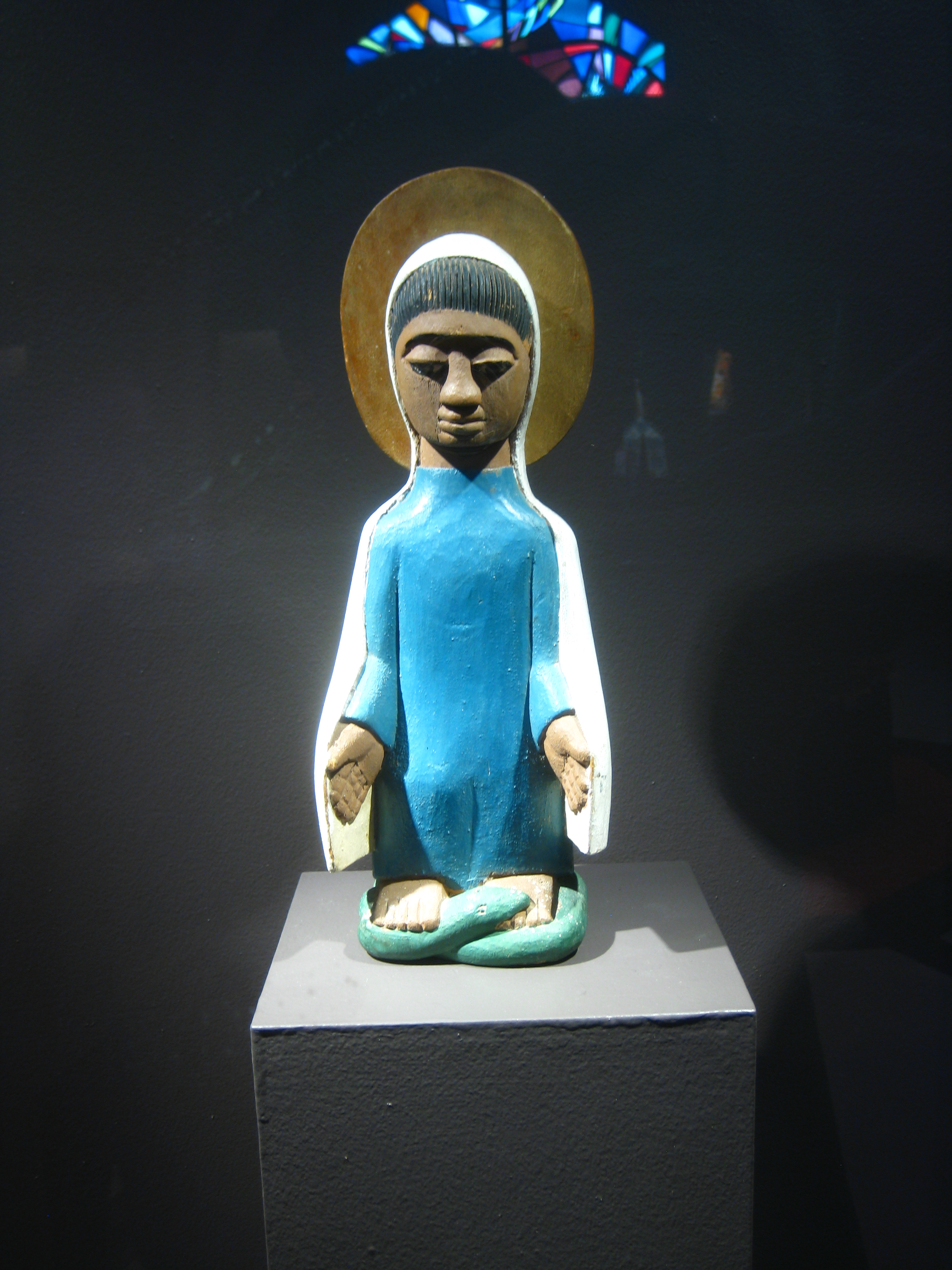
Bandele, George_Virgin Mary
George Bandele (Nigerian, 1910–1995), Virgin Mary, 1960s, wood and pigment. Collection of the SMA African Art Museum, Tenafly, New Jersey. Photo: Victoria Emily Jones.

With the feast of the Visitation coming up on May 31, I’ve been thinking about the song Mary sings in Luke 1:46–55 upon meeting up with her cousin Elizabeth in the hill country of Judea following their miraculous conceptions. It’s bold, exultant, and worshipful, oriented around the liberative power of God. As we continue to reel from the string of mass shootings in the US (Tuesday’s shooting at Robb Elementary School in Uvalde, Texas, was the 212th this year alone), I wonder how Mary’s song might speak to us in this moment—how we, too, might exclaim it with her same fervor and hope, truly believing that God is at work in the world, bringing about justice and healing, even though it is injustice and hurt that so often sound the loudest.

Here is a modern interpretation of the Magnificat by Rev. M Barclay, cofounder and director of enfleshed, an organization that creates prayers, liturgies, art, meditations, teachings, and other spiritual resources for collective liberation. Written in 2019, it captures the verve of Mary’s words while also drawing out shades of sorrow and adding a petitionary element. Barclay uses the gender-neutral pronoun “They” for the Triune God.

My soul is alive with thoughts of God.
What a wonder, Their liberating works.
Though the world has been harsh to me,
God has shown me kindness,
seen my worth,
and called me to courage.
Surely, those who come after me will call me blessed.
Even when my heart weighs heavy with grief,
still, so does hope abide with me.
Holy is the One who makes it so.
From generation to generation,
Love’s Mercy is freely handed out;
none are beyond the borders of
God’s transforming compassion.
The power of God is revealed
among those who labor for justice.
They humble the arrogant.
They turn unjust thrones into dust.
Their Wisdom is revealed in
the lives and truths of those on the margins.
God is a feast for the hungry.
God is the great redistributor of wealth and resources.
God is the ceasing of excessive and destructive production
that all the earth might rest.
Through exiles and enslavement,
famines and wars,
hurricanes and gun violence,
God is a companion in loss,
a deliverer from evil,
a lover whose touch restores.
This is the promise They made
to my ancestors,
to me,
to all the creatures and creations,
now and yet coming,
and in this promise,
I find my strength.
Come, Great Healer,
and be with us.

Easter, Day 4

How did Jesus’s mother, Mary, come to find out that he had risen from the dead? Was she there when it happened, keeping vigil? Was she among the holy women at the tomb to whom the angel made the announcement, or did these women go to Mary to relay the news to her? Maybe an angel came to tell her personally? Or perhaps Jesus himself appeared to her, to tell and show, at the home where she was staying.

The Bible is silent as to Mary’s whereabouts between the time of Entombment and the events of Easter morning. Historically, there have been proponents of each of the above suppositions. But the one that has taken the strongest hold is the last one—that Jesus made direct personal contact with his mom after his resurrection, before appearing to anyone else. He wasn’t at the tomb when Mary Magdalene got there (unless, perhaps, he was lingering somewhere in the shadows). Where did he go in the early morning? Some scholars say he must have gone to console his mother.

The claim that Jesus appeared first to Mother Mary can be found as far back as Ambrose (340–397), who wrote in his De virginitate, “Therefore Mary saw the resurrection of the Lord: she saw it first and believed.”

Around 1300 the anonymous writer known as Pseudo-Bonaventure elaborated on this tradition in his highly influential Meditationes Vitae Christi (Meditations on the Life of Christ), providing a vivid and affecting narrative in which Mary, when the women depart for the tomb on Sunday morning, stays behind and prays for God to restore her son to her alive.  

And with that, she so praying, sweet tears shedding, lo suddenly our Lord Jesus came and appeared to her, and in all white clothes, with a glad and lovely cheer, greeting her in these words: “Hail, holy mother.” And anon she turning said: “Art thou Jesus, my blessed son?” And therewith she kneeling down honored him; and he also kneeling beside her said: “My dear mother, I am. I have risen, and lo, I am with you.” And then both rising up kissed the other; and she with unspeakable joy clasped him, sadly, resting all upon him, and he gladly bare her up and sustained her. [as translated into Middle English by Nicholas Love in The Mirror of the Blessed Life of Jesus Christ, ca. 1400, with modernized spellings]

Pseudo-Bonaventure imagines a private, emotional reunion in a domestic interior. This episode was picked up by Ludolph of Saxony in his Vita Christi and by other writers, and it circulated throughout Europe. It made its way into the visual arts starting in the first half of the fourteenth century. The two most famous examples are the right wing of Rogier van der Weyden’s Miraflores Triptych and a woodcut from Albrecht Dürer’s Small Passion series.

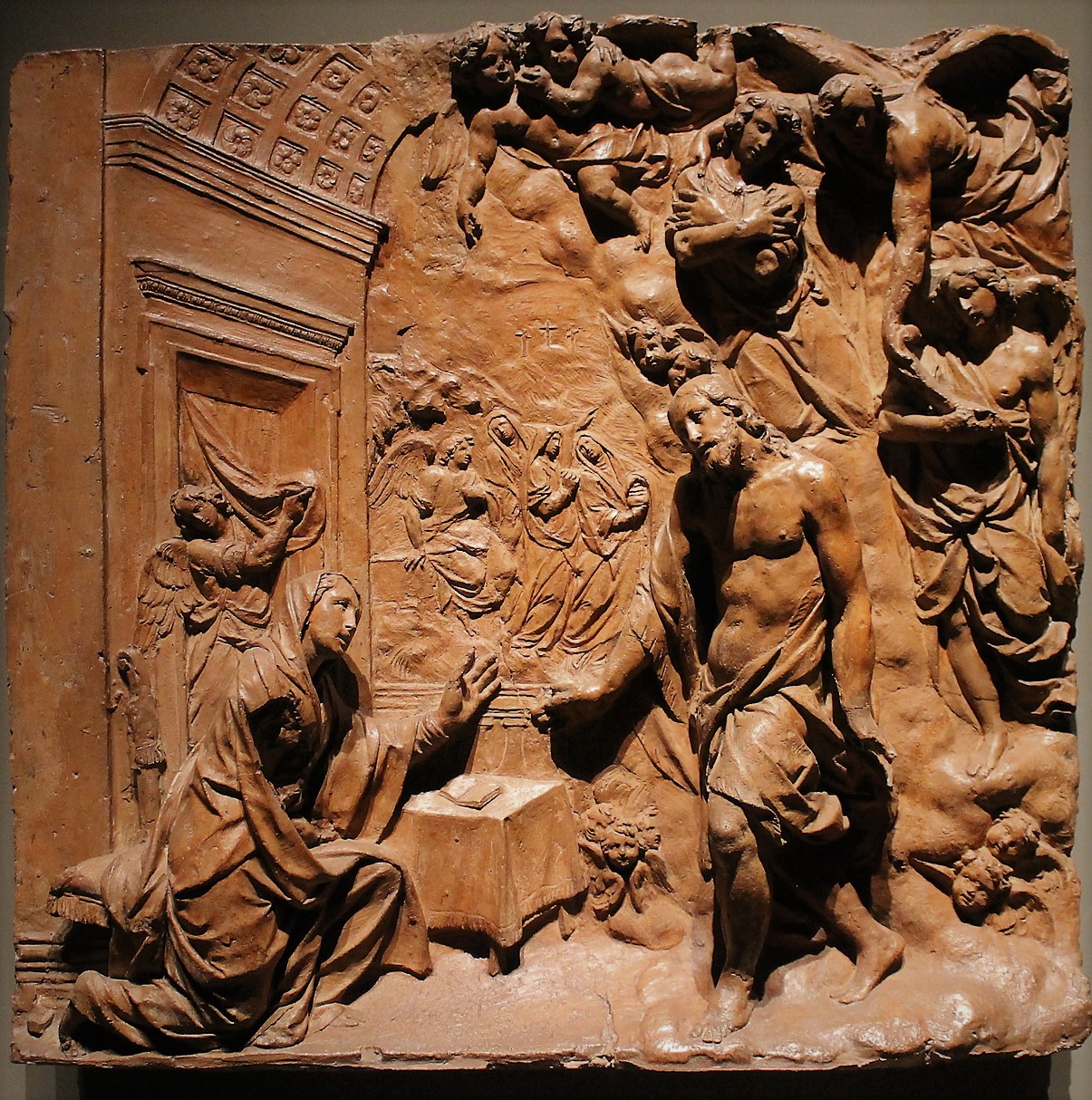
But I want to take a look at this Italian Baroque bas-relief by the minor artist Giovanni Pietro Lasagna.

LOOK: Christ Appearing to His Mother by Giovanni Pietro Lasagna

Lasagna, Giovanni Pietro_Christ Appearing to His Mother
Giovanni Pietro Lasagna (Italian, d. 1658), Christ Appearing to His Mother, first quarter of 17th century. Terracotta.

I found this artwork in the blog article “Iconography of the Resurrection – Christ Appears to His Mother” by Margaret Duffy, which provides a fascinating compilation of images. Duffy cites its location as unknown, and I’ve not been able to find reference to it anywhere else. It was probably made in Milan, where the artist was active. An email inquiry I sent last month to the city’s Museo del Duomo, which has similar terracottas from the same period in its collection, has garnered no reply. It’s possible the work was made as a design for a marble sculpture.

Carved in low relief in the background, an angel sits on the edge of an empty sarcophagus and tells the three women with their ointment jars that Jesus is not here but is risen. Three untenanted crosses are visible in the distance on Mount Calvary, a shadow of Friday’s events.

In the foreground, sculpted in high relief, we see Mary at her prayer desk. She is interrupted by the triumphant entry of her risen son, attended by angels. Their arms reach out to embrace each other as her grief turns to joy.

To reinforce the news of resurrection, an angel who stands behind Mary peeks out from behind a curtained doorway and points to the concurrent scene that’s unfolding in the garden of Jesus’s burial.

I’m not certain of the identity of the figures behind Jesus. But in looking into it, I did find that there’s a legend, likely originating in fourteenth- or fifteenth-century Spain, that when Jesus appeared to his mother after the resurrection, he presented to her the redeemed of the Old Testament, whom he had just freed from Hades.* So it’s possible that the beardless young man at the upper left with his arms crossed over his chest is Adam, and that the figure at the right with one breast bared is Eve. And I think the man at the top right corner who’s touching them both is an angel.

Note the iconographic similarity to scenes of the Annunciation—Gabriel’s announcement to the young Mary that she had been chosen by God to bear his Son. This “emphasizes the parallelism between the heralding of the Incarnation by the Archangel, and Christ’s own announcement, to his mother, of the fulfillment of that Incarnation, that is, the Resurrection.”**

* James D. Breckenridge, “‘Et Prima Vidit’: The Iconography of the Appearance of Christ to His Mother,” Art Bulletin 39, no. 1 (March 1957): 28. This excellent illustrated article traces the literary and visual history of the resurrected Christ appearing to his mother, in its several variations.

** Ibid., 26–27.

LISTEN: “Be Joyful, Mary” (Regina caeli, jubila) | Words: Latin, 17th century, based on the 12th-century “Regina caeli”; anonymous English translation from Psallite, 1901 | Music by Nicholas Andrew Barber, 2020

Be joyful, Mary, heav’nly queen
Gaude, Maria!
Your son who died was living seen
Alleluia!

Laetare, O Maria
O Maria

The son you bore by heaven’s grace
Gaude, Maria!
Did all our guilt and sin efface
Alleluia!

Laetare, O Maria
O Maria

The Lord has risen from the dead
Gaude, Maria!
He rose with might as he had said
Alleluia!

Laetare, O Maria
O Maria

This song has its roots in a medieval liturgical text that is still used as an antiphon (short hymn) in the Roman Catholic Church throughout the Easter season. Gaude means “rejoice”; laetare, “be glad.”

The lyrics could be in the voice of the women who went early to the tomb and are returning with the great news, or it could be that we the faithful are imaginatively addressing Mary across time, inserting ourselves into that story of the first Easter morning.

Lent, Day 21 (Feast of the Annunciation)

LOOK: The Annunciation by Steven Homestead

Homestead, Steven_The Annunciation
Steven Homestead (American, 1982–), The Annunciation, 2020. Digital collage.

Artist, composer, writer, curator, and speaker Steven Homestead of Orange County, California, created this collage by overlaying and manipulating three photographs from Unsplash. It depicts the moment when the angel Gabriel came to Mary of Nazareth to tell her that she had been chosen to bear God’s Son. Though Mary was initially taken aback by this announcement, she ultimately gave her full assent, leaning into the future God had for her. Through her fiat, her yes, God worked the salvation of the world.

Gabriel and Mary are represented here by two Brazilian models whose raised arms—his right, her left—form near symmetrical arcs. It’s as if he’s calling and she’s responding. She’s bending to God’s will, but not with the sort of demure posture so often assigned to her in art history; instead, her stance is one of freedom and power and becoming.

The curve of Gabriel’s hand matches the curve of the stained glass leading, which encircles his head and frames a representation of the Holy Spirit as dove, flying forth from a sunburst.

The setting is outdoors in a wooded area. Mary is dressed in white, like a bride. As she surrenders to the Divine, she becomes filled with light, the sun’s rays converging on her womb. A mystical veil falls around the two figures, suggesting sanctity and mystery. Her body has become the temple of the Lord.

March 25—exactly nine months before Christmas—is when the church celebrates the miraculous conception of Christ in Mary’s womb, the first stage of the Incarnation. It’s an event that fills me with awe and wonder—as it has thousands of artists over the centuries. I’m building a Pinterest board of Annunciation art that I find compelling, which you may be interested to browse: https://www.pinterest.com/art_and_theology/annunciation/. Homestead’s piece is my latest addition.

LISTEN: “Lord, Prepare Me to Be a Sanctuary” by Randy Lynn Scruggs and John W. Thompson, 1982 | Arranged and performed by the West Angeles COGIC Mass Choir and Congregation on No Limit, 2007

Lord, prepare me
To be a sanctuary
Pure and holy
Tried and true
And with thanksgiving
I’ll be a living
Sanctuary
For you

And whatever you tell me, my answer will be yes
Yes (yes)
Yes (yes to your will, Lord)
Yes (yes to your way)
Yes (Lord, I’ll go where you want me to go)
Yes (yes)
Yes, yes (yes)
Yes (whatever you tell me to do, Lord)
Yes
Yes (my will is your will for me, Lord)
Yes (come on, let’s take it higher, say yeah)

Lord, prepare me
To be a sanctuary
Pure and holy
Tried and true
And with thanksgiving
I’ll be a living
Sanctuary
For you

Hallelujah, hey!
Now I want the Lord to mold me
I want him to make me, I want him to shape me
I want him to direct me, I want him to purge me
I want him to wash me
Whatever he wants me to be
I’ll be just that, so I tell him:

Lord, mold me (mold me)
What you want me to be (what you want me to be)
Oh mold me (mold me)
What you want me to be (what you want me to be)
Oh and say mold me (mold me)
Say what you want me to be (what you want me to be)
Oh mold me (yes, what you want me to be) (mold me)
What you want me to be (what you want me to be)

Mold and we’ll say yes (yes)
Yes to your will say (yes to your will)
Say yeah, yeah (yeah)
Yes to your way, Lord (yes to your way)
Say yes everyday (yes everyday)
Yes to your way (yes to your way)
Say yes, I’ll obey (yes, I’ll obey)
Say yes to your way (yes to your way)

Lord, mold me
What you want me to be
Say what you want me to do
Where you want me to go
Say where you want me to go
When you want me to go
Say how you want me to go
What you want me to do

And you will say yeah (yeah)
Say yeah, yeah, yeah, yeah, yeah, yeah, yeah, yeah (yeah)
Say yes to your way (yes to your way)
Ooh ooh ooh yeah, yeah, yeah, yeah (yeah)
Say yes to your will (yes to your will)
Say, say yeah, yeah, yeah, yeah (yeah)
Say:

Lord, prepare me
To be a sanctuary
Pure and holy
Tried and true
And with thanksgiving
I’ll be a living
Sanctuary
For you

Hallelujah
Lord, I say yes
Lord, I say yes
Lord, I say yes
To your will and to your way
Not my time, but yours

If there’s one word I most associate with the Annunciation, it’s “yes.”

This song doesn’t directly reference the Annunciation, but it does capture the attitude of surrender to God that Mary modeled for us. “Lord, I say yes to your will and to your way.” We can assume that throughout her girlhood she cultivated a devotion that made her open and receptive to God’s call when it came. She was ready to offer herself as God’s sanctuary, a house for his incarnate presence. She literally became pregnant with God!

In a spiritual sense, we too are called to bear Christ within us (Rom. 8:10; 2 Cor. 4:6–7; 13:5; Gal. 1:15–16; 2:20). To be temples of his Spirit (1 Cor. 6:19–20). And to answer yes when God invites us into some new adventure.

“After Luke 2:19” by Michelle Ortega

Mantegna, Andrea_Madonna with Sleeping Child
Andrea Mantegna (Italian, 1431–1506), Madonna with Sleeping Child, ca. 1465. Tempera on canvas, 16 1/2 × 12 1/2 in. (42 × 32 cm). Gemäldegalerie, Berlin.

She took it all in: the shepherds and the royal and learned
men with their prophecies and proclamations. Resting among
common beasts, nipples sore and womb-ached, she smiled at
their praise—but her awe had begun with the angel’s decree.
At the mysterious life-pulse deep inside her. When flicker-
kicks strengthened to rolls and turns, elbows and heels in her
ribs. As buttocks bounced on her bladder.

The brightest star above them—a wondrous sign, but no
more miraculous than when, far from her mother and the
other village women, the flesh of her depth awakened and she
willed the baby from contentment into a harsh night. His cry
pierced the darkness, then quieted as, pressed to her breast,
he found her heartbeat again.

“After Luke 2:19” by Michelle Ortega, reproduced here by the author’s permission, was written for the 2021–22 exhibition Mary, Mary: Contemporary Poets and Artists Consider Mary at St. Michael’s Episcopal Church in Arlington, Virginia. Ortega is the author of the chapbooks Don’t Ask Why (Seven Kitchens Press, 2020) and Tissue Memory (Porkbelly Press, forthcoming).

Four scenes from a medieval German altarpiece

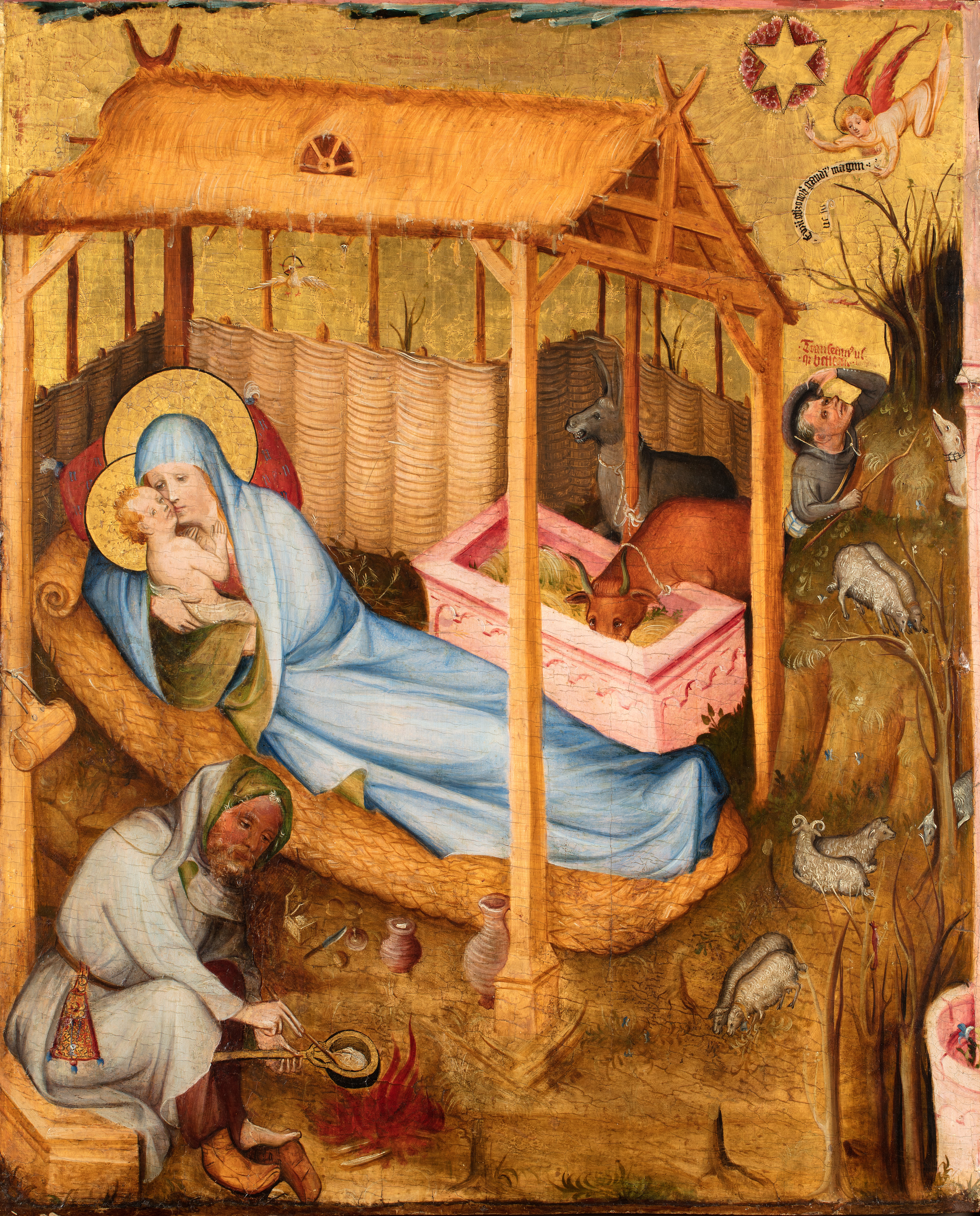
When I was at the Museum Catharijneconvent in Utrecht, Netherlands, in 2019, one of the standout pieces I saw was an early fifteenth-century altarpiece from the Middle Rhine region of Germany. The central section, which I imagine would have been a sculpted Crucifixion scene, has been lost, and the surviving panels are arranged in a modern frame.

Middle Rhine Altarpiece (Catharijneconvent)
Altarpiece from the Middle Rhine, ca. 1410. Tempera on panels. Museum Catharijneconvent, Utrecht, Netherlands. Photo: Ruben de Heer.

Ten panels depicting eight scenes from the life of the Virgin Mary decorate what would have originally been the interior wings—that is, visible when the altarpiece was open.

  1. The Annunciation (2 panels)
  2. The Visitation
  3. The Nativity
  4. The Adoration of the Magi
  5. The Resurrection
  6. The Ascension (2 panels)
  7. The Descent of the Holy Spirit
  8. The Dormition

I’ll describe the first four, as they’re my favorites.

All photos in this post are from the museum’s website, which courteously provides them in high resolution under an open-access policy, promoting scholarship and digital engagement. The Annunciation image is a composite I made from two separate photos.

The Annunciation

Annunciation (Middle Rhine Altarpiece)

In the Annunciation, Mary sits in her bedroom beside a window in front of an open pink chest (her dowry chest?), quietly reading the scriptures, when the angel Gabriel slips in through an open door, holding a banderole that bears his greeting: Ave gratia plena d[omi]n[u]s tecum (“Hail, favored one, the Lord is with you,” Luke 1:28). He then goes on to tell her that she has been chosen to bear God’s Son into the world.

What will Mary say? Four little angels look on in eager anticipation from a tower in the panel above, while in the room two angels already start rolling out the royal treatment, holding up a gilt-brocaded velvet “cloth of honor” behind the young maiden in recognition of her high calling.

A thin column divides Gabriel’s space from Mary’s, creating a sense of threshold. It marks a boundary that is about to be crossed. The separation between God and humanity will be broken down by the Incarnation.

Mary ultimately responds to the surprise invitation with acceptance: Ecce ancilla d[omi]ni fiat michi s[e]c[un]d[u]m verbu[m] t[uu]m (“Behold the handmaid of the Lord, be it unto me according to thy word,” Luke 1:38).

Mary’s yes triggers the release of a thick stream of light—it looks to me like a golden conveyor belt!—from the heart of God the Father, who is peering down through an upper window. Riding that stream is a haloed dove (the Holy Spirit) followed by a tiny yet fully formed infant Christ who’s holding a cross and headed straight toward Mary’s womb.

Annunciation (Middle Rhine Altarpiece, detail)
“Weeee!!!”

The homunculus (“little human”) motif in Annunciation images, though relatively rare, always makes me chuckle. It’s one way artists came up with to visualize the unvisualizable mystery of Christ’s conception, one that includes the Second Person of the Trinity as an actor in the event and shows a very literal descent. Not long after the motif started appearing in the fourteenth century, it was disapproved of by theologians, such as Antoninus of Florence and Molanus, and it was finally banned in the eighteenth century by Pope Benedict XIV as being heretical, since it suggests that Jesus did not take his body from Mary.

For brief commentary on this particular scene by Msgr. Herman Woorts, a Dutch art historian and an auxiliary bishop in the Roman Catholic Church, see this video produced by Katholiekleven.nl:

(To translate the Dutch into your language, click the “CC” button on the player, then the cog icon, and select Subtitles→Auto-translate.)

The Visitation

Visitation (Middle Rhine Altarpiece)

In the Visitation panel, Jesus and John the Baptizer are visible in their mothers’ wombs, each encased in a mandorla (almond-shaped aureole). This visual device of showing the cousins in utero was not uncommon at the time, especially in the Low Countries; art historian Matthew J. Milliner amusingly calls it “ultrasound Jesus”! Here you can actually see little John kneeling before his cousin in adoration.

Elizabeth has emerged from a door at the right, whose frame is labeled “Civitas Juda,” City of Judah (and notice the dog in the doorway! a traditional symbol of faithfulness). As she and Mary embrace each other in celebration of their miraculous pregnancies and imminent salvation, scrolls unfurl with their words from the Gospel of Luke: Et unde michi hoc q[uo]d mater d[omi]ni mei venit ad me (“And why is this granted to me that the mother of my Lord should come to me?” Luke 1:43), at right, and at left, Magnificat a[n]i[m]a mea d[omi]n[u]m. Et exultavit sp[iritu]s meus i[n] deo salutalutari (sic) meo (“My soul magnifies the Lord, and my spirit rejoices in God my Savior,” Luke 1:46–47). The scrolls provide a delicate, wing-like framing around the two women.

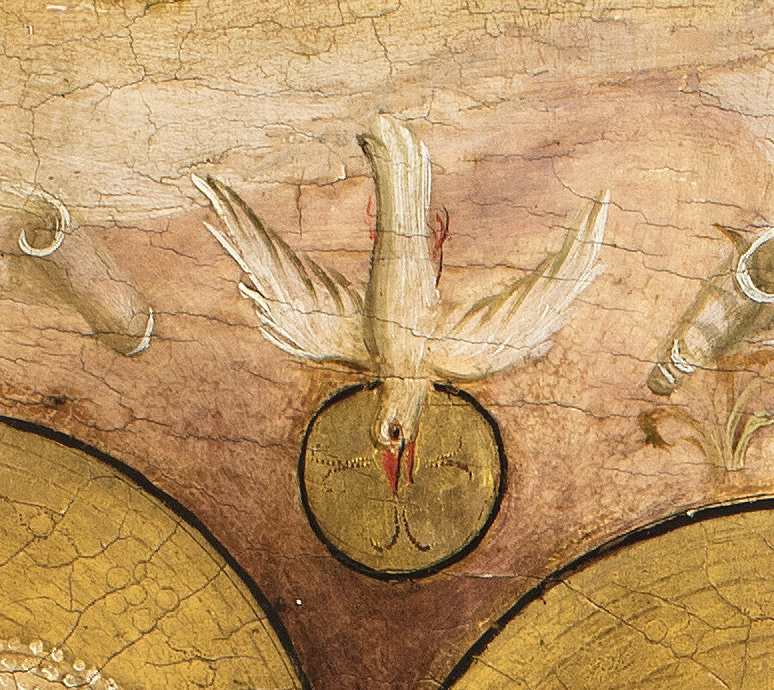
And at their head, in the center, an open-beaked dove descends, signifying the Holy Spirit—an extremely rare appearance in Visitation images. This is God breathing on his daughters, blessing their ministries, receiving their praise. Like the prophets of old, they are filled with God’s power and truth spills forth from their lips.

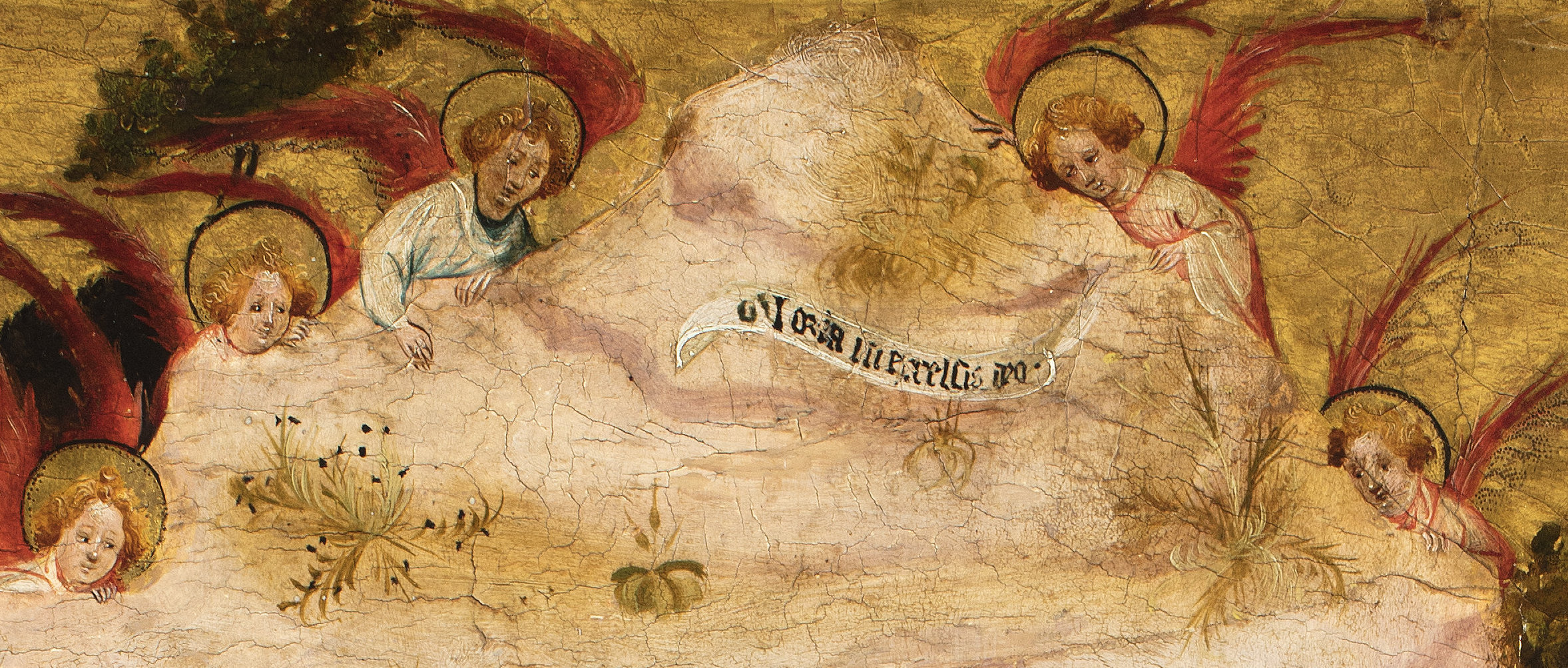
Visitation (Middle Rhine Altarpiece, detail)

At their feet flows a spring of water, a possible allusion to Isaiah 35:6b–7a: “waters shall break forth in the wilderness, / and streams in the desert; / the burning sand shall become a pool, / and the thirsty ground springs of water.” Not to mention the Living Water that is Christ (see John 4).

Another charming detail of this panel is the angels, with their wispy red wings, peeking in at this intimate moment from behind rocks. I’m reminded of the epistle of 1 Peter, whose author says that the mysteries of salvation are “things into which angels long to look!” (1:12). Here they seem to whisper their song that will be exclaimed at full blast on the night of Jesus’s birth: Gloria in exelsis deo (“Glory to God in the highest,” Luke 2:14).

The Nativity

Poor Joseph is often overlooked as a player in the Christmas story, and yet he, too, faithfully responded to a (quite terrifying!) divine calling: to be the adoptive father of Jesus, raising him as his own. Though he initially had doubts about Mary’s story of supernatural conception—who wouldn’t?—an angel set him straight, and he ultimately acted in love and loyalty to Mary, and to God. He was an advocate and a provider for his family, looking out for their best interests all along the way.

Nativity (Middle Rhine Altarpiece)

I mention this because the Middle Rhine Altarpiece shows an actively caring and resourceful Joseph at the Nativity, cooking porridge over an open fire to nourish his hungry and tired wife, who reclines on a rollout mat with her newborn.

Also, notice that his left foot is bare. A legend of unknown origin says that Joseph removed his stockings (German hosen) following Jesus’s birth, cutting them into strips in order to swaddle the child. This narrative detail appealed to popular imagination and was referred to in stories, poems, songs, and the visual arts from the fourteenth through sixteenth centuries in the Netherlands and the Rhineland. At the time this altarpiece was made there was even a venerated relic at Aachen Cathedral purported to be the stockings-turned-swaddling bands.

As had become standard in images of the Nativity, this one includes an ox and an ass. The canonical Gospels don’t mention any animals at the birth—though the mention of a manger in Luke 2:7 implies an animal presence. The seventh-century Gospel of Pseudo-Matthew specifically names the ox and ass, citing their supposed adoration of the Christ child as a fulfillment of an Old Testament “prophecy”: “And on the third day after the birth of our Lord Jesus Christ, the most blessed Mary went forth out of the cave, and entering a stable, placed the child in the stall, and the ox and the ass adored Him. Then was fulfilled that which was said by Isaiah the prophet, saying: The ox knows his owner, and the ass his master’s crib (Isa. 1:3).” These two domestic animals are also mentioned in the Nativity account that appears in the Golden Legend, an immensely popular text from the thirteenth century.

Here the ox is nose-deep in straw, while the ass looks up with his mouth agape. Perhaps he’s excited at having just spotted the Spirit-dove under the rafters.  

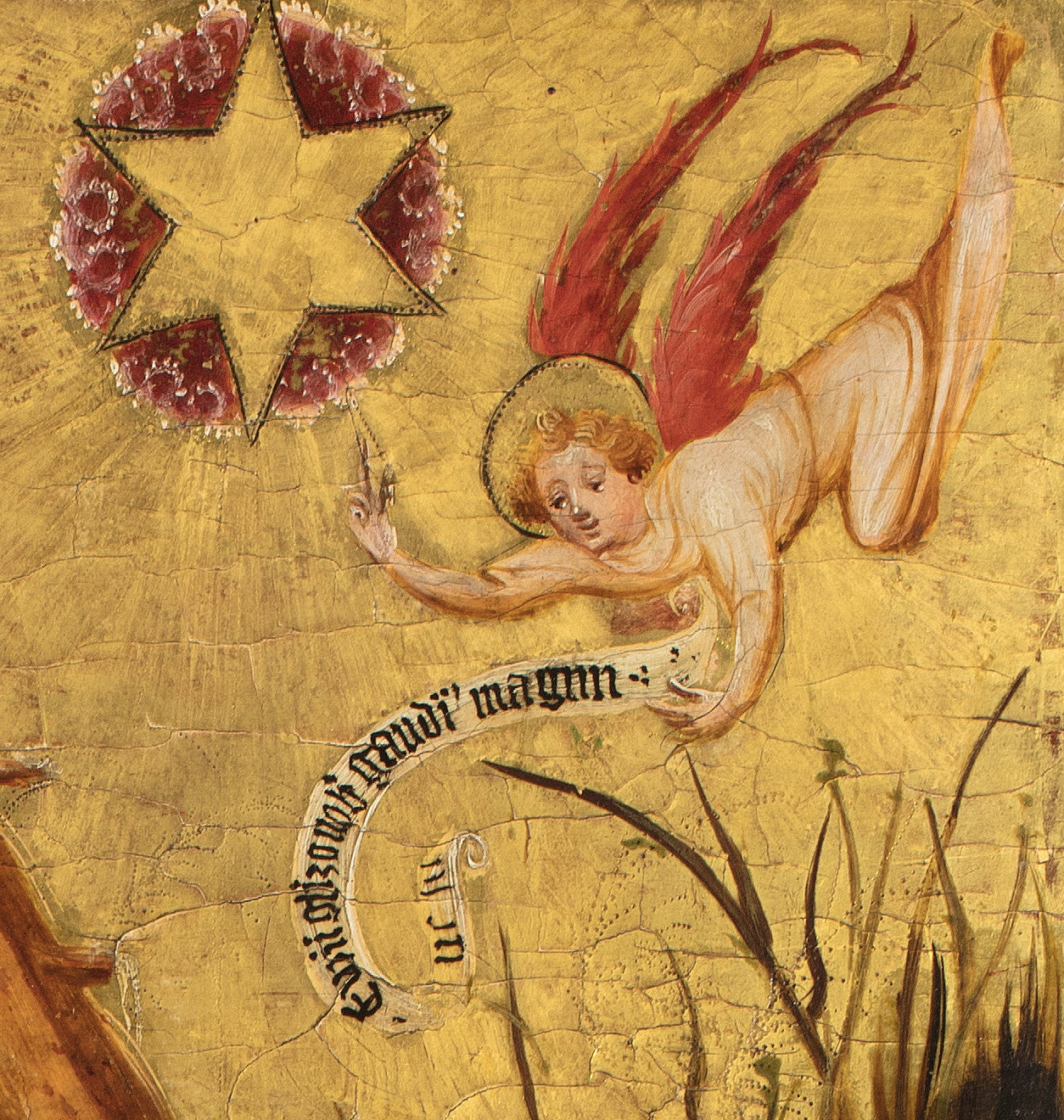
The shepherds are about to arrive at the stable, as in the right background the birth is announced to them. The scroll held by the angel reads, Evanglizo vob[is] gaudi[um] magnu[m] (“I proclaim great joy to you,” Luke 2:10), and above the shepherd is the inscription Transeamu[s] us[que] Betleem (“Let’s go to Bethlehem,” Luke 2:15).

The Adoration of the Magi

In the Adoration of the Magi panel, Mary holds the Christ child on her lap, who is nude save for a thin diaphanous drape, emphasizing his full humanity. She wears a crown, alluding to her identity (in Catholic tradition) as Queen of Heaven. As in the Annunciation, she’s backed by a cloth of honor, which Joseph pulls aside to see what new visitors have come calling. And again, the ever-present Holy Spirit hovers above!

The pointing angel at the top, with the aid of a star, has directed three magi, portrayed here as kings, from their far-off homelands to the Christ child. Ite in iudeam ubi / nascit rex iudeor[um] (“Go to Judea where the king of the Jews was born”), he says.

Having cast his crown at the child’s feet, one of the magi kneels down and kisses the hand of the King of kings. He presents a container of gold coins as tribute, which Jesus rifles through with curiosity (ooo, shiny!).

Two other magi stand behind with their gifts of frankincense and myrrh. One of them, whom tradition calls Balthazar, is African. In the eighth century the historian Bede described Balthazar as having a “black complexion,” and from around 1400 onward he came to be portrayed that way in art, reflecting the growing visibility of other races in Europe.

Exterior Panels

Just to give you a full picture of the altarpiece as a whole . . .

The exterior panels, which were visible when the altarpiece was closed, comprise ten scenes from Christ’s passion. Three, however, are missing, and several of the remaining ones are damaged.

  1. The Agony in the Garden
  2. The Arrest of Christ (lost)
  3. Christ before Pilate
  4. The Flagellation
  5. The Crowning with Thorns
  6. Christ Carrying His Cross
  7. The Deposition (lost)
  8. The Entombment
  9. Mary supported by John
  10. Longinus with the lance (lost)

So all together, the altarpiece would have told the gospel story from Christ’s conception and birth to the Crucifixion to the Resurrection and Ascension to Pentecost. And it would have served as the backdrop to the celebration of the Eucharist, spiritually forming parishioners week after week.

Art museums are full of such treasures as these. I encourage you to visit one of your local museums (or maybe take a weekend trip to one), find a piece of historical art that intrigues you, and sit with it for at least ten minutes. What do you notice? What is strange to you? What makes you smile? What was the object’s original context? What lineages is it a part of (e.g., what communities has it passed through, what iconographies or textual traditions does it draw from and develop, etc.)? What theological ideas, if any, does it express?

If you struggle to meaningfully engage with an artwork, I’m sure a docent would love to help you.

You might also take a photo of the artwork and share it on your social media. Ask your friends what stands out to them.

Advent, Day 13

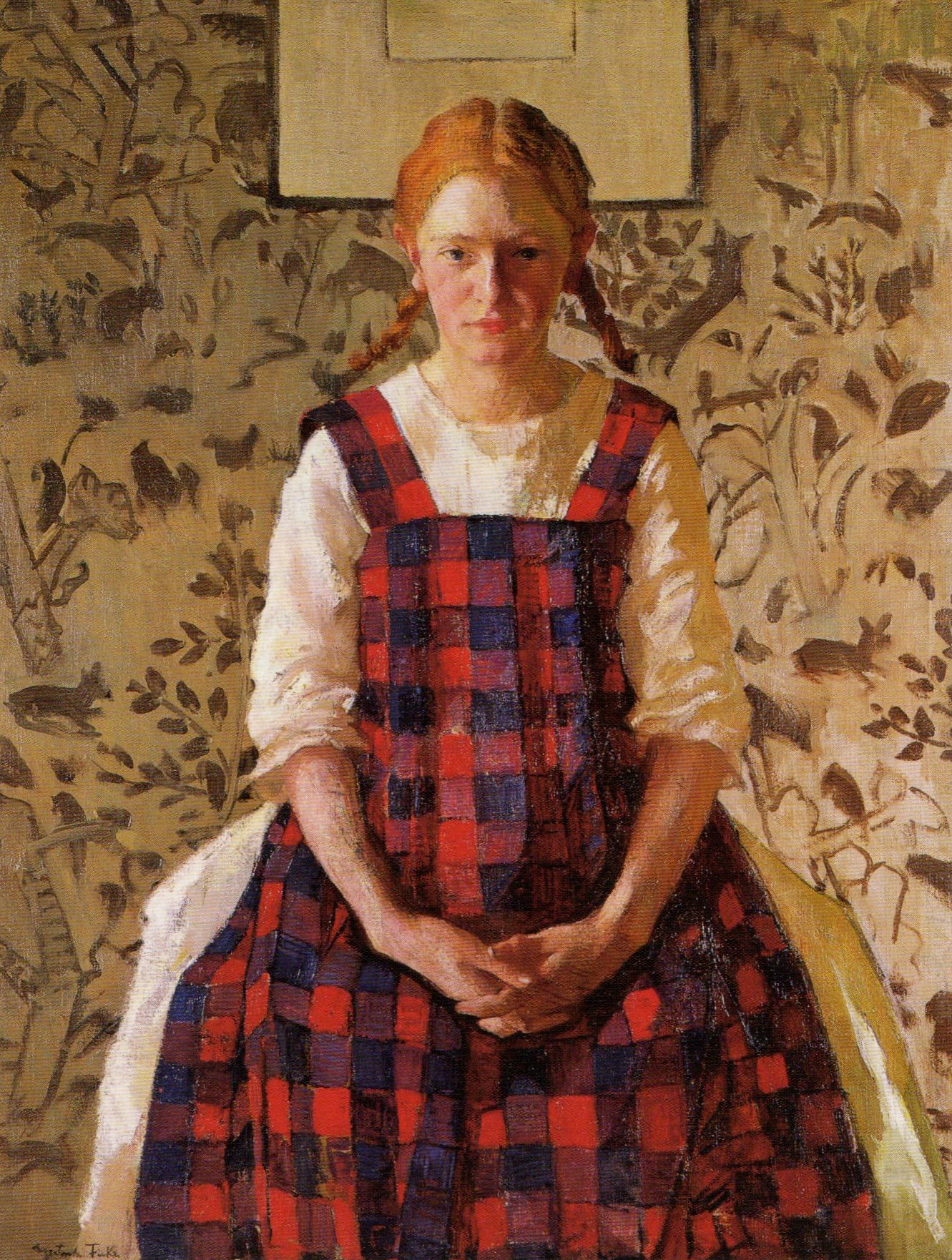
LOOK: Mary by Gertrude H. Fiske

Fiske, Gertrude_Mary
Gertrude H. Fiske (American, 1878–1961), Mary, 1920. Oil on canvas, 39 1/2 × 30 in. (100.3 × 76.2 cm). Davis Museum, Wellesley College, Wellesley, Massachusetts.

In the exhibition catalog Divine Mirrors: The Virgin Mary in the Visual Arts (2001), Rebecca Mongeon writes,

Fiske did not intend to present this Mary as the Virgin Mary, but because they share a name, the viewer begins to notice similarities. Images of the young Virgin Mary present her as innocent and demure, with her head lowered humbly, eyes downcast, and hands drawn to her chest. In Fiske’s portrait, the girl’s innocence is suggested by her youth. Though she may be a teenager, the braids in her hair and the pinafore she wears tie her to childhood. This Mary also slightly bows her head and modestly holds her hands close to her body. In addition, the Virgin’s traditional colors, royal blue and blood red, appear in the long dress worn by Fiske’s Mary. The Virgin’s head is usually framed by a halo; in Fiske’s portrait, a framed picture placed directly behind her Mary’s head creates a haloing effect. (248)

LISTEN: “Ave Maria (The Song for Mary)” by Jason Gray, on Christmas Stories: Repeat the Sounding Joy (2012)

She picks the flowers in the morning
Tucks just a few in her hair
The joy of her mother and father
As she spins around unaware
She carries her song in the evening
And the dreams of all little girls
She carries the bread to the table
She carries the hope of the world

Ave Maria
Ave Maria

Angels can carry glad tidings
Or burdens to bear in the dark
Love can take both fear and wondering
And hold them inside the same heart
You carried hope and a promise
You carried shame and disgrace
Which was the heavier burden
That drew lines in a little girl’s face

Ave Maria, gratia plena
Maria, gratia plena
Maria, gratia plena
Ave, ave dominus
Dominus tecum
Benedicta tu in mulieribus
Et benedictus
Et benedictus fructus ventris
Ventris tui, Jesus

Held by the love you were holding
Is this what it means to be blessed
To carry your hope through the darkness
As it carries you into your rest

Ave Maria
Ave Maria

Singer-songwriter Jason Gray describes the vision behind the song:

When Nichole Nordeman, Cason Cooley, and I were conceptualizing this song, the idea was that musically it would be something like Michael Bublé meets Elvis and that lyrically it would zoom in on very personal details of what it might have been like in Mary’s world and then zoom out to the broad historical view, going back and forth between personal/intimate/rooted in the story that belonged to Mary alone, and then timeless/big picture/rooted in the story that belongs to all of humanity.

As a kid growing up Protestant, I sometimes felt like I didn’t quite know what to do with Mary—it seemed to my young mind that maybe she belonged more to my Catholic friends, so I felt tentative around the idea of her. But she has since become very dear to my heart and an inspiration to me—the progenitor of all who are called to bear Christ to the world.

My hope was to write a song that would contain both a very earthy picture of Mary intermingled with an otherworldly reverence of the mother of Christ. I love getting to sing it every year.

Hear Gray discuss the song further in this two-minute video, especially the double-sided nature of being “chosen”:

The refrain is, of course, a traditional Roman Catholic prayer in Latin, set to the famous tune by Franz Schubert (who actually wrote the tune for a Walter Scott poem!). Taken from the words of the angel Gabriel and, later, Elizabeth to Mary, it translates to “Hail Mary, full of grace, the Lord is with thee; blessed art thou among women, and blessed is the fruit of thy womb, Jesus.”

I love how Gray’s adaptation of the Ave Maria captures Mary’s youthful innocence and the sense of her being forever changed by God’s call on her life.

Annunciation roundup: “The Parliament of Heaven” mystery play, reversioning the story through poetry, and more

Those of you who follow this blog regularly know that the Annunciation is one of my favorite biblical stories. It’s beautiful and wild—and rife with artistic potential! The church celebrates Jesus’s conception in Mary’s womb yearly on March 25, but naturally, it also comes up in the songs, prayers, image cycles, dramas, and meditations of the Advent season. Here’s a roundup of Annunciation-themed art. (You can find more by searching the “Annunciation” tag in the blog archives.)

SONG: “Never Before” by Deanna Witkowski: Jazz pianist and composer Deanna Witkowski [previously] wrote this three-part women’s a cappella piece in 1998 for a Lessons and Carols service at All Angels’ Church in New York City. In the song Mary marvels at the uncanny prospect that she will feel God growing inside her womb, will breastfeed him, will mend his boo-boos—and mourns that she will one day watch him die. “Never Before” appears on Witkowski’s 2009 album From This Place, sung by her, Laila Biali, and Kate McGarry, and was also featured on NPR’s Weekend Edition Sunday (see “Deanna Witkowski: Liturgical Jazz”).

The angel said the Lord is with me:

The Lord is with me in a way he’s never been before;
his Spirit is my lover, his son shall fill my womb
with holiness and joy
and with life that I can feel kicking at my insides.

The Lord will stay with me in a way he’s never stayed before;
he will suckle at my breast and let me hold him in my arms.
He will run to me when he cuts his finger
or wonders aloud at his Father’s creation in a brightly colored butterfly.

Oh, who is this child, Lord, who comes from up above,
whose eyes will look beyond my own to a destiny I do not know?
Oh, who is this God-boy whose hands shall clasp mine
and whose tears I shall wipe away with trembling fingers of my own?

The Lord will leave me in a way he’s never left before;
as a king whose time has come, as a son his mother loved,
as a boy whose laughter has filled my heart,
and as a baby whose tears I have cried as if they were my own.

The angel said the Lord is with me.

+++

ESSAY: “Saying Yes to the Annunciation” by Peggy Rosenthal: Peggy Rosenthal, author of The Poets’ Jesus: Representations at the End of a Millennium, is an excellent guide through poetry. Here she meditates on lines from five poems on the Annunciation: by Hildegard of Bingen, John Donne, Rupert Brooke, Kathleen Wakefield, and Katharine Coles.

+++

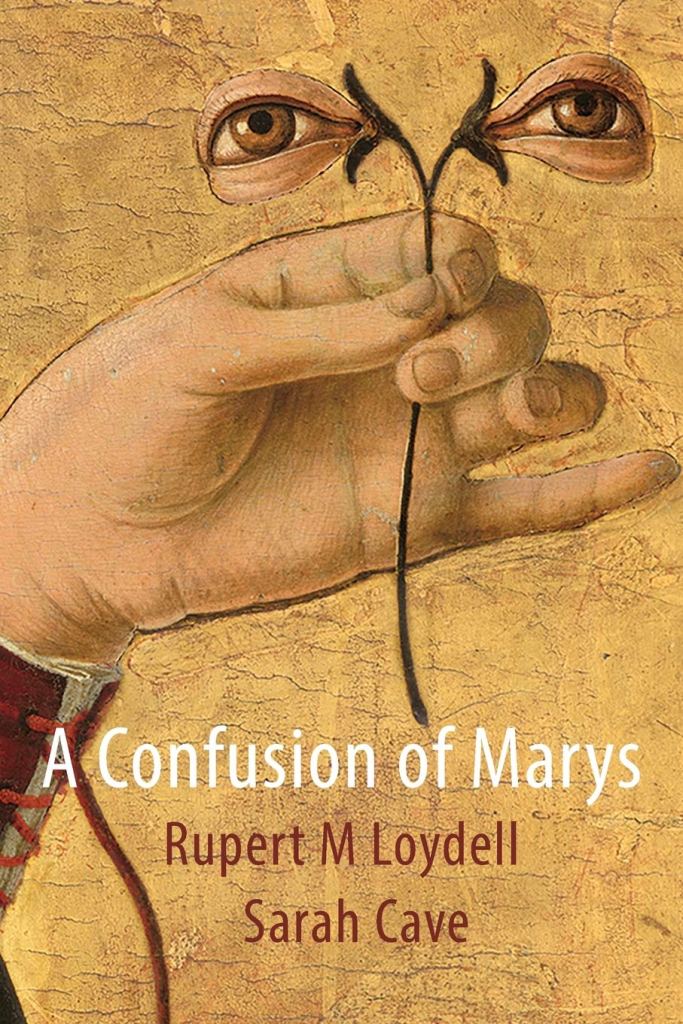
CONVERSATION: “Aliens, angels & annunciations”: In this article, poets Sarah Cave and Rupert Loydell dialogue about their 2020 book A Confusion of Marys, a collection of poems they’ve written inspired by the Annunciation. It’s a series of (sometimes irreverent or humorous) variations on a theme, and not what you’d call devotional poetry. Loydell quotes Gabriel Josipovici, who said stories die unless they are changed, reinvented, argued over, and made new, and that’s what this book does. I definitely gravitated more to some poems than to others.

A Confusion of Mary book cover

“I’m interested in the idea of regenerative theology,” Cave says. “I was a cradle Anglican and within that tradition Mary is more of a backseat figure – usually appearing in knitted form at crib services – no intercessions, etc. I wanted to bring her to the forefront and to understand how, in her all-pervasive way, she has shaped my life and the expectations people place on my life – gender, sexuality, politics, mysticism – and the lives of the women around me, and of course, how those expectations must have affected Mary’s own life.”

As for Loydell, he says he’s interested not in theological certainty but in “doubt and myth, symbolism and tangential ideas”—the Marian annunciation scene as palimpsest. He comes at it from a less personal angle.

+++

MYSTERY PLAY + ART PRESENTATION: “Hope Ubiqui: The Gift of the Annunciation”: This online event hosted by Holy Family (Catholic) Church in South Pasadena, California, on March 16, 2021, combines art reflections by Dr. Leah Marie Buturain Schneider (who’s incredibly warm, wise, and engaging) with a performance of the medieval mystery play The Parliament of Heaven, Salutation, and Conception (from the N-town cycle), translated from the Middle English by Colleen E. Donnelly and directed here by Grete Gryzwana.

The video starts with artist Patty Wickman [previously] outlining the five emotional states Mary cycled through in response to the angel Gabriel, as famously identified by art historian Michael Baxandall. Schneider then discusses a handful of historical artworks depicting the Annunciation, including ones by Fra Angelico and Andrea della Robbia. The thirty-minute play follows, which enacts not only the Annunciation but also an imagined precursor: a heavenly debate among four of God’s virtues—Truth, Mercy, Peace, and Righteousness [previously; see also this Instagram post]—about how to answer humanity’s cries for salvation. (Keep in mind that this was Zoom-mediated, with each actor calling in from a different location, and some with spotty internet connections, so there are some technical glitches, but it’s still a stirring and enjoyable performance!) Schneider continues by highlighting additional artworks of significance, focusing on Dieric Bouts’s Getty Annunciation, particularly the detail of Mary’s hands. She reads from the mystics Meister Eckhart and Julian of Norwich on responding to Love’s call; they ask, What does it matter if Mary gives birth to Jesus if we ourselves do not give birth to him in our souls, in our lives?

2:51–7:41: Introduction by Patty Wickman
9:44–18:16: Leah Marie Buturain Schneider
18:37–50:10: Mystery play
52:01–1:08:27: Leah Marie Buturain Schneider
1:08:52–1:31:00: Q&A

The remaining video is just informal chatting among a few church members who linger behind on the call.

+++

CHILDREN’S VIDEO: “The Gospel According to Hamlet” by SALT Project: A whimsical retelling of the Annunciation story, narrated by kids—and by a small ceramic pig figurine! The characters are played by a reproduction of Antonello da Messina’s Virgin Annunciate, a Barbie with tinsel wings, and a matryoshka doll.