
LOOK: Home by Olya Kravchenko
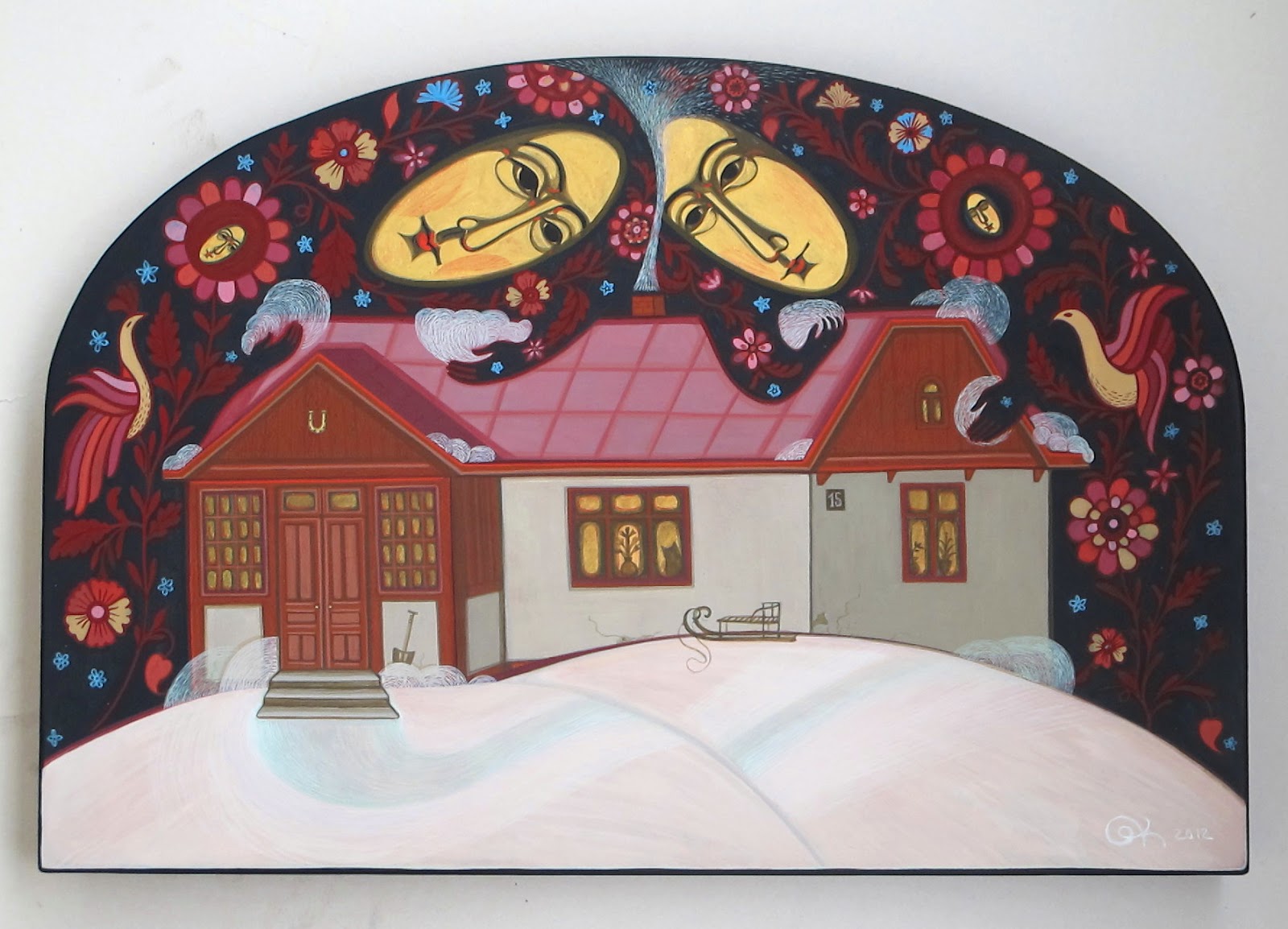
This painting shows a cottage on a snowy hillside at night. Inside, a fire is lit in the hearth, casting a warm glow and sending smoke rising up the chimney. There’s a cat in the window and a sled on the lawn.
On all sides, the sky is populated by a mystical swirl of birds and flowery tendrils and angelic beings. Two of those angels, represented by large golden heads, hold wisps of snow in their hands and embrace the house, offering a protective presence.
Sadly, this cozy winter idyll is elusive for many this year, not least those in Ukraine, where this painting comes from. Many Ukrainians have had to flee their homes to evade the encroaching Russian troops. Others are dealing with the trauma of having lost family members in the war, or the fear of having loved ones on the front line.
Kravchenko told me this month that the situation in her country is “terrifying and unfathomable,” and she alerted me to a few of the recent icons she has painted in response to the war, including Air Defense, The one who protects the sky above the city, Crucifixion in War, and The Virgin of Peace and Victory. Follow her on Instagram @olyakravchenkoart.
LISTEN: “Jul, Jul, Strålande Jul” (Christmas, Christmas, Glorious Christmas) | Words by Edvard Evers, 1921 | Music by Gustaf Nordqvist, 1921 | Performed by Zero8 on A Zero8 Christmas, 2011 (YouTube: 2016)
Jul, jul, strålande jul, glans över vita skogar,
himmelens kronor med gnistrande ljus,
glimmande bågar i alla Guds hus,
psalm som är sjungen från tid till tid,
eviga längtan till ljus och frid!
Jul, jul, strålande jul, glans över vita skogar!Kom, kom, signade jul! Sänk dina vita vingar,
över stridernas blod och larm,
över all suckan ur människobarm,
över de släkten som gå till ro,
över de ungas dagande bo!
Kom, kom, signade jul, sänk dina vita vingar!English translation by Michael A. Lowry:
Christmas, Christmas, glorious Christmas: shine over white forests,
heavenly crowns with sparkling lights,
glimmering arcs in the houses of God,
hymns that are sung throughout the ages,
eternal longing for light and peace!
Christmas, Christmas, glorious Christmas, shine over white forests!Come, come, blessed Christmas: lower your white wings,
over the battlefield’s blood and cry,
over the sighs from the bosoms of men,
over the loved ones who’ve gone to their rest,
over the daybreak of newborn life!
Come, come, blessed Christmas: lower your white wings!
“Jul, Jul, Strålande Jul” is one of the most widely sung Swedish Christmas songs. It personifies Christmas as a luminous winged being, asks it to descend over our wooded neighborhoods and over our songs and our longings, dispensing blessing; to extinguish our wars and raging and spread its comforts over our anxieties and losses; and to cradle the new lives that have been born this year, reminders of innocence and signs of hope for a future.


Dear Victoria,
Thank you for all your posts; introducing new work, music and artists to us all. It both opens our minds and refreshes the soul.
Your post today of the work of Olya Kravchenko was particularly meaningful to us here in this house. For the last eight months we have hosted a Ukrainian family (mother and two young boys). We share some of their worries and terror as we all muddled through day by day. God only knows what they are going through with their father (and husband) so far away in Dnipro.
It is so uplifting to see that artists like Olya are still producing wonderful work and work that not only acknowledges what their country is going through but imbues it with a real sense of Hope.
Keep up your splendid work Victoria.
As ever, Nick
Nicholas Mynheer http://www.mynheer-art.co.uk Sent from my iPad
>
LikeLike
[…] Advent, Day 3: Come Christmas […]
LikeLike
Such lovely and tender art in the midst of a horrific situation…thank you for holding the paradox of Advent in your poignant posts.
LikeLike
[…] Olya Kravchenko (Ukrainian, 1985–), Home, 2012. This sermon was given, with some variations, on Sept. 24th at the 9:30 a.m. service at Grace Episcopal Church, Amherst. We observed, as our patronal feast, St. Michael and All Angels (due to a glorious stained glass window at the back of our church). You can view the sermon in video form here, around the 19:42 mark. You can read the readings for this day here. This sermon draws heavily on the fantastic book Consider the Birds: A Provocative Guide to Birds of the Bible by Debbie Blue. “And he dreamed that there was a ladder set up on the earth, the top of it reaching to heaven; and the angels of God were ascending and descending on it.”In the name of the Father, the Son, and the Holy Spirit, one God, mother of us all. Amen.Sometimes I’ve struggled with the idea of angels because they’ve struck me as somewhat redundant. If our faith includes God’s-own-self-made-flesh-walking-among-humanity; if it includes a Holy Spirit who dwells within our very beings; if it includes a mysterious God who is somehow three and somehow one who was there before the beginning of time and will be there after anything we can imagine…what is the point, then, of angels? What more do any of us need than this weird, strange, making-Herself-present-with-us God?Angels can almost seem like a distraction compared to getting to know the core of who God is! And yet – it seems important: that Jacob’s vision includes God and angels ascending and descending. What if these angels aren’t redundant – some unnecessary extra – but rather a sign of something about the core of who God is? A sign of God’s abundance? A sign of how creative and even excessive God is in manifestations of God’s glory…how excessive and wonderful and over-the-top God’s creation is?What if mentions of angels should push us to see more – more than just ourselves – into seeing God for the mysterious artist that God is, investing the whole universe with grace?In our Gospel today, Nathanel first recognizes the greatness of Jesus through something personal – Jesus seeming him under the tree. This is a tremendous place to begin: Jesus seeing us, Jesus knowing us. In fact, it can take our whole lives to practice believing it. But Jesus says there’s even more to what Nathanael will experience. “You will see greater things than these. Very truly I tell you, you will see heaven opened and the angels of God ascending and descending upon the Son of Man.”Jesus almost seems to be saying, you’re about to see a whole other plan of existence, another realm cracking open, showing itself in him. Jesus seems to say, You will know and experience and see more than you can ever imagine. With angels, God seems to be painting a picture that brings us into connection not only with God’s own holiness, but with the whole of God’s wide and wonderful creation – even what’s not necessarily visible or knowable. Angels are a sign of the abundance of God’s imagination – that it sometimes exists in realms beyond us; sometimes under the surface; sometimes only accessed by dreams or art or creativity or wonder – not always able to be grasped rationally.Of course, angels aren’t the only sign of God’s overflowing imagination. Some of that abundance we can see simply by opening our eyes more to what is present and knowable all around us. As many of you know, Grace, along with many Episcopal churches and churches of different traditions, has been observing the Season of Creation – which goes throughout this month until the Feast of St. Francis in October, encouraging us to focus on how our faith intersects with the call to care for our whole earth and all its creatures. So we might also think today about how all of creation helps us know the things that angels help us know: God’s abundance.Recently, I read a book I picked up a while back from our St. Nicholas Bazaar – so perhaps at least one of you has read it too! It’s called Consider the Birds: A Provocative Guide to the Birds of the Bible by Debbie Blue.Throughout the book, the author shared spiritual reflections on different birds. For example, Debbie Blue thinks deeply about an animal we might not usually give much consideration to – pigeons. Doves and pigeons are in the same family of bird, and every time, the Scripture mentions doves, Debbie Blue think it’s likely the writers are talking about a rock dove – a bird that looks much more pigeon-like than the pristine white dove that we might see in Pentecost decorations.Pigeons have been pretty abundant in different times and places – sometimes to the point of being overwhelming.Debbie Blue describes it this way:“There are lots of birds that want to avoid us, who are too wild for us, who need their space…Pigeons want to be close to us. They are where we are – in some of the worst places we have made…and some of the best…They won’t leave us alone….People are not very fond of pigeons…They are considered pests who ‘infest’ urban areas. Cities have tried countless ways of exterminating them, usually unsuccessfully. What if the Spirit of God descends like a pigeon, somehow–always underfoot, routinely ignored, often despised?…The passenger pigeon used to be so prolific in North America that Audubon described flocks so large that they took three days to pass by, blocking out the sun…Early explorers described ‘infinite multitudes,’ ‘countless numbers.’….This is hard to imagine: the skies bursting with…life (like an ever-flowing spring, like eternal life, almost)….Maybe the spirit of God is so common—wherever life is, that we don’t’ recognize it or necessarily respect it…Maybe we don’t notice because we are looking for something pure and white, but the spirit of God is more complicated than that–fuller and richer and everywhere…God, after all, created LIFE (everything swarming and creeping, fruitful and multiplying.) Maybe the Holy Spirit of God is more creative than puritan. Maybe we are mistaken about what holy means.”Debbie Blue also points readers to a famous and controversial passage in the book of Job. Job faces a series of losses and spends much of the book questioning God – wanting God to give him an answer. God indeed shows up to Job, but doesn’t give any satisfying answers. Instead, he asks Job a lot of seemingly pointed rhetorical questions about where he was at the creation of the world. Sometimes this gets interpreted as a cruel rebuttal to Job’s complaints, but Debbie Blue finds something redemptive there.“The images are…of God giving birth to life: weird, beautiful, diverse life; and God really focuses on the weird and the wild life: ostriches, vultures, goats, and the sea…God doesn’t defeat Leviathan, the sea monster of chaos who breathes fire…. God speaks adoringly for quite a long time about Leviathan’s chest and feet and skin and teeth….The whirlwind doesn’t speak of subduing…God marvels–marvels at the wild beasts at play….God goes on and on about all the wild life as though God loves it–all of it….…maybe God is saying, ‘Look, stop focusing on yourself, look around for a minute–look at it all. it’s all so beautiful and mysterious and complex– and bigger than you, way bigger than you…’…Maybe it is not meant to diminish us in some scornful way, but rather to diminish us in a way that sets us free. God is trying to give us a break–consider what is not you….”Or as one of Debbie Blue’s biblical scholar friends Abigail Pelham puts it: “Whereas the world of Job and his friends is cramped and narrow, God’s world is wild and beautiful….Here is where you really live, God tells Job. You do not live in that narrow world you thought you occupied. That’s not real. That’s something you made up. Come out here and be free, as you were meant to be.“I can’t help but see resonances with Jacob and the ladder of angels ascending and descending. It’s not only important that Jacob encounters God; it’s important that Jacob encounters a different world, a different reality, bigger and more sacred than he knew before.For that, God used angels, but perhaps for us, something smaller than angels will do – glimpses at the wildness and diversity and creativity of this world, whether that’s in birds or just in one another, all our wildly different passions and gifts and forms of beauty. “Faith is the imagination for abundance,” Debbie Blue writes.Contemplating creation, as this Creation Season asks us to do – whether that’s angels, or seemingly less mysterious counterparts – may help us see abundance where we hadn’t seen it before.This imagination for abundance is important, because it’s not always easy to believe in an abundantly loving, creative God. After all, a part of this Season of Creation is recognizing that creation – that our world – is suffering, and at our hands.Revelation perhaps might remind us of this great, global, existential kind of challenge. “War broke out in heaven.” We might think of the conflicts between peoples and nations, but also the greater war of humanity against its worst impulses: against violence, and prejudice, and indifference, and greed, all the things that lead us to harm ourselves, or one another, or this world that we have been gifted by God.Revelation tells us that when there is a struggle, particularly a struggle for what is holy, the angels are in the fight. It is not people we see in this passage fighting to make things right. We are still responsible for striving for goodness here on earth, but this passage should be a support and reminder for us, that when we are in the midst of struggle and despair and destruction, we might look for where God’s abundance and creativity lurks; we might look for how we are being accompanied by angels. So the next time your world feels “cramped and narrow,” may you think of angels and hear the message that God’s world is wild and beautiful. May you look for evidence of wild, creative, overflowing, undercover, sometimes-only-showing-up-in-dreams beauty and the wild, beautiful God who made it and us. Here is where you really live. You do not live in that narrow world you thought you occupied….Come out here and be free, as you were meant to be. [quoting Abigail Pelham from Debbie Blue’s Consider the Birds]Amen. […]
LikeLike