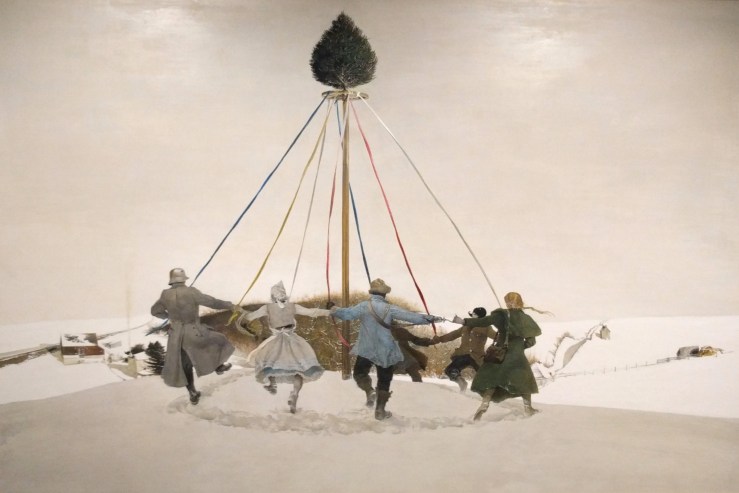
Andrew Wyeth (American, 1917–2009), Snow Hill, 1989. Tempera on hardboard panel, 48 × 72 in. (121.9 × 182.9 cm). Andrew and Betsy Wyeth Collection. Photo: Victoria Emily Jones (at the Brandywine River Museum of Art 2017 retrospective).
. . .
Then the eyes of the blind shall be opened,
and the ears of the deaf unstopped;
then shall the lame man leap like a deer,
and the tongue of the mute sing for joy.
. . .
And the ransomed of the Lord shall return
and come to Zion with singing;
everlasting joy shall be upon their heads;
they shall obtain gladness and joy,
and sorrow and sighing shall flee away.
—Isaiah 35:5–6a, 10
+++
SONG: “Therefore the Redeemed” by Ruth Lake, 1972 | Performed by Kim McLean, on Soul Solace, 2008
+++
Snow Hill by Andrew Wyeth [previously] is “a conscious summary of his artistic life that is both somber memoir and playful recalibration” (John Wilmerding). It shows six of his friends and neighbors, who modeled for him many times throughout his career, dancing around a beribboned Maypole in winter in Chadds Ford, Pennsylvania. Their coats, earflaps, and braids fly in the wind, as does one untouched white ribbon, which, it has been posited, could represent Christina Olson (who had a degenerative muscle disorder and could not walk), the artist’s wife Betsy, or the artist himself.
This painting, one of Wyeth’s last, was the finale of a major retrospective at the Brandywine River Museum of Art in 2017, which has been one of the most memorable art exhibitions I’ve ever attended. The wall text there read,
Painted over a two-year period, Snow Hill is both fantasy and memorial, a visual summation of the iconic places and people of Chadds Ford that occupied [Wyeth] for the previous fifty years. Wyeth looks backward and inward, bringing together many of these subjects from his past, a number of them now deceased. Depicted are Karl Kuerner (dressed in his German uniform), holding the hand of Anna Kuerner, who is in turn linked to William Loper, whose prosthetic hook is held by Helga Testorf, rounding the circle to Allan Lynch (of Winter 1946) and Adam Johnson (partially obscured). They are surrounded by a landscape that shows, left to right: the railroad tracks where Wyeth’s father, N. C. Wyeth, was killed in 1945; the Kuerner farmhouse and barn; the remains of Mother Archie’s octagonal church; the Ring family home in the distance; and Adam Johnson’s shed and haystack.
Wyeth’s models are shown holding ribbons—although one white ribbon is symbolically floating free—and dancing atop Kuerner Hill—a site at once iconic for its recurrence in Wyeth’s work and for its proximity to the site of his father’s death. . . .
I love how the dead and the living join together in this Yuletide circle dance, in which suffering is taken up into joy. Wyeth had lived through Karl Kuerner, a World War I veteran, succumbing to cancer, Allan Lynch to suicide, and Bill Loper to mental illness, as well as the early death of his father and nephew in a car accident. And while such darkness is not fully dissipated in this gray-day scene, a mood of celebration and hope and friendship does take over.
This post belongs to the weekly series Artful Devotion. If you can’t view the music player in your email or RSS reader, try opening the post in your browser.
To view all the Revised Common Lectionary scripture readings for the Third Sunday of Advent, cycle A, click here.
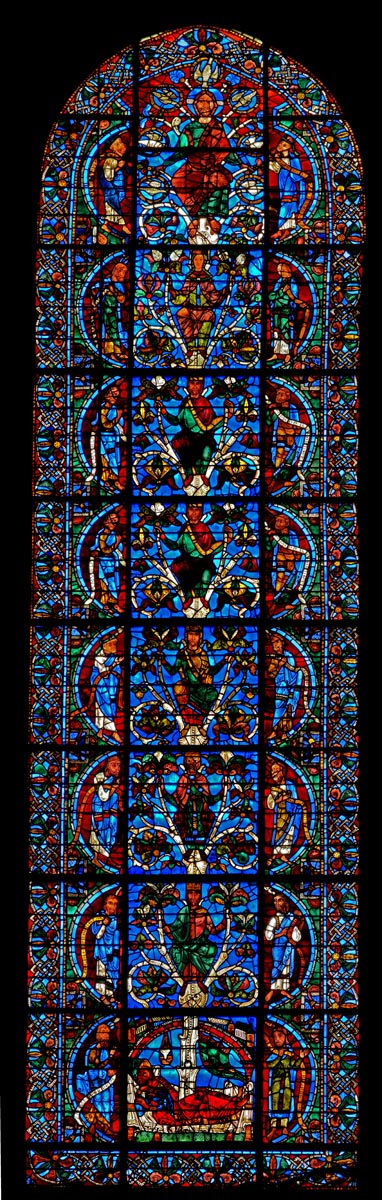
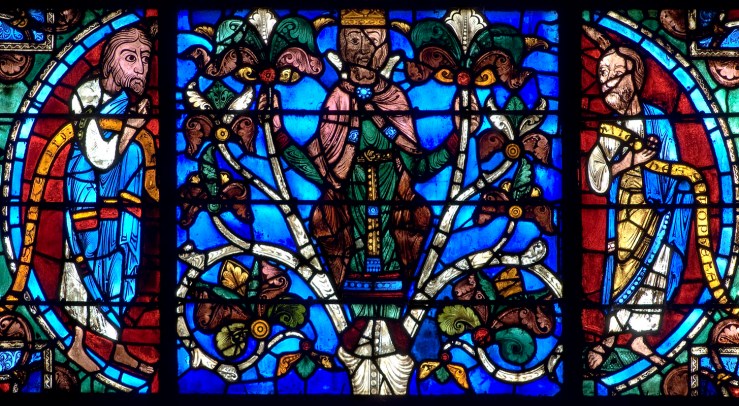
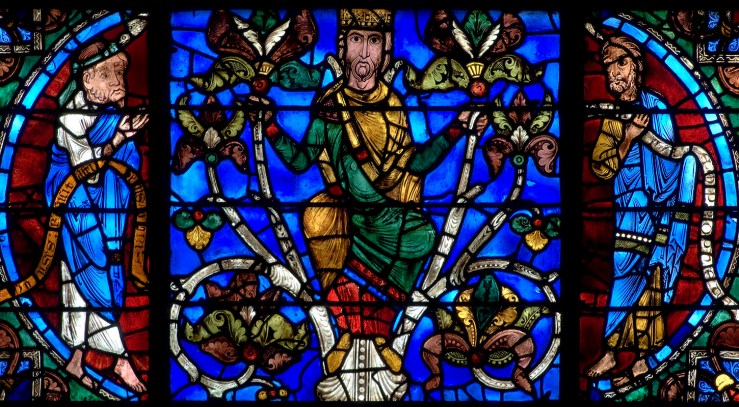
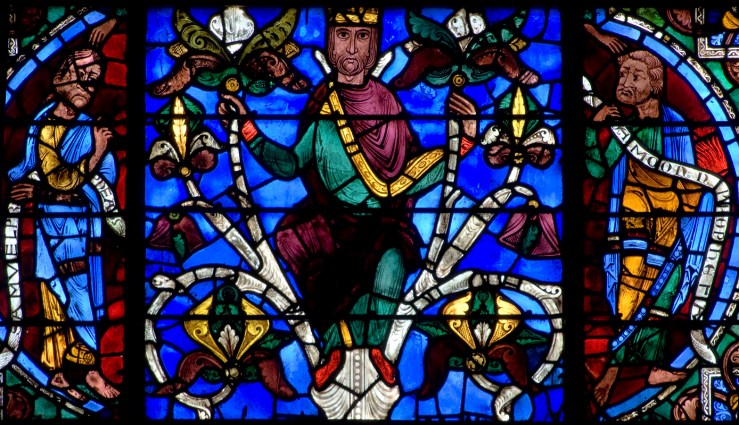
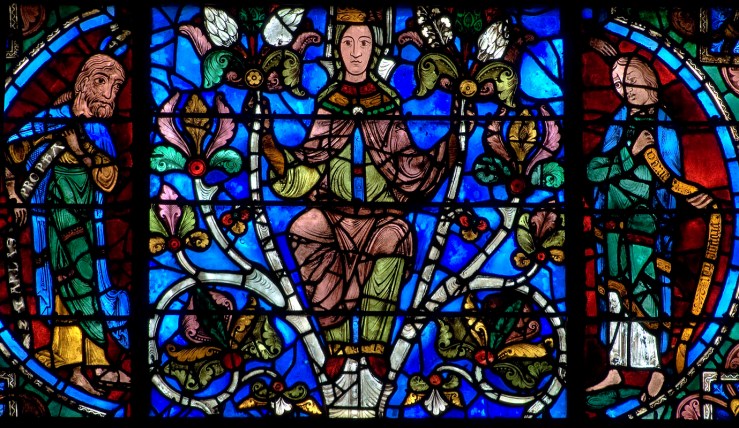
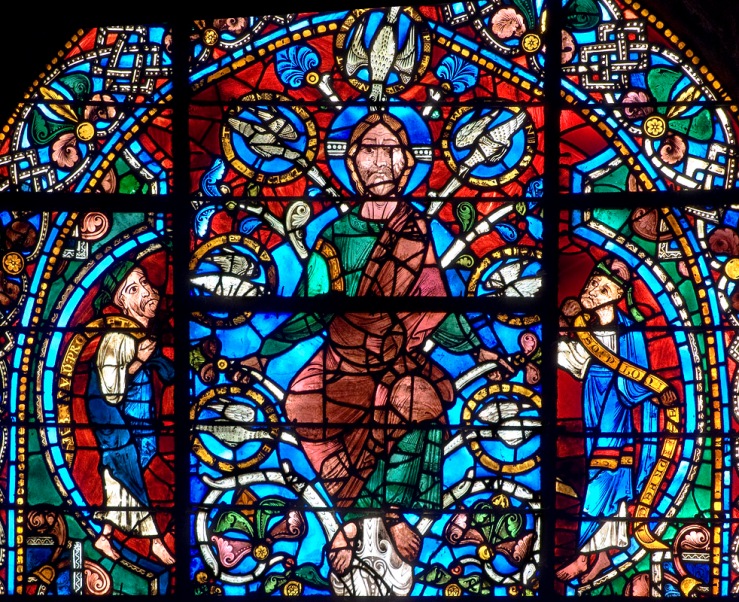
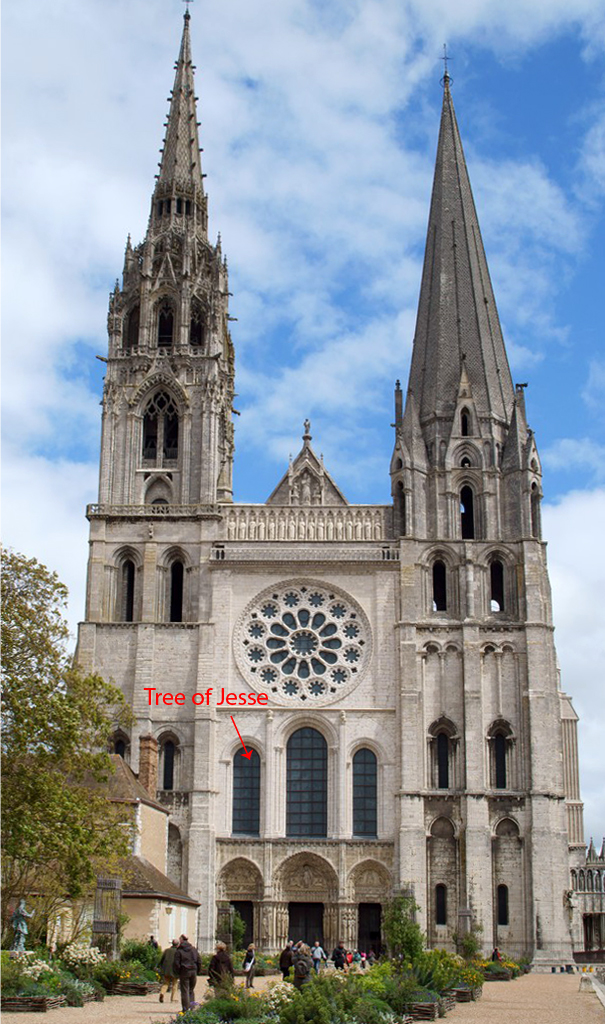
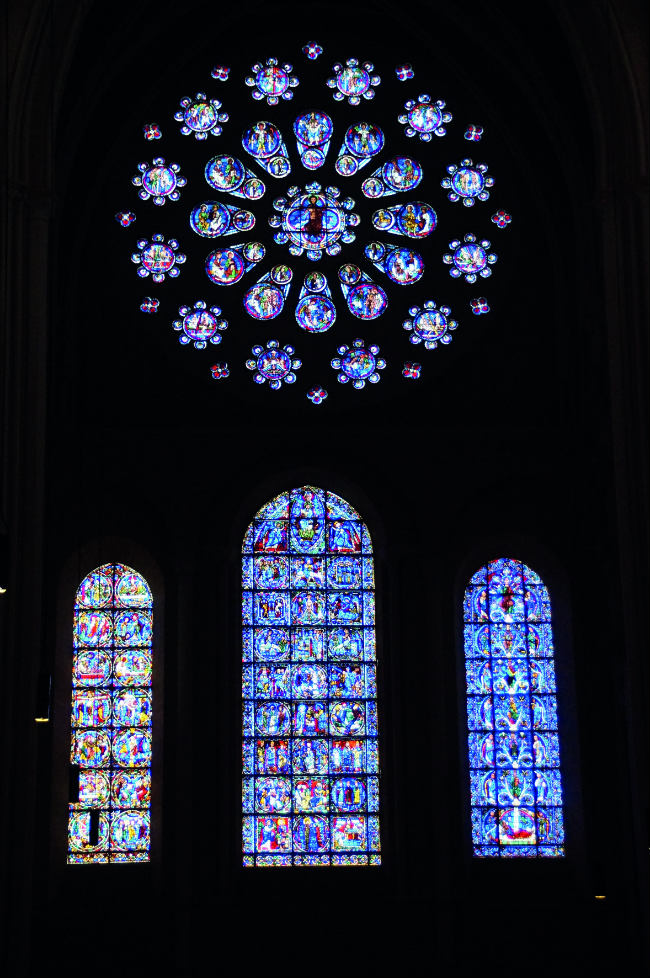
The Tree of Jesse, 12th century. Stained glass window (Bay 49), Chartres Cathedral, France. Photo: Painton Cowen.
There shall come forth a shoot from the stump of Jesse,
and a branch from his roots shall bear fruit.
And the Spirit of the Lord shall rest upon him,
the Spirit of wisdom and understanding,
the Spirit of counsel and might,
the Spirit of knowledge and the fear of the Lord.
And his delight shall be in the fear of the Lord.
He shall not judge by what his eyes see,
or decide disputes by what his ears hear,
but with righteousness he shall judge the poor,
and decide with equity for the meek of the earth;
and he shall strike the earth with the rod of his mouth,
and with the breath of his lips he shall kill the wicked.
Righteousness shall be the belt of his waist,
and faithfulness the belt of his loins.
. . .
In that day the root of Jesse, who shall stand as a signal for the peoples—of him shall the nations inquire, and his resting place shall be glorious.
—Isaiah 11:1–5, 10
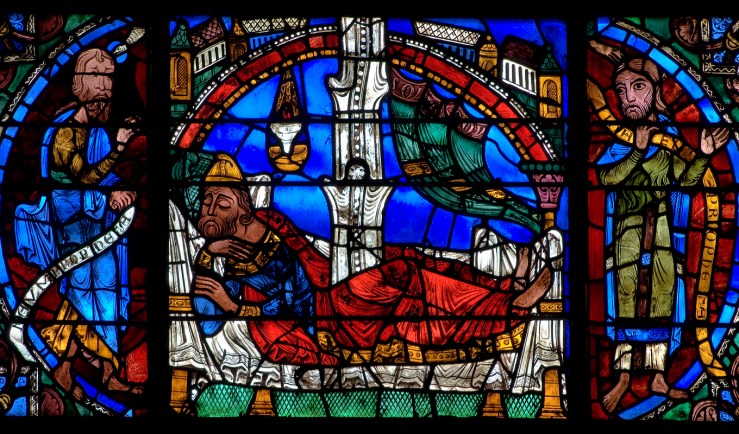
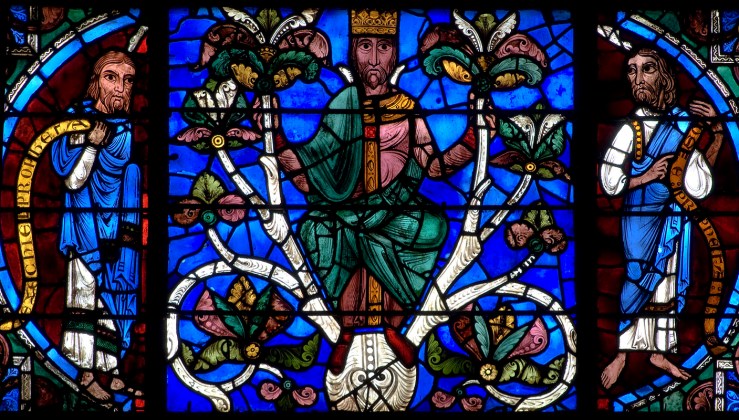
The bottom panel depicts Nahum, Jesse, and Joel. This and all the following detail photos are by Dr. Stuart Whatling.Ezekiel, David, HoseaIsaiah, Solomon, MicahMoses, generic king, BalaamSamuel, generic king, AmosZechariah, the Virgin Mary, DanielHabakkuk, Christ with the Seven Gifts of the Spirit (wisdom, understanding, counsel, fortitude, knowledge, piety, and fear of the Lord, per Isa. 11:2), Zephaniah
+++
SONG: “O Root of Jesse” | Text: Latin original from the sixth through eighth centuries, English translation from the Church of England’s Common Worship liturgy | Music by Ole Schützler (b. 1976) | Performed by the Junger Kammerchor Rhein-Neckar (Rhine-Neckar Youth Chamber Choir), under the direction of Mathias Rickert, on Advent (2014)
Latin: O Radix Jesse, qui stas in signum populorum, super quem continebunt reges os suum, quem Gentes deprecabuntur: veni ad liberandum nos, jam noli tardare.
English:
O Root of Jesse, standing as a sign among the peoples;
before you kings will shut their mouths,
to you the nations will make their prayer:
Come and deliver us, and delay no longer.
“O Radix Jesse” (O Root of Jesse) is one of the seven O Antiphons, names for Christ that are sung during Advent. (The others are O Wisdom, O Lord, O Key of David, O Dayspring, O King of Nations, and O God-with-Us.) Their precise origin is unknown, but their use in the eighth century is substantiated.
+++
Chartres Cathedral is “the high point of French Gothic art” (UNESCO) and one of my must-sees before I die. Its portals boast many exquisite figural sculptures, and its interior is renowned for, among other things, its stained glass windows. The Tree of Jesse, showing the royal lineage of Jesus, is one of three large, rounded lancet windows at the west end—the other two depicting the Life of Christ (center) and the Passion of Christ.
This post belongs to the weekly series Artful Devotion. If you can’t view the music player in your email or RSS reader, try opening the post in your browser.
To view all the Revised Common Lectionary scripture readings for the Second Sunday of Advent, cycle A, click here.
VISUAL MEDITATION: On The Alpha & The Omega by Betye Saar: A few weeks ago my commentary on a Betye Saar installation was published on ArtWay.eu. The idiomatic Hebrew in the title is a reference not to Christ but to the beginning and the end of life, a theme Saar explored by arranging around a blue-painted room such found objects as an antique cradle, dried hydrangeas, a boat shell, a mammy figurine, a washboard, empty apothecary bottles, books, clocks, a moon-phase diagram, etc.
Betye Saar, The Alpha & The Omega: The Beginning & The End, 2013. Installation at Roberts & Tilton, Culver City, California.
With an educational background in design, Saar began her career as a printmaker and working in theater on costumes and sets. She then ventured into collage, which led to assemblage (for which she is most celebrated), sculpture, and installations. With installations, she likes how “the whole body has the experience”—how you are quite literally inside the work. Saar is one of today’s leading American contemporary artists, with twoexhibitions currently running in the United States: one at MoMA, and the other at LACMA. I first encountered her in a college art history course, through her most famous work, The Liberation of Aunt Jemima. Race, memory, and spirituality are recurring themes in her oeuvre.
+++
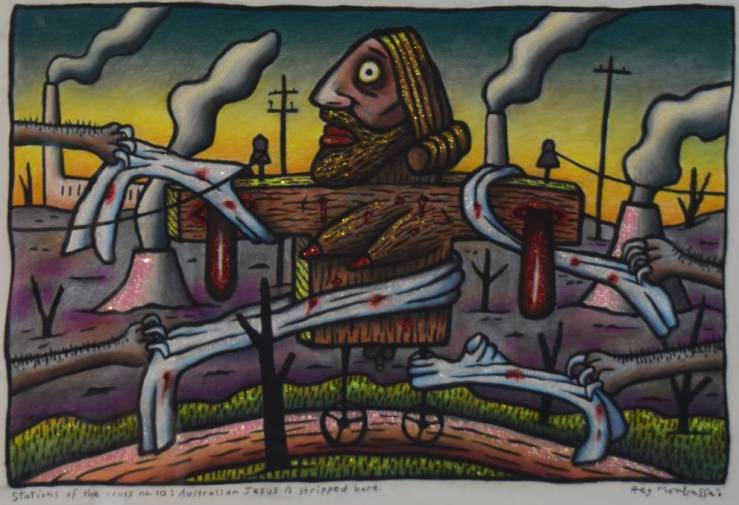
ESSAY: “‘A pretty decent sort of bloke’: Towards the quest for an Australian Jesus” by Jason A. Goroncy: “What happens to religious images and symbols when they get employed outside of their traditional contexts and charged with unapproved and heterodox interpretations?” asks Goroncy. “From many Aboriginal elders, such as Tjangika Napaltjani, Bob Williams and Djiniyini Gondarra, to painters, such as Arthur Boyd, Pro Hart and John Forrester-Clack, from historians, such as Manning Clark, and poets, such as Maureen Watson, Francis Webb and Henry Lawson, to celebrated novelists, such as Joseph Furphy, Patrick White and Tim Winton, the figure of Jesus has occupied an endearing and idiosyncratic place in the Australian imagination. It is evidence enough that ‘Australians have been anticlerical and antichurch, but rarely anti-Jesus’. But which Jesus? In what follows, I seek to listen to what some Australians make of Jesus, and to consider some theological implications of their contributions for the enduring quest for an Australian Jesus.” [HT: Art/s and Theology Australia]
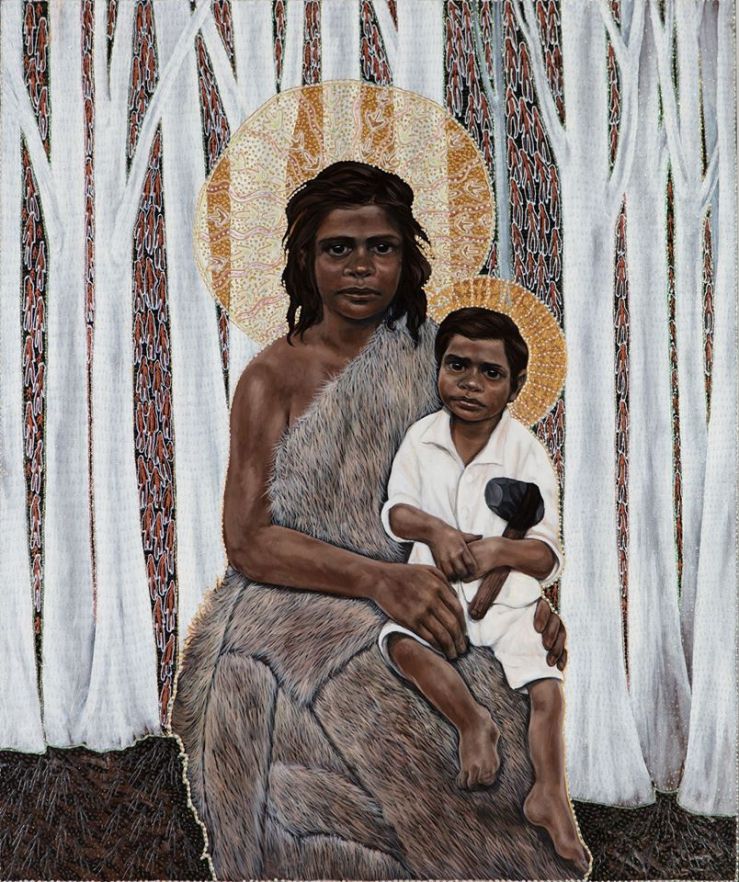
Julie Dowling (Badimaya/Yamatji/Widi, 1969–), Black Madonna: Omega, 2004. Synthetic polymer paint, red ocher, glitter, and metallic paint on canvas, 120 × 100 cm. Art Gallery of Western Australia. “I painted this in honour of First Nation mothers who have their children stolen from them by white governments in order to assimilate their children.”Chris O’Doherty (aka Reg Mombassa) (Australian, 1951–), Australian Jesus Is Stripped Bare, station 10 from the Stations of the Cross cycle. Chapel at the Australian Centre for Christianity and Culture, Barton, ACT, Australia. Photo: Katherine Spackman.
Goroncy quotes Wilson Yates, who says that Jesus has become “a part of the culture and life far beyond the final control of the church, . . . imaged in diverse ways by non-Christian as well as Christian artists, often contrary to the church’s dominant interpretation. . . . This should not be viewed as threatening,” however, but rather as “a means by which, paradoxically, the traditional symbols are kept vital – are kept alive in the midst of human life.”
+++
AUDIO INTERVIEW: Justin Paton on New Zealand artist Colin McCahon: In celebration of the centenary of Colin McCahon’s birth, art critic and curator Justin Paton has published McCahon Country, which examines nearly two hundred of the artist’s paintings and drawings. In this Saturday Morning (RNZ) interview, Paton says that McCahon is one of the great modern religious artists; an unabashed Christian, he grappled with how to make religious art in a post-religious age, often interweaving biblical themes and texts with New Zealand landscapes. His paintings, Paton says, are “an unequivocal statement of faith,” painted at times with “sophisticated unsophistication.” In 1948 one critic described them dismissively as “like graffiti in some celestial lavatory”—a comparison Paton affirms but sees as commendatory.
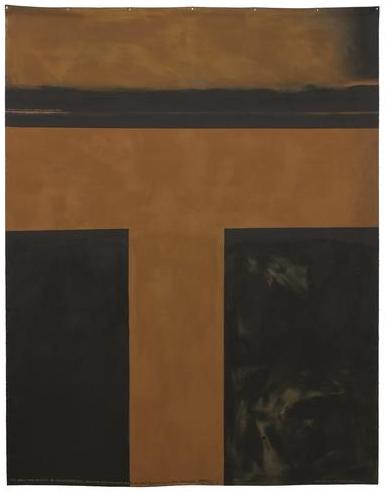
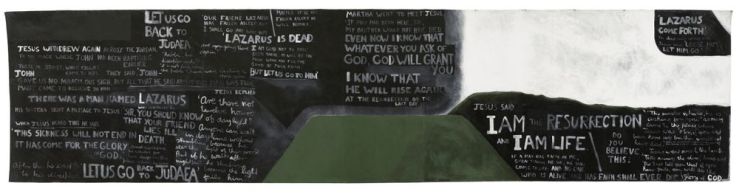
Colin McCahon (New Zealand, 1919–1987), The days and the nights in the wilderness showing the constant flow of light passing into a dark landscape, 1971Colin McCahon (New Zealand, 1919–1987), Practical religion: The resurrection of Lazarus showing Mount Martha, 1969–70. Acrylic on unstretched canvas, 207.5 × 807 cm. Te Papa (Museum of New Zealand), Wellington.
I was familiar with McCahon’s early works—Annunciations, Crucifixions—but not so much the later ones featured here. For example, The days and the nights, about which Paton says,
You could take a first look at this thing and you could think it’s not so exciting, in a way. It’s . . . smeary blacks and then there’s this . . . kind of clay color—muddy, you might say. . . . The form is this kind of ocher cross with black surrounding it. But give it some time, and you realize that the space above describes a horizon line. You can see the riffle of clouds along that horizon. If you know Muriwai on the West Coast, you can recognize it as a West Coast landscape, which is of course the spirit landscape up which souls travel in Maori mythology. And then you realize that this cross is also a kind of estuary, that it is descending through to areas or gates. So it is at once the Christian cross, it’s the Buddhist idea of light as grace which descends towards us . . .
About Lazarus:
McCahon said the Lazarus story was one of the great stories about seeing: all those people who were witnesses to this event saw as never before. What’s wonderful in the work is, as you read your way from left to right—and it really is this kind of epic telling of the story—when you’re about two-thirds of the way across, he almost makes you into Lazarus. He puts you into the position of this person who is emerging from the tomb, because there’s this sliver of light that opens up and bursts then fills the right-hand third of the painting. It’s like coming out of a dark space and suddenly being blinded by sunlight.
It’s a great example of what a great reader he was. He got into these texts with the avidity of a fan. You really felt he was there with these people in this ancient story and then tries to put us inside it as we stand and walk in front of this giant canvas. It has a terrific oscillation between something worldly and vernacular and then something exalted and sacred at the other end.
CHANT: “I Am Here in the Heart of God” by Erin McGaughan, adapt. & arr. Chandra Rule: At the Singing Beloved Community workshop held in September in Cincinnati, song leader Chanda Rule led participants in a chant that she adapted from Erin McGaughan. To McGaughan’s original, Rule added three new verses with a modulation between each, and she presented the whole of it in a call-and-response format. [HT: Global Christian Worship]
I am here in the heart of God
God is here in the heart of me
Like the wave in the water and the water in the wave
I am here in the heart of God
I am here in the breath of God
God is here in the breath of me
Like the wind in the springtime and the springtime in the wind
I am here in the breath of God
I am here in the soul of God
God is here in the soul of me
Like the flame in the fire and the fire in the flame
I am here in the soul of God
I am here in the mind of God
God is here in the mind of me
Like the earth in my body and my body in the earth
Like the flame in the fire and the fire in the flame
Like the wind in the springtime and the springtime in the wind
Like the wave in the water and the water in the wave
I am here in the heart of God
+++
SONG: “I Hunger and I Thirst,” words by John S. B. Monsell (1866), with new music by Wally Brath: I was listening to the video recording of the Grace College Worship Arts jazz vespers service that took place November 8 at Warsaw First United Methodist Church in Indiana, when I heard this striking hymn. Written by a nineteenth-century Anglican clergyman, it was set to music by Wally Brath, an assistant professor of worship arts at Grace College, who’s playing the piano in the video. The performance features Grammy Award–winning bassist John Patitucci, and vocalist Ethan Leininger. Click here to listen to the whole service and to see the full list of musicians. [HT: Global Christian Worship]
I hunger and I thirst:
Jesu, my manna be;
ye living waters, burst
out of the rock for me.
Thou bruised and broken Bread,
my life-long wants supply;
as living souls are fed,
O feed me, or I die.
Thou true life-giving Vine,
let me thy sweetness prove;
renew my life with thine,
refresh my soul with love.
Rough paths my feet have trod
since first their course began:
feed me, thou Bread of God;
help me, thou Son of Man.
For still the desert lies
my thirsting soul before:
O living waters, rise
within me evermore.
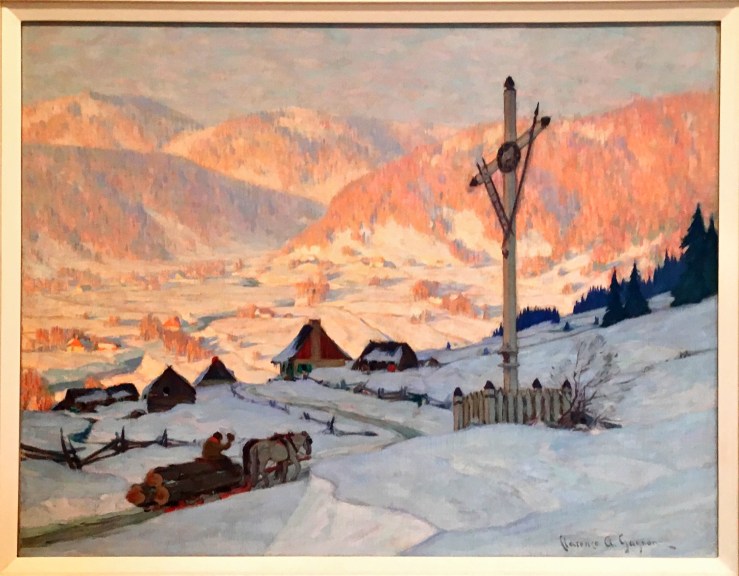
Clarence Gagnon (French Canadian, 1881–1942), The Wayside Cross, Winter, ca. 1916–17. Oil on canvas, 28 × 37 in. (71.1 × 94 cm). Art Gallery of Ontario, Canada. Photo: Jim Forest.
You know the time; it is the hour now for you to awake from sleep. For our salvation is nearer now than when we first believed; the night is advanced, the day is at hand.
This post belongs to the weekly series Artful Devotion. If you can’t view the music player in your email or RSS reader, try opening the post in your browser.
To view all the Revised Common Lectionary scripture readings for the First Sunday of Advent, cycle A, click here.
Toros Taronatsi (Armenian, 1276–ca. 1346), Tree of Jesse, 1318. Ink, pigments, and gold on parchment, 10 1/4 × 7 1/16 in. (26 × 18 cm). “Matenadaran” Mesrop Mashtots Institute of Ancient Manuscripts, Yerevan, Armenia (MS 206, fol. 258v).
“Behold, the days are coming, declares the LORD, when I will raise up for David a righteous Branch, and he shall reign as king and deal wisely, and shall execute justice and righteousness in the land. In his days Judah will be saved, and Israel will dwell securely. And this is the name by which he will be called: ‘The LORD is our righteousness.’”
—Jeremiah 23:5–6
+++
SONG: “Jesus, Name Above All Names” | Words and music by Naida Hearn, 1974 | Arranged and performed by Nick Smith, feat. Liz Vice, 2015
The song’s original lyrics are:
Jesus, name above all names
Beautiful Savior, glorious Lord
Emmanuel, God is with us
Blessed Redeemer, living Word
Jesus, loving Shepherd
Vine of the branches, Son of God
Prince of Peace, Wonderful Counselor
Lord of the universe
Light of the world
Praise him, Lord above all lords
King above all kings, God’s only Son
The Prince of Peace, who by his Spirit
Comes to live in us, Master and Friend
Smith’s arrangement uses the first verse, plus adds this bridge:
O holy Lord
Praise be to your name
O risen Son
Hear us as we sing
+++
In 1318 Esayi Nch‘ets‘i (1260/65–1338), abbot of the Monastery of Gladzor in Armenia, commissioned three scribes to copy a Bible for the monastery, and T‘oros of Taron to illuminate it. The sumptuous illumination above, showing a genealogical tree sprouting from Jesse’s reclining body, serves as the frontispiece to the book of Psalms. Jesse was the father of King David and hence an ancestor of Jesus, who is enthroned at the end of the tree’s central branch, at the top of the composition. Various prophets with their scrolls are perched on the side branches. (We’ll revisit this iconography in the second week of Advent.)
According to Sirarpie Der Nersessian, this is the first example of a Tree of Jesse found in Armenian art; the inspiration for this image is derived from Western European manuscripts, where it was portrayed as early as the mid-twelfth century. However, T‘oros has modified the traditional Western European iconography: the top of the tree normally depicts the Virgin and Child, but in this example he has placed a youthful Christ in a mandorla holding a book in his left hand and blessing with his right. In the center of the trunk is the head of David, whereas in Western European traditions he is usually represented by a bust. In addition, T‘oros added an image of Samuel anointing the young David in the lower right, a scene not usually included with the Tree of Jesse. He also depicted the prophets and other figures seated cross-legged, a posture not commonly depicted in Western European manuscripts. (119)
This post belongs to the weekly series Artful Devotion. If you can’t view the music player in your email or RSS reader, try opening the post in your browser.
To view all the Revised Common Lectionary scripture readings for Proper 29 (Reign of Christ), cycle C, click here.
Advent, which begins December 1 this year, ushers in four weeks of holy longing for Christ’s coming into our dark and broken world to make all things new. With the Old Testament saints and the early Christians alike, we cry, “Come, Lord!” The anticipation that marks the season is both joyful and aching, as on the one hand, we have a sure hope that the Lord is coming, and that’s cause for celebration, but on the other hand, well, we’re tired and weak, and sometimes hope hurts.
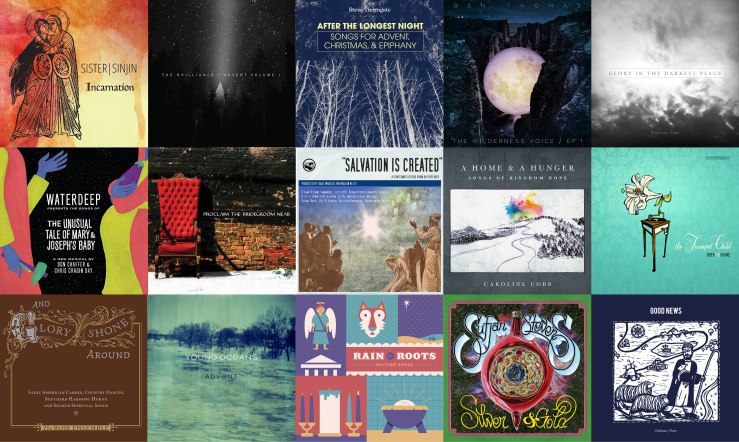
Every Advent, my husband and I whip out the Spotify playlist I’ve been building over the years, and we let the music shape our longings toward Christmas, toward new creation. Centuries’ worth of Christian song comes through our speakers to build up our hearts and minds with words and tunes that prepare us to welcome not just Christ’s birth but also the parousia. While I’m not a stickler for “no Christmas music before December 25!,” I have come to appreciate the distinctiveness of Advent and have found something sweet in the waiting. Of course, Advent bleeds into Christmas, and both seasons contain both darkness and light, mourning and gladness—but setting aside a month to linger with the visions of the prophets, the stories of Elizabeth, Zechariah, John the Baptist, Mary, and Joseph, and Jesus and Paul’s sobering warnings of impending judgment can deepen one’s appreciation of the fullness of Christmas and how it fits into God’s bigger story.
People, I think, are generally unaware of the rich body of Advent-themed music that’s available to us. Apart from the classics “O Come, O Come, Emmanuel” and “Come, Thou Long-Expected Jesus,” and maybe a selection or two from Handel’s Messiah, I bet many Christians would be hard-pressed to name a single Advent song.
There’s intention to the structure of the list, which moves from God’s promise to Abraham that “all shall be well” to ancient prophecies of a redemption-to-come to Gabriel’s visit to Mary and her subsequent Magnificat to Jesus’s parable of the ten bridesmaids and other such warnings of and yearnings for his second coming, with glimmers and bursts of hope scattered throughout.
Sometimes the line between a “Christmas” song and an “Advent” song is blurry, but generally I characterize an Advent song as one that’s marked by a sense of longing or expectation. As I said before, this longing can be expressed joyously or with tears and groaning, and both these shades are present in the playlist.
The predominant musical style represented is indie-folk (Sufjan Stevens, Josh Garrels, The Welcome Wagon, The Oh Hellos [previously], The Brilliance, Ordinary Time, etc.), but there’s also some choral, gospel, jazz, Taizé chant, sixties rock, show tunes, a Harry Potter-esque celesta interlude, and an Irish reel! Oh, and a smattering of virtuosic oud solos by Joseph Tawadros, with evocative titles like “Dream with Me” and “Where It All Began.” I hope the list is full of surprises for you.
I must note that there are plenty more traditional Advent hymns that exist but that I’ve excluded either because I could not find suitable recordings on Spotify, or because the tunes are dull or awkward. (And I’m sure there are also many songs that I’m simply not aware of.) I put a lot of stock in musical composition and vocal quality.
As you move down the first third of the list, let me draw your attention to some of the biblical texts the songs are drawn from—various foretastes of the coming kingdom that God vouchsafed to certain Hebrew poets and seers. May we capture their vision this Advent:
Psalm 24:7–10: “Lift Up Your Heads, Ye Mighty Gates”
“Come, Lord” is the cry of Advent, and you will find it manifest in many of the songs here, from the bright, guitar-picked “Come into My Heart” by Reilly & Maloney or Isaac Wardell’s “Messiah” waltz to St. Ambrose’s fourth-century “Veni, Redemptor gentium”—translated variously into English as “Savior of the Nations, Come” and “Come Thou Redeemer of the Earth,” each set to a different tune—to the African American spiritual “Kumbaya” (Gullah for “Come by Here”) [previously].
I’ve included only a few non-English songs, and where you encounter them, I encourage you to look up lyric translations, so as not to miss their full impact. The Swedish “Jul, Jul, Strålande Jul” (Christmas, Christmas, Glorious Christmas) by Edvard Evers and Gustaf Nordqvist, for example, prays, “Come, come, blessed Christmas: lower your white wings, / over the battlefield’s blood and cry . . .”
The “Come, Lord” song that makes me the most emotional, that taps deeply into my longing for the world, and my own heart, to be made new, is “Immanuel” by Jason Morant. “God with us, where are you now? . . . Be here somehow . . . in this desert of prosperity.” I’ve prayed through this song for years but have only just now discovered the music video Morant made for it, which attaches to it a story of desperation:
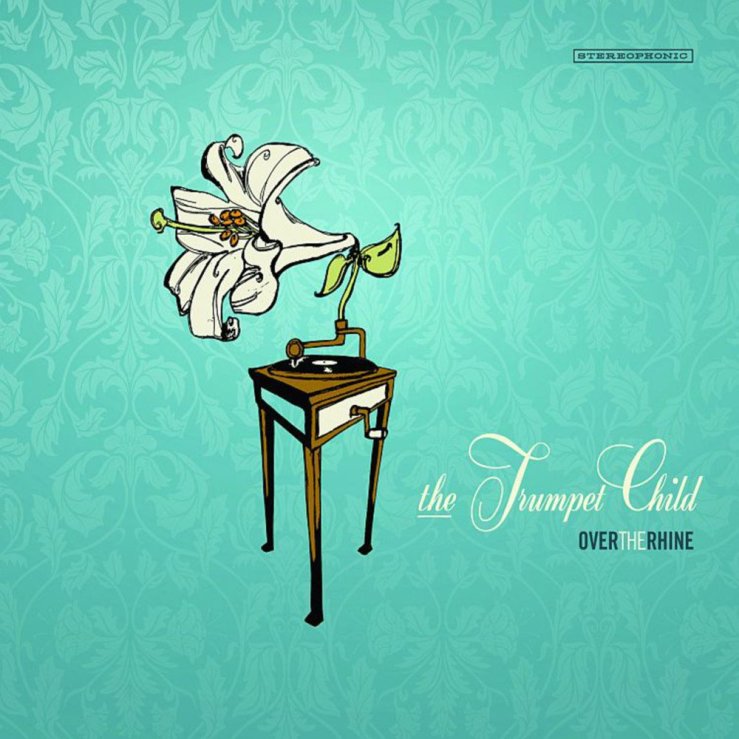
Perhaps my favorite Advent song is “The Trumpet Child,” written by husband-wife duo Linford Detweiler and Karin Bergquist of Over the Rhine. The two are superb songwriters, here giving us some stunning imagery and a really unique take on Advent:
The trumpet child will blow his horn
Will blast the sky till it’s reborn
With Gabriel’s power and Satchmo’s grace
He will surprise the human race
The trumpet he will use to blow
Is being fashioned out of fire
The mouthpiece is a glowing coal
The bell a burst of wild desire
The trumpet child will riff on love
Thelonious notes from up above
He’ll improvise a kingdom come
Accompanied by a different drum
The trumpet child will banquet here
Until the lost are truly found
A thousand days, a thousand years
Nobody knows for sure how long
The rich forget about their gold
The meek and mild are strangely bold
A lion lies beside a lamb
And licks a murderer’s outstretched hand
The trumpet child will lift a glass
His bride now leaning in at last
His final aim to fill with joy
The earth that man all but destroyed
The song intertwines Christ’s first and second advents, combining incarnation with apocalypse. The trumpet is a heralding instrument, announcing the arrival of a ruler or dignitary—but the aural image here is not of a ceremonial fanfare, formal and rigid, but of a fiery, improvisatory jazz solo, blaring soulfully into the night, and played by the comer himself. At his arrival, Christ will “blast the sky till it’s reborn,” rupturing the old world order. (I think of Isaiah 64:1–2: “Oh that you would rend the heavens and come down, that the mountains might quake at your presence—as when fire kindles brushwood . . .”) A fearsome thought, that sudden splitting, that roar . . . and yet at the same time, the arrival is smooth and graceful. Strength and tenderness, hand in hand.
Christ’s mouthpiece, the part of the trumpet you blow on to make sound, is a burning coal, the song says; this picks up on imagery from Isaiah 6:6–7 and evokes notions of the sacred, sacrifice, purgation. The bell, or flare—the part of the trumpet where sound comes out—is “a burst of wild desire.” Christ’s song is full of passionate intensity. This smoky, smoldering, bursting quality is reflected in the playing of piano, double bass, and percussion throughout, and by the trumpet and sax that come in after the final verse. (Note: The live performance above has no trumpet or saxophone.) Appropriately for Advent, the song does not end on the tonic, the home chord, but rather remains unresolved, playing out the tension that we presently live in, between the “already” and the “not yet” of Christ’s kingdom—that is, the space between his first and second comings.
Major props to Rob and Amy Seiffert of Madhouse for the album’s brilliant cover illustration, by the way, which converts the flaring horn of a vintage record player into an open white lily. The result is a hybrid image of “power” and “grace,” which is how Christ comes to us. His gospel packs a punch, blaring into our lives, but it’s also full of delicate beauty. The choice of a lily to allude to the “trumpet child’s” advent has precedent in countless traditional paintings of the Annunciation, where the angel Gabriel holds such a flower out to Mary just before Jesus is conceived in her womb.
“The Trumpet Child” references legendary jazz trumpeter Louis Armstrong (nicknamed “Satchmo”) and jazz pianist Thelonious Monk, as well as the “peaceable kingdom” prophecy of Isaiah 11, where predation is no more, and the end-time Marriage Supper of the Lamb (Rev. 19:6–9). Jesus’s final aim, Bergquist sings, is to fill the earth with joy. Joy to the world.
So lastly, that joy: Christy Nockels. Her hand-clapping, foot-stomping “Dance at Migdal Eder,” played on the Irish fiddle, never ceases to get me excited for Christmas! Although it uses the present progressive tense, not the future, I have it on my Advent list because it creates for me a sense of Love’s call revving up, coming closer, beckoning me to dance. And it amplifies my yearning for “home.” It’s from Nockels’s 2016 album The Thrill of Hope, and indeed, it captures that thrill.
Can you hear it calling
Mercy is falling down
Heaven rejoices
This Christmas
Love is calling
Love is calling you home
I had to look up the name in the title: Migdal Eder (literally “tower of the flock”) is an ancient geographic locale on the outskirts of Bethlehem, where shepherds tended their sheep. So Nockels likely had in mind the rejoicing of the shepherds (Luke 2:8–20) when she wrote this song.
+++
So there you go. I offer this lovingly crafted Advent playlist, with many thanks to all the contributing artists, as an invitation to slow down and reconnect with the amazing, ongoing salvation narrative that God’s authoring. Christ has come, Christ will come again. And in the Spirit, he is with us now, Emmanuel. Let’s reorient our desires and expectations toward him.
If 170-plus songs is too overwhelming a list for you to work through, use this abridged Advent playlist instead, which contains just an hour’s worth of highlights:
As you prepare room for Christ Jesus this season, may you come to experience more deeply and intimately all the hope, peace, joy, and love that are yours in him.
(Update, 1/6/20: Thank you for all the positive feedback! I’ve just added another batch of songs to the list, some of them at the end, others integrated higher up to maintain the narrative. New additions include “Will There Really Be a Morning” by Julie Lee, “Let There Be” by Gungor, “Advent Moon” by Cecilia McDowall, some selections from Drew Miller’s, Nathan Partain’s, and Lo Sy Lo’s new Advent albums, some Katy Wehr and Nina Simone, and the title track of the Duke of Norfolk album Attendre et Espérer, whose text comes from The Count of Monte Cristo by Alexandre Dumas:
Live, then, and be happy, beloved children of my heart, and never forget, that until the day when God will deign to reveal the future to man, all human wisdom is contained in these two words: “Wait and hope.”)
Romare Bearden (American, 1912–1988), New Orleans: Ragging Home (from the Of the Blues series), 1974. Collage of plain, painted, and printed papers, with acrylic, lacquer, graphite, and marker, mounted on Masonite panel, 36 1/8 × 48 in. (91.8 × 121.9 cm). North Carolina Museum of Art, Raleigh. Photo: Victoria Emily Jones.
You will say in that day:
“I will give thanks to you, O LORD,
for though you were angry with me,
your anger turned away,
that you might comfort me.
“Behold, God is my salvation;
I will trust, and will not be afraid;
for the LORD GOD is my strength and my song,
and he has become my salvation.”
With joy you will draw water from the wells of salvation. And you will say in that day:
“Give thanks to the LORD,
call upon his name,
make known his deeds among the peoples,
proclaim that his name is exalted.
“Sing praises to the LORD, for he has done gloriously;
let this be made known in all the earth.
Shout, and sing for joy, O inhabitant of Zion,
for great in your midst is the Holy One of Israel.”
For another Artful Devotion featuring the Uptown Worship Band, see “Exalted Trinity.”
This post belongs to the weekly series Artful Devotion. If you can’t view the music player in your email or RSS reader, try opening the post in your browser.
To view all the Revised Common Lectionary scripture readings for Proper 28, cycle C, click here.
Great is the LORD, and greatly to be praised,
and his greatness is unsearchable.
One generation shall commend your works to another,
and shall declare your mighty acts.
On the glorious splendor of your majesty,
and on your wondrous works, I will meditate.
—Psalm 145:3–5
Young Harriet Tubman (born Araminta Ross) was shaped, among other things, by stories of the mighty acts of God in history, especially his bringing his people into freedom. Her parents, who were devout Methodists, and others in her Maryland slave community fired her imagination with stories of the Red Sea crossing, Pharaoh overthrown, and a land flowing with milk and honey. Harriet craved that kind of freedom for her people and, as we all know, later led many into it.
In the 1960s, Windmill Books founder Robert Kraus commissioned the famous New York artist Jacob Lawrence to paint a series of pictures on any subject in American history to serve as the basis of a new children’s book. Lawrence chose Harriet Tubman (whom he had also painted a series on in 1939–40, The Life of Harriet Tubman [previously]). After Lawrence completed seventeen new paintings, Kraus wrote rhymed verse to go along with them, and the book was published in 1968 as Harriet and the Promised Land. (It was reissued in 1993 by Simon and Schuster; Kraus’s contribution is uncredited by choice in both editions.) It was the first children’s book to be reviewed in the Art section of the New York Times. The book emphasizes Harriet’s faith in God and his provision along the Underground Railroad, and Harriet’s role as a Moses figure.
Jacob Lawrence is one of my favorite artists, and I particularly love this painting of his that shows little Harriet sitting on a rock in rapt attention as an elder woman gives a performative telling of the biblical exodus story, recounting in detail how God brought his children up out of Egypt. In this nighttime scene, abnormally large bugs creep around on leaf and ground as the North Star shines bright above, a light that beckons and that will come to guide Harriet and others in a nineteenth-century exodus. Kraus’s text for the painting reads,
Harriet, hear tell
About “The Promised Land”:
How Moses led the slaves
Over Egypt’s sand.
How Pharaoh’s heart
Was hard as stone,
How the Lord told Moses
He was not alone.
SONG: “I Love to Tell the Story” | Words by Kate Hankey, 1866; refrain by William G. Fischer, 1869 | Music by William G. Fischer, 1869 | Performed by Emmylou Harris and Robert Duvall, on The Apostle soundtrack, 1998
Arabella Katherine Hankey (1834–1911) was a contemporary of Harriet Tubman’s (ca. 1822–1913), but she grew up in a much different context, as the (white) daughter of a wealthy English banker. Her family, though, used their wealth and influence to serve others. Her father, Thomas Hankey, was a leading member of the Clapham Sect, a group of evangelical Anglican social reformers whose avid campaigning, in society and in Parliament, led to the abolition of slavery in the British Empire in 1833. Though the group was waning as Kate was growing up, social justice (alongside personal conversion) remained a key aspect of the gospel her parents taught her, which impelled her to embark on ministry to young female factory workers in London, teaching them the Bible and, I presume, advocating for better working conditions, as her father had a generation earlier.
In her early thirties, a serious illness left Kate bedridden for a year. During her convalescence she wrote a long poem in two parts that she called “The Old, Old Story,” which tells the story of redemption, from the Garden of Eden to Jesus Christ’s life, death, and resurrection to the Spirit’s outpouring, in fifty-five quatrains. “I Love to Tell the Story,” as well as her other famous hymn, “Tell Me the Old, Old, Story,” are derived from this longer work.
I like the paradox of “old” and “new” in Kate’s hymn, underscoring the enduring relevance and impact of Jesus’s self-giving. His sacrifice for sin was planned since the foundation of the world and accomplished in first-century Palestine but continues to resound anew today as it’s received into countless hearts and lives. It reminds me of Augustine’s famous exclamation to God in his Confessions: “O Beauty so ancient and so new!”
“I Love to Tell the Story” features in the 1997 movie The Apostle, starring Robert Duvall as a charismatic preacher, with many flaws, who starts a church in the Louisiana bayou. Jeffrey Overstreet writes that it “may be the most unapologetic, intimate portrayal of a religious man in the history of American cinema.” Duvall wrote, directed, and, since Hollywood wasn’t interested, produced the movie himself. He said it was important to him to show Sonny as a complex character with a genuine faith rather than as a caricature of southern Christianity.
+++
Sunday’s reading from Psalm 145 celebrates the “wondrous works” of God, told down through the ages. Whether it’s God’s work through Moses or Harriet or the Clapham abolitionists to bring people out of literal enslavement, or God’s salvation of an individual soul from the bondage of sin, these are wonders to proclaim, stories that are part of God’s story, that we should love to tell.
This post belongs to the weekly series Artful Devotion. If you can’t view the music player in your email or RSS reader, try opening the post in your browser.
To view all the Revised Common Lectionary scripture readings for Proper 27, cycle C, click here.
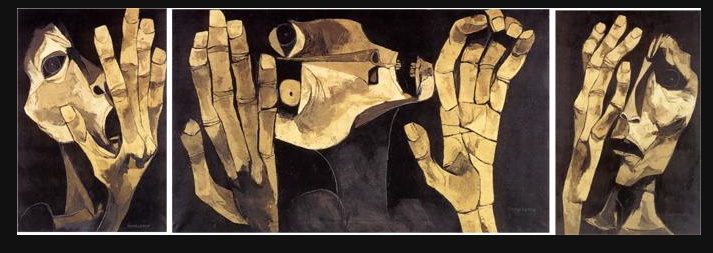
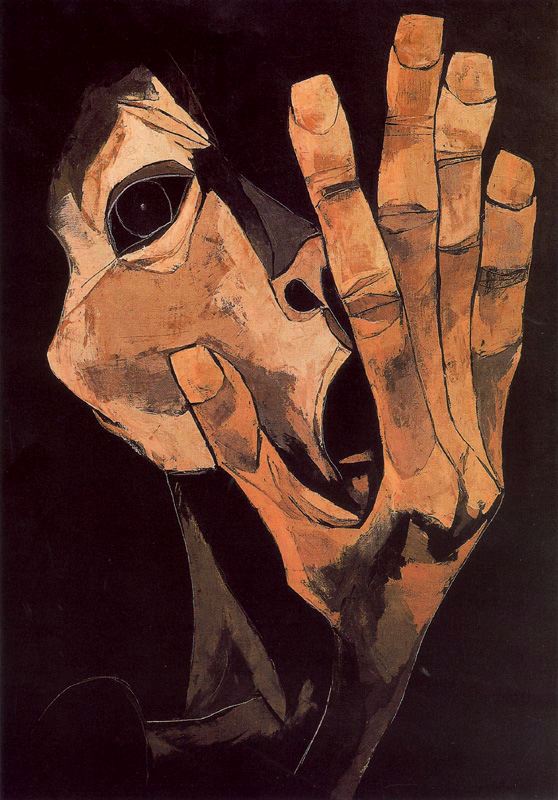
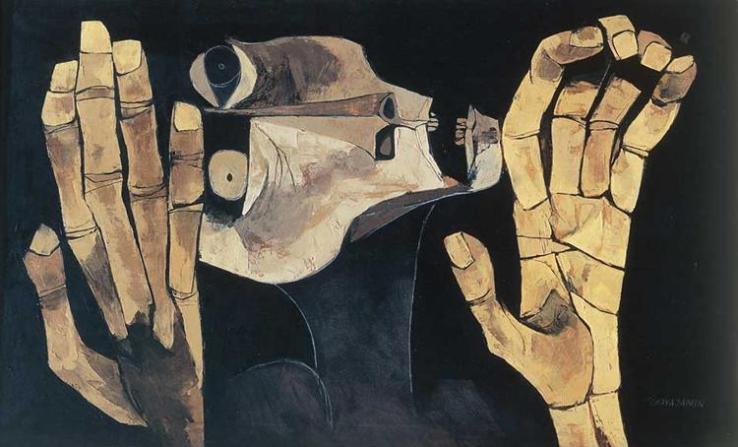
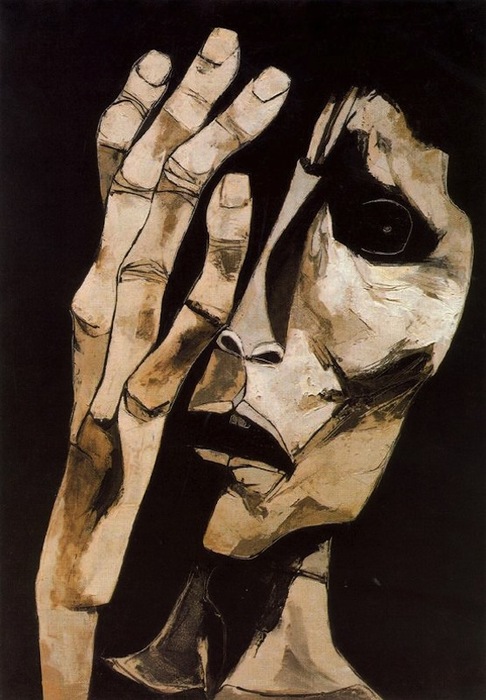
Oswaldo Guayasamín (Ecuadorian, 1919–1999), El Grito [The Cry], 1983. Oil on three canvases. Fundación Guayasamín, Quito, Ecuador.
O Lord, how long shall I cry for help,
and you will not hear?
Or cry to you “Violence!”
and you will not save?
Why do you make me see iniquity,
and why do you idly look at wrong?
Destruction and violence are before me;
strife and contention arise.
So the law is paralyzed,
and justice never goes forth.
For the wicked surround the righteous;
so justice goes forth perverted.
I haven’t really known what to say about the violence in our nation and around the world. There are specific events that I’m grieving, and then there’s just the toll of senseless violence stacked on senseless violence. I’m exhausted, and I’m not even a member of any of the affected communities. Lord have mercy. This lament just kind of poured out of me last week. How long O Lord?
Justin Ruddy is the founding pastor of Resurrection Church in East Boston, which just launched this fall. As a former minister at Citylife Boston, where I attended for five years, he has been influential in shaping my faith—especially my appreciation of liturgy and my practice of lament. When he wasn’t preaching or singing/playing music in worship, he often served as “presider” over the service, connecting together the various liturgical elements, weaving a narrative through line that illuminated the gospel for me week after week. When he spoke theology, he did so in such thoughtful and relevant ways. He also occasionally led us in responding to national or global tragedies or crises. His prayers in the wake of such events, such as the Boston Marathon bombings in 2013, have taught me a way to pray through suffering. His song “How Long, O Lord?” exemplifies his approach—a biblical one—of bringing pain, grief, anger, exasperation fully before God.
+++
A theology that has no place for lament is left only with thin, inadequate murmurings. The covenantal relationship is reduced to a mere shell, maneuvered about with smoke and mirrors rather than serious and faithful engagement. . . . A theology which takes our covenantal relationship with God seriously must then also take the laments seriously. One cannot happen without the other.
—Logan C. Jones, The Psalms of Lament and the Transformation of Sorrow
Oswaldo Guayasamín, El Grito IOswaldo Guayasamín, El Grito IIOswaldo Guyasamín, El Grito III
This post belongs to the weekly series Artful Devotion. If you can’t view the music player in your email or RSS reader, try opening the post in your browser.
To view all the Revised Common Lectionary scripture readings for Proper 26, cycle C, click here.
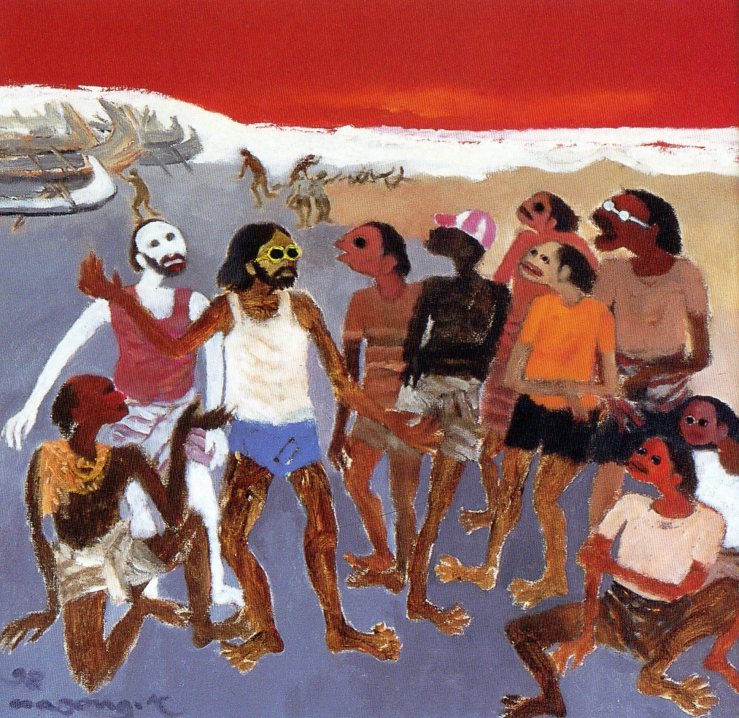
Bagong Kussudiardja (Indonesian, 1928–2004), Christ and the Fishermen, 1998. Oil on canvas. Source: Ron O’Grady, ed., Christ for All People: Celebrating a World of Christian Art (Asian Christian Art Association, 2001), page 67
But the saints of the Most High shall receive the kingdom and possess the kingdom forever, forever and ever.
—Daniel 7:18
And he lifted up his eyes on his disciples, and said:
“Blessed are you who are poor, for yours is the kingdom of God.
“Blessed are you who are hungry now, for you shall be satisfied.
“Blessed are you who weep now, for you shall laugh.
“Blessed are you when people hate you and when they exclude you and revile you and spurn your name as evil, on account of the Son of Man! Rejoice in that day, and leap for joy, for behold, your reward is great in heaven; for so their fathers did to the prophets. . . .”
—Luke 7:20–23
Christians believe that the forever kingdom foreseen by the Old Testament prophet Daniel (in the vision that precedes the above verse) is the same kingdom that Jesus inaugurated in the New Testament. As Jesus preached the Beatitudes, he described those who would possess said kingdom: the meek, the merciful, and so on.
Daniel’s vision was of “one like a son of man” who was given, by the Ancient of Days, everlasting dominion over all peoples. Jesus uses the title “Son of Man” for himself all throughout the Gospel of Luke. He is the ruler of that expansive kingdom that had been prophesied about centuries earlier. It’s a kingdom that extends across the realms of earth and heaven, which will one day be joined back together. Its citizens are the saints of old (who trusted in God’s promises) and the saints of today.
On All Saints’ Day (November 1) we remember the powerful spiritual bond we have with our fellow “citizens” in heaven. We celebrate the examples they have left us, giving thanks for their lives.
Below is a song by a living saint that invites us into God’s kingdom and to “see with new eyes,” paired with a painting by a saint who has passed on, which shows Jesus building the kingdom.
+++
SONG: “Behold Now the Kingdom” by John Michael Talbot | Performed by John Michael Talbot and Terry Talbot, on The Painter (1980)
Grammy Award–winning singer-songwriter John Michael Talbot came to faith in 1975 while rock-’n’-rolling and shortly after joined the Jesus Movement. He converted to Catholicism in 1978 and two years later founded the Brothers and Sisters of Charity, an integrated monastic community with celibate brothers and sisters, singles, and families. He now lives at St. Clare Monastery in Houston, where he is still writing and producing music, donating all his proceeds to charities. On the album The Painter, he sings with his brother, Terry.
+++
Bagong Kussudiardja (1928–2004) [previously] was a well-known dancer and choreographer from Indonesia who combined classical Javanese dance with modern dance, the latter of which he studied under Martha Graham in the 1950s. He was a Christian, and several of his dance-dramas were based on events from the life of Christ: the Nativity, the Crucifixion, and the Ascension, for example. He was also a visual artist who pioneered batik painting in Indonesia, although he worked in oils too. In 1958 he founded Pusat Latihan Tari Bagong Kussudiardja (Bagong Kussudiardja Center for Dance), followed by Padepokan Seni Bagong Kussudiardja (Bagong Kussudiardja Center for the Arts) in 1978, which is still flourishing. He was honored with a Google Doodle on his birthday in 2017.
Kussudiardja’s Christ and the Fishermen shows Jesus on an Indonesian beach (notice the traditional fishing boats in the background) wearing modern dress: a blue bathing suit, a white tank top, and yellow-rimmed sunglasses. He gestures expressively as he preaches to his new disciples who, in their contouring, are reminiscent of shadow puppets (wayang).
+++
For All Saints’ Day devotions from the previous two lectionary cycles, see:
“Sky World,” featuring a song in Mohawk by Theresa Bear Fox and a fancy dance by Apsáalooke hip-hop artist Supaman
“Around the Throne,” featuring an early Renaissance altarpiece from Italy and a late Renaissance motet from Spain
For other thematically related Artful Devotions, see:
“Shine Like a Star,” featuring a contemporary Ukrainian icon and an American folk song from the 1953 Ruth Crawford Seeger songbook, American Folk Songs for Christmas
“Cloud of Witnesses,” featuring a Paduan dome fresco of heaven and a hymn by Brian Wren and Gary Rand
This post belongs to the weekly series Artful Devotion. If you can’t view the music player in your email or RSS reader, try opening the post in your browser.
To view all the Revised Common Lectionary scripture readings for All Saints’ Day, cycle C, click here.







 Art & Theology