Today’s two featured artists draw on the mythology of the phoenix, a fantastical bird that dies in flames but then is born again out of its own ashes. (An alternate legend, not as popular, says the phoenix dies and decomposes but then rises out of its rot.) In Christianity the phoenix became a symbol of resurrection—Jesus’s, and our own. The First Epistle of Clement to the Corinthians from the late first century CE is the first Christian writing to make this connection. And the phoenix points to not only the reconstitution of our bodies after death but also the spiritual regeneration we undergo in this life. Out of the ashes of our sin, the death of the old self, the new self rises with Christ.
Apart from (but not opposed to) this theological framework, the phoenix can be seen as a symbol of resilience through trials, of withstanding the forces of destruction, and it seems that’s the sense that life coach and creative Yolonda Coles Jones [previously] is after in her song. The chorus is a mantra that anyone, regardless of faith tradition, can make their own: “Rise from the ashes.”
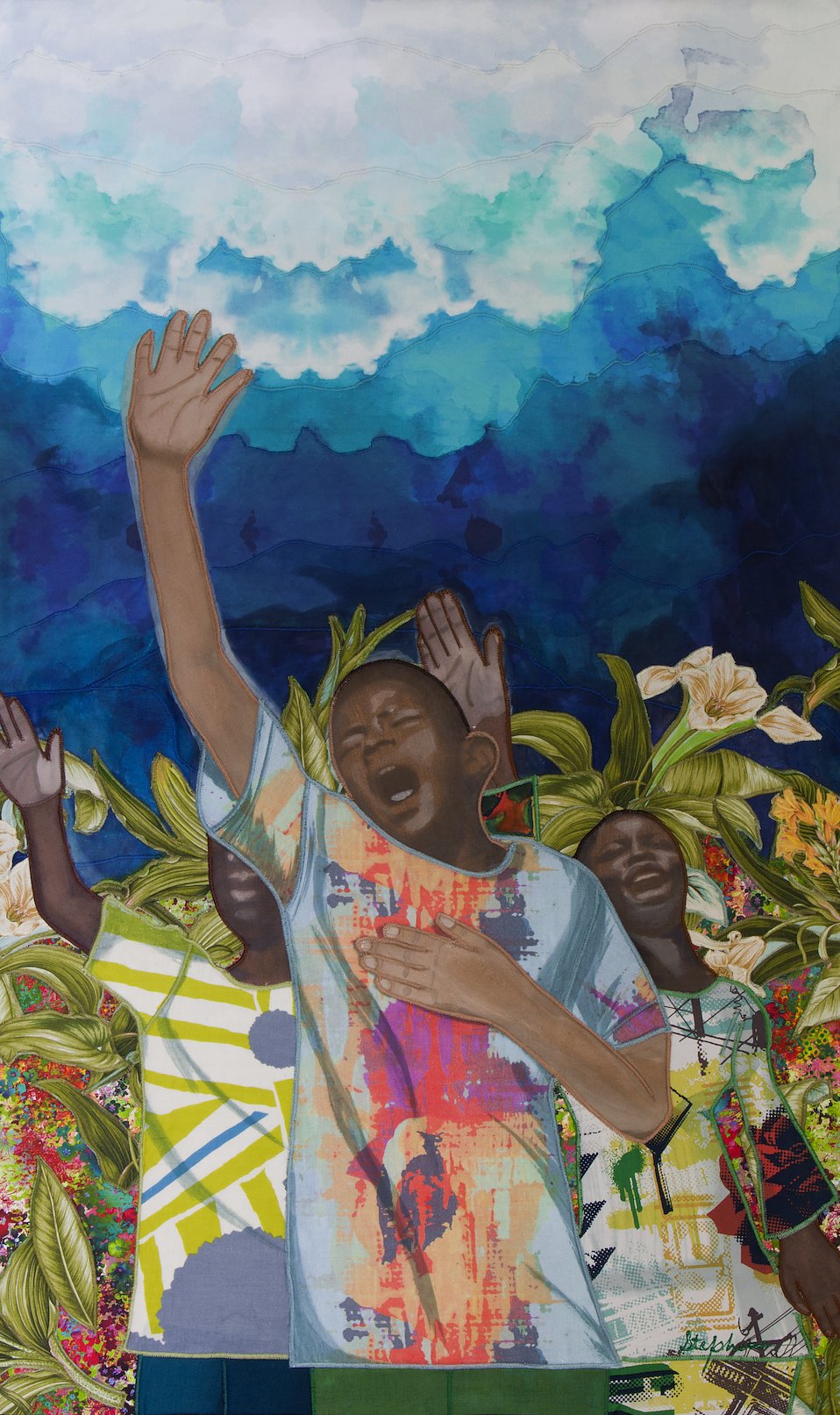
LOOK: Nathan Florence (American, 1972–), Winging Phoenix, 2010. Oil on printed cotton, 20 × 20 in.
Amazed at what I’m able to do Lookin’ back on all I’ve been through Survived unimaginable things, yeah Phoenix bird claps her wings
Rise from the ashes (×4)
Spread your wings and fly Phoenix bird, rise
Note to reader: I’m not able to sustain daily posts for the duration of Lent (I’m a one-woman show here!), so there won’t be a “Lent, Day 8,” etc., but I will continue to provide regular content throughout the season. In the meantime, I hope you’re enjoying the Lent Playlist I put together.
LOOK: Mark Newport (American, 1964–), Mend 9 (detail), 2016. Embroidery on muslin, 17 × 13 in.
Artist’s statement: “As I fold my son’s laundered clothes, the holes in the knees of his pants remind me of my childhood exploits, the falls that punctuated each adventure and the scars I carry from those accidents. My body and most often the knees of my pants would be repaired the same way: wash then patch (an iron-on patch for the pants and a Band-Aid for me). When things were more serious, stitches might be required for the body and the clothes would be discarded. Even then, darning and suturing leave a mark, a scar. Each pierces the substrate it is repairing, performing a modest violence upon what is to be mended, and reminding each of us of our sensitivity, vulnerability, and mortality.”
[Chorus] Let my love fix you up when you’re coming undone Let my love fix you up when you’re coming undone
[Verse] Do you believe me when I say: “My mind is a radio calling your name” When you’re heavy with uncertainty Tune in and I’ll sing you to sleep
[Pre-Chorus] ’Cause the silver strings from my heart to yours Send signals back and forth And when we’re apart if you listen close They play our favorite chord
[Chorus] Let my love fix you up when you’re coming undone Let my love fix you up when you’re coming undone
[Bridge] Close your eyes, open your mind I’ll meet you there outside of time When you fall apart across the great divide I’m a satellite, a telescope I’m a pyramid, a secret door I’m a mystery that’s pointed straight at you
LOOK: (1) “St. Juliana of Nicomedia, the devil at her feet,” from a Picture Bible made at the Abbey of Saint Bertin, Saint-Omer, France, ca. 1190–1200. KB, 76 F 5, fol. 32r. Koninklijke Bibliotheek (Royal Library), The Hague, Netherlands. (2) “St. Juliana of Nicomedia binding the devil,” from the Passionary of Weissenau, made in Germany, 12th century. Codex Bodmer 127, fol. 44v. Fondation Martin Bodmer, Cologny, Switzerland.
Saint Juliana (ca. 286–ca. 304) was a Christian from Nicomedia in present-day Turkey—the eastern capital of the Roman Empire in her day—who suffered martyrdom under the Diocletian persecutions. Legend has it that she engaged in some serious combat with the devil, so in art she is sometimes shown beating him with a club, binding him with a rope or chain, or otherwise incapacitating him. Bam!
LISTEN: “Satan, Take Your Hands Off Me” by Essie Mae Brooks, on Rain in Your Life (2000)
. . . Satan, take your hand off me. I’m in God’s hand. Jesus, my Jesus, Has got his arm, They wrapped all around me, And the world can’t do me no harm. . . .
Born in 1930, Essie Mae Brooks is a gospel singer-songwriter from Houston County, Georgia. Rain in Your Life is her debut album, which was followed up by I’ve Been Washed in the Water in 2002.
These two projects were financed by the Music Maker Relief Foundation, a nonprofit dedicated to preserving the musical traditions of the South by directly supporting the musicians who bear those traditions. Cofounder Tim Duffy realized, while studying folklore in college, that preservationists tended to focus on documenting and archiving rather than on taking care of the artists themselves, and he wanted to take a more people-centered approach. So he and his wife Denise launched the foundation in 1994, seeking to empower and sustain folk and blues musicians in and around Winston-Salem, North Carolina, and beyond.
Music Maker provides tour booking, management, and recording services to its artists in addition to grants, but more than that, it offers ongoing support that helps artists pay their bills. The organization focuses on the most vulnerable musicians: those over fifty-five who live on less than $25,000 a year.
LOOK: Antonello da Messina (Italian, ca. 1430–1479), Christ Crucified, 1475. Oil on wood, 41.9 × 25.4 cm. National Gallery, London.
I’m struck by the strong verticality of this painting, which, by elevating Jesus so far above the ground, gives it a certain solitariness. Antonello composed the picture with a low viewpoint so that we, like John the apostle on the right, also have to look up to view the crucified Christ.
As they looked upon the staff That Moses wrapped the snake around So my eyes behold the cross That my Lord is placed upon
Bring me healing, bring me sight Bring me feeling, bring me light Bring anointing to my head Make alive what once was dead
This song is inspired by Jesus’s words in John 3:14–15: “As Moses lifted up the serpent in the wilderness, so must the Son of Man be lifted up, that whoever believes in him may have eternal life.” Jesus is, of course, referring not only forward to his crucifixion but also back to the episode in Numbers 21:4–9, in which the people of Israel were healed from fatal snake bites by casting their gaze on a bronze serpent raised up on a pole.
Josh Compton is a singer-songwriter from Canton, Ohio, whose collaborative music projects have been recorded under the names The Brothers of Abriem Harp (I reviewed their Last Days album here) and A Ship at Sea [previously]. The latter’s Awake, Awake is one of my favorite albums.
LOOK: C. F. John (Indian, 1960–), Gathering Fragments 1, 2009. Mixed media on banana fiber sheets on canvas, 12 × 12 in.
C. F. John is an internationally exhibited, award-winning artist and social activist based in Bangalore, India. I learned about him from my friend Jyoti Sahi [previously], whose art ashram John lived at from 1984 to 1986. He works in oils, mixed media, and installation and has even designed a few architectural spaces. Spirituality and ecology are important in his practice.
The featured artwork here is from John’s Gathering Fragments series. To me it’s evocative of an emptying of self and the desire to be filled with God—a characteristic Lenten posture. The woman holds out her bowl with a readiness to receive.
Fill my cup, Lord; I lift it up, Lord; Come and quench this thirsting of my soul. Bread of Heaven, feed me till I want no more. Fill my cup, fill it up and make me whole.
Richard Blanchard (1925–2004) was an American Methodist minister and gospel songwriter. This most famous song of his was inspired by the story of the marginalized Samaritan woman whom Jesus engaged in conversation as the two of them were gathering water at a public well (John 4:1–45). Seeing that the woman was not only physically thirsty but also had a deep spiritual thirst, Jesus offered her “living water.” “Whoever drinks of the water that I will give him will never be thirsty again. The water that I will give him will become in him a spring of water welling up to eternal life,” he said. To which she replied, “Sir, give me this water!”
Though Blanchard’s song has three verses that make this connection explicit, gospel recording artists sometimes isolate the chorus and sing it as a standalone piece, as it’s such a powerful, concentrated expression of Godward yearning.
“Bread of Heaven” is a Christological title derived from John 6, a dialogue between Jesus and the crowds the day after he miraculously multiplied five loaves and two fishes a thousandfold.
When they found him on the other side of the sea, they said to him, “Rabbi, when did you come here?” Jesus answered them, “Truly, truly, I say to you, you are seeking me, not because you saw signs, but because you ate your fill of the loaves. Do not work for the food that perishes, but for the food that endures to eternal life, which the Son of Man will give to you. For on him God the Father has set his seal.” Then they said to him, “What must we do, to be doing the works of God?” Jesus answered them, “This is the work of God, that you believe in him whom he has sent.” So they said to him, “Then what sign do you do, that we may see and believe you? What work do you perform? Our fathers ate the manna in the wilderness; as it is written, ‘He gave them bread from heaven to eat.’” Jesus then said to them, “Truly, truly, I say to you, it was not Moses who gave you the bread from heaven, but my Father gives you the true bread from heaven. Forthe bread of God is he who comes down from heaven and gives life to the world.” They said to him, “Sir, give us this bread always.”
Jesus said to them, “I am the bread of life; whoever comes to me shall not hunger, and whoever believes in me shall never thirst. But I said to you that you have seen me and yet do not believe. All that the Father gives me will come to me, and whoever comes to me I will never cast out. For I have come down from heaven, not to do my own will but the will of him who sent me. And this is the will of him who sent me, that I should lose nothing of all that he has given me, but raise it up on the last day. For this is the will of my Father, that everyone who looks on the Son and believes in him should have eternal life, and I will raise him up on the last day.”
—John 6:25–40 (emphasis mine)
Some modern hearers get confused by the request “Feed me till I want no more,” wondering at what point we would ever be so full of God that we wouldn’t want to be fed any more of him. But the word “want” is being used in the archaic sense of “lack”—the same way it’s used in Psalm 23: “The Lord is my shepherd, I shall not want.” (And in “Guide Me, O Thou Great Jehovah,” which contains the same exact line.) So it’s asking of God, “Feed me till I lack nothing.”
I love CeCe Winans’s rendition best, posted above. But if you want to watch a performance, here’s Tasha Cobbs Leonard singing live at Passion City Church in Atlanta:
And here’s a recording of the full song released just last month by the Living Stones Quartet from India. I’m not opposed to the verses, but they are a little hokey. Regardless, they bring back warm memories for me of singing this in church as a child. I’ve always been moved by the chorus.
LOOK: Valérie Hadida (French, 1965–), Nuage (Cloud), 2013. Hadida is a contemporary figurative sculptor from France who works mainly in bronze and clay. Many of her “petites bonnes femmes” (little women) sculptures are available for sale through websites like Artsper and Artsy. View process photos on the artist’s Facebook page.
English Translation: Silence For you, silence is praise
Dumiyyah (alternatively transliterated as dumiyah, dumiyya, or dûmîyâ) is one of several Hebrew words for “silence.” It’s used four times in the Psalms, most famously in Psalm 62:1—“For God alone my soul waits in silence; from him comes my salvation”—but also in Psalm 65:1. In addition to its straightforward sense, the word implies waiting or repose.
The song above is a contemplative setting of the opening phrase of Psalm 65 in two languages. It layers the Hebrew dumiyyah with the Latin Vulgate translation of Leka dumiyyah tehillah.
In “Mystery of the Missing Silence,” Christian spirituality writer Carl McColman ponders why so many English translations of Psalm 65:1 eliminate or obscure the word dumiyyah that’s in the original text. The few well-established ones (in Christian circles) that retain it are:
The Darby Bible (DBY): “Praise waiteth for thee in silence, O God, in Zion . . .”
The New American Standard Bible (NASB): “There will be silence before You, and praise in Zion, O God . . .”
The GOD’S WORD Translation (GW): “You are praised with silence in Zion, O God . . .”
The English Standard Version (ESV) has “Praise is due you,” but a footnote provides the alternate translation “Praise waits for you in silence.”
McColman’s word study led him to reach out to Jewish friends with a familiarity of Hebrew, including one in rabbinical school, who pointed him to the Stone Edition Tanach from ArtScroll. First published in 1996, this translation by an international team of Torah scholars renders Psalm 65:1a as “To you, silence is praise, O God in Zion.” (Other modern Jewish translations, like Rabbi A.J. Rosenberg’s, have something similar.) A footnote in the Stone Edition cites commentary from the medieval rabbinic scholar Rashi (1040–1105), who said, “The praises of infinite God can never be exhausted. Silence is his most eloquent praise, since elaboration must leave glaring omissions.”
* Note: In most modern Jewish translations, which tend to count the original headings in the Psalms as verses, this is Psalm 65:2. In the Vulgate and in Eastern Orthodox Bibles, which follow the Septuagint numbering system instead of the Hebrew (Masoretic) one, it is Psalm 64:2. However, for consistency, I refer to it throughout this post as Psalm 65:1, following the numbering in Protestant Bibles.
LOOK: Bradford Johnson, Untitled, 1987. Mixed media, 12 × 28 × 3 in. This image is featured in the essay “Wreckage and Rescue: The Art of Bradford Johnson” by Joel Sheesley in Image no. 25 (Spring 2000).
“Child of Dust” is the final song of a four-EP cycle structured on the four basic elements: Fire, Water, Air, and Earth. It’s written as a sonnet in the voice of Earth.
Dear prodigal, you are my son and I Supplied you not your spirit but your shape, All Eden’s wealth arrayed before your eyes. I fathomed not you wanted to escape.
And though I only ever gave you love, Like every child you’ve chosen to rebel, Uprooted flowers and filled the holes with blood. Ask not for whom they toll, the solemn bells.
O child of dust, to Mother now return, For every seed must die before it grows. And though above the world may toil and turn, No prying spades will find you here below.
Now safe beneath their wisdom and their feet, Here I will teach you truly how to sleep.
The earth personified laments how humanity has not reciprocated the care she gives. We’re made of her (Gen. 2:7) and are invited to enjoy her beauty, and yet we abuse and destroy her and each other.
The second stanza alludes to Cain’s murdering Abel. “The voice of your brother’s blood is crying to me from the ground,” God tells Cain in Genesis 3:10. Line 8 is a reference to John Donne’s “Meditation 17” from Devotions upon Emergent Occasions, which uses a metaphor of land erosion to express humanity’s interconnectedness:
No man is an island, entire of itself; every man is a piece of the continent, a part of the main. If a clod be washed away by the sea, Europe is the less, as well as if a promontory were, as well as if a manor of thy friend’s or of thine own were. Any man’s death diminishes me, because I am involved in mankind; and therefore never send to know for whom the bell tolls; it tolls for thee.
In other words, when one person dies, a part of the whole of humanity is severed, and in that sense any time a funeral bell rings, we ought all to mourn the loss of a piece of ourselves.
Line 10, in the third stanza, references Jesus’s parable of the grain of wheat: “Truly, truly, I say to you, unless a grain of wheat falls into the earth and dies, it remains alone; but if it dies, it bears much fruit” (John 12:24). Jesus was talking about his own literal death and resurrection, but the principle applies to our dying to sinful desires, an act that enables new life to spring up in us (see, e.g., Rom. 6; Gal. 2:20, 5:24; Col. 3:2–5; 1 Pet. 2:24).
Kensrue’s lyrics have Mother Earth asking her prodigal children to return to her. As they sing the final couplet, the band puts the microphone in a wooden box (a “coffin”) and shovels dirt on top of it, creating a muffled sound effect. The last sixty seconds of the track are near silence, just the faint clinking of shovels into dirt and rocks. It’s as if we, the listener, are being buried.
Lent is a time when, beneath the world’s incessant noise and toil, we sow ourselves; we reground ourselves in God. The song can be interpreted in several ways, but I see it as calling us to die to self so that we might truly live. Dying and rising is a lesson that Earth, with her seasons and agricultural cycles, can teach us. The seed must be buried before it can experience growth.
The Lent 2021 edition of the Daily Prayer Project prayerbook is now available, covering February 17–April 3. (I serve as curator.) The stunning cover image is Prayers of the People I by Meena Matocha, who works in charcoal, ashes, acrylic, and wax. You can purchase the booklet in either digital or physical format.
In the opening letter, Project Director Joel Littlepage writes, “Lent is a season that disturbs many people. Maybe that includes you. Among Protestant Christian communities that I have been a part of over the years, Lent can either be seen as a ‘graceless,’ ‘harsh,’ ‘legalistic’ part of the Christian year or, on the other hand, trivialized into a time to ‘pick something to give up,’ like a seasonal spiritual diet plan. Both these characterizations miss the mark.” He goes on to describe the bidirectionality of the Lenten journey: downward, as we are crucified with Christ, and upward, toward the victory of resurrection and new life. “It is a season to sense again the path of the Christian life.”
+++
NEW CHILDREN’S BOOK: Pippy the Piano and the Very Big Wave by Roger W. Lowther, illustrated by Sarah Dusek: My friend Roger Lowther [previously], director of Community Arts Tokyo and host of the Art Life Faith podcast, has written his first children’s book, which released in December. It’s inspired by the story of a church in Kamaishi, who after the 2011 tsunami found their beloved piano upside down and covered in mud and debris but, rather than discard it, decided to spend enormous amounts of time and money to restore it—a picture of God’s love for his precious creation, and the lengths he went to to demonstrate that love. Hollywood and Broadway actor Sean Davis reads the book in the video below. [Available on Amazon]
+++
EXHIBITION: The Cobblestone Gospel by Trygve Skogrand, Vår Frue Kirke (Our Lady Church), Trondheim, Norway, July 2020–April 2021: “An exhibition of collages of historic low-church art merged with photographs of our own contemporary surroundings. The essence of the works is the meeting. Between painting and photography, the mystical and the mundane, and how the meeting makes both worlds renewed and re-visibled.” The original advertising says the exhibition is open Mondays through Saturdays from 12 to 3 p.m., but I’m not sure whether COVID has changed that; you can contact the church here.
Trygve Skogrand (Norwegian, 1967–), Found, 2020. Collage / pigment print on paper.Trygve Skogrand (Norwegian, 1967–), The Beloved, 2020. Collage / pigment print on paper.
When I was a child, I went to a Christmas party at our local church. At the end of the party, every child got a small bag of gifts to take home. In the bag: a pack of raisins, a small orange, some sweets – and a prayer card showing Jesus in paradise. Oh, how beautiful I thought the small prayer card was! Jesus and butterflies and a sunset and flowers AND a golden glittery border. A wonder of loveliness and holiness!
Move on twenty years. I was 30, had started working as an artist, and found the bible card again. I had changed, and the card too. Instead of seeing loveliness, I found the card rather sad. It looked to me as if Jesus was imprisoned in a dusty and suffocating make-believe paradise.
Then it struck me: What if I remove the paradise?
I have now been working with the merging of high and low historical Christian art with our contemporary surroundings for twenty years. For me, this process not only binds together what nowadays normally is shown as sundered but also re-actualizes the classical art and infuses the everyday, modern surroundings with holiness.
+++
MUSIC VIDEO: “Fear Thou Not” by Josh Garrels: This beautiful new setting of Isaiah 41:10 by Josh Garrels appears on Garrels’s 2020 album Peace to All Who Enter Here [previously]. “Fear thou not; for I am with thee: be not dismayed; for I am thy God: I will strengthen thee; yea, I will help thee; [and] I will uphold [you] with the right hand of my righteousness” (KJV).
+++
SHORT FILM: A Colorized Snowball Fight from 1896 Shows Not Much Has Changed in the Art of Winter Warfare: This is pure joy! “A short clip, originally captured by Louis Lumière in 1896, documents a rowdy snowball fight [bataille de boules de neige] on the streets of Lyon, France. Thanks to Saint-Petersburg, Russia-based Dmitriy Badin, who used a combination of the open-source software DeOldify and his own specially designed algorithms to upscale and colorize the historic footage, the video of the winter pastime is incredibly clear, revealing facial features and details on garments.”
Hannah Rose Thomas, paintings from the Tears of Gold series, 2017. Click image to learn more, and see the Google Arts & Culture exhibition.Nicola Ravenscroft, With the Heart of a Child, 2016. Sculpture installation comprising seven life-size bronze children. The artist calls the figures “eco-earthling-warrior-mudcubs.” Click image for artist interview, and here for a theological reflection.
+++
VISUAL COMMENTARIES: Elijah’s Ascent by Victoria Emily Jones: My latest contribution to the Visual Commentary on Scripture was published this month. It’s a mini-exhibition on 2 Kings 2:1–12, featuring a seventeenth-century Russian icon, a 1944 painting by African American artist William H. Johnson, and a 1985 painting (a Jewish chapel commission) by Polish-born Israeli artist Shlomo Katz. (For more context on the Katz painting, see here.)
+++
NATIONAL MOURNING:Washington National Cathedral tolled its mourning bell four hundred times Tuesday evening in remembrance of the 400,000 lives lost from COVID in the United States thus far—each ring representing one thousand dead. I spent the thirty-eight-minute livestream lamenting this enormous loss, praying for all those who are grieving and for patients and health care workers, and pleading with God for an end to this virus.
The origami paper doves you see in the video are part of the Les Colombes installation by Michael Pendry [previously], erected in December in the cathedral’s nave to symbolize hope and the Holy Spirit.
+++
MUSIC VIDEO: “For the Sake of Old Times” (Auld Lang Syne): Directed by Tyler Jones of the narrative studio 1504, this short film premiered December 30, 2020, by NPR. “From the pews of a church where white deacons once refused to seat African Americans, a group of Black singers in Alabama reminds us why preserving our memories of this historic year is vital—even if we’d rather just leave 2020 behind.” [HT: ImageUpdate]
“To me the piece is a personal encouragement going into the future,” Jones says, “that we hopefully strive to work together for a kinder future, especially at a time where we are so distanced.” Read about the making of the film at https://n.pr/3n6d8Ct.
+++
ARTICLE: “On the Gifts of Street Art” by Jason A. Goroncy, Zadok: The Australasian Religious Press Association awarded silver prize for “Best Theological Article” to Jason Goroncy [previously] for this piece. (How cool that it won in the theology category!) Like all art, street art can function as a form of civic dialogue, protest, play, hope, remembrance, etc., but Goroncy discusses how some of its particular qualities uniquely position it to perform those functions: its (usually) unsanctioned and interventionist nature, its fragility and impermanence, its celebration and development of culture, its inseparability from place, and its redefinitions of proprietorship. [HT: Art/s and Theology Australia]
Human Ants, Liverpool Street, Melbourne, Australia. Photo: Jason Goroncy.
“Among the many gifts that street artists offer,” Goroncy writes, “is a proclivity to bear witness to how things are and not merely to how they might appear to be. Such a proclivity involves a telling of the truth about those largely-untampered-with and untraversed spaces of our urban worlds, about what is present but underexposed or disregarded; and even, as Auden hints, to lead with ‘unconstraining voice’ the way toward healing and toward a renewed sense of enchantment, freedom and praise beyond the pedestrian and clamorous. Such a proclivity is also a form of urban spirituality. It can even be a form of public theology.”
Archibald J. Motley Jr. (1891–1981) was one of the most important artists of the Harlem Renaissance. He’s best known for his paintings of urban Black culture, especially the Chicago jazz scene and other nightlife, and he was also a wonderful portraitist.
His final painting, however, shows none of the carefree conviviality that was characteristic of much of his work. On the contrary, it’s nightmarish. Begun in 1963 and reworked over the course of a decade, The First One Hundred Years: He Amongst You Who is Without Sin Shall Cast the First Stone: Forgive Them Father For They Know Not What They Do chronicles race relations in the United States from the Civil War to the civil rights era. It’s the most overtly political painting in Motley’s oeuvre, and once completed, he didn’t paint for the remaining nine years of his life.
The “one hundred years” in the title refers to the period since the Emancipation Proclamation took effect in 1863, changing the legal status of more than 3.5 million enslaved African Americans to “free.” The Civil War ended May 9, 1865, and slavery was officially abolished with the Thirteenth Amendment on December 18 of that year. But the legacy of that institution was still felt throughout the next century, in which Black people suffered disenfranchisement, segregation, lynchings, and a number of other injustices and terrors.
Motley visualizes the Black struggle for freedom and equality through symbols and vignettes.
At the top of the painting are the death masks of John F. Kennedy, Martin Luther King Jr., and Abraham Lincoln, all of whom were assassinated as they sought to advance the rights of African Americans.
Below King’s visage is a Confederate flag, hanging from the front porch of a crumbling Southern manse. The red is replicated in the blood running out the house’s downspout, a horned devil (who surveys the domain he’s claimed), the blood-drop cross insignia of a Ku Klux Klansman, and the tongue of a snarling police dog.
At the bottom right a traditional African mask lies beside a human skull, alluding not only to physical death but also to the fragmentation or loss of cultural identity experienced by those who were abducted from their homeland and brought across the Atlantic to live in captivity, separated from their families and communities and ways of life and even given new names by their oppressors. This wound is also felt by the enslaved persons’ descendants, who are unable to trace their lineage.
Above this still life is a Black person on horseback, operating a plow right next to a coffin. Besides the obvious reference to plantation labor, the vignette also evokes the African American spiritual that goes, “Keep your hand on the plow, hold on”—a song of endurance through hardship.
In the center of the painting the Statue of Liberty stands in ironic contrast to a lynched man, the color of her freedom torch echoed in the burning cross of the KKK. Just behind this dead Black man who hangs from a tree is another dead man hanging from another tree: Jesus on the cross. (For more on how these two symbols mutually interpret each other, see theologian James H. Cone’s The Cross and the Lynching Tree.) The hill of Calvary is the brightest part of the entire composition, which I imagine Motley, a practicing Catholic, intended to signify hope, enlightenment, and a call to repentance. The cross illuminates our sin and the love of God that compels us to love our neighbors. I will address this further, in relation to an MLK sermon, below.
In the shadow of the cross is a sea of protest and counterprotest signs. Alongside slogans like “We Want to Vote,” “Black Power,” and “We Shall Overcome” are swastikas, “America for Whites, Africa for Blacks,” and “Go home, niggers, and get your relief check.” To the left of this activity, a white police officer beats a Black man with a baton, and a fireman turns a high-pressure hose on Lady Justice. This vignette evokes the chilling news footage from May 1963, when Birmingham Public Safety Commissioner Bull Connor ordered the use of fire hoses and attack dogs on peaceful Black protesters, including children. The force of the jet streams ripped off boys’ shirts and pushed girls over the tops of cars. It was an assault on Black bodies and on justice itself.
Birmingham, Alabama, was, and still is, one of the most racially divided cities in the US, and in the 1960s it became a center of civil rights activism. From 1947 to 1965 it was the site of fifty racially motivated dynamite explosions, earning it the nickname “Bombingham.” The bombing that caught the most international attention was of Sixteenth Street Baptist Church on September 15, 1963. The blast killed four girls who were leaving Sunday school: Addie Mae Collins, Cynthia Wesley, Carole Robertson, and Carol Denise McNair. Motley alludes to this terrorist act with the stained glass window wherein the face of a white Jesus is blown out, as that’s actually what happened at Sixteenth Street Baptist. (“The absence of the face,” said James Baldwin, “is something of an achievement since we have been victimized so long by an alabaster Christ.”)
In the center foreground, emerging from the phantasmagoria, is another faceless figure, his form and features undefined. He’s a specter, really, walking toward us—or is it someone in a dream state? Motley mixes historical scenes of violence and terror with contemporary ones, showing how the ghosts of our nation’s past are still haunting us.
Scattered throughout the painting are animals that represent ill omens or evil: a bat, a vulture (who feeds on death), a black cat, a serpent, a scorpion (on the right, crawling across the door marked “1863”). The latter two call to mind Luke 10:19, where Jesus tells his disciples, “Behold, I give unto you power to tread on serpents and scorpions, and over all the power of the enemy . . .” A dove of peace, the only nonsinister animal presence, perches on the margins.
Church, listen up: we have the call and the power, in Christ(!), to tread on racism and every other evil that erects itself against the kingdom of God. Don’t let the Enemy have a stranglehold. Let us be active in confronting the evil of white supremacy and dismantling it—in our own hearts, our congregations, our government, and in all the other systems it operates in—so that the supremacy of Christ and his gospel of freedom and reconciliation can be made known.
Where Are We Today?
I encountered The First One Hundred Years through the 2015 retrospective Archibald Motley: Jazz Age Modernist and have been sitting with the image ever since, thinking: What progress have we made? Do I recognize this scene? What will “The Next One Hundred Years” look like in America?
It’s been almost fifty years since Motley completed the painting, and blood still flows. Black people are still being lynched (Ahmaud Arbery, killed by white vigilantes while out on a jog, is one example). Some people and businesses are still flying their Confederate flags. And racist hate groups are as active as ever. Last October the Department of Homeland Security named white supremacist extremists the country’s number one domestic terrorism threat, a threat that came to fruition January 6 when a mob of radical Trump supporters, catalyzed by the president himself, stormed the Capitol equipped with climbing gear, riot helmets, shields, gas masks, bear spray, flex cuffs, lead pipes, and baseball bats, attempting to overturn the 2020 presidential election results by force. The insurrectionists erected a functional gallows and noose on the lawn and shouted and graffitied death threats. A Confederate battle flag was marched through the halls of Congress, as were other neo-Confederate, neo-Nazi, and nationalist symbols, along with crosses, the Christian flag, a “Jesus 2020” banner, “Make America Godly Again,” etc. (Christian nationalism, on flagrant display at the Capitol, has been publicly denounced by several prominent American Christians these past four years, so I won’t get into it here.) The mob was a mishmash of different groups and individuals united around Trump’s claims of election fraud and trying to hold on to (white) power.
Law enforcement’s completely deficient planning for the white-led protest (and thus inability to properly respond when the protest turned into a siege) stood in stark contrast to the way Black Lives Matter protests in DC were handled last summer, with militarized officers at the ready, low-flying helicopters, and eight-foot-tall fences. Peaceful Black protesters in the streets were met with tear gas and rubber bullets, whereas January 6’s white protesters were able to invade the Capitol with little resistance.
Why the woeful lapse in security, despite clear intelligence that right-wing extremists would be gathering there the day Congress was convening to ratify Biden’s democratically won victory? Because despite the DHS’s recent Homeland Threat Assessment, white people are, in general, not perceived as dangerous; Black (and brown) people are. And because white people know the system works for them, those who stormed the Capitol felt empowered to do so with impunity. They weren’t scared of the police. They didn’t even try masking their identities; on the contrary, several posted photos and videos of their crimes online. After trespassing, assaulting police officers (one of whom died), and vandalizing and looting while federal legislators ran and hid in fear for their lives, the insurrectionists were gently told by President Trump to “Go home. We love you.” Only a few were detained. Investigations have since been launched and more and more arrests are being made. But I bring this all up to show just one recent instance of racial disparities in policing as well as the rise of white nationalist fervor, which are just two of the many symptoms that prove that America does indeed still have a race problem.
The Trump presidency has really brought white supremacy to the fore, forcing us to confront a national sin that perhaps we thought was mostly behind us. “Reckoning” is a word I’ve been seeing a lot. Activist and author Ibram X. Kendi says that if we can be thankful to Trump for anything, it’s this: “He has held up a mirror to American society, and it has reflected back a grotesque image that many people had until now refused to see: an image not just of the racism still coursing through the country, but also of the reflex to deny that reality.”
The Need for Enlightenment
The two subtitles of Motley’s painting are both quotations of Jesus, which together indict sin and ask God for mercy. “He amongst you who is without sin shall cast the first stone” (John 8:7) was spoken to pierce the consciences of a mob of religious elites who sought to stone a woman for adultery; it exposed their two-facedness, their eagerness to punish another’s sin but not to examine their own. Motley is thus urging viewers to confront the ways in which they themselves have violated God’s law, how they have said, by their words or actions (or inaction), that Black lives do not matter. Admit. Admitting sin, admitting that there’s a problem, is the first step in rooting it out.
“Forgive them, Father, for they know not what they do” (Luke 23:34) was spoken by Jesus on the cross. As he hung dying, he prayed to God on behalf of his killers, recognizing in them a spiritual blindness. Forgiveness is a nuanced concept whose complexities I won’t discuss here, but Jesus’s prayer expresses his goodwill toward his enemies, a spirit of wanting to see them reconciled to God. Jesus recognized that even as sinners hurt people, they themselves are also hurting. They don’t even realize how their sin binds them and blinds them.
In a ca. 1962 sermon on this text, Martin Luther King describes his oppressors (and Jesus’s) as suffering from an “intellectual and moral blindness . . . an ill which man inflicts upon himself by his tragic misuse of freedom and his failure to use his mind to its fullest capacity. There is plenty information available if we consider it as serious a moral obligation to be intelligent as to be sincere. One day we will learn that the heart can never be totally right if the head is totally wrong.” King describes how enslavers sought to rationalize their beliefs, drawing from “science,” history, and biblical interpretation, and segregationists were doing the same, ignoring all evidence that contradicted what they sincerely believed to be true. These days we’ve seen how those who benefit from white privilege seek to explain away racial inequalities or even simply refuse to believe they exist, because who wants to give up power? And of course they find online communities or curate social media feeds that bolster their view that everyone is treated equally in America, that skin color does not grant any unfair advantages, and so when another unarmed Black person is killed by police, they interpret it through the white lens of “Well, he must have been doing something wrong . . .”
Maybe as you read this very article you’re tensing up and want to tell me X, Y, and Z regarding why white privilege is a fallacy or how I’ve been taken in by a “liberal agenda,” or how my narrative of the recent event at the Capitol is completely off—it wasn’t an insurrection, and it had nothing to do with white supremacy, and those weren’t really Trump supporters (yes, I’ve actually heard people say that). Maybe you think it’s me who’s blind.
King talks about the need for enlightenment.
Light has come into the world. There is a voice crying through the vista of time calling men to walk in the light. Man’s earthly life will be reduced to a tragic cosmic elegy if he fails to heed this call. “This is the condemnation,” says John, “that light is come into the world, and men loved darkness rather than light.”
John’s saying, King says, is demonstrated vividly at the cross, which shows God at his best and humanity at its worst.
We must continue to see the Cross as a magnificent symbol of love conquering hate, and light overcoming darkness. But in the midst of this glowing affirmation, let us never forget that our Lord and Master was nailed to that Cross because of human blindness. Those who crucified him knew not what they did.
In what ways are we nailing Christ to the cross afresh, so to speak, unaware of what we’re doing? In what ways are we resisting the work of the Holy Spirit to expose sin, both personal and collective? In what ways are we closing our ears to the cries of our hurting Black brothers and sisters, and to the calls to action from those who are continuing King’s legacy of nonviolent resistance? I’m speaking to white American Christians in particular here. We all want America to heal. But the sin of racism must be acknowledged and confessed, and repentance undertaken, before healing can proceed.
Repenting of sin is a foundational Christian practice; it’s in the church’s DNA. And yet with this particular issue, there’s been a lot of unwillingness among Christians to see and to act. These past four years have been for me a time of self-examination and also critical examination of the evangelical tradition I grew up in and which you might say I’m still a part of. In addition, I’ve spent a lot of time relearning history, locating my privilege, unlearning biases, rereading the Psalms and the Prophets, repenting, exploring more deeply the witness of the Black church and all-around diversifying the voices I listen to, and slowly (admittedly, hesitantly!) wading into the waters of civic engagement. I have a long way to go, to be sure, but I’m on the journey.
I see Motley’s painting as a lament for all the racial injustices perpetrated in the US but also a statement of hope, as the cross beckons us to persist in (or join) the freedom struggle. It’s a prayer that the scales would fall off the eyes of white America—that we would shed willful ignorance—and that people of all races would walk together not only in the light of “liberty and justice for all” but, as King preached, in the light and Spirit of Christ.