Forever Blessed (Artful Devotion)

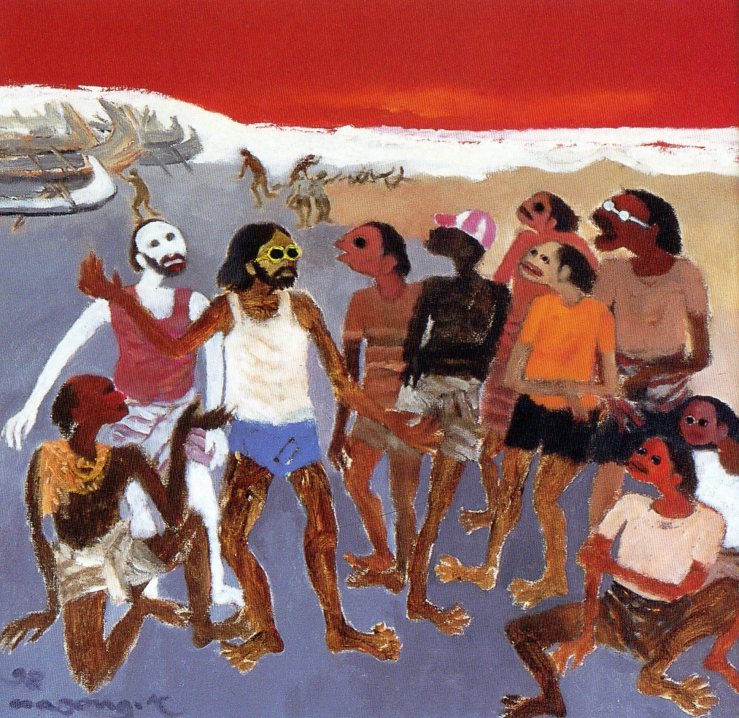
Kussudiardja, Bagong_Christ and the Fishermen
Bagong Kussudiardja (Indonesian, 1928–2004), Christ and the Fishermen, 1998. Oil on canvas. Source: Ron O’Grady, ed., Christ for All People: Celebrating a World of Christian Art (Asian Christian Art Association, 2001), page 67

But the saints of the Most High shall receive the kingdom and possess the kingdom forever, forever and ever.

—Daniel 7:18

And he lifted up his eyes on his disciples, and said:

“Blessed are you who are poor, for yours is the kingdom of God.

“Blessed are you who are hungry now, for you shall be satisfied.

“Blessed are you who weep now, for you shall laugh.

“Blessed are you when people hate you and when they exclude you and revile you and spurn your name as evil, on account of the Son of Man! Rejoice in that day, and leap for joy, for behold, your reward is great in heaven; for so their fathers did to the prophets. . . .”

—Luke 7:20–23

Christians believe that the forever kingdom foreseen by the Old Testament prophet Daniel (in the vision that precedes the above verse) is the same kingdom that Jesus inaugurated in the New Testament. As Jesus preached the Beatitudes, he described those who would possess said kingdom: the meek, the merciful, and so on.

Daniel’s vision was of “one like a son of man” who was given, by the Ancient of Days, everlasting dominion over all peoples. Jesus uses the title “Son of Man” for himself all throughout the Gospel of Luke. He is the ruler of that expansive kingdom that had been prophesied about centuries earlier. It’s a kingdom that extends across the realms of earth and heaven, which will one day be joined back together. Its citizens are the saints of old (who trusted in God’s promises) and the saints of today.

On All Saints’ Day (November 1) we remember the powerful spiritual bond we have with our fellow “citizens” in heaven. We celebrate the examples they have left us, giving thanks for their lives.

Below is a song by a living saint that invites us into God’s kingdom and to “see with new eyes,” paired with a painting by a saint who has passed on, which shows Jesus building the kingdom.

+++

SONG: “Behold Now the Kingdom” by John Michael Talbot | Performed by John Michael Talbot and Terry Talbot, on The Painter (1980)

Grammy Award–winning singer-songwriter John Michael Talbot came to faith in 1975 while rock-’n’-rolling and shortly after joined the Jesus Movement. He converted to Catholicism in 1978 and two years later founded the Brothers and Sisters of Charity, an integrated monastic community with celibate brothers and sisters, singles, and families. He now lives at St. Clare Monastery in Houston, where he is still writing and producing music, donating all his proceeds to charities. On the album The Painter, he sings with his brother, Terry.
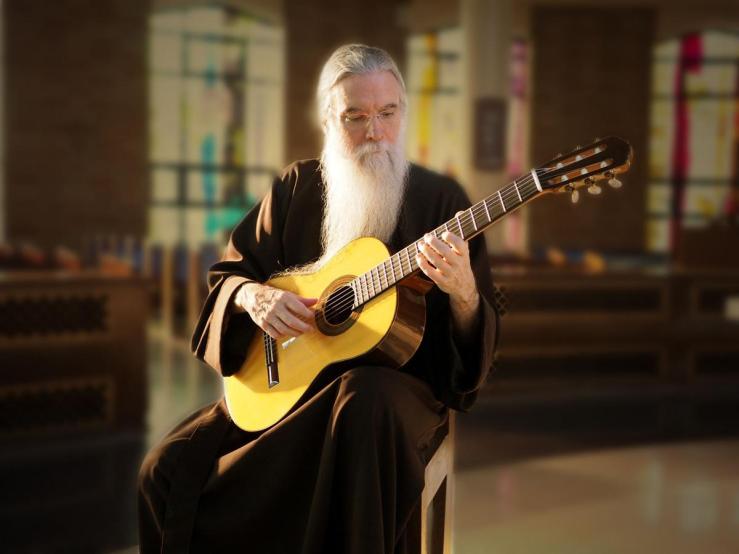
John Michael Talbot

+++

Bagong Kussudiardja (1928–2004) [previously] was a well-known dancer and choreographer from Indonesia who combined classical Javanese dance with modern dance, the latter of which he studied under Martha Graham in the 1950s. He was a Christian, and several of his dance-dramas were based on events from the life of Christ: the Nativity, the Crucifixion, and the Ascension, for example. He was also a visual artist who pioneered batik painting in Indonesia, although he worked in oils too. In 1958 he founded Pusat Latihan Tari Bagong Kussudiardja (Bagong Kussudiardja Center for Dance), followed by Padepokan Seni Bagong Kussudiardja (Bagong Kussudiardja Center for the Arts) in 1978, which is still flourishing. He was honored with a Google Doodle on his birthday in 2017.
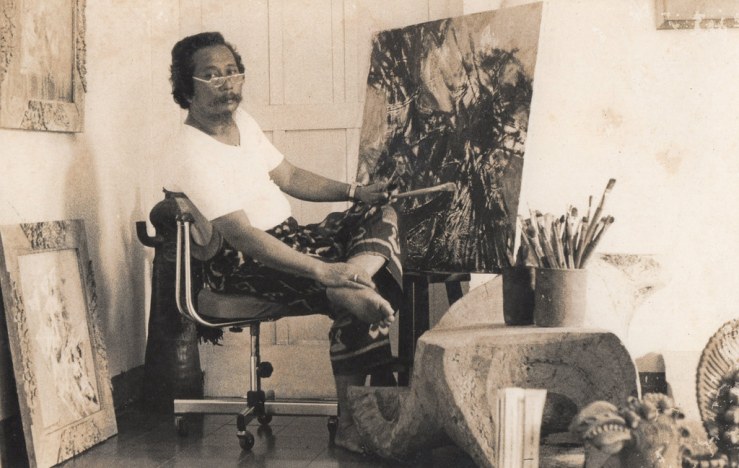
Bagong Kussudiardja

Kussudiardja’s Christ and the Fishermen shows Jesus on an Indonesian beach (notice the traditional fishing boats in the background) wearing modern dress: a blue bathing suit, a white tank top, and yellow-rimmed sunglasses. He gestures expressively as he preaches to his new disciples who, in their contouring, are reminiscent of shadow puppets (wayang).

+++

For All Saints’ Day devotions from the previous two lectionary cycles, see:

  • “Sky World,” featuring a song in Mohawk by Theresa Bear Fox and a fancy dance by Apsáalooke hip-hop artist Supaman
  • “Around the Throne,” featuring an early Renaissance altarpiece from Italy and a late Renaissance motet from Spain

For other thematically related Artful Devotions, see:

  • “Shine Like a Star,” featuring a contemporary Ukrainian icon and an American folk song from the 1953 Ruth Crawford Seeger songbook, American Folk Songs for Christmas
  • “Cloud of Witnesses,” featuring a Paduan dome fresco of heaven and a hymn by Brian Wren and Gary Rand

This post belongs to the weekly series Artful Devotion. If you can’t view the music player in your email or RSS reader, try opening the post in your browser.

To view all the Revised Common Lectionary scripture readings for All Saints’ Day, cycle C, click here.

Highways to Zion (Artful Devotion)

Choumali, Joana_Ca Va Aller 54
Joana Choumali (Ivorian, 1974–), Ça Va Aller #54, 2018. iPhone photograph printed on cotton canvas and hand-embroidered with cotton, lurex, and wool thread, 9 2/5 × 9 2/5 in. (24 × 24 cm).

Blessed are those whose strength is in you,
in whose heart are the highways to Zion.

—Psalm 84:5 ESV

Alternate translation (NKJV):

Blessed is the man whose strength is in You,
whose heart is set on pilgrimage.

+++

SONG: “Marching to Zion” | Words: Isaac Watts, 1707, and Robert Lowry, 1867 (adapt.) | Music: Traditional black gospel | Performed by The Long Walk Home Gospel Choir, led by Dr. Clifford Bibb, on The Long Walk Home original motion picture soundtrack (1991)

I first heard this song years ago in the end credits of The Long Walk Home (1990), a historical drama film about the impact of the 1955 Montgomery bus boycott on a black maid and her white employer. I was so moved by the spirited communal singing of this song about the people of God heading confidently through the fray of this world toward heaven, which alludes to the literal ascent of ancient Jewish pilgrims up the hill to Jerusalem. I looked up the song afterward to find that it is a gospelized adaptation of the Isaac Watts hymn “Come, we that love the Lord” and the nineteenth-century refrain added by Robert Lowry, which goes, in 6/8 time,

We’re marching to Zion,
Beautiful, beautiful Zion;
We’re marching upward to Zion,
The beautiful city of God.

Writing during the rise of American revivalism, Lowry also gave the hymn the tune by which it is commonly known and sung today, reproduced in many hymnals. Despite my being raised Baptist, I never recall having sung this hymn before.

The version of the song used in The Long Walk Home has a completely different meter (4/4) and tune, and it also foregrounds this revised refrain:

We’re marching, marching up to Zion
That beautiful city of God
We’re marching, marching up to Zion
That beautiful city of God

Despite extensive searching, I’ve not been able to find the composer of this version. The soundtrack liner notes credit it as a “Traditional” arranged for the movie by Bernard Sneed, who’s on piano, and Dr. Clifford Bibb, the song leader. The version they’ve arranged almost surely originated in the black church in America and appears to have risen to popularity in the late 1940s. Some early recordings include the Roberta Martin Singers, feat. Eugene Smith (1953); the Blind Boys of Alabama (formerly the Happyland Singers), feat. Clarence Fountain (1954, 1971, etc.); Rev. James Cleveland; the Swan Silvertones; and the Ward Gospel Singers, feat. Viola Crowley (1963). These are all great—but I think I still like the Long Walk Home Gospel Choir recording the best. The intro and outro, which use other musical motives from the film, were composed by George Fenton, who wrote the score not only for this film but also for Dangerous Liaisons, Groundhog Day, You’ve Got Mail, Anna and the King, Sweet Home Alabama, Hitch, The Lady in the Van, and others.

The song also appears under the titles “We’re Marching to Zion,” “Marching Up to Zion,” or “Marching On to Zion.”

If you have any info on the history of, or piano music for, this particular version of the song, please do share! Black churches, from what I can tell, sing both versions, but all the hymnals I’ve consulted use Lowry’s version.

+++

Joana Choumali from Côte d’Ivoire is doing beautiful mixed-media work that combines photography and embroidery. The above work is from her series Ça va aller (“It will be OK”). She began this series three weeks after the 2016 terrorist attack in Grand-Bassam, a historic southeastern seaside town where she used to spend peaceful Sunday afternoons on the beach. With her iPhone, she took photos of residents going about their daily business in the aftermath of this traumatic event, bearing their melancholy quietly. She said that adding the colorful stitches to the printed photographs was healing for her and an act of defiant hope. View more on her website.

In Ça Va Aller #54, a man walks a dusty road that erupts before him into a spectacular upward whirl of tiny cross-shapes that evoke a flock of wild birds or flower blossoms. I see joy, I see hope. I see a man stepping into and being led forward by these virtues.


This post belongs to the weekly series Artful Devotion. If you can’t view the music player in your email or RSS reader, try opening the post in your browser.

To view all the Revised Common Lectionary scripture readings for Proper 25, cycle C, click here.

Wrestling Jacob (Artful Devotion)

Jacob Wrestling by Walter Habdank
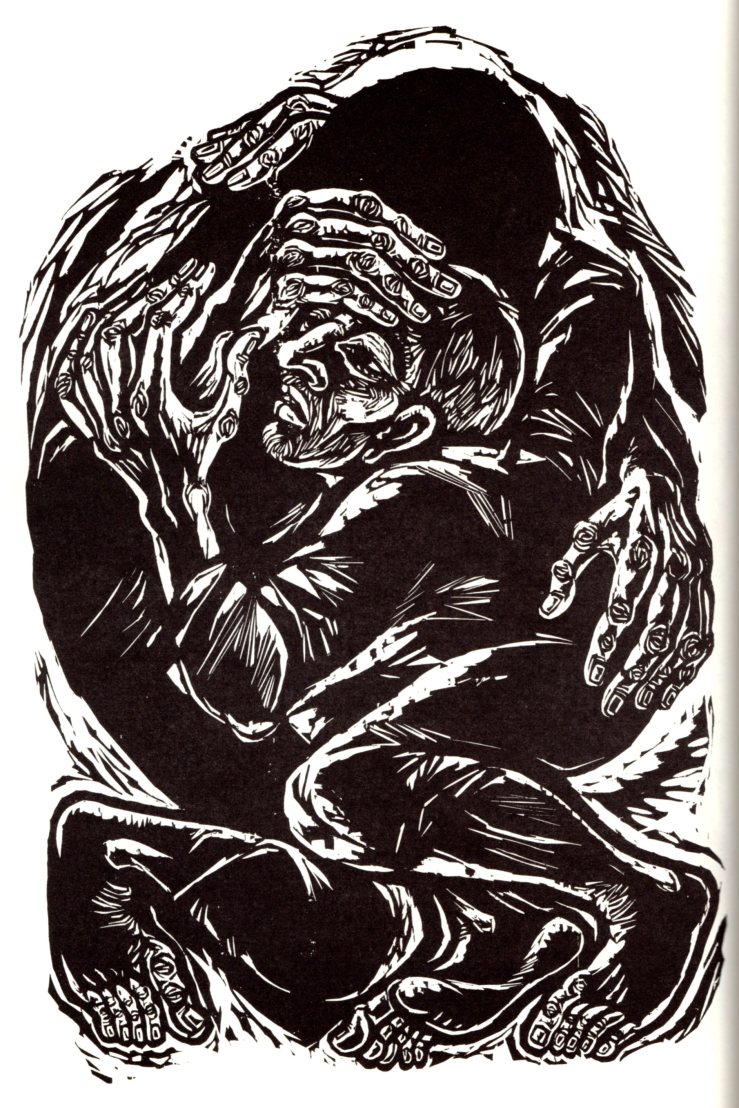
Woodcut of Jacob wrestling with God by Walter Habdank (German, 1930–2001), from the Habdank Bibel (Augsburg: Pattloch, 1995)

The same night he arose and took his two wives, his two female servants, and his eleven children, and crossed the ford of the Jabbok. He took them and sent them across the stream, and everything else that he had. And Jacob was left alone. And a man wrestled with him until the breaking of the day.

When the man saw that he did not prevail against Jacob, he touched his hip socket, and Jacob’s hip was put out of joint as he wrestled with him. Then he said, “Let me go, for the day has broken.”

But Jacob said, “I will not let you go unless you bless me.”

And he said to him, “What is your name?”

And he said, “Jacob.”

Then he said, “Your name shall no longer be called Jacob, but Israel, for you have striven with God and with men, and have prevailed.”

Then Jacob asked him, “Please tell me your name.”

But he said, “Why is it that you ask my name?” And there he blessed him.

So Jacob called the name of the place Peniel, saying, “For I have seen God face to face, and yet my life has been delivered.” The sun rose upon him as he passed Penuel, limping because of his hip.

—Genesis 32:22–31

+++

SONG: “Wrestling Jacob,” aka “Come, O Thou Traveler Unknown” | Words by Charles Wesley, 1742 | Traditional Scottish melody (CANDLER / BONNIE DOON), from The Hesperian Harp, 1848 | Performed by Tim Eriksen, on Soul of the January Hills, 2010

Come, O thou Traveler unknown,
Whom still I hold but cannot see!
My company before is gone,
And I am left alone with Thee;
With Thee all night I mean to stay,
And wrestle till the break of day.

I need not tell Thee who I am,
My misery and sin declare;
Thyself hast called me by my name,
Look on Thy hands, and read it there;
But who, I ask Thee, who art Thou?
Tell me Thy name, and tell me now.

In vain Thou strugglest to get free,
I never will unloose my hold!
Art Thou the Man that died for me?
The secret of Thy love unfold;
Wrestling, I will not let Thee go,
Till I Thy name, Thy nature know.

Wilt Thou not yet to me reveal
Thy new, unutterable Name?
Tell me, I still beseech Thee, tell;
To know it now resolved I am;
Wrestling, I will not let Thee go,
Till I Thy Name, Thy nature know.

’Tis all in vain to hold Thy tongue
Or touch the hollow of my thigh;
Though every sinew be unstrung,
Out of my arms Thou shalt not fly;
Wrestling I will not let Thee go
Till I Thy name, Thy nature know.

What though my shrinking flesh complain,
And murmur to contend so long?
I rise superior to my pain,
When I am weak, then I am strong,
And when my all of strength shall fail,
I shall with the God-man prevail.

My strength is gone, my nature dies,
I sink beneath Thy weighty hand,
Faint to revive, and fall to rise;
I fall, and yet by faith I stand;
I stand and will not let Thee go
Till I Thy Name, Thy nature know.

Yield to me now, for I am weak,
But confident in self-despair;
Speak to my heart, in blessings speak,
Be conquered by my instant prayer;
Speak, or Thou never hence shalt move,
And tell me if Thy Name is Love.

’Tis Love! ’tis Love! Thou diedst for me!
I hear Thy whisper in my heart;
The morning breaks, the shadows flee,
Pure, universal love Thou art;
To me, to all, Thy bowels move;
Thy nature and Thy Name is Love.

My prayer hath power with God; the grace
Unspeakable I now receive;
Through faith I see Thee face to face,
I see Thee face to face, and live!
In vain I have not wept and strove;
Thy nature and Thy Name is Love.

I know Thee, Savior, who Thou art.
Jesus, the feeble sinner’s friend;
Nor wilt Thou with the night depart.
But stay and love me to the end,
Thy mercies never shall remove;
Thy nature and Thy Name is Love.

The Sun of righteousness on me
Hath rose with healing in His wings,
Withered my nature’s strength; from Thee
My soul its life and succor brings;
My help is all laid up above;
Thy nature and Thy Name is Love.

Contented now upon my thigh
I halt, till life’s short journey end;
All helplessness, all weakness, I
On Thee alone for strength depend;
Nor have I power from Thee to move:
Thy nature, and Thy name is Love.

Lame as I am, I take the prey,
Hell, earth, and sin, with ease o’ercome;
I leap for joy, pursue my way,
And as a bounding hart fly home,
Through all eternity to prove
Thy nature and Thy Name is Love.

In “Come, O Thou Traveler Unknown,” Charles Wesley merges his own faith struggle with the story of Jacob’s literal wrestling with God at the Jabbok river. Holding on with a fierce resolve, the speaker demands to know the name and nature of the elusive being with whom he grapples, and midway through the poem, both are revealed to him as Love.

This story from Genesis has always compelled me—the strangeness of it, Jacob’s tenacity (“I will not let you go until you bless me!”), God’s naming act. I wrote about it in my very first contribution to ArtWay, back in January 2013, in relation to a painting of the subject by the Jewish artist Arthur Sussman. I see in it an invitation to wrestle with the unknown. If Jacob’s story can be taken as paradigmatic, then that means our persistence will be rewarded with divine revelation. In his striving with God, Jacob comes to see God truly, and he is forever changed.

Wesley brilliantly captures the essence of Jacob’s middle-of-the-night encounter in “Come, O Thou Traveler Unknown.” I discovered the hymn years ago through Americana artist and musicologist Tim Eriksen’s moving a cappella rendition, which appears on his album Soul of the January Hills. (You can watch him singing it to a fiddle accompaniment at a Baroque church in Poland in this video.) Though it circulates with various tunes, Eriksen uses the one known as CANDLER, which originated in Scotland but first appeared in the US, in written form, in The Hesperian Harp in 1848, a shape-note tune book compiled by the Rev. Dr. William Hauser of Jefferson County, Georgia.

Hesperian Harp title page
Title page from the 1874 edition of The Hesperian Harp

I’m an amateur pianist and a church music leader, so when I encounter hymns I like, I try to find the four-part piano score to print, play, and archive. I found “Come, O Thou Traveler Unknown” with CANDLER as #386 in the United Methodist Hymnal. (As for online availability, see a similar hymn sheet here.) The two-page version with notation includes only four verses (stanzas 1, 2, 8, and 9 of Wesley’s original fourteen-stanza poem), but it is followed by a lyric page, #387, that reproduces Wesley’s full text. A note follows:

John Wesley ended his obituary tribute to his brother Charles at the Methodist Conference in 1788: “His least praise was his talent for poetry: although Dr. [Isaac] Watts did not scruple to say that ‘that single poem, Wrestling Jacob, was worth all the verses he himself had written.’”

For more on this hymn, see the “History of Hymns” article from the UMC’s Discipleship Ministries, and the outline by Rodney Sones from the 2008 symposium on Charles Wesley at the Southern Baptist Theological Seminary.

+++

To visually illuminate Genesis 32:22–31, I’ve chosen a woodcut by the late Walter Habdank. It is one of eighty interpretive woodcuts he made (some black-and-white, some color) for the Habdank Bibel, an illustrated German-language Bible published in 1995. His works are technically and exegetically skillful. Here the “unknown traveler” is a shadowy figure whose hands on Jacob’s head and back seem gently placed rather than combative. It almost seems as if the two are embracing.

The image recalls the scene of Isaac bestowing blessing on his son, a blessing Jacob “stole” from his slightly elder twin brother, Esau, from whom he is now on the run. Habdank links the two episodes to emphasize that ultimate blessing, ultimate validation, come from God, who condescends to engage our grappling and who names us. God never does tell Jacob his name, but Jacob eventually recognizes who he is, as he exclaims afterward, “I have seen God face to face!” And he commemorates the momentous occasion by naming the place Peniel, “the face of God.” Our struggles, too, afford us the opportunity to encounter God—to experience through our weakness and our brokenness, as Charles Wesley would say, a deep realization of “pure, universal Love.”


This post belongs to the weekly series Artful Devotion. If you can’t view the music player in your email or RSS reader, try opening the post in your browser.

To view all the Revised Common Lectionary scripture readings for Proper 24, cycle C, click here.

A Spacious Place (Artful Devotion)

Kravchenko, Olya_Landscape
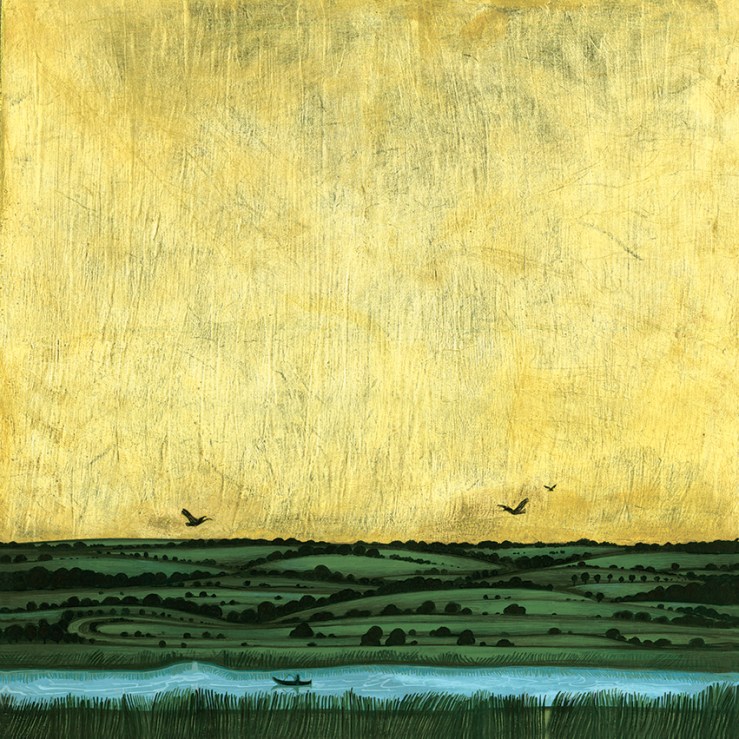
Landscape painting by Olya Kravchenko, 2016

. . . you have brought us out to a spacious place.

—Psalm 66:12 RSV

I will be glad and rejoice in your love, for you saw my affliction and knew the anguish of my soul. You have not given me into the hands of the enemy but have set my feet in a spacious place.

—Psalm 31:7–8 NIV

+++

MUSIC: “Restoration Sketches” by Daniel Martin Moore, on Stray Age (2008)

+++

God has brought us out to “a spacious place,” the psalmist says in Sunday’s lectionary reading from Psalm 66—also translated as “a wealthy place,” “a watered place,” “a wide open place,” or “a place of abundance.” I love that phrase, “a spacious place.” In our English Bibles, it’s used also in Psalm 31 (though the Hebrew words are different).

Psalm 31:7–8 first stood in relief for me when, spurred by a loved one’s cancer diagnosis, I read Rejoicing in Lament: Wrestling with Incurable Cancer and Life in Christ by J. Todd Billings. He opens the book with a meditation on these two verses:

One thing about the experience of being diagnosed with cancer is that it feels like a narrowing, a tightening, rather than “a spacious place” to dwell. . . . It feels a bit like the lights in distant rooms are turning off or, rather, flickering. They were rooms that you were just assuming would be there for you to pass through in future years. The space starts to feel more constricted, narrowed. . . .

In light of all this, it is important to remember a distinctive entryway that Christians have into this Psalm—that through God’s victory, our feet have been placed in “a spacious place.” Ultimately, to be and to dwell in Christ is to dwell in the most “spacious place” imaginable. In our culture, to focus one’s trust and affection on one hope—Jesus Christ—strikes many as narrow or risky. But because of who Jesus Christ is [the Alpha and Omega, and the One in whom all things hold together], to dwell in him is to occupy a wide, expansive place. (5)

This word, merchâb—“spacious place” or “large room”—is also found in 2 Samuel 22:20, Psalm 18:19, Psalm 118:5, and Hosea 4:16, where it denotes a place of openness, safety, and freedom.

Since reading Billings’s personal take on Psalm 31:7–8, whenever I feel like walls are closing in on me, whenever I feel pressed down by circumstances, I visualize a wide-open space and myself standing smack-dab in the middle of it, to remind myself that in Christ, there is freedom, there is freshness, there is an infinitely wide ground to stand on. However constricted we might feel in the moment, we must remember, as our spiritual forebears have testified in scripture, that our huge God leads us out of constriction and into a spacious place. Our circumstances might not change, but our spirits, through the Spirit, can know rest and relief.


This post belongs to the weekly series Artful Devotion. If you can’t view the music player in your email or RSS reader, try opening the post in your browser.

To view all the Revised Common Lectionary scripture readings for Proper 23, cycle C, click here.

Rivers of Babylon (Artful Devotion)

Lilien, Ephraim Moses_By the Rivers of Babylon
Ephraim Moshe Lilien (Austrian, 1874–1925), On the Rivers of Babylon, 1910. Etching and aquatint, 28 × 55 cm.

By the waters of Babylon,
there we sat down and wept,
when we remembered Zion.
On the willows there
we hung up our lyres.
For there our captors
required of us songs,
and our tormentors, mirth, saying,
“Sing us one of the songs of Zion!”

How shall we sing the LORD’s song
in a foreign land?
If I forget you, O Jerusalem,
let my right hand forget its skill!
Let my tongue stick to the roof of my mouth,
if I do not remember you,
if I do not set Jerusalem
above my highest joy!

Remember, O LORD, against the Edomites
the day of Jerusalem,
how they said, “Lay it bare, lay it bare,
down to its foundations!”
O daughter of Babylon, doomed to be destroyed,
blessed shall he be who repays you
with what you have done to us!
Blessed shall he be who takes your little ones
and dashes them against the rock!

—Psalm 137

+++

SONG: “Rivers of Babylon” | Words and music by Brent Dowe and Trevor McNaughton of The Melodians, 1970 | Covered by Linda Ronstadt, on Hasten Down the Wind (1976)

In Psalm 137, a communal lament, Israel remembers with sadness the Babylonian captivity and, in the infamous final line (v. 9), wishes violence against her captors’ children. The Kingston, Jamaica–based reggae group The Melodians set Psalm 137:1–4, along with Psalm 19:14, to music in 1970 as “Rivers of Babylon.” (Unsurprisingly, the controversial imprecation is excluded.) The song became a sort of anthem for Rastafarianism, an Afrocentric religious movement that laments the exile of Africans to the West Indies and the Americas—“Babylon”—through slavery and expresses longing for the homeland, Africa, “Zion.” Boney M.’s 1978 disco cover popularized the song in Europe. I’m not a fan of this famous rendition, because the bright, bouncy style doesn’t fit the tone of the lyrics. In fact, I even prefer Linda Ronstadt’s California folk cover to the original Melodians recording. She sings it a cappella with Andrew Gold and Kenny Edwards:

+++

The etching above is by Ephraim Moshe (Moses) Lilien, an Austro-Hungarian art nouveau illustrator and a member of the Zionist movement. He helped found the Bezalel Art School in Jerusalem. Click here to see other religious-themed prints by the artist.

I first encountered this image in a challenging blog post by theologian W. David O. Taylor, who, addressing the oft-expunged vindictive sentiments of Psalm 137’s third stanza and citing Miroslav Volf, claims that our rage belongs before God liturgically. Taylor has contributed a very fine trio of visual commentaries on Psalm 137 to the Visual Commentary on Scripture project, where he discusses an English Romanesque manuscript illumination, a mosaic by Marc Chagall, and an Abu Ghraib prison series triptych by Fernando Botero in light of the psalm.

Psalm 137 VCS

An assistant professor of theology and culture at Fuller Theological Seminary, Taylor has done much work on the Psalms, especially for popular audiences, including interviewing Eugene Peterson and Bono on the topic, compiling an excellent list of Psalm resources for the church, and writing Open and Unafraid: The Psalms as a Guide to Life, due out from Thomas Nelson next March.


This post belongs to the weekly series Artful Devotion. If you can’t view the music player in your email or RSS reader, try opening the post in your browser.

To view all the Revised Common Lectionary scripture readings for Proper 22, cycle C, click here.

Dives and Lazarus (Artful Devotion)

Lazarus and the Rich Man (11th cent.)
“Lazarus and Dives,” fol. 78r from the Codex Aureus of Echternach, ca. 1035–40. German National Museum, Nuremberg, Germany.

There was a rich man who was clothed in purple and fine linen and who feasted sumptuously every day. And at his gate was laid a poor man named Lazarus, covered with sores, who desired to be fed with what fell from the rich man’s table. Moreover, even the dogs came and licked his sores. The poor man died and was carried by the angels to Abraham’s side. The rich man also died and was buried, and in Hades, being in torment, he lifted up his eyes and saw Abraham far off and Lazarus at his side. And he called out, “Father Abraham, have mercy on me, and send Lazarus to dip the end of his finger in water and cool my tongue, for I am in anguish in this flame.” But Abraham said, “Child, remember that you in your lifetime received your good things, and Lazarus in like manner bad things; but now he is comforted here, and you are in anguish. And besides all this, between us and you a great chasm has been fixed, in order that those who would pass from here to you may not be able, and none may cross from there to us.” And he said, “Then I beg you, father, to send him to my father’s house—for I have five brothers—so that he may warn them, lest they also come into this place of torment.” But Abraham said, “They have Moses and the Prophets; let them hear them.” And he said, “No, father Abraham, but if someone goes to them from the dead, they will repent.” He said to him, “If they do not hear Moses and the Prophets, neither will they be convinced if someone should rise from the dead.”

—Luke 16:19–31

+++

SONG: “Dives and Lazarus” | Traditional English ballad | Performed by Cooper, Nelson & Early, on Love & War (2004)

+++

The illuminated manuscript page above tells visually, in three sequential strips, the parable of the rich man (“Dives”) and Lazarus. (The personal name Dives is not given in the scripture text but is traditionally used as shorthand for the rich man, as dives is Latin for “rich.”) The top register shows Lazarus, a sick homeless man, dying at Dives’s door; the middle, Lazarus’s soul being carried off to paradise by two angels and seated in Abraham’s bosom; and the bottom, Dives’s soul being carried off to hell by two devils and tortured.

This is one of four full-page miniatures that preface the Gospel of Luke in the Codex Aureus (“Golden Book”) of Echternach, a Vulgate edition of the four Gospels produced at the Benedictine Abbey of Echternach in Luxembourg in the eleventh century shortly after the Ottonian dynasty came to an end. It is a preeminent example of the Ottonian style.


This post belongs to the weekly series Artful Devotion. If you can’t view the music player in your email or RSS reader, try opening the post in your browser.

To view all the Revised Common Lectionary scripture readings for Proper 21, cycle C, click here.

Balm in Gilead (Artful Devotion)

Hirsch, Joseph_Lynch Family
Joseph Hirsch (American, 1910–1981), Lynch Family, 1946. Oil on canvas, 35 × 33 in. (88.9 × 83.8 cm). Nelson-Atkins Museum of Art, Kansas City, Missouri. [zoom in]

My joy is gone; grief is upon me;
my heart is sick within me.
Behold, the cry of the daughter of my people
from the length and breadth of the land:
“Is the Lord not in Zion?
Is her King not in her?”
. . .
“The harvest is past, the summer is ended,
and we are not saved.”
For the wound of the daughter of my people is my heart wounded;
I mourn, and dismay has taken hold on me.

Is there no balm in Gilead?
Is there no physician there?
Why then has the health of the daughter of my people
not been restored?

—Jeremiah 8:18–22

+++

SONG: “There Is a Balm in Gilead” | Negro spiritual | Arranged and performed by Archie Shepp (tenor sax), feat. Jeanne Lee, on Blasé (1969, reissued 2009)

+++

In this coming Sunday’s lectionary reading from the Prophets, Jeremiah grieves over the suffering of his people. “Is there no balm in Gilead?” he cries. Gilead was a region in ancient Palestine, east of the Jordan River. Now it is known primarily as the fictional locale of two famous contemporary novels, but back then it was known for the soothing, aromatic plant resins produced there, which were used medicinally. In Israel’s desolation, though, they could feel no balm—not even in the place where it was said to abound.

The anonymous writer(s) of the slave song featured above knew communal suffering well. He or she taps into Jeremiah’s poetic grief, extracting the “balm in Gilead” expression but bending it toward hope. There is a balm, the song attests, albeit wearily, through tears. And this balm makes the wounded whole. Archie Shepp’s soulful arrangement, with vocals by Jeanne Lee, express that woundedness and yearning for deliverance so poignantly.

As a visual point of focus, I’ve chosen Joseph Hirsch’s Lynch Family, a forward extension of the history of African American oppression. The gallery label for the painting reads,

Joseph Hirsch painted Lynch Family as a response to racial disturbances in the South in 1946. That year the number of lynchings rose from an all-time low in January to a fevered pitch by August. Citizens across the country urged President Truman and Congress to end the horrors. To capture the tragedy of Lynch Family, Hirsch presented a mother with her baby, presumably survivors of a lynching victim, in abstracted surroundings. The painting focuses on the mother’s intense yet restrained hold on her defiant child while she turns to hide her anguish. The blue background floats around the figures. It both highlights their pain and contrasts with the sheer beauty of Hirsch’s painterly technique.

Though painted in the 1940s, this work bears strong relevance for today. The figures could be any black mother and child left to grieve the loss of husband and father—to prison, or to death by shooting, choking, or other form of brutality.

For another painting by Hirsch from the blog, see “Stations of the Cross at the Smithsonian American Art Museum.”


This post belongs to the weekly series Artful Devotion. If you can’t view the music player in your email or RSS reader, try opening the post in your browser.

To view all the Revised Common Lectionary scripture readings for Proper 20, cycle C, click here.

The Lost Lamb (Artful Devotion)

Good Shepherd (Chinese)
Chinese scroll painting of the Good Shepherd, 1966. Collection of the Church of the Good Shepherd, Ann Arbor, Michigan.

“What man of you, having a hundred sheep, if he has lost one of them, does not leave the ninety-nine in the open country, and go after the one that is lost, until he finds it? And when he has found it, he lays it on his shoulders, rejoicing. And when he comes home, he calls together his friends and his neighbors, saying to them, ‘Rejoice with me, for I have found my sheep that was lost.’”

—Luke 15:4–6

+++

SONG: “The Lost Lamb” by Abigail Washburn and Jingli Jurca | Performed by Abigail Washburn, on Song of the Traveling Daughter (2005)

Zai na yaoyuan de guxiang
Wo shiluo liao yi ge gulao de meng
Yi ge youshang de meng
Zai na yangyu wo de defang

Wo fenbian buliao muse he chenguang
Wo yanjuanliao chenmo he sixiang
Feng nanchui you zhuanxiang beifang
Jianghe ben hai, hai que bu zhang

Wo xin manliao choucheng
Yu lai you shi qing bu jiuchang
Fuzu tianbuman linghun de kewang
Zhihui dangbukai yongsheng de shuangjiang

Wo
Wo shi
Yi zhi
Mitu de gaoyang

Shei neng ying wo zouchu mimang
Nar you wo chongsheng de xiwang
Oh, muyangren ah
Ni zai hefang?

In that far distant land I call home
I lost the ancient dream
A sorrowful dream
In that place that raised me

I cannot discern the growing shadows of dusk
And the first faint rays of the morning sun
I’ve wearied in the silence and searching
Wind blows south and turns again north
River flows to the sea, yet the sea does not rise

My heart is filled with melancholy
The rains come, clear skies will follow soon
Even fortune and good blessings
Cannot quench the soul’s thirst
Wisdom cannot relieve us our eternal lot

I am a lost lamb

Who will lead me from this haze?
What will bring me hope again?
Oh shepherd
Where are you? [source]

+++

Before Abigail Washburn (previously featured here) became one of America’s most acclaimed folk musicians, she was a college student majoring in East Asian studies and Mandarin, traveling intermittently to China and ready to pursue a degree in international law at Beijing University. But before her planned departure, she heard at a party one night a recording of Doc Watson singing “Shady Grove,” and she instantly fell in love with American bluegrass music. She bought herself a banjo and traveled Appalachia, learning the instrument and developing a repertoire. Her skill and enthusiasm soon landed her at a recording studio in Nashville, the city where she now lives with her husband, Béla Fleck.

Although Washburn decided not to pursue a law career in Beijing, her love of Chinese language and culture has continued. In 2011 she embarked on a Silk Road Tour, where she collaborated with Chinese musicians at each stop along the way. That year also marks the founding of The Wu-Force, a self-described “kung fu-Appalachian avant-garde folk-rock” trio consisting of Washburn, guzheng (Chinese zither) virtuoso Wu Fei, and multi-instrumentalist Kai Welch. As her website says, “her efforts to share US music in China and Chinese music in the US exist within a hope that cultural understanding and the communal experience of beauty and sound rooted in tradition will lead the way to a richer existence.” Learn more by watching her 2012 TED talk, “Building US-China Relations . . . by Banjo,” or by listening to her (and Fleck’s) 2015 interview with Krista Tippett, “Truth, Beauty, Banjo.”

“The Lost Lamb” is one of several songs that Washburn co-wrote with her friend Jingli Jurca, a poet from Beijing. Washburn says it was inspired by one of the Chinese students she was teaching English to in Vermont in the early 2000s. He had come to the States to earn money to send back home, but four years later he received a letter from his wife saying that she and their daughter were going to start a new life without him. This mournful ballad gives expression to his feeling of exile, of rootlessness, of being far from home and unable to return to what was once a place of joy and connection.

The first time I heard this song, I was incredibly moved. Having no knowledge of Mandarin or the context of the song’s composition, I looked up a translation, finding that the lyrics have a beautiful resonance, whether intentional or not, with Jesus’s parable of the lost sheep, where he likens himself to a good shepherd who seeks out and restores those of his flock who have wandered off. I hear it as very psalmic, a grasping after God through pain. It’s hard to tell dusk from dawn, the speaker says. My soul thirsts. It ends, “Oh Shepherd, where are you?” Shepherd, who promises to lead us through dark valleys and bring us to still waters. The speaker is readily confessing that he’s lost; “come find me” is essentially what he pleads.

In the spirit of the biblical psalmists, the speaker appears to take God to task, questioning whether he will show up as he said he would. “Who will lead me from this haze? / What will bring me hope again?” It’s an earnest reaching, through tears and uncertainty, for something stable that he or she once knew.

Whether you want to interpret the song as lamenting a felt distance from one’s home country or culture or family or faith, it rings so true, so beautiful.

I’ve paired it with a visual artwork and scripture reading that fulfill its longing, showing a being found.


This post belongs to the weekly series Artful Devotion. If you can’t view the music player in your email or RSS reader, try opening the post in your browser.

To view all the Revised Common Lectionary scripture readings for Proper 19, cycle C, click here.

Clay (Artful Devotion)

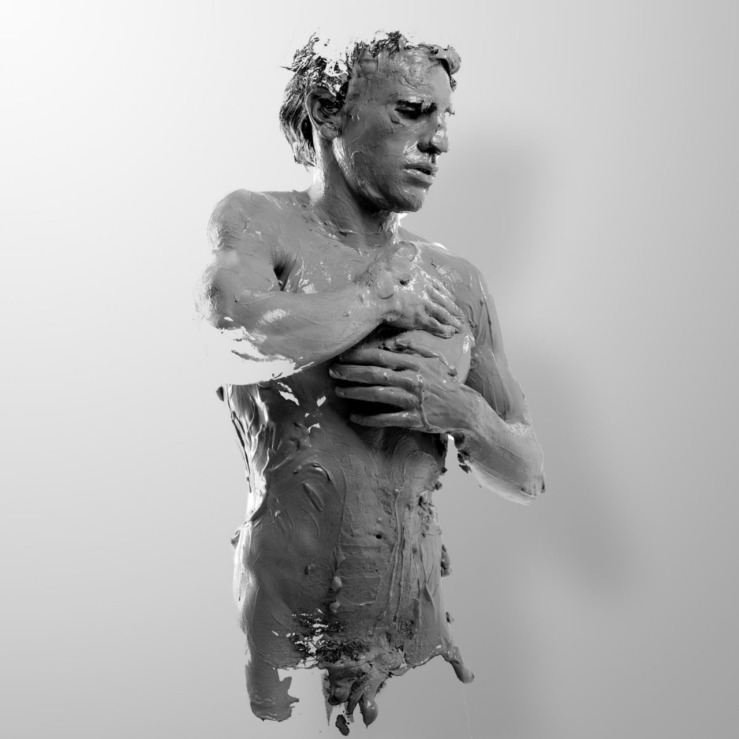
Photo by Alejandro Maestre Gasteazi
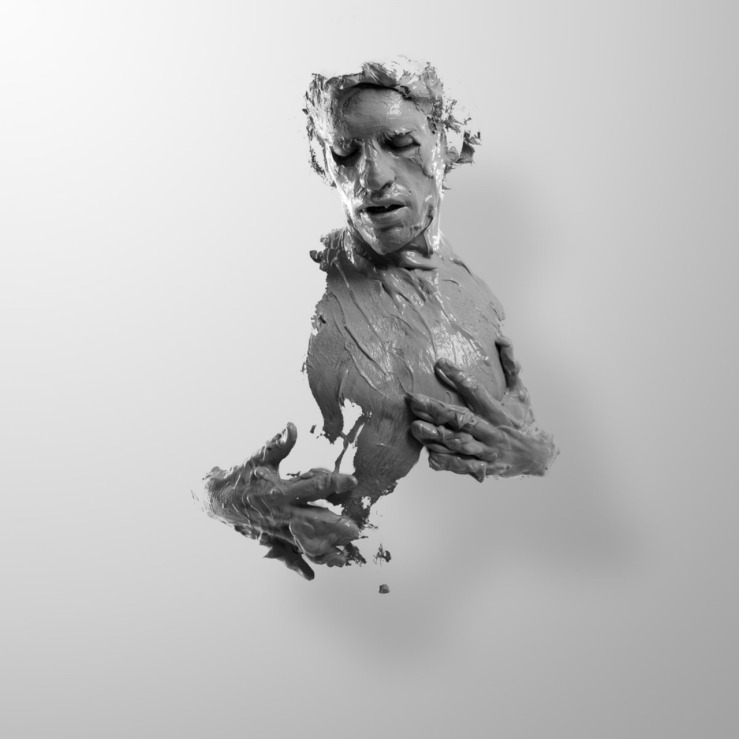
Alejandro Maestre Gasteazi (Spanish, 1979–), Untitled, 2010. Printed ink on cotton paper, 40 × 40 cm. Edition of 20.
Photo by Alejandro Maestre Gasteazi
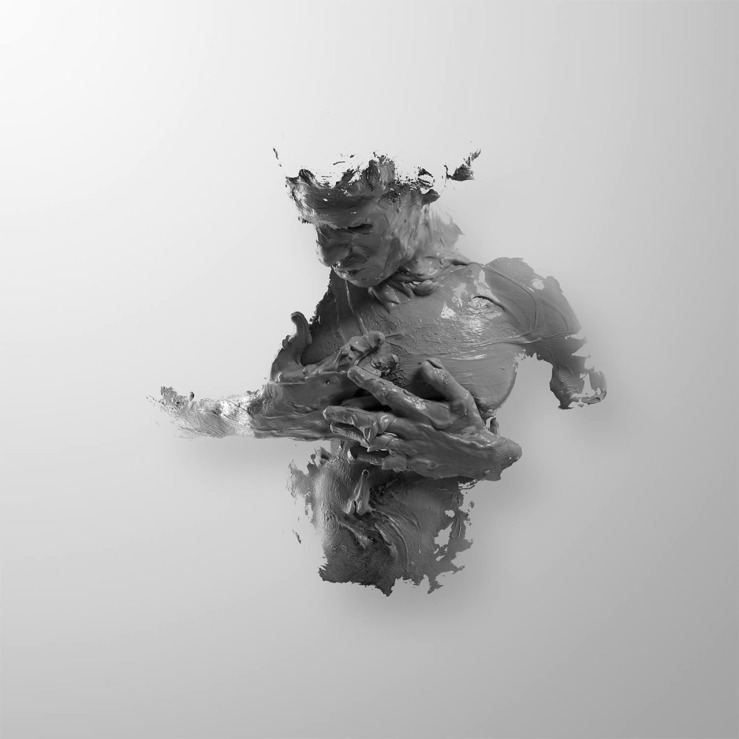
Alejandro Maestre Gasteazi (Spanish, 1979–), Untitled, 2010. Printed ink on cotton paper, 40 × 40 cm. Edition of 20.
Photo by Alejandro Maestre Gasteazi
Alejandro Maestre Gasteazi (Spanish, 1979–), Untitled, 2010. Printed ink on cotton paper, 40 × 40 cm. Edition of 20.

The word that came to Jeremiah from the Lord: “Arise, and go down to the potter’s house, and there I will let you hear my words.” So I went down to the potter’s house, and there he was working at his wheel. And the vessel he was making of clay was spoiled in the potter’s hand, and he reworked it into another vessel, as it seemed good to the potter to do.

Then the word of the Lord came to me: “O house of Israel, can I not do with you as this potter has done? declares the Lord. Behold, like the clay in the potter’s hand, so are you in my hand, O house of Israel.”

—Jeremiah 18:1–6

+++

SONG: “Have Thine Own Way, Lord” | Words by Adelaide A. Pollard, 1906 | Music by George C. Stebbins, 1907 | Performed by Johnny Cash, 1973, and released on Bootleg, Vol. I: Personal File, 2006

Update, July 25, 2021: Orlando Palmer, aka IAMSON, has just posted an Instagram video of himself singing the first verse of “Have Thine Own Way, Lord.” So beautiful:

+++

It is not you who shapes God, it is God who shapes you.
If then you are the work of God, await the hand of the artist
Who does all things in due season.
Offer God your heart, soft and tractable,
And keep the form in which the artist has fashioned you.
Let your clay be moist,
Lest you grow hard and lose the imprint of God’s fingers.

—Irenaeus, Against Heresies 4.39.2

+++

The three photographs above by Alejandro Maestre Gasteazi are from a cycle of twenty portraits of the artist’s friend Julián Cánovas-Yañez, which show his mud-lathered form gradually taking shape—an effect achieved, in part, in digital postprocessing. Credit goes to Philip Chircop for first pairing these photographs with this quote by the second-century Greek bishop Irenaeus.


This post belongs to the weekly series Artful Devotion. If you can’t view the music player in your email or RSS reader, try opening the post in your browser.

To view all the Revised Common Lectionary scripture readings for Proper 18, cycle C, click here.

Blest Be the Tie (Artful Devotion)

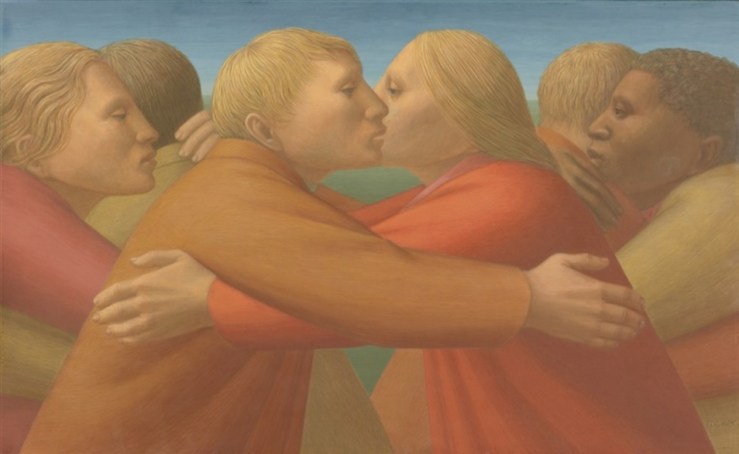
Tooker, George_Embrace of Peace II
George Tooker (American, 1920–2011), Embrace of Peace II, 1988. Egg tempera on gesso panel, 18 × 30 in. Private collection.

Let brotherly love continue.

—Hebrews 13:1

+++

SONG: “Blessed Be the Tie That Binds” | Words by John Fawcett, 1782 | Music by Johann G. Nageli, 1828; arr. Lowell Mason, 1845 | Performed by Zero8, on Mes très chers frères (“My dearest brothers”) (2017)

While looking online and on Spotify for the best available recording of this classic, I decided on the a cappella rendition by Zero8, a Stockholm-based male choir. But my favorite solo rendition is, ironically, from this year’s Chilling Adventures of Sabrina: Season One (Original Television Soundtrack). Though I don’t endorse the show, Jaz Sinclair’s vocal performance in episode 8 is gorgeous. (Her character sings the hymn during a funeral scene.) I also came across a retuned version by Sara Groves from her 2013 album The Collection, which is quite lovely, though I remain attached to the original tune.

+++

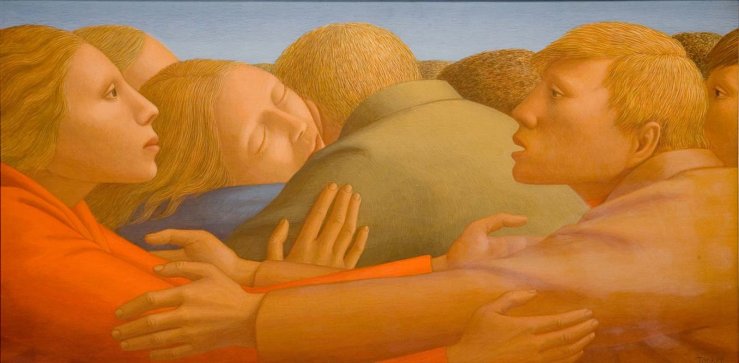
The “embrace of peace” in the title of the above George Tooker painting refers to a liturgical element in many Christian worship services in which congregants bless one another in the name of Christ. Depending on the church culture, this can be done with a handshake, a hug, or in some cultures, a kiss. The ritual is commonly referred to as the “passing of the peace” and, more than a mere greeting, is a significant gesture of reconciliation, unity, and love. Here’s a variation by Tooker on the same theme:

Tooker, George_An Embrace of Peace
George Tooker (American, 1920–2011), An Embrace of Peace, 1986. Egg tempera on gesso panel, 16 × 26 in.

This post belongs to the weekly series Artful Devotion. If you can’t view the music player in your email or RSS reader, try opening the post in your browser.

To view all the Revised Common Lectionary scripture readings for Proper 17, cycle C, click here.