Playlist: Funeral Songs: The Christian Hope of Life After Death

Death is hard. No matter your religion and its consolations, whether you’re the one dying or you’re saying goodbye to someone who is or has, it’s often a painful ordeal.

For the Christian, death holds a tension. It’s something to grieve, as Jesus did at the grave of his friend Lazarus; it was not part of God’s original design and so in that sense is not “natural,” even though it’s inevitable. We can and should mourn its power to (at least temporarily) sever. But death can also be something to celebrate if the deceased was in Christ, since as the apostle Paul wrote, “to be absent from the body [is] to be at home with the Lord” (2 Cor. 5:8), in a state of blissful rest.

Christians regard death as an entrance to the dwelling-place of God that we call heaven or paradise. Contrary to popular conception, that heaven is not our eternal home—not really. It’s a temporary holding place for the souls of the Christian departed, who await the general resurrection, at which time our souls will be reunited with our bodies and heaven will be remade and brought down to a new earth, where we will dwell forever, as whole, embodied persons, vibrant and active, with God. That, as the New Testament scholar and theologian N. T. Wright has been reiterating for decades, is our ultimate hope: not an ethereal existence in the skies, but physical resurrection, cosmic renewal, and God making his forever home with us here. The joining of heaven and earth—God’s space and ours—in a lasting embrace.

When my paternal grandpa passed away in May 2017, I began building a private Spotify playlist of songs about death to help me move through that loss. I’ve been adding to it for the past nine years, and now I want to make it public.

I hesitated for a while on whether to share the list, because I worry that overall, it does promote a lopsided hope, a truncated view of what eternal life looks like. Wright’s Surprised by Hope: Rethinking Heaven, the Resurrection, and the Mission of the Church was paradigm-shifting for me, and I’ve wrestled with its implications on the theologies we articulate, including through song, at funerals. Wright decries how Platonism, with its degrading of bodies and of the created order in general, has infected whole swaths of Christian thinking, misleading people into supposing that Christians are meant to devalue this present world and our material selves; that our goal is to escape them both.

The early Christian hope was not, Wright declares, to be rescued from this world, but to be rescued with and for it: that is, that the world itself, people included, would be liberated from its present state of corruption and decay. They centered this hope firmly on the resurrection. They talked very little about “going to heaven” when they died; instead, they emphasized the promise of the dead being raised on the last day to image God in a new bodily existence in a newly remade world. If they did refer to heaven as a postmortem destination, Wright says, those early Christians seemed to regard it as a temporary stage on the way to the eventual resurrection of the body.

Wright laments that so many Christian songs look forward chiefly to “life after death” (the intermediate state, entered immediately after one’s death, in which one’s soul resides in heaven while one’s body remains “asleep” in the grave) instead of “life after life after death” (the eschaton; the resurrection; the descent of the New Jerusalem; the new heavens and new earth), which is God’s whole telos. This glut of songs that focus on the prelude to eternal life as the biblical authors envisioned it has contributed to many Christians’ ignorance of the two-step narrative of life after death, with step two being what we should really be singing about.

I get what Wright is saying. But I think he sometimes overstates his points. He hates the phrase “going to heaven,” preferring instead “heaven coming to earth”—and yet “going to heaven” does accurately describe what the Christian soul does at the moment of bodily death. He also disparages lyrical expressions like “way beyond the blue,” “a faraway strand,” “up over yonder,” “the great beyond,” anything that suggests otherworldly distance . . . but again, if what is being described is that interim place of souls where God’s throne currently is, which is outside the space-time continuum but for which the Bible uses directional “up” language, such descriptions seem to me to be appropriate.

And the word heaven, I feel, can also encompass the final reality: the marriage of heaven and earth. I see the word as shorthand for “where God is.” Of course, Wright is correct that heaven-as-stopover (out there and we as incorporeal) and heaven-as-new-creation (right here and we gloriously corporeal) often get muddled in our songs, and that greater theological precision might be warranted. But we also have to consider the limits of sung verse—especially particular forms, like the spiritual, which is meant to be simple and repetitive so as to be transmitted orally—to convey nuanced ideas or to express all aspects of a given theme.

Wright also eschews the “just passing through” spirituality that infuses much hymnody, folksong, and preaching—the idea that earth is not our home; heaven is. That idea, he claims, treats the world as irrelevant at best and evil at worst, when in fact, God loves the world and wants to and indeed will redeem it, not evacuate us from it. This earth will be transformed one day into our eternal habitation.

I do agree that there’s a dangerous strand of escapist theology that has arisen in Christianity, which nurtures aspirations to flee the world, to regard is as mere dross and so to care nothing for its welfare. But I also don’t automatically dismiss hymns that describe this present life as “night,” for example, or that mention “earth’s vain shadows”—Wright negatively references both in Surprised by Hope. This present world is incomplete. It’s groaning for redemption, and we in it. We see through a glass darkly. We often stumble. We’re tempted to pursue pleasures or glories that are ultimately empty. Pain, toil, and fragmentation are part of the human experience. I think it’s right that we don’t feel entirely at home here, even as we anticipate God’s future purposes for the world—healing, transforming—through concrete actions, living as new-creation people. The apostle Paul says we’re citizens of heaven (Phil. 3:20), which is in part where the concept of “our heavenly home” comes from. The kingdom of heaven is the place from which Christ reigns. And yes, one day that will be earth, but right now, it’s not.

In the grand scheme of things, our mortal existence is short—so the idea of us being transient between this life and the next is not, I think, out of step with the biblical view, many passages of which comment on life’s brevity and the fleetingness of the flesh, which fades like grass.

While Wright stresses the continuity between earth as it is now and earth as it will be, there is also—and he does concede this—discontinuity. The earth will be itself and yet radically new when God re-creates it. It will be somehow both familiar and other. The same is true of our bodies, which—hallelujah!—God redeems along with our souls. (We are saved not as souls but as wholes, Wright quips.) These bodies we have now are good, yes, but they also break down and can be burdensome—hence why so many Christian songs of death express a yearning to cast off the body. Even the apostle Paul, in Romans 7:24, bemoans, “Who will deliver me from this body of death?” Like Wright, though, I do wish there were more songs that coupled that desire with the anticipation of a renewed body, as Paul does, instead of suggesting that a bodiless existence is the consummate state. As Wright argues, a focus on the soul’s immortality, on leaving the body behind, is a distraction from the supreme hope of the resurrection.

The funeral song that theologians, both professional and armchair, love to hate on most for its supposed Gnosticism is the Southern gospel classic “I’ll Fly Away” by Albert E. Brumley. They object to its anti-this-worldly stance that celebrates the soul’s breaking free “like a bird from prison bars has flown” (“no more cold iron shackles at my feet”), which implies that this world or this body, or both, is a prison keeping our true self captive. But is that sentiment not in some ways consonant with Romans 8:19–21, which says that “the creation waits with eager longing . . . [to] be set free from its bondage to decay and . . . obtain the freedom of the glory of the children of God”?

I see how the metaphor of the body as a prison can be problematic, but imagine it from the perspective of a person in advanced age, losing their vision, hearing, speech, reason, memory, strength, dexterity, mobility, bowel control, appetite, and so on. Or someone with chronic illness, or a debilitating disease, or on life support. That’s not at all to say such people should just die, or that they bear God’s image any less—but for them, life in the body is an immense struggle, and if they long to leave it to be with God, that’s not sinful or misguided. Many faithful Christians throughout history have prayed that God would take them or their loved one out of this life, out of their suffering.

The refrain “I’ll fly away” is actually mentioned in two biblical psalms:

My heart is in anguish within me;
    the terrors of death have fallen upon me.

Fear and trembling come upon me,
    and horror overwhelms me.

And I say, “O that I had wings like a dove!
    I would fly away and be at rest;

truly, I would flee far away;
    I would lodge in the wilderness; Selah

I would hurry to find a shelter for myself
    from the raging wind and tempest.”

—Psalm 55:4–8

For all our days pass away under your wrath;
    our years come to an end like a sigh.
The days of our life are seventy years
    or perhaps eighty, if we are strong;
even then their span is only toil and trouble;
    they are soon gone, and we fly away.

—Psalm 90:9–10

I wouldn’t program “I’ll Fly Away” for a Sunday morning worship service, but I happen to think it’s a great funeral song—I’ve included three different versions on my playlist, first from the movie soundtrack that in 2000 popularized it for a new generation—expressing an exuberant sense of release from suffering and joy in meeting God. I’d leave it to the preacher, and a fuller song set, to place it in context of the greater Christian hope of the resurrection of the body and the renewal of this world.

SONGWRITERS: To you I extend the challenge of expanding the repertoire of Christian music about last things, composing songs that capture the grander biblical vision of God’s intent for what he’s made. Give us new songs that anticipate the merging of heaven and earth! That trace the line of new creation from Jesus’s resurrection to our own. That celebrate not so much our going to live with Jesus when we die as Jesus’s coming to live with us when he brings his kingdom project to full fruition. Help us to see the goodness of our bodies and the world and to treasure God’s promise to redeem both; enlarge our concern about final destinies to encompass the whole cosmos, reorienting our hope around being raised to life in God’s new heaven and new earth. Remind us that our labor on earth is not in vain but will last into God’s future. Draw together Genesis 1–2, Isaiah 65, Romans 8, 1 Corinthians 15, 2 Peter 3:13, and Revelation 21–22.

In his engagement with Wright’s Surprised by Hope and what it means for funeral reform, John L. Drury suggests “we can still talk about grandpa going to heaven and being with Jesus. We just need to also talk about grandpa coming back with Jesus to reign with us in the new heavens and the new earth.” He advises that “one must also transform the language describing the present state of the person to express its interim character. We can still say they have gone to a better place, but we must then immediately modify this by saying that they will one day enter the best place of all, the new creation. We can still say they have entered into rest, but we must then immediately modify this by saying they are resting in the sense of waiting, waiting for the final act in God’s story.”

Why have I spent so long discussing Wright in this article that is supposed to be introducing a playlist of funeral songs? Because his teachings on eschatology, which includes the subject of heaven, have been vastly influential, not just for me but within Protestantism at large.

No doubt he will object to some of the entries on my “Funeral Songs” playlist. In building it, I eliminated some egregious offenders, but I feel comfortable putting forward these remaining songs. Even if some refer primarily to the deceased’s temporary residence “on high” or temporarily immaterial state—rather than their final, physical state in restored creation, i.e., the new heavens and the new earth—there’s still value in celebrating this initial phase of postmortem life they’ve entered. At funerals, it’s good and right to look forward to the consummation of all things, but it’s also good to assure those who grieve that their late beloved is presently in a place of rest, joy, and refreshment. It’s “home” insofar as home is where God is.

Consider the different metaphors for death represented in the playlist: Crossing the Jordan River into the promised land. Summiting a mountain. Culminating a pilgrimage. Laying down a burden. A valley. A sunset, to be followed by dawn. Death as a mode of transport, by train, chariot, or even airplane! The safe arrival of one’s ship, after a turbulent journey, into harbor. Death is conceptualized in terms of homegoing, meeting Jesus face-to-face, reunion with family, freedom, happiness, repose, healing, inheritance, victory, glory. It’s a threshold into an indescribable new reality.

Some songs incorporate descriptions of heaven or the New Jerusalem drawn from scripture, which have unfortunately become hackneyed: pearly gates and gold-paved roads (Rev. 21:21), mansions (John 14:1–3), harps (Rev. 5:8; 15:2), angelic choirs, white robes (Rev. 7:9–14) and gleaming crowns (Rev. 2:10). Concentrated mainly in the book of Revelation, these details were the writer John’s attempts to convey something of the beauty, purity, perfection, and grandeur he saw in his heavenly visions.

The playlist opens and closes with “I Bid You Goodnight,” aka “The Christian’s Good Night” or “Sleep On, Beloved,” a hymn for the lowering down of caskets written in 1871 by Sarah Doudney, with music, in 1884, by Ira David Sankey. (View the sheet music.) It was sung at the funeral of the preacher Charles Spurgeon in 1892. It later made its way to the Bahamas, where it was adapted and recorded in 1958 and 1965 by Joseph Spence and the Pinder Family. Spence’s sister, Edith Pinder, sings lead, ad-libbing a number of calls in the latter half, such as “One of these mornings, bright, early, and soon,” “Walkin’ through the valley of the shadow of death,” “His rod and staff shall comfort me,” “Goodness and mercy shall follow me on,” “John Divine said, ‘I saw the sign,’” and “Gonna walk in Jerusalem just like John.”

The Spence-Pinder recordings became the basis of subsequent folk versions in the US, such as the one that the Grateful Dead often closed their concerts with, and my two favorites: by Kent Gustavson (below) and Sweet Honey in the Rock. These all utilize only the first verse of Doudney’s original seven.

Lay down, my dear brother [sister, mother, father], lay down and take your rest
Won’t you lay your head down upon your Savior’s breast
I love you, but Jesus loves you the best
I bid you goodnight, goodnight, goodnight

The hymn wishes the departed a pleasant sleep before their eternal waking at the resurrection.

Since I shared one of my mom’s funeral picks above (“I’ll Fly Away”), now let me share one of my dad’s: “Peace in the Valley,” written by the Black gospel songwriter and musician Thomas A. Dorsey. Watching reruns of The Ed Sullivan Show, my dad would call me and my brother to the TV whenever Elvis’s performance of this song came on from the January 6, 1957, episode. As he would regale us every time: “The producers didn’t want him to sing a gospel song on national television. They just wanted his rock and roll. But he insisted. It was his mom’s favorite song. He said he wouldn’t do the show if they didn’t let him sing it.”

The Ed Sullivan performance leaves out the second verse, likely for time—it’s included in Elvis’s studio recording released a few months later—but its imagery provides a fuller picture of peace, drawing on the description of the messianic kingdom in Isaiah 11:

Well, the bear will be gentle, and the wolves will be tame
And the lion shall lie down by the lamb, oh yes
And the beasts from the wild shall be led by a child
And I’ll be changed, changed from this creature that I am, oh yes

Dorsey wrote the song as world tensions were mounting in the late 1930s, just prior to World War II. Traveling by train through Indiana, he observed horses, cows, and sheep grazing together in a small valley and wondered why humans across nations couldn’t live peaceably with one another, as these animal species were, sharing the grass. This was also a time of racial terror in America, of lynchings and other acts of anti-Black violence. “Peace in the Valley” asserts that the violence of the world will one day be undone, when creation is made new.

I like the Lower Lights’ rendition.

Another famous gospel song by Dorsey is “Precious Lord, Take My Hand.” Hearing it makes me emotional because a dear elderly friend from my church, who has since passed away, often requested it in worship. Here’s a gorgeous arrangement by Arnold Sevier, performed by the Aeolians of Oakwood University:

The genres of gospel, blues, and spirituals are heavily represented in the playlist, all birthed out of the African American experience.

The spiritual “Trouble of the World,” or “Soon-a Will Be Done,” is another song that sounded from my family television set many a time in my childhood, during my dad’s at least once-yearly watch of the 1959 film Imitation of Life. The funeral scene, which features Mahalia Jackson singing this solemn yet triumphant song that originated on Southern plantations during the era of slavery, always got him weeping:

While songs like this convey weariness, others burst with jubilation, like “Joy” by Ruthie Foster, from her 2002 album Runaway Soul:

“When I Get Home,” a traditional revival hymn performed by Elizabeth Mitchell with Dan Zanes, is more gently joyous. They based their version on a 1958 recording by Elizabeth Cotten, who recalled the song from her youth in North Carolina:

For a Christocentric song, consider Andy Zipf’s rendition of “Immanuel’s Land,” aka “The Sands of Time Are Sinking.” The hymn was written by Anne Cousins in 1854 and is traditionally sung to the tune RUTHERFORD, composed by Chrétien Urhan in 1834. Zipf sings three of its nineteen stanzas.

Oh! Christ, he is the fountain,
The deep sweet well of love!
The streams on earth I’ve tasted,
More deep I’ll drink above:
There, to an ocean fullness,
His mercy doth expand,
And glory—glory dwelleth
In Immanuel’s land.

Oh! I am my Belovèd’s,
And my Belovèd’s mine!
He brings a poor, vile sinner
Into his house of wine:
I stand upon his merit,
I know no other stand,
Not e’en where glory dwelleth
In Immanuel’s land.

The bride eyes not her garment,
But her dear bridegroom’s face;
I will not gaze at glory,
But on my King of grace;
Not at the crown he giveth,
But on his piercèd hand:
The Lamb is all the glory
Of Immanuel’s land.

There are also a few choral pieces on the playlist, including “Goin’ Home,” an adaptation of the English horn melody from the second (Largo) movement of Antonín Dvořák’s New World Symphony by one of Dvořák’s students in America, William Arms Fisher, who also added lyrics. Though Fisher says the composition was inspired by African American spirituals, it’s not Christian-specific, but it is compatible with Christian belief, its speaker “just goin’ home . . . through an open door,” to where friends and family are waiting; “nothin’ lost, all’s gain. . . . Real life’s just begun.” The arrangement sung by VOCES8 in the following video is by Jim Clements.

The Silkroad Ensemble, renowned for its unique cross-cultural collaborations, recorded the song in Mandarin and English, featuring Abigail Washburn on lead vocals and banjo, Wu Tong on backing vocals and sheng, Yo-Yo Ma on cello, Johnny Gandelsman on violin, and Kinan Azmeh on clarinet.

As for songs of the end that consider the natural world, I recommend “Over the River” by Jon Foreman, the lead vocalist of Switchfoot. It’s from his 2008 solo album Limbs and Branches:

Hush, hush, hush, hush

I heard a sound come from the ground
All of the trees are a-buzz
Talking in tongues, talking with lungs
Talking of freedom

All of the earth is soon to give birth
Look at the mountains alive
Birds and the bees, insects and leaves
All of us longing, longing for home
Home, home is somewhere I’ve never known

Refrain:
Over the river
Over the river
I’ve set my hope
Over the river
Over the river
I’ll find my hope in You, You

Death, where is your sting?
Your signet ring?
Where is your power?
Why all this war?
Death to the score
Nations are fading

Kingdom of light, setting us right
Finally human
Give me a tongue
It will be done
Inside I’m longing, longing for love
Love, love is something I’ve never known

Thoughtful lyrics are also a hallmark of the folk trio Ordinary Time, who have several songs on the playlist, two with original words and one that sets a passage, lightly adapted, from the final chapter of Augustine’s City of God, titled “All Shall Be Amen Alleluia.”

All shall be Amen, Alleluia
We shall rest and we shall see
All shall be Amen, Alleluia
We shall see and we shall know
We shall know and we shall love
We shall love and we shall praise
All shall be Amen, Alleluia
Behold our end which is no end

For songs on the playlist that I’ve previously featured on the blog, see:

Moreover, there are many hymns that build to a final stanza about death, heaven, or resurrection, several of which are funeral classics:


This is just a sampling of the nearly two hundred songs on the “Funeral Songs” playlist. Note that even though I’ve subtitled the list “The Christian Hope of Life After Death,” I mean that to include both the first and final phase of that life, both the soul’s immediate ascent to heaven and its ultimate reuniting with the raised body on a renewed earth—though as I’ve mentioned, existing catalogs skew heavily toward the former, and we’re in need of better balance that reflects Christians’ central hope of resurrection.

What songs have brought you comfort after the death of a loved one or are helping you face your own death? Is there a particular one you want sung at your funeral?
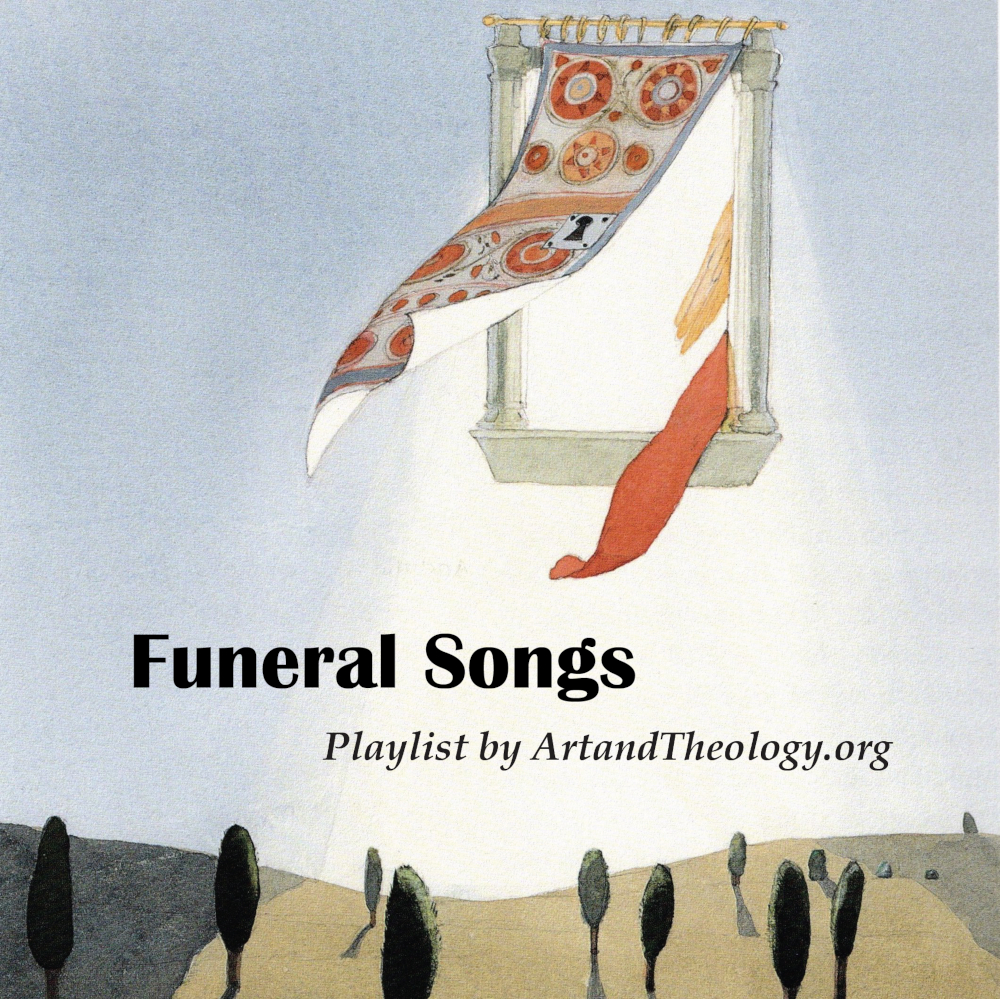
Funeral Songs playlist
Cover art: The New Jerusalem, watercolor by Lisbeth Zwerger from Stories from the Bible

Roundup: Multilingual Paschal greeting, Easter sermon by N. T. Wright, the Myrrhbearers and the Magi, and more

VIDEO: “The Lord is Risen! Proclaimed by people from 29 countries”: This video was put out in 2020 by ICF Rotterdam, an intercultural church in the Netherlands whose congregation consists of members from over forty nations! They asked a handful of them to recite the Paschal greeting in their native tongue, so represented here are Indonesian, Chinese, Zulu, Igbo, Urdu, Nepali, Kurdish, Romanian, and more. [HT: Global Christian Worship]

Wycliffe Bibliafordítók (Wycliffe Bible Translators) in Hungary produced a similar video last year:

+++

SERMON: “Let Beauty Awake” by N. T. Wright: One of the things I love about the Anglican cleric N. T. Wright’s preaching and teaching is the importance he places on beauty. (I actually met Wright once—and it was at an arts conference.) In this sermon, which he preached at Durham Cathedral on Easter Sunday 2009, he takes as his text what I’ve heard him say is his favorite chapter in the Bible, John 20, and discusses how in Jesus’s rising, the glory of God was let loose in all the world.

“Easter carries with it a strange and powerful beauty,” he says. “I hope that, by exploring the biblical roots of why this is so, I may have surprised some of you at least into asking, afresh, What can we do to celebrate, more consciously and deliberately, the reawakening of beauty which comes with the light of Easter Day? How can we take this forward, as an explicit project, so that a world so full of ugliness and functionality, and in consequence so full of unbelief or false belief, can once again be wooed into belief and love?”

He opens the sermon by quoting a stanza from a poem by Robert Louis Stevenson, and near the close, he reprises it in his own words, which were developed into a song by Steve Bell:

Let Beauty awake in the morn from the cool of the grave,
Beauty awake from death;
Let Beauty awake,
For Jesus’ sake,
In the hour when the angels their silence break
And the garden is bright with His Breath.

+++

RECIPE: “Tsoureki: The Symbolic Greek Easter Bread”: On her blog The Liturgical Home (and on Instagram), Ashley Tumlin Wallace shares a recipe for tsoureki, a brioche-like sweet bread made by many Greek Christians on Easter. It is soft and fluffy, flavored with citrus, and decorated with red-dyed eggs!

+++

SPOKEN WORD + SONG: “Because He Lives” by Sharon Irving: Singer-songwriter, worship leader, and spoken word artist Sharon Irving [previously] recorded this video for City First Church Spring Creek’s virtual worship service for Easter 2020. It begins with an original spoken word piece, and then is followed by her singing the Gaither classic “Because He Lives.”

+++

SONG: “Sbab Dia Hidup” (Because He Lives) by Prison Akustik: The song “Because He Lives,” written in 1971 by Bill and Gloria Gaither, has made its way all around the world and has been translated into many languages. Here is the group Prison Akustik [previously] singing it in Indonesian.

+++

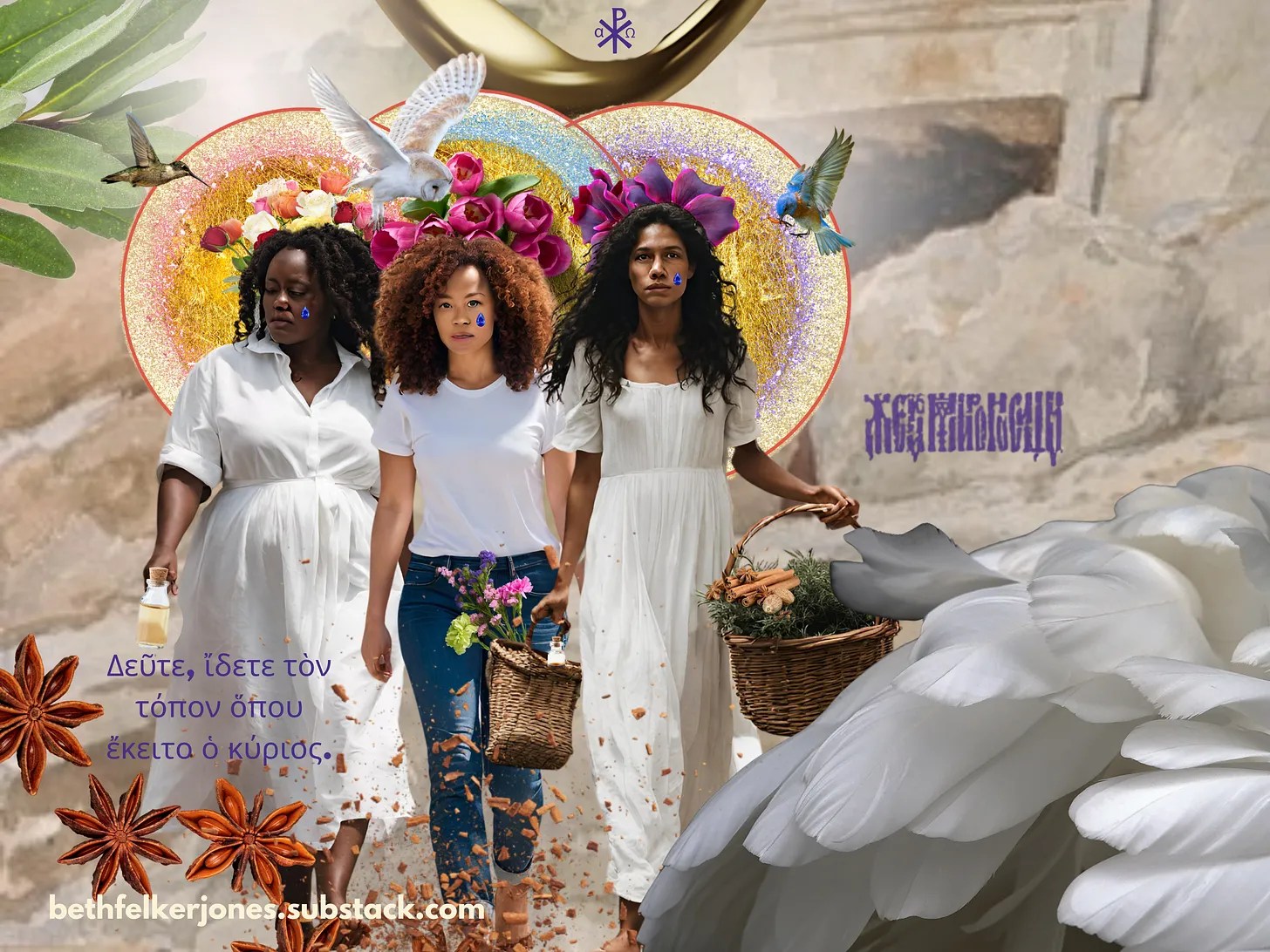
SUBSTACK POST: “Myrrhbearers & Magi” by Beth Felker Jones: In her Church Blogmatics post from last week, theologian Beth Felker Jones [previously] shares three new digital collages she made: one of the three myrrh-bearing women who discovered Jesus’s empty tomb, one of the three magi who brought gifts to the newborn Christ, and one that combines both groups of devoted witnesses. She provides descriptions of each and two original prayers, including the one below.

Myrrhbearers
Digital collage (with AI-generated elements) by Beth Felker Jones, 2025

Holy Father, who accompanied your daughters on their way to the tomb, and in the power of your Spirit, turned their sorrow into joy, bring us too into the joy of those who found the tomb empty, and incorporate us, with them, into your resurrection life. With our sisters at the tomb that day, help us to say, “I have seen the Lord!” Amen.

Pentecost roundup: “All Flesh” by Steve Thorngate, animated fabrics, and more

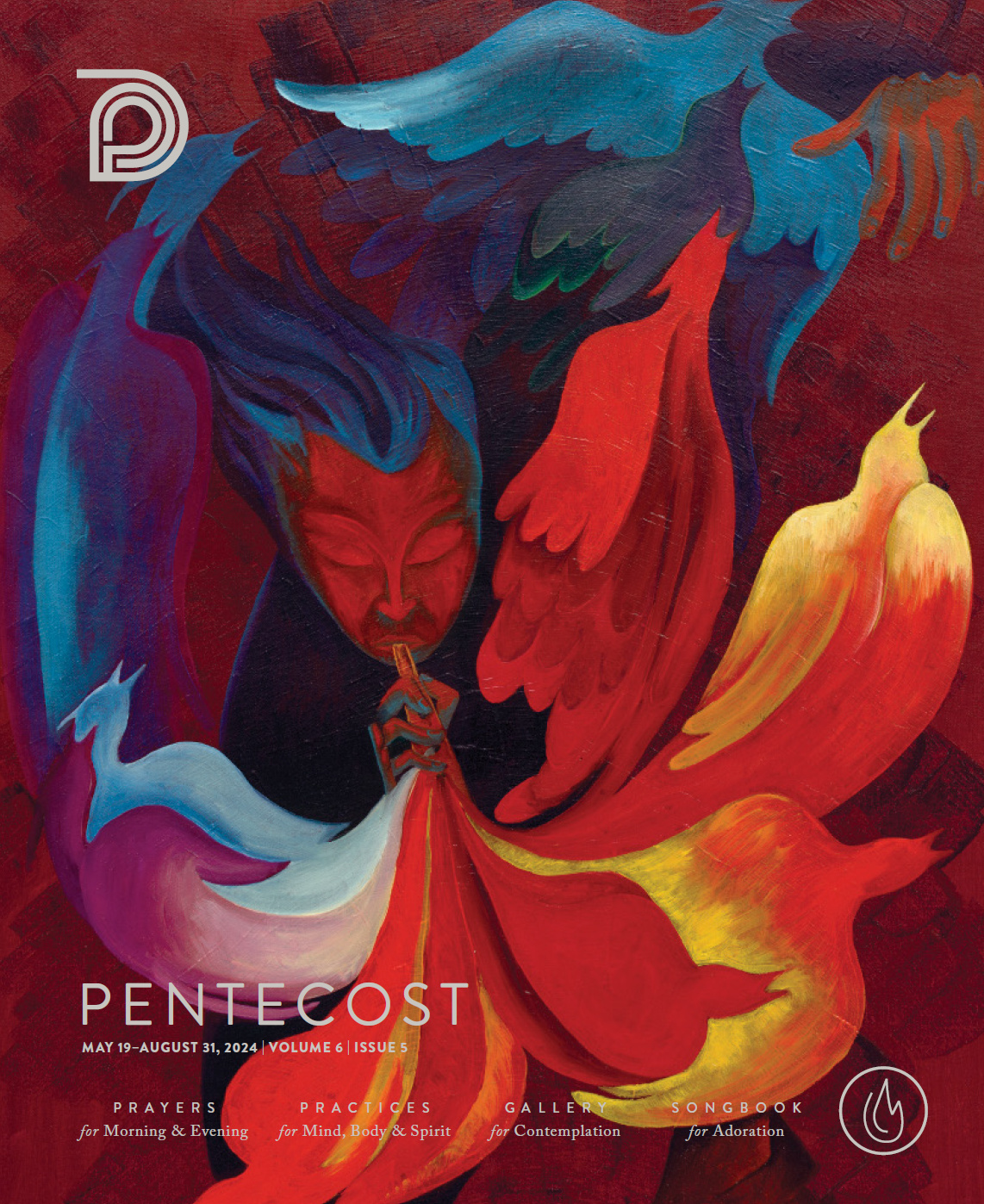
LIVING PRAYER PERIODICAL: Pentecost 2024: The latest edition of the Daily Prayer Project’s Living Prayer Periodical is available for purchase! Pentecost is this Sunday, May 19, so grab your copy soon. The booklet provides a distinct liturgy of scripture and prayer for each day of the week, through August 31, as well as art with accompanying reflections, songs, spiritual practice essays, and, new this issue, a poem! I curate the art and poetry for the DPP. The cover image is cropped from a painting by the Guatemalan artist Juan Francisco Guzmán (it’s reproduced in full in the interior). And the poem we feature, which I wrote a short commentary for to help readers engage it more meaningfully, is “Not Like a Dove” by Mary F.C. Pratt; I’m grateful to the directors for taking a risk with this unusual, even difficult, poem, which rewards those willing to sit with its imagery over time.

Pentecost LPP 2024

+++

SERMON (text only): “When the Spirit Comes” by N. T. Wright: Preached May 23, 2010, at Durham Cathedral, where he was bishop at the time, this Pentecost sermon by the esteemed N. T. Wright is a rousing call to stand, like Jesus, at the place where heaven and earth collide: in the Spirit. Here are two excerpts:

  • “The point about Pentecost is that it’s the point at which two worlds collide and look like they are now going to be together for keeps. The two worlds are of course heaven and earth. . . .
              The whole point of heaven and earth in Jewish thought is that they are meant to meet and merge. And the point of the gospel story as Luke has told it in his first volume is that Jesus had come to bring the life of heaven and earth together. That is the meaning of the ‘kingdom of God’. Thy kingdom come, he taught us to pray, on earth as in heaven. The disciples, we may presume, had been praying that prayer, among others, in the fifty days since Easter. And now the prayer is answered.”
  • “When the Spirit comes, the Spirit will prove the world wrong [in how things are run] . . . which is not a comfortable message, and it’s not meant to be. But if we can at least recognise that discomfort, and see it as the thing you should expect when the two worlds collide, we can put our shoulders back, take a deep breath – in other words, breathe in God’s breath – and get on with the task to which the New Testament commits us but in which . . . we feel a strange reluctance.
              Of course we can get it wrong, and of course we will find it awkward. But how much more wrong would it be not to try! How much more awkward, when God finally brings heaven and earth fully together, will it be to discover that we had continued to live in the split-level world when we were invited, by Ascension and Pentecost together, to dare and to risk the possibility of bringing them together in our own lives and in our own witness! Because of course none of this is in the last analysis ‘about’ us. If we are embarrassed at the heaven-and-earth conjunction, we are forgetting that we are not, after all, the centre of attention in all this. Jesus went on to say that the Spirit would glorify him, not us: he will take what belongs to Jesus and declare it to us and through us to the world.”

+++

MUSIC:

>> “All Flesh” by Steve Thorngate: This playfully serious song is rooted in Joel 2:28–29, which Peter quotes in his sermon at Pentecost: “I will pour out my spirit on all flesh; your sons and your daughters shall prophesy, your old men shall dream dreams, and your young men shall see visions. Even on the male and female slaves, in those days I will pour out my spirit.” Thorngate wrote it several years ago, but this recording, new this year, is the first he’s released, and it’s available only on Bandcamp for now.

>> “Ruach” by Delvyn Case, performed by the Mivos Quartet: Inspired by the story of Pentecost in Acts 2, this sacred concert work for string quartet, writes composer Delvyn Case, “bring[s] to our awareness many different ways ‘breath’ and ‘spirit’ can become sonically and dramatic present. Throughout the piece the performers are asked to make various kinds of breath sounds with their instruments and their own voices, blurring the line between music and sound. Overall, the piece emphasizes idea of the spirit as a powerful force that is surprising, shocking, and fundamentally resistant to control.”

>> “Sweet, Sweet Spirit” by Doris Akers, performed by Ruah Worship: Consisting of siblings Joshua Mine, Julia Mine, Erika Grace Izawa, and Marian Mine, Ruah Worship from Japan performs original worship songs as well as covers. I especially love their a cappella arrangements of Black gospel songs. Here they sing a song by Gospel Music Hall of Famer Doris Akers (1923–1995), about the sweetness of the Holy Spirit, who revives communities and fills them with love.

+++

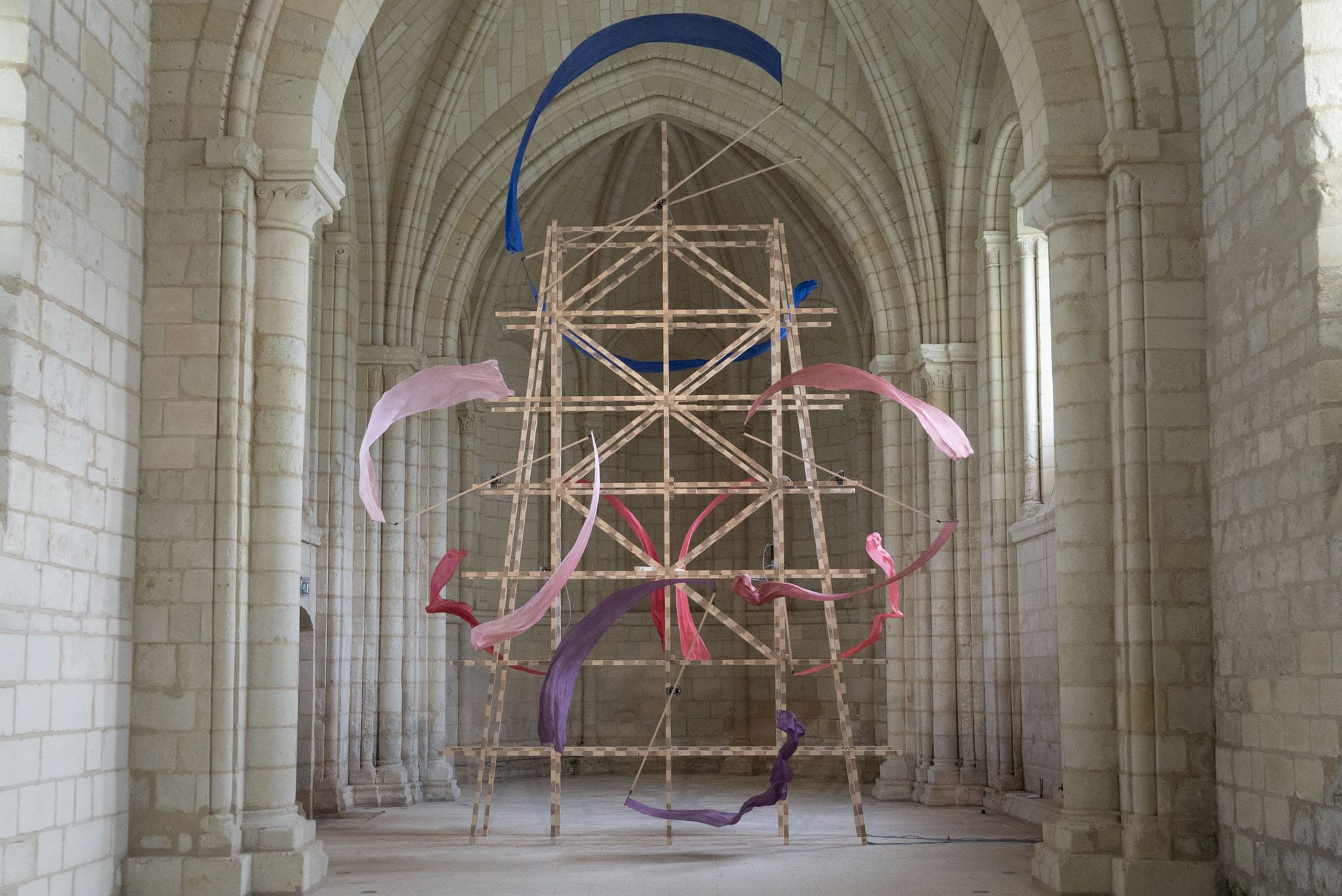
ART INSTALLATION: Fanions et Carillons by Pinaffo & Pluvinage: I learned of this kinetic sculpture by the French artist duo Marion Pinaffo (b. 1987) and Raphaël Pluvinage (b. 1986) in a Colossal article in February and thought of the movement of the Holy Spirit. Fanions et Carillons, French for “Pennants and Chimes,” was commissioned by Fontevraud Abbey and was on display earlier this year in one of the abbey’s twelfth-century chapels. Inspired by the historical striking clocks of churches, the automaton comes to life every half hour, sending fourteen pennants of blue, red, pink, and purple swinging and swirling.

Fanions et Carillons
Marion Pinaffo and Raphaël Pluvinage (aka Pinaffo & Pluvinage), Fanions et Carillons, 2023. Painted wood, motor, silk, electronic, 4 × 2 × 7 m. Temporary installation at the Chapelle St-Benoît, Abbaye Royale de Fontevraud, Anjou, Maine-et-Loire, France.

On their website, Pinaffo & Pluvinage write of the piece, “Although its mechanics are simple and rudimentary, using rotational or pendulum movements, it doesn’t produce the sound of bells, but rather animates fabrics. A set of 14 inert pennants awaken in turn to create ephemeral forms that mutate, respond and compose. Like a harmony of chimes creating a melody, this ensemble creates a choreography lasting a few minutes at regular intervals.” Whereas one might associate a certain rigidness and predictability with clocks, in this piece there’s a freedom, with the pennants moving at different rates and occasionally reversing direction.

+++

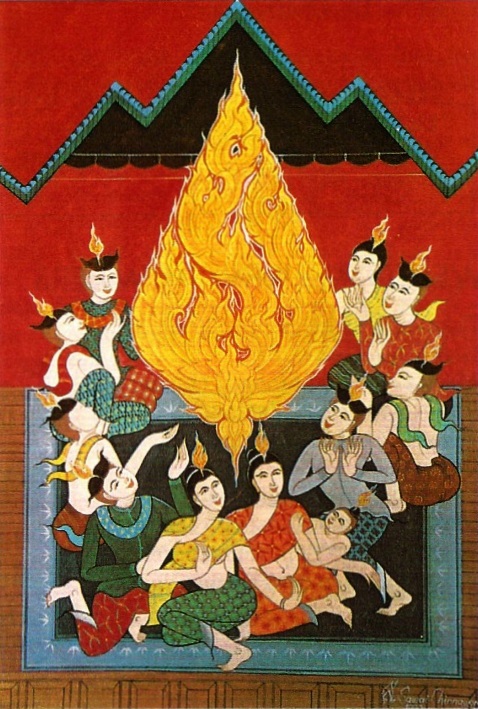
ARTICLE: “Painting Pentecost: Painter Sawai Chinnawong saturates the outpouring of the Spirit with the colors Thai art traditionally associates with the holy” by Amos Yong and Jonathan A. Anderson, Christian Century: Adapted from the book Renewing Christian Theology: Systematics for a Global Christianity (Baylor University Press, 2014), this article explores one of the Pentecost paintings of Thai Christian artist Sawai Chinnawong, who adopts and adapts a Thai Buddhist visual vernacular in terms of color choices, design elements, and the gestures and postures of figures. I’m appreciative of how the painting shows both men and women, and even a child, present at Pentecost and being recipients of the gift of the Spirit, as they surely were.

Chinnawong, Sawai_Pentecost
Sawai Chinnawong (Thai, 1959–), Pentecost, 1997. Acrylic on canvas.

(Related post: “Pentecost art from Asia”)

Some Christians are uncomfortable with art that transposes biblical events into other cultural contexts. But I think it’s a beautiful picture of the global character of the gospel, which has taken root in countries all over the world. As the authors write, in addition to celebrating a historic event, Chinnawong’s Pentecost “prompts us to see this as another event altogether: the outpouring of the Spirit in a room in 21st-century Bangkok rather than first-century Jerusalem. Chinnawong sets the scene here not out of disregard for the historical particularity of the original event but as a means of imagining and visually praying for the Spirit’s presence in his own historical moment. For Chinnawong, the Holy Spirit’s filling is not isolated to a single event, a particular moment, or one place but may be repeated at any time and place and for any people. Thus the circle of believers being filled with the Spirit is repeatedly repopulated and renewed.”

Roundup: Baby Jesus in the rubble of Gaza, a dragon at the Nativity, and more

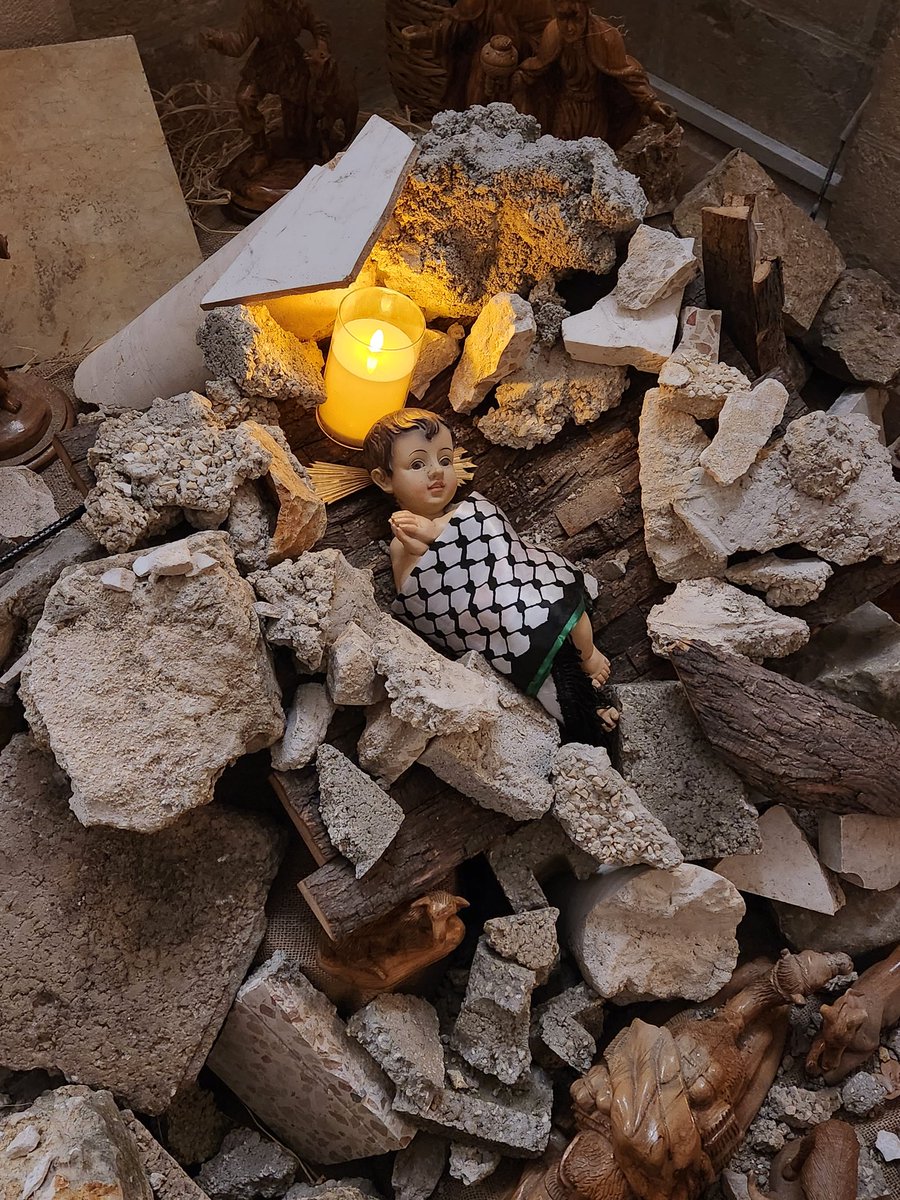
CHRISTMAS CRÈCHE: After my Advent Day 2 post, a reader shared with me a photo of this jarring crèche from Bethlehem:

Rubble Creche, Bethlehem
Crèche, December 2023, Evangelical Lutheran Christmas Church, Bethlehem. Photo: Munther Isaac.

It shows the baby Jesus wrapped in a black-and-white checkered keffiyeh (Palestinian headdress) and lying in a pile of rubble while Mary, Joseph, the shepherds, the wise men, and the animals search for him. It is situated at the side of the altar in Bethlehem’s Evangelical Lutheran Christmas Church, which Rev. Dr. Munther Isaac, a prominent Palestinian Christian peacemaker, pastors. He said he wants the world to know that this is what Christmas looks like in Palestine this year, and for his own congregation to know the solidarity of Christ with the oppressed. Al Jazeera ran a news segment on the crèche on Tuesday, which features an interview with Isaac:

Since October 7, over 16,000 Palestinians have been killed by Israeli forces, and almost 1.9 million Palestinians (over 80 percent of the population) have been displaced. Morgues and hospital halls are overflowing in Gaza, and many people remain trapped under buildings felled by air strikes.

“In Gaza today, God is under the rubble. He is in the operating room,” Isaac wrote on Instagram. “If Christ were to be born today, he would be born under the rubble. We see his image in every child killed and pulled from under the rubble. In every child in incubators.” He expanded on these sentiments in a sermon preached October 22, titled “God Is Under the Rubble in Gaza,” reproduced in Sojourners. See also this video clip of Isaac explaining why his church chose to display such a scene in their sanctuary.

Besides serving as a pastor, Isaac is also the academic dean at Bethlehem Bible College, director of the Christ at the Checkpoint conferences, and author of The Other Side of the Wall: A Palestinian Christian Narrative of Lament and Hope.

+++

“Alternative Advent 2023” by Kezia M’Clelland: I wrote about M’Clelland’s “Alternative Advent” last year and in previous years, an annual online project that thoughtfully brings together global photojournalism from the year with scripture. Following along with her daily Instagram posts @alternative_advent (which she will later compile at https://keziahereandthere.org/) has become an integral part of my Advent practice. Here’s day one:

+++

SONG: “How Long, How Long?” by Jordan Hurst: Worship musicians Jordan Hurst, Jaleesa McCreary, and Brian Douglas Phillips [previously] from Providence Church in Austin, Texas, perform an original lament song from Providence’s 2020 album Long-Awaited / You Arrived.

+++

BLOG POST: “When a Dragon Tried to Eat Jesus: The Nativity Story We Don’t Talk About” by Chad Bird: “I’m still searching for a Christmas card with a red dragon in the nativity, lurking amidst the cows and lambs, waiting to devour the baby in the manger,” writes Bible scholar Chad Bird [previously]. “None of the Gospels mention this unwelcome visitor to Bethlehem, but the Apocalypse does. John paints a seven-headed, ten-horned red dragon onto the peaceful Christmas canvas. You can read all about it in Revelation 12. It’s the nativity story we don’t talk about. A dragon trying to eat our Lord . . .”

I’ve been wanting to write a long-form essay on this topic for some time—the dragon as a character in the Christmas story; a cosmic battle underlying our cozy little crèches. I would pull in iconography of the Woman of the Apocalypse and the treading of the beasts, as well as some Christmas songs and poems that reference the dragon. I won’t get around to it this season . . . but it’s coming sometime!

For now, I simply offer Chad Bird’s wonderful blog post to get you thinking about it. Since it was published in 2016, I’ve started seeing more people bringing it up. In 2019, Glen Scrivener, a minister in the Church of England, released the kids’ video “There’s a Dragon in My Nativity,” with illustrations by Alex Webb-Peploe and animation by Diego M. Celestino:

In 2020, Rev. Yohanna Katanacho, a Bible professor in Nazareth, wrote “The Christmas Dragon” for Radix, a retelling of the Nativity story through the lens of Revelation 12. And in a Christianity Today article published last December, Julie Canlis recommended adding a red dragon to your nativity set! Apparently some families have been doing this for years, such as the Gowins and the Palpants:

Dragon at the Nativity
Left photo by Michael Gowin; right photo by Ben Palpant

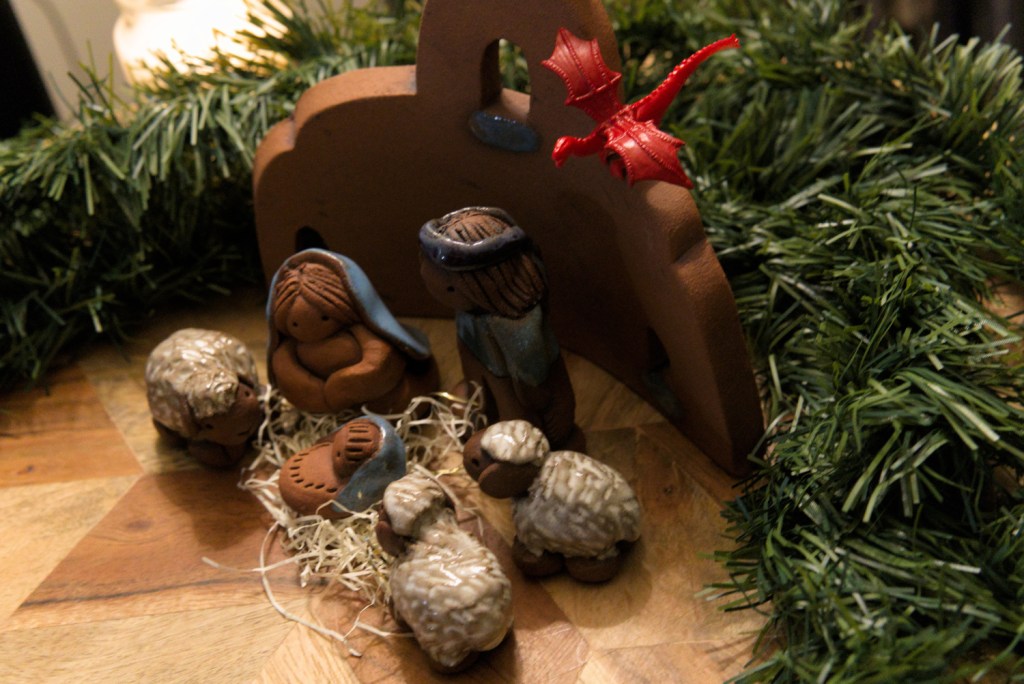
This year I bought a little plastic dragon myself to add to my household nativity! Below are some photos my husband and I took. The clay figurines and adobe-style backdrop were made by Barbara Boyd, an artisan from New Mexico. (I bought them in 2016 at a festival in Albuquerque.)

The dragon was part of a cheap multipack from Amazon, and there are twenty-three other dragons that I don’t know what to do with—so if you live in the US and you want one, shoot me an email at victoria.emily.jones@gmail.com and your physical mailing address and I’ll send you one! The first three respondents get a red one. None of them are seven-headed or horned per Revelation (a gap in the Christmas market, perhaps?!), but they still convey the gist.

+++

LECTURE: “What Is God’s Future for the World?: An Eschatological Vision for the Kingdom on Earth” by N. T. Wright: This talk on inaugurated eschatology, on heaven and earth coming together redemptively and new-creatively, was delivered at the Fuller Forum at Fuller Theological Seminary on May 3, 2014. Any time we talk, sing, or preach about the return of Christ and the end, Wright says, we’re really using signposts that point into a bright mist. But we need those signposts. Wright seeks to dispel the popular belief that humans’ ultimate destination is some disembodied existence “up there” and instead have us embrace the ancient vision of this world as the site of the Messiah’s eternal reign and these bodies as participants, a vision of creation made new from the old. To believe that God will eventually abandon the world to the forces of human wickedness or entropy and decay instead of claiming it as his own undermines the entire narrative of scripture. Wright makes his case by way of the books of Genesis, Isaiah, Ezekiel, Daniel, the Psalms, the Gospels, Romans, and Revelation—the whole gamut.

“The Jewish vision of God’s ultimate future was never that people would leave this world and end up somewhere else called heaven in the company of God. . . . When eschatology comes into full focus, . . . it is all about God’s kingdom being set up on earth as in heaven, and indeed on earth by means of heaven.” He continues, “Heaven is the place where God’s future purposes are stored. And the New Jerusalem comes down from heaven to earth so that the dwelling of God is with humans.”

There’s so much more I could say—but instead of reading my takeaways, listen to the talk itself! It ends at 1:04:45 and is followed by an hour of Q&A. Here is a list of the questions with time stamps:

  • 1:05:33: What is your reading of 2 Peter 3:10–12, which says that the earth will be burned up?
  • 1:08:18: What does Paul mean in 1 Thessalonians 4:17: “Then we who are alive, who are left, will be caught up in the clouds together with them to meet the Lord in the air, and so we will be with the Lord forever”?
  • 1:13:05: Where do you land on premillennialism, amillennialism, postmillennialism?
  • 1:15:42: If earth is already crowded, how will everyone fit in the renewed creation after the resurrection?
  • 1:21:42: If this world is going to be renewed, why should we make economic and lifestyle sacrifices now to protect endangered species and such?  
  • 1:24:18: How do you interpret John 14:3: “I go and prepare a place for you; I will come again and take you to myself”?
  • 1:27:48: How do you understand hell? What are your thoughts on the teaching of universal restoration, the idea that everyone will eventually be saved?
  • 1:33:48: Since you take issue with Michelangelo’s Last Judgment, what would you have painted at the east end of the Sistine Chapel instead?
  • 1:34:17: How does Paul’s “now and not yet” correlate with Jesus’s teaching that “this generation will not have passed away before all this has happened” (Matt. 24:34; Mark 13:30; Luke 21:32)?
  • 1:36:59: What is the role of departed saints (the “cloud of witnesses”)? What are your thoughts on the intercession of the saints?
  • 1:41:17: What are your words of advice for preaching on these subjects and for pastorally caring for congregants who come with certain stock images of and language about heaven?
  • 1:44:30: Since we believe in Jesus’s bodily resurrection, where is Jesus now?
  • 1:46:28: Please give us some guidance on Paul’s view on homosexuality and how to address this complex issue in the church.
  • 1:52:16: Is there any sense in which the State of Israel founded in 1948 could be the fulfillment of biblical prophecy?
  • 1:56:40: What impact do you hope your work has on Christian discipleship?
  • 2:10:34: What’s the relationship between faith and action?

Oh, and at 1:18:58, Wright offers this rousing sidebar on Christian art:

We are starved imaginatively as Christians. Christian art easily collapses into sentimentalism, just as contemporary postmodern art easily collapses into brutalism. Both of those are ways of seeing something but not the whole picture. Sentimentalism is what you get when you’re determined to smile even if the whole world is falling apart; it becomes inane, this sort of silly grin, and sadly, there’s a lot of Christian art like that.

But actually, Christians ought to be at the forefront of the art and the music, because that creates the imaginative world within which it’s possible to think differently about things. I think the secular world has done a pretty good job, and we’ve colluded with that, of keeping our imaginative levels down to the level of eighteenth- and nineteenth-century Epicureanism or deism, so that heaven is just this odd place, etc., etc. We need the new art and the new music which will create a world in which it makes sense to think of these things.

+++

BLOG POST: “Advent Love and Anselm Kiefer’s Alchemist” by Alexandra Davison: I grew up, and my parents and sibling still live, in a suburb of Raleigh, North Carolina, so I’m a somewhat frequent visitor to the North Carolina Museum of Art. Their untitled triptych by Anselm Kiefer is one of my favorite pieces in their collection—it transfixes me every time—so I was delighted to see that Alexandra Davison [previously], a creative director of Artists in Christian Testimony International whom I bump into at arts conferences now and again, wrote about it a few years ago. She describes it as an image of “cosmic drama that waits for resolution,” conveying “an unflinching Advent longing.” I sense that too when I stand in front of it.

Kiefer, Anselm_Untitled (NCMA)
Anselm Kiefer (German, 1945–), Untitled, 1980–86. Oil, acrylic, emulsion, shellac, lead, charcoal, and straw on photograph, mounted on canvas, with stones, lead, and steel cable, overall 130 1/4 × 218 1/2 in. North Carolina Museum of Art, Raleigh. Photo: Victoria Emily Jones.

Kiefer is the subject of an acclaimed new documentary by Wim Wenders (which I’m eager to see when it comes to streaming!). He was born in Germany at the tail end of World War II, and his art, which often incorporates materials such as lead, ash, and straw, is inextricably connected to the ravaged landscapes and haunted history of his country.

Roundup: Steve Martin on banjo, poetry comic about the Resurrection, and more

BANJO DUET: “Foggy Morning Breaking” by Alison Brown and Steve Martin: Did you know the actor Steve Martin also has a music career? He’s been playing the banjo since he was a teenager, and he writes, records, and tours, both solo and as part of bluegrass bands. He’s even won three Grammys for his banjo music!

Fellow banjoist Alison Brown invited him to contribute to one of the tunes on her forthcoming album, On Banjo, which releases May 5. It’s called “Foggy Morning Breaking.” She wrote and plays the A section; he wrote and plays the B. The piece was released last month as a single, along with this music video.

+++

VIDEO: “Spring” by Jamie Scott: This time-lapse short film of flowers blooming is extraordinary! It’s by visual effects artist and time-lapse photographer Jamie Scott (IG @invisiblejam). The score is by Jim Perkins. [HT: Tamara Hill Murphy]

+++

EVENTS:

>> April 22: “The Ekstasis Café: An Evening of Poetry, Music, Testimony, and Gallery,” Goldberry Books, Concord, North Carolina: Ekstasis is a beautiful quarterly magazine “exhibit[ing] arts and letters that reflect the depths of Christian life.” Next Saturday they are hosting their first-ever public gathering! Their hope with it is to foster meaningful connections, conversation, deep aesthetic encounters, and inspiration.

>> April 28: Artists’ Talk and Reception for The Resurrection and the Life by Fish Coin Press Exhibition, Sojourn Arts Gallery, Louisville, Kentucky: Fish Coin Press (IG @fishcoin.press) is a Richmond, Virginia–based publisher of illustrated books, comics, and trading cards rooted in the story of scripture. They work with a range of artists and are doing really imaginative work.

Procopio, Stephen_Ascension
Stephen Procopio, Ascension, 2020. A full-color version of an illustration for Come See a Man (an illustrated Gospel of John) by Fish Coin Press.

From April 9 to May 28, the gallery at Sojourn Church Midtown in Louisville is exhibiting a selection of art from Fish Coin projects (open Sundays from 9 a.m. to 12:30 p.m., or by appointment); here are a few exhibition views. And two Friday evenings from today, Fish Coin Press creative director Jared Boggess and development lead Stephen Procopio, who are illustrators themselves, will be visiting the gallery to discuss “visual theology” and its role in the local church. There will be a Q&A and a sneak preview of upcoming publications.

+++

POEM: “Psalm” by Dorianne Laux: This poem sings the glories of “the hidden and small,” of the plants and creatures beneath our feet. Read more of Laux’s poems at https://www.doriannelaux.net/poems.

+++

LECTURE: “Resurrection and the Renewal of Creation” by N. T. Wright: In this 2018 lecture sponsored by Lanier Theological Library and Baylor University’s Truett Seminary, ancient historian and New Testament scholar N. T. Wright discusses the meaning of Jesus’s resurrection, a topic he explores thoroughly in the influential academic tome The Resurrection of the Son of God and its more accessible corollary, Surprised by Hope: Rethinking Heaven, the Resurrection, and the Mission of the Church. “Easter is the start of something; it isn’t the ending,” he says. With the resurrection of Christ, the new creation has been launched and put to work in the world. It’s not about securing our souls a place in some nonspatiotemporal heaven when we die but about heaven colonizing earth here and now. We humans, he says, are meant to stand at the place where heaven and earth interlock. We who have received life are to be ourselves life-bringers, to participate in God’s massive renewal project. We are resurrection people!

Wright addresses common Christian misconceptions about death, judgment, and the fate of this world, seeking to root out the corrupting influence of Platonism and other pagan Greek philosophies on Christian eschatology. (For example, the new creation won’t be a creatio ex nihilo, creation out of nothing; it will be a creatio ex vetere, a creation out of the old. The implications of that are huge.) He also affirms the absolute importance of belief in Jesus’s bodily resurrection—his rising is no mere metaphor!—and calls on Christians to recover a centralizing hope in the general resurrection (what he calls “life after life after death”; fully embodied life in the new heavens and the new earth that comes after the not-yet-fully-realized life experienced in the interim between one’s death and the future cosmic coming of Christ) rather than regarding what happens immediately after one’s death as the ultimate beatitude.

Wright always makes me excited about what God’s doing and excited to be a disciple of Jesus. What more could a preacher ask for?

The final half hour of the video is Q&A.

+++

DIGITAL COMIC: 30 Days of Comics (2022) by Madeleine Jubilee Saito: Madeleine Jubilee Saito [previously] is a Seattle-based cartoonist who is interested, as she says on her website, in “friendship, formal experimentation, medieval sacred comics, the built environment, solidarity, climate justice, the psalms, the material world, and the sacred.” Last year she was one of five artists in the inaugural cohort of On Being Project’s Artist Residency; during that time she created “For living, in climate crisis.” Her work is poetic, spiritual, and earthy, and I love it.  

Saito, Madeleine Jubilee_Made New
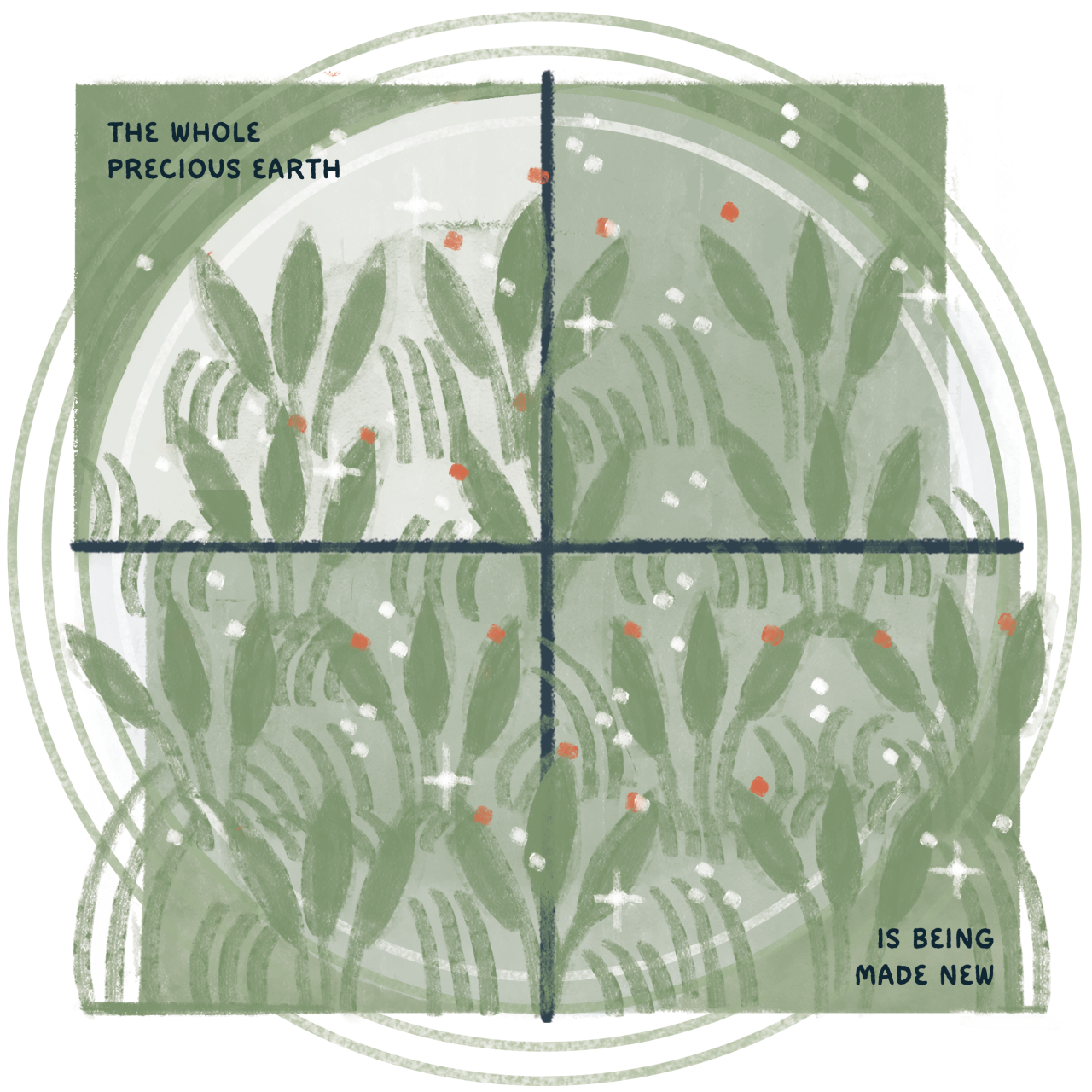
Comic by Madeleine Jubilee Saito, 2022, the ninth of thirty from “30 Days of Comics.”

In November 2022 Saito made a one-page, four-panel comic (almost) every day for the duration of the month. The series is resurrection-themed and, she told me, inspired by one of my blog posts: the one about Fra Angelico’s Noli me tangere at San Marco, a painting in which Christ the Gardener sows his stigmata across the lawn, as art historian Georges Didi-Huberman so beautifully interprets in his monograph on the artist. Click on the image and scroll down (then, at the bottom, click “←older”) to view all twenty-seven comics from the series. Each can stand alone, but they also have a cumulative effect. It’s stunning! You can follow Saito on Instagram @madeleine_jubilee_saito.

Father, Son, Spirit

Thamburaj, A. J._The Holy Trinity
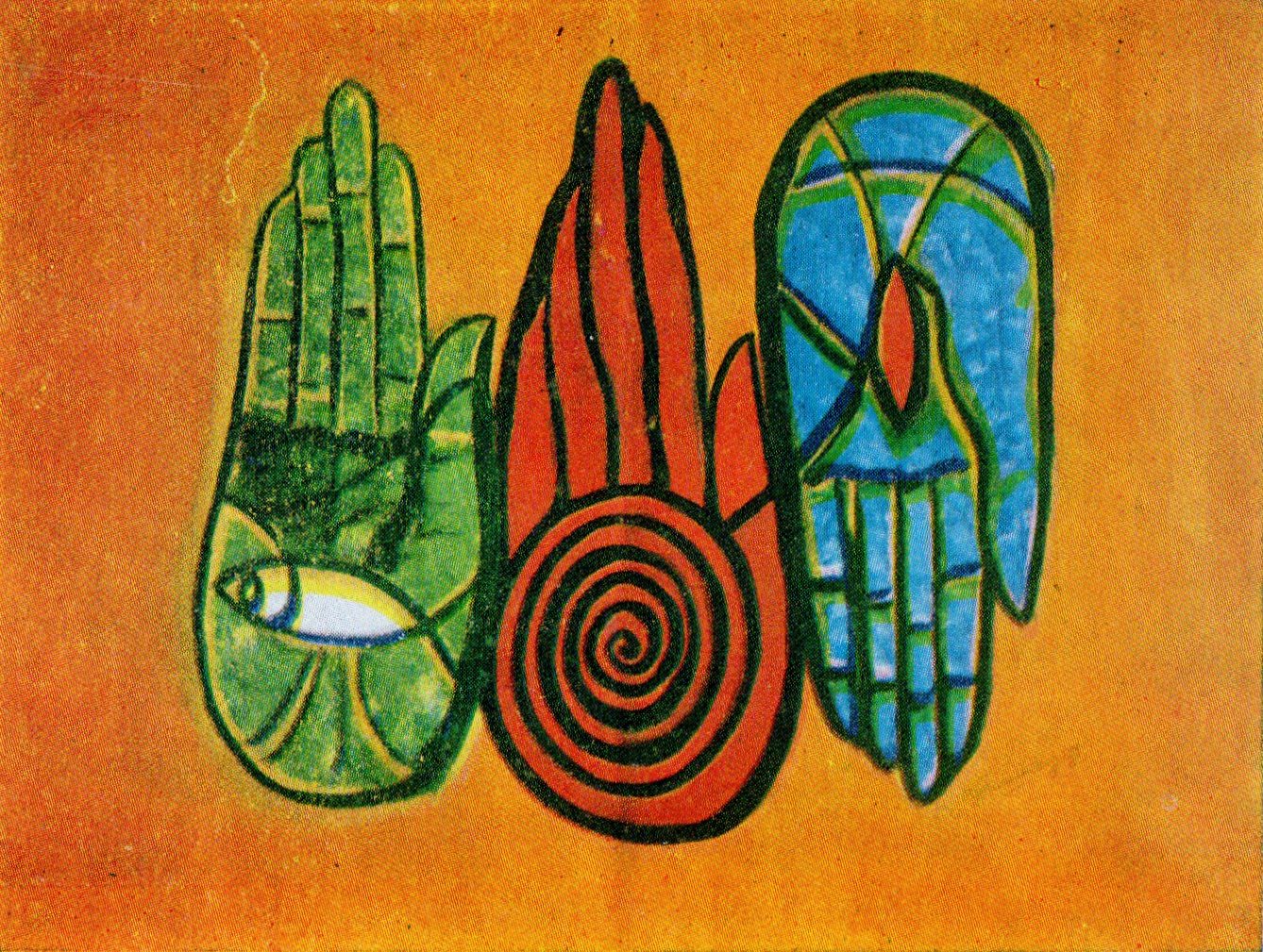
Fr. A. J. Thamburaj, SJ (Indian,, 1939–), The Holy Trinity, before 1982. Oil painting, 23 × 33 in.

The grace of the Lord Jesus Christ and the love of God and the fellowship of the Holy Spirit be with you all.

—2 Corinthians 13:14

+++

SONG: “Om Bhagwan” | Song from the Saccidananda Ashram songbook, composer unknown | Arranged by Chris Hale and Miranda Stone | Performed by Yeshu Satsang Toronto, on Bhakti Geet, vol. 4 (2019)

This Trinitarian song in Hindi comes from a Benedictine monastery in Tamil Nadu. It is performed here by married couple Chris Hale (who grew up in Nepal and India) and Miranda Stone and others from Yeshu Satsang Toronto, a community whose expression of Yeshu Bhakti (Jesus devotion) is “distinctly urban and Canadian, yet informed by the simplicity of the village, honouring what is handmade, humble, and real . . . , navigating . . . between what is traditional and what is progressive.” A transliteration, with English translation, follows. The sacred syllable Om, or Aum, isn’t really translatable.

Om Bhagawan, Om Bhagawan, Om Bhagawan, Prabhu Pita Bhagawan
Om God, Om God, Om God, Lord Father God

Om Bhagawan, Om Bhagawan, Om Bhagawan, Prabhu Putra Bhagawan
Om God, Om God, Om God, Lord Son God

Om Bhagawan, Om Bhagawan, Om Bhagawan, Prabhu Aatma Bhagawan
Om God, Om God, Om God, Lord Spirit God

Om Bhagawan, Om Bhagawan, Om Bhagawan, Prabhu Yeshu Bhagawan
Om God, Om God, Om God, Lord Jesus God

[Related posts: “Exalted Trinity (Artful Devotion)”; “Namaste Sate (Artful Devotion)”]

+++

Painted by the Jesuit artist-priest Father A. J. Thamburaj, The Holy Trinity expresses a complex theological doctrine through mudras (Indian hand gestures) and color. I scanned the image from the excellent book Christian Art in India by Herbert E. Hoefer (Chennai: Gurukul Lutheran Theological College and Research Institute, 1982), which features art by thirty-five artists and essay contributions by Jyoti Sahi. Hoefer describes the painting:

Green is the colour of creativity and fertility. Red is the colour of activity. Blue is the colour of the sea and sky, symbols of mystery and eternity. Yellow [saffron] is an auspicious and joyful colour in Indian custom.

The upraised hand [abaya mudra] is a symbol of protection in Indian art and dance. It represents the Father. Its message is ‘Fear not’. The fish denotes the ever-watching eye of God, for the eyelids of the fish never close.

The downward hand [varada mudra] represents Christ. This gesture is common in Indian sculpture and dance. God is said to point his devotees to hide under the arch of his foot for refuge. The red wound reminds us that the risen Lord bears the redemptive marks of the crucifixion.

The red hand symbolizes the purifying fire, the Holy Spirit. The spiral line indicates the wind, connecting all three Persons in unity. Fire and wind are power.

Our life is in the ever-present protecting, redeeming, purifying and empowering hands of the Triune God.

+++

In the church’s year, Trinity Sunday is the day when we stand back from the extraordinary sequence of events that we’ve been celebrating for the previous five months—Advent, Christmas, Epiphany, Lent, Good Friday, Easter, Ascension, Pentecost—and when we rub the sleep from our eyes and discover what the word “god” might actually mean. These events function as a sequence of well-aimed hammer-blows which knock at the clay jars of the gods we want, the gods who reinforce our own pride or prejudice, until they fall away and reveal instead a very different god, a dangerous god, a subversive god, a god who comes to us like a blind beggar with wounds in his hands, a god who comes to us in wind and fire, in bread and wine, in flesh and blood: a god who says to us, “You did not choose me; I chose you.”

You see, the doctrine of the Trinity, properly understood, is as much a way of saying “we don’t know” as of saying “we do know.” To say that the true God is Three and One is to recognize that if there is a God then of course we shouldn’t expect him to fit neatly into our little categories. If he did, he wouldn’t be God at all, merely a god, a god we might perhaps have wanted. The Trinity is not something that the clever theologian comes up with as a result of hours spent in the theological laboratory, after which he or she can return to announce that they’ve got God worked out now, the analysis is complete, and here is God neatly laid out on a slab. The only time they laid God out on a slab he rose again three days afterwards.

On the contrary: the doctrine of the Trinity is, if you like, a signpost pointing ahead into the dark, saying: “Trust me; follow me; my love will keep you safe.” Or, perhaps better, the doctrine of the Trinity is a signpost pointing into a light which gets brighter and brighter until we are dazzled and blinded, but which says: “Come, and I will make you children of light.” The doctrine of the Trinity affirms the rightness, the propriety, of speaking intelligently that the true God must always transcend our grasp of him, even our most intelligent grasp of him.

—N. T. Wright, For All God’s Worth: True Worship and the Calling of the Church


This post belongs to the weekly series Artful Devotion. If you can’t view the music player in your email or RSS reader, try opening the post in your browser.

To view all the Revised Common Lectionary scripture readings for Trinity Sunday, cycle A, click here.