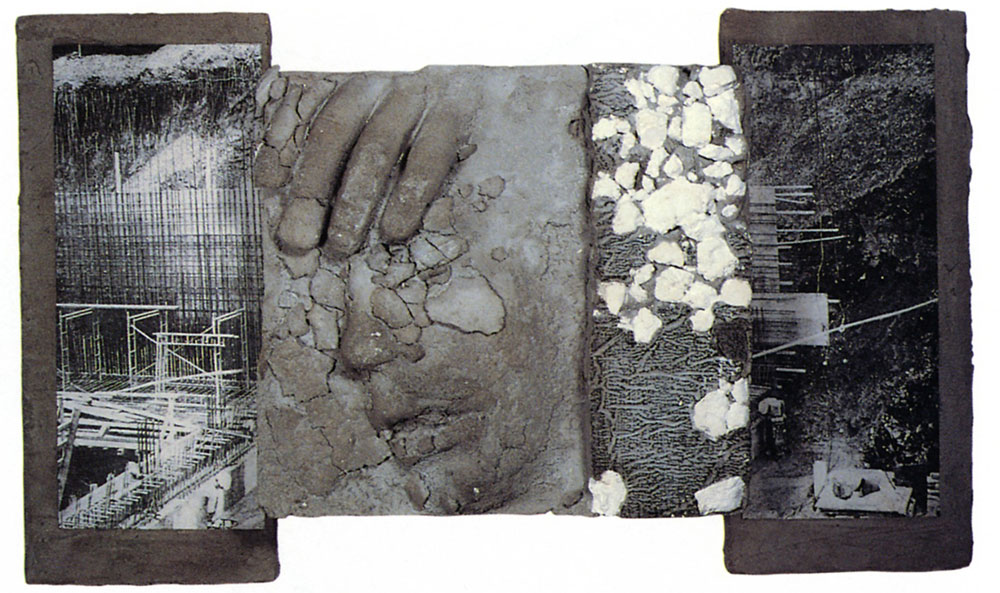
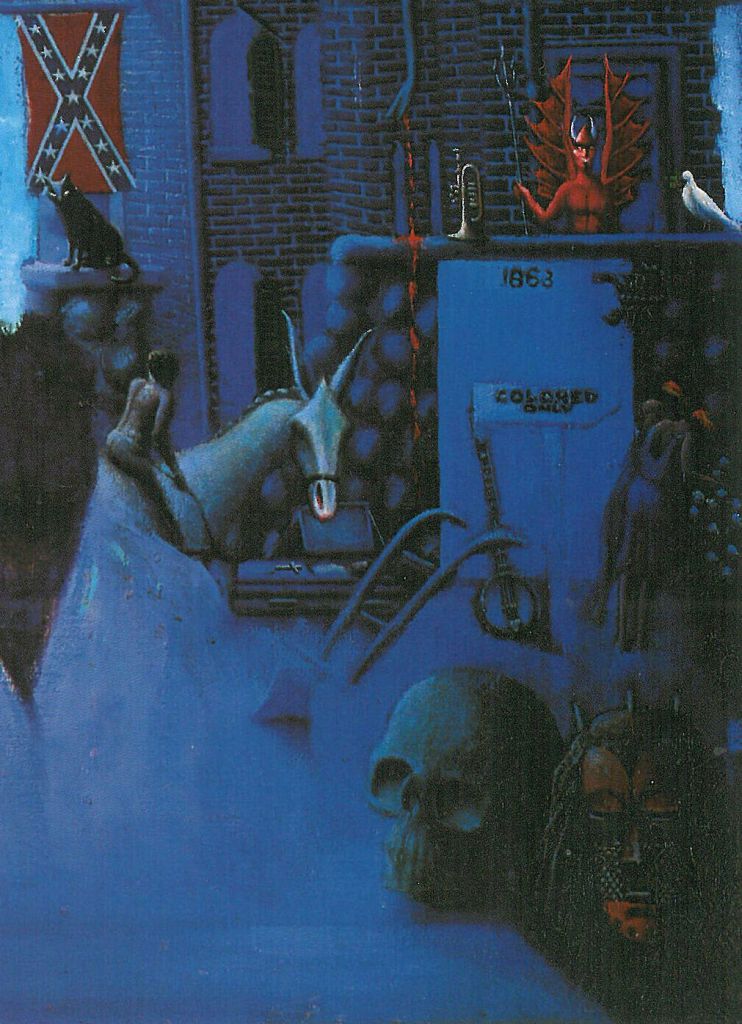
LOOK: Bradford Johnson, Untitled, 1987. Mixed media, 12 × 28 × 3 in. This image is featured in the essay “Wreckage and Rescue: The Art of Bradford Johnson” by Joel Sheesley in Image no. 25 (Spring 2000).
“Child of Dust” is the final song of a four-EP cycle structured on the four basic elements: Fire, Water, Air, and Earth. It’s written as a sonnet in the voice of Earth.
Dear prodigal, you are my son and I Supplied you not your spirit but your shape, All Eden’s wealth arrayed before your eyes. I fathomed not you wanted to escape.
And though I only ever gave you love, Like every child you’ve chosen to rebel, Uprooted flowers and filled the holes with blood. Ask not for whom they toll, the solemn bells.
O child of dust, to Mother now return, For every seed must die before it grows. And though above the world may toil and turn, No prying spades will find you here below.
Now safe beneath their wisdom and their feet, Here I will teach you truly how to sleep.
The earth personified laments how humanity has not reciprocated the care she gives. We’re made of her (Gen. 2:7) and are invited to enjoy her beauty, and yet we abuse and destroy her and each other.
The second stanza alludes to Cain’s murdering Abel. “The voice of your brother’s blood is crying to me from the ground,” God tells Cain in Genesis 3:10. Line 8 is a reference to John Donne’s “Meditation 17” from Devotions upon Emergent Occasions, which uses a metaphor of land erosion to express humanity’s interconnectedness:
No man is an island, entire of itself; every man is a piece of the continent, a part of the main. If a clod be washed away by the sea, Europe is the less, as well as if a promontory were, as well as if a manor of thy friend’s or of thine own were. Any man’s death diminishes me, because I am involved in mankind; and therefore never send to know for whom the bell tolls; it tolls for thee.
In other words, when one person dies, a part of the whole of humanity is severed, and in that sense any time a funeral bell rings, we ought all to mourn the loss of a piece of ourselves.
Line 10, in the third stanza, references Jesus’s parable of the grain of wheat: “Truly, truly, I say to you, unless a grain of wheat falls into the earth and dies, it remains alone; but if it dies, it bears much fruit” (John 12:24). Jesus was talking about his own literal death and resurrection, but the principle applies to our dying to sinful desires, an act that enables new life to spring up in us (see, e.g., Rom. 6; Gal. 2:20, 5:24; Col. 3:2–5; 1 Pet. 2:24).
Kensrue’s lyrics have Mother Earth asking her prodigal children to return to her. As they sing the final couplet, the band puts the microphone in a wooden box (a “coffin”) and shovels dirt on top of it, creating a muffled sound effect. The last sixty seconds of the track are near silence, just the faint clinking of shovels into dirt and rocks. It’s as if we, the listener, are being buried.
Lent is a time when, beneath the world’s incessant noise and toil, we sow ourselves; we reground ourselves in God. The song can be interpreted in several ways, but I see it as calling us to die to self so that we might truly live. Dying and rising is a lesson that Earth, with her seasons and agricultural cycles, can teach us. The seed must be buried before it can experience growth.
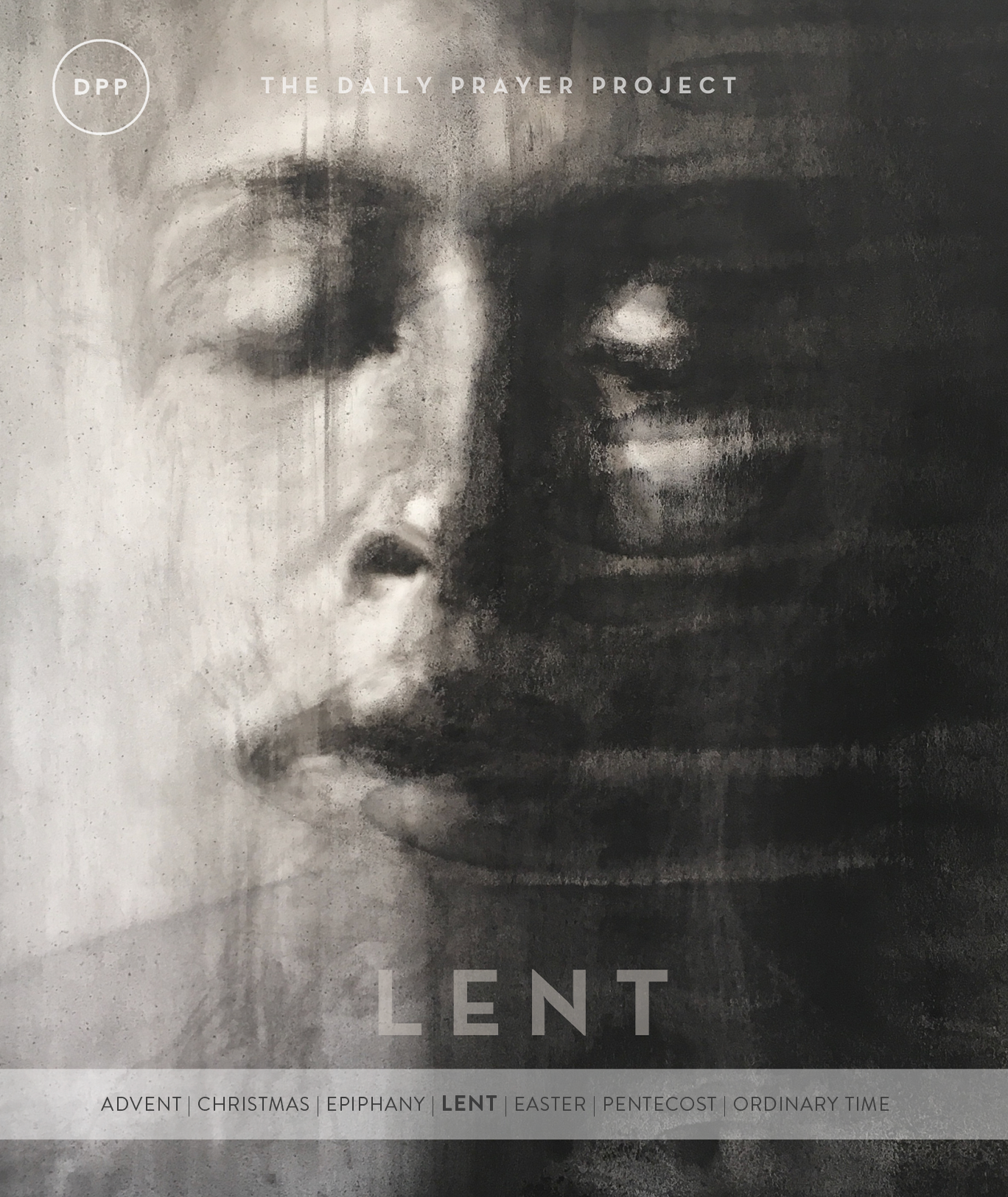
The Lent 2021 edition of the Daily Prayer Project prayerbook is now available, covering February 17–April 3. (I serve as curator.) The stunning cover image is Prayers of the People I by Meena Matocha, who works in charcoal, ashes, acrylic, and wax. You can purchase the booklet in either digital or physical format.
In the opening letter, Project Director Joel Littlepage writes, “Lent is a season that disturbs many people. Maybe that includes you. Among Protestant Christian communities that I have been a part of over the years, Lent can either be seen as a ‘graceless,’ ‘harsh,’ ‘legalistic’ part of the Christian year or, on the other hand, trivialized into a time to ‘pick something to give up,’ like a seasonal spiritual diet plan. Both these characterizations miss the mark.” He goes on to describe the bidirectionality of the Lenten journey: downward, as we are crucified with Christ, and upward, toward the victory of resurrection and new life. “It is a season to sense again the path of the Christian life.”
+++
NEW CHILDREN’S BOOK: Pippy the Piano and the Very Big Wave by Roger W. Lowther, illustrated by Sarah Dusek: My friend Roger Lowther [previously], director of Community Arts Tokyo and host of the Art Life Faith podcast, has written his first children’s book, which released in December. It’s inspired by the story of a church in Kamaishi, who after the 2011 tsunami found their beloved piano upside down and covered in mud and debris but, rather than discard it, decided to spend enormous amounts of time and money to restore it—a picture of God’s love for his precious creation, and the lengths he went to to demonstrate that love. Hollywood and Broadway actor Sean Davis reads the book in the video below. [Available on Amazon]
+++
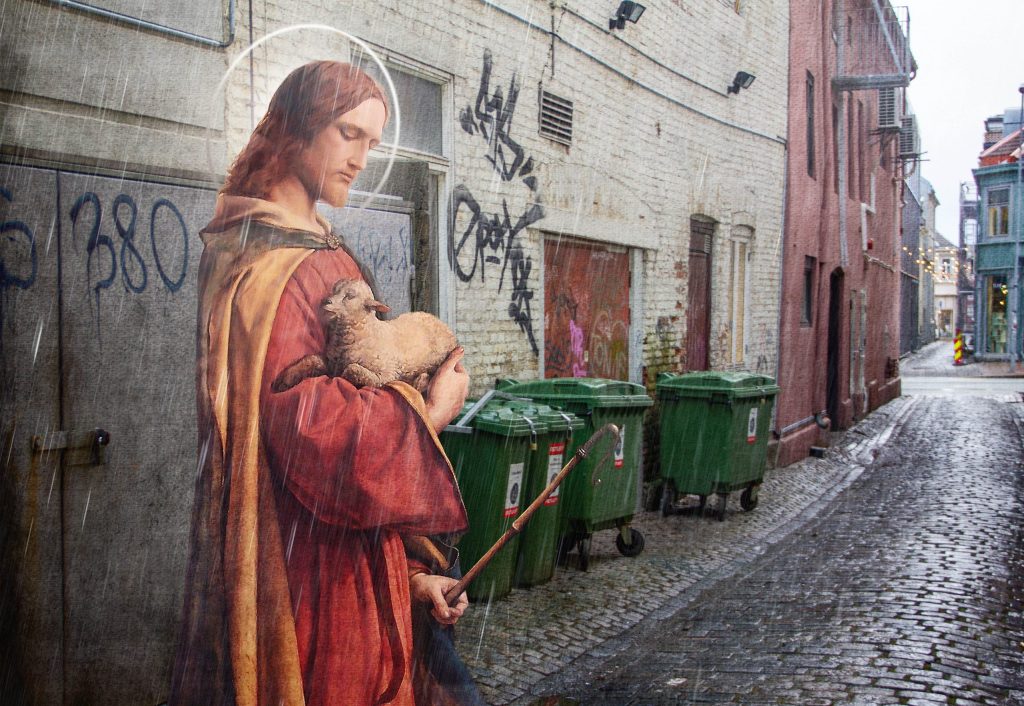
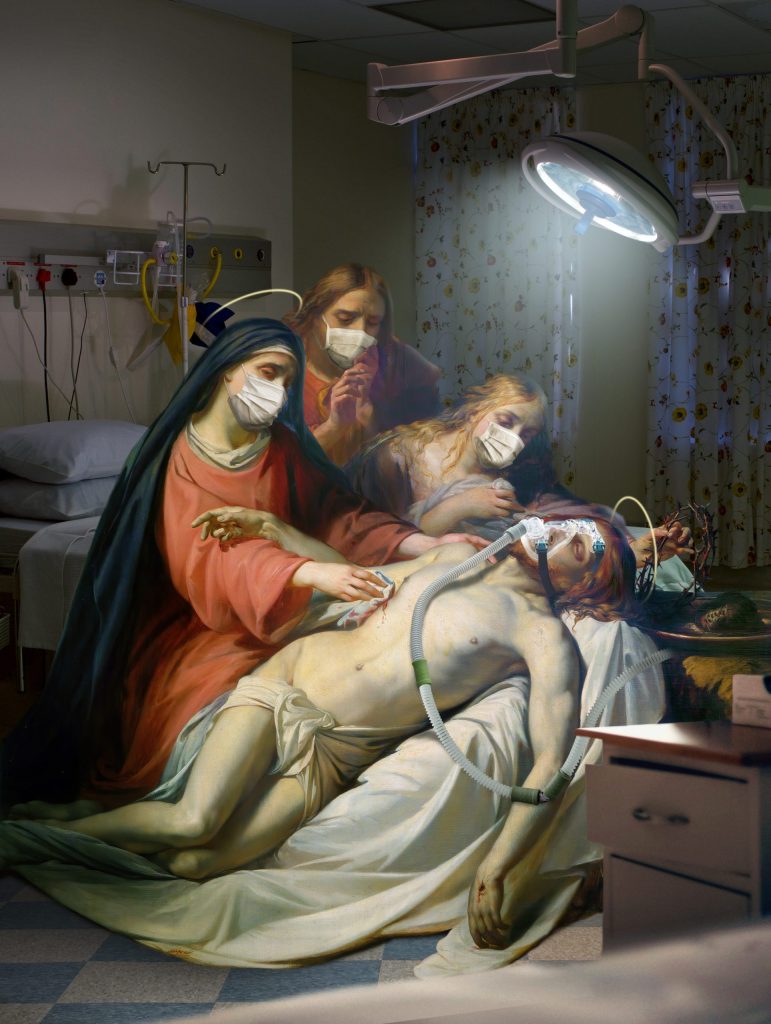
EXHIBITION: The Cobblestone Gospel by Trygve Skogrand, Vår Frue Kirke (Our Lady Church), Trondheim, Norway, July 2020–April 2021: “An exhibition of collages of historic low-church art merged with photographs of our own contemporary surroundings. The essence of the works is the meeting. Between painting and photography, the mystical and the mundane, and how the meeting makes both worlds renewed and re-visibled.” The original advertising says the exhibition is open Mondays through Saturdays from 12 to 3 p.m., but I’m not sure whether COVID has changed that; you can contact the church here.
Trygve Skogrand (Norwegian, 1967–), Found, 2020. Collage / pigment print on paper.Trygve Skogrand (Norwegian, 1967–), The Beloved, 2020. Collage / pigment print on paper.
When I was a child, I went to a Christmas party at our local church. At the end of the party, every child got a small bag of gifts to take home. In the bag: a pack of raisins, a small orange, some sweets – and a prayer card showing Jesus in paradise. Oh, how beautiful I thought the small prayer card was! Jesus and butterflies and a sunset and flowers AND a golden glittery border. A wonder of loveliness and holiness!
Move on twenty years. I was 30, had started working as an artist, and found the bible card again. I had changed, and the card too. Instead of seeing loveliness, I found the card rather sad. It looked to me as if Jesus was imprisoned in a dusty and suffocating make-believe paradise.
Then it struck me: What if I remove the paradise?
I have now been working with the merging of high and low historical Christian art with our contemporary surroundings for twenty years. For me, this process not only binds together what nowadays normally is shown as sundered but also re-actualizes the classical art and infuses the everyday, modern surroundings with holiness.
+++
MUSIC VIDEO: “Fear Thou Not” by Josh Garrels: This beautiful new setting of Isaiah 41:10 by Josh Garrels appears on Garrels’s 2020 album Peace to All Who Enter Here [previously]. “Fear thou not; for I am with thee: be not dismayed; for I am thy God: I will strengthen thee; yea, I will help thee; [and] I will uphold [you] with the right hand of my righteousness” (KJV).
+++
SHORT FILM: A Colorized Snowball Fight from 1896 Shows Not Much Has Changed in the Art of Winter Warfare: This is pure joy! “A short clip, originally captured by Louis Lumière in 1896, documents a rowdy snowball fight [bataille de boules de neige] on the streets of Lyon, France. Thanks to Saint-Petersburg, Russia-based Dmitriy Badin, who used a combination of the open-source software DeOldify and his own specially designed algorithms to upscale and colorize the historic footage, the video of the winter pastime is incredibly clear, revealing facial features and details on garments.”
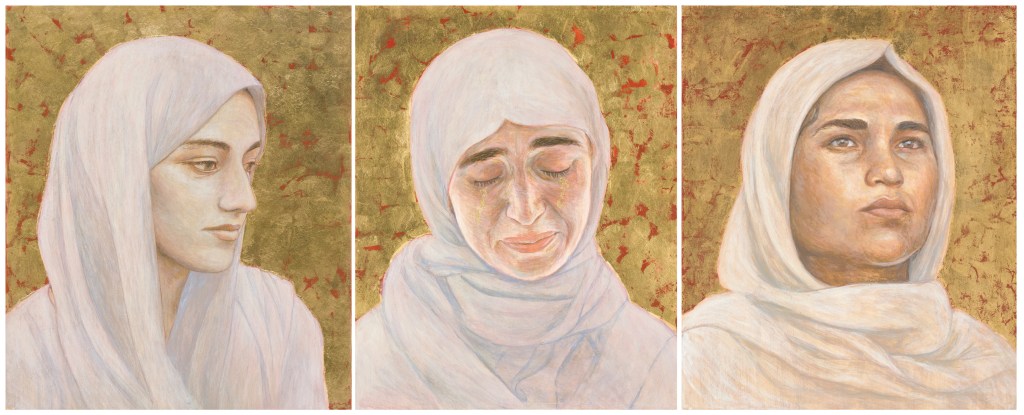
Hannah Rose Thomas, paintings from the Tears of Gold series, 2017. Click image to learn more, and see the Google Arts & Culture exhibition.Nicola Ravenscroft, With the Heart of a Child, 2016. Sculpture installation comprising seven life-size bronze children. The artist calls the figures “eco-earthling-warrior-mudcubs.” Click image for artist interview, and here for a theological reflection.
+++
VISUAL COMMENTARIES: Elijah’s Ascent by Victoria Emily Jones: My latest contribution to the Visual Commentary on Scripture was published this month. It’s a mini-exhibition on 2 Kings 2:1–12, featuring a seventeenth-century Russian icon, a 1944 painting by African American artist William H. Johnson, and a 1985 painting (a Jewish chapel commission) by Polish-born Israeli artist Shlomo Katz. (For more context on the Katz painting, see here.)
+++
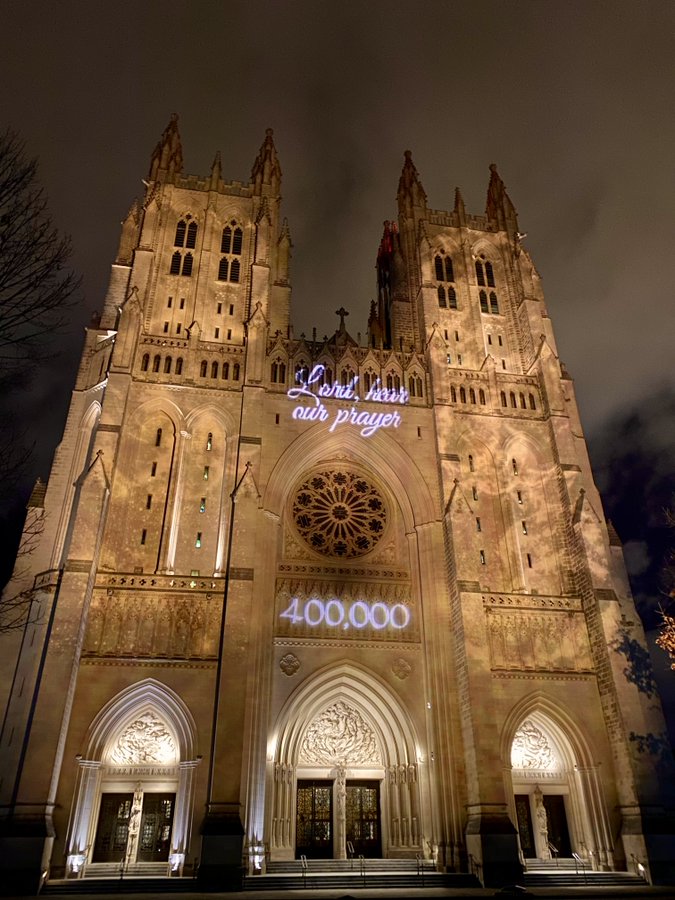
NATIONAL MOURNING:Washington National Cathedral tolled its mourning bell four hundred times Tuesday evening in remembrance of the 400,000 lives lost from COVID in the United States thus far—each ring representing one thousand dead. I spent the thirty-eight-minute livestream lamenting this enormous loss, praying for all those who are grieving and for patients and health care workers, and pleading with God for an end to this virus.
The origami paper doves you see in the video are part of the Les Colombes installation by Michael Pendry [previously], erected in December in the cathedral’s nave to symbolize hope and the Holy Spirit.
+++
MUSIC VIDEO: “For the Sake of Old Times” (Auld Lang Syne): Directed by Tyler Jones of the narrative studio 1504, this short film premiered December 30, 2020, by NPR. “From the pews of a church where white deacons once refused to seat African Americans, a group of Black singers in Alabama reminds us why preserving our memories of this historic year is vital—even if we’d rather just leave 2020 behind.” [HT: ImageUpdate]
“To me the piece is a personal encouragement going into the future,” Jones says, “that we hopefully strive to work together for a kinder future, especially at a time where we are so distanced.” Read about the making of the film at https://n.pr/3n6d8Ct.
+++
ARTICLE: “On the Gifts of Street Art” by Jason A. Goroncy, Zadok: The Australasian Religious Press Association awarded silver prize for “Best Theological Article” to Jason Goroncy [previously] for this piece. (How cool that it won in the theology category!) Like all art, street art can function as a form of civic dialogue, protest, play, hope, remembrance, etc., but Goroncy discusses how some of its particular qualities uniquely position it to perform those functions: its (usually) unsanctioned and interventionist nature, its fragility and impermanence, its celebration and development of culture, its inseparability from place, and its redefinitions of proprietorship. [HT: Art/s and Theology Australia]
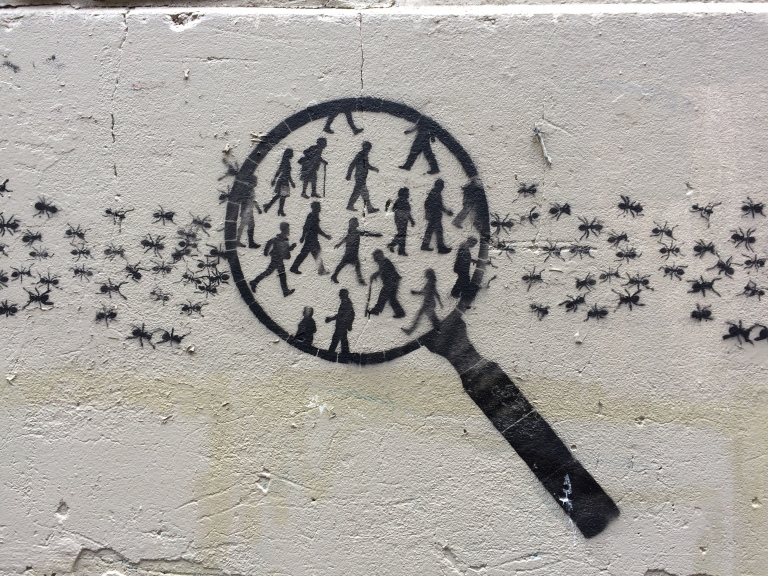
Human Ants, Liverpool Street, Melbourne, Australia. Photo: Jason Goroncy.
“Among the many gifts that street artists offer,” Goroncy writes, “is a proclivity to bear witness to how things are and not merely to how they might appear to be. Such a proclivity involves a telling of the truth about those largely-untampered-with and untraversed spaces of our urban worlds, about what is present but underexposed or disregarded; and even, as Auden hints, to lead with ‘unconstraining voice’ the way toward healing and toward a renewed sense of enchantment, freedom and praise beyond the pedestrian and clamorous. Such a proclivity is also a form of urban spirituality. It can even be a form of public theology.”
Archibald J. Motley Jr. (1891–1981) was one of the most important artists of the Harlem Renaissance. He’s best known for his paintings of urban Black culture, especially the Chicago jazz scene and other nightlife, and he was also a wonderful portraitist.
His final painting, however, shows none of the carefree conviviality that was characteristic of much of his work. On the contrary, it’s nightmarish. Begun in 1963 and reworked over the course of a decade, The First One Hundred Years: He Amongst You Who is Without Sin Shall Cast the First Stone: Forgive Them Father For They Know Not What They Do chronicles race relations in the United States from the Civil War to the civil rights era. It’s the most overtly political painting in Motley’s oeuvre, and once completed, he didn’t paint for the remaining nine years of his life.
The “one hundred years” in the title refers to the period since the Emancipation Proclamation took effect in 1863, changing the legal status of more than 3.5 million enslaved African Americans to “free.” The Civil War ended May 9, 1865, and slavery was officially abolished with the Thirteenth Amendment on December 18 of that year. But the legacy of that institution was still felt throughout the next century, in which Black people suffered disenfranchisement, segregation, lynchings, and a number of other injustices and terrors.
Motley visualizes the Black struggle for freedom and equality through symbols and vignettes.
At the top of the painting are the death masks of John F. Kennedy, Martin Luther King Jr., and Abraham Lincoln, all of whom were assassinated as they sought to advance the rights of African Americans.
Below King’s visage is a Confederate flag, hanging from the front porch of a crumbling Southern manse. The red is replicated in the blood running out the house’s downspout, a horned devil (who surveys the domain he’s claimed), the blood-drop cross insignia of a Ku Klux Klansman, and the tongue of a snarling police dog.
At the bottom right a traditional African mask lies beside a human skull, alluding not only to physical death but also to the fragmentation or loss of cultural identity experienced by those who were abducted from their homeland and brought across the Atlantic to live in captivity, separated from their families and communities and ways of life and even given new names by their oppressors. This wound is also felt by the enslaved persons’ descendants, who are unable to trace their lineage.
Above this still life is a Black person on horseback, operating a plow right next to a coffin. Besides the obvious reference to plantation labor, the vignette also evokes the African American spiritual that goes, “Keep your hand on the plow, hold on”—a song of endurance through hardship.
In the center of the painting the Statue of Liberty stands in ironic contrast to a lynched man, the color of her freedom torch echoed in the burning cross of the KKK. Just behind this dead Black man who hangs from a tree is another dead man hanging from another tree: Jesus on the cross. (For more on how these two symbols mutually interpret each other, see theologian James H. Cone’s The Cross and the Lynching Tree.) The hill of Calvary is the brightest part of the entire composition, which I imagine Motley, a practicing Catholic, intended to signify hope, enlightenment, and a call to repentance. The cross illuminates our sin and the love of God that compels us to love our neighbors. I will address this further, in relation to an MLK sermon, below.
In the shadow of the cross is a sea of protest and counterprotest signs. Alongside slogans like “We Want to Vote,” “Black Power,” and “We Shall Overcome” are swastikas, “America for Whites, Africa for Blacks,” and “Go home, niggers, and get your relief check.” To the left of this activity, a white police officer beats a Black man with a baton, and a fireman turns a high-pressure hose on Lady Justice. This vignette evokes the chilling news footage from May 1963, when Birmingham Public Safety Commissioner Bull Connor ordered the use of fire hoses and attack dogs on peaceful Black protesters, including children. The force of the jet streams ripped off boys’ shirts and pushed girls over the tops of cars. It was an assault on Black bodies and on justice itself.
Birmingham, Alabama, was, and still is, one of the most racially divided cities in the US, and in the 1960s it became a center of civil rights activism. From 1947 to 1965 it was the site of fifty racially motivated dynamite explosions, earning it the nickname “Bombingham.” The bombing that caught the most international attention was of Sixteenth Street Baptist Church on September 15, 1963. The blast killed four girls who were leaving Sunday school: Addie Mae Collins, Cynthia Wesley, Carole Robertson, and Carol Denise McNair. Motley alludes to this terrorist act with the stained glass window wherein the face of a white Jesus is blown out, as that’s actually what happened at Sixteenth Street Baptist. (“The absence of the face,” said James Baldwin, “is something of an achievement since we have been victimized so long by an alabaster Christ.”)
In the center foreground, emerging from the phantasmagoria, is another faceless figure, his form and features undefined. He’s a specter, really, walking toward us—or is it someone in a dream state? Motley mixes historical scenes of violence and terror with contemporary ones, showing how the ghosts of our nation’s past are still haunting us.
Scattered throughout the painting are animals that represent ill omens or evil: a bat, a vulture (who feeds on death), a black cat, a serpent, a scorpion (on the right, crawling across the door marked “1863”). The latter two call to mind Luke 10:19, where Jesus tells his disciples, “Behold, I give unto you power to tread on serpents and scorpions, and over all the power of the enemy . . .” A dove of peace, the only nonsinister animal presence, perches on the margins.
Church, listen up: we have the call and the power, in Christ(!), to tread on racism and every other evil that erects itself against the kingdom of God. Don’t let the Enemy have a stranglehold. Let us be active in confronting the evil of white supremacy and dismantling it—in our own hearts, our congregations, our government, and in all the other systems it operates in—so that the supremacy of Christ and his gospel of freedom and reconciliation can be made known.
Where Are We Today?
I encountered The First One Hundred Years through the 2015 retrospective Archibald Motley: Jazz Age Modernist and have been sitting with the image ever since, thinking: What progress have we made? Do I recognize this scene? What will “The Next One Hundred Years” look like in America?
It’s been almost fifty years since Motley completed the painting, and blood still flows. Black people are still being lynched (Ahmaud Arbery, killed by white vigilantes while out on a jog, is one example). Some people and businesses are still flying their Confederate flags. And racist hate groups are as active as ever. Last October the Department of Homeland Security named white supremacist extremists the country’s number one domestic terrorism threat, a threat that came to fruition January 6 when a mob of radical Trump supporters, catalyzed by the president himself, stormed the Capitol equipped with climbing gear, riot helmets, shields, gas masks, bear spray, flex cuffs, lead pipes, and baseball bats, attempting to overturn the 2020 presidential election results by force. The insurrectionists erected a functional gallows and noose on the lawn and shouted and graffitied death threats. A Confederate battle flag was marched through the halls of Congress, as were other neo-Confederate, neo-Nazi, and nationalist symbols, along with crosses, the Christian flag, a “Jesus 2020” banner, “Make America Godly Again,” etc. (Christian nationalism, on flagrant display at the Capitol, has been publicly denounced by several prominent American Christians these past four years, so I won’t get into it here.) The mob was a mishmash of different groups and individuals united around Trump’s claims of election fraud and trying to hold on to (white) power.
Law enforcement’s completely deficient planning for the white-led protest (and thus inability to properly respond when the protest turned into a siege) stood in stark contrast to the way Black Lives Matter protests in DC were handled last summer, with militarized officers at the ready, low-flying helicopters, and eight-foot-tall fences. Peaceful Black protesters in the streets were met with tear gas and rubber bullets, whereas January 6’s white protesters were able to invade the Capitol with little resistance.
Why the woeful lapse in security, despite clear intelligence that right-wing extremists would be gathering there the day Congress was convening to ratify Biden’s democratically won victory? Because despite the DHS’s recent Homeland Threat Assessment, white people are, in general, not perceived as dangerous; Black (and brown) people are. And because white people know the system works for them, those who stormed the Capitol felt empowered to do so with impunity. They weren’t scared of the police. They didn’t even try masking their identities; on the contrary, several posted photos and videos of their crimes online. After trespassing, assaulting police officers (one of whom died), and vandalizing and looting while federal legislators ran and hid in fear for their lives, the insurrectionists were gently told by President Trump to “Go home. We love you.” Only a few were detained. Investigations have since been launched and more and more arrests are being made. But I bring this all up to show just one recent instance of racial disparities in policing as well as the rise of white nationalist fervor, which are just two of the many symptoms that prove that America does indeed still have a race problem.
The Trump presidency has really brought white supremacy to the fore, forcing us to confront a national sin that perhaps we thought was mostly behind us. “Reckoning” is a word I’ve been seeing a lot. Activist and author Ibram X. Kendi says that if we can be thankful to Trump for anything, it’s this: “He has held up a mirror to American society, and it has reflected back a grotesque image that many people had until now refused to see: an image not just of the racism still coursing through the country, but also of the reflex to deny that reality.”
The Need for Enlightenment
The two subtitles of Motley’s painting are both quotations of Jesus, which together indict sin and ask God for mercy. “He amongst you who is without sin shall cast the first stone” (John 8:7) was spoken to pierce the consciences of a mob of religious elites who sought to stone a woman for adultery; it exposed their two-facedness, their eagerness to punish another’s sin but not to examine their own. Motley is thus urging viewers to confront the ways in which they themselves have violated God’s law, how they have said, by their words or actions (or inaction), that Black lives do not matter. Admit. Admitting sin, admitting that there’s a problem, is the first step in rooting it out.
“Forgive them, Father, for they know not what they do” (Luke 23:34) was spoken by Jesus on the cross. As he hung dying, he prayed to God on behalf of his killers, recognizing in them a spiritual blindness. Forgiveness is a nuanced concept whose complexities I won’t discuss here, but Jesus’s prayer expresses his goodwill toward his enemies, a spirit of wanting to see them reconciled to God. Jesus recognized that even as sinners hurt people, they themselves are also hurting. They don’t even realize how their sin binds them and blinds them.
In a ca. 1962 sermon on this text, Martin Luther King describes his oppressors (and Jesus’s) as suffering from an “intellectual and moral blindness . . . an ill which man inflicts upon himself by his tragic misuse of freedom and his failure to use his mind to its fullest capacity. There is plenty information available if we consider it as serious a moral obligation to be intelligent as to be sincere. One day we will learn that the heart can never be totally right if the head is totally wrong.” King describes how enslavers sought to rationalize their beliefs, drawing from “science,” history, and biblical interpretation, and segregationists were doing the same, ignoring all evidence that contradicted what they sincerely believed to be true. These days we’ve seen how those who benefit from white privilege seek to explain away racial inequalities or even simply refuse to believe they exist, because who wants to give up power? And of course they find online communities or curate social media feeds that bolster their view that everyone is treated equally in America, that skin color does not grant any unfair advantages, and so when another unarmed Black person is killed by police, they interpret it through the white lens of “Well, he must have been doing something wrong . . .”
Maybe as you read this very article you’re tensing up and want to tell me X, Y, and Z regarding why white privilege is a fallacy or how I’ve been taken in by a “liberal agenda,” or how my narrative of the recent event at the Capitol is completely off—it wasn’t an insurrection, and it had nothing to do with white supremacy, and those weren’t really Trump supporters (yes, I’ve actually heard people say that). Maybe you think it’s me who’s blind.
King talks about the need for enlightenment.
Light has come into the world. There is a voice crying through the vista of time calling men to walk in the light. Man’s earthly life will be reduced to a tragic cosmic elegy if he fails to heed this call. “This is the condemnation,” says John, “that light is come into the world, and men loved darkness rather than light.”
John’s saying, King says, is demonstrated vividly at the cross, which shows God at his best and humanity at its worst.
We must continue to see the Cross as a magnificent symbol of love conquering hate, and light overcoming darkness. But in the midst of this glowing affirmation, let us never forget that our Lord and Master was nailed to that Cross because of human blindness. Those who crucified him knew not what they did.
In what ways are we nailing Christ to the cross afresh, so to speak, unaware of what we’re doing? In what ways are we resisting the work of the Holy Spirit to expose sin, both personal and collective? In what ways are we closing our ears to the cries of our hurting Black brothers and sisters, and to the calls to action from those who are continuing King’s legacy of nonviolent resistance? I’m speaking to white American Christians in particular here. We all want America to heal. But the sin of racism must be acknowledged and confessed, and repentance undertaken, before healing can proceed.
Repenting of sin is a foundational Christian practice; it’s in the church’s DNA. And yet with this particular issue, there’s been a lot of unwillingness among Christians to see and to act. These past four years have been for me a time of self-examination and also critical examination of the evangelical tradition I grew up in and which you might say I’m still a part of. In addition, I’ve spent a lot of time relearning history, locating my privilege, unlearning biases, rereading the Psalms and the Prophets, repenting, exploring more deeply the witness of the Black church and all-around diversifying the voices I listen to, and slowly (admittedly, hesitantly!) wading into the waters of civic engagement. I have a long way to go, to be sure, but I’m on the journey.
I see Motley’s painting as a lament for all the racial injustices perpetrated in the US but also a statement of hope, as the cross beckons us to persist in (or join) the freedom struggle. It’s a prayer that the scales would fall off the eyes of white America—that we would shed willful ignorance—and that people of all races would walk together not only in the light of “liberty and justice for all” but, as King preached, in the light and Spirit of Christ.
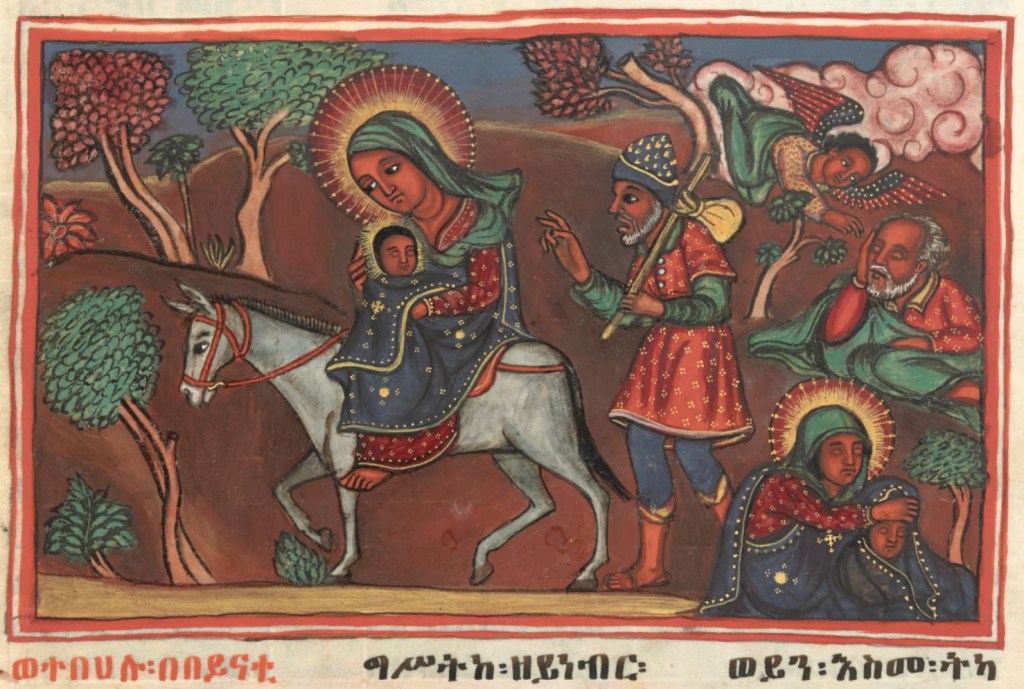
“The Christmas Story: Images from Ethiopic Manuscripts” by Eyob Derillo: The British Library has a fantastic collection of Christian manuscripts from seventeenth- and eighteenth-century Ethiopia. This blog post by curator Eyob Derillo shows Christmas-related illuminations from four different ones. Follow the links in the captions to explore each manuscript further.
“Flight into Egypt,” from the Nagara Māryām (History and Miracles of the Blessed Virgin Mary), Ethiopia, ca. 1730–55. British Library Or. 607, fol. 17r.
You can follow Derillo on Twitter @DerilloEyob. He’s always posting fascinating things about Ethiopian art and its intersection with the country’s history, culture, politics, and Christianity, including lots of Ethiopian saints’ stories!
A 16th c. Ethiopian book claims that the Magi, the 3 kings who visited Jesus were all Ethiopians. Legend has it that they consumed coffee on their journey to stay awake. In their memory #coffee in #Ethiopia is served 3 times. Serving are named after the Magi Abol, Tona & Baraka pic.twitter.com/mf0YyHcqcN
Animals with magical abilities are frequently recorded in biographies of #Ethiopian saints. They appear when hermits are praying in mountain caves, or at the death or funeral of a Saint. #birds appear on a birth or death of a saint, #lions reveal themselves to serve them. pic.twitter.com/ZdNHdREnc2
There are over 500,000 manuscripts in #Ethiopia housed in churches & monasteries located in remote places. The exact amount is not known. Most don't permit access to the archive. Some monastic libraries have #medieval MSS dated to the 6th c. a few have been digitised & conserved pic.twitter.com/gi6Lzgb0Jn
If you enjoyed the blog post, I recommend the highly accessible book The Road to Bethlehem: An Ethiopian Nativity, an interweaving of ancient (apocryphal) tales surrounding Jesus’s birth that flourished in Ethiopia, compiled and told by Elizabeth Laird, with the biblical narrative. It’s illustrated in full color with images from the British Library’s collection and is perfectly appropriate for children (and adults!). I’ve perused the Ethiopian manuscripts on the BL website but am not able to decode several of the images because I’m unfamiliar with the tales and cannot read Ge’ez, and Laird’s book helped me out in that respect, at least in part. For a deeper dive into Ethiopian art—which is inextricable from its patrons’ and makers’ Christian spirituality—see the informative and beautifully produced Ethiopian Art: The Walters Art Museum, a catalog from another museum that houses a fine collection of Ethiopian art.
+++
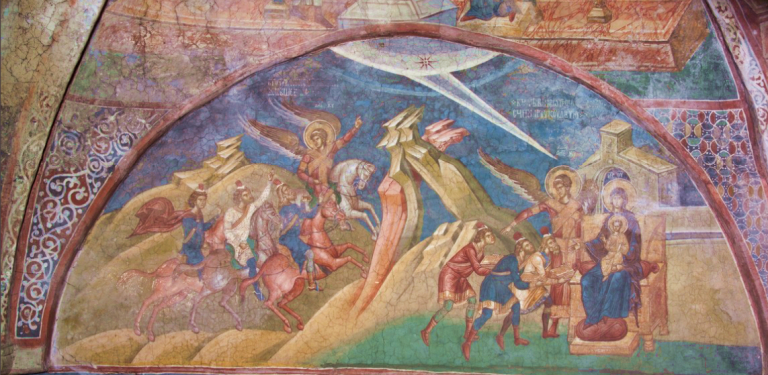
The Angel of the Lord in icons of the Magi: In this recent post from Icons and Their Interpretation [previously], icons consultant David Coomler spotlights a fresco from Decani Monastery in Serbia that shows an angel on horseback leading the magi to the Christ child, emphasizing supernatural direction. He identifies the same, idiosyncratic figure in a 1548 painting by Frangos Katelanos at Varlaam Monastery in Meteora, Greece, comparing it to two more common appearances of an angel with the magi in Eastern iconography: on foot beside the newborn king’s “throne,” presenting the magi to him.
Journey of the Magi and Adoration of the Magi, 14th century. Fresco, Decani Monastery, Serbia. View a modern copy here.
+++
SONG MEDLEY:“Christmas Around the World” by Acapals: “Acapals is a collaboration of four friends and a penguin who share a love for making a cappella music (despite not sharing much in the way of geography, culture or language).” They are Nick Hogben, tenor, from England; Leif Tse, baritone, from Hong Kong; Jacky Höger, alto, from Germany; and Prayer Weerakitti, soprano, from Thailand. In this video each of them arranged a holiday song in their native language, which they sing together: “Hark! The Herald Angels Sing” (English), “Silent Night” (Cantonese), “Es ist ein Ros’ entsprungen” (German), and “New Year Greeting” (Thai). [HT: Global Christian Worship]
+++
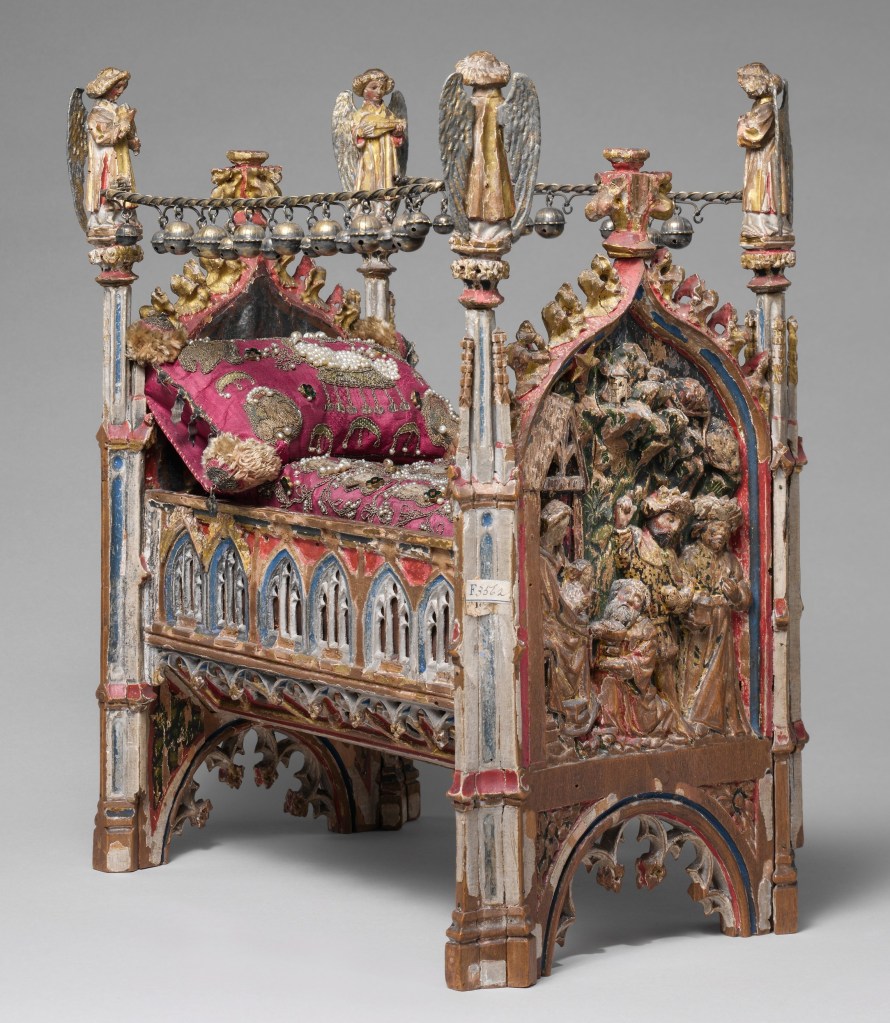
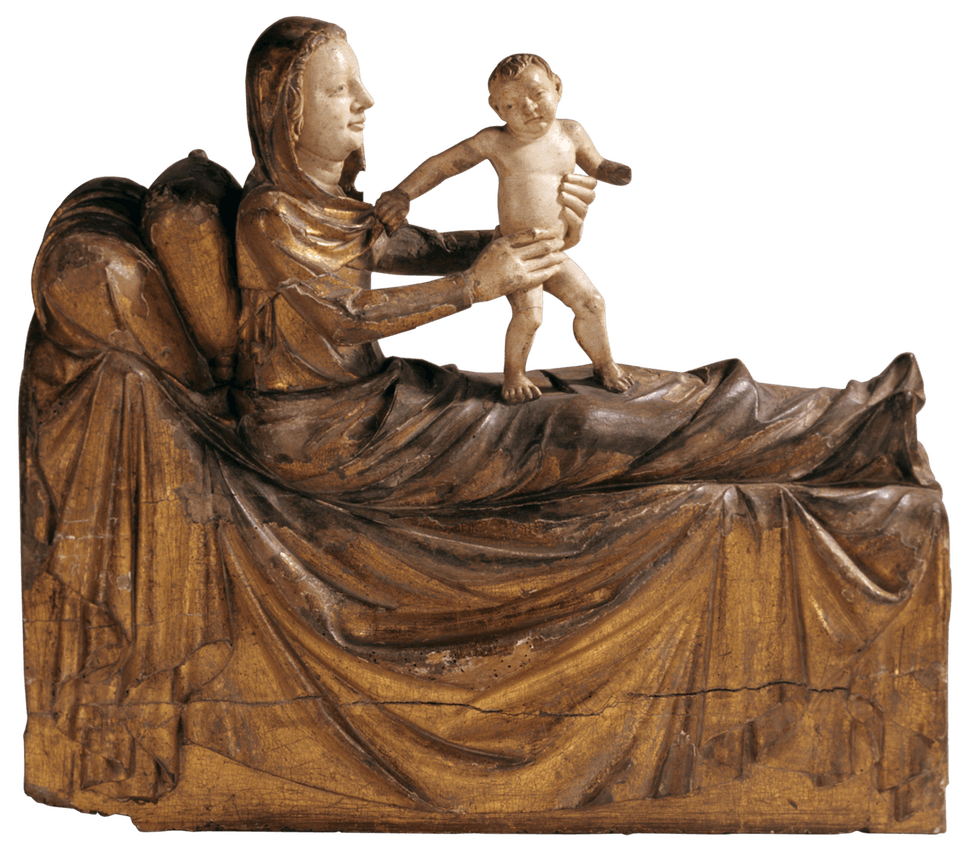
“The Cloister and the Cradle” by Shannon Reed: Some medieval nuns and lay religious women cared for baby Jesus dolls (ceramic or wooden) as a devotional practice—dressing them, playing with them, “feeding” them, singing to them, rocking them in cradles. Full of wit and tenderness, this Vela magazine essay by Shannon Reed explores that practice. “It is difficult to separate my modern reaction to the sight of a grown woman (in a habit!) acting in such bizarre ways, carrying a doll around and pretending it’s real,” Reed writes. “But I try to remember that for these women, this was an empowering opportunity to be Mary, most holy, most blessed.”
Reed considers women’s agency in the Middle Ages, mystical visions made tangible, and the desire for maternal intimacy, incorporating personal stories and reflections, as a single woman without children, about attending baby showers, nannying through grad school, shopping for godchildren, and teetering between enjoyment of her non-mom status and an inclination to mother. As a thirty-two-year-old woman who also does not have kids (though I am married) and is content but constantly surrounded by reminders of what I’m missing, I can relate to a lot of the feelings and experiences Reed articulates here. I chanced upon this essay when trying to find more information about a Beguine cradle I saw at the Met, pictured below (spurred, too, by the description of a Virgin and Child ivory). I found myself unexpectedly moved by the author’s vulnerability and by the connections she draws between modern-day longings for and expressions of motherhood and those played out in medieval Christian convents.
Crib of the Infant Jesus, 15th century, from the Grand Béguinage in Louvain (now at the Metropolitan Museum of Art). Click to view details of the carved Nativity and Adoration of the Magi at the head and foot and, on the embroidered coverlet, Jesus’s family tree.
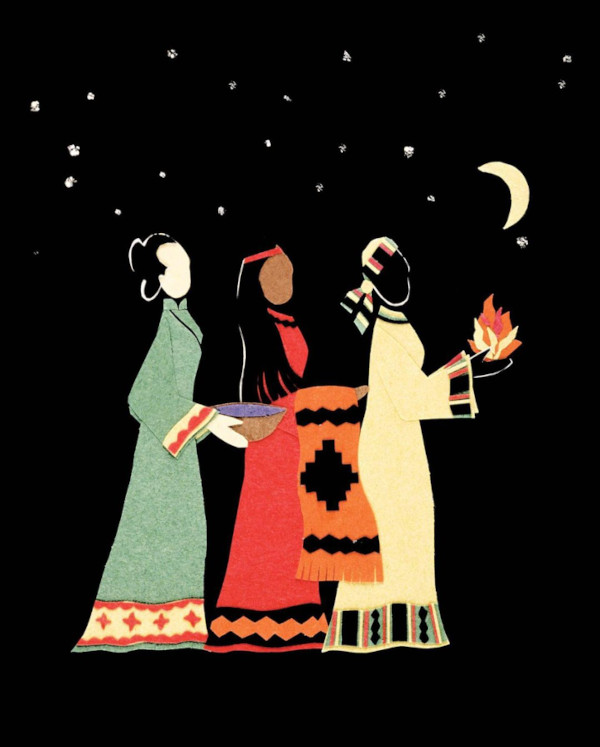
The Sanctuary Between Us: A Retreat for Women’s Christmas by Jan Richardson: Every year artist, writer, and Methodist minister Jan Richardson provides a new compilation of her art, blessings, and spiritual reflections as a free PDF download. The subtitle references the Irish custom of Nollaig na mBan, or Women’s Christmas, observed particularly in County Cork and County Kerry. “Women’s Christmas originated as a day when the women, who often carried the domestic responsibilities all year, took Epiphany [January 6] as an occasion to celebrate together at the end of the holidays, leaving hearth and home to the men for a few hours.” In this spirit Richardson offers an opportunity “to pause and step back from whatever has kept you busy and hurried in the past weeks or months, . . . spend[ing] time in reflection before diving into what this new year will hold.”
“Blessing to Summon Rejoicing,” “Blessing of Memory,” “Blessing the Body,” and “Blessed Are You Who Bear the Light” are among the several benedictions, thoughtfully introduced and many accompanied by collages, paintings, or encaustics. Some sections also include questions for personal reflection. For example: “How do you experience—or desire to experience—remembering in community? Who are the people who hold your memories with you? Are there ways you experience memory as a sacrament, a space where you know the presence and grace of God at work in your life? For whom might you be (or become) a sanctuary of memory as you help them hold their stories and their lives?”
The poem “Wise Women Also Came,” printed as an interlude, is especially compelling, describing how, in addition to the wise men mentioned in the biblical narrative, wise women also came to Jesus’s birth bearing gifts—“water for labor’s washing, / fire for warm illumination, / a blanket for swaddling.”
Sometimes we rush to judgment of artworks that at first glance seem dull and conventional. We assume they have nothing to show us. But if we were to look more closely, we might find something unexpected. Even subtly subversive.
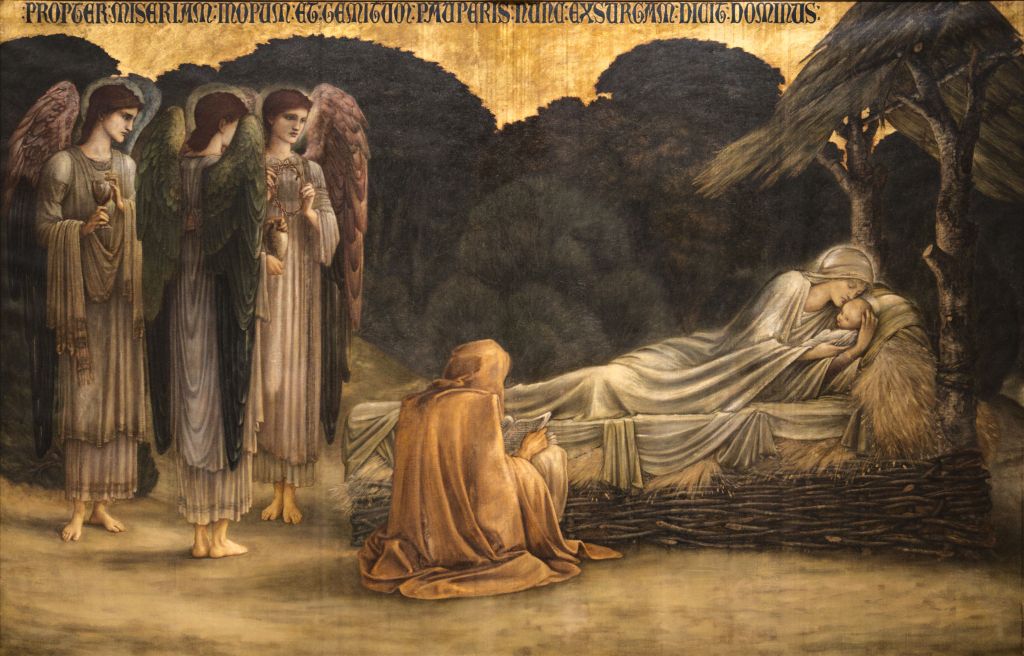
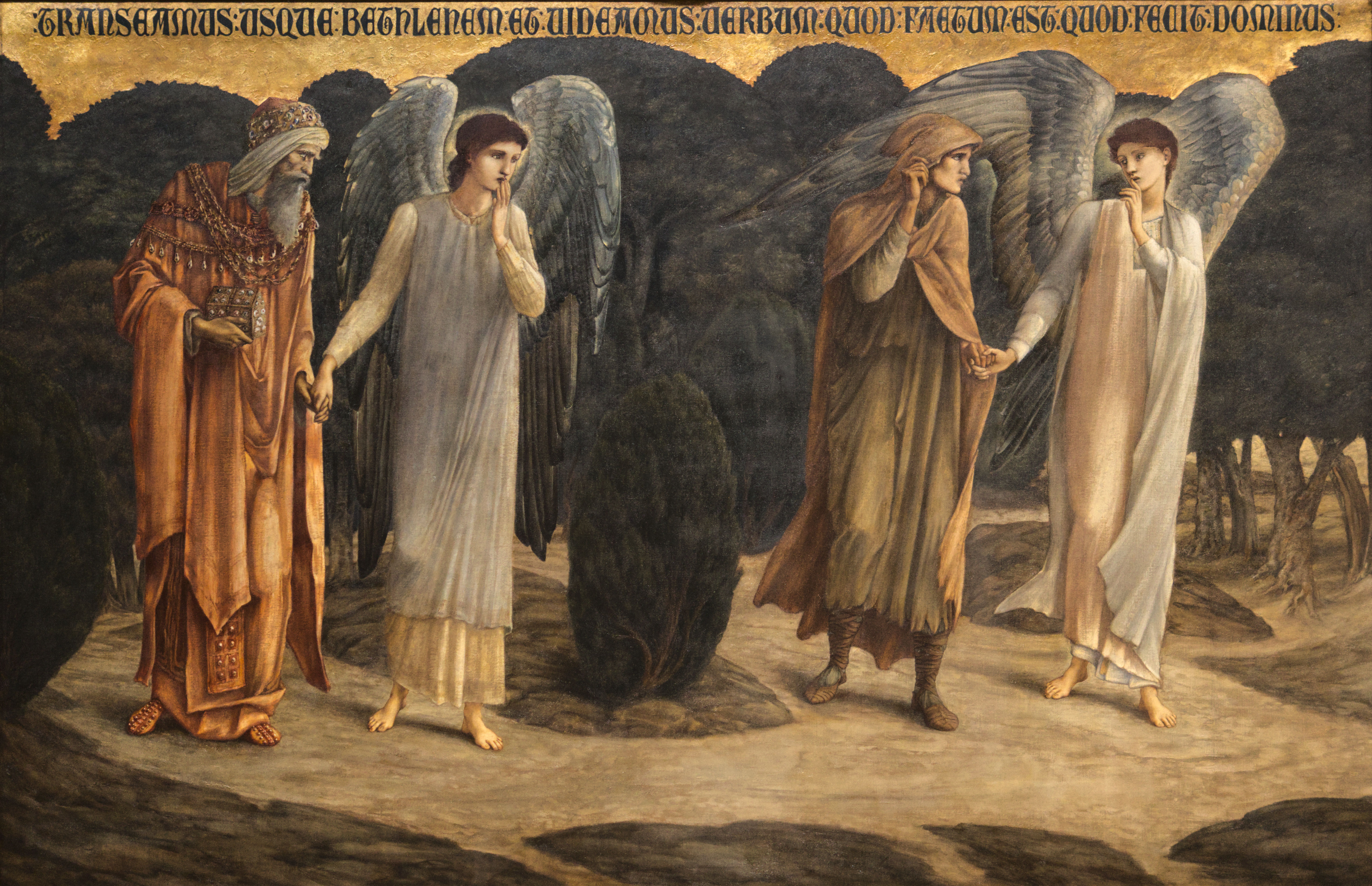
Such is the case with The Nativity and its companion piece, The King and the Shepherd, which were commissioned from the Pre-Raphaelite artist Edward Coley Burne-Jones in 1887 for the chancel of Saint John’s Church in Torquay, England. Seven by ten feet each, they hung on the north and south walls for just over a hundred years before being sold by the church in 1989 to pay for a new roof. (Copies were hung in their places.) Musical theater composer—and Victorian art collector!—Andrew Lloyd Webber bought them and, in 1997, donated them to the Carnegie Museum of Art in Pittsburgh, Pennsylvania. That’s where I saw them earlier this year.
Sir Edward Coley Burne-Jones (British, 1833–1898), The Nativity, 1888. Oil on canvas, 81 × 124 1/2 in. (205.7 × 316.2 cm). Carnegie Museum of Art, Pittsburgh, Pennsylvania.Sir Edward Coley Burne-Jones (British, 1833–1898), The King and the Shepherd, 1888. Oil on canvas, 81 1/4 × 124 1/2 in. (206.4 × 316.2 cm). Carnegie Museum of Art, Pittsburgh, Pennsylvania.
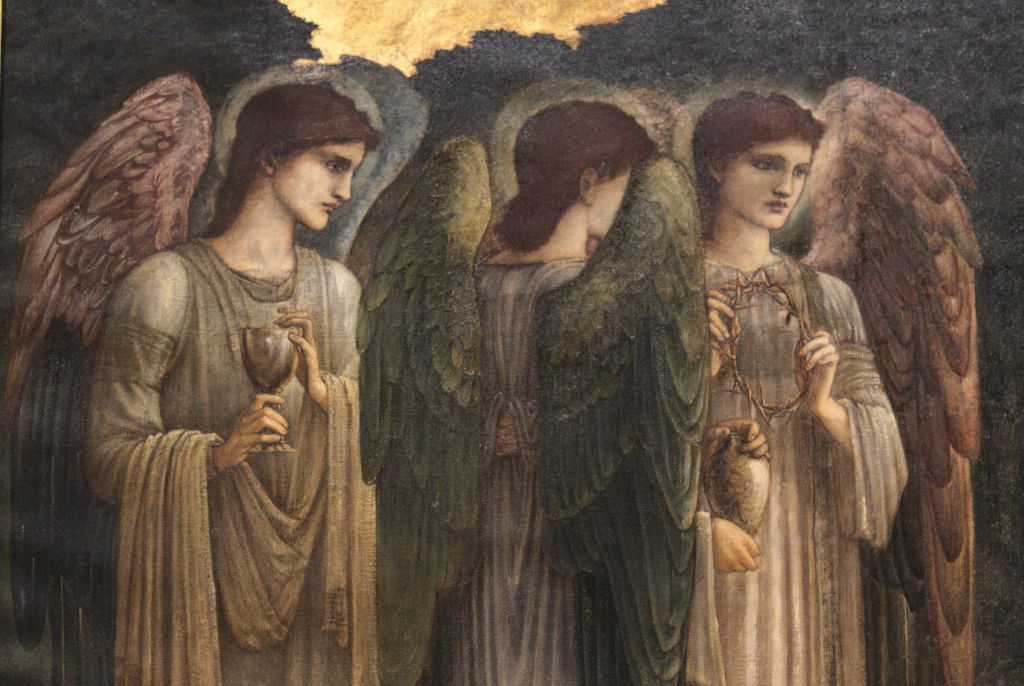
The Nativity shows Mary reclining outdoors on a rustic bed that resembles a bier with her newborn son, Jesus, both wrapped in shroud-like garments. Her partner, Joseph, who has his cloaked back to the viewer, sits on the ground reading a manuscript in Gothic script; the text is indiscernible, but I presume it’s meant to be the scriptures that prophesy the birth of a savior or his sacrificial death. Three angels stand to the side holding symbols of the passion: a crown of thorns, a chalice, and a jar of myrrh, a traditional burial spice. The painting, therefore, links the entrance of Jesus onto the world stage to his ultimate saving act on the cross.
Pastel sketch for The Nativity by Sir Edward Coley Burne-Jones, 1887. The New Art Gallery Walsall, England.
This foreshadowing approach was not new in Nativity art. But in addition to gesturing toward the redemption from sin that Jesus would bring, the painting also quotes from a community lament psalm in which God’s people cry out for deliverance from those in authority who lie and manipulate. Propter miseriam inopum et gemitum pauperis nunc exsurgam dicit Dominus, the Latin inscription reads, which translates, “Because of the misery of the poor and the groaning of the needy, now will I arise, saith the LORD” (Psalm 12:5a). When God’s people are oppressed, God is aroused to action, and Burne-Jones’s choice of this atypical scripture text for a Nativity painting reminds us of the sociopolitical context of Jesus’s birth, which involved Roman occupation of Israel and a despotic ruler so obsessed with power that he mandated the extermination of Jewish male babies in Bethlehem, thinking he would quash the threat of usurpation. This is the reality into which Jesus was born. And though he didn’t deliver Israel from Rome during his lifetime, he did launch a new “kingdom” and declare a jubilee (Luke 4:16–21).
The biblical inscription speaks not only to Jesus’s day but also to contemporary times, which were marked by high unemployment and great hardship among London’s working class. It’s “a subtle allusion to the social miseries of Victorian Britain,” says Louise Lippincott, curator for the Carnegie at the time of acquisition. She speculates that Burne-Jones intended the painting “as his public statement, albeit a muted one, on 19th-century social horrors. . . . It is quite likely that he was thinking of reports of the bestial living conditions of the London poor that were appearing in the press in the early 1880s.” In 1886, 1887, and 1888, as Burne-Jones was planning and executing the painting, violent strikes and riots were going on in London to protest economic inequality. As people starved, those in power continued to fatten themselves with apparent disregard. The incorporation into this humble scene of a divine vow from the Psalms, where God states his commitment to the poor, expresses hope that God will again arise to deliver from affliction those who trust in him.
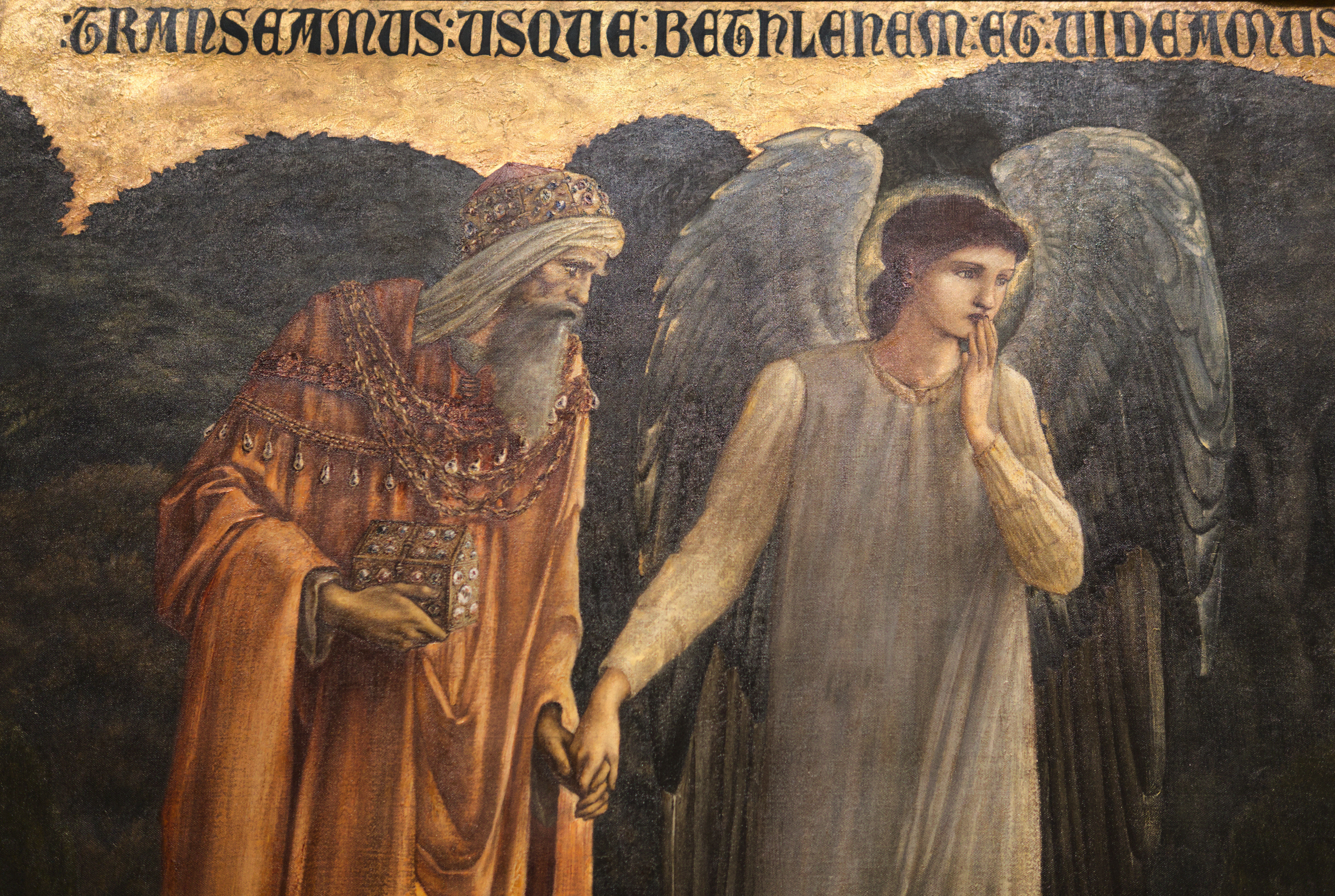
The King and the Shepherd extends this critique of the wealth gap by showing the two titular figures—one rich, the other poor—approaching the Christ child as equals. As was and still is common, Burne-Jones combines Matthew’s account of the magi with Luke’s account of the shepherds, showing both as welcome participants in the same event, but uniquely, he chooses only one figure to represent each group. (Traditionally, three magi attend the birth, along with a nonstandard number of shepherds.) An angel leads each traveler by the hand, reminding them to keep their voices low so as not to wake the sleeping infant.
“The pairings visually suggest the equality, in the face of divinity, between the wealthy king and the humble peasant,” reads the museum wall text. “In the context of the enormous social inequalities rife in Victorian England, this message smacked of social and political radicalism.” The Latin inscription—Transeamus usque Bethleem et videamus hoc verbum quod factum est quod fecit Dominus [et ostendit nobis]—comes from the New Testament description of the journey of the shepherds. “Let us now go even unto Bethlehem,” they say, “and see this thing which is come to pass, which the Lord hath made known unto us” (Luke 2:15b).
God chose to reveal his Son’s birth not only to bookish scholars or, as tradition has it, royalty, but also to a bunch of blue-collar laborers. The shepherds’ and kings’ mutual presence at Christ’s bedside was only the beginning of the reconciliation across lines of division that Christ came to enact.
ONLINE LECTURES, organized by Bridge Projects: This Los Angeles gallery is offering a series of free online events to complement A Composite Leviathan, an exhibition of emerging Chinese artists that runs through February 27, 2021. Here are two I RSVPed for. (Both will be presented in English and Chinese.)
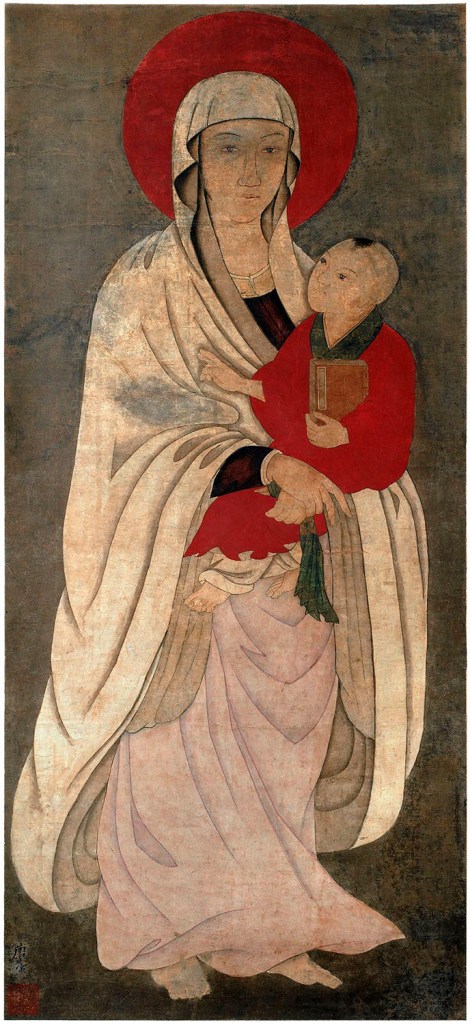
“The Virgin Mother, Her Majesty, Our Lady: Globalism, All-Under-Heaven, and Madonna In-Between” by Dong Lihui, January 12, 8–9:30 p.m. EST: Dong Lihui (PhD, art history), whose research centers on art exchange between East and West, is the author of Chinese Translation of Western Images: Christian Art in China in the 16th and 17th century. In this talk she will discuss the hybridization of European globalism and the Chinese “all-under-heaven” worldview as observed in Chinese Madonna icons made between the sixteenth and twentieth centuries.
Madonna and Child, China, 15th–17th century. Painting on silk, 8 feet high. Field Museum of Natural History, Chicago. Photo: John Weinstein.
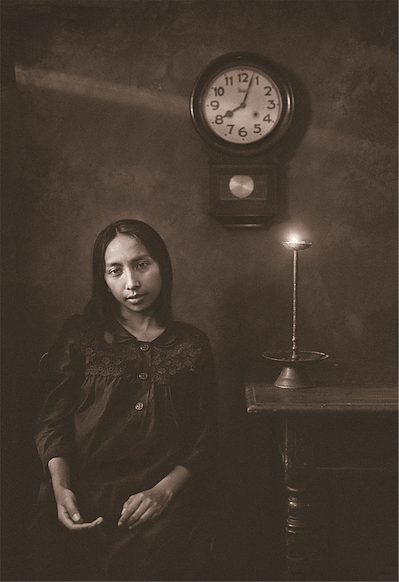
“Counterculture: Chinese Contemporary Christian Art and the Bible” by Clover Xuesong Zhou, January 26,8–9:30 p.m. EST: “The advent of modernity brought with it enmity between Christian traditions and a newly liberated art world. Similarly, contemporary artists in China found themselves at odds with the government beginning in the 1980s. All the while, Christianity has had a torrid relationship with Chinese government and culture. Thus, Chinese artists who are also practicing Christians work within these complex intersections.” Art writer and art theologian Clover Xuesong Zhou will be discussing some such artists, including photographer Stanley Fung (Feng Junlan), video artist Li Ran, and installation artist Gao Lei.
Stanley Fung (Chinese, 1961–), The Lord’s Handmaiden, 2012
+++
SONG: “O Holy Night” by Ben Caplan and friends: An absolutely stunning minor-key rendition by Canadian singer-songwriter Ben Caplan (who is often compared to Leonard Cohen) and a team of others, combining gypsy jazz, classical, and Jewish folksong influences. Caplan, who is Jewish, didn’t grow up listening to much Christmas music. “I have to admit that I find a lot of that music a bit corny. Where is that minor fall? Where is the major lift? Where is the bafflement?” He continues, “I have a deep felt belief that if you don’t like something, you should do something about it. It’s not enough to complain from the sidelines! There are some truly beautiful songs and carols out there, and I wanted to make something that tip-toes towards the sublime rather than shopping-mall-easy-listening.” Arcade Fire’s “My Body Is a Cage” was one of his reference points. (“I wanted to try to recreate that gradual build, and the sublime surrender to an enormous scale of sound.”) There are a few intentional semitone clashes to generate dissonance.
Filmed last year inside Halifax’s Fort Massey United Church and released in November, this recording was in the making for four years and is the result of much collaboration. The left-handed violinist in the video, Donald MacLennan (see, e.g., 1:34), reharmonized the carol, and he, Caplan, upright bass player Anna Ruddick, drummer Jamie Kronick, and vocalist Taryn Kawaja worked out an arrangement for their band, which they performed at a Christmas concert in 2016. Peter-Anthony Togni, who plays organ for the song, was brought in later to arrange the song for string quartet, pipe organ, and bass clarinet. Caplan chose the instrumentation and aesthetic shape. He recounts the process in detail and names all the people involved on his Bandcamp page. “I want to dispel the myth of the lone genius,” he says. “It took a lot of people with a lot of talent to pull this off. I am just the lead singer, and the guy who was stubborn enough to bring all the people together and spend an outlandish amount of money trying to achieve this vision.” Purchase on Bandcamp, and/or stream on Spotify.
I am truly moved by this atmospheric take on an old classic, which perfectly brings together the darkness and light of the Christmas season. “Original, and righteous—hymn for the COVID time,” says one YouTube user. “You’ve found things in this old carol that I never knew existed,” says another. And another: “A sensory feast. So deeply piercing.”
“Mele Kalikimaka” (“Merry Christmas”) is a Hawaiian-themed song written in 1949 by R. Alex Anderson. Born in Honolulu in 1894, Anderson, a Caucasian, became one of the most popular composers in the hapa haole (“half-white”) genre, which describes music with a Hawaiian tune, styling, and/or subject matter but lyrics that are mostly or entirely in English. Over his long career Anderson composed nearly two hundred songs, several of which became popular standards, and he was posthumously inducted into the Hawaiian Music Hall of Fame in 1998. “His ear for Hawaiian music’s special sound and rhythm was exceptional,” the HMHF wrote, “and he was regarded as a successor to Charles E. King in maintaining the melodic and lyrical qualities which are Hawaii’s musical identity.”
In a 1994 interview, shot just a year before his death at age 100, Anderson said he was inspired to write “Mele Kalikimaka” when a coworker lamented to him one day that there were no original Hawaiian Christmas songs; all that existed were Hawaiian translations of carols from other countries.
So he got to writing:
Jingle bells upon a steel guitar Through the palms we see the same bright star
“Mele Kalikimaka” is the thing to say On a bright Hawaiian Christmas Day That’s the island greeting that we send to you From the land where palm trees sway Here we know that Christmas will be green and bright The sun to shine by day and all the stars at night “Mele Kalikimaka” is Hawaii’s way To say “Merry Christmas” to you
A year later, in 1950, the song appeared on the flip side of Bing Crosby’s White Christmas album, featuring the Andrews Sisters.
Since then it has been covered by a range of artists, including the Monkees, Bette Midler, Jimmy Buffett, Train, Teresa Carpio, Ingrid Michaelson, She & Him, the Puppini Sisters, the Petersens, Leslie Odom Jr., and others. I especially like the playful version performed by married couple Gianni Nicassio and Sarah Blackwood of the Canadian indie-pop band Walk Off the Earth. They do vocals, ukulele, guitar, djembe, chimes, cymbals, and kazoo! The song can be purchased here.
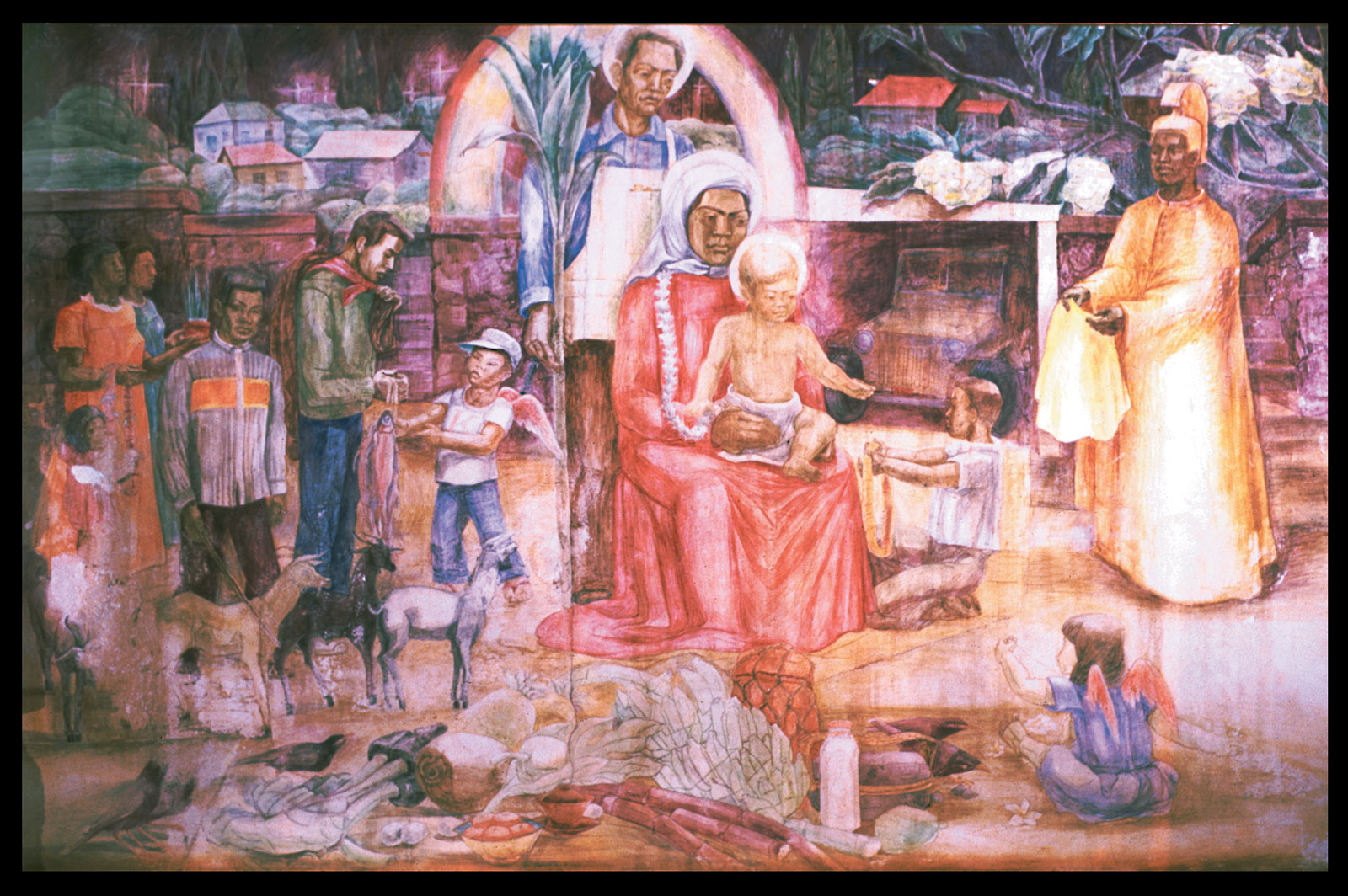
In the same decade that Bing Crosby catapulted Anderson’s Hawaiian Christmas song to nationwide popularity, painter Juliette May Fraser carried out a mural commission for the newly built St. Catherine’s Catholic Church in Kapa‘a, Kauai, commonly referred to as Hawaiian Nativity. Covering the makai (sea-facing) wall, it shows Hawaiians of various ethnicities presenting ho‘okupu (gifts) to the newborn Christ child, who sits on his mother’s lap.
Juliette May Fraser (American, 1887–1983), Hawaiian Nativity, 1958. Fresco, 4 1/2 × 8 ft. St. Catherine’s Catholic Church, Kapaʻa, Kauai, Hawaii. Photo: Timothy T. De La Vega, 1999.
Fraser is of Hawaiian, Chinese, Filipino, Portuguese, and Irish ancestry, and this multiculturalism is reflected in her Nativity. She wanted the painting to be modern and “international in flavor,” she said, reflecting Hawaii’s ethnic diversity.
Instead of a donkey, a jeep has brought the holy couple, who are portrayed as Native Hawaiian, to the place of their son’s birth. The license plate reads, “4-20-58,” the date on which St. Catherine’s was dedicated. Mary wears a muumuu and lei, while Joseph stands behind her with a sugar cane stalk. “The Holy Child is hapa [mixed race] with blond hair and strong Polynesian features,” writes Anthony Sommer in the 1999 article for the Honolulu Star-Bulletin that introduced me to this painting. That Jesus’s skin tone is the lightest of the bunch might be regarded by some as problematic, a subtle reinforcer of racial hierarchy. However, I see this more as the artist’s attempt, whether you deem it successful or not, to show a multiracial Christ, bearing the features of different peoples.
In Fraser’s fresco, locals approach with ho‘okupu, the fruits of their personal labors given freely as offerings in expression of gratitude, respect, and aloha. Filipino fishermen present their freshest catch, and Portuguese goatherds (as the artist identified them) come with their flocks; they are greeted by a Chinese angel in a T-shirt, jeans, a sideways ballcap, and flip-flops. From the right, a Hawaiian ali‘i (hereditary noble) comes with the gift of an ʻahu ʻula (feathered cloak), made only for royalty. He stands in line behind a child who offers Jesus a lei (flower garland). Traditionally, ho‘okupu are given to an akua (god), king, priest, doctor, or host, so this painting acknowledges Jesus as fulfilling all those roles.
The photo here, by Timothy T. De La Vega, was taken prior to the 2001–2 restoration; he emailed it to me when I reached out to him. I’ve sought out more recent photos through multiple channels—the church office, the parish Facebook page, a priest in the diocese, the restoration fundraiser—but have not had any success.
St. Catherine’s also houses frescoes by two other celebrated Hawaii artists: Compassionate Christ by Jean Charlot and Francis Xavier, Apostle of Asia by Tseng Yo Ho. Charlot, Tseng, and Fraser were hired by Father John McDonald—who (fun fact) was also the one who convinced movie producers to cast St. Catherine’s choir in the movies South Pacific and Blue Hawaii!
DIGITAL EXPERIENCE: “Holy Night: The Christmas Story and Its Imagery”: This “Digitorial”—a responsive, multimedia, educative webpage—was created as a supplement to a physical exhibition at the Liebieghaus Skulpturensammlung in Frankfurt that ran from October 12, 2016, to January 29, 2017, which brought together over one hundred paintings, sculptures, and other precious objects, mostly from medieval Germany, to tell the story of Jesus’s birth. Featured online are a magnificent Rhenish tapestry (seriously, click that link and zoom in!), an ivory relief carving, an altar, a wooden statuette of Mary with a removable flap on her belly that reveals the Christ child, a liturgical cradle and doll, a manuscript illumination, a woodcut, and more. Also included, for listening, are readings from the Revelations of Saint Bridget of Sweden (a fourteenth-century mystic whose vision of the nativity had widespread influence) and the Gospel of Pseudo-Matthew (source of the legend of the miraculous palm tree on the Holy Family’s flight to Egypt), as well as a lullaby from a medieval mystery play at Leipzig and perhaps also sung as part of the custom of Kindleinwiegen. Curator Stefan Roller introduces the exhibition in this video:
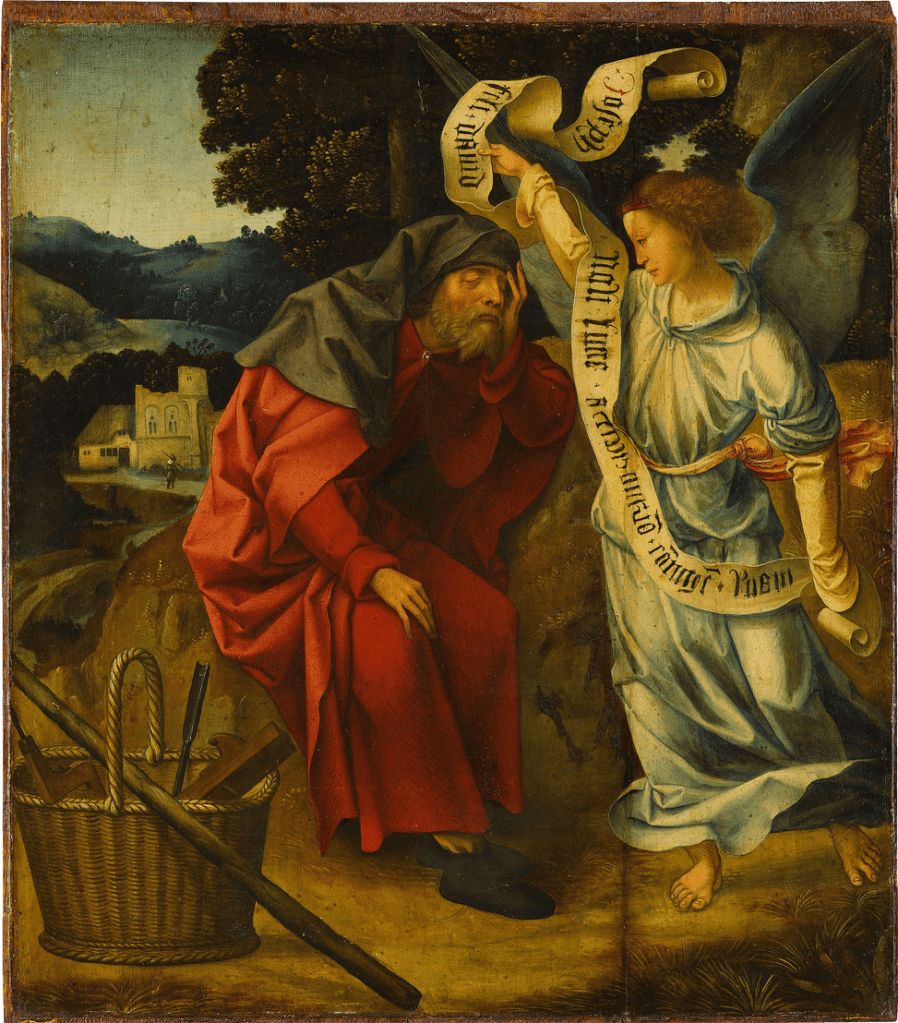
The Angel Appears to Joseph in His Dream, 1518, from the predella of the Antwerp Altarpiece in the Lady Chapel of Saint Mary’s Church, Lübeck, Germany. Mixed media on oak, 46 × 40.2 cm. Staatsgalerie Stuttgart, Germany.The Virgin Mary’s Confinement, Meuse region, ca. 1380. Walrus tooth with remains of the old coating, 51.8 × 58 × 14 cm. Badisches Landesmuseum, Karlsruhe, Germany. Photo: Thomas Goldschmidt.
The “Holy Night” Digitorial is written for a middle-grade reading level, I’d say; some of the narration seems geared toward kids. It doesn’t assume any knowledge of the Nativity story, and in addition to highlights from the biblical accounts, it mentions some apocryphal story elements, like Joseph’s backstory, the midwives at the birth, the palm tree and wheatfield miracles, and the identity of the “kings.” I appreciate how it covers the full story, including Jesus’s circumcision and the flight to Egypt. My only two wishes are that the images were provided in higher resolution and that full credits (especially the collection these objects are from) were given at the bottom.
I really love the Digitorial format! It’s engaging. If I could afford it, I would endeavor to hire web designers to help me produce products like this. This one was designed and developed by Scholz & Volkmer with funding by the Aventis Foundation. More about Digitorials: “Digitorials are short, interactive, online editorials that combine text, images and animations into a meaningful whole and enable innovative storytelling. Digitorials are not intended to replicate or replace physical exhibitions. Rather, they are a useful way of adding breadth and depth, and are usually used before or after visiting an exhibition. The format was developed by the Städel Museum, Liebieghaus Skulpturensammlung and Schirn Kunsthalle in Frankfurt and is breaking new ground in art mediation, as it uses digital technology to offer an accessible and approachable way of engaging with art. It has already been awarded the Grimme-Preis.” See other examples: https://www.staedelmuseum.de/en/digitorial; https://www.liebieghaus.de/de/angebote/digitorial; https://www.schirn.de/en/program/offerings/digitorial/.
+++
SONGS:
>>“Jeg Synger Julekvad” (In dulci jubilo): This Christmas hymn of German origin often appears in English-language hymnals as “Good Christian Men, Rejoice!” or the gender-neutral “Good Christian Friends, Rejoice!” This jazz arrangement by Heidi Skjerve, with Norwegian lyrics by Magnus Brostrup Landstad, is performed by Skjerve (she’s the vocalist on the left) and students from the Norwegian University of Science and Technology (NTNU) Department of Music [previously]. The other two vocalists are Liv Ellen Rønning and Jakob Leirvik. See the full list of musicians in the YouTube description. [HT: Global Christian Worship]
>>“Carol of the Bells,” arr. Al White, performed by the Berea College Bluegrass Ensemble: Al White, who taught Appalachian instruments at Berea College in Kentucky until retiring in May, founded the Berea College Bluegrass Ensemble in fall 1999 to give students with backgrounds or potential in bluegrass music an opportunity to play in a bluegrass band with weekly rehearsals, performances, and travel. This is one of the many arrangements he wrote—sometime around 2008. In this 2016 video, recorded inside Berea’s Danforth Chapel and outdoors, White plays mandolin and leads four other musicians: Brenna Macmillan on banjo and vocals and Theo Macmillan on fiddle (the two are siblings, now performing and recording as the Theo & Brenna Band), Matt Parsons on guitar, and Casey Papendieck on upright bass (he’s part of the Handshake Deals). As of this fall, the Berea College Bluegrass Ensemble is under the direction of Sam Gleaves. [HT: Global Christian Worship]
>>“Peace Upon the Earth” by Hillsong Worship: Since being introduced to Chopin by my piano teacher as a kid, he’s been one of my favorite composers to play—his etudes, nocturnes, waltzes, fantasias. In this 2017 song from Hillsong’s Christmas: The Peace Project, Marty Sampson wrote lyrics for Chopin’s Nocturne in E-flat major (op. 9, no. 2), which actually works really well! It’s a beautiful handling of the iconic melody. Starting at 3:44, Sampson talks about his songwriting process. He says he was inspired by “Hark! the Herald Angels Sing,” which came about when William Hayman Cummings adapted the melody of “Vaterland, in deinen Gauen,” a song from Mendelssohn’s secular Gutenberg Cantata, to fit Charles Wesley’s hymn text.
+++
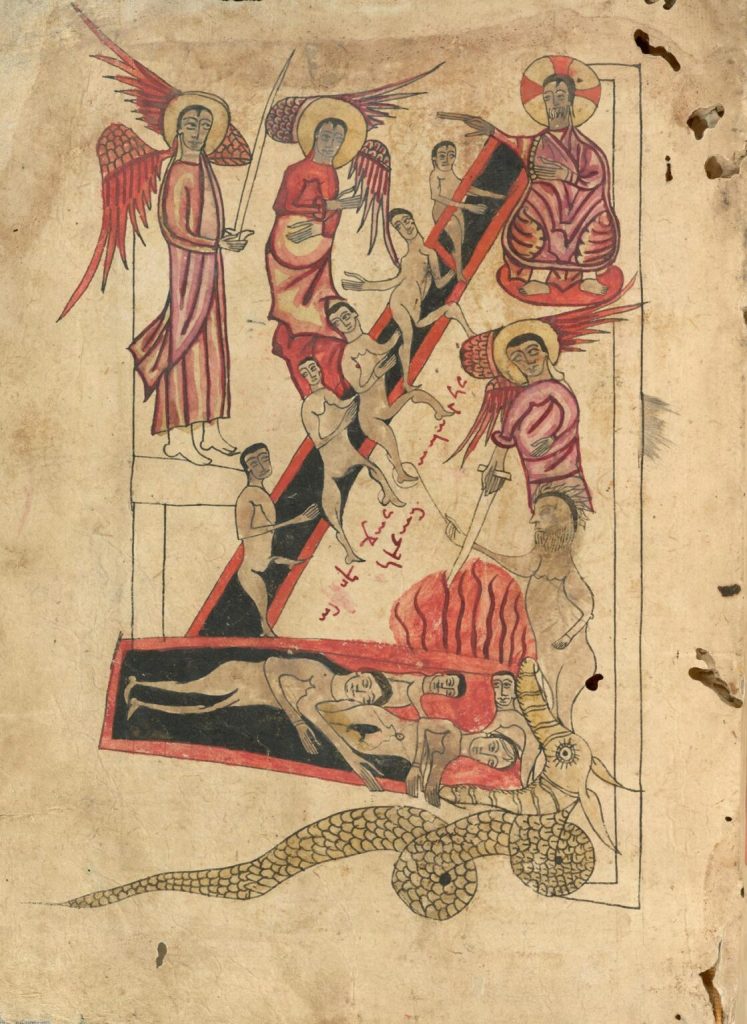
NEW ACQUISITIONS: “2 Armenian Manuscripts Join the Getty Collection”: This year the J. Paul Getty Museum in Los Angeles acquired, among other art objects, (1) a detached leaf with a full-page Nativity illumination from a seventeenth-century Armenian Gospel-book, and (2) a sixteenth-century Armenian Gospel-book illuminated by a brother and sister team, Ghoukas and Eghisabet. (A female illuminator named in an early modern manuscript—woot woot!) “Little is known about the involvement of women in the trade of manuscript illumination, but we hope that highlighting figures like Eghisabet will spark further research and understanding about their role,” write Elizabeth Morrison and Nava Streiter in this Getty blog post.
Mesrop of Khizan (Armenian, active 1605–1651), The Nativity with the Adoration of the Shepherds and Magi, from a Gospel-book made in Isfahan, Persia, 1615. Tempera, gold, and ink on parchment, 23 × 16 cm. J. Paul Getty Museum, Ms. 118 (originally from Ms. Ludwig II 7).Eghisabet (Armenian), The Way into Eternal Life, from an Armenian Gospel-book, 1583. Tempera and ink on parchment, 24.8 × 17.9 cm. J. Paul Getty Museum, Ms. 119, fol. 6v.
Ms. 119 is now the third Armenian Gospel-book in the museum’s collection, and Morrison and Streiter compare one of the illumination subjects side-by-side across all three books—in addition to providing visual comparisons with Ethiopian and Byzantine Gospel-books.
PANEL DISCUSSION: “Religious Art,” organized by the Forum for Philosophy: I posted about this live online event a month ago, and now that it’s passed, I want to share the video recording. Theologian Ben Quash (King’s College, London), curator Lieke Wijnia (Catharijneconvent Museum, Utrecht), and art historian Mehreen Chida-Razvi (Khalili Collections, London) discuss the relationship between art and religion, how art can function within religious practice, how to exhibit religious art in a museum, and artworks as sites of conversation across religious traditions.
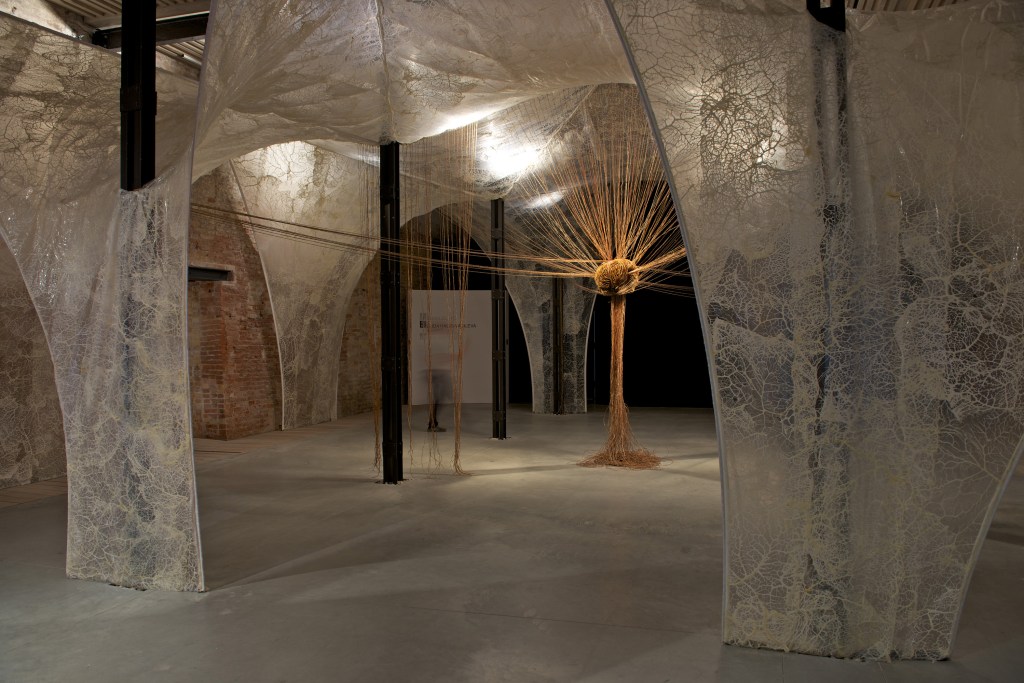
Quash opens by proposing different categories of “religious art”: art for religion, art about religion, art with religion, and art instead of religion. The three unpack those a bit, discussing the intentions of the artist or patron versus how the artwork is perceived by the viewer. Quash mentions Haruspex by Elpida Hadzi-Vasileva (a fascinating installation commissioned by the Vatican for the 2015 Venice Biennale, a contemporary artist’s response to “In the beginning . . . the word became flesh”; read Quash’s essay and an artist interview), the East Window at St Martin-in-the-Fields by Shirazeh Houshiary, the Raphael Cartoons, and Aaron Rosen’s 2016 Stations of the Cross exhibition throughout the city of London, which shows the permeability of the boundaries between sacred and secular. (I participated, as viewer/pilgrim, in a 2019 iteration of the Stations project in Amsterdam.)
Elpida Hadzi-Vasileva (Macedonian, 1971–), Haruspex, 2015. Organic materials. Installation at the Pavilion of the Holy See at the 56th Venice Biennale.
In reference to Hadzi-Vasileva’s canopy of pig’s caul fat, Quash says that challenge or provocation can be a meaningful thing to happen in a religious context:
Works that ambush you are also religiously important, because a sort of religious art that only gives you what you already expect and want quickly becomes kitsch. It’s just a reward of your expectations. And that shouldn’t be what religious art does, it seems to me. It should actually want to take you somewhere else, just as good religion should—it should be transformative, not merely confirming where you already are. So there’s a role for these sorts of artworks within religion as well as outside it.
Chida-Razvi shares slides of Islamic architectural spaces, devotional objects, and manuscript illuminations, including a Mughal painting that exemplifies the interfaith dialogue going on at the court of Akbar in Lahore, and Wijnia shares her experience curating objects people pray with for museum display and (forthcoming) an exhibition on Mary Magdalene. Such great content!
+++
ADVENT SONGS:
“He Comes,” words by Kate Bluett, music by Paul Zach: A lovely new Advent hymn, performed here by Paul Zach.
“The Heavens Shake” by Reindeer Tribe:Reindeer Tribe is a group of friends based in Los Angeles who get together each year to make a live Christmas album, a mix of originals and traditional, sometimes retuned, carols. They bring their voices, instruments, and arrangements and jam together for a long weekend in a big living room. (COVID-19 put the kibosh on this year’s gathering.) This original song, perfect for Advent, is on their 2014 album, A Great Light. “For thus says the LORD of hosts: Yet once more, in a little while, I will shake the heavens and the earth . . .” (Haggai 2:6).
+++
ARTICLE: “We don’t need to be afraid of the Christmas tree’s pagan roots” by Damian Costello, America: Dr. Damian Costello specializes in the intersection of Catholic theology, Indigenous spiritual traditions, and colonial history. In this article he considers how the Christmas tree pictures Christ as the new Yggdrasil (the giant ash tree at the center of the Norse cosmos), and the spiritual character of nature. The second half—about “the hidden agency of trees”—stretches my categories for sure, and I wonder if it’s a bit overwrought, but I’m intrigued by the links Costello draws between the Psalms, Anishinaabe spirituality, and the theology of the Catholic saint John Henry Newman. The article reminds me of Luci Shaw’s poem “Perfect Christmas Tree.”
+++
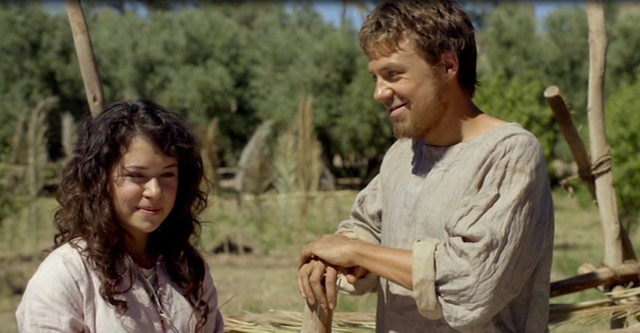
FILM: The Nativity (2010), written and directed by Tony Jordan: I’m always skeptical of film adaptations of the Bible because so many are poorly done. But I gave this four-part BBC miniseries (streaming on Amazon Prime) a shot, and, other than a really cheesy moment during the birthing scene, I thought it was quite good! Writer-director Tony Jordan is not a Christian but approaches the story with the reverent curiosity of a dramatist. He said he never connected with the nativity story until he worked on this project and started to see the very real humans beneath the auras tradition has given the “holy couple”—he saw their earthiness and complexity and began to imagine their emotional lives, especially their reactions to the disruptions they encountered. He said the relationship between Mary and Joseph was key to him. Many storytellers assume that because the marriage was arranged (or because, according to apocryphal sources, Joseph was an old man), there was no passion in their relationship, that they were bound together more by duty than by love, but Jordan, without overly romanticizing, imagines otherwise. The warmth between Mary and Joseph in the first half, which they have to work to regain after news of Mary’s pregnancy hits Joseph like a ton of bricks, is a hallmark of the movie.
Tatiana Maslany (Orphan Black) is probably my favorite Mary I’ve seen onscreen. (I also like Andrew Buchan [Broadchurch] as Joseph.) Jordan says most people see Mary as “a one-dimensional character with a halo round her head,” but actually, “she’s not saccharine. Just a nice kid—real but fallible.” He shows her as virtuous but not a goody-goody, fun-loving and confused and scared and courageous all at once, stepping into her new role by faith without seeing the full picture and even discipling Joseph into that faith. Maslany plays the part brilliantly, endearingly. The film addresses the isolation Mary felt, being rejected not only by her fiancé at first but also by the synagogue leadership and disbelieved, too, by the community she had grown up in. I’ve seen many actors portray Mary as detached, transcending all her difficult circumstances with calm, unshaken resolve. This Mary, by contrast, experiences hurt and fear and yet endures, which, I suspect, is closer to the historical reality. This in no way undermines her faith.
I was delighted by the Annunciation scene, where Gabriel comes to Mary as an ordinary man, much like the angels who visited Abraham generations earlier. He is not wearing ermine or carrying a scepter or standing on a rock above Mary with a booming voice and a heavenly glow. He’s simply a stranger who startles her, even more so when he relays his news. He speaks gently, colloquially. The moment of conception is portrayed as sudden and visceral; Mary feels Light enter her and reacts with a sort of joyful shock.
The trailer and posters, I will say, make the film seem pretty conventional. It does follow some conventions, but it’s also fresh, and while it has some flaws, I think it’s a very worthy use of two hours—it brings this ancient story to life in compelling ways.






#/media/File:Edward_Burne-Jones_-_The_Nativity.jpg)




 Art & Theology