Roundup: Peter’s tears, “The Mission” film, Tan Dun’s “Water Passion,” and more

VISUAL COMMENTARY: “Repentance (Transforming Tears)” by Clemena Antonova: One of the three works that art historian Clemena Antonova curated for the Visual Commentary on Scripture exhibition on Peter’s denial of Christ (Matt. 26:69–75; Mark 14:66–72; Luke 22:54–62; John 18:15–18, 25–27) is the installation Lágrimas de São Pedro (Tears of Saint Peter) by contemporary Brazilian artist Vinícius Silva de Almeida. The artist used hundreds of light bulbs, filled with water and suspended on near-invisible nylon threads, to create an environment in which visitors move between “tears” falling like raindrops from above. In the Christian tradition, Peter is regarded as a paradigm of penitence, as scripture says he “wept bitterly” when he realized his sin, and soon after he was restored to Christ. As Antonova interprets, Tears of Saint Peter invites folks to reflect on the interconnection of sorrow and healing in Peter’s story and in their own.

Silva de Almeida, Vinicius_Tears of Saint Peter
Vinícius Silva de Almeida (Vinícius S.A.) (Brazilian, 1983–), Lágrimas de São Pedro (Tears of Saint Peter), 2005–21. 6,000 light bulbs filled with water (various numbers in different locations). Photo: Erivan Morais.

View additional photos here.

+++

SONGS:

>> “Peter” by Montell Fish: Montell Fish (the stage name of Montell Frazier) is a singer-songwriter from Pittsburgh whose music combines elements of lo-fi and classic R&B. In his song “Peter” from the album Camp Lukewarm (2020), he compares himself, in confessional mode, to the titular apostle, who denied Christ three times. “Sometimes I feel like Peter / Denied you and I cannot deny that I did / Can I rest my head on your shoulders again?” In the bridge, Christ answers in the affirmative: Yes, come rest.

>> “O How He Loves You and Me / Your Love Divine”: The first song in this medley was written by CCM (contemporary Christian music) pioneer Kurt Kaiser in 1975; the second by the legendary gospel artist Richard Smallwood. Recorded live at Jericho City of Praise in Landover, Maryland, it’s performed here by Smallwood (at piano) and his vocal and instrumental ensemble Vision, featuring soloist Vanessa Williams. The recording appears as two separate tracks on Persuaded: Live in D.C. (2001).

Here are the lyrics to the second song, starting at 3:06:

Refrain:
Lord, you know the pain, pain we bear
And Lord, you know the toils, toils and cares
Send your direction
Send your protection
Send your compassion
And your love divine

Verse:
Help us love those who would do us wrong
Send your cleansing power from above
Unite our hearts as one
Make us vessels for the flow-through of your love

[Refrain]

Vamp:
Your love divine
Your love divine

+++

BOOK CHAPTER: “Maundy Thursday—The Mission,” chap. 16 from Films for All Seasons by Abby Olcese: Abby Olcese is a writer on film, faith, and popular culture, living in Kansas City. Last year her book Films for All Seasons: Experiencing the Church Year at the Movies was published by InterVarsity Press, spotlighting twenty-six films as lenses through which to reflect on the great themes of the church calendar. I was preparing to write something on The Mission, the 1986 film directed by Roland Joffé, for Lent this year when I encountered this book, and because Olcese covers the movie so well, I secured permission from IVP to provide a free PDF download of the chapter to Art & Theology readers. Olcese situates The Mission as a film that’s especially appropriate for Maundy Thursday, a day when the church reflects on the call to servant-love and commemorates, among other things, Jesus’s arrest in the garden of Gethsemane, during which he and his disciples “face the forces of human empire, a dramatic moment of conflict ending in what, for the moment, feels like defeat.”

The Mission addresses themes of Christian ministry, the kingdom of God, repentance, forgiveness, love, respect, and the nonviolent ethic of Christ. Based on actual events, it follows an eighteenth-century Spanish Jesuit priest, Father Gabriel (Jeremy Irons), as he establishes a mission among the Guaraní people in the borderlands of present-day Argentina, Paraguay, and Brazil and seeks to protect the Guaraní from the encroachment of Spanish and Portuguese enslavers. He is later joined by the penitent Rodrigo Mendoza (Robert De Niro), a recent convert and former slave dealer and mercenary soldier. But the two clash over how best and most faithfully to protect the people they live among and serve.

PDF excerpt from Films for All Seasons by Abby Olcese. Copyright © 2024 by Abigail Olcese. Used by permission of InterVarsity Press. www.ivpress.com

+++

ORATORIO: Water Passion After St. Matthew by Tan Dun: Commissioned for the 250th anniversary of Bach’s death in 2000, this eclectic, Asian-influenced Passion oratorio by the Chinese American composer Tan Dun follows Jesus from his baptism to his resurrection. As the title suggests, water plays an important role in the work. When performed, seventeen large transparent water bowls, dramatically lit from below, form a cross on the stage and are used by percussionists throughout the piece’s ninety-minute duration, creating various timbres. (“The three percussionists make water drip, flow, burble, crash and hiss. They lift handfuls of water, then fling it back down. They stir it, strike it with pairs of plastic cups, float soup bowls upside down in it and play them,” Justin Davidson described in his review of the world premiere.) For Tan, water is “a symbol of baptism, renewal, re-creation, and resurrection.”

Tan Dun
Composer Tan Dun plays a “water drum” in Hangzhou, Zhejiang Province. Photo courtesy of Visual China Group (VCG).

In addition to the water percussion, the work calls for an SATB chorus that doubles on stones and tingsha (Tibetan finger cymbals); soprano and bass soloists who double on the xun (Chinese ocarina, or globular vessel flute) and who are required to do some Mongolian overtone singing; one violin; one cello; and one sampler player (Yamaha A-3000).

Water Passion premiered in Stuttgart, Germany, on September 8, 2000, conducted by Tan—you can listen to the full live recording on Spotify—and it has since been performed a handful of other times across the globe. I recommend the following hour-long video from Symphony Tacoma in Washington, which features excerpts from their March 30, 2016, performance augmented by interviews with some of the key players:

+++

ARTWORK: The Judas Window by Laurence Whistler: In 1940, St Nicholas Moreton in Dorset was hit by a German bomb, destroying much of the church building, including its nineteenth-century stained glass windows. After rebuilding, the church commissioned the renowned glass engraver Laurence Whistler in 1955 to make twelve new windows, replacing the ruined ones, a project he worked on for the next three decades; they depict butterflies, birds, rabbits, wildflowers, candles, stars and planets, and local scenes. (See a few photos at The Dorset Rambler or Chris Belsten’s Flickr album.) In 1987 he offered to donate a thirteenth window on the theme of forgiveness, featuring the death of Judas, which would be visible, by design, from the outside only (the proposed space was blocked on the inside by a memorial tablet). The idea was entertained but, after consultation between the rector, parish council, and local diocese, was ultimately rejected due to its controversial nature—too many felt that it just wasn’t a fitting subject for a church window. Eager to pursue his vision, Whistler made the window anyway and loaned it to the county museum in Dorchester but insisted that if the church ever changed its mind, it should be given to them.
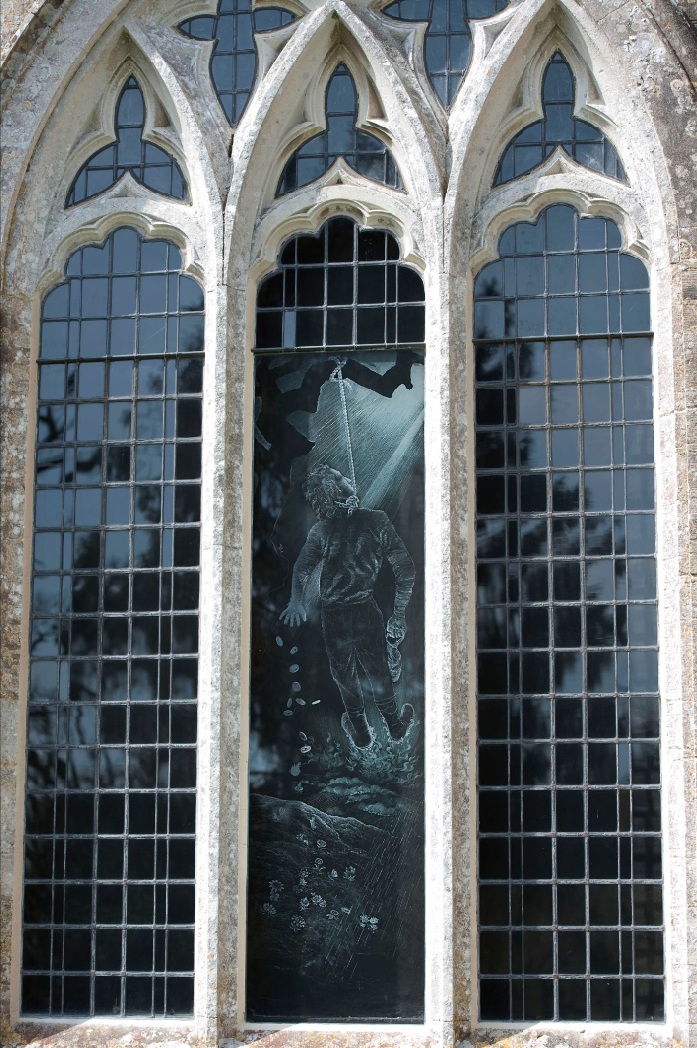
Whistler, Laurence_The Death of Judas
Laurence Whistler (British, 1912–2000), The Death of Judas (aka the Forgiveness Window), made 1993, installed 2013. Engraved glass, St Nicholas’ Church, Moreton, Dorset, England. Photo: Phil Yeomans / Bournemouth News and Picture Service.

In 2012, Rev. Jacqueline Birdseye, the new rector, encouraged the parish to revisit the issue, and this time around, there was unanimous approval to install the window, startling though it is. Again, it’s a blind window—behind it is black wooden boarding—which was the artist’s intent, as he wanted Judas to be a “shadowy” figure (so he couldn’t be front-lit and backlit) and on the outside, near the graveyard. But, unlike traditional portrayals of Judas’s suicide, which are bleak and punishing, Whistler’s portrayal is one of subtle hope, redemption, and new life. The uniting theme of the twelve interior windows is “light,” and here a bright shaft falls from the heavens on Judas’s upturned face. Hanging from his noose, he relinquishes the thirty coins for which he sold his Savior, and when they hit the ground they transform into flowers; the “field of blood” (Acts 1:18–19) becomes a spring meadow.

Scripture tells us that after realizing his enormous error, Judas “repented” (Matt. 27:3 KJV), “was filled with remorse” (NLT), and returned the blood money. Though Christians have historically counted Judas as eternally damned, other Christians have suggested the possibility of forgiveness beyond the grave for the traitorous disciple who was desperately grieved by his sin. “There’s a wideness in God’s mercy.” “A broken and contrite heart, O God, you will not despise” (Ps. 51:17).
Roundup: Bolivian Christian art, Ukrainian folk carol, and more

ART SERIES: Pallay: Andean Weaving of Liturgy and Design by Daniela Améstegui: Daniela Améstegui is a graphic designer from Cochabamba, Bolivia, who holds a master’s degree in theological studies from Regent College in Vancouver, with a specialization in Christianity and the arts. Her work “revolves around exploring faith, social justice, and Christian contextualization through design” and “reflects her commitment to using design as a tool for expressing and exploring theological concepts,” she says. She currently lives in Langley, British Columbia, with her husband and two young children, working as a freelancer.

Améstegui’s final Integrative Project in the Arts and Theology for her master’s program was Pallay: Andean Weaving of Liturgy and Design, a series of seven digital illustrations, one for each of the major seasons/feasts of the liturgical year: Advent, Christmas, Epiphany, Lent, Easter, Pentecost, and Ordinary Time. The designs are inspired by Andean textile art and culture. You can view the full series at the link above from Regent College’s Dal Schindell Gallery, where the works were first exhibited in early 2022, but also listen to this wonderful online talk Améstegui gave about Pallay in 2020 for INFEMIT’s Stott-Bediako Forum, where she discusses not only her motivation and influences but also the content of each specific piece:

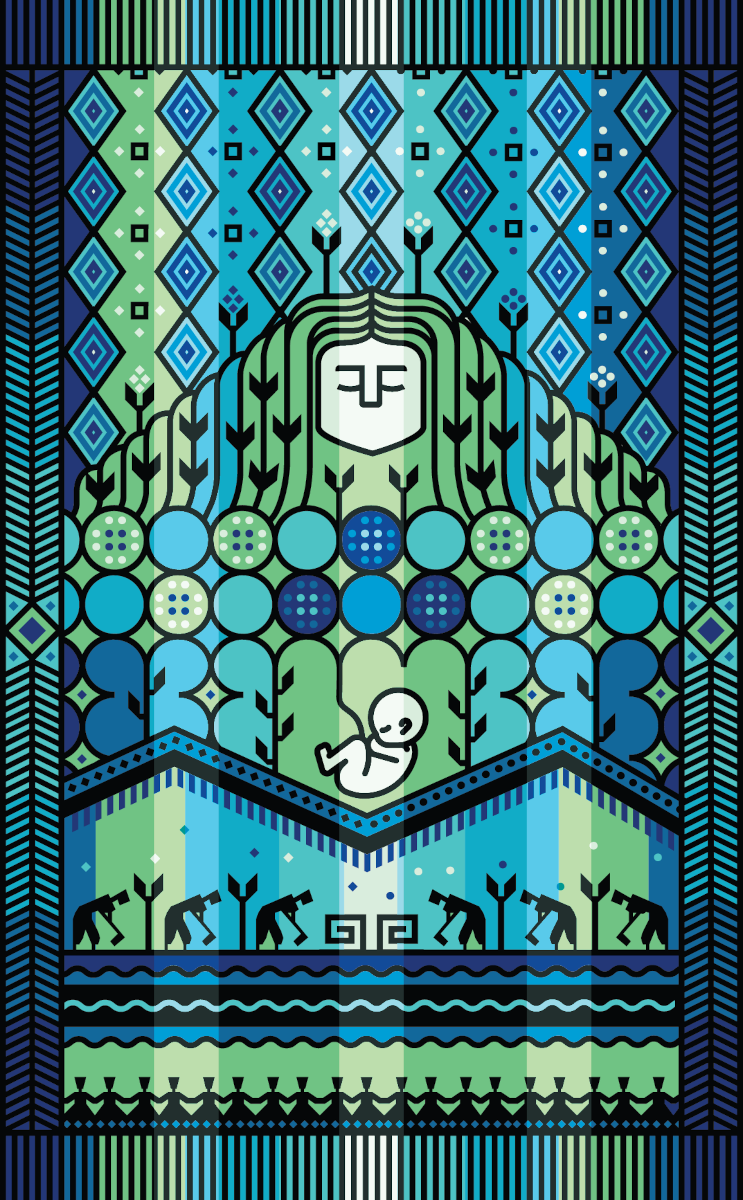
Whereas those of us in the northern hemisphere associate Advent with cold, darkness, and the onset of winter, in the southern hemisphere Advent falls in early summer, a time when the earth is most fertile and farmers plant their seeds. In her Advent design, Améstegui connects Mary carrying the seed of new life within her with Pachamama (Mother Earth).

Amestegui, Daniela_Advent
Daniela Améstegui (Bolivian, 1990–), Adviento (Advent), 2019–20, from the digital illustration series Pallay: Andean Weaving of Liturgy and Design. Used with permission.

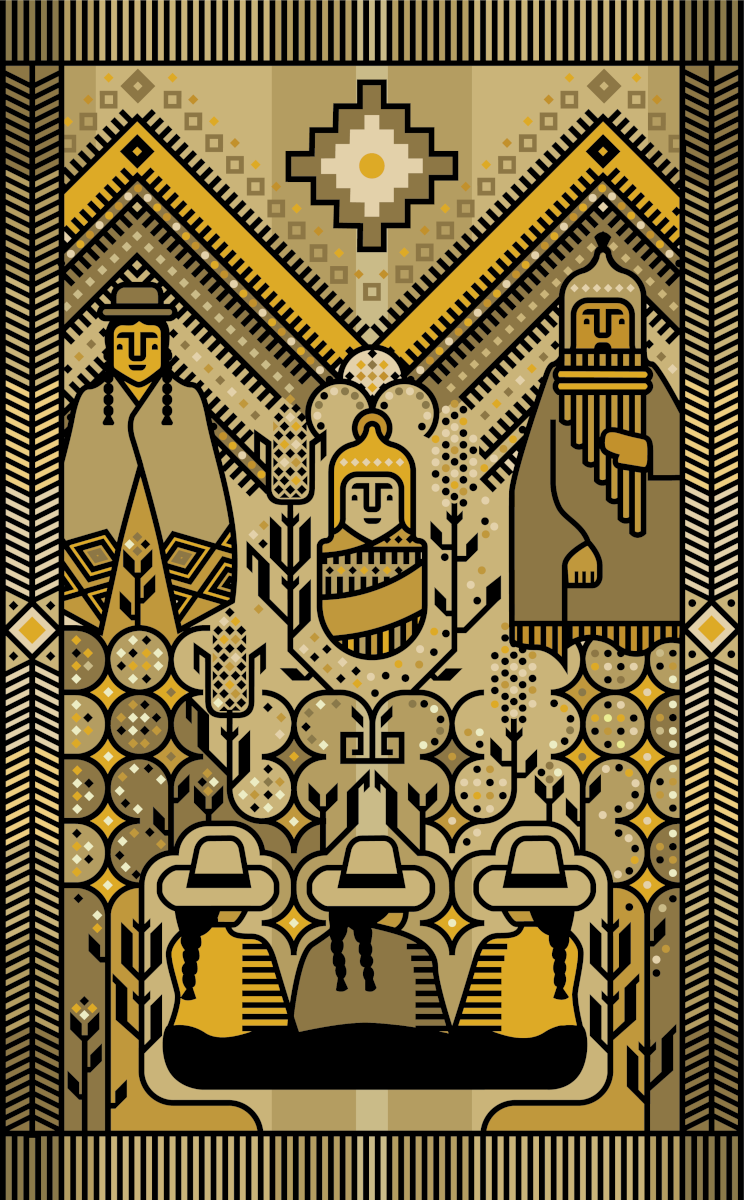
In Bolivia, Christmas takes place during a season of harvest, so in her Christmas design, Améstegui places Jesus in the center between crops of corn and quinoa, the two main agricultural foods cultivated in the country. Mary wears braids and a bowler hat and Joseph plays the zampoña (Andean panflute), and at the bottom three cholitas, Indigenous women from the Bolivian countryside, gather reverently to greet the Christ child.

Amestegui, Daniela_Christmas
Daniela Améstegui (Bolivian, 1990–), Navidad (Christmas), 2019–20, from the digital illustration series Pallay: Andean Weaving of Liturgy and Design. Used with permission.

Améstegui does not have a website just yet but tells me she plans to launch one in 2025. If you would like to purchase one or more of her Pallay pieces, you can contact her at daniela@amestegui.com.

Thank you to blog reader Nicole J. for alerting me to this striking series!

+++

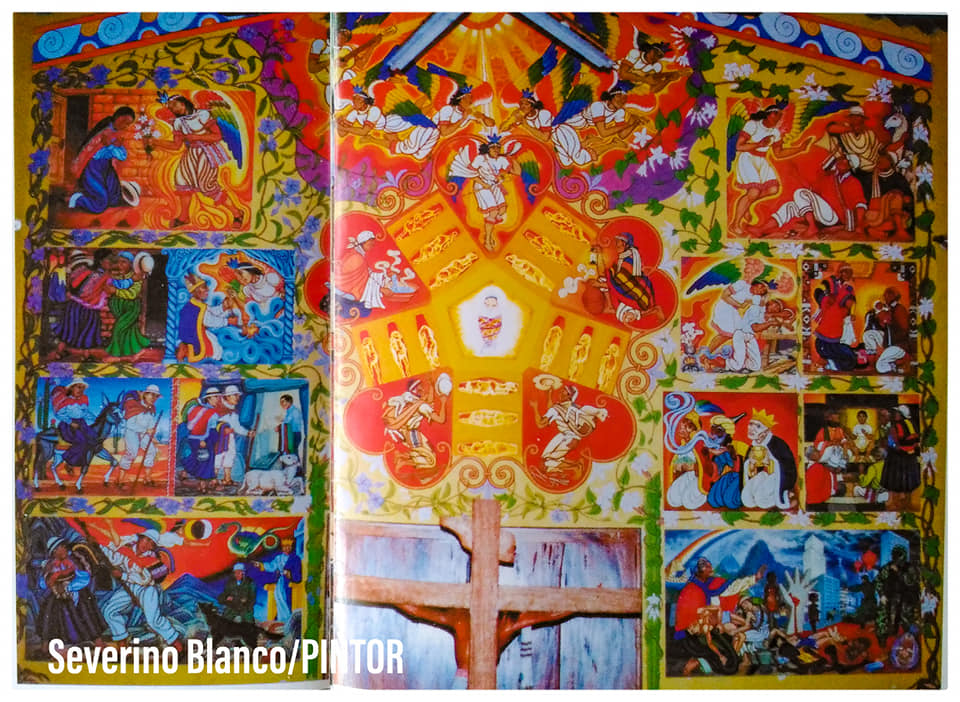
VIDEO COLLECTION: Casa del Catequista (CADECA) chapel paintings: As chance would have it, the same week I learned about Daniela Améstegui’s work, a different blog reader, Mark M., emailed me a link to some videos his Langham Partnership colleague Paul Windsor took during a recent trip to Bolivia. They record the many paintings, most by the late Quechua artist Severino Blanco [previously], inside the chapel of CADECA in Cochabamba, a place where men and women are trained as Christian leaders who then go out to serve their rural communities. They portray scenes from the Old and New Testaments, the parables of Jesus, and Latin American church history, including a remarkable liberation theology–inspired Resurrection, in which Jesus breaks down the doors of death and hell, holding high a cacique’s staff and leading the people of Bolivia into their future. Here’s a 360-degree view captured by Windsor, but visit the boldface link to see additional videos that narrow in on particular portions.

Blanco, Severino_Nativity
Severino Blanco (Quechua [Bolivian], 1951–2020), Infancy of Christ painting cycle, 1985. Chapel of the Casa del Catequista (CADECA), Cochabamba, Bolivia.

On the west end of the chapel (where people enter the space) is an Infancy of Christ cycle—reproduced here from a scan of a pamphlet, it appears. In the center is a Nativity, the Christ child painted over a pane of glass through which natural light comes gleaming in (see a closer view). The oblong shapes radiating out from the center are also glass, onto which the artist has (I think) etched lambs in various stages of prostration. On the sides, two villagers come with hot water and towels, and at the bottom two shepherds kneel before the Savior, removing their hats as a sign of respect. At the top, a host of angels with rainbow-colored wings and indigenous instruments sing Christ’s praises.

To the left of the Nativity are six scenes: (1) The Annunciation to Mary, (2) The Visitation, (3) The Annunciation to Zechariah, (4) The Journey to Bethlehem, (5) No Room at the Inn, and (6) The Flight to Egypt. To the right are (7) The Annunciation to the Shepherds, (8) The Annunciation to Joseph, (9) The Presentation in the Temple, (10) The Adoration of the Magi, (11) Jesus with the Scholars in the Temple, and (12) The Massacre of the Innocents.

+++

SONGS:

>> “Admirable Consejero” (Wonderful Counselor) by Santiago Benavides: Santiago Benavides is a Colombian singer-songwriter living in Toronto. On his Facebook page he describes his musical style as “trova-pop-bossa-carranga worship.” This song he wrote is a setting of Isaiah 9:2, 6–7 in Spanish. In the video, he’s the guitarist with the red-tinted glasses.

>> “The Word Became Flesh” by John Millea: John Millea is “a storyteller with a guitar,” singing in the tradition of Americana, folk, and gospel “about life and all of its joys, sorrows, and struggles.” He’s one of the artists I support through Patreon. This was the first song of his I encountered, and it’s one of my favorites, engaging with John 1:1–3, 14 in a wholly unique way!

In contrast to everyone and everything else in the universe, Millea explains, God had no beginning point, and all that is can in some way be traced back to him, the first link in a massive chain of cause and effect. So here Millea playfully traces his guitar all the way back to God—from the store he bought it at in Illinois, to the factory in Pennsylvania they ordered it from, to the mill in Washington that supplied the wood, to the Alaskan forests whence the tree was logged, and so on and so forth, imagining many thousands of years of fallen and dispersed tree seeds that traversed seas and continents, with an ultimate source in a tree planted in Eden by the Word of God.

When he hits on Eden, he starts moving forward again, through the story of creation, fall, and redemption in Christ, the divine beginningless One who graciously and mysteriously entered human history, born of a woman named Mary.

>> “Mary Had a Baby”: Arranged by Roland Carter, this African American spiritual is performed by the Nathaniel Dett Chorale, featuring the amazing mezzo-soprano Melissa Davis. It’s from their 2003 album An Indigo Christmas, the tracks taken from two live concerts given at the Church of St. George the Martyr in Toronto.

>> “Що то за предиво” (Shcho to za predyvo) (Behold a Miracle): This Ukrainian folk carol is performed by Trioda (Тріода), a musical group consisting of Andrii Gambal, Volodymyr Rybak, and Pavel Chervinskyi.

What is this awe-inspiring miracle?
There is great news on earth!
That the Virgin Mary gave birth to a son.
And upon birthing him, she declared,
“Jesus—my son!”

And the aging Joseph stands nearby in awe
Of Mary having given birth to a son.
And he prepares the swaddling for Jesus Christ.
And Mary swaddles him, and scoops him to her heart—
The pure Virgin Mary!

Trans. Joanna (Ivanka) Fuke [source]

Online events

Organized by Mount Tabor Ecumenical Centre for Art and Spirituality:

>> April 10, 11 a.m.–12:30 p.m. EDT: “The Victory of Life (Easter in Renaissance Art)”: “The most important event of New Testament belief, Christ’s Resurrection, is not described in the Scriptures. That has not prevented artists however from imagining it. As we celebrate Eastertide, we invite you to join Monsignor Timothy Verdon as he reflects on a number of works focused on this theme.”

View more events at https://mounttabor.it/mount-tabor-talks-topics/.

Organized by HeartEdge:

>> April 15, 11:30 a.m.–1 p.m. EDT: “In the Shadow of Your Wings: Musical Bible Study on the Psalms”: Deus Ex Musica presents this interactive event in which participants watch prerecorded live performances of three brand-new vocal settings of Psalm 57, each set to music by a composer representing a different Christian tradition. After viewing the performances, participants will engage in moderated small-group discussions. No musical expertise is required.

Deus Ex Musica is an ecumenical organization of musicians, educators, pastors, and scholars that promotes the use of sacred music as a resource for learning and spiritual growth.

>> April 26, 3–4 p.m. EDT: “Art and the Liturgical Year: Bringing the Church Calendar to Life”: Organized in partnership with the CEEP Network. “This workshop explores ways of engaging artists with churches/congregations using the church calendar. What might inspire artists in engaging with the patterns that underpin the life of many churches, and how might engaging with artists open up understandings of faith in new ways for congregations? Examples of the kind of projects we will explore include initiatives using the visual arts in dialogue with scripture or exhibitions/installations in particular seasons such as Advent or Lent. Fundamentally, though, this workshop seeks explore a range of ideas and approaches and to hear about the benefits both for artists and congregations.”

Panelists:

  • Janet Broderick, Beverly Hills, California: Rector, All Saints Beverly Hills
  • Paul-Gordon Chandler, Casper, Wyoming: Bishop, Diocese of Wyoming; and Founding President of CARAVAN Arts (moderator)
  • Catriona Laing, Brussels: Chaplain, St. Martha & St. Mary’s Anglican Church Leuven; Associate Chaplain, Holy Trinity Brussels
  • Ben Quash, London: Professor, Christianity and the Arts & Director, Center for Arts and the Sacred, King’s College London; Director, Visual Commentary on Scripture Project
  • Aaron Rosen, Washington, DC: Professor, Religion and Visual Culture; Director, Henry Luce III Center for the Arts and Religion, Wesley Theological Seminary; Cofounder, Stations of the Cross Public Art Project

>> June 4, 11, 18, 25, 11:30 a.m.–1 p.m. EDT: “Jesus Is Just Alright: What Pop Songs About Jesus Can Teach Christians Today”: Led by composer, musician, and educator Delvyn Case of Deus Ex Musica. “For over fifty years, pop musicians in all genres have explored the meaning and significance of Jesus in their music. The result is a rich collection of songs that consider important spiritual questions like faith, doubt, and prayer in unique and often provocative ways. Through a combination of listening and discussion, this four-part series invites participants to explore a different spiritual topic each week. Join us to listen to great music that asks tough questions about our faith and our lives as Christians.”

View more events at https://www.heartedge.org/.

Organized by Art + Christianity:

>> April 21, 1–2 p.m. EDT: “Exhibiting Faith in the Museum and Beyond”: World-leading experts Ittai Weinryb, Neil MacGregor, and Jennifer Sliwka will discuss the joys and difficulties of introducing to the general public art that builds on a faith tradition. “They will discuss what has become a major concern for teachers, lecturers and museum curators in many countries. How do you encourage a largely secular audience to step inside a work of art, in such a way that its religious meaning is felt and understood, and the artistic experience can become immersive? . . . Among the topics to be explored are:

  • The opening up of museums and galleries to enhanced audiences during the pandemic.
  • How certain objects are altered by their move from a sacred space into a museum, yet how they also ‘live on’ beyond the museum plinth or computer screen.
  • The need to understand secular inhibitions and the loss of interest in Christianity and to find ways in which works of art can readdress this situation.”

>> April 29, 2–3:30 p.m. EDT: “Coventry Cathedral: Icon and Inspiration”: “Join Alexandra Epps [an Accredited Lecturer for The Arts Society and Guide and Lecturer at Tate Modern, Tate Britain and the Guildhall Art Gallery] for the extraordinary story of the rebuilding of Coventry Cathedral as a symbol of peace and reconciliation and its inspiring commitment to the modern. Experience the artistic journey that is the Cathedral discovering the work of many of the world-class artists associated with its many treasures including Jacob Epstein, Elisabeth Frink, John Piper, Graham Sutherland and more.”

View more events at https://www.artandchristianity.org/upcoming-events.

Organized by Image journal:

>> May 5, 56 p.m. EDT: “The Art of Criticism: The People’s Madonna”: “Filmmaker Lucia Senesi grew up in Arezzo, Italy, within walking distance of several Old Master Madonnas. But it wasn’t until she was older—and viewing films by Andrei Tarkovsky and Valerio Zurlini, who were both captivated by the Madonna del Parto in Monterchi—that she saw these paintings with fresh eyes. Her essay in the spring issue of Image describes the fascinating history of a Madonna commissioned by peasants, executed by a Renaissance master, condemned by popes, and preserved through wars and social upheaval. She’ll talk with culture editor Nick Ripatrazone about film, the populism of sacred art, and the scandal of a woman pregnant with God.”

>> May 26, 56 p.m. EDT: “The Art of Imagery: You Are What You Contemplate”: “Artist Scott Erickson wanted to design a series of Stations of the Cross that people in his Portland neighborhood could encounter without the barrier of having to enter a church building—and he wanted to make them accessible to all. The result is a series of downloadable, printable images that have appeared all over the globe. His most recent book is Honest Advent: Awakening to the Wonder of God-with-Us Then, Here, and Now. He’ll speak with Image editor in chief James K.A. Smith about church, art, and ‘spiritual formation through image contemplation.’”

Lectionary Art and Music

For the last three-plus years I’ve been publishing a weekly blog series called Artful Devotion, choosing one of four scripture texts from the Revised Common Lectionary for the coming week and then selecting one visual artwork and one musical work that resonate with that scripture in some way—sometimes directly, sometimes more obliquely. I’m interested in the meaning that can open up in one’s Bible reading when the arts are engaged alongside that discipline.

After having covered all three lectionary cycles and then some, I’ve decided to end the series so that I can direct my energies toward developing other blog content. I still plan to use the lectionary as a guide throughout the year and to continue including “bite-size” posts at regular intervals, but by not committing myself to a formula and a particular text and a weekly deadline, I will have freedom to experiment with other modes of presentation and time to pursue more in-depth lines of research and other curatorial projects.

For a quick reference, I’ve compiled links to all the Artful Devotions below. Or, if you prefer, you can scroll through them from newest to oldest by following this tag: https://artandtheology.org/tag/artful-devotion/. If you want more context for the series, read the introduction.

In this archive you’ll find a mixture of art from different countries and eras: early Christian mosaics, late medieval Italian frescoes, a Chinese scroll painting, a Japanese woodcut, a Dutch still life, a Tongan stone carving, an Indian batik, African American folk art, contemporary Ukrainian icons, an installation in a vacant chapel in London, a hand-embroidered photograph from the Ivory Coast, biblical door carvings from Zimbabwe, a Jewish illuminated manuscript, an eighteenth-century Moravian devotional card, a Victorian “spirit drawing,” a modernist painting from New Zealand, a Quechua illustration of Christ’s Presentation in the Temple, a bronze fountain in Poland, and so much more.

In addition to shape-note hymns, spirituals, Black gospel, jazz, bluegrass, and indie folk from America and choral and classical music from Europe, there are also songs from Polynesia, Argentina, Congo, Israel, Georgia, China, Jamaica, and more. There’s an Armenian funeral tagh, an Indian bhajan, a Hollywood musical number, an English ballad about Mary Magdalene, a reggae setting of Psalm 137, and lots of other treasures!

Thank you for journeying with me through the church calendar here at Art & Theology. If you have found joy and inspiration from the Artful Devotion series, please consider making a small donation toward the further development of this website.

Donate here

Year A

First Sunday of Advent: Romans 13:11–12
Second Sunday of Advent: Isaiah 11:1–5, 10
Third Sunday of Advent: Isaiah 35:5–6a, 10
Fourth Sunday of Advent: Isaiah 7:14

Nativity of the Lord: Luke 2:7; Psalm 96:10; John 1:1, 14
First Sunday after Christmas Day: Matthew 2:13–18
Second Sunday after Christmas Day: John 1:3b–4, 9

Epiphany of the Lord: Isaiah 60:1; Psalm 72:10–11; Matthew 2:1–12
Baptism of the Lord: Isaiah 42:1–9; Matthew 3:13–17; Acts 10:37–38, 42–43
Second Sunday after Epiphany: Psalm 40:1–3
Third Sunday after Epiphany: Isaiah 9:1–5; Matthew 4:12–17
Fourth Sunday after Epiphany: 1 Corinthians 1:18–25
Presentation of the Lord (Candlemas): Luke 2:25–32
Fifth Sunday after Epiphany: Matthew 5:14–16
Sixth Sunday after Epiphany: Matthew 5:21–24
Transfiguration Sunday: Matthew 17:1–9

Ash Wednesday: Joel 2:1, 12–13; Psalm 51:8, 17
First Sunday of Lent: Genesis 3:6–7
Second Sunday of Lent: Psalm 121
Third Sunday of Lent: John 4:7–14
Fourth Sunday of Lent: Ephesians 5:14
Annunciation of the Lord: Luke 1:26–38
Fifth Sunday of Lent: John 11:1–45

Palm Sunday: Matthew 21:8–11
Holy Monday: John 12:1–11
Holy Tuesday: John 12:23–36
Holy Wednesday: John 13:18b–19, 21–30
Holy Thursday: John 13:1–17, 31b–35
Good Friday: Isaiah 53:1–12
Holy Saturday: John 19:38–42

Resurrection of the Lord: Matthew 28:1–6; John 20:1–8; Acts 10:39–41
Second Sunday of Easter: Acts 2:22–32
Third Sunday of Easter: 1 Peter 1:18–22
Fourth Sunday of Easter: Psalm 23
Fifth Sunday of Easter: John 14:1–3
Sixth Sunday of Easter: John 14:15–21
Ascension of the Lord: Acts 1:1–9
Seventh Sunday of Easter: Psalm 55:22; 1 Peter 5:7
Visitation of Mary to Elizabeth: Luke 1:39–55

Pentecost: Acts 2:1–21
Trinity Sunday: 2 Corinthians 13:14

Proper 6: Romans 5:5b
Proper 7: Psalm 69:1–3, 13–17
Proper 8: Genesis 22:1–14
Proper 9: Matthew 11:28
Proper 10: Psalm 65:5–13; Romans 8:6
Proper 11: Psalm 86:12–13, 15; Matthew 13:43
Proper 12: Romans 8:31b, 35, 37; Matthew 13:31–32
Proper 13: Genesis 32:22–31; Isaiah 55:1–2
Proper 14: Psalm 85; Matthew 14:29b–33
Proper 15: Psalm 133
Proper 16: Isaiah 51:3; Romans 12:1–2
Proper 17: Exodus 3:1–15; Romans 12:9–18; Romans 12:21
Proper 18: Exodus 12:1–14; Psalm 119:37
Holy Cross: Numbers 21:4–9; John 3:14–15
Proper 19: Exodus 14:19–31 (also)
Proper 20: Psalm 105:4; Jonah 3:10–4:11
Proper 21: Psalm 25:4–5; Ezekiel 18:26–32
Proper 22: Psalm 19:7–10; Philippians 3:13b–14
Proper 23: Psalm 106:4; Isaiah 25:6–9
Proper 24: Exodus 33:18–23; Psalm 96:1
Proper 25: Psalm 90:14; Matthew 22:37–38
Proper 26: Psalm 43:3
All Saints’ Day: Matthew 5:3–11; Revelation 7:9–12
Proper 27: Joshua 24:14–15; Amos 5:21–24
Proper 28: Psalm 90:1–6, 10, 12; 1 Thessalonians 5:2b–10
Reign of Christ: Ephesians 1:17–23

Year B

First Sunday of Advent: Psalm 80:1–3
Second Sunday of Advent: Isaiah 40:3–5; Mark 1:1–8
Third Sunday of Advent: Luke 1:39–55 (Visitation)
Fourth Sunday of Advent: Romans 16:25–26

Nativity of the Lord: Luke 2:10–12, 14, 16
First Sunday after Christmas Day: Isaiah 61:10–11
Second Sunday after Christmas Day

Epiphany of the Lord: Isaiah 60:3, 5–6; Ephesians 3:4–5
Second Sunday after Epiphany: 1 Samuel 3:9
Third Sunday after Epiphany: Mark 1:17
Fourth Sunday after Epiphany: Mark 1:23–28
Presentation of the Lord (Candlemas): Luke 2:28–32
Fifth Sunday after Epiphany: Psalm 147:3
Sixth Sunday after Epiphany: 2 Corinthians 4:3–6
Transfiguration Sunday

Ash Wednesday
First Sunday of Lent: Genesis 9:8–17
Second Sunday of Lent: Romans 4:13–25
Third Sunday of Lent: John 2:13–17
Fourth Sunday of Lent: Ephesians 2:1–10
Fifth Sunday of Lent: Psalm 51:1–2, 8

Palm Sunday: John 12:12–15
Good Friday: John 19:18

Resurrection of the Lord: Isaiah 25:7, 9b
Second Sunday of Easter: John 20:27–28
Third Sunday of Easter: Psalm 4:7
Fourth Sunday of Easter: 1 John 3:17–18
Fifth Sunday of Easter: John 15:5–8
Sixth Sunday of Easter: 1 John 5:3–4a
Ascension of the Lord: Luke 24:51; Acts 1:9
Seventh Sunday of Easter: Psalm 1:1–3 (cf. Jeremiah 17:7–8)

Pentecost: Ezekiel 37:14
Trinity Sunday: Romans 8:14–17

Proper 4: Psalm 81:10b
Proper 5: 2 Corinthians 4:16–5:1
Proper 6: 2 Corinthians 5:10
Proper 7: Psalm 107:23–31; Mark 5:35–41
Proper 8: Lamentations 3:22–23
Proper 9: 2 Corinthians 12:7b–10
Proper 10: Ephesians 1:7–8a
Proper 11: Psalm 23:1–3a, 4
Proper 12: Ephesians 3:18–19
Proper 13: Exodus 16:9–10
Proper 14: Psalm 130:5
Proper 15: Proverbs 9:1–6
Proper 16: Ephesians 6:10–17
Proper 17: James 1:21
Proper 18: Mark 7:31–37
Proper 19: Psalm 19:1–6
Proper 20: James 4:7
Proper 21: Psalm 124
Proper 22: Mark 10:13–16
Proper 23: Mark 10:17–22
Proper 24: Psalm 104
Proper 25: Mark 10:46–52 
All Saints’ Day: Wisdom of Solomon 3:2–4
Proper 26: Psalm 119:1
Proper 27: Hebrews 9:27–28
Proper 28: Hebrews 10:19–22
Reign of Christ: Daniel 7:9, 14

Year C

First Sunday of Advent: Luke 21:28
Second Sunday of Advent: Luke 1:68–79
Third Sunday of Advent: Zephaniah 3:14–20 (cf. Zechariah 9:9a)
Fourth Sunday of Advent: Micah 5:2–5

Nativity of the Lord: Isaiah 52:10; Titus 2:11; Luke 2:11
First Sunday after Christmas Day: Colossians 3:12–14
Second Sunday after Christmas Day

Epiphany of the Lord: Matthew 2:1–2, 9–11
Baptism of the Lord: Luke 3:15–17, 21–22
Second Sunday after Epiphany: Isaiah 62:1–5
Third Sunday after Epiphany: Luke 4:16–21
Fourth Sunday after Epiphany: 1 Corinthians 13:1–3
Presentation of the Lord (Candlemas): Luke 2:29–32
Fifth Sunday after Epiphany: Luke 5:1–11
Sixth Sunday after Epiphany: Luke 6:20b–23
Seventh Sunday after Epiphany: Psalm 37:4
Transfiguration Sunday: Luke 9:28–36

Ash Wednesday: Matthew 6:19–21
First Sunday of Lent: Psalm 91:9–10, 13–14
Second Sunday of Lent: Philippians 3:20
Third Sunday of Lent: Psalm 63:1
Fourth Sunday of Lent: Luke 15:11–32
Fifth Sunday of Lent: Psalm 126

Palm Sunday / Holy Week: Luke 19:28

Resurrection of the Lord: Psalm 118:14–17; Luke 24:6a
Second Sunday of Easter: John 20:24–29
Third Sunday of Easter: Revelation 5:11–14
Fourth Sunday of Easter: John 10:28–29
Fifth Sunday of Easter: Psalm 148
Sixth Sunday of Easter: John 14:23–29
Ascension of the Lord: Luke 24:44–53
Seventh Sunday of Easter: Revelation 22:13

Pentecost: Acts 2:3–4
Trinity Sunday: Romans 5:1, 5

Proper 7: Psalm 42:1–2, 5
Proper 8: 2 Kings 2:11–12a
Proper 9: 2 Kings 5:1–14
Proper 10: Psalm 82:1–4, 8
Proper 11: Colossians 1:15–20
Proper 12: Colossians 2:13–14
Proper 13: Psalm 107
Proper 14: Luke 12:32
Proper 15: Hebrews 12:1–2
Proper 16: Isaiah 58:11
Proper 17: Hebrews 13:1
Proper 18: Jeremiah 18:1–6
Proper 19: Luke 15:4–6
Proper 20: Jeremiah 8:18–22
Proper 21: Luke 16:19–31
Proper 22: Psalm 137
Proper 23: Psalm 66:12 (cf. Psalm 31:7–8)
Proper 24: Genesis 32:22–31
Proper 25: Psalm 84:5
All Saints’ Day: Luke 7:20–23
Proper 26: Habakkuk 1:2–4
Proper 27: Psalm 145:3–5
Proper 28: Isaiah 12:1–6
Reign of Christ: Jeremiah 23:5–6

Roundup: Controversial Eve painting, liturgy, protest, visualizing belief, and “Ya Hey”

“Mormon painting of a black Eve draws fire, but not for the reasons you might think” by Peggy Fletcher Stack, Salt Lake Tribune: Early this year a new painting of a seminude black Eve by Mormon artist J. Kirk Richards went on display at Writ & Vision gallery in Provo, Utah. While many Mormons have expressed how captivated and inspired they are by it (and I should note, black figures are extremely rare in Mormon art), a few have insisted it’s wrong for a white man to depict a nude black woman because it conjures up collective memories of sexual brutality and enslavement. The article features some interesting perspectives by black Mormon feminists. In addition to raising important questions surrounding racial histories and representation, the painting, I’ve noticed, also illustrates a distinctly Mormon view of the Fall, which differs from the orthodox Christian view—a fact Richards alludes to in his March 14 gallery talk. View the painting.

+++

“A Conversation about Creativity and the Liturgical Calendar,” panel discussion presented by Brehm Center and Fuller Studio: Moderator Edwin M. Willmington, composer-in-residence at Fuller Theological Seminary, talks with an all-star trio of creatives and liturgists comprising David Gungor of The Brilliance [00:50], on authenticity in songwriting and introducing liturgical practices to the evangelical church he attended; Todd E. Johnson [10:40], on the history, purpose, and major observances of the church calendar; and Lauralee Farrer [26:18], on discovering the Canonical Hours in a New Mexico desert and later developing them into characters for a film project. Questions: [34:02] How has liturgy shaped you? [36:20] Advice for artists on how to bring the church year to bear in their art? [37:11] Have you found that lament is generally embraced or resisted? [39:41] Advice for worship leaders?

+++

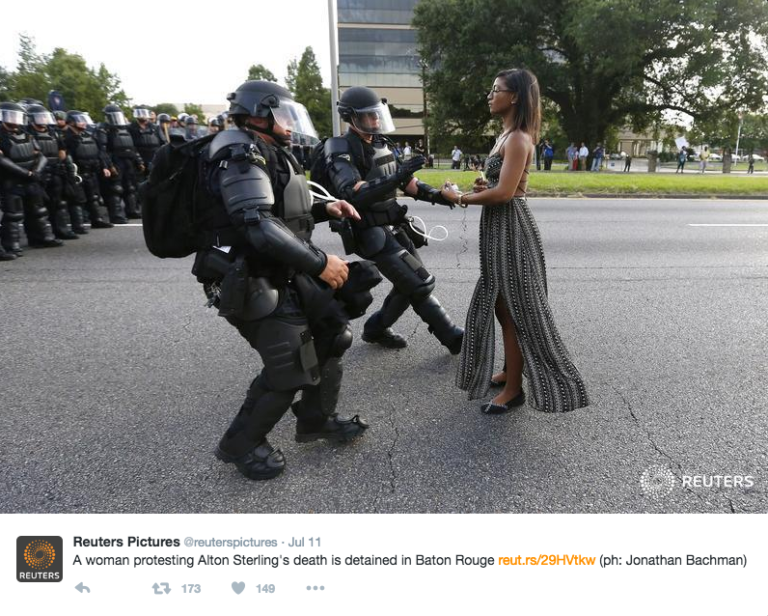
“An Art Historical Perspective on the Baton Rouge Protest Photo that Went Viral” by An Xiao Mina and Ray Drainville, Hyperallergic: During a July 10 protest following the fatal killing of Alton Sterling, Reuters photographer Jonathan Bachman captured the moment of twenty-eight-year-old Ieshia L. Evans’s arrest. As heavily armored policemen pressed in, the other protestors dropped back, but Ieshia stood assuredly in the middle of the three-lane highway, prepared to be bound. This article lauds the strength of this image of confrontation by citing compositionally and thematically similar paintings, including Briton Riviere’s Daniel in the Lion’s Den and Giotto’s The Arrest of Christ, and other works of art.

Ieshia Evans arrest photo

Ieshia considers herself a vessel of God, eager to be used by him to bring justice and peace. Here’s what she wrote on her Facebook wall the night of her release from jail:

Ieshia Evans statement

+++

“Things Unseen: Vision, Belief, and Experience in Illuminated Manuscripts”: Running through September 25 at the Getty Center in Los Angeles, this exhibition “explores the visual challenges artists faced as they sought to render miraculous encounters with the divine, grand visions of the end of time, the intricacies of belief, and the intimate communications of prayer.” It includes a September 15 talk, “How Do We Depict Religious Experiences?”—that is, how do we convey metaphysical essence in physical form? I appreciated the Getty’s blog post this week featuring a newly acquired choir book leaf that’s part of the exhibition. Curator Bryan C. Keene writes about the difficulties of identifying the illuminator and about discovering, through an examination of the back and a search on the Cantus database, that the illumination depicts the wiping of tears from saints’ eyes, not, as previously assumed, the healing of the blind.

Christ wiping the tears from the eyes of the saved
Initial A: Christ Wiping the Tears from the Eyes of the Saved, attributed to the Master of the Antiphonary of San Giovanni Fuorcivitas, ca. 1345–50. Tempera and gold leaf on parchment, 5 1/3 × 5 1/3 in. (13.5 × 13.5 cm). The J. Paul Getty Museum, Ms. 113, recto. Digital image courtesy of the Getty’s Open Content Program.

+++

“Ya Hey” song cover by The Brilliance: Written by Ezra Koenig of Vampire Weekend, “Ya Hey” is a modern-day psalm that expresses frustration with God’s seeming unresponsiveness—to being spurned and being sought, to brokenness and suffering, to sin and struggle. The title is a play on the word Yahweh, the Hebrew name for God. The chorus references the burning bush of Exodus 3: “Through the fire and through the flames / You won’t even say your name / Only ‘I am that I am.’” The Brilliance’s acoustic cover of “Ya Hey” was released last month as a music video on YouTube featuring four New York City ballet dancers. It abandons the shrill vocoder and heavy percussion of the original song in favor of a softer, purer sound. Read the lyrics and an analysis at Sound: Interrupted.

The sanctification of time in the church year

Other than celebrating the two high holy days of Christmas and Easter, I did not follow the liturgical calendar growing up; it was never highlighted in my church. It wasn’t really until after college, when I became involved in a denominationally diverse Christian community, that I realized what I was missing out on, and since then the liturgical calendar is something I’ve learned to appreciate and observe—at least its main seasons: Advent, Christmas, Lent, and Easter, which concludes with the feast of Pentecost. The observance of these seasons is not mandated in scripture, but the church has devised them as a way to help us relive the story of God together throughout the year and to encourage us to meditate over an extended period on key mysteries of the faith.

12 feast days
Russian icon depicting the twelve great feasts of the Orthodox Church, plus the “feast of feasts,” the Resurrection, in the center, ca. 1903.

Wendy M. Wright has aided me greatly in my understanding of the set-apart days and seasons of the church year—their history, significance, and how they can be used as tools for spiritual growth. In her introduction to The Rising: Living the Mysteries of Lent, Easter, and Pentecost (part of an excellent trilogy of books written from an ecumenical perspective), she describes how and why the church has structured time. This passage is quoted here with her permission:   Continue reading “The sanctification of time in the church year”